
“The Cuban people must get their voice back to begin the transition” / 14ymedio, Reinaldo Escobar, Rosa Maria Paya

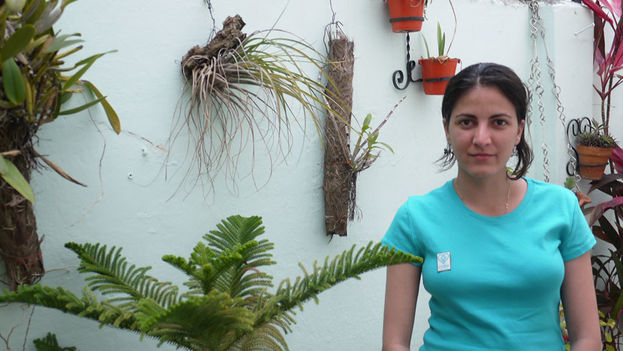
Rosa María Payá. (14ymedio)

14ymedio bigger14ymedio, Reinaldo Escobar, Havana, 17 May 2012 — In the summer of 2012, Rosa María Payá had just started out in the political arena. She moved among the young people who animated the Varela Project, El Camino del Pueblo (The Path of the People) and the Heredia Project, initiated by the Christian Liberation Movement founded by her father, the dissident Oswaldo Payá Sardiñas. Now 26 years old, she has two missions that consume most of her time. The first, is demanding an independent investigation into the death of her father, for the government to explain an “accident” which she believes was an attack. The second is leading the project Cuba Decides, which promotes a referendum on a proposal to hold free elections in the country.

Escobar: Your departure from Cuba came less than two years ago. How do you see the situation in the country upon your return?

Payá: We left Cuba under political persecution. The persecution against my father and my family before the attack, that ended his and Harold Cepero’s lives, continued after they died and became increasingly intense. They chased my brother when he was driving my dad’s car and did so in cars that have the same make as those that were chasing my father and that finally rammed [the car he was traveling in] on 22 July 2012. In addition, they did it with uniformed people, so that everyone — not only my family but also the local people — was aware of it. continue reading

We had always been persecuted, but this time they were doing it in an ostentatious way. There were also death threats over the phone, they began to spread slanders and defamations about us, they published those articles of the penal code which according to them would provide a reason to imprison us, accusing us of defamation. The situation became untenable and we decided to leave the country for the United States. Our experience was very dramatic. They ultimately killed my father and Harold and the danger was very great.

“These definitions of final departure, of living forever in one country or another, belong to the language of totalitarianism.”

This is my country and I will never stop living in Cuba. The center of my return has been to honor the memory of my father and to visit his grave. I would also like to get to Chambas in Ciego de Avila where the remains of Harold Cepero rest. If I do not do it now I will do it another time. With this I put on the table that there be an independent investigation into the death of my father, an issue that has been taken up by the Cuban democratic movement and political and intellectual personalities worldwide.

Escobar. You are now visiting Cuba. Do you have plans to return, even to stay more permanently?

Payá. Where I am visiting is the United States. I interrupted this visit to come to my own country. These definitions of final departure, of living forever in one country or another, belong to the language of totalitarianism. The Cuban government still keeps intact the power to decide whose departure is permanent and who is not allowed to return.

There are many people who cannot enter and others who cannot leave and I’m not just talking about opponents, such as the Group of 75; I’m talking about professionals who “for issues of the public interest” cannot travel, perhaps, and as one example, a doctor because he is the only neurologist in Holguin. Freedom of movement that gives the right to enter and leave the country is not guaranteed. The times I leave Cuba, the times I decide to be outside of Cuba and the government’s repression with respect to limiting my freedom of movement are situations that are real.

Escobar. During your stay in the United States you have had the opportunity to talk to many people, and even with part of the US delegation participating in the talks with the Cuban government. Have you talked to them about your demand for an independent investigation into the deaths of Oswaldo and Harold?

Payá. The Government of the United States, from the United States Congress itself, has publicly called for this independent investigation to be carried out. More recently, on the occasions that I have met with Mrs. Roberta Jacobson and at the White House with Mr. Ricardo Zuniga, I have had the opportunity to bring it up. Because if this had been previously a request to the American government, now that they are talking with the Cuban government it should also be one of the issues discussed. I have understood that the matter has been talked about, but so far I don’t know what the response of the Cuban government has been.

My father denounced “the fraud change,” this process of scrubbing its image started by the Cuban government in the face of the international community

Escobar. There is a lot of debate about whether the government’s reforms are going to lead to a transition and also a lot of debate about the validity of the conversations that were announced on 17 December. What is your opinion on all this?

Payá. My father denounced and exposed what he called “the fraud change,” referring to this process of reforms and the scrubbing of its image started by the Cuban government in the face of the international community. But without recognizing the rights of Cubans, without actually, for Cubans, substantially changing things. In fact they have barely changed except maybe for the fact that there are more paladares (private restaurants).

The wellbeing of Cubans is still not a priority and of course they continue to violate our fundamental rights. There has been an effort to change the image at the international level that has borne fruit. We are experiencing a process where it seems that the international community is very interested in including the Cuban State in the family of world nations. We have seen it with the Organization of American States, in the negotiations promoted by Obama and in the process of negotiations with the European Union.

It seems very good to us that Cuba is included, but Cuba is not the Cuban Government. The citizens remain excluded precisely because they lack a tool to participate, because they do not enjoy basic human rights.

Escobar. Cuba Decides, this project that you are now promoting, could that be this tool?

Payá. The National Assembly of People’s Power never responded to the request of thousands of Cubans presented in the Varela Project. There we asked for a referendum. Cuba Decides is a project that in some way gives the appropriate continuity to that demand, that doesn’t come from any political party nor from any organization of civil society, but from the citizenry. It is a demand that is not based in any political color, it has no partisan position.

Escobar. So Cuba Decides is not a project of the Christian Liberation Movement?

Payá. All the opposition political parties and all civil society organizations are invited to take up the campaign. I repeat: it is not from a political platform because it has no political color. We are specifically demanding that they ask Cubans if, after 67 years in which there have not been ​​free and multi-party elections, they want a process of free, fair and multi-party elections, recognition of different political parties and access to the media. Do they want this process of free, multi-party and fair elections, yes or no?

“We demand that Cubans be asked if they want free, fair and multi-party elections, yes or no”

Escobar. Are you counting on the backing of the Christian Liberation Movement to carry out the project Cuba Decides?

Payá. My opinion is yes, but the project has no owner. If tomorrow someone goes out into the street saying “I Am Cuba Decides,” he is Cuba Decides. Anyone is Cuba Decides. The point is that we have invited many organizations to participate, we have not left anyone out, but we have not based it within any one [person or organization].

Escobar. Recently, the Government announced that it intends to adopt a new electoral law that would be in effect for the elections of 2018. Among various actors in Cuban civil society, especially in the context of the Cuban Civil Society Open Forum, there has emerged the initiative to maintain a storm of ideas so that each one adds to what we think should be in new electoral law. How do you see this initiative?

Payá. This initiative seems very good to me and I believe it complements what Cuba Decides is asking for. In fact, the Varela Project includes elements of an electoral law that is very specific on what changes there have to be in the current law to have minimally democratic and free elections. A representative part of the Cuban citizenry has already demanded those changes. It is interesting and opportune that this exercise is being done from within civil society. The Varela Project is one proposal, and there have been others, demonstrating that there is the capacity and diversity to design the country we Cubans want.

Escobar. Do you feel yourself to be a leader for the future?

Payá. The Cuban Government cannot claim to represent Cubans because it has not been democratically elected by its people. Nor have we as the opposition been elected. I do think that the opposition and civil society represent the vanguard of citizenship, but I do not want to speak for Cubans because Cubans never elected me. I have a proposal: that Cubans have a voice. I love the exercises that are being done and the proposals that are being presented. The Cuban people must get their voice back, not to begin democracy but to begin the transition. Cuba Decides is one citizen initiative and we invite everyone to participate, joining with us to demand that Cubans have the right to decide.

This would be the trigger to get to a stage in which the proposals of the Cuban Civil Society Open Forum can be presented and face the citizenry. Cuba Decides is not intended to replace other projects, nor presented as the only way. It is one step among others.

Cuban Baseball: Ciego de Avila, 2015 Champion / Ivan Garcia

ciego-de-ávila-campeón-2015-_mn-620x330

Ivan Garcia, 18 April, 2015 — 2015 is another Year of the Tiger.  The avileño* team, headed by former receiver Roger Machado, scored twice, then in the 2012 season they won their first title in the local league to unseat Industriales in five games.

Cuban baseball right now is very even.  For years it was dominated by the usual suspects: Industriales, Pinar del Río, Santiago, or Villa Clara.

It is necessary to go back to 1979, when Sancti Spiritus surprised more distinguished rivals. Or to 2001, when in a dramatic play-off to the best of seven against those Sancti Spiritus roosters when Yulieski Gourriel and Frederick Cepada, the Holguin bloodhounds, clouded the sky with the all the bottle rockets that went up after their unexpected victory. continue reading

Baseball on the Island is played in the rough. Some matches seem like jungle games, what with torn gloves, pitchers that throw more balls than strikes, and strategies that leave the experts with their mouths agape in wonderment.

For the last five years, the 9-man teams that would look down their noses at others have been diminishing, due the constant draining-away of their talented players.

Industriales, the Havana team, has suffered the most from the exodus of players. They could assemble three clubs from the members who have opted to play professionally, and easily manage their finances.

But Santiago, Villa Clara and Pinar del Río have also diminished their playing power as a result of the emigration of various budding stars from a league where they play all year, yet earn only worker’s salaries.

This is exploited by other, formerly minor, teams. Although it cannot be said that Ciego de Ávila is a team without substance. In the 90s it enjoyed a golden age with players who were brimming with talent and could never earn anything.

Two years ago they lost their coveted middle outfielder, Rusney Castillo, who went on to make the highest salary of a Cuban baseball player in Major League Baseball. A young prospect like Yozzen Cuesto climbed over the wall, and veterans such as Mario Vega and Yorelvis Charles made their exits.

As of today, the Tigers of Ciego are the best team in the playing field in Cuba. In a baseball league where the defense averages 974, the avileños come out to about 980. Their shortstop Yorbis Borroto is no great shakes moving in either direction, but very sure in those plays that are “out.”

Probably their most talented player is the wildcard Raúl González — good at defense and a thoroughbred batter. Behind the plate they have, in Osvaldo Vázquez, a consistent slugger and a clutch hitter.

If forced to choose, I would pick the right fielder José Adolis García, brother of Adonis, who plays in the Venezuelan professional league, and who at 22 has definitively exploited local baseball.

García has a cannon for a right arm and forcefully bats the ball towards all parts of the field. As the first at-bat, he hit 11 home runs and drove in 59 runs. On the bench awaiting his turn is an 18-year-old player who will make history. Make note of his name: Robert Luis Moiran.

Roger knew to request his reinforcements very tactfully. The Tigers’ bullpen, along with that of the tobacco farmers*** from Pinar del Río before being dismantled, is among the most reliable in Cuba. Three quality openers such as Yander Guevara, Vladimir García (who because of an injury did not have a good season), and the reinforcement from Villa Clara, Alain Sánchez.

Coming up on the rear, to slaughter the games, Machado showed up with a novice such as Yunier Cano, who can launch a two-seamer up to 96 mph. At zero hour, Ariel Borrero and Yoelvis Fizz produced a lot.

Ciego de Ávila was a perfect team, the team with the best performance in the second round. It was the favorite to win the title. But on the other shore, they had the Pirates of the Isle of Youth.

A team without a history and prominent names, but gutsy to no end. The isleños** were lacking pitching talent. Their openers, except for the reinforcement Yoalkis Cruz, did not make it past the third inning.

If the promising southpaw from Las Tunas, Darién Núñez, who throws a powerful fastball at 93 mph and a straight curveball, could have taken baseball seriously, the outcome for the Isle would have been different.

All of the games won by the Pirates in the playoff were thanks to their bullpen. The duo of Danny Aguilera and Héctor Mendoza was the sure one.

Their regular lineup connects almost 10 hits per game, but they lack power. In modern baseball it is very difficult to connect three hits off one pitcher of caliber. Their ability to throw sinkers justifies their fabulous salaries, for their innate capacity to change, with the flick of a wrist, the final score of a game.

But the Pirates knew how to play with commitment, timely batting, and a manager who was skilled at managing his pieces in the small game. They boast a 20-year-old shortstop with hands of silk.

His name is Alfredo Rodríguez, native of the Havana municipality of San Miguel del Padrón, and still today many Industriales fans ask themselves what Manager Lázaro Vargas’ reason was for getting rid of this player.

After Cienfuegos native Erisbel Arruebarrena (now in the Major Leagues), Alfredo is the best in the glove in Cuban baseball: spectacular at fielding, excellent throw, and a powerful arm.

At any rate, Isle of Youth faced the consequences. They lost against Ciego in a game that was going downhill from the first. With the game at three runs for two in favor of Ciego, at then end of the seventh inning, García’s error in an easy play let in two runs that cost a ton.

With the Tigers finally let loose, the rest was a walk in the park. In the final inning, Yunier Cano appeared, throwing fireballs, and the isleños put down their arms. The Pirates play an entertaining game and they go to have fun in the field. The Isle contributed color to the proceedings, and Ciego the mastery.

Translated by: Alicia Barraqué Ellison, and Others

Translator’s Notes:

* “Avileño” denotes someone from the city of Ciego de Ávila in central Cuba.

** Similarly, “isleño” is someone from an island; in the context of this article, the island is the Isle of Youth, the second-largest Cuban island, located south of Havana.

*** Pinar del Río province is the center of tobacco farming in Cuba.


Fidel Castro’s “Hardships” in Prison / Cubanet, Roberto Jesus Quinones

Fidel Castro’s mug shot (photo from the internet)

“We sleep with the lights off, we have no roll calls or formations all day, we get up whenever (…) Plenty of water, electric lights, food, clean clothes and all for free”

cubanet square logoCubanet.org, Roberto Jesus Quinones Haces, Guantanamo, 15 May 2015 – This May 15 marks the 60th anniversary of the release of the Moncadistas. The attack on the Moncada barracks is characterized by many as a terrorist act. Beyond the adjectives, always debatable, those who have been charged with praising the rebellious generation and denigrating the army officers of the time say nothing about the soldiers killed that Carnival dawn. Nineteen officers fell, but their names do not count for the official historians.

What would happen today if a group of Cubans, tired of political discrimination and abuses, were to attack a military unit? Would they receive sanctions as benign as those applied to the Moncadistas? Would they be allowed to meet in jail and be separated from the regular prisoners? Would they be granted amnesty? continue reading

The “cruel” prison of the Moncadistas

In the articles that the figureheads of Castro Communism have written about the event, it is emphasized how “cruel” the prison was for the Moncadistas during the year and nine months that they were held. It is embarrassing to read that in comparison with what many opponents of the regime later had to — and still — suffer.

In the book “The Fertile Prison,” published in 1980, historian Mario Mencia says that Melba Hernandez and Haydee Santamaria were sentenced to seven months for their participation in that event, a surprising sentence compared to the sentences currently meted out to the brave women who dare to raise their voices against the regime. Suffice it to say that recently Sonia Garro spent more than a year in jail awaiting trial.

Arriving at the women’s jail at Guanajay, Melba and Haydee were not only allowed to make phone calls to inform their families, but they were fixed up with accommodations consisting of a bedroom, kitchen, bathroom and dining room; they were permitted to receive all kinds of books, visits by family and friends, and they were always separated from the ordinary prisoners. I must add that before 1959 only three women were sentenced for political reasons, all during the Batista dictatorship, an insignificant number if we compare it to what happened after 1959.

The 27 Moncadistas were sent to the Model Prison on the Island of Pines and separated from the common prisoners, something that Castro-communism has never done with political prisoners. Mr. Mencia says that jail was a hell because it had 460 cells for 930 prisoners and only three showers and two toilets per 25 men. I would like, if he is still alive, for Mr. Mencia to see the 2C outpost of the Guantanamo prison where I was a prisoner between 1999 and 2003, a place built for 90 men and that at that time came to house up to three hundred, many of them sleeping on the floor with only two holes for defecating and two showers. Or he should see the sealed cells where political prisoners are kept. Would Mr. Mencia write about that?

The Moncadistas – according to Mencia – were allowed to have an electric stove, a library with more than 600 books, to read even after the 10 pm roll call, to play ping pong and volleyball and to form an ideological academy in which they debated all kinds of subjects without intervention by the prison authorities. Fidel Castro had at his disposal a Silvestone brand radio. Sixty years later, no Cuban political prisoner enjoys such benefits.

On page 76 of the book there appears a letter by Fidel dated April 4, 1954, where he wrote: “I am going to dinner: spaghetti with squid, Italian chocolates for dessert, fresh brewed coffee and then an H. Upman 4 [cigar]. Don’t you envy me? They take care of me, they take care of me a little among everyone… They take no notice, I am always fighting so that they do not send anything. When I take the sun in the morning in shorts and feel the sea air, it seems that I am on a beach, then a little restaurant here. They are going to make me believe that I am on vacation. What would Karl Marx say about such revolutionaries?”

The permissiveness of the authorities so encouraged the prisoners that their families bought them a refrigerator.

In another letter from August 1954, page 149, the despot in the making wrote: “Cleaning is for the prison staff, we sleep with the lights off, we do not have roll call or formations all day, we get up whenever; I did not ask for these improvements, of course. Abundant water, electric lights, food, clean clothes, and it’s all free.”

The Supposed Isolation

The supposed isolation of the Moncadistas is another falsehood because the book records that on July 8, 1954, Bohemia published an interview with Fidel Castro with the title “The Political Prisoners on the Isle of Pines.”

The prisoners’ mothers formed the group “Cuban Mothers,” which would become the Committee of Pro-Amnesty Relatives of Political Prisoners. They were never beaten for fighting for their relatives’ freedom, much less arrested or slandered as the most worthy Ladies in White are today by the government.

On March 25 of 1955 Bohemia magazine published a document by the Moncadistas addressed to the Cuban people, and on several occasions they were visited by high officials of the regime. Castro-Communism has never permitted that liberty to its opponents.

The lessons of a political mistake

The mistake by the politicians of that era was to believe that if they granted amnesty to the Moncadistas, they would renounce the violent vocation that the letters written by Fidel Castro from his comfortable prison clearly announced.

The dictatorship disguised as Revolution, which that young man of supposed ideals imposed on us, is now 56 years old. He and his brother learned the lesson very well. Hopefully some day the Cuban people will learn that the best leader of a country is respect for institutions and, consequently, will create the needed mechanisms so that we never again suffer another dictatorship.

About the Author

jesus-quinones-haces.thumbnailRoberto Jesus Quinones Haces was born in the city of Cienfuegos September 20, 1957. He is a law graduate. In 1999 he was unjustly and illegally sentenced to eight years incarceration and since then has been prohibited from practicing as a lawyer. He has published poetry collections “The Flight of the Deer” (1995, Editorial Oriente), “Written from Jail” (2001, Ediciones Vitral), “The Folds of Dawn,” (2008, Editorial Oriente), and “The Water of Life” (2008, Editorial El Mar y La Montana). He received the Vitral Grand Prize in Poetry in 2001 with his book “Written from Jail” as well as Mention and Special Recognition from the Nosside International Juried Competition in Poetry in 2006 and 2008, respectively. His poems appear in the 1994 UNEAC Anthology, in the 2006 Nosside Competition Anthology and in the selection of ten-line stanzas “This Jail of Pure Air” published by Waldo Gonzalez in 2009.

Translated by MLK


Success with a Little Knowledge of Economics / Dora Leonor Mesa

A new way of thinking: 2 x 2 = 7

The advantage of economics is that it is a discipline in which a few ideas can take you a long way. You can’t say that about, for example, the study of physics or Japanese.

Economics has virtues of both politics and science. It is truly a social science. “Its subject is society, that is, how individuals choose to live and how they interrelate. And it brings the subject matter into focus with the dispassion of a science, applying the scientific method to policy issues, in order to make advances in the fundamental challenges facing any society.” continue reading

A worldwide reference manual exists, the book Principles of Economics by Gregory Mankiw. A special published by the Spanish newspaper El Pais in January 2005, to mark the thousandth edition of its Sunday Supplement on Economics, included a section entitled “Ten Titles for Two Decades.” The first edition of this book was published in 1998 to coincide with the fiftieth anniversary of the most popular college textbook ever written, Economics, by Paul Samuelson, one of those rare scientists who can easily communicate with the lay public.

The publisher commissioned a new textbook from Mankiw with the aim of making it the “Samuelson” of the coming decades. Mankiw is described as a “neo-Keynesian” for his “new Keynesian” or “new monetarist” economics.

In the preface to his book Mankiw recounts that he grew up in a family where politics was often discussed at dinner. “The pros and cons of the various solutions for solving the problems of society aroused fervent debates. But in school I leaned toward the sciences. Politics always seemed to me vague, speculative, and lost in subjectivity, while science was analytical, systematic, and objective. As political debates were continuing without reaching any conclusion, science was advancing.” His first course, Introduction to Economics, opened his eyes to a new way of thinking.

Mankiw’s “Ten Principles of Economics”:

—People face tradeoffs.

—The cost of something is what you give up to get it.

—Rational people think at the margin.

—People respond to incentives.

—Trade can make everyone better off.

—Markets are usually a good way to organize economic activity.

—The state can sometimes improve market outcomes.

—A country’s standard of living depends on its ability to produce goods and services.

—Prices rise when the government prints too much money.

—Society faces a short-run tradeoff between inflation and unemployment.

Note: This post is dedicated to Professor Gilberto Lugo Rodríguez of the Interamerican University of Puerto Rico and to Abel Mirabal, the best colleague in the Microeconomics course. Havana, May 1, 2015.

Excerpts from the article “Principles Generally Accepted in Economics” by Juan Francisco García Aranda. Extoikos No. 7, page 81. Available here

The Reconversion of the Devils / Cubanet, Miriam Celaya

papa-Francisco-raul-castro
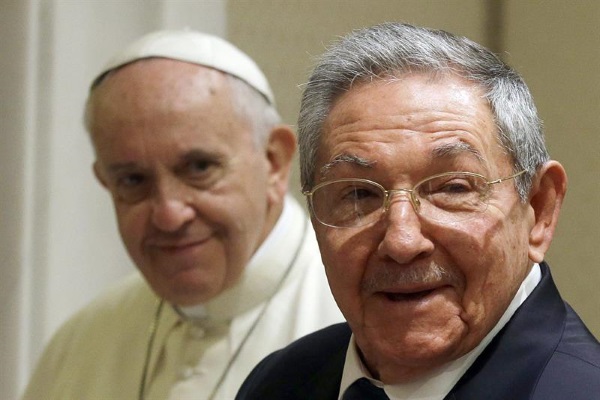
cubanet square logoCubanet, Miriam Celaya, Havana, 12 May 2015 — Yesterday, Tuesday May 11, 2015, the front page of Granma, the official organ of the Communist Party of Cuba (PCC), showed a photograph of the Cuban President General amicably shaking the hand of Pope Francis in Vatican City. Quirks of politics, to convince us of the survivability of the Castro regime, represented by another member of the same caste that in the decade of the 70’s and 80’s harassed members of religious orders, reviled priests and marginalized the faithful. Now, just like that, the Castro regime perfumes its stubborn Marxist conviction with myrrh and frankincense, and it is almost hard to believe that this seemingly respectable octogenarian who visits with the Pope is one of those guerrilla leaders of that Revolution that was anticlerical, antireligious and church-phobic even before declaring itself Marxist.

In retrospect, the war against religious faith in Cuba was not just a momentary attack, but a policy of systematic and ongoing state-sanctioned persecution or discrimination against individuals for reasons of their religious beliefs, while, at the same time, Marxism-Leninism, that other fake religion, kept spreading with the aid of the Kremlin’s petro-rubles. continue reading

Thus, just like in the days when Christians hid in Roman catacombs to celebrate their sacred rites, in the years of bloody Sovietizing doctrine in Cuba many publicly denied their faith while attending sneak churches sufficiently distant from their neighborhoods so as not to be recognized and betrayed by their neighbors. Those were the days that faithfulness to God was not only irreconcilable with the Communist militancy, but constituted a serious obstacle to getting ahead in one’s education or employment.

We’re just making mention of Catholic Christians. Jehovah’s Witnesses, considered the quintessence of ideological poison that needed to be eradicated by the roots to safeguard the Revolution, were martyrized, and as such, suffered the worst wrath of the Bolshevik commissariat.

With the end of the Russian Communist adventure in this and other regions of the Third World, and the loss of its European satellites, the anti-religious crusade in Cuba came to an end, and the chameleon-like ability of the Castro regime was evidenced, when the unthinkable became reality: officially, overnight, it was established that Marxism was not incompatible with religious faiths.

And then, with the childlike enthusiasm characteristic of the Cuban people, not only did the Communist militants dust Bibles, old images of Christ and the Catholic calendar, or wear colorful necklaces and other attributes of the African deities, but many members of religious sects who had remained true to their faith, courageously facing persecution and ostracism, ran to become Communist militants. Obviously there are always those who fail to see the difference between one system of belief and another, between one dogma and another: in short, for some, everything is summarized as an exercise of pure faith.

Epaulettes and cassocks

There is a popular Cuban saying that tells us to remember Santa Barbara when it thunders. Castro’s leadership is no exception, so the Castro epaulets and Catholic cassocks have once again been reconfigured without reverence.

God’s return to this island purgatory was first blessed in 1998, during the visit of Pope John Paul II, and without the benefit of repentance or even an act of contrition for its many wicked acts, the Great Orate, active back then, allowed the return of the Christmas season and Christmas carols banned for decades, and the Catholic Church began to recover larger areas, though civil rights for Cubans did not return, and political repression continued. Praying to God while swinging the mallet, says a Spanish proverb.

The government never apologized for the many acts of plundering the Church nor was there an apology to religious members, sacred or secular, rich or humble, though, in truth, the victims have not demanded an official explanation. The lambs are for sacrificing. Thus, the system self-forgave its own sins without even mentioning them and without doing any penance. Today, the Cardinal and the Church have become almost commonplace at some public events, and even –Oh, Marx! arise and watch the sacrilege! – the most important religious events have begun to be televised as good ones and reported by the supposedly “Communist” press.

The second papal visit to Cuba, when the ‘defunct’ Benedict XVI blessed all of us, including the regime, turned into the consecration of the symbiosis between Marxism and Christianity. For some time now the manuals consulted by students have not stated repeatedly that “religion is the opium of the people,” as once proclaimed our mandatory core textbooks.

And, as if the hand of God had turned this Island topsy-turvy, the furious former guerrillas and their troupes have started to attend religious services and to accept (or seek) the pious mediation of the Church and the high clergy, formerly stripped and humiliated by the arrogance of a proclaimed Communist Revolution to solve some uncomfortable domestic minor matters – like of the prisoners of the Black Spring, necessary to free without it seeming as a defeat of the revolution – or, more recently, to reconcile with its staunchest enemy, “US imperialism,” in order to help them extend their time in power for a little longer while they remain in this vulgar material world.

Now, with the visit of the lesser devil to the Vatican, it has become known that the General-President and Pope Francis bless each other through their prayers, and the thought of a praying Castro stands out in its grotesqueness. But so magnanimous is the Church of God. In any case, none of this may prove sincere, but at least everything looks very touchy-feely, just like in the best soap operas ranked #1 by the people.

Believers say God works in mysterious ways, and it must be true, because, without knowing how, it seems that the miracle of conversion of the devils at the Palace of the Revolution into loving lambs of Christ has taken place, and right now they seem to be closer to the Lord than the millions of Cubans who continue to suffer lives of material deprivation and the absence of rights. At this rate, I bet the day will come when future Cubans will witness the canonization of these crooked olive-green old men. And that would be proclaimed, without doubt, as another one of the Revolution’s resounding achievements. After all, maybe it’s really just a matter of faith.

Translated by Norma Whiting

Could Liborio* Be the Enemy of Your Opinions?

1430767279_souvenir-ii-bota1okIn search of economists who can speak the language of everyday people

In economics it’s not enough that ideas or conclusions be based on concrete data; to be effective they must be shared by society. In other fields of knowledge, such as medicine, it is enough merely that the doctor knows the remedy in order for the patient to accept it. continue reading

In economics it doesn’t work that way, even if there are second or third opinions in agreement. In economics it is essential that public opinion agrees with the views of the experts in order for them to be applied. Dissemination and acceptance of economic ideas is absolutely essential to their success.

In these times of crisis (not just economic) it seems that ideas are systematically imposed by slogans. The aim of this article is to highlight the principles on which there is agreement among economists and, for the other issues, to appeal for reflection and dedication to the task of finding new common ground. All of this with the intention of trying to solve the specific problems that now require solutions.

As a complement to “The Ten Principles of Economics” by Mankiw, or rather, to support or confirm them, we present “The Rules of the Game of Economics,” taken from the fourth edition (2000) of the book Economics. Theory and Policy by Francisco Mochón. As you can see, the similarity between the “principles” and the “rules” is apparent.

The Rules of the Game of Economics

—We all want more, but we have to choose with appropriate criteria.

For all economic actors, the cost of a thing is what has to be given up to get it.

If we want to get more with the resources available, we must turn to specialization and trade.

Economic activity is usually best organized by transactions freely made in the markets.

—The public sector can sometimes correct and improve the way the markets act.

—Economic actors respond to incentives presented.

—To understand economics one must know how economists carry out their analysis.

—Economists seek not only to understand reality, but sometimes also to change it.

—Economics must simplify reality in order to comprehend it: the models.

We can deduce therefore that, if on the issues identified there is agreement, then on those not covered by the principles and the rules there is no degree of consensus. Changes in the theory and practice of the science of economics are constantly under discussion.

The economics section of any bookstore contains a surprising number of books trying to explain the economic crisis and how to get out of it. The same is true of the opinion articles from newspapers and magazines.

A large number of well-founded economics blogs are available on the internet. The information at our disposal is so boundless that merely pre-selecting sources or authors to consult becomes a problem.

Economists should make an effort to explain, in the clearest and most informative way possible, why on some points there is widespread consensus. They should also should identify the points on which no such agreement exists, and explain why that is so. And all of this under the umbrella of the phrase from Borges that is so easy to relate to, “there may be enemies of my opinions, but if I wait a while, I may also be the enemy of my opinions.”

Excerpts from the article “Principles Generally Accepted in Economics” by Juan Francisco García Aranda. Extoikos No. 7, page 81. Available here.

The Harvest of the Sowing of Violence / Cubanet, Rafael Alcides

Repression Against the Ladies in White (Internet photo)

cubanet square logoCubanet, Rafael Alcides, Havana, 13 May 2015 – Extremely worried, doctoral candidate in physics Antonio Rodiles and his wife the actress and political activist Ailer Gonzalez, in their home, related to me two events that I have prayed over, that those events that started with the blood of Moncada wouldn’t end up being a circular story. Ailer and Antonio spoke of the increased police repression after December 17, most particularly of the brutality with which the oppressors are being dispatched.

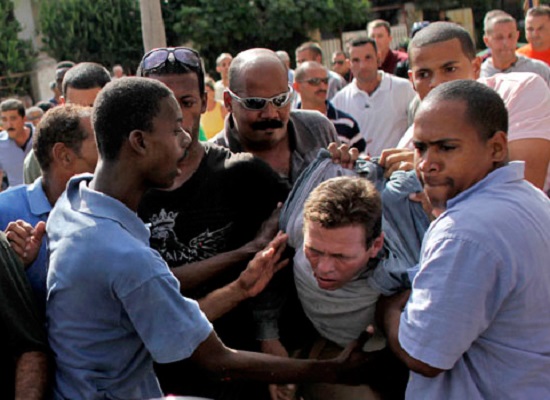
On Sunday the 26th of last month, with their trucks crammed with martial arts experts at the end of the usual parade of the Ladies in White, Carlitos, the son of Jesus Menendez, an elderly diabetic with heart problems, was grabbed, dragged and thrown in the back of the truck like a sack of potatoes. Yury, Blas Roca’s grandson, was put in plastic handcuffs so tightly that his hands turned black and they didn’t cut them off. Up Calabazar, the truck with the prisoners inside was left in the sun to bake them a little. They grabbed Antonio among the many present and pushed him with blows to the back before throwing him headfirst into the truck. An endless number of books could be written about the mistreatment and repression of the Ladies in White, apparently excluded from government’s media campaign to end violence against women. continue reading

There has been no lack of repression since 1959. Nor cruelty. In the Canary Islands, during a tribute to the poet Manuel Díaz Martínez, Raúl Rivero talked to me about a blind dissident attorney on the outskirts of Ciego Avila who for a time took lottery bets from the area’s cops. They detained him and when night came they left him in the boondocks. The cop won a bet on what time the blind guy would be seen groping his way into the village using a stalk of sugar cane or a bare branch.

Amazed at not having seen him for a long time, at the Cuban Writers and Artists Union (UNEAC) I met the Galician Regueral, now in his 60s, a Spanish journalist who has lived in Cuba since the 40s. “I was imprisoned for a year in Villa Marista,” he told me. “Why?” “I asked them that when they let me go. ‘Get out of here you Galician, go! Go!’ was the response. They never interrogated me.”

But it couldn’t be pinned on the political police. Kidnapped, homes invaded at midnight and turned upside down, and struggling, taking down the opponent by force, but it can’t be pinned on them. Or not exposed. For this they use the supposed “outraged people,” a mob disguised by its sheer numbers.

Repression intensifies against opponents in Cuba (Internet photo)

On the other hand, this is the least likely moment to make a show of brutality. They’re expecting investors in the Port of Mariel project (although those in the know say with so little bait they’re not going to catch big fish) There are also the American government authorities frequently visiting the Island, and behind them, or in front or them, are those who come to check out the part where they would like to stay, the government and entrepreneurs are expecting four million American tourists who speak of the myth. And in September Pope Francis will come. It is, I insist, the least likely moment to step up the heat.

After the first years of the Revolution, there were no more firecrackers going off, no place for sabotage, or attacks or an uprising to happen. Those methods of fighting, traditional on the Island in and those that in the 26th of July Movement were considered excellent, disappeared. The dissidence, in that regard, has been more peaceful than plaster saints. But violence often engenders violence.

I remember a boy from those times of Aguirre Park who didn’t want to get involved in anything. Seeing him appear, the group changed the subject. “Hush,” they said. It scared him. “I’m getting cold,” he complained. One night he came close to tears, but was determined. “Gentlemen, count me in on whatever,” he said. A cop whose girlfriend he’d offended had punched him. Then, from what I learned after 1959, he became the best at planting bombs.

A man without a job in dangerous, but a man with a policeman’s hand over him could be the beginning of civil war. I understand Army General Raul Castro. If he allows the demonstrations of the Ladies in White, he would have to allow others and all the rest, but if he doesn’t allow them, he will have to continue to use brutality and then he has crossed the line than can’t be crossed. He’s caught in a lose-lose situation. All that’s left is to open the game. Inaugurate democracy. His time has run out.

Russia and Raúl Castro’s Mediating Role / 14ymedio, Jose Gabriel Barrenechea

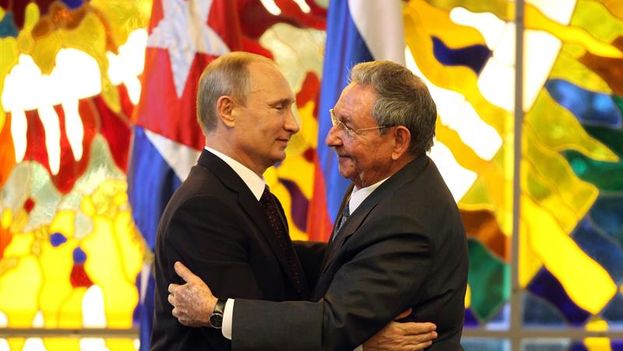
Raúl Castro and Vladimir Putin in Havana’s Palace of the Revolution in July 2014. (EFE/Alejandro Ernesto)

14ymedio bigger14ymedio, Jose Gabriel Barrenechea, Santa Clara, 5 May 2014 — Russia is not the West’s Enemy, with a capital “E.” And even if it were, it would not be taken seriously. Russia is no longer the industrial superpower of the ’70’s and ’80’s, nor is it a leader in innovation. Its population is dwindling to catastrophic levels, as its share of GDP in comparison to those of other countries. It is indeed true its army is still the only one that can face the American army in all-out symmetrical war, but for how much longer?

In fact, Russia is not the enemy because it shares real enemies with the West, the enemies we really should fear. And we share them because Russia is part of the West. continue reading

The proof of this not only lies in Russia’s Christian tradition, but more importantly, it is one of the countries that has influenced Western culture the most. If you make a list of the ten most important figures in any scientific field, technology, the arts, music, philosophical inquiry, or of the literature of our Western civilization that have paved innovative and unforeseen paths, said list would invariably include at least one Russian surname.

Russia’s problem has been, as compared, for example, to France or Spain, that the segment of its society that has supported rationalism (and I mean rationalism as defined by Karl Popper) has not been able to replace the traditional and instinctively Russian characteristics of its society. As a matter of fact, Russian rationalism, which peaked at the end of the 19th century until approximately 1925, has been repeatedly purged by a pseudo-rationalistic survival method derived from tradition and national instincts. This pseudo-rationalism, a form of modernized half-baked Asiatic culture, started winning the race once the Bolshevik counterrevolution dissolved the constitutional convention of 1917, culminating with Stalin’s rise to power.

Needles to say, the continuing success of “Asiatic culture” in Russia has had a lot to do with mistaken impression the rest of the West has of it. This was understandable when the West indisputably ruled the world, and every nation fought for its piece of the pie. But now that is not the case at all. It is very clear that in this moment in time our civilization and its values are beginning to lose the unrestricted worldwide supremacy they once enjoyed.

Western civilization should try to do away with the anachronistic last vestiges of bloody civil wars, and what we call world wars, all waged for the sake of global domination. The West should attempt to lure Russia into joining the consensus building and security structures that have been gradually established since 1945. For this to work we should bear in mind that Russia is not a second or third-rate country. Russia has a genuine imperial tradition. In other words, Russia is not Poland, Czechoslovakia, nor even Turkey. Russia cannot be asked to just fall in line. It should be given its rightful place among the great nations.

Around 1920, José Ortega y Gasset said that Europe would unite only when it saw the enemy coming over the horizon. That danger exists today, and not only for Europe, but also for the whole West, and it comes from authoritarian China, and particularly, the Islamic world. China is a traditional empire with incredible rates of economic expansion. The Islamic world is experiencing an explosive demographic growth. While in the West, the United States is the only country whose population is increasing.

Jihadism threatens Russia’s entire southern flank, and after the disastrous Soviet invasion of Afghanistan, many Islamists perceive Moscow as the perfect personification of the enemy, more than they even do Washington. Or at least Moscow is the enemy they can hurt with greater ease. As far as China is concerned, not only does it threaten Russia’s Far East, it has now started expanding into it. It should be noted that the population density on the border between the two countries is 62 percent higher on the Chinese side than on the Russian. The Russian Far East is full of natural resources that the country cannot exploit in the face of an expanding China that needs them more and more.

In the next few years, when the Arctic Ocean is opened for navigation, Moscow will not benefit if it does not by that time exercise total control over its Far East, and especially its Pacific coast. Russia will need to maintain a naval force in that ocean, which in itself clashes with the Chinese strategic interest of controlling all its adjacent seas, and what they call “the first island chain” that surround them: Japan, the Philippines, Taiwan, Indonesia, and Australia.

Therefore both nations are already clashing on the continental mainland and on the ocean, and in the future they will do so with even more force.

In the face of all the jingoism of recent years, the first step should be changing the way the average Westerner sees Russia. The cultural achievements of the rational segment of Russian society should be disseminated throughout the whole West. The rediscovery of Dostoyevsky, Tolstoy, Tchaikovsky, Mendeleev, Lobachevsky, Chekhov, Eisenstein, Shostakovich, Tarkovsky… could help change the perception that the average Westerner has of Russia. Meanwhile, Western admiration for Russian rationalism might motivate the Russians to rediscover it for themselves.

Saving Russia is of vital importance. In the first place, it is part of our civilization, and secondly, because the West finds itself under threat. Only an alliance between the Russian bear and the American bald eagle could perhaps save them from being subordinated by other civilizations that are on the rise.

Cuba can play a significant role in the rapprochement between these two giants that Alejo Carpentier described as being situated at the two extremes of the West. It would be a very, very positive step if Raúl Castro were to realize this before embarking on his next visit to Russia to attend the festivities of the victory over Nazi Germany. If this were the case, and Castro were to indeed try to do something to secure a rapprochement, he could secure a legacy for himself and significantly bolster Cuba’s prestige as well.

Translated by José Badué

Photo Gallery: Daily life of the People of Jaruco / Hablemos Press, Elio Delgado

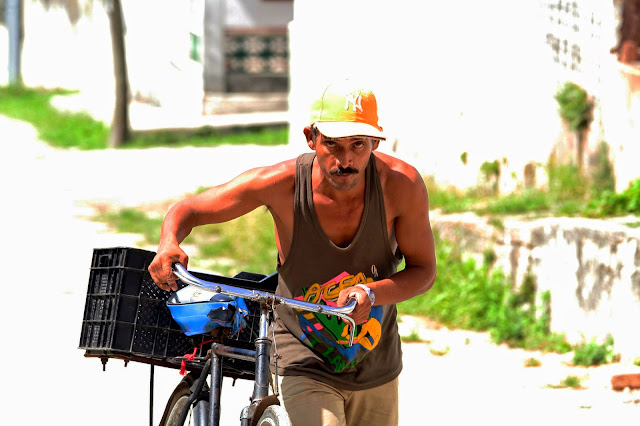
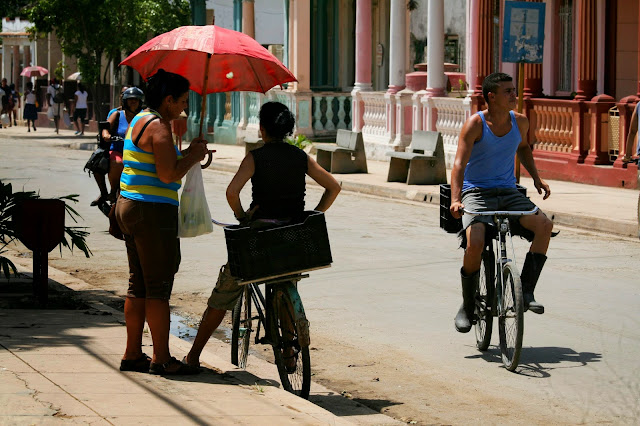
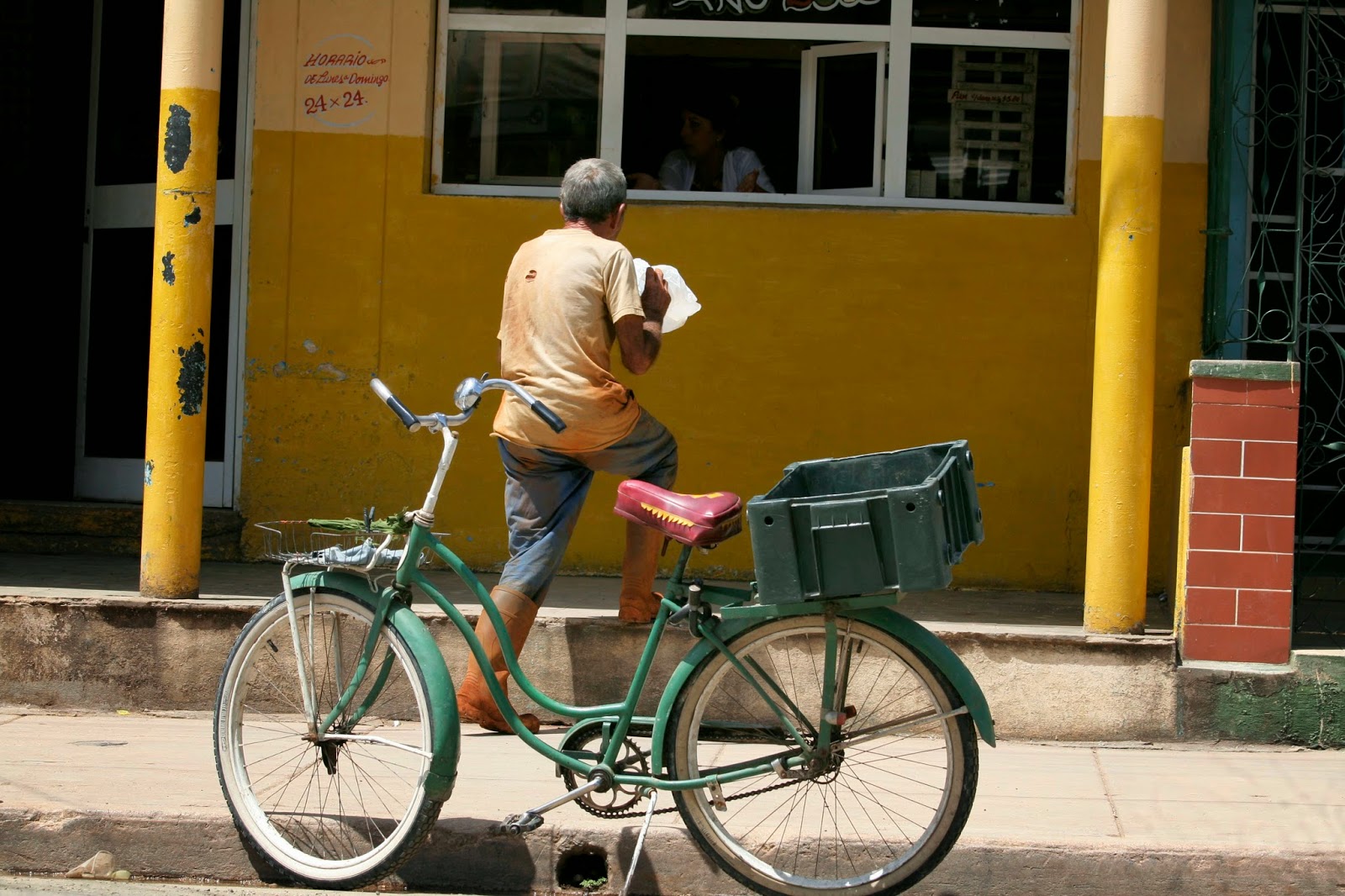
Mayabeque, Cuba. – Cubans immersed in the day to day of survival with a salary of $20 per month do thousands of work-arounds to earn a living. These images captured by my lens reflect the daily life of the inhabitants of Jaruco.
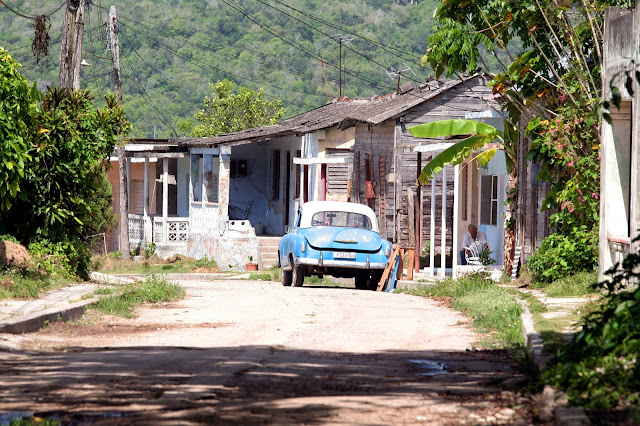
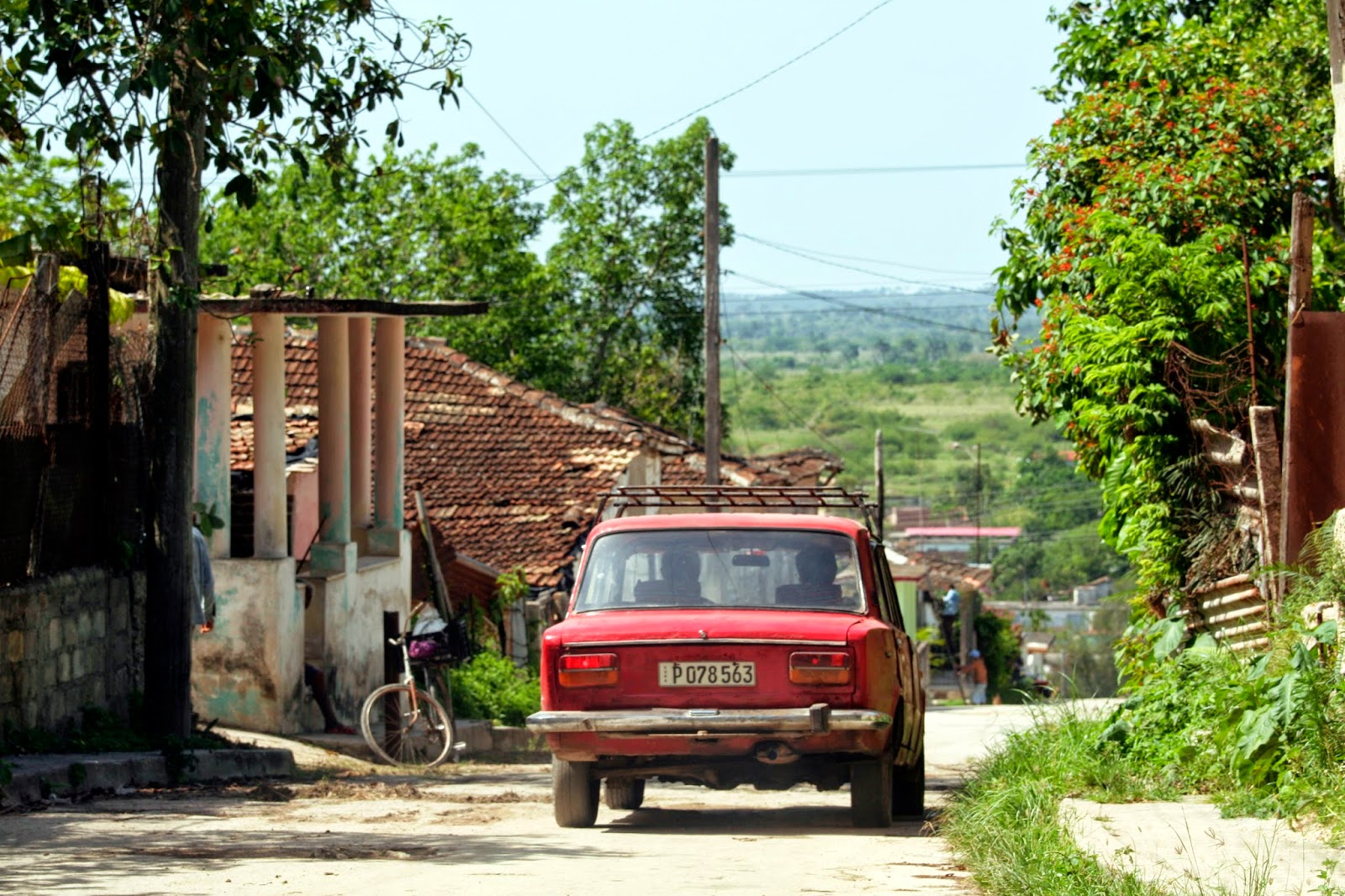
Jaruco is a municipality of Mayabeque province, situated some 30km southeast of Havana. Its norther border abuts the municipality of Santa Cruz del Norte, and on the south, San José de las Lajas [the provincial capital].

Economic activities are based mainly on livestock and agriculture–both of which are impacted by the socialist bureaucracy.

Photo Credits: Elio Delgado, Hablemos Press

Translator: Alicia Barraqué Ellison

From “White Udder” to the seven-legged bull / Yoani Sanchez

Illustration of a cow. (14ymedio)

Generation Y, Yoani Sanchez, Havana, 5 May 2015 – For a long time the extraordinary, the unusual, was our hope. On this Island which must have been Atlantis, the reincarnation of Alexander the Great was born and there lived a cow who gave the most quarts of milk in the history of humanity. Like all childish people we needed to feel that nobody surpassed us and that the ordinary rested far from our borders. White Udder, the cow that still owns the Guinness World Record, was a sacrificial victim on the altar of this national and political vanity. Gone are the times of those exaggerated ranching achievements, now we can only crow about our anomalies.

Muñeco is a bull with seven legs. The local press just narrated his story, a wild yearling born from two commercial zebu breed cattle, and ultimately adopted by the cattle rancher Diego Vera Hernandez in the Trinidad area. What distinguishes this exemplar from so many others that die of hunger and thirst in the Cuban countryside is that springing from its back, near the shoulder hump, are three additional legs and one testicle. Its anatomy includes everything the official rhetoric needs: on the one hand the inconceivable, on the other, this piece of virility that should not be lacking in anyone or anything that wants to brag about being made in Cuba.

Gone are the times of those exaggerated ranching achievements, now we can only crow about our anomalies.

Muñeco’s three legs have saved him from the illegal slaughter to which so many of his peers succumb due to the needs and poor livestock management displayed by the current system. That piece of another bull hanging from his back has freed him from the middle-of-the-night butcher’s knife because a clever farmer realizes that he has before his eyes a fair animal, a circus creature, to show off to journalists at the agricultural fairs. But there is not much difference from this pet with mischievous genes and that cow that represented all our hopes of seeing milk run in the streets and factories drowning in cheese and yogurt.

White Udder died from the excesses of a leader who needed results, but Muñeco has lived for the pride of this nation burdened by its own malformations.

Changing the Subject / Fernando Damaso

Fernando Damaso, 12 May 2015 — When it comes to talking about human rights, our authorities ignore the 30 items in the Universal Declaration about them, and they go on to extol the medical, educational and other types of assistance they lend to dozens of countries–as well as to foreigners in our country–without clarifying the fact that in the majority of these cases, this help is paid-for by those countries, and by the individuals who receive it in Cuba. In reality, more than help, it consists of services that are commercialized for very good political and economic returns for the government. Everything should be called by its proper name.

Such assistance, albeit respectable, does not form part of human rights and, therefore, should not be used to evade responsibility for their disrespect where Cuban citizens are concerned, nor accepted in international forums. continue reading

From the moment when exclusions exist within the country with regard to the exercise of civic and political rights, repression, and beatings, there are violations of those rights. Freedom of opinion and of expression, to not be harassed because of opinions, and to freely research information and opinions and disseminate them with no limits, remain unfinished business. So, too, freedom of peaceful assembly and association. Many others could be mentioned.

Regarding these rights and all the others, there should be conversation and, by means of respectful and serious dialogue, their establishment in the country–as well as their inclusion in the Constitution, without “tags” to render them meaningless, as occurs with some in the current version. In addition, the judiciary should guard them and demand that they be respected.

It is time to start dotting the i’s, and not continue allowing the authorities to change the subject at their convenience, if we truly want to solve our problems.

 Translated by: Alicia Barraqué Ellison

Evo Morales, The Dissident Who Was Abused / Angel Santiesteban

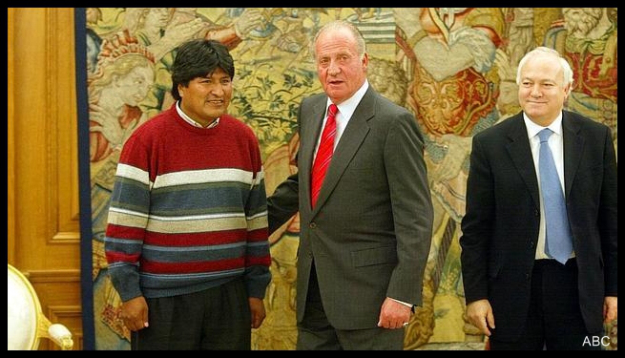
evo-morales-en-los-primeros-tiemposAngel Santiesteban, 12 May 2015 — At the Summit of the Americas, the Bolivian president told journalists about the arrests, humiliations and violations of human rights he suffered when he opposed the officialdom of his country, from the beginning of his union movement activism back in 1988.

So it’s outrageous that this same human being, statesman and politician, who tells of the suffering inflicted upon him by the extremist regimes of his time, is today the one who defends the dictatorship of the Castro brothers, which commits the same human rights violations against the Cuban opposition. It might be assumed that he would show solidarity with the abused of today. But, like they say, “with fame comes memory loss.”

Although perhaps it’s not forgetfulness so much as the price he pays, because in reality he was chosen by Fidel Castro for his country’s presidency, and provided with economic and strategic support, personal protection and intelligence. continue reading

Fidel did the same with the others who today make up that Latin American mafia of “leftist” presidents: Hugo Chavez, Nicolas Maduro, Lula da Silva; or even Ollanta Humala in Peru, who has had to pay for the favor quietly, because in his country it has been impossible to imitate Venezuela, Bolivia, and Ecuador.

Nor is it possible to deny that, since his rise to power, Morales has achieved a better situation for the lower classes, developed the economy and created better opportunities and conditions in general for his people, while the most notable is having restored the rights of indigenous citizens, forgotten and out of favor for centuries.

So far, President Morales would have made history as the best chief of the national tribe, and I write this with respect. But that commitment to work for the development of the country still isn’t enough for Evo Morales, nor is it for those other leftist leaders on the continent, those that I call “mafia,” in which I include Venezuela, Cuba, Nicaragua, Ecuador, Brazil, Argentina, Bolivia and, to a lesser extent, because of their more independent paths from the dictates of Cuba, Uruguay and some small Caribbean islands.

Continuing in the fashion of popular dictators, Morales manipulated the law to gain indefinite re-election and eternalize his power. In doing so, he betrayed himself, but he did the greatest damage to his nation, sticking a dagger in the back of democracy, since it ensures for him, and for those who can replace him when he decides to leave power, the opportunity to maintain a dictatorship with support from the Parliament.            

Evo Morales, who had the responsibility of ensuring those democratic terms, violated the meaning of his own name — morals — by defiling and hijacking democracy. But, as luck would have it, a light is possibly dawning in the person of Soledad Chapetón Tancara, a young Aymaran woman and educator, who has become mayor of El Alto, Bolivia’s second most important city.

To play at being a dictator is a slow process of degradation, as one falls into the abyss and tries to grab onto some branches. But in the end it is still a fall. When surveys and advisers suggested to Evo Morales the possibility that the Bolivian Socialist Movement (MAS) might lose some of the country’s most important towns, he threatened to “withdraw financial support” from those municipalities. And that was just the beginning of his descent.

It’s undeniable that he opened doors for himself and others with absolutist intentions, and therein lies the danger: he committed the stupidity of letting go of a child’s hand in the roadGenerally, this stupidity ends with a lot of suffering and blood. Morales’ mistake will erase whatever was best of the noblest and altruistic actions he took in his mandate as the first president in favor of his people, who have already begun to withdraw their confidence. It shows, once again, that overcoming a decade in power entails a wear and tear of image, which usually ends, inevitably, in the general ill will of one’s own citizens.         

Losing the municipality of El Alto is the first notice. Now it’s the turn of the mayor, Soledad Chapeton Tancara, who shows she knows what she wants and where she wants to lead her people, who are grateful to her.

Evo Morales is trying to show that what occurred isn’t very important and that everything is going well. Hopefully he will rise above his partisan pains and cooperate with the young Aymara, who asks for “less ideology and more transparency” and offers new proposals for the development of her nation.

Let’s remember that the vote against Morales was partly due to corruption of the authorities in those municipalities, resulting from the lack of control of the president in his obstinate commitment to manufacture a war against the United States.

Soledad Chapeton will remain as mayor of El Alto until 2021, and later, according to how her management goes, will be a possible candidate for the National Unity party together with its leader, the businessman Samuel Doria Medina, who will have the challenge of healing that wound in the Constitution of his own country, a wound which leaves open a clear path for autocrats to install themselves and put forth their ideologies as cloaks for their appetites and personal ambitions. Of course, before healing the wound the knife needs to be removed.     

When Evo Morales finished recounting his stories of abuse in one of the arranged rooms during the Panama Summit, the journalists started questioning him, showing impatience, since in those few words the Bolivian president had never touched on those delicate subjects that bother him so much.

He found himself in front of a group of professionals, among whom were some of those he himself censured in the official spaces, where those who are invited and the questions they can ask are chosen.

When a journalist asked him how it was possible that, with his experience as a victim of abuse from political leaders, he could support Castro’s totalitarian regime, which committed the same outrageous acts that other governments committed against him, Morales threw himself onto a heap of trash, spewing garbage, and tried, shamefully imitating Cantinflas*, to justify himself by saying that when someone badmouths the Cuban people he takes it as a personal attack.

But here’s a curious observation: in Raul Castro’s appearance at the Summit (those twelve minutes that multiplied, since it’s impossible not to violate the time limit rule), he didn’t refer to the most publicized demand of Evo Morales, Bolivia’s exit to the sea, in spite of mentioning other important demands of that mafioso group of acolytes: the condemnation of Obama’s decree against Venezuela, Argentina’s right to the Malvinas, putting the brake on the transnationals who “contaminate” the soil of Ecuador, the “decolonization” of Puerto Rico, poverty in Haiti, peace in Colombia. But Evo Morales’ demand wasn’t mentioned, perhaps so Bachelet wouldn’t be annoyed. I wouldn’t be surprised if some juicy agreement is signed in Chile for financial aid to Cuba.

Morales was obviously nervous when they asked him the question. He looked at the journalist like a weirdo, surely wanting to throw the microphone at him rather than answer; and, searching perhaps for a way out, it occurred to Morales to ask him if he were a journalist, perhaps in case he wasn’t, to negate his words. But his interlocutor said “yes”, leaving the president no other decent option than to respond, or at least to try to, as he finally did.

The leader knew before starting that he was plunging into the ridiculous and he extracted forced words, produced ready-made phrases and readings, learned in the best moment of the educative rigor that Cuba offered to that mafioso alliance, conscious of the quota of impudence assimilated by obligation as part of being affiliated with the mafia of “leftist” Latin America.

A dangerous double-edged knife, that this time injured its carrier, removing him, if some time he was close, from that vociferous leftist longing to receive the Nobel Peace Prize, when in reality every one of his steps showed that he was preparing for a war and, even worse, for a war against his own people and his Aymara brothers.

The Bolivian sovereign, while trying to guarantee that the garbage wouldn’t smother him, cited the words of Fidel Castro: “We have to share what we have, not that which is left over.” But Castro didn’t talk about the price that the Cuban people have paid for decades, for more than a half century, for his narcissistic obsession of reaching a preponderant level on an international scale.

It didn’t matter to Castro that he has made his people sacrifice and suffer, crushing generations of Cubans, one after the other, and worse, converting them into lost generations socially, like throwing away offerings in empty sacks, discarding victims; finally, considering them dispensable human beings, those whom he always saw as mere numbers.

What Fidel Castro lacked was the spirit of a benefactor, and the facts prove it. Or perhaps you can call someone a benefactor who collects hundreds of millions from Venezuela in petroleum, in exchange for the Cuban collaborators placed in that country, which has almost been taken over by Cuba?

Does a benefactor charge Brazil an undreamt amount of money for the doctors it rents to them, paying them a poor salary and pocketing the major part of what it pays for every doctor sent to the Carioca nation? This only mentions two countries of those where this slavery business of the 21st century imposed by Fidel Castro proliferates. It’s known that professionals who refuse to go can forget about receiving income in their specialty or material rewards for their work. The impoverished economic situation confronting their families obligates them to accept.

Perhaps one day there will be a study on the marital cost of this separation, this distance between couples, the lack of protection for family and children who remain. Divorces from that physical separation on average are very high. What make this more deplorable and shameful is that in the end those “internationalists” receive a tiny part of the payment that the government charges, a miserable payment that evaporates over months, because some decide to loan themselves again to slavery and so perform two or more collaborations in other countries.

I knew someone who spent six years in Venezuela, while they kept his wife, two kids and old parents in Cuba. And he did that, planned it, to resolve the family calamities and be able to celebrate his daughter’s “quince**” with a little decorum.

Evo Morales knows, but perhaps doesn’t want to see out of pure convenience, that all the foreign graduates in Cuba, thousands, today professionals in their countries, are converted in the great majority into agents, ideological stone-masons, silent allies of the Cuban government, who in many cases have ascended to important posts in their governments, with all the intention of influencing these nations, once the era of guerrillas has passed. Solidarity, it’s not.

Castro thought out very well his plans for global power. He gave the stairways to power to Chavez, Maduro, Lula da Silva, Evo Morales, among others, but on credit, and charging them means destroying that staircase, snatching away from them that initial impulse and launching them into the worst of the history of their countries.

In summary, Evo Morales, more than being a satellite, like the one recently launched into space, needs a shaman to enlighten him and show him the reality of today and the future, and one who, moreover, will make him think about the question of office that the journalist at the Panama Summit asked him: “And you, Evo, are you the president?”

Ángel Santiesteban-Prats
April 16, 2015 , Border Prison Unit, Havana.

Translator’s notes:
*Cantinflas was a Mexican comic actor who often portrayed impoverished peasants.
**The “Quince” is the tradition of celebrating a young girl’s coming of age on her 15th birthday.

Translated by: Nathan Clarke and Regina Anavy

Cuba and Venezuela, in the same mirror / 14ymedio, Yoani Sanchez

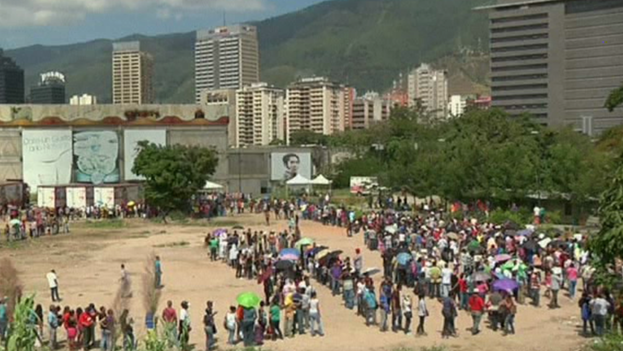
Line to buy food in Venezuela (Twitter)

14ymedio bigger14ymedio, Yoani Sanchez, Havana, 14 May 2015 – “I got soap and some toys for her son,” one Venezuelan mother was telling another in Tocumen Airport in Panama. At her feet a carry-on looked like it was about to explode it was so full, as the lady enumerated everything she was taking back to her country. The conversation reminded me of my own compatriots who return to the Island with luggage stuffed with products, including everything from toothpaste to sewing needles.

In a situation of scarcities, we human beings end up looking like those “leafcutter ants,” capable of carrying a part of the forest back to their anthills. But the task of seeking what we lack at any cost also locks us into a cycle of obsessions, where buying eggs, stocking up on milk or locating the market that has toilet paper will consume a major share of our time and energy. We end up trapped in a cycle of survival, in which we can hardly concern ourselves with our role as citizens. continue reading

However, there will also be some who want to explain the hardships in their own way. Like the official analyst who, some days ago on Cuban television, addressed the scarcity of basic goods in Venezuela. In that lady’s opinion, the blame for the shortages falls on the sector that hoards, or fails to import, merchandise in order to provoke social chaos. In her discourse, the “evil rich” make it difficult for the “good poor” to put a plate of food on the table. A line of argument so ridiculous that I stopped to listen to it, as if it were a comedy show.

The biased analyst was an outstanding student of the school of “Castroism,” in which Hugo Chavez and Maduro were also trained, and where they learned that while filling political discourse with a constant reference to the enemy may not serve to appease the burning hunger in the stomach, at least it keeps the needy entertained. A policy of fanfare, where there are always “the others” who do evil things and boycott the government, which claims to be the target of attacks coming from all sides.

A policy of fanfare, where they are always the others who do evil things and boycotting the government, which claims to be the target of attacks coming from all sides

The truth is that long lines outside markets are not a media hoax nor an exaggeration of the Venezuelan independent news media, but a reality that affects the entire country. Flour is unavailable for everyone and economic instability knows no social classes nor distinguishes ideologies, although the corruption and an extensive network of privileges awarded to those closest to power offer them a significant material respite. In these circumstances individuals are reduced to their condition as desperate consumers, a situation that results in a more controllable society, and a citizenry less attuned to the political scene.

As in a warped mirror, we Cubans see our worst moments reflected in Venezuelans. If previously we could say with pride that we share a culture, a language, and even geographic proximity, now we see ourselves in issues no one would want to brag about.

We are both a people who have learned to wait, stand in long lines, always carry a bag to catch on the fly any rumors of a reappearance of some product. The luggage we check at the world’s airports travels loaded with the same things and full of the same anxieties of deprivation. When we listen to ourselves speak it is now difficult to distinguish if we are in Havana or Caracas, if we are waiting outside a market in Maracaibo, or in Santiago de Cuba. Are we them or are they us?

Four Years Without Justice / Mario Lleonart

Juan Wilfredo Soto García, “The Student,” October 13, 2010

May 5th was the fourth anniversary of the brutal beating of activist Juan Wilfredo Soto García, which resulted in his death two days later. It was followed bythe deaths of noted leaders Laura Pollán and Oswaldo Payá Sardiñas, in which many also acknowledge the presence of the criminal hand. The effectiveness of extrajudicial execution, verified in the case of Juan Wilfredo Soto and amply proven by other governments, is also beyond doubt in Cuba.

The regime that began with firing squads no longer needs them. The moratorium on the death penalty since 2003 is possible because those in power have perfected their method of eliminating political opponents, paying for it at the lowest possible price. North Korea, which “judicially” exterminates without ceremony, as demonstrated again a few days ago, should take lessons from its more sophisticated Cuban allies, the best students of Machiavelli. continue reading

The common denominator in the three cases cited above is the lack of impartial investigations, which would most benefit murder suspects who were truly innocent. Four years after his death, what has happened in Juan Wilfredo’s case?

– His closest relatives, his two children, well aware of the criminality of the regime, opted for safety and emigrated through the Refugee Program of the United States.

– The impartial investigation requested of the Attorney General’s Office has not provided any conclusion.

– Not a single witness from the list that I gave to the Provincial Prosecutor of Villa Clara was called to testify. When I recently went to Prosecutor Osmel Fleites Cárdenas seeking information, he listened to my statement, reviewed the file, and confirmed that there is sufficient evidence to open a case, but then explained to me that he “no longer has anything to do with the matter because the investigation has been handed over to the Military Prosecutor.”

– It has been impossible to contact the family of Alexis Herrera Rodriguez, then a neighbor at 204 5th Street in the Camacho subdivision of Santa Clara. He was one of the three soldiers who participated in the fatal beating of Soto, the investigation of which was handled with total security by officers of the Political Police. Several witnesses placed him at the scene of the beating that fatal morning. He committed suicide by gunshot on Sunday May 8, 2011, Mother’s Day (the day we buried Soto), but survived some five days and was ultimately buried with a ceremony surrounded by heavy security on Friday May 13.

– It has also proved impossible to locate the other two police officers who participated in the beating—a man and a woman, twenty-year-olds, like Alexis—although it is rumored that both are now out of the military, at least from outward appearances, and that one is probably interned in a psychiatric hospital.

We live our lives aware of the dangers we face in denouncing the reality that extra-judicial executions are carried out with impunity in Cuba. We are supported in this every day in different ways, but we have no alternative if we truly want to represent the God of Justice whom we say we serve and to whose protection we entrust ourselves.

And in the case of Juan Wilfredo, having exhausted the meager options of the rigged Cuba legal system, we have no recourse but to appeal to the established international mechanisms, for which we have the support of the Commission on Human Rights, headed by Elizardo Sanchez, and of the beleaguered organization Cubalex.

6 May 2015

Mass in Cuba for Oswaldo Payá and Harold Cepero / Cubanet, Ignacio Gonzalez and Osmel Almaguer

cubanet square logoCubanet, Ignacio Gonzalez and Osmel Almaguer, Havana, 13 May 2015 – A Mass for the deceased Oswaldo Payá Sardiñas, opposition leader, and Harold Cepero, activist, was held this afternoon at the Church of Los Pasionistas in Havana, with Rosa María Payá in attendance. Rosa María, daughter of the Cuban human rights activist and recipient of the European Union’s Andrei Sakharov Prize for Freedom of Thought, arrived from the Miami Airport to Cuba on the morning of May 11, to reunite with her family and friends and to honor the memory of her father.

The Mass was attended by activists of the Estado de Sats project, Antonio Rodiles and Ailer González, and by Manuel Cuesta Morua, leader of Progressive Arc, among others.