“Neither side set deadlines or made any coercive statements,” a regime official said in response to several US media outlets.
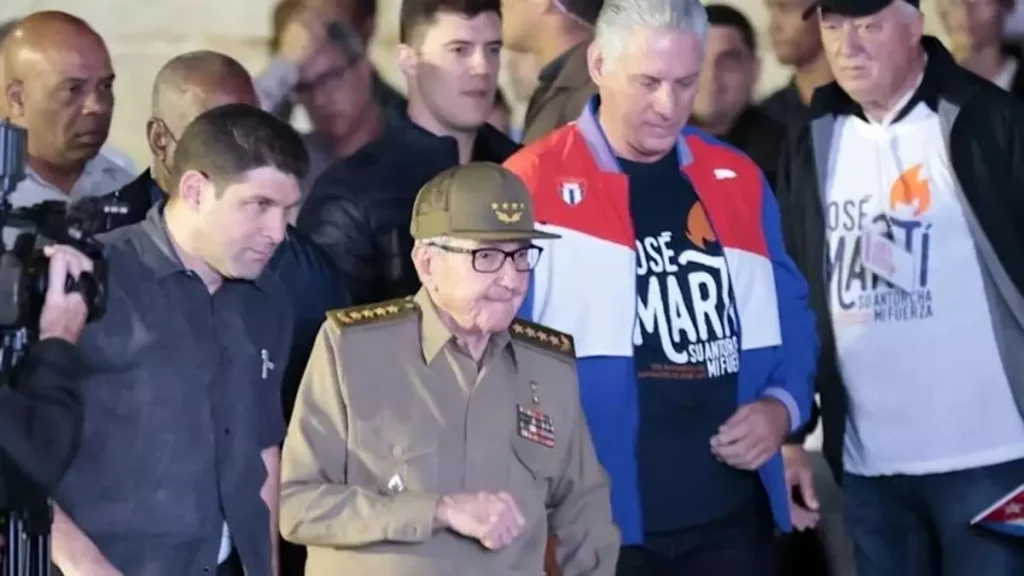
 14ymedio, Havana, April 20, 2026 — The Cuban government confirmed on Monday direct contacts with the United States, responding to “recent publications in the foreign press,” and asserted that “the meeting was respectful and professional, without deadlines or conditions.” With this brief statement, the government attempts to deny the 15-day ultimatum allegedly issued by Washington during conversations held on April 10.
In a very brief interview published in the State newspaper Granma, the deputy director general in charge of the US at the Cuban Ministry of Foreign Affairs, Alejandro García del Toro, stated that “within the framework of the meeting, neither party established deadlines or made threatening statements, as has been mentioned by US media.”
According to information revealed by Axios, the talks included a two-week ultimatum for the Cuban regime to release “high-profile” political prisoners—including Luis Manuel Otero Alcántara and Maykel Castillo Osorbo—as a “gesture of goodwill.” The request was confirmed by a White House spokesperson to USA Today, who also urged Havana to “stop playing games while direct talks are underway.”
The Cuban government had reacted this same Monday to the revelation of the US ultimatum, through a text published by the official media outlet Razones de Cuba – coincidentally titled Lies with Footnotes – where the meeting was not entirely denied, but rather the existence of a “secret trip of high-level officials with demands.”
The article vehemently denies the existence of political prisoners, but what it reveals is the State’s refusal to release them.
Later, Razones de Cuba tried to justify the possible existence of the meeting: “If that meeting with ‘high-level officials’ really took place and demands such as the release of prisoners, political freedom, compensation and conditions for aid were raised, Cuba’s response was and will be the same as always: a resounding rejection.”
The article vehemently denies the existence of political prisoners, but what it reveals is the State’s refusal to release them: “’Freedom for political prisoners’ is a euphemism for demanding the release of people convicted of common crimes or for violating Cuban laws. The Cuban judicial system is independent and does not negotiate hostages.”
The article in Razones de Cuba emphasizes the rejection of Starlink, the satellite tool of SpaceX, Elon Musk’s company, whose use to offer internet services to the Island was also included in Washington’s ultimatum.
For the regime, this option is a direct threat to its control of information. The possibility that free internet access will no longer be filtered by the state terrifies the Cuban government. Thus, in the official statement, “technological sovereignty” is invoked with the same firmness with which the regime rejects “releasing prisoners.”
The possibility that free internet access will no longer be filtered by the state terrifies the Cuban government.
The rest of the text reiterates the usual narrative of describing the Island as a victim of imperialism and the blockade; and concludes with what is the regime’s stubborn response to dialogue with the US: “No conditions. No exchange of ‘prisoners’. No surrendering sovereignty.”
In this sense, the campaign of “voluntary” signatures initiated by Díaz-Canel in defense of a “vocation for peace” has been mobilized, which completely ignores the political opening that is demanded of him.
The recent attempt by Raúl Guillermo Rodríguez Castro, “El Cangrejo” [The Crab]—the grandson of Raúl Castro who uses him as a mediator— to send a letter to the White House through an intermediary, bypassing Secretary of State Marco Rubio, a staunch opponent of the regime, ended in resounding failure. The messenger was intercepted at Miami airport and the document, bearing an official seal, was confiscated, according to The Wall Street Journal.
USA Today had also reported in a previous article that the Pentagon had accelerated plans for a possible intervention – without implying a decision had been made – and, just a day later, a Navy drone flew over the island for 12 hours in what many interpret as a warning sign.
According to ‘USA Today’, Washington’s ultimatum ends this weekend.
The regime’s “gestures of goodwill” regarding prisoner releases remain unsatisfactory. Of the 51 prisoners freed following the agreement with the Vatican announced on March 12, only 27 were political prisoners. The subsequent pardon of more than 2,000 prisoners, presented as a “humanitarian and sovereign” act, has benefited exclusively common criminals. To date, the independent organization Prisoners Defenders reports 1,252 political prisoners.
According to USA Today, Washington’s ultimatum ends this weekend. The US demands included, in addition to the release of political prisoners and the introduction of satellite internet service with Starlink, economic reforms to facilitate foreign investment, a review of the confiscations of the 1960s, and the elimination of restrictions on political freedoms.
______________________
COLLABORATE WITH OUR WORK: The 14ymedio team is committed to practicing serious journalism that reflects Cuba’s reality in all its depth. Thank you for joining us on this long journey. We invite you to continue supporting us by becoming a member of 14ymedio now. Together we can continue transforming journalism in Cuba.