A Deafening Noise at Tania Bruguera’s Door / El Fogonero

bruguera2El Fogonero, 22 May 2015 – The Cuban dictatorship has been left without arguments, and so they do not dare to listen to Cubans, nor let them be listened to. The latest proof of this is what is happening right now to a doorway in Havana where a woman is reading outloud.

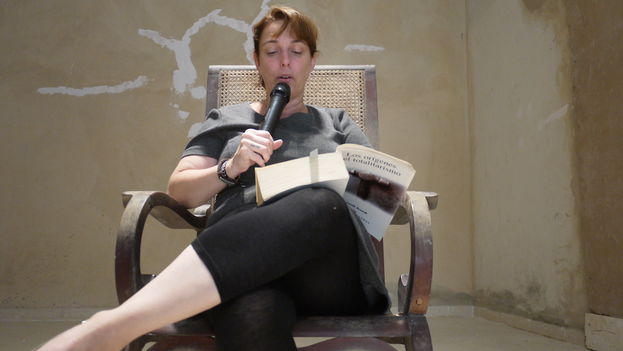
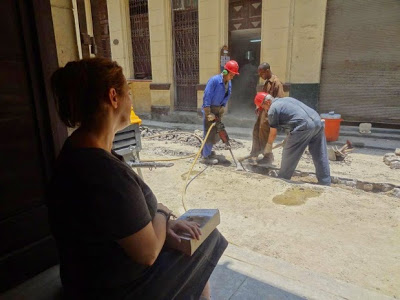
The artist Tania Bruguera (who weeks previously was the victim of an act of censorship preventing her from presenting a performance in public) decided to sit in the doorway of her house and read, for 100 hours, the book “The Origins of Totalitarianism” by Hannah Arendt.

In response, the dictatorship sent a construction brigade to break up the pavement even more (in Havana the majority of the streets are torn up) in front of Tania’s door. It is not difficult to calculate that they will keep jackhammering for 100 hours.

According to sources close to the artist, Bruguera will wait for the “repair” work to be completed before resuming her reading. By then, we can be sure, Raul’s henchmen will have come up with a new ruse.

Meanwhile, beyond the outrage provoked by such cowardice, at least here is good news: right in front of artist Tania Bruguera’s house, a few steps from the glass case where the yacht Granma is preserved, a small stretch of Tejadillo Street will finally be repaired.

‘14ymedio’ seen by its readers / 14ymedio, Rosa Lopez

Printed version of 14ymedio distributed on the island through alternative networks

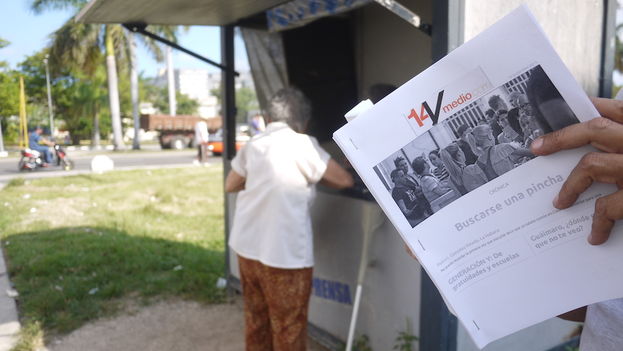
14ymedio bigger14ymedio, Rosa Lopez, Havana, 21 May 2015 – “The connection doesn’t work,” the young man tells the employee who frowns at him for making her get out of her comfortable chair. The heat is terrible and the air conditioning hasn’t worked for weeks in a State-run “Nauta” Internet room centrally located in Havana’s Plaza municipality. The woman approaches listlessly, looks at the screen, types in a some web address and the page opens with no problems. The client returns to the fray, “And why when I type in 14ymedio.com nothing happens?” A snort is heard throughout the navigation room. “Look son, it is because you can’t enter that site, you understand me?” In a few seconds the internaut has received his first lesson in censorship.

Who in Cuba reads the digital daily 14ymedio? This is the question for which the management of this medium has gone out into street to look for answers and suggestions to improve our work. We have surveyed different age groups, political viewpoints, and geographic situations, to try to trace a map of those Cubans who have in front of their eyes some of the content that we publish on the site. continue reading

An initial incursion along busy G Street, last Saturday night, shed light on some of those followers or detractors. “Ah, yes, I’ve had a copy for some months, but they publish almost nothing on videogames,” although, “my dad likes it because it talks about politics and that stuff,” says Juan Carlos Zamora, 19, a student at the Pedagogical Institute. “A friend told me about the newspaper, but I would recommend more topics for young people, like fashion and technology,” added this young man.

Since the day it was founded, 14ymedio has been blocked on the national servers that provide public Internet. Internet rooms, connections from hotels and other state locales show an error message on the screen when someone tries to access the portal. A PDF version published every Friday, with the best of the week’s news and an active network of friends and colleagues, is distributed within the country. The appearance in February of last year of Nauta email service has also contributed to the spread of the content, although there is much more to do in that direction.

For Marcia Sosa, a retired civil engineer living in Santiago de Cuba, “The best part is the list of prices for products in the farmers market, because you can see how expensive life is.” The lady receives the content of our site by email, because, “My son sends it to me every day from Miami, but without the images because that takes too long to load.” The retiree believes that “they should open a section saying where to find what product, because sometimes I’m like a crazy person looking all over and not knowing where to find it.” What she likes least, however, are “the opinion columns, because here everyone has an opinion, there are 11 million Cubans and 20 million opinions.”

In the city of Ciego de Avila, Ruben Rios has taken on the task of sharing with his friends copies of the 14ymedio articles that come his way. “I do it because I believe people should hear all versions, although I don’t agree with part of what you publish.” Recently released from prison, Rios has dedicated himself to getting his life back, “and informing myself is a way of feeling free, so I read everything that comes to hand and I am lucky that the newspaper comes my way.”

In the guts of 14ymedio, Juan Carlos Fernandez finds that his work on the team “Has been a liberating experience.” For this activist and reporter, writing for the digital site is not only “a democratic exercise, but also it is a very serious project.” He remarks with pride, “This is the prelude of the new press that is coming, the prelude of freedom of the press, of democracy.” However, he concedes that there is a long way to go to improve the quality and elevate the training of the press’s reporters and correspondents. “This is a school for me, now I have to publish every article with more objectivity.”

Yunier receives the articles appearing in our independent daily through the so-called “Marta’s list.” A Cuban immigrant living in Miami who participated in December 2004 in the founding of the digital magazine Consenso (Consensus), one of the first embryos of the independent press that took advantage of the new technologies. Marta Cortizas performs the true “labor of a little ant” compiling every day the best of the Cuban and international press and sending it by email to a growing number of subscribers. “If it weren’t for her, it would cost me a lot of work to read what you publish from Holguin.”

And why is it called 14ymedio, asks a resident of the Fanguito neighborhood when we inquire about our portal. With long experience standing in lines and counting every gram she receives from the ration market, the elderly lady is sure that behind a name like this, “there has to be something hidden, a warning… come on.” She doesn’t accept the explanation about the 14th floor where our headquarters are located, the “Y” from a well-known digital blog, nor the polysemy of “medio” in Spanish, which means both “half” and “press media.” “There is some trick here, some mathematical formula or who knows,” she concludes maliciously.

Not everyone likes it, which is evidence of the plurality of tastes and information preferences of the Cuban population. “I haven’t read it, I’m not going to read it, because I don’t have to visit this site to know that you want to destroy the country and do away with the Revolution,” says Nelson Bonne. A self-employed worker in Las Tunas, the man considers that “The [the State run newspaper] Granma is enough for me, and I don’t need any little newspaper created by the enemy.”

The director of the magazine Convivencia (Coexistence), Dagoberto Valdes, has a more constructive opinion. “To have a newspaper made in Cuba, by Cubans and for Cubans, is for me the best, and we are going to all push together to get access to the Internet so that we Cubans can look into this window.”

State Sponsors of Forgetfulness / Angel Santiesteban

The pernicious, failed, and pathetic ideologues of the Cuban totalitarian regime want you to believe that they should never have been on the “list of state sponsors of terrorism.” Never mind that it’s true, or that there is evidence that proves their constant support, military provisioning and training to all the guerrillas created in the Americas.

In particular, Cuba was added to the list for the help it offered the guerrillas of El Salvador, which, moreover, it did not hide, and which it then called “internationalism.”

The Castros have that characteristic of never being wrong, nor of ever declaring any political or economic action a failure. In more than a half century of dictatorship—and a depressing and chaotic political administration—they have never on any occasion recognized that they were wrong, and as the Silvio Rodriguez song says (which party officials treat as an anthem) “I die as I lived,” so the Castros also do not now recognize that at the time, according to the American criteria for including these countries, Cuba met all the requirements.

But what is important for the Castros is maintaining the image of victims, like the “kitten of Maria Ramos*,” and officially declare that they should never have been on that list, and therefore should not be grateful for this gesture from Obama, and will constantly “bite the hand.”

Ángel Santiesteban-Prats

April 14, 2015, Border Prison Unit, Havana.

*Translator’s note: Based on the story of a prostitute, Maria Ramos, who on being charged with the murder of her pimp, claimed it was her kitten, not her, who had thrown the stone that killed him. (She didn’t get away with it.)

When the victim’s time comes / Angel Santiesteban

Harold Cepero and Oswaldo Paya

Laura Pollan

God forbid that another death is necessary in order to understand the abusive attitude of the Cuban government against dissidents. I learned by telephone that last Sunday the government authorized the political police to use teams of athletes—judokas and boxers, among others—in combat mode, in another desperate attempt to stop these ladies (the Ladies in White), who only peacefully ask for the release to their families of prisoners and other political opponents who are serving time for thinking differently.

Since I became aware of the physical assaults and the corresponding arrests, an idea has remained fixed in my mind: “We have to expect this to happen in order for the international political community to understand that you cannot negotiate with totalitarian governments, that it is a dead end. That they only appear to adapt to the new times out of their economic desperation, as ‘parasite countries’ that suck what they can out of whatever economy they get near.” continue reading

Is an agreement with the United States and the European Union above the objective needs that civil society urges be resolved? By negotiating with the regime, these countries are establishing a dynasty that will last for generations. The shameful truth is that, Sunday after Sunday, the Ladies in White are abused. Now more so, as I learned during my recent call, because those criminal mobs inflicted bone fractures on these helpless women, who have not given up, nor will they give up on their desire for freedom. Even if the above statements fall on ears deafened and eyes clouded by the absurdities with which the Castro brothers enchant them, and make them dance to their tune.

I still hope that the governments involved in the openings understand that they are losing their valuable time, and retracing their steps, only to approach that truth which I have not doubted for a moment: the dictatorship will not submit to a truce in order to change this sad reality that has oppressed us for over half a century.

And I continue to declare that the more the dictatorship strengthens and sends out roots, the more suffering the Cuban people will continue to endure, as the powers reach a deal.

Ángel Santiesteban-Prats
April 23, 2015, Border Prison Unit, Havana.

The Risks of Journalism / Yoani Sanchez

Generation Y, Yoani Sanchez, Havana, 21 May 2015 – If you has asked me a year ago what would be the three greatest challenges of the digital newspaper 14ymedio, I would have said repression, lack of connection to the Internet, and media professionals being afraid to work on our team. I did not imagine that the another obstacle would become the principal headache of this informative little paper: the lack of transparency in Cuban institutions, which has found us many times before a closed door and no matter how hard we knock, no one opens or provides answers.

In a country where State institutions refuse to provide the citizen with certain information that should be public, the situation becomes much more complicated for the reporter. Dealing with the secrecy turns out to be as difficult as evading the political police, tweeting “blind,” or becoming used to the opportunism and silence of so many colleagues. Information is militarized and guarded in Cuba as if there is a war of technology, which is why those who try to find out are taken, at the very least, as spies. continue reading

Belonging to an outlawed media makes the work even more problematic, and gives a clandestine character to a job that should be a profession like any other. Now, if we look at “the glass half full,” the limitation of not being able to access official spaces has freed us, in 14ymedio, from that journalism of “statements” that produces such harmful effects. To quote an official, to collect the words of a minister, or to transcribe the official proclamation of a Party leader, has been for decades the refuge of those who do not dare to narrate the reality of this country.

Lacking a press credential to enter an event, we have approached its participants in a less controlled setting, one where they have felt more free to speak

Our principal limitation has become the best incentive to seek out more creative ways of to inform. Government silence about so many issues has motivated us to find other voices that can relate what happened. Lacking a press credential to enter an event, we have approached its participants in a less controlled setting, one where they have felt more free to speak. From Federica Mogherini, High Representative of the European Union for Foreign Affairs and Security Policy, who answered several of our questions outside the press conference where our access was denied, to employees who alert us in whispers about an act of corruption in their companies or anonymous messages that put us on the trail of an injustice.

It has also been hard to work out our true role as providers of information, which is different from the role of a judge, a human rights activist and a political opponent. It is our role to make facts visible, so that others can condemn or applaud them. In short, as journalists we have the responsibility to inform, but not the power to impute.

Nor can we justify our failings because we are outlawed, persecuted, stigmatized and rejected. No reader is going to forgive us if we are not in the exact place of history’s twists and turns.

Cuba has 11,000 sources of pollution that affect water / 14ymedio, Rosa Lopez

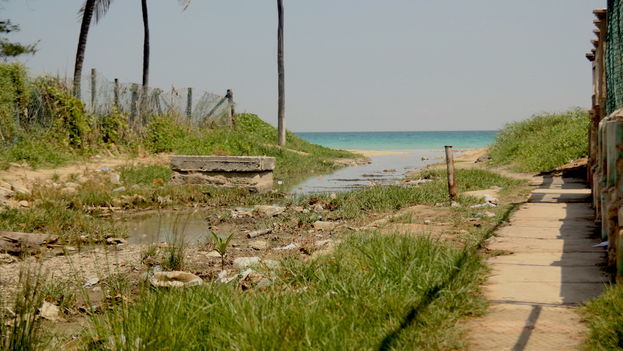
Ditch with sewage from the town of Guanabo, east of Havana. (Luz Escobar)

14ymedio bigger14ymedio, Rosa Lopez, Havana, 20 May 2015 – On World Environment Day, this coming 5 June, Cuba will have 11,000 sources of pollution that affect ground water and coastal areas. This information was updated by Odalis Goicochea, Director of the Environment at that Ministry of Science, Technology and Environment (CITMA), in a press conference Monday.

The figure is very alarming, especially when we take into account our dwindling water reserves. 2014 was the driest year reported since the beginning of this century, and 2015 looks like it wants to compete for this negative record. With a long and narrow island and with no major surface or underground water resources, the country needs to do a better job of managing its waste stream to protect the water. continue reading

The town of Guanabo, east of Havana, is a clear example of the drama that is damaging our most precious natural resource. Part of the sewage from the urban area ends up in the sea and is mixed with the water where people swim. In some areas, the air stinks from the waste exposed in ditches and ponds, becoming an epidemiological danger and contributing to environmental degradation in areas crossed by the filth.

2014 was the driest year reported since the beginning of this century, and 2015 looks like it wants to compete for this negative record

The residents have appealed to every agency, even writing complaints to the “Letters to the Editor” section of the newspaper Granma. However, the town continues down the slippery slope of apathy and ecological damage. “Before this was a nice beach, when families came with their children, but now the number of people coming is greatly diminished,” says Agustin, a resident of the area who has a home where he hosts tourists near to the famous Horses of Guanbo.

According to the latest report from CITMA, Cuba needs large investments in the environment, although the text also stressed that the provinces of Villa Clara, Holguin and Artemisa have improved environmental management in recent years, such that the latter has been selected to host the activities for World Environment Day. But there is a long road ahead, especially in the proper recycling of waste, the creation of a social conscience of respect for nature and the application of legal penalties to entities and individuals who contribute to the deterioration of the environment.

The country urgently needs to begin implementing solutions, because every day that passes water is slipping through the fingers of indolence.

May 20, That Hole in Our Memory / Reinaldo Escobar

On 20 May 1902, Cuba gained its independence from the United States of America

Desde Aqui, Reinaldo Escobar, Havana, 20 May 2015 — Yesterday I invited my granddaughters to get ice cream. To boast of her knowledge, the oldest, who is in the third grade, said to me: “Today marks the 120th anniversary of the death in combat of José Martí, our National Hero.” She said it with the same pride in wisdom with which one day, many years ago, I alerted my parents to the fact that the earth was round.

“And tomorrow, May 20, what will we celebrate?” I asked her, imitating the emphasis of schoolteacher. Almost arrogantly she responded, “On May 20 nothing happened.”

As she was born in the 21st Century I invited her to look for the significance of the date on a phone app containing Wikipedia, which she could consult without an Internet connection. Surprise! The text there reads: “1902: Cuba achieves independence from the United States of America.” continue reading

But the newspaper Granma wasn’t having it: In the top right corner of the last page, where anniversaries often appear under the heading “Today in History,” it said: “1902: The neocolonial republic was installed in Cuba.”

I can foresee that in the future, that bright morning of the first day of the year will not be remembered as the end of a dictatorship, but as the beginning of another

The protagonists of History are not to blame for how the future interprets their acts. For example, the massacred aboriginals who inhabited our beautiful island never could have suspected the enthusiasm with which Cubans would celebrate the 500th anniversary of the Spanish colonial settlements. The people of Bayamo who watched their properties burn could never have imagined the degree of voluntary unanimity today attributed to the glorious fire of 1869. No one could have convinced those who lost a son, a father, a brother in the bloody events of 26 July 1953, that that date would be a national holiday.

On May 20, 1902 dozens of countries around the world publicly recognized the advent of Cuba as an independent nation. The joy was massive, sincere and overwhelming. And I do not say unrepeatable because 56 years later there was a first of January on which Cubans never thought that a tyrannical regime would be installed in Cuba.

I can foresee that in the future, that bright morning of the first day of the year will not be remembered as the end of a dictatorship, but as the beginning of another. Nor that when my great-grandchildren are asked what happened on that date, they will respond “nothing happened that day.”

Tania Bruguera’s Tribute to Hannah Arendt Worries Cuban State Security / 14ymedio

Tania Bruguera during her performance (14ymedio)

14ymedio bigger14ymedio, Havana, 20 May 2015 — Wednesday morning the artist Tania Bruguera began more than 100 hours of consecutive reading, analysis and discussion of Hannah Arendt’s book The Origins of Totalitarianism. The event, which started in the presence of a dozen people, began in the “Hannah Arendt International Artivism Institute,” which is named after the renowned German philosopher.

The artistic action comes just at a time when galleries and cultural centers throughout the entire city are engaged in getting ready for the start, this coming Friday, for the Havana Biennial. Bruguera is not invited to the official event, but has joined the alternative artists’ circuit staging performances, expositions and shows of their current works.

Hours before the reading, Bruguera was visited by two members of State Security, who expressed their concern because the artist had bought audio equipment. They also let her know that they were aware that she intended to “go out into the street” at the conclusion of the event and warned her not to do so.

According to what was made known in the announcement, the newly opened Hannah Arendt International Artivism Institute, “proposed to provide a platform for research into the theoretical-practical approach for a socially committed art, and for a specific political moment.” Its headquarters is located in Bruguera’s home, at 214 Tejadillo Street, in Old Havana.

Yoani Sanchez Wins 2015 Knight International Journalism Award / 14ymedio

Logo of the International Center for Journalists

14ymedio bigger14ymedio, 19 May 2015 – The director of 14ymedio, Yoani Sanchez, has won the 2015 Knight International Journalism Award, the International Center for Journalists reported today. Priyanka Dubey, an independent Indian journalist has won the same award for exposing the atrocities of rapes, child trafficking and forced labor through her in-depth reporting, despite threats from human traffickers and gangs in her country.

The award, which will be delivered in Washington DC on November 10, has as its objective to honor journalists who, through pioneering work or technological innovation, have produced high-quality information and news that has had a significant impact on the lives of people in the developing world. continue reading

Yoani Sánchez has overcome censorship, arrests and poor Internet access to give the world a rare glimpse of daily life under Cuba’s communist regime and to open the door for other independent voices” read a press note on the announcement.

“Our winners this year show uncommon resolve in tackling censorship and sexual violence,” said ICFJ President Joyce Barnathan. “Thanks to their courageous reporting, Cuba’s closed society is more open and India’s democratic society is more responsive to the plight of abused women.”

“These winners are committed to upholding the best principles of journalism—acting as information leaders in communities that need it most and capturing stories in new and innovative ways,” said Jennifer Preston, Knight Foundation vice president for journalism. “Their work continues to have wide impact and holds valuable lessons,” she concluded.

Cuba: May Downpours Arrive Ahead of Schedule in Havana / Ivan Garcia

lluvias-en-la-habana-29-abril-2015-_mn-620x330

Until Wednesday, April 29, when intense rains fell on Havana, Agustin — a private-sector farmer who grows chard, lettuce and peppers on a patch of parched land on the outskirts of the capital — was looking skyward to see if he could discern storm clouds on the horizon.

“My yields are low because of the water shortage. I have had to throw out hundreds of kilograms of vegetables because they were too small and their color was bad. It hasn’t rained for months,” says Augustin, who is now worried because too much water is falling on his crops.

National meteorologist Jose Rubiera had declared that the island was experiencing record heat levels in the month of April. It seemed that the rains would have to wait. continue reading

May’s traditional downpours occurred over the course of a few days in western and central Cuba but in the eastern part of the country the widespread drought has continued to raise alarms at the Institute of Hydraulic Resources. Various dams and springs are dry or at very low levels.

In the poor neighborhoods of Santiago de Cuba, Mayari and Guantanamo, water from an aqueduct arrives every nine days. Tomas, a resident of Granma province, 800 kilometers east of Havana, reports that water is delivered there by truck.

“No one goes out onto the street at noon. The city is like a desert. The ground is as hard as stone. If it does not start raining in Oriente by May, the government will have to declare a state of emergency,” he says by phone.

Countless homes in Cuba are without tap water twenty-four hours a day. Typically, families must buy it in order to drink, cook, wash dishes, do laundry and bathe.

“It is often stored in plastic containers that previously held industrial products. As a result potable drinking water can become contaminated. When storage facilities are not maintained properly, they can become breeding grounds for Aedes Aegypti mosquitoes, which transmit Dengue fever, chikungunya infections and diarrheal diseases,” says an epidemiology official.

Like Augustin, Leticia, a Havana shopkeeper, was also gazing at the sky, hoping it would finally bring the blessed rain. Sitting on a wooden bench, surrounded by bags of Vietnamese rice and Cuban brown sugar, she tries to relieve the summer heat by fanning herself with a piece of cardboard.

“When there is no rain, the heat is unbearable. The worst thing is when you get home, want to take a shower and the building’s water pump is broken or there is no water in the tank. The fan just gives off a stream of hot, dry air. I really envy those who have air conditioning,” she said on April 28, one day before it rained heavily in Havana.

Moraima, a retiree, no longer has to sit on her porch to listen to soap operas on the radio to see if the air is blowing. “I was thinking it would never cool off. This heat takes away your appetite. You want to eat fruits and drink milkshakes. Two large mangoes cost me 25 pesos. People wonder if it is because of the damned blockade (embargo) that there are no cheap fruits like we always used to have in Cuba,” she notes angrily.

The heat, rain and hurricanes cannot be blamed on Yankee imperialism, although in some of his periodic rantings Fidel Castro still accuses modern capitalism of altering the environment by releasing disproportionate amounts of carbon dioxide into the atmosphere.

Air conditioning is still a luxury in Cuba. Only the cars of ministers, generals and tourists are climate controlled. It takes a strong disposition to travel by bus or public taxi, no matter the time or day. State inspectors who could pass for Luca Brasi (a character from The Godfather) ply the streets looking to see what money they can make from bribes and kickbacks.

“These people (inspectors and police) are really corrupt. They’re always walking by my stall, trying to “hustle” a few pesos off me. There’s nothing to stop them,” says Arnaldo, the owner of a produce stand in the La Vibora neighborhood.

In a country where good news is hard to come by, the newspaper Granma announced on April 20 that 80,000 induction ranges would be made available to families on public assistance. Made in China, they will cost 500 pesos and can purchased in installments.

“These stoves reduce energy consumption because of the efficiency of the electric burners,” claimed a bureaucrat of the Ministry of Domestic Trade. In 2006 Fidel Castro led his final campaign, which he called the Energy Revolution. It included the nationwide distribution of refrigerators, rice cookers and Russian air conditioners.

At the time the state offered payment plans. Nine years later, the number of people in default is in the thousands. “They break down just by looking at them. Not only that, but the state has been robbing us for fifty-six years, so my revenge is to not pay them one penny for the trinkets they’ve given me,” says Raudel, who still owes the bank for the credit it extended him.

The farmer Augustin and many Havana residents were eagerly awaiting the arrival of May, typically the rainy month in Cuba. But the weather was ahead of schedule and on Wednesday, April 29, a terrifying downpour fell, which led to three deaths, floods, landslides and the evacuation of more than two thousand people, among other damages.

“We wanted the rain to give us a break from the heat but not like this,” says Leticia, the shopkeeper. “I guess you can’t control nature.”

Ivan Garcia

1 May 2015
How Do You Tame Computer Users? / Yoani Sanchez

User on Revolico, the Cuban "Craigslist" (Silvia Corbelle, 14ymedio)
User on Revolico, the Cuban “Craigslist” (Silvia Corbelle, 14ymedio)

Generation Y, Yoani Sanchez, Havana, 18 May 2015 – Nimble fingers over the keyboard, a life divided between reality and the digital world, plus the gratification of amusing yourself, learning, teaching and being free through technology. These are some of the points shared by those of us in Cuba who have linked ourselves to information and communication technologies, whether for professional reasons or simply from personal passion. Now, a new association is trying to support these enthusiasts of circuits and screens, although the management of the organization proposes many limits on autonomy and ideological ties. continue reading

The new Computer Users Union of Cuba (UIC) will enjoy the official recognition that has been lacking until now for independent groups of bloggers, gamers and programmers. It will have statutes, a code of ethics and members will be able to rely on support and visibility through its structure. Nor is there any doubt that at the next international event where “pro-governmental civil society” appears — in the manner of the Summit of the Americas — the new affiliates of the UIC will attend.

If the promoters of these activities, in whatever part of the world, want to know how a pretend non-governmental organization is generated, they should pay attention to the details of the genesis of the new organization that will bring together Cubans engaged in new technologies. It will be an excellent opportunity not to see “a star being born,” but to witness how a black hole is created that that will seek to engulf one of the wildest, freest phenomenon parallel to power in Cuban society today.

They will try to engulf one of the wildest, freest phenomenon parallel to power in Cuban society today

The process for signing up for the UIC will be open until July 15. Applicants must submit the registration form, a photocopy of their academic degree, and sign a letter accepting the draft Bylaws and Code of Ethics, which first must be downloaded from the Ministry of Communication’s website. It is surprising that at this point the organizing committee which emerged from the entity’s constituent congress – despite its undeniable technological capabilities – doesn’t have its own digital site. It would have required a “civilian” portal that does not include “.gob.cu” in its internet address, because that would identify it as subject to the government… not as an NGO.

The UIC defines itself as an organization with a professional profile, with both voluntary and at the same time select affiliation, created under Article 7 of the Constitution of the Republic of Cuba. A glance at this part of the Constitution clarifies that these organizations “represent their specific interests and incorporate them into the task of edification, consolidation and defense of the Socialist society.” As if that isn’t enough, the president of the organizing committee, Allyn Febles, who is also vice rector of the University of Information Sciences, told reporters that “the new organization has as a base the unity of it members in support of the social project of the Cuban Revolution.”

An attempt, no doubt, to assign a political color to kilobytes, tweets and apps. As if they felt the need to demarcate the limits of technologies starting from Party considerations. Why are they so crude? Why isn’t it possible to create a Union of Cuban Computer Users dedicated to teaching the population to use the tools that allow them to more freely and easily access new technologies? Why do they have to interpose themselves between the keyboard and the social networks, and not just from any ideology but from a particular sectarian and exclusionary ideology?

The restrictions don’t end there. In its introduction, the ethics code defines a priori computer users as “committed to our Socialist Revolution…” while in Article 3 it imposes maintaining conduct “in accord with the norms and principles of our Socialist society.” The situation worsens, because Article 13 of the code itself imposes on the UIC members the obligation to inform on colleagues who incur offenses. Rather than an entity to preserve the rights to technology enthusiasts, it is creating an oversight body to control them.

It is expected that the members of the UIC will put intolerance ahead of information sciences, being soldiers ahead of being internauts…

Like a ghost of the past, the little check box of “political membership” reappears on the application form for admission to the UIC, where the applicant must put checkmarks next to organizations such as the Communist Party, the Young Communist Union or… the Federation of Cuban Women, the Committees for the Defense of the Revolution, and the Cuban Workers Center. Which contradicts the official spokespeople who shout themselves hoarse saying that these latter three are not political but rather social entities. Which is it?

The nice part of the UIC’s founding documents is where they warn that the UIC “will be working to create a climate of scientific and technical creation and for the elevation of its members to a professional level and a permanent technological upgrade, encouraging the identification and the recording of the knowledge of its associates and their preparation and fitness to undertake specific projects, as well and the identification of opportunities to impact the economic development of the country and the exporting of goods and services, and in this way contributing to an increase in the welfare of its members.”

But why, in order to receive these undeniable benefits, must they show political obedience and loyalty? The answer is simple: because it is expected that the members of the UIC will put intolerance ahead of information sciences, being soldiers ahead of being internauts… being censors ahead of being young people who play with binary code.

What will happen in Cuba? / 14ymedio, Reinaldo Escobar

The new generations will also have to define what will happen in Cuba. (Franck Vervial / Flickr)

14ymedio bigger14ymedio, Reinaldo Escobar, Havana 16 May 2015 – On the back of a copy of the I Ching were examples of questions about which one might consult this Chinese. Should I marry X? Is this the time to take a trip to Y? What will happen in Cuba? The readers of this copy from 43 years ago have had time to find out for themselves who they ended up sharing their lives with, or where they went on vacation. The situation for those of us who asked the ominous book about the fate of the Island has been very different.

The question written on that cover has continued to haunt me, as it has so many other Cubans. From restless foreigners who tried to practice their Spanish and ended up wanting to know the nation’s destiny, to foreign journalists, Cubanologists of all stripes, academics from various disciplines, politicians and career diplomats, coming from whatever part of the world. At one point or another our conversation always slid into the question: What is going to happen in this country? continue reading

After 17 December 2014, the question picked up steam. Hypotheses about possible scenarios are leaving behind the options of eternal immobility, foreign invasion and social explosion. At the same time, gaining credibility if the assumption that the driving force for change will come from above, in a more or less controlled form and with the critical approval of former foreign enemies. But anyone could predict that. What is lacking is the details.

Hypotheses about possible scenarios are leaving behind the options of eternal immobility, foreign invasion and social explosion

All indications are that on 24 February 2018, Cuba will unveil a president elected under the rules of the new Electoral Law. The characteristics of the person who holds this responsibility will be determined in line with the democratic character of the new regulations. If the current practice of a nominating committee that draws up a list of candidates or deputies is maintained, if it continues to be prohibited for candidates to present their programs, and if the current method in which the National Assembly appoints the president of the Council of State is prolonged, then the presidential chair will be filled by someone designated by those in power.

Deportees in Their Own Country / Cubanet, Reinaldo Cosano

In Cuba, if you do not have permission to reside in Havana, they deport you to your province of origin (internet photo)

Cuban Apartheid, suffered by families who abandoned their homes and went to Havana in search of a new life

cubanet square logoCubanet.org, Reinaldo Emilio Cosano Alen, Havana, 15 May 2015 – Rodolfo Castro, from Santiago de Cuba, met with three other young men detained at the Guanabo police station east of Havana. Driven to the Central Train Terminal in a patrol car – so that they could not escape – they were put on the train and deported to their provinces, following imposition of a fine of a thousand Cuban pesos – some 50 dollars – each. So says Osmany Matos, of Guanabo, arrested for a traffic offense who witnessed the incident.

The “Palestinians” (as they ironically call those who come from the eastern provinces) Yordanis Reina, Maikel Cabellero and Edilberto Ledesma, from the rural area El Parnaso; and Amaury Sera, from the Manati township, all in the Las Tunas province, explained to Graciela Orues Mena, independent trade unionist: continue reading

We went to work at Guira de Melena in Mayabeque province, because here either we don’t work or they pay a pittance, always hired by a farmer. One afternoon we were walking through the city with work clothes covered in red dirt, when two police officers asked us for identification. We were arrested and deported for the crime of ‘being illegal.’ They put us on the train with the warning that if we came back we would wind up in the courts. They didn’t let us collect our pay for the time we worked or change clothes or get our belongings. We spent so many hours hungry on the train, without money. An abuse.”

The Crime? Not having a registered address in Havana.

Independent lawyer Rene Lopez Benitez, resident of Arroyo Arenas in Havana, explains: “The Law Decree 217 of April 22, 1997, Internal Migratory Regulations for the City of Havana and its Contraventions, better known as the Internal Immigration Law, tries to control immigration to Havana (also to the capitals of the western provinces). They justify its application because of the dire housing situation, difficulty getting work, public transportation crisis, the supply of water, drainage, electricity, domestic fuel, sanitation, the low level of quality in the provision of other services, which put great pressure on the capital’s infrastructure. The Decree arranges for the eradication of illegal persons and settlements in Havana and the other provincial capitals with work of the Interior Ministry and the National Housing Institute. They have carried out thousands of deportations, forced evictions. Appeals to the Government and the Communist Party for legal protection are a waste of time. The evictions seriously undermine the integrity of entire families, including children and elderly people, who had achieved labor, social and personal stability.”

Slums surround the country’s western cities. There are onslaughts of demolitions “in the name of urban order and discipline in the charge of the Institute of Physical Planning, whose director is the Division General Samuel Rodiles, which intends to eradicate the slum areas that have emerged in the face of the government’s construction paralysis. Now – with the failure of the state initiative – they are trying to increase housing construction through their own efforts and a policy of bank credits and subsidies,” adds Lopez.

Graciela-Orúes
Graciela Orúes (photo by author)

Acts of rebellion across the island against the evictions have managed to paralyze some removals and building collapses.

Resolution 267 of Internal Immigration is at odds with recent laws related to self-employment and Housing. Says Lopez:

“On October 7 of 2010 the Minister of Employment and Social Security issued Resolution 32-2010 arranging for the Regulation of the Practice of Self-Employment by which the restrictions of Law Decree 217 – among other reasons because of lack of work – do not have justification. Many go to the capital to work for themselves in the most varied trades to provide services in construction, plumbing, house cleaning, child care, health care, agriculture, trade, agricultural supplies, farming. Also the essential requirement of proving legality in housing in order to get a license to work is facilitated through Law Decree 288 from the October 28, 2011, Modifications to Law 65, General Law of Housing, in reference to the conveyance of property by buying and selling, inheritance and gift; and it supports the leasing of dwellings, rooms and spaces. All of which, in fact, would annul the restrictions of migration to the capital and decrease the record ‘floating population’ of almost half a million, according to the Housing and Population Census of September 2012.”

The most important thing would be to eliminate, above all, the inhumane deportation. People and even whole families abandoned their homes in order to work, study and try to move forward, but then they were deported like pariahs.

The Internal Immigration Law denies Article 13, Paragraph 1 of the Universal Declaration of Human Rights (1948): “All people have the right to freely move and to choose their place of residence within the borders of a nation.”

The construction industry, prosperous until 1958, was in rapid decline thereafter. Internal deportation for political reasons was used by the colonial Spanish government in the 19th century. Carlos Manuel de Cespedes (1819-1874), Founding Father, was banished to Contramaestre, near Bayamo, his hometown.

About the Author

cosano.thumbnailReinaldo Emilio Cosano, Havana, May 1943, graduate in Philology from the University of Havana. He worked as a teacher the last 20 years of his career. He was removed teaching for lack of “political suitability,” as recorded in the minutes of his final dismissal. He was a member of the Cuban Committee for Human Rights and participated in the Cuban Democratic Coalition. He has written for more than ten years for CubaNet, through the Sindical Press agency, with email address of cosanoalen@yahoo.com

Translated by MLK

Exclusion as a policy / 14ymedio, Fernando Damaso

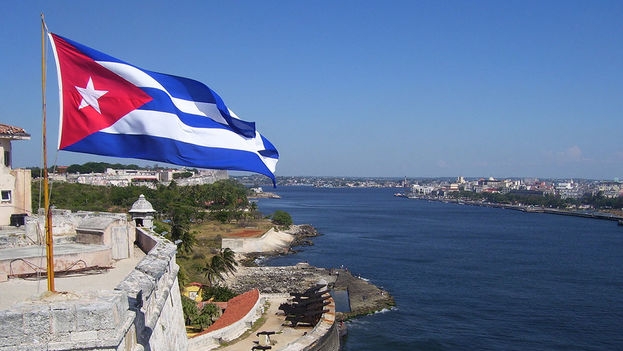
The Cuban flag serves as a symbol of the nation (14ymedio)

14ymedio bigger14ymedio, Fernando Dámaso, Havana, May 17 2015 – The Cuban government, since it seized power on January 1959, has maintained an authoritarian and exclusive approach to politics. Patriots, Cubans and citizens are considerations that have only been extended to those who unconditionally support the establishment. Those who do not or who simply criticize it are deemed unpatriotic, traitors, and anti-socials.

This system is primitive in its simplicity, but it has been useful. This absurd and unnatural positioning has been applied to everything: democracy, liberty, human rights, unity, opposition and many other terms have been redefined according to the ideological and political interests of those who govern, giving the impression that the Island exists in an unreal political and geographical space, outside of planet Earth. continue reading

Difference has never been accepted; instead it has been repressed: a sad example is that of the so-called Military Units to Aid Protection or UMAPs (Unidades Militares de Ayuda a la Producción), those camps where thousands of citizens were forced into labor because of their religion, sexual preferences, fashion choices, or rejection of the authorities.

Only a few years ago, more for circumstantial political convenience than humanitarianism, different religious and sexual preferences were officially accepted, although in day-to-day practice, they continue to be regarded with reticence by a large part of the authorities. However, never have ideological and political differences been accepted, according to authorities, “due to the need to maintain national unity in the face of the enemy’s aggressions.”

Lately, in line with the atmosphere of dialogue between the governments of Cuba and the United States, although neither the aggressive language nor the violence have stopped, some topics regarded as taboo for many years have been put on the table. That of civil society, which had been banished from official discourse, as well as that of democracy and human rights are now very much present. Of course, it could not be any other way, “our civil society” is now spoken of, and for some time now “our democracy” and “the human rights which we defend” are pronounced. They seem to be the government’s private property, which, ironically, it has always frowned upon. Once again, exclusion reveals itself.

To attempt, as is the case today, to internationally legitimize governmental organizations as the only members of Cuban civil society is aberrant

There is only one civil society and it belongs to the country, it includes as many organizations and associations that support the government as it does those that question it, reject it or simply are not interested in politics and are dedicated to issues of ecology, religion, art, and others. To attempt, as is the case today, to internationally legitimize governmental organizations as the only members of Cuban civil society is aberrant.

The issue is not founded upon rejecting current organizations because they support the government, but because they are bodies of the same, which organizes, directs, controls, and finances them. Nobody accepts that they, with what their members may be able to contribute, can sustain themselves economically, maintain their bulky bureaucratic apparatuses, premises, transportation, defray intense propaganda campaigns and travel costs, organize and hold meetings, workshops, and even congresses, with the participation of dozens of foreign invitees, for whom all travel expenses are paid.

The Cuban nation is also only one, despite the authorities’ claims of owning it, taking into consideration only their supporters and excluding everyone else.

What’s even worse is that this governmental malpractice, perhaps due to having lived under its influence for too many years, has been adopted by some members of the opposition who not only apply it to the authorities but also to those who, within their own ranks, do not share their political opinions, not taking into consideration the serious injuries that doing so inflicts on themselves and, more importantly, on the opposition and, as a result, on Cuba. Today, we must do whatever it takes; leave personal differences aside and search for unity in order to save the country. There needs to be a real and responsible unity of all Cubans, regardless of how they think and without exclusion, for the good of the nation.

This month, we Cubans remember two important dates: May 19, the 120th anniversary of José Martí’s fall in combat, and May 20, which marks 113 years since the foundation of the Republic. In all of Cuba’s history, no one has been more inclusive than the Apostle, as José Martí is called among us. His thought, “the homeland is the fortune of all, and the pain of all, and skies for all, but no one’s fief or chaplaincy” and his dream of “a nation with all and for the good of all” still constitute matters unresolved. Let us dedicate our best efforts to their attainment.

Translated by Fernando Fornaris

No Leader is Interested in the Rights of Cubans / Hablemos Press, Eduardo Herrera

Cubanos
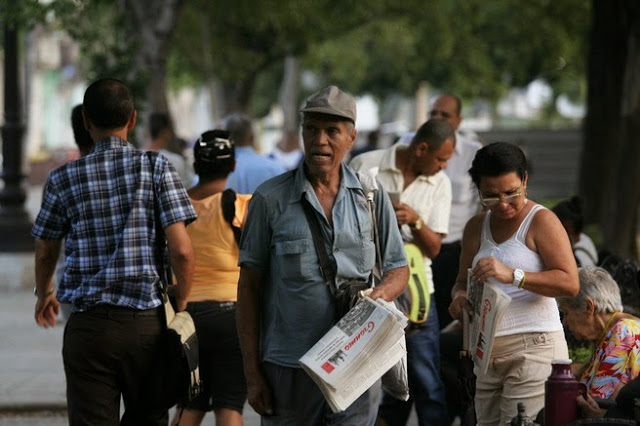
An old man selling newspapers on the streets of Havana (Elio Delgado)

Hablamos Press, Eduardo Herrera, Havana, 16 May 2015 — In recent weeks, meetings between Raúl Castro and various heads of state have attracted the attention of national and international public opinion.

During his visit to Algeria, Castro met with Abdelaziz Buteflika, who at 78 years of age has been president of his country for 16 years. Later, Castro travelled to Russia to commemorate the 70th anniversary of the Second World War. continue reading

Throughout those days of celebration, Castro had exchanges with Vladimir Putin, with whom he committed to continuing the deep relationship that unites the Cuban Revolution with Russia.

Castro then continued on to the Vatican, where he conversed with Pope Francis and expressed gratitude for the Pope’s mediation to promote the reestablishment of diplomatic relations between Cuba and the U.S.

Raúl completed his tour in Rome, where he met with Italian Prime Minister Matteo Renzi and, during a press conference, said, “One must be respectful of others’ ideas, even when they do not coincide with ours.” He also referred to the rights of all peoples to self-determination, and to the reopening of relations with the U.S.

Upon his return to Cuba, Castro received French President Francois Hollande, whose visit had generated great expectations of demands for substantial changes in the Island’s politics and respect for civil rights. But apparently, the French leader chose to speak only about business relations.

In sum, there were many conversations with world leaders, including of democratic countries such as France and Italy.

Yet, none of these leaders has taken into account the reality of the Cuban people who, it would seem, will go on not knowing what freedom is, and unable to be happy.

Thus, a form of slavery will continue to be legitimized, even in the 21st Century.

Translated by: Alicia Barraqué Ellison