Cuban Airbnb Market Doubles in Just 40 Days / 14ymedio

Airbnb website offers private accommodation all over the world.

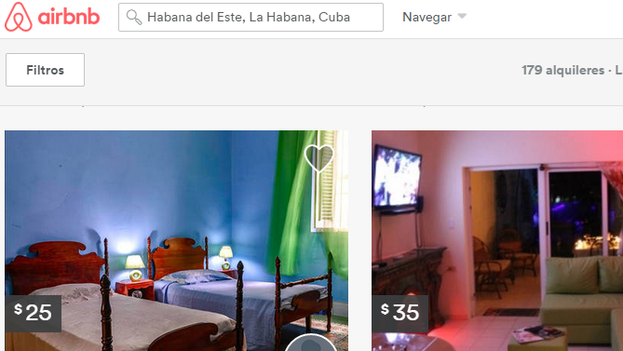
14ymedio biggerCuba is Airbnb’s fastest-growing market, Brian Chesky, the group’s executive director, said in an interview with Bloomberg Television. The company, based in San Francisco, began offering its services on the Island this April, allowing travelers from the United States to rent private rooms on the Island via the Internet.

“It has been forty days since we launched in Cuba. We started with 1,000 homes and now we have 2,000,” Chesky congratulated himself. The success is even more amazing when you take into account the fact that the vast majority of homeowners do not have Internet and must resort to intermediaries to offer their services. continue reading

The Airbnb director believes that US president Barack Obama’s announcement on December 17 of last year to restore diplomatic relations with Havana has been a boon for the company, as have the relaxations of the rules for travel to the Island, although they still don’t permit Americans to visit as tourists.

Chesky was in Washington on Monday to meet with the US president and several businessmen to promote the Executive’s global entrepreneurship program. “The desire of President Obama is to unite the American and Cuban communities,” added the newly appointed staffer for the White House on issues related to the Island.

On its website, the company founded in 2008 explains that “Airbnb believes Cuba could become one of the largest markets in Latin America group.”

More than half of the rooms offered at the Island are in the capital (with a price ranging from $23 a day for a room to $370 for an apartment for nine people). The offers in other localities such as Morón, Camagüey, Santa Clara and Cienfuegos are much more modest and prices remain below the average for Havana.

Rosa Maria Returns to the Revolution of Death / Orlando Luis Pardo Lazo

Click on image for link to video in Spanish

ROSA MARIA AND DEATH

Orlando Luis Pardo Lazo, 11 May 2015

Since she was a little girl, death was a guest in her home. A guest no one invited in the midst of the family happiness, rather an intruder imposed by a fascist State called Revolution. A totalitarian state that began killing before the assault on power, killing that prevailed for decades, and that will end up killing more, sooner than later. It is the only logic of a governance in which the Castros are effective, a dynasty of several generations that were never elected in Cuba. Since she was a little girl, death peeked through the blinds and revealed the probable terror: she always knew that the Cuban wanted to kill her papá. continue reading

Rosa María Payá, after a year and a half living outside Cuba, returns today to the Island where lie the remains of Harold Cepero — her soulmate — and those of Oswaldo Payá. She brings them a flower. A little flower of the most commercial and cowardly Miami. Where thousands of “mules” travel daily as accomplices of the Castro regime. Where all the entrepreneurs are Castros with Cubanologist ties, but ultimately they are simply thirst for dollars and power. A caste that, with the story of the economic empowerment of civil society, aspires to enslave Cuba based on their earnings and their corruption. They are not another shitty mafia, but they are the same and of the same ideological sign as the shitty mafiosos of the Plaza of the Revolution.

Cepero and Payá were assassinated in Cuba by order of the high command of the Ministry of the Interior on Sunday, 22 July 2012. It was a personal vengeance on the part of the homicidal brothers. A crime against humanity whose atrocious guilt will never expire, and for which they will be held accountable before justice, including the descendants of the tyrants: in particular Alejandro Castro Espín, who was already in office when they killed Cepero and Paya.

This crime would never have been undertaken blindly. Before executing it, the Castro regime consulted on the double homicide with the highest spheres of power in the European Union and in the United States. And also with the insulting insular Catholic hierarchy, and it is possible with the Vatican (Ratzinger’s resignation will eventually be totally explained). The Cuban-American tycoons, of course, did their part, with the perverse promise they would soon be allowed to return.

Such a plot is not launched directly, but with hallway inquiries and social destabilization blackmail. With hostages and promises of appeasement. The diplomacy of disgust. And everyone was in agreement that there would be no penalty for the Castros for the death of a man in his sixties who to the majority felt too weighty, whose moral superiority is intolerable in Cuba and in our ex-exile. He had to be sacrificed to the sanctimoniousness of democracy. It had to sink Cuba even deeper into despair. Harold Cepero, on that summer afternoon, was just collateral damage. And if Rosa María had been traveling in that Hyundai rental car, as she thought she might hours beforehand, Rosa María  would have been buried three years ago along with her papá.

But today Rosa María Payá returns as a Cuban of Cuba to Cuba. The whole world, and especially the Casto agents of the Miami press, sneeringly called her on zero day a “refugee” and the last of the “exiled.” As if all of us Cubans, wherever we live, weren’t refugees and exiles under the boot of our olive-green barbarity. Now they will tell Rosa María  whatever other vile things, as soon as the officials of El Habana Herald sends them by email the ongoing strategy of stigmatization of her.

But Rosa María will face the executioners whom she has known since childhood to be hunting her papá to behead him. The family has not even been given the autopsy showing how Oswaldo Payá died. Only Fernando Ravsberg, a Uruguayan terrorist turned privileged journalist on the Island, wrote with demonic detail of the destruction of Payá’s body: head split into five pieces, almost decapitated, heart pierced and kidneys turned to “mush.”

Rosa María Payá faces Monday May 11, 2015 in Cuba with that “mush” of a nation. The detritus of a country without citizens. Without values. Without a vision of the future. Aberration in time. Constitutional ugliness. Hatred on the surface and language as a hobby in perpetuity. Culture of simulation and a vocation to kill or be killed. De-anthropological damage, inhumane humanity. A double lack of State and of God.

From the Castro regime we can expect anything against that girl visited by death in her dreams in El Cerro in the midst of the Special Period. Because today the assassins no longer need to consult on their crimes ahead of time. The hands of President Obama and those of Pope Francis have exquisitely stretched out to the Cuban dictator, the octogenarian who has been stained and stained again with the innocent blood of Cubans.

Pray for Rosa María, please, at least those who still retain a remnant of what it is to pray after half a century of strictly observed Revolution.

Havana Is More Vulnerable Than Ever to Thunderstorms and Downpours / Ivan Garcia

Inundaciones-en-La-Habana1-_mn-620x330Ivan Garcia, 12 May 2105 — On Campanario Street, in the Havana neighborhood of Pueblo Nuevo, where in the fall of 2013 tremendous downpours caused the collapse of a house and the death of its two residents, all that remains is a vacant lot.

Several boys play there, seeing who can throw a piece of stone from the old foundation the farthest. Across the street, a man surveys the scene, sitting silently on a wooden stool, smoking, listening on a battery-powered radio to the Champions League game between Real Madrid and Juventus.

“A year and a half ago my neighbors, Fidel Vega and Pastora Góngora, died when the roof of their house collapsed. There was a tremendous roar in the middle of the night, as if a bomb had gone off. Now, since the April 29th rains, many more houses and apartments in Pueblo Nuevo have suffered damage,” he says quietly. continue reading

He is silent for a few seconds. Then he suddenly raises his voice and asserts that the storm caught the Civil Defense and the authorities unprepared. “Nobody showed up here to warn us, like they did before. Any downpour will flood the area and cause building collapses. If a category five hurricane passes through Havana, it would bury the city. The government is focused on other things—on speeches and propaganda,” he says indignantly.

When you walk through densely populated areas of Central and Old Havana, you can see that 70% of the housing is in fair or poor condition.  Recent rains have left their mark. Dozens of houses still show traces of moisture on their walls. On Vives Street, in Jesus Maria, some people lost all their belongings.

“They could only get out with the clothes on their backs. It was thanks to neighborhood solidarity that they were not buried by the rubble. Some people built crude boats with rubber inner tubes and pieces of styrofoam. The firefighters never came. The authorities and the provincial government were involved in preparations for May Day. That bunch of scoundrels doesn’t care what happens to the people in these poor neighborhoods. They live the high life,” says an elderly woman, visibly upset.

The Institute of Meteorology forecast heavy rains for the coming days in the western part of the country. Heavy rains have also caused flooding and landslides in Baracoa, in the eastern end of Cuba.

According to Jose Rubiera, head of the weather forecasting department, a depression that could become a tropical storm is forming in the Straits of Florida.

All of this indicates that May will be a very rainy month on the island. And the Atlantic hurricane season starts on June 1. Many Havanans wonder if the city’s infrastructure can withstand rain and winds of greater intensity without collapsing.

“If with four hours of rain, and wind gusts of 98 kilometers per hour, electricity was cut in several municipalities of Havana and the low-lying areas were flooded, I have no doubt that if a hurricane hits, or if it rains for three or four days in a row, the collapses and tragedies will be even greater,” said a capital taxi driver.

Most of the city’s drains stop working with moderate downpours. And the most densely populated neighborhoods, like Centro Habana, Habana Vieja, Cerro, or the flat areas of Diez de Octubre, flood immediately with heavy rains.

The Civil Defense noted the lack of foresight for Wednesday April 29. These days, work brigades are clearing sewers and cutting tree branches that could damage power lines.

Families living in houses in danger of collapsing have been advised that during bad weather they should take refuge in sites approved by the municipal government, or in secure dwellings of neighbors or relatives.

While part of Havana Vieja has been renovated with hard-currency cafes, hotels, and shops, so that tourists will spend money and take photos, in the adjacent neighborhoods a large number of properties are held in place by a miracle.

A heavy rain or tropical storm could cause major damage to the city. State neglect is taking a toll on Havana. The only thing left is to pray.

François Hollande expresses his admiration for Fidel Castro / 14ymedio

14ymedio bigger14ymedio, Havana, 12 May 2015 — “I wanted to experience this historical moment. It is the history of Cuba and of the world! Fidel Castro wanted to meet me and I also desired it. Regardless of what one thinks about what he has done, he belongs to History. I also wanted to meet him out of respect for the Cuban people.” With these words, French President Francois Hollande commented to reporters before his meeting on Monday with the Cuban president in Havana.

Ecology Minister Ségolène Royal, who is accompanying him on the first trip to the island by a French head of state, described Fidel Castro as character who is “mythical, beyond politics.” continue reading

During the meeting, which the French authorities kept secret until the last minute, Hollande and Castro addressed issues such as the “blockade” and its consequences for the island. The president, who transferred power to his brother Raul in 2006, spoke also of the need to avoid “war.” Hollande, for his part, said he was “surprised that he was so informed on current issues” and that he was so interested in food issues.

At the meeting, however, there was no talk of human rights, despite that fact that in 2003 Holland, then first secretary of the French Socialist Party, published in the newspaper Le Nouvel Observateur an opinion which he expressed his outrage at the “wanton brutality of the Castro regime.”

“That was 12 years ago,” the French president justified himself, and today Fidel Castro “is an old man.” He added in response to a question from the French journalists, “You can’t say: well now, you be held accountable before the tribunal of history.”

“I told him that I knew what his place in history would be and that one part of the French had looked at the Cuban Revolution at times with fervor and others with criticism.”

Why Can’t Cubans Have a Civil Discussion? / Ivan Garcia

Second and third from R. are Manuel Cuesta Morua and Laritza Diversent -- see more details at the bottom of the post.
Second and third from R. are Cuban Human Rights Activists Manuel Cuesta Morua and Laritza Diversent — see more details at the bottom of the post.

Ivan Garcia, 7 May 2015 — The harm caused to Cubans by the military dictatorship is anthropological. We have an economy that has tanked, a fourth-world infrastructure and salaries that are a bad joke.

Chances are that we will eventually recover from the economic disaster but it will take two or more generations to overcome the damage done to ethics and civic values. The ideological madhouse Fidel Castro created in January 1959 has polarized society.

The regime has divided families and exacerbated differences. It has criminalized political differences while the special services and Communist Party propaganda have turned repression into an art form. continue reading

Among its strategies are acts of repudiation. These are basically verbal lynchings designed to suppress the opposition through the use of civilians and paramilitaries disguised as students and workers.

Cuba is a nation governed from the top down. Ordinary people do not have mechanisms that might allow them alter their circumstances. A party membership card and unconditional loyalty have become a kind of passport, allowing a person to climb the state’s ladder of success.

Twenty-five years ago a commitment to the revolution was rewarded with a television, an apartment or a week’s vacation at the beach. However, the ongoing economic crisis that has plagued the island since 1990 has drained the state’s coffers and eliminated material incentives for the most loyal workers and employees.

Now governing is not so easy for the Castros. Their narrative no longer appeals to large  segments of the population. Fifty-six years of continuous rule has led to exhaustion and economic disaster has created a breach in society.

Although people now feel free to express their opinions on the streets without fear, the official strategy is to disparage dissidents and intimidate Afro-Cubans.

The Castro regime has been successful at isolating the opposition in spite of the fact that dissidents’ statements have been in tune with popular opinion. Unfortunately, the opposition has not been able to capitalize on the frustrations of the population.

After the fall of the Berlin Wall in November 1989, the most reasonable solution would have been for Fidel Castro to sit down with his opponents and work out a joint solution.

But Fidel is not genetically predisposed to tolerate disagreement. Instead, he chose to dig in. What is despicable is not that he mortgaged Cuba’s future; it is that he has used the intelligentsia and related sectors in his confrontation with Cuba’s dissidents.

Neither potato harvests nor milk production will be increased by isolating our compatriots who hold different political positions. The bureaucracy and criminal cartels imbedded in state institutions will not disappear by intoning stanzas from genocidal anthems extolling the use of machetes.

In the peace of quiet of their own homes these people — transformed into weapons of moral destruction — will try to see that refrigerators remain empty and the future remains a question mark.

Behaving like gangsters will not improve the erratic economic performance of a failed system or put an end to material shortages. The solution to the island’s structural and political problems will only be resolved through dialogue.

The statement by Luis Morlote, a spokesperson for artists and writers, that “we as a civil society are defending what is ours, so we cannot share the same space as dissidents” is at best unfortunate.

What will they do with opponents? Ship them to an outpost on Turquino Peak? And when Castro supporters come to share the opinions of dissidents and independent journalists, what are they going to do? Run away? Ask permission to sit next to us on a bus or in a taxi?

How will the regime resolve disagreements? With imprisonment, exile, beatings and extrajudicial assassinations? There is still time to redesign the current repressive system and replace aggression with a handshake and an exchange of views. 

Irascible activists, like those the Cuban government sent to the recent Summit of the Americas in Panama, could be repulsed by the prospect of sitting down with “mercenaries” who snap photos with Che’s “murderer.” Similarly, there are dissidents who would rather dine with the Borgias than have a chat with representatives of the regime.

Everyone is in his own trench, but the reality is that the problems that affect all Cubans remain unresolved.

Photo: On Friday April 10, 2015, during the celebration of the VII Summit of the Americas in Panama, the presidents of the United States, Costa Rica and Uruguay met behind closed doors with a group of human rights activists from several Latin American countries. Among them were two Cubans: the independent attorney Laritza Diversent, and politician and academic Manuel Cuesta Morua, both Afro-Cuban. From La Nación, Venezuela.

Welcome Hollande, Goodbye Hollande / Yoani Sanchez

François Hollande and Raul Castro, at their meeting at the Palace of the Revolution. (EFE)

Generation Y, Yoani Sanchez, Havana, 12 May 2015 — The official reception at the airport, the photo shaking hands with the host, the wreath laid at the statue of José Martí and the expected lecture at the University of Havana. How many foreign politicians have followed this script in recent months? So many that we have lost count.

A true shower of presidents, foreign ministers and deputies has intensified over Cuba without daily life feeling any kind of relief from such illustrious presences. To this parade of world leaders has been added, this week, the French president François Hollande, who assured us that his country wants to “strengthen ties with Cuba” so that both nations, “assume greater international leadership.

During his stay, the politician met with Raul Castro, visited Fidel Castro in his home, and awarded the Legion of Honor to Cardinal Jaime Ortega y Alamino. The agenda did not include, however, any meeting with dissidents and activists. His vision of the Cuban stage could not be completed with a critical eye on the Government’s relationship with its own people. As the presidential plane lifted off, the official version of events barely registered on the retinas and ears of the French. continue reading

In a lecture at the University of Havana’s Great Hall, Hollande said that “to come to Cuba is to come to a country that represents for Latin America a form of expression, of vindication of dignity and independence.” Although he didn’t say it, the French president knows that he is in a nation with prisoners of conscience, without political parties, where opponents are threatened and repressed. A land without union rights, with an illegal independent press, and a military power that is handed down in the family.

On this visit we needed reaffirmation that the France of the Rights of Man still believes in the unshakeable values that recognize the rights of individuals to disagree, to express their differences without fear and to organize around them. We demanded some words of support, words that would confirm for us that the government of the European country is willing to support, in Cuba, the desires for freedom that have so marked and modeled its own national history.

In the minds of many, the first French president on Cuban soil will be remembered for his complacent posture toward the authorities

A man who has declared that French and Cubans have “shared the same movement of ideas, the same aspirations, the same philosophical inspiration, cannot believe that he has visited a country where citizens have chosen by their own free will to subordinate themselves to a totalitarian power. Does Hollande think that we have tacitly chosen the cage? Does he suppose, perhaps, that we are comfortable in our chains?

On the positive side of this visit, we will be left with the opening of the new Alliance Francaise headquarters, and a wider collaboration in tourism, education and health. However, in the minds of many, the first French president on Cuban soil will be remembered for his complacent posture toward the authorities. Hard to remember, after all these years, a trip with a script so very played-out.

Hollande was accompanied by a business delegation made up of companies such as Pernod Ricard, the hotel chain Accor, Air France, the distribution group Carrefour, the telecommunications company Orange, and several banks. Closing deals in the energy and tourist sectors was ultimately the most substantial share of their presence in Cuba, although the meeting with Fidel Castro has dominated the headlines.

Time will pass and our country will progress to a new political situation. We will hear some historians say that the influence exercised by the French president was decisive on this path to change. But that will be later, when the historians rewrite the past and adorn it at their convenience. For now, it is difficult to know how this insipid visit could influence our future.

Should foreign leaders meet with civil society when they visit Cuba? / 14ymedio

14ymedio bigger14ymedio, 11 May 2015 — The arrival in Cuba of French President Francois Hollande has fueled the controversy about whether the presidents and other foreign leaders visiting the island should meet with representatives of civil society. The debate has intensified since it was announced that the agenda of the French President, Francois Hollande, on Cuban soil includes only a meeting with Cardinal Jaime Ortega y Alamino as representative of civil society.

Manual Cuesta Morua, Coordinator of Platform for a New Country: “Civil society actors are the most legitimate interlocutors to express the concerns and demands of the population.”

vs.

Luis Morlote, President of the Hermanos Saiz Association (Saiz Brothers Association): “The Cuban Revolutionary delegation, the true civil society (…) we cannot be in the same space (…) as a supposed civil society (…) that is paid and manipulated.”

Other presidents and international leaders who have visited the country in recent years have also chosen not to have contact with opponents and independent activists. The argument for this decision lies in not offending their hosts and trying to remove obstacles from the path of understanding with the Cuban government. Meanwhile, the authorities of the Island themselves do not recognize the legitimacy of these independent groups.

For their part, activists argue that representatives of the Cuban government, when they travel abroad, receive and meet with politicians who belong to the opposition in their respective countries and also with leaders of civil society in other nations. They also complain that an exclusively official agenda will never let the visitors approach the real problems of the country, and will give them a skewed vision of Cuban reality.

Contact with civil society: Yes or no? It seems to be one of the questions that is most difficult to answer for those considering a trip to Cuba.

“I come to my country because it is my right” — Rosa Maria Paya / Cubanet, Ignacio Gonzalez and Osmel Almaguer

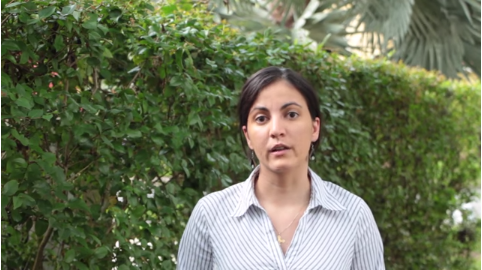
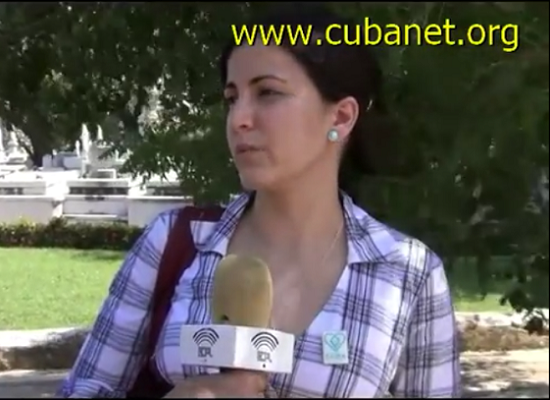
Screen shot from a video of Rosa speaking in Havana after visiting her father's grave at the cemetery
Screen shot from a video of Rosa speaking in Havana after visiting her father’s grave at the cemetery

cubanet square logoCubanet, Ignacio González and Osmel Almaguer, Havana, 11 May 2015 — Rosa María Payá, daughter of the late fighter for human rights in Cuba, Oswaldo Paya, arrived in Havana on Monday morning, from the Miami airport, in order to reunite with family and friends and to honor the memory of the father.

The daughter of the important fighter, who traveled to her homeland in the company of other activists, commented on the military presence in the “José Martí” National Airport, which is, according to his fellow passengers, an anomaly.

She also said she does not know the length of her stay and must take care of some legal paperwork before her return.

“I come to my country because that is my right as it is the right of all Cubans, whether or not it is recognized in the law. I think we have a unique opportunity as Cubans to work for our welfare, taking the risks to work to win our rights,” she said. continue reading

Rosa Maria kindly agreed to answer some questions for this team of reporters, and thanked those who support her cause, and the importance of the legacy of her father:

“My greatest thanks to the people who have accompanied me on my return to my country, to the people who have electronically sent flowers to honor the memory of my father. We have many friends and Cubans who want to honor the memory of Oswaldo Paya, and emphasize that his legacy is still relevant.”

Oswaldo Paya was one of the founders of the Christian Liberation Movement, created in 1988 with the aim of fighting for the human and civil rights of Cubans. He is known worldwide for his intention to run for deputy to the National Assembly of People’s Power, and in 1997 achieved hundreds of signatures supporting his candidacy.

He also co-founded the Varela Project in 1998, which pursued collecting over 10,000 signatures to present to the government asking for for changes in legislation through a national referendum. For this work, he received the prestigious Andrei Sakharov Prize for Human Rights from the European Parliament in 2002.

His death took place in dubious circumstances and there is currently an ongoing investigation, pushed by Rosa Maria, to confirm suspicions about the possible involvement of State Security in his death.

The video accompanying this article is in Spanish:

“Return to Ithaca” or the Magic of Censorship / 14ymedio, Miriam Celaya

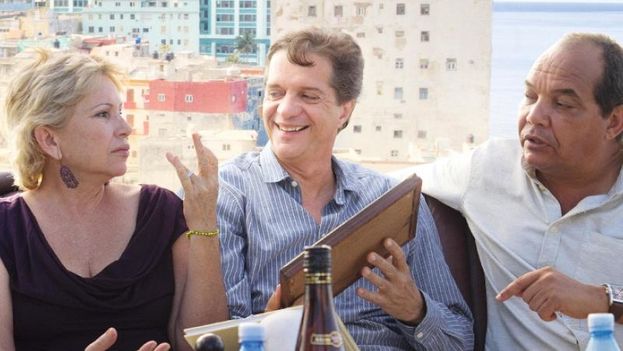
Scene from the film "Return to Ithaca"
Scene from the movie “Return to Ithaca”

14ymedio bigger14ymedio, Miriam Celaya, Havana, 4 May 2015 — The reunion of five friends on a roof terrace in Central Havana is the thread on which Return to Ithaca’s plot rests. Leonardo Padura wrote the screenplay and Laurent Cantet directed this French film about Cuban topics.

The film is currently circulating underground among Havana moviegoers, preceded by the best possible presentation: the official censorship that prevented its showing during the latest edition of the Latin American Film Festival, held in Havana in December, 2014. However, Return to Ithaca has been shown at the Charles Chaplin auditorium in Havana, in the framework of the French Film Festival, being held throughout the month of May.

The film has become the cultural phenomenon of the moment, largely “by the grace of” the official censorship in a country where direct or veiled criticism of the system remains an event, even when — as in this instance — it makes use of worn-out clichés and platitudes. continue reading

The second element in its favor is participation in the script by Leonardo Padura, who has, in recent years, become a fashionable writer inside and outside Cuba, especially since the success of his greatest achievement to date, the novel The Man Who Loved Dogs, a best seller that has sparked what has been termed in literary cliques as “Paduramania”.

Almost the entire cast of the film is composed of experienced and well-known actors such as Isabel Santos, Nestor Jiménez, Fernando Hechavarría and Jorge Perugorría, though it should be noted that the actors do not always come out unscathed from the setbacks imposed on them by the script’s faults and the confinements of the straightjackets their characters embody.

Apart from that, Return to Ithaca is but a mediocre movie that, perhaps with the pretense of presenting the drama of a generation born and raised in the deceit of half a century of a failed Cuban socialist revolution, barely manages a pathetic caricature summarized in the five life stories of resentful and frustrated individuals who do not even come close to representing the spirit of their generation.

The plot, settings, characters and actions turn on stereotypical machinations to the point of lacking credibility and dramatic force. The script is somewhat forced and artificial, in addition to widely appealing to the ease of profanity and vulgarity that, for some, has become “the recourse of Cubanism” in film and literature. It seems that, regardless of what level of education or schooling we Cubans may have, we can only express ourselves through the use of obscene language.

Neither do the characters’ stories reach sufficient depth. They are stiff, synthetic, lacking nuance and not very credible, all of which fail to convey their personal conflicts or to move the viewer’s emotional fiber, thus establishing an atmosphere of distancing between actors and spectators bordering on rejection.

Plot, settings, characters and actions turn out stereotypical machinations to the point of lacking credibility and dramatic force

Amadeo (played by Nestor Jiménez) is the reason for the 50-something reunion of this group of friends. He is a writer who left Cuba to go live in Spain for reasons his friends only find out at the beginning of the movie.

So Amadeo decides to stay in Spain during a working trip to avoid betraying his friend Rafa (played by Fernando Hechavarría), a talented painter who has been harassed and marginalized because of his lack of political commitment to the system. When the reunion takes place, Rafa, who has never asserted himself over the hedge of official censorship, feels bitter about having to survive producing paintings lacking in artistic value for sale to tourists, while Amadeo embodies the misfit émigré who has never been able to write again since his departure, and is now determined to stay in Cuba.

Tania (Isabel Santos) is a doctor specializing in Ophthalmology who, during the so-called Special Period crisis of the 90’s, authorized her minor children’s departure from Cuba. Her decision plunged her into a depression, which she tries to overcome by appealing to her religious beliefs of African origins, as evidenced by the hand of Orula on the bracelet she wears on her wrist. Tania’s debate centers on whether or not she acted correctly when she distanced herself from her children.

Eddy (Jorge Perugorría), manages some enterprise or “firm.” He is a cynic, a hedonist, an opportunist, a parasite, and he is unethical. He travels frequently, he “gets around by car,” constantly gets calls on his cell phone and arrives on the scene with two shopping bags and a bottle of whiskey, a real sign of his status. He is the living image of the great pretender.

Aldo (Pedro Julio Díaz), a character and a perfectly forgettable performance, serves as host for the meeting. He is a frustrated engineer dedicated to the crafting of batteries and just barely making a living, the reason his wife left him to leave the country with an Italian. He is the resigned, conciliatory type, and – together with his mother, with whom he still resides – is one of the plot’s most obvious clichés: a decent and nice Afro-Cuban living in poverty in Central Havana, in a promiscuous environment, surrounded by marginal individuals who sacrifice pigs on the roof terrace next door, of couples who argue loudly from their balcony and of good-natured neighbors who shout out the scores of the baseball game they are watching on TV.

His mother is the kindly black woman who gives good advice, with a scarf wrapped around her head, who makes the best black beans that everyone wants to eat, and who humbly sets the table before leaving the room. She is a shockingly dispensable character.

The cliché of drawings showing El Malecón, the harbor, the Plaza of the Revolution and the Capitol’s cupola are abundant, as silent evidence that the story takes place in Havana, which the same the scenery painted on cardboard could have validated. This almost forces one to remember – in contrast — the masterful way in which Fernando Pérez managed those icons of the Havana environs in his film Suite Havana, where, rather than mere scenes, they are co-stars conveying the spirit of the cityscapes.

What reasons did the commissioners have to censor this poor film during the last film festival in Havana?

Return to Ithaca exudes the oblique, patronizing and folk interpretation of a team of foreign filmmakers and, as such, it’s oblivious to the reality it that wants to present. Therefore, since they are ignorant of the intricacies of such a complex, varied, and nuanced community, the final result offers a superficial and plain view of that reality, unfolding, as a touch of local color, what actually constitutes yet another unfortunate stereotype.

In general, the plot clings to the past — which is really the only element all the characters have in common — by appealing to victimization, to catharsis and to forced conflicts between them, while the Cuban socio-political system, reflected primarily among the memories of the characters, is the invisible villain, the victimizer, flowing from each actor’s lines, though only in the third person, singular: “they sent us to agriculture,” they made us go to the harvest,” “they took us to pick tobacco in the countryside,” “they did not let us listen to The Beatles,” “they fucked up our lives,” and others along the same lines. A non-committal “they did such-and-such to us,” a kind of impersonal culprit entity which is, all at once, the system and nobody, and that allows sneaking the bundle out through the open escape hatch.

And, to put the icing on the cake, there is a version of Return to Ithaca, this calamitous cinematographic accident, that breaks both scenic as well as temporary and situational planes, so that, in some passages, the viewer witnesses a sudden and dramatically useless blackout on the roof, and immediately afterwards, as if by magic, the characters converse with a perfectly lit up Havana in the background, or a roof scene ends and — without a transition — the next scene takes place indoors, with the characters seated around a table in the dining room, savoring Aldo’s mother’s incomparable black beans.

If this disruptive intention was to surprise the viewer, it only serves to baffle him.

In short, when the parade of credits indicates that Return to Ithaca is over (at last!), the viewer can feel a strange mixture of relief and disappointment. Relief, because it will probably convince him that the most wasted 90 minutes of his life are just over. Disappointment, because, just like the very characters in the movie, he will feel deeply cheated. And so perhaps, as it happened to me, he will get up from his chair wondering what reasons the commissioners had to censor this poor film during the last film festival in Havana.

*Orula, a major Orisha in the Afro Cuban religion of Santería, (Yoruba in English), is the future prophet and the counselor of humans.

Translated by Norma Whiting
The Two Halves of Raul Castro / 14ymedio, Yoani Sanchez

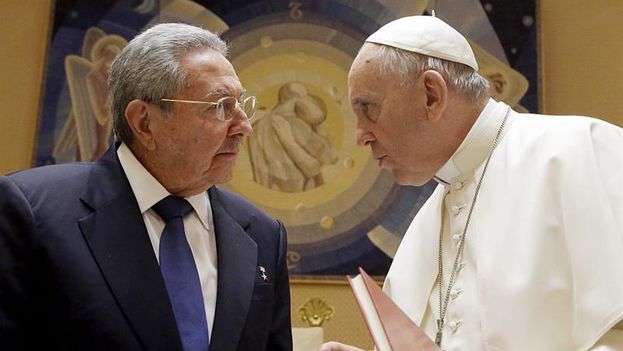
The meeting between Raul Castro and Pope Francisco. (EFE)

14ymedio bigger14ymedio, Yoani Sanchez, Havana, 11 May 2015 – Raul Castro arriving in Italo Calvino’s other homeland, like the Viscount of Calvino’s book, landed divided in two, split down the middle. He came from a flood of soldiers and armaments at the Red Square parade in Moscow, where he showed his Communist nostalgia recalling the “glory days” of the Soviet Union. In Rome, however, he arrived with his other side taking the lead. At the Vatican he became the man educated in a Jesuit college and even confessed to Pope Francis that he might be disposed to return to the Church and once again take up prayer.

This Sunday, the two contradictory and irreconcilable pieces of Raul Castro have returned to Cuba, a country also fragmented between the celerity with which it feeds hopes and the slow pace of reality. The official media only reported the tour of one of the General’s parts, that of commitments and continuity and the embrace of the Kremlin comrades. However, with regards to the meeting with the pope, they only reported the words of thanks for the mediation between Cuba and the United States, accompanied by a reference to the pope’s upcoming visit to the Island. continue reading

Why did neither prime time TV news nor the newspaper Granma report Raul Castro’s declarations about a possible return to the faith? Because this part is not suitable to be aired indoors, it should only be exposed to a foreign public. Inside the house, within the national frontiers, the image must continue to be that of a tough, strong man of clenched fist, who neither wavers nor exhibits any weakness. In Cuba he is not willing to show the moderation or the diplomatic side on display during his trip. Here, he wants to make it clear who leads and reaffirm that there is no room for differences nor opposition.

At home, the image must continue to be that of a tough, strong man of clenched fist, who neither wavers nor exhibits any weakness

To add to the contradictions, while the General-President was engaged in a foreign tour, Fidel Castro published some reflections that reinforce the choice of Marxism-Leninism. Speaking out for an atheistic and materialistic ideology a few hours after his younger brother was received by Saint Peter’s successor. It was not a coincidental text, nor a careless one. It focused on reining in the reformist side that Raul Castro exhibited before democratic governments. The commander-in-chief also needed to make clear the limit of the transformations Cuba is experiencing, which so far have been timidly focused on the economic sphere without going so far as political changes.

Like the story written by Italo Calvino, it is very difficult for these two halves to coexist without confrontation. The pope, the French president and Barack Obama, among others, have shaken the hand of the politician who says he is willing to talk. They do not observe how the military and intolerant side, that is also a part of him, behaves on Cuban soil. Under this Raul Castro are authorized the acts of repudiation against the dissidents, State Security’s harassment and surveillance of activists and the greater part of the population which doesn’t even dare to criticize the system out loud.

A Raul Castro who maintains a benign moderation towards the outside world and a harsh authoritarianism within Cuba would be a terrible scenario for the future

Which of the two halves will prevail? A Raul Castro who returns to religious faith, propels a comprehensive reform of the country and sits down to talk with the internal opposition? Or that other, raised up in military intransigence, who incites political hatred and puts the interests of his family clan above the urgent needs of the nation? Will there come a time when he cannot sustain such duplicity?

In the last part of the book by the famous Italian-Cuban writer, the two halves of the protagonist are sewn together and live in harmony after trying to annihilate himself. In the Cuban case, that could be the most devastating of the choices. A Raul Castro who maintains a benign moderation towards the outside world and a harsh authoritarianism within Cuba would be a terrible scenario for the future.

Terrorism and the Revolution of 1959 / 14ymedio, Jose Gabriel Barrenchea

14ymedio bigger14ymedio, Jose Gabriel Barrenchea, Santa Clara, 21 April 2015 – Recently we have been hearing the official spokesmen of Castro’s submissive society accusing everybody of being terrorists. However, did you know that the Castro Revolution came to power on a wave of urban terrorism, which left in its wake a quite significant sum of “collateral damage?”

The Revolution that triumphed in Cuba on January 1, 1959 is often very misunderstood, and what is understood, is often biased. For example, did you know that on July 26, 1953 Fidel and Raúl Castro (who was not a teenager back then, he was 22) used a hospital full of patients as a firing position to attack the Moncada Barracks, in flagrant violation of every international convention then in effect regarding warfare? A hospital serving servicemen and their families, veterans of the Cuban War of Independence, as well as ordinary citizens, suddenly became the spot from where one of the Castros’ lieutenants held the Moncada garrison under gunfire. continue reading

It is hard to believe that a lawyer as brilliant as Fidel Castro would have been unfamiliar with these international conventions. Unless, of course, we wish to believe those dubious sources claiming Fidel Castro’s schooling left much to be desired, and that he earned his grades only thanks to the help of his trusted friend, a Colt .45 pistol.

The following are eleven cases I have chosen from the extensive list of victims published in the back pages of the Cuban weekly magazine Bohemia in its first three issues of January 1959: the misnamed (only time would teach us how misnamed) “Special Liberty Editions.” Among the murders, battles, and executions listed, I have selected only a few of the Revolutionary attacks that left innocent victims.

I should make it clear that my source is incomplete: it references the list of the Bohemia journalists, who compiled it hastily during the first few days of January 1959, based almost exclusively on press releases of the time. It should also be noted that the Cuban press was subject to censorship by the dictatorship of Fulgencio Batista for virtually the entire time between 1956 until December 31, 1958. Consequently, many events went unrecorded.

February 22, 1955

Antonio Goulet, sixty years old, father of Corporal Dionisio Goulet, an army barber, was killed, mangled by a bomb at his home on 112 Cuartel de Pardos Street, Santiago de Cuba. The elder Goulet’s fifteen-year-old granddaughter Emilia Iris Tabares was also injured in the attack.

January 1, 1957

Magaly Martínez Arredondo, 17, residing at 12021 69th Avenue in Marianao, was injured when a bomb exploded at Havana’s Tropicana Nightclub, resulting in one of her arms having to be amputated. Marta Pino Donosos, 18 years old, living at 12209 69th Avenue, Marianao, was also injured in the attack.

January 15, 1957

An emergency judiciary investigation was launched into a bombing on 21st Street, between 14th and 16th Street in Vedado, which injured Amada Apezteguía Armenteros and Nilda Llorente Carrascal.

Juan Pío Manresa, residing at 323 Virtudes Street in the city of Santa Clara, was injured when an explosive device went off at the corner of Virtudes and Lucena Streets in that same city.

Victoria Rodríguez, 33, residing at 256 Arrellano Street, and a seventy-year-old senior citizen, Tito Mayea Villalobos, residing at 318 Enma Street, were critically injured when a bomb exploded next to them at the corner of Fábrica and Concha Streets in Havana.

January 23, 1957

Oliverio González Mesa, 35, was killed, mangled by a bomb placed in front of the mansion owned by his employer Luciano Sampedro, located between 6th and 7th Avenue in Miramar. González Mesa had worked at the mansion as a cook for two years.

March 9, 1957

Luís González García, a twelve-year-old boy residing at 108 Jenaro Sánchez Street, suffered critical wounds when sticks of dynamite he found at the beach exploded in his hands.

April 27, 1957

Havana was rocked by eight separate bombings in eight separate businesses in a single day. The following were injured as a result: Carolina Torrente Fernández, 27, residing at 64 Tenerife Street; Ramón Fernández, 28, a resident of Rosalía District; and Faustino Cancedo, 61, residing at 66 Bejucal Avenue.

August 3, 1957

Mrs. Lidya Dorado was killed by a powerful bomb explosion on Trocha Street in Santiago de Cuba. Police Officer Arvelio Martín Céspedes was also critically injured.

August 5, 1957

Mercedes Díaz Sánchez del Águila, a resident of Milagros Street, was killed when a bomb exploded at the Ten Cents Department Store on the corner of Galiano and San Rafael Streets in Downtown Havana. Seriously injured were Lidia González Rebull, from Fontanar District; Etelvina Arencibia Gil, residing at 358 Franklin Street; Lidia Bular Barquet, 19 years old, resident of Vedado; Gladys Valdivieso, residing at 532 Parque Street; and Nelson Huerta Truichet, 72 years, and resident of the city of Marianao.

August 12, 1957

Alfonso Vivero, 43, from the beach town of Santa Fe, was rushed to an emergency room in critical condition after a bomb exploded at the dry cleaners on Luz Street, between Habana and Compostela Streets in Old Havana.

August 14, 1957

A bomb exploded at Havana’s Manzana de Gómez retail and office complex, killing José Martínez, 65, who resided at 4 Cuarteles Street.

September 3, 1957

Eusebia Díaz Páez, a young lady of 19, who resided at 3 Ángeles Street in the city of Guanabacoa was killed, mutilated when a bomb exploded in the ladies’ room of the América movie theater in Havana.

And now for some final thoughts.

In his book, Descamisados (“The Shirtless Ones”), Brigadier General Enrique Acevedo tells us that shortly after he began to publicly stand out as the most active revolutionaries in his town, a military official loyal to the Batista régime waited for him in a secluded place and threatened to kill him if something were to happen to the official’s family. As I cited earlier, the terrorist killings of people such as Antonio Goulet did not come without a price. We should not be surprised if we found Corporal Goulet’s name among those who were executed in the early months of 1959 for having “gotten even” with one or several revolutionaries.

Still today the death of Agustín “Chiqui” Gómez Lubián is officially commemorated in Santa Clara. There are even schools named after him. In other words, these schools carry the name of a terrorist who together with a partner was killed when a bomb they planned to throw through a window of the Provincial Government headquarters fell a few yards short of its objective, in Buen Viaje Street. The victims of this heroic act would have surely been the secretaries and archivists working in the building, or some of the readers in the public library located on the ground floor. Neither the Provincial Governor nor any other figure associated with the Batista régime would have been injured or killed since their offices were on the second floor, or in windowless offices in the back of the first floor.

The commemoration of this event enjoys ample coverage in Vanguardia, the puny Official Communist Party newspaper of Villa Clara Province, as does the death of Sergio González, alias “Curita,” material and intellectual author of many of the attacks mentioned above. This demonstrates that the Castro régime still exalts its terrorist roots, regardless of what it wants to make us believe when it wraps itself in the lily white tunics of its historic discourse.

Terrorists like Luis Posada Carriles* do not graduate from some sinister, clandestine CIA academy. Perhaps the CIA did indeed ultimately shape him into the coldblooded murderer he became, but people such as he grew up admiring individuals like “Curita” and “Chiqui” Gómez. Posada Carriles, no matter hos much the regime’s intellectual spokesmen, such Abel Prieto, Miguel Barnet, Fernando Martínez Heredia, or Esteban Morales want to deny it, is a more legitmate heir of the Revolution of 1959 than they themselves are.

* Translator’s note: Accused by the régime of being the mastermind behind the 1976 terrorist bombing of Cubana Airlines Flight 455 near Barbados, killing 73 passengers, and several other terrorist attacks. Posada Carriles currently lives in Miami.

Translated by José Badué

The Ferry At Last! / Rebeca Monzo

For many years, a ferry in our country served as a practical and economic means of communication between Havana and Key West (Cayo Hueso).  It was heavily utilized by those people who travel with their automobiles, to facilitate movement to other places after arrival at the destination. This was only up to the year 1959, when everything changed dramatically.

Again, after 56 years, the exchange of travel by ferry with the United States of America has been reestablished, this time with certain limitations: people cannot come to our city accompanied by their cars and at the moment only certain people can utilize this means of transportation: Cuban citizens resident in the US and those on the island, and those Americans that qualify for cultural, sports, scientific, academic and other types of exchange. continue reading

Upon learning the news, the Cuban population has proved to be somewhat disconcerted with these limitations, because they haven’t been given any explanations in this regard. I supposed that this is due, fundamentally, to the lack of infrastructure in our ports to receive these vessels transporting automobiles, the necessary legalization of the use of American and Cuban license plates and driver’s licenses and the deficiency of supplies to deal with the rapid increase in visitors.

As a friend who works in tourism told me, recently a large cruise ship arrived and the travelers descended to visit the historic center of Old Havana and, in a flash, the supplies of bottled water and beer were exhausted.  What does the administration think about confronting this problem, an administration that right now is mired in severe shortages in the shops, markets and businesses of our capital?

As always, the opening measures seem to surprise the Government that says it is working on it “without haste but without pausing*.”  I imagine that, with the prices and salaries of our country, in spite of the ferry, many more  flimsy and clandestine boats will continue leaving, loaded with Cubans “without a visa but in a hurry.”

*Translator’s note: A phrase from a speech by Raul Castro (“sin prisas pero sin pausas”) describing the regime’s approach to “updating” the economy.

 Translated by: BW

The water does not come to Santiago de Cuba / 14ymedio, Yosmany Mayeta Labrada

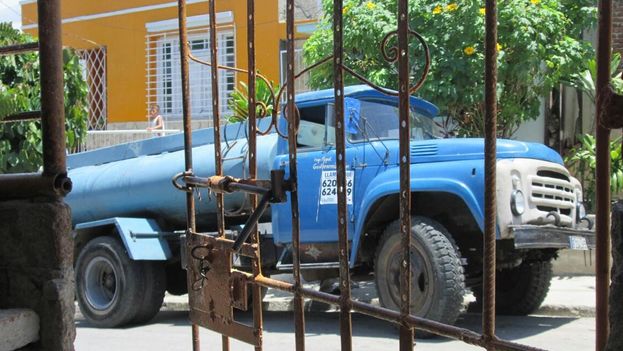
Tanker truck on a street in Santiago de Cuba. (Yosmani Mayeta)

14ymedio bigger14ymedio, Yosmany Mayeta Labrada, Santiago de Cuba, 9 May 2015 – The drought has become an undesirable comrade for the residents of Santiago de Cuba. For years, the city has suffered low rainfall, deficiencies in the water supply system, and an erratic distribution policy.

In the midst of the celebrations for the fifth centenary of the city’s founding, the contents of a water truck cost the equivalent of ten convertible pesos on the black market, almost half the average monthly salary. The families who can’t pay it have to be satisfied with storing in tanks and buckets the trickle that comes out of the taps once or twice a month.

In recent months, the water supply situation has become more drastic, and although the rains flooded a part of the center and west of the country, they have not made it to the east. The residents of Santiago’s slums and neighborhood look to the sky in hopes of a downpour that will fill the reservoirs and improve the situation of agriculture. continue reading

Dayana Despaigne, mother of two, uses the water given to her by some neighbors with more resources, to clean, wash and do the cooking. She says she doesn’t have the money “to buy the water,” so she hopes for the generosity of others or of the “the workers on the aqueduct” supplying the neighborhood where she lives.

Not far from Dayana’s house is the Chicharrones neighborhood, where Luisa Hernandez said that “almost a month has gone by with no water coming to the block, and this is not only the fault of the drought.” The lady complains of the lack of organization and a regular supply schedule and says that “they have forgotten to open the aqueduct when it touches us,” referring to the taps that allow the water to flow to different areas of the city.

The situation extends to the area known as Venceremos, where the water comes every 15 days. On this occasion, according to comments from Juana Milagros Bonne, “They passed us up, because it’s been more than twenty-five days without a drop and it seems that for now it won’t come our way, because we have been informed that there is a break and that the cistern that supplies us is empty.”

The water trucks, commonly known as “pipes,” should help to ease the situation when the water doesn’t come through the actual water pipes. However, much of their cargo ends up diverted to the black market, where there is a growing demand due to need.

A resident of Altamira commented to 14ymedio that on several occasions they have bought water from the trucks because “the cycle is very long and my tank supplies several family houses.” But he considers “ten convertible pesos to be a lot of money,” and “in the neighborhood we’ve never seen the supply trucks sent by the government to supply water to the people.”

The problem is not just that the water doesn’t fall from the sky, but how much is lost through leaks and breaks. A worker on the aqueduct revealed to this newspaper that “the meters that measure the water are in poor condition in many houses, which negatively affects the wasting of water.” The employee also recognizes that “the company does not have the necessary means to repair the networks in the short term.”

Just two years ago, Raul Castro made a speech at the 26th of July celebration in the Santiago capital where he set as a goal repairing the water system throughout the city. Today, many families in the area give up a good part of their wages to pay for the water trucks or the water carriers who sell buckets and bottles. Water days don’t seem to arrive for Santiago de Cuba.

Cuba Civil Society Open Forum meets for the 7th time / 14ymedio

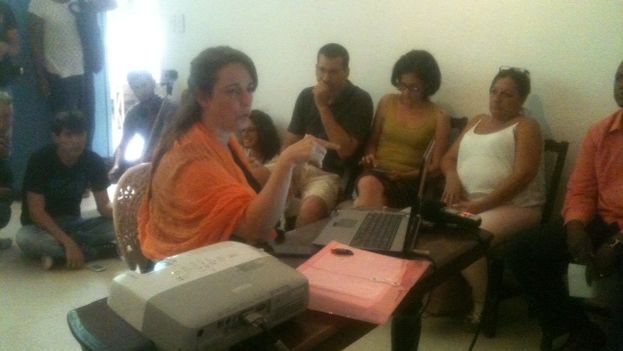
Tania Bruguera during the discussion group at her home in Havana Vieja (14ymedio)

14ymedio bigger14ymedio, Havana, 8 May 2015 – Some twenty activists, political leaders, intellectuals and artists participated in a new meeting of Cuban Civil Society Open Forum last Friday morning. At the meeting they discussed the need to take into account in future discussions the organization of the parallel forums at the recent Summit of the Americas.

The discussion touched on points such as the lack of transparency on the part of the State in the administration of public funds, the participation of independent candidates in elections and the current state of Cuban society.

An intense discussion developed around several initiatives, such as “Citizen Hour” inscribed within the Constitutional Consensus project, which seeks to promote a new elections law, as well as a new law of associations and political parties. Also discussed was a proposal to create five working groups on the issues of human rights, democracy and governability, civil society, communications, and the private sector.

Finally, it was agreed to send a letter to the European Union, the US government and the Cuban government expressing the deep concerns of the participants with the systematic repression against human rights activists and against the citizenry in general, which contrasts with the context in which they are promoting understanding and dialog.

Among the participants were the artist Tania Bruguera and the writer Victor Manuel Dominguez. The attorney Laritza Diversent and opposition member Manuel Cuesta Morua also spoke at the event, along the analyst Pedro Campos and the Baptist minister Mario Felix Lleonart, among others.

Our Children Make Us Less Cowardly / Yoani Sanchez

Generation Y, Yoani Sanchez, 10 May 2015 – There is a memory I often escape into. At times of greatest tension, I travel back to that August morning when I held my son for the first time. If I feel overcome by fear, I visualize the tiny fingernails that had grown inside my womb, soft and bent around the tips of his fingers. I also calm myself evoking the backs of his hands, with the marks of amniotic fluid in which they were submerged for so long. I take refuge in the memory, feeling that no repression nor hatred can reach me, because I am protected by his birth.

Our children give us the gift of will. When our eyelids are heavy and the most powerful alarm clock cannot get us out of bed, it’s enough for them to whimper in their crib for us to wake up. If they come into the world while we ourselves are still students, they give us the confidence to believe that standing up to the test of motherhood means that no diploma can resist us. They, with their gaze and their questions, also force us to be less cowardly. How can we explain to a child the opportunistic silence, the masks, the faking it… without destroying, in these declarations, a part of the paradigm we represent for them?

Our children are always better than we are. So today, while in Cuban homes mothers celebrate their day, some surrounded by their loved ones and others with the sadness of distance, I am going to give my “little boy” a gift. It will be a small present, simply making lunch together, which will allow us to talk while he chops the spices and I start to heat the pan. Perhaps he will tell me about last week, or about some book or a girl that he knows. While we chat, I will sneak a peek at his hands, now larger and stronger than mine. I will compare the sounds of a baby with his current deep voice, and conclude that this man of today also gives me strength to continue, a great strength.

Twenty years have passed and I still don’t need any other present for Mother’s Day… I already have it, standing in front of me.