Thank you from Danilo Maldonado for the 2015 Vaclav Havel Award

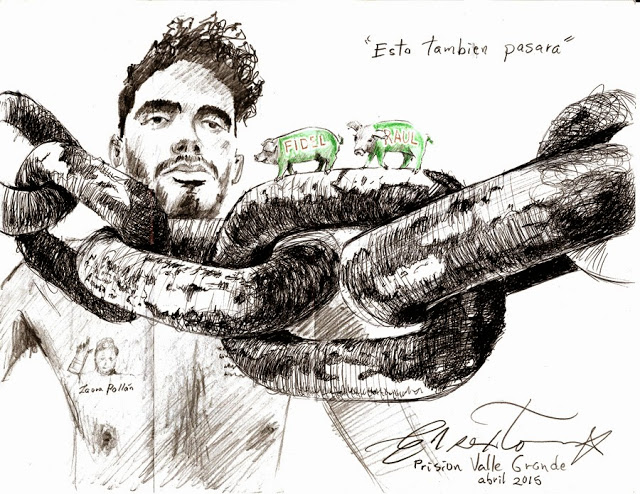
"This too shall pass"
“This too shall pass”

Danilo Maldonado (El Sexto), Valle Grande Prison, April 2015 — From the Valle Grande prison I thank you for the Vaclav Havel International Award for Creative Dissent from the Human Rights Foundation.

When something like this happens, and even more so given the conditions I am in, it makes me believe that what I have done has not been in vain.

The love for what I do and the love that every person brings to noble and just causes can never be extinguished by violence and lies.

I congratulate the winners and want you to know that being locked up in this prison will not stop me for one minute from pursuing my dream of freedom for all Cubans.

I want to express a special thanks to Tania Bruguera, thank you for your support, I admire you very much!

Danilo Maldonado
El Sexto (The Sixth)

Anticipated News of Another May Day / 14ymedio, Reinaldo Escobar

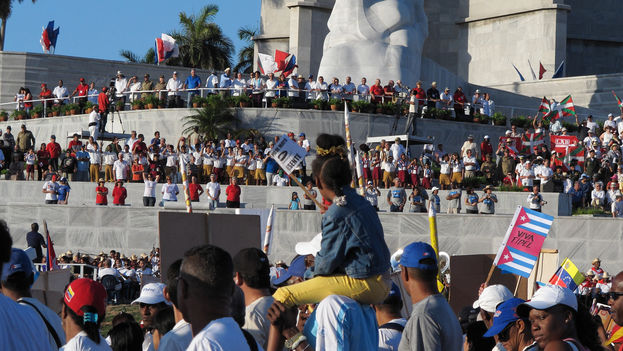
Celebration of May 1st in Cuba. (FLICKR/CC)

14ymedio bigger14ymedio, Reinaldo Escobar, Havana, 30 April 2015 — Like all ritual ceremony, the parade for International Workers Day involves previous preparation and specific purposes. Along with 26th of July events and the Triumph of the Revolution’s anniversaries, May 1st has always stood out as the celebration that mobilizes the most people in Cuba.

In some of these parades around a million participants have been recorded. Depending on the directions coming from the top of the hierarchy, they are sometimes organized under neutral mottos, such as “To defend the homeland”; in others the motto can be more specific, such as “Against the imperialist embargo” or, like last year’s motto, “For the return of the Five Heroes.” The 2015 parade’s main motto is “United for the construction of socialism” and official chroniclers claim that it will be massive, compact, strong, unforgettable and other similar adjectives. continue reading

In the capital, starting at midnight on the night of April 30, the main avenues surrounding the Plaza of the Revolution will be blocked to traffic along with a parking ban. If rain does not play us a trick, from early morning on May 1 the march will deploy in 18 groups which will begin gathering at previously planned staging points. At the front, there will be 50,000 public health workers, headed by members of the Medical Brigade that confronted the Ebola epidemic of in Africa.

The selection of this group to represent the vanguard of the vanguard has different connotations. Perhaps the most significant is related to the new winds blowing in the relations between Cuba and the United States as of December 17. Sheathed in their protective suits, physicians and Cuban nurses worked side by side with American specialists and many times carried out their work under the direction of and with the resources of the United States.

This time the State Security will have to be attentive to any extremist who shows up with insults against Obama or extemporaneous fundamentalisms

They’ll need an eagle eye to detect any anti-imperialist messages in the placards held high. This time the State Security operation, which traditionally deploys close to the platform to detect any provocations “from the enemy,” will have to be attentive to any extremist who shows up with insults against Obama or extemporaneous fundamentalisms.

Like every year, visitors from half the world will gather to contemplate the magnificent spectacle. More than 1,800 representatives of nearly 200 organizations from 68 countries have already confirmed their participation. Of these, 285 are American. The majority are trade union members, but groups of solidarity and social movements will also be present. Many of them will also be present on Saturday, May 2, at a scheduled meeting on international solidarity to chart the new course that they will need to focus on, now that there are no longer imprisoned heroes, that Cuba will no longer be on the list of countries who collaborate with terrorism, and that the embargo seems to have its days numbered.

Workers, soldiers, students, athletes will wave their flags so that the present continues to resemble the past

The pattern of the parade, the model to follow, is directed from the Plaza of the Revolution in Havana. Each province organizes its own events, but with little room for improvisation. So in each provincial square the parade will start with public health workers in a number that will total around 300,000 across the country, including those who work in the Antivector Brigades (brigades that fight for the elimination of the Aedes Aegiptis mosquito responsible for Dengue Fever), known as “the grays,” reinforced with the presence of young recruits from the Military Service, which in the ranks of the Youth Labor Army are devoted to detecting and eliminating sources of mosquitoes and who receive a white Public Health logo T-shirt that they wear in proletarian march.

The choreographers in charge of this colossal dance have determined that the last marching group at the parade will be the young people. Workers, soldiers, students, athletes, intoxicated by hormones and adrenaline, will wave their flags and march singing or dancing. With the same ecstasy in which some cultures victims went to the altar of sacrifice, they will be swearing eternal loyalty to elderly leaders, they will be ratifying their commitment to socialism and to the Cuban Communist Party Guidelines, and they will be offering up their future so that the present continues to resemble the past.

Shortly afterwards an army of sweepers will eliminate the trash.

Translated by Alberto

The Cuban population is aging faster than expected / 14ymedio, Orlando Palma

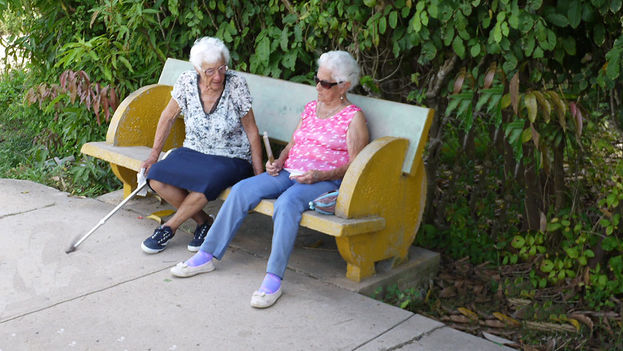
Two elderly women talking. (14YMEDIO)

14ymedio bigger14ymedio, Orlando Palma, Havana, 28 April 2015 — In a park in Central Havana the Grandparents’ Circle meets every week for physical exercises that help to prolong a healthy life. A few yards away, the line to buy rationed bread is also filled with gray-haired people more than six decades old.

The aging of the population is moving at a more accelerated pace than foreseen by the plans developed to deal with the consequences. This issue will be addressed at the 7th International Longevity Seminar to be held at the Palace of Conventions in Havana from Monday until Thursday.

The Cuban speakers at this event will present their proposals for how the healthcare system can meet the challenges of offering high quality care to adults age 65 and older who represented 18.3% of the population in the 2013 census and could exceed 25% in 2025. The situation is aggravated if we consider that the active working population won’t exceed 60% in the same year, according to studies by the National Bureau of Statistics. continue reading

In an interview with the newspaper Granma, Dr. Alberto Fernández Seco, head of the Department of the Elderly, Social Assistance and Mental Health in the Ministry of Public Health, said it has increased both geriatric services in the country as well as the number of residents in this specialty. “That is a great strength. However, the greatest challenge that we all have, not only in the healthcare sector, is the issue of care.”

In this concept of care aimed at seniors, we need to concentrate material and human resources, and improve infrastructure. Seemingly minor details, like the size of the text in public notices, the streetlighting schedule to allow pedestrians to pass along the main streets, the presence of chairs in the waiting rooms of institutions, in addition to other more visible and urgent aspects such as the poor condition of sidewalks or lack of information on the issues that matter most to older people.

The training of caregivers for the elderly is a true specialty in the modern world. We must learn to communicate with this sector, which at times becomes very sensitive to the codes of respect and understanding evidenced by the younger generations. To the extent that the number of elderly people increases, there will be a greater use of wheelchairs, walkers, special beds and mattresses, as well as the consumption of vitamins, medications and other supplies.

The desire to live 120 years or more, which was proclaimed in Cuba with the intensity with which the political slogans are launched, is a noble goal that is only viable and sustainable if it is based on a solid economic base. Most experts agree that to ensure a better old age Cubans will have to provide incentives for births and increases in the productive population. At the same time, we must provide opportunities for young people so they will not seek a better life abroad.

In the next 35 years Cuba could become one of the most aged nations in the world, which would not be exclusively the consequence of increased life expectancy, but also of the fact that fewer children will be born and more young people will emigrate.

New requirements for language schools prioritize workers / 14ymedio, Orlando Palma

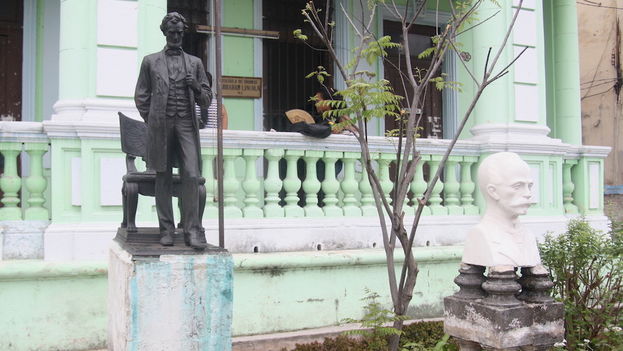
Sculpture of Abraham Lincoln at the most popular language school in Havana. (14ymedio)

14ymedio bigger14ymedio, Orlando Palma, Havana, 29 April 2015 – The high demand for foreign language instruction in Cuba in recent years has forced the Ministry of Education to augment the requirements for access to language schools. Resolution Number 75 of 2015, recently published in the Official Gazette, regulates entry to these schools to people over 17, prioritizes workers, and limits students to studying one language at a time.

The regulation establishes that students who want access to this variety of adult education must have completed at least the ninth grade in high school. Only through special exceptions will the schools admit “housewives, retirees, other students in senior high schools or universities, or those not working for the social-economic interests of the locality and for the creation of an emerging workforce, requiring language school training.” continue reading

To the new restrictions is added, however, the flexibility to open language classrooms in workplaces. With previous authorization, there may also be specialized training courses for people who will be serving on missions of cooperation in foreign countries.

An official from the Ministry of Education who preferred to remain anonymous said that among the motives for making the entry requirements stricter is that a large percentage of the students “end up emigrating and taking with them the knowledge that has been given to them at a very low cost or, in most cases, for free.” He explained, “We need to bring language learning to people who are going to use it in the local economy.”

None of these measures directly affect private sector instruction in foreign languages, although they could benefit from a greater influx of students who no longer meet the requirements to enroll in state schools.

Alarming Repression Against the Ladies in White in Cuba / Forum for Rights and Freedoms

Cuba_031-300x168The repression against the Ladies in White, opposition activists and human rights defenders in Cuba, that we have seen during the last couple of weeks is alarming. The increase of violence from the authorities has come as a result from the exercise of the right to public protests and from the public exposure of the faces of political prisoners. Beatings, physical abuse and various types of torture have become routine. In only a few weeks, the numbers of arrests have skyrocketed and they now exceed several hundred.

The Forum for Rights and Freedoms and Civil Rights Defenders raise a warning regarding the deteriorating situation for human rights defenders in Cuba, and we note with great concern the indifference of the international community, especially from the US government, the EU and the Vatican, of which the latter played an active role in the talks between the Cuban government and the US administration.

The current actions by the Cuban government are a response to the silence of the international community. continue reading

In accordance with the Universal Declaration of Human Rights – of which Cuba is a signatory – the International Covenant on Civil and Political Rights – which the government of Raul Castro has signed but not ratified – and, as the UN Special Rapporteur on the rights to freedom of peaceful assembly and of association, Maina Kiai has recently explained clearly in his final report; states shall ensure the full exercise of freedom of assembly, association and peaceful demonstration.

The Forum for Rights and Freedoms and Civil Rights Defenders call on the international community to act against the dangers that Cuban human rights defenders are facing. It is time for the American and European governments, usually eager to improve their relations with the Cuban government, to use their influence and speak out against the worsening violations of human rights in Cuba.

Antonio G. Rodiles, Coordinating Committee, Forum for Rights and Freedoms
Erik Jennische, Programme Director for Latin America, Civil Rigths Defenders

For more information on the repression against Damas de Blanco/Ladies in White on April 26 2015, follow the link

Give It Time / Fernando Damaso

Fernando Damaso, 30 April 2015 — Looking over some documents from different eras, I have determined that, when it comes to renaming things, our authorities have broken all records. Victims of their frenzied efforts have included numerous streets, public plazas, parks, virtually all sugar refinery factories, businesses and outlying buildings, towns, cities, provinces, commercial and service establishments, educational and health care facilities, theaters, cinemas and even some of the keys within our archipelago. One needs the patience of a saint to find a name from the past that is still in use today. I can only imagine how arduous the work of our historians must be.

The result has been to create widespread historical confusion, which strikes me as being more than a coincidence given that it happens to coincide with an interest in blotting out significant parts of our past in order to address the political needs of particular moments in time. continue reading

If we take a look at some of these changes, we see that Havana’s former Civic Plaza is now referred to as the Plaza of the Revolution. This latest designation has also been applied to every town square in every municipality in every province. The possible exception is Tenth of October, where it is referred to as Red Square, though it might more appropriately be called Black Square in honor of all the grime that has accumulated there.

The historic beer factory La Tropical (shuttered along those of La Polar and Hatuey) has for years now been called Jose Marrero. The Saint Francis Piers are now called the Sierra Maestra. The neighborhood formerly known as Country Club is now Cubanacán. The Blanquita Theater is now the Karl Marx (not even Carlos Marx).

The names of all the sugar refineries along with those of their outlying buildings were replaced with names of personalities from the new pantheon of saints established after January 1, 1959. Gone also were well-known, resonant names such as Toledo, Hershey, Constancia, Narcisa, Cunagua, Jaronu, Najasa Violeta, Baltony, Chaparra, Jobabo, Preston, Miranda, San Germán and many more, to be replaced by 161 others, which was the total number of enterprises at the time. A cement factory known as Titan was rechristened José Mercerón.

An even greater misfortune befell commercial establishments. Rather than allowing the stores to retain their original names, in a showy display of bureaucratic pretension, each was given a letter and number that identified it by province. As though that were not enough, Isla de los Pinos (Isle of Pines) was rechristened Isla de la Juventud (Isle of Youth). At least its residents are still referred to as pineros rather than as they might otherwise be called: juventuderos. Then there is Key Smith, located in Santiago de Cuba Bay, now called Key Granma*.

As absurd as these examples are, the saddest case is that of so-called Granma province (the repeated use of this name is striking), formerly known as Bayamo province out of respect for its rich history. Carlos Manuel de Céspedes, the father of the country, was bayamés, and the first government of an independent Cuba was established here. Its citizens burnt down their city rather than hand it over to the enemy. The flag hoisted here was the flag of Bayamo and the first stanza of our national anthem begins, “To the battle in haste, Bayameses…” To Cubans, Granma is simply a letter of the Greek alphabet, the name of a yacht, a baseball team and a newspaper, and a very tedious one at that.

Making a Living From Trash / 14ymedio, Victor Ariel Gonzalez

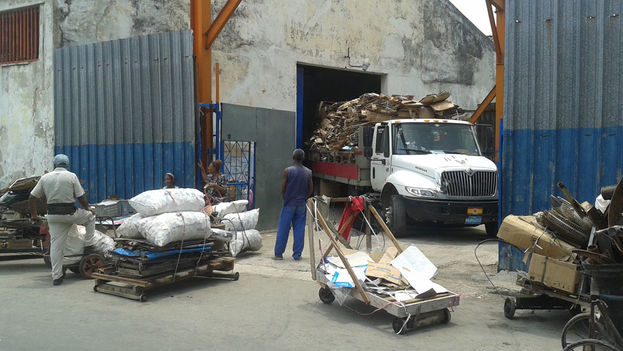
Collection point (14ymedio)

14ymedio bigger14ymedio, Victor Ariel Gonzalez, Havana, 1 May 2015 – They appear silently, without anyone taking notice, a little after dawn.  They will not hide again until nightfall, when they return home or camp out in some corner of the city to count their profits.  They used to be called “divers,” not without a certain disdain; now, the activity is gaining organization as well as workers.  Without the collectors of raw materials, Havana would be an even dirtier city.

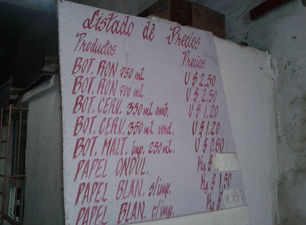
Jesus is one of them.  Dragging a mountain of cardboard pieces on his cart, he goes to a buying house with the merchandise acquired today.  For each kilo they pay one peso and 20 cents, but sometimes he gets other material – pieces of aluminum or bronze – and they pay him more.  “It all depends on knowing how to search,” he says.

At Benjumeda and Retiro Streets in Central Havana is one of the warehouses where the collectors go to patiently wait their turn in line.  Each one carries the merchandise however he can, whether in a street sweeper cart or a trailer hitched to a car, a luxury, this latter one, uncommon in the business.  In Cuba, gathering rubbish is a job like any other, because it barely provides enough for survival. continue reading

Around the recycling industry there has been created a whole network of private workers who play various roles.  The “buying houses” can be individuals, like the one at Belascoain and Santo Tomas Streets, next to another state collection warehouse.  The difference between the two may be, for example, that in the private ones they also buy the imported beer bottles that no other site accepts.

With the unveiling of the private sector came the legalization of this kind of job.  The trash collectors must pay around 30 pesos a month for their license, in addition to social security.  Their tax system does not include the obligation to present a sworn statement, explains Jesus while he waits for another truck.  The one that was there has just left completely full.

But there are also workers who operate without authorization, as an extra job.  They see trash in the street, pick it up and discreetly put it in a little bag.  “Are you going to throw that out, sir?”  they ask when a neighbor approaches the containers at the corner of his house with a box of empty bottles.

The illegals must always be careful about the police, but the legal ones also are harassed sometimes, above all if their presence coincides with an important event in the city and it is not “proper” for them to be in the streets, wandering and ragged, because they “mar” the environment.

The official media estimate that 430,000 tons of trash is recycled each year, which means a savings of 212 million dollars for the national economy.  Sixty-four percent of the collection – which includes a first cleaning, sorting and transporting of material to the collection point – is achieved thanks to the army of individuals who roam the streets.  They see an empty can, they pick up an empty can.

Prices for trash (14ymedio)

Those in line at Benjumeda think that figure falls short, and they accuse the State of barely employing a few trucks and waiting, while they bring everything.  “We must really account for 80 to 90% of the total gathered,” estimates the driver of a Fiat who pulls a small trailer loaded with pieces of stainless steel and who clarifies that he does not regularly devote himself to recycling.

“In the Carlos III [shopping center] they do it, but I don’t know anywhere else like this,” says a young man referring to the small raw materials warehouse located next to the crowded store.  Some more warehouses exist, but not many.  Big Havana stores have one or another hidden space dedicated to accumulating the boxes, now empty and disassembled, awaiting transport.

“Those in charge of doing it don’t pick up the trash on time,” according to a recent television report.  The official report said that “in most cases there is no control over the contracts, there is a lack of stringent performance among the involved parties, there is slowness to approve cancellations of resources and equipment, and they do not fulfill delivery plans.”

“Big enterprises have to deal with their own rubbish and finance the process with their own resources,” the report specified.  Thus, the private sector demonstrates a management capacity superior to that of the State, working on a smaller scale.

The deficiencies, therefore, exist at an institutional level.  In Cuba the infrastructure for the treatment of trash is insufficient.  Dumps are lacking – those that exist still do not use any system for sorting wastes – and transportation is scarce.  Also, there is a lack of industrial interest and of exportation of re-useable material.

All these conditions mean that there is not an effective collection system, and trash accumulates on the corners.  Fires are frequent, and the micro-dumps constitute a serious sanitation problem, which is aggravated in the poorer neighborhoods, where service is even worse than in the downtown and tourists areas.

Although these problems have been recognized by the authorities, no measure has been announced to address trash collection via a coherent state policy.

Meanwhile, it is possible to see gatherers working at dawn, after each important event that attracts the public and generates a lot of trash.  Without a contract, without security for the dangerous circumstances or other conditions of their work.  That is how it works, the silent army that lives from the trash of others.

Translated by MLK

They Didn’t Let the Rain “Rain on the Parade” / 14ymedio, Eliecer Avila

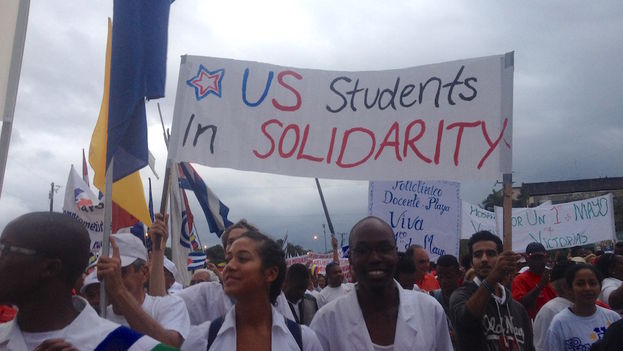
American students marching in Havana's May Day parade (Luz Escobar/14ymedio)
American students marching in Havana’s May Day parade (Luz Escobar/14ymedio)

14ymedio bigger14ymedio, Eliecer Avila, Havana, 1 May 2015 – Right now in the City of Havana, especially in the neighborhoods, families and individuals with fewer economic possibilities are living through hard times. Downpours, normal enough in many capitals in the world, take on a different character here.

A few days ago many were clamoring for a few drops of water to ameliorate the unbearable heat. But when you live with the danger of the roof falling in on you, desires are confused and you end up preferring to sweat.

I know exactly what it means to sleep with fear. I spent my childhood, teenage years, and early adulthood sleeping in a bed-hammock with my grandmother and my first cousin. At the least downpour, the power went out and with the boards creaking, the house moved as if dancing with the wind. continue reading

Mima went down on her knees on the ground and began to pray, which made Carlitos and me more nervous. The gaps in the thatched roof let all the water through and we had to seek out each drip with a candle and put pots, jugs, cups and whatever receptacle we had to protect the little display cabinet, the Caribe television and the mattress.

The worst of it was that not only water fell from the roof. Scorpions, spiders, cockroaches and ants, feeling threatened by the thunder and rain, slipped out of the walls, rushed under the doors or fell on our chests as we were trying to get back to sleep.

At five in the morning, after a sleepless night, Mima would try to light some damp coconut shells to brew coffee over a wood fire, whose ashes we used on our toothbrushes many times instead of toothpaste, which was a luxury at one time…

How many grandmothers watch over their sleeping grandchildren while it rains, trying to hold up the walls with their faith

Under these conditions, Mima raised us two grandsons, having also raised as good people our parents, working like a mule, although ill, for 110 Cuban pesos (roughly US$5.50) a month. No one is going to convince me today that my grandmother is not a true heroine.

Today she continues to live under these conditions, after a lifetime devoted to family, work and the Revolution. After a year of efforts at every level at the Ministry of Agriculture to approve the paperwork that would allow us to start building a small room on the ground where she has been living for more than 60 years, through her own efforts, we carried on without authorization. And they say that delay…

I think of my grandmother when I hear the news of building collapses in Havana. How many like her will watch over their sleeping grandchildren while trying to hold up the walls with their faith.

While floods ravage Havana, those directly responsible for the misery that prevents so many families from repairing their houses; the creators of a system that slowly demolishes every trace of beauty, comfort and dignity, it doesn’t even occur to them to appear on TV lamenting the loss of three Cuban lives that are added to so many others. On the contrary, with their harangues, and the excitement of the celebration, they show their lack of respect for the pain of the families who are mourning today.

Those directly responsible for the misery don’t even think of even appearing on television to lament the loss of three Cuban lives

The official press barely mentions the names of the deceased, as if they were potatoes, at the end of the newscast. In all honesty, they dedicate more broadcast time to potatoes.

Nothing can tarnish the brilliance of the parade, one old woman more or less. What matters is that the world sees Cubans making fools of themselves disguised as a victory that breaks all the Guinness Records for the absurd.

The State announced that it was calling into service more than 3,200 buses for the parade, including 78 damaged by the rains that were repaired in one day for the occasion. It seems that not a single journalist in Cuban has investigated the costs of these events and of how much progress could be made in repairing homes and building infrastructure with those resources.

Surely those interested in organizing the May Day celebrations don’t have to worry about their families, their homes, or many other things missing from our national daily life that have already been forgotten as the decades pass.

I just hope that this time, the General didn’t ask for the earth to tremble.

Obama Dances with Wolves / Angel Santiesteban

Angel Santiesteban-Prats, Unidad de Guardafronteras Prison, Havana, April 10, 2015 — President Obama is surrounded by Castros. In front he has the old wolf Raul, taking his turn as tyrant. To his left is Raul’s grandson and chief bodyguard. To his right, just behind Ban Ki Moon, is Raul’s son Alexander, wearing his faux-angelic expression, because he was suddenly promoted from colonel to brigadier general, and directs the black hand of State Security.

Raul Castro appears not to understand anything that Obama is saying. Alejandro displays a look of delight, of orgasm, of dreaming of reaching power with the approval of the Americans. When in a change of plans Obama shows up alone, the grandson clumsily shields his diminutive grandfather, and in his officiousness almost knocks Foreign Minister Bruno Rodriguez to the floor.

I don’t think the Castros are off the hook, at least not for the time being, if before they didn’t arrange to put their house in order, to organize the truths and the lies, to present, in the matter of human rights, something that relates to the present day.

A Flooded May Day in Havana / Yoani Sanchez

The sewers can barely deal with the mud from the storm (14ymedio)

Yoani Sanchez, 1 May 2015 – The El Cerro neighborhood is mud and tears right now. One of Havana’s most populous municipalities is trying to recover from the surprise rains that left three dead in the city, more than 1,400 houses affected and 27 partial or total building collapses. Many families lost their most precious belonging and the whole city has that smell that is left after floods, a mixture of sewage, garbage and pain.

The main scene of the tragedy experienced in the Havana capital is indoors, in the homes where they couldn’t save even a chair, but the official press tries to minimize it because it happened a few hours before the “triumphant” First of May, which is meant to show the world “the Cuban people’s attachment to the socialist system.” continue reading

The drama of those still cleaning out the mud with own efforts, shoveling it from their living rooms and bedrooms, doesn’t fit with today’s “workers’ glory,” foreign guests, and even Nicolas Maduro’s trip to share the platform in the Plaza of the Revolution with those who live in houses well-protected from inclement weather. Meanwhile, a few yards from the place where they waved flags and chanted slogans this morning, those affected by Wednesday’s storm tried to recapture the rhythm of their lives. The high water mark, which reached nearly six feet in some areas, is still fresh on the facades and in memories.

They should have suspended a parade that has cost thousands of pesos needed to help the victims

There are countries where it costs a president his job if he doesn’t personally go to the scene of an accident or a natural disaster. The absence of government officials in an area affected by a storm, a volcano or an earthquake earns the enmity of the citizens in many places, and the condemnation of the international community. In Cuba, however, fanfare has been imposed as a strategy to divert attention from the problems. This May Day has been an example of how official propaganda privileges triumphalism and minimizes misery.

A lady was sitting on the corner of Amenidad and Infanta Streets this morning, looking at the sky. Her hands wet from bailing out the water from the downstairs apartment where she lives. “I’m just waiting for the parade to end,” she said in a loud voice to anyone who would listen, with that wave of courage that overcomes us when we no longer have anything to lose. “When that’s over, maybe they will remember us,” she reaffirmed with a certain illusion.

They didn’t organize any parties in this miserable place. Out of shame, they should have suspended a parade that has cost thousands of pesos needed to help the victims. A little political sanity would have been required… but, who can ask those who have lived as well-to-do bourgeoisie for 56 years to think like the proletariat?

Cuba: A Bill to Penalize Acts of Repudiation / Juan Juan Almeida

Act of repudiation against and arrests of Ladies in White/
Act of repudiation against and arrests of Ladies in White.

To guarantee the prevalence of solidarity and respect, a bill is urgently needed that would penalize acts of repudiation, and hold their perpetrators and accomplices criminally responsible.

Help me to promote this bill.

Act of Repudiation Act of Repudiation

A Bill to Penalize Acts of Repudiation in Cuba

By Juan Juan Almeida

To guarantee the prevalence of solidarity and respect, a bill is urgently needed that would penalize acts of repudiation, and demand their perpetrators and accomplices be held criminally responsible.

We Cubans are living through an unequivocal social collapse and loss of values that we should, for the benefit of all, reverse. The Government bears much blame for this phenomenon that underlies civic conduct. Perhaps it thought that it was doing enough by providing us the opportunity for suitable professional advancement, and upon decreeing that good manners were a petit bourgeois vestige, created the “anti-value.” continue reading

It is true, although somewhat belatedly, that the Catholic Church plays an important role in reversing the process of moral degradation, and as of a few months back, Cuban television has been insistently broadcasting messages related to social education. This is commendable, but not enough – and to carry out such a campaign seems cynical and ironic to when in fact stupidity and rudeness are promoted and rewarded.

It seems contradictory that in Cuba, where the levels of instruction are decidedly elevated, formal education should be absolutely fractured and undervalued by the authorities.

What type of good behavior can be imparted to a child who is party to the impunity of someone who, without any legitimate reason, inflicts violence on his equals, or attacks others’ dignity and physical integrity, causing injuries with anatomical, physical and/or mental consequences?

We are a passionate people. I understand the urge to earnestly defend certain convictions, and that, under current circumstances, the government needs to display its superiority and control. But the ignominious act of repudiation is a form a discrimination that seeks to persecute, harass and exert the domination of one social group over another. It is the vulgarization of discord and a daily erosion of social mechanisms.

How many times have we not seen how a group of persons – immune to the law, but operating outside the cases authorized by the law – by employing violence, force and even intimidation, enter others’ homes without spoken or unspoken permission of its residents? The Internet is full of examples.

At this point, it is impossible to achieve good forms of conduct, and incorporate social courtesy in the Cuban temperament, without first penalizing similar behaviors that endanger community stability and social relations.

Today, to guarantee the prevalence of solidarity and respect, a bill is urgently needed that would penalize acts of repudiation, holding their perpetrators and accomplices criminally responsible. Sanctions would extend from prohibiting the frequenting of certain locations; prohibiting the practice of a given profession, charge or office; warnings; fines; limitation of freedom; correctional work with or without internment; up to incarceration – depending on the level of social dangerousness of the committed act, its circumstances and consequences, as well as any prior criminal record, recidivism and/or multiple repeat acts of the “repudiators” implicated in such intolerable outbursts of rage and violence.

Society belongs to all of us, equally. To promote a bill of this nature is not to confront the State, it does not undermine any of its inefficient institutions, it does not inflame anybody. It is merely a civic and civilized way to encourage respectful coexistence among Cubans – because when social distress signals are so clearly seen, it is everyone’s responsibility to pay attention and act.

Translated by: Alicia Barraqué Ellison

Cuba: Hildebrando Chaviano Tried / Ivan Garcia

El-candidato-_mn-620x330

Iván García, 20 April 2015 — Hildebrando Chaviano could pass for Obama if the US president’s secret service wanted to use him as a double. At his 65 years, Chaviano shines with the ability to lead. He likes to intone with the voice of a radio announcer, and doesn’t hide his affection for politics.

Like father, like son. His father was a member of the People’s Socialist Party, the Marxist party of Republican Cuba, with a vast labor union and influence on the intellectual and cultural environment.

He came to dissent from the bosom of the Revolution. He was a member of the Young Communists and for five years worked in the Ministry of the Interior (MININT). continue reading

“With my rebellious and liberal attitude I was always a controversial person. I wasn’t guy the government had confidence in. When they threw me out directly, they showed me the door to get out. I always questioned the role of the party, the government and the union,” he says, sitting in the living room of his apartment in the Focsa Building, one of the jewels of Cuban architecture and engineering.

The living room is living and lacks furnishing. Books are piled up on cheap wooden bookcase. From the window there is a panoramic view of the city and if feels like you can reach out and touch the intense blue of the Atlantic Ocean, visible on the horizon.

“From up here, you can’t see the misery and abandonment of the city. When I ran for delegate of the People’s Power, I didn’t present myself as a political opponent. My proposal is social. I think about the growing number of elderly who are forced to beg or rummage through garbage cans. The poverty, the chaotic infrastructure and the bad public transport service that affects everyone, whether or not they support the government. I firmly believe that the dissidence should start to work within the community. We are prepared for this change.”

After Hildebrando asking MININT, he entered the University of Havana and in 1978 graduated in Law. For 15 years he worked in the State-owned Select Fruits company. But in the summer of 1994, for being the kind of guy who is uncomfortable for the regime, he was left unemployed.

“As an option they offered me a place as a stevedore in a warehouse. I declined. I no longer believed in the system. I joined the dissidence in 2006. Leonardo Hernandez, a friend from childhood, introduced me to Jose Idelfonso Velez, who I consider my political manager. I joined an opposition association that worked for racial integration along with Juan Antonio Madrazo, Leonardo Calvo and Manuel Cuesta Morúa.”

The father of three and grandfather of four, Hildebrando feels comfortable in his role as a political activist. On a rainy afternoon in 2014 he joined the proposed Candidates for Change, led by the political scientist and freelance journalist Julio Aleaga Pesant.

“The strategy was to present some possible candidates. We had six, but through legal chicaneries of the regime, or because they gave up, we ended up with only two, Yuniel Lopez and me. Yuniel ran in a hard neighborhood in Arroyo Naranjo, the poorest and bloodiest in Havana,” said Chaviano.

The opposition strategy to infiltrate the few legal loopholes left unprotected by the olive-green regime is longstanding. In the 80s a regime opponent of the Ricardo Bofill group ran in a neighborhood assembly. In 2010, in Punta Brava, a Havana municipality of La Lisa, a platform was created to insert dissident candidates into the institution of the People’s Power. The only opponent who ran got very few votes.

“The elections to choose neighborhood delegates is probably the only democratic opening that exists on the island. It is undeniable that it is very difficult to pass through the sieve created by the political police and state institutions. But with a single narrative for the outside we will never be strong enough to send our message of democratic change to ordinary Cubans,” explains Chaviano.

The Achilles heel of the opposition is its scant power and its lack of a popular base. Its message is directed  more to the other side of the Florida Straits than to its next door neighbors.

Hildebrando regrets the lukewarm support of the dissidence for his run. “Some have told me that it was a betrayal. And have suggested to me that in the future I might use it as a springboard to State institutions. Solidarity has been minimal. Iván Hernández Carrillo, a former political prisoner of the Group of 75, is among the few who have supported me. Others have underestimated me and Yuniel.”

On election night he received 21 votes from his neighbors in the area where he lives in El Vededo. “Unlike the dissidence, neighbors and workers have shown me their support, openly or discreetly. I’ll take that,” said the dissident candidate.

Some hours after the neighborhood elections, Hildebrando is confident. “Several observers will supervise the vote and the counting, which is public. If I don’t win, I’ll propose to the candidate election that I will work with him to solve the innumerable social cases that are  beyond politics.”

Chaviano considers that the dissent must engage the community to play a leading role in the future of Cuba. On a distant night in 2004 on an old Russian radio, he heard a speech at a Democratic convention in the United States by a guy with an unpronounceable name.

His name was Barack Obama, and after reading the books written by the former Senator from Illinois, Hildebrando Chaviano is convinced that to achieve popular support you need to wear out your shoes in your community and listen to the people.

“It is true that in a totalitarian society it is more complex. You run the risk of going to jail and suffer harassment from the political police. But it’s worth a try. ”

Text and photo: Ivan Garcia

Note: Neither of the opposition candidates won the elections.
Eduardo Galeano’s Last Embrace / Angel Santiesteban

eduardo-galeanoAngel Santiesteban, Border Control Prison, Havana, 13 April 2015 — I met him at the beginning of the 90s. I was introduced to him after reading one of my stories and he liked it. He signed one of his books for me which I keep with devotion. In those years I accompanied him, along with his wife Helena, on some vacations in Veradero. They told me they wanted to talk, listen to ordinary Cubans, and they wanted to share with the people of Havana and Varadero. They talked with people as if they’d known them forever.

He had a sensibility that any artist would like to possess. I remember that cartoon where a boy watches a sculpture chiseling a rough stone. Later he starts to give it form and the silhouette of a horse emerges. And then the boy, surprised and curious, has the sculptor how he knew there was a horse inside the stone. continue reading

Eduardo Galeano, who was a victim of political persecution by another dictatorship, was not spared Cuban censorship. Fidel Castro and his cultural ideologues expunged some pages from his books and didn’t accept him. I am of the opinion that Galeano never forgave them.

When he broke with Cuba and made statements against the regime, they didn’t forgive him, and the distancing was maintained until his death. Since then Galeano avoided Cuba. The same thing happened with the “Sandinista Revolution” with which he had had strong ties of solidarity, and a deep friendship with the Commander Tomas Borges.

When the Piñata* happened, and the commanders shared out the riches of the country making themselves millionaires, including the current president Daniel Ortega, Galeano, who was a transparent and honest man decided to distance himself. But only physically because recently he was one of the activists most engaged in the transoceanic canal in Nicaragua because of the ecological damage it would cause.

In one of the last interviews he gave, we watched on Telesur when the interviewer asked him, “What do you want for your country (Uruguay) once Tabaré Vázquez assumes the presidency of your country.” Galeano avoided answering, nor did he response to the next question about the politics of his country, from which I inferred he didn’t have a good relationship. Galeano reflected, or vice versa, the sensibility reflected in his books, in the actions of his life, regardless of flags or the corners of political militancy, keeping his transparency and his soul.

*Translator’s note: From Wikipedia: “In Ortega’s last days as president [in his previous term in 1990], through a series of legislative acts known as “The Piñata,” estates that had been seized by the Sandinista government (some valued at millions and even billions of US dollars) became the private property of various FSLN officials, including Ortega himself.”