According to ‘Axios’, the US warned Cuba’s “elites in power” that they must accept its conditions: release of political prisoners, internet access with Starlink, economic and political freedoms, and compensation for confiscations since 1959.
 14ymedio, Havana, April 18, 2026 — Washington is no longer speaking to the Cuban regime in terms of détente, but rather in terms of ultimatums. Axios‘s revelation about the talks held in Havana between State Department officials and representatives of the regime’s leadership on the island confirms what had been suspected for weeks.
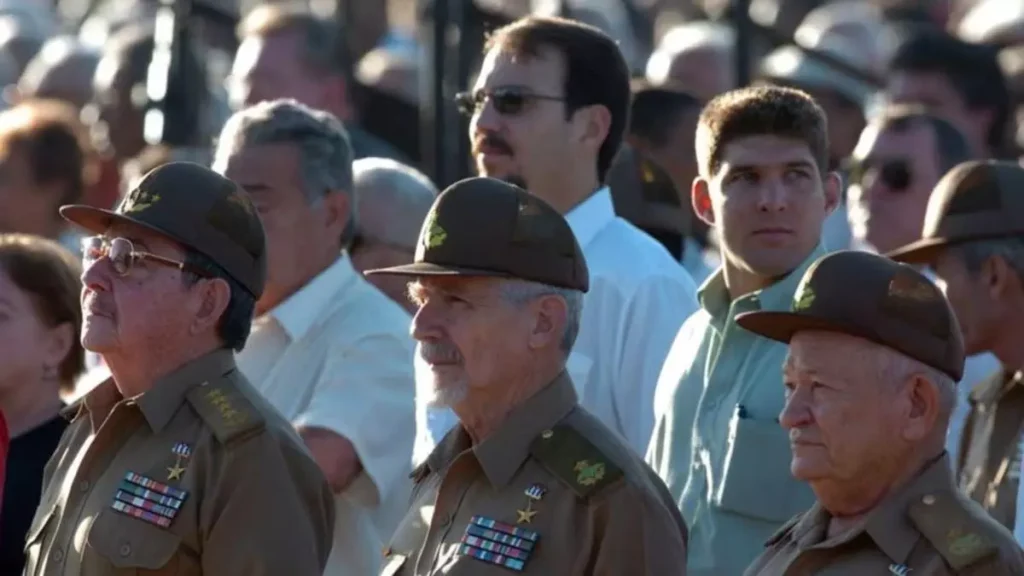
On the Cuban side were, among others, Raúl Guillermo Rodríguez Castro, Raúl Castro’s grandson, known as ” El Cangrejo” (The Crab), whom the United States considers a de facto spokesperson for the general. The U.S. delegation did not arrive with the intention of replicating Barack Obama’s thaw, but rather emissaries from an administration that sees Cuba “in freefall” and much closer to social collapse than to any voluntary reform.
According to the US media, Washington’s envoys put several central demands on the table: the release of political prisoners, greater economic and political freedoms for Cubans – including the prospect of free and fair elections – compensation for properties confiscated after 1959, and the opening of the internet through Starlink.
Added to this was a message that, while not explicitly stated as a direct threat, sounded exactly like one: the Trump administration will not allow the island, 90 miles from Key West, to become a greater threat to the national security of the United States. Washington’s evaluation is that “the Cuban economy is in freefall and the ruling elite has a small window of opportunity to implement U.S.-backed reforms before the situation deteriorates irreversibly.”
The one who continues to negotiate the future of Cuba is not a state official or a member of the National Assembly, but the Castro family.
Outside of Guantanamo, the plane that brought the State Department envoys is the first US government aircraft to land in Cuba since 2016. But the resemblance to the Obama era ends there. Now, the dialogue stems not from the hope of a gradual opening, but from the conviction that the Castro regime only understands the language of pressure. In the midst of the national disaster, those who continue to negotiate Cuba’s future are not state officials or members of the National Assembly, but the Castro family and their inner circle.
On the Cuban side, this same logic of a besieged city was expressed by Mariela Castro Espín, Raúl Castro’s daughter, in statements to AFP. As the director of the National Center for Sex Education (Cenesex) she asserted that her father, although no longer holding official positions, remains involved in the regime’s decision-making and “is rigorously following all the news, participating in the analyses” amidst the escalating tensions with Washington. During the ceremony commemorating the 65th anniversary of the Bay of Pigs invasion, she added that Cubans want “dialogue” with the United States to reduce tensions, but without questioning the island’s political system, and admitted that the government is “preparing for the worst.”
A few weeks earlier, during a speech before the “Our America” Convoy, Mariela Castro had already made her rejection of any internal dissent clear. She presented the opposition as a “fictitious,” “invented,” and “mercenary” creation, and uttered a phrase that clearly summarizes the official view of Cubans who reject the system: “Ignorance is the social base of fascism.” She did not need to add much more. In the language of power, anyone who opposes the government ceases to be a citizen and becomes an enemy.
In a similar tone President Miguel Díaz-Canel expressed himself during the ceremony commemorating the 65th anniversary of the proclamation of the socialist character of the Revolution. Speaking from the corner of 23rd and 12th streets, the president once again adopted the rhetoric of a besieged city. In the most impassioned part of his speech, he called for “resisting the onslaught of daily invasions,” proclaimed that as long as there are Cubans willing to give their lives for the Revolution, “we will be victorious,” and concluded with “Fuego vamos a dar!” [“We will give fire!”]
“Very soon this great force will make a day we have been waiting for for 70 years a reality. It is called a new dawn for Cuba.”
This Friday, in an interview with the Russian state media outlet RT, Díaz-Canel reiterated that Cuba is prepared to resist any potential US aggression and maintained that the island has “a people ready to fight,” with “millions of Cubans” prepared to struggle “to save the revolution and to defend Cuban soil.” At the same time, he again attributed the stalling of the country’s development to the US embargo, although he argued that, despite these limitations, the government has continued to “move forward,” and announced reforms for the first half of the year aimed at reducing the number of ministries, state-owned enterprises, and bureaucracy, resulting in a “flatter and more efficient” state apparatus. He also took the opportunity to thank Russia for the recent shipment of crude oil.
Across the Strait, Trump turned up the heat even more. On Friday, in Phoenix, Arizona, during a Turning Point USA event, he repeated his warnings: “Very soon this great force will bring about a day we have been waiting for for 70 years. It is called a new dawn for Cuba.” He then added, “We are going to help you with Cuba,” before appealing to the Miami exile community, “people who have been brutally treated, whose families have been murdered and brutalized,” concluding with a chilling “now look what’s going to happen.”
The Cuban leadership is invoking the specter of the Bay of Pigs invasion (April 1961) to rally its supporters; Trump is calling for a “new dawn” with rhetoric that blends promise, pressure, and threat. Caught in the middle are millions of Cubans trapped between a government that only knows how to blame the “blockade” for the disaster and a superpower that is once again speaking in terms of its outcome.
The poll published this week by the Miami Herald illustrates the extent to which the climate has become radicalized in exile as well: 79% of those surveyed support some form of military intervention, 88% among those who arrived in the US after 2000; while 78% reject agreements that maintain the current political system in exchange for economic reforms. Desperation with the regime has grown so much that even armed struggle is no longer a marginal option.
______________________
COLLABORATE WITH OUR WORK: The 14ymedio team is committed to practicing serious journalism that reflects Cuba’s reality in all its depth. Thank you for joining us on this long journey. We invite you to continue supporting us by becoming a member of 14ymedio now. Together we can continue transforming journalism in Cuba.