The call for workers to applaud the list of 176 bets on capitalism closes the cycle
 14ymedio, Havana, Manuel Cuesta Morúa, June 30, 2026 / The first death was quick. That of 1962, the one that left the democratic restoration behind. The second was slower and just as traumatic: it liquidated both the microfaction’s Bolshevism and the heterodox Marxism of the journal Pensamiento Crítico, while pulverizing, along the way, small and medium-sized businesses in 1968. The third occurred in the early 1990s, when the country began to get pregnant with frontier capitalism through Sun City-style tourism (that pleasure resort in the middle of apartheid South Africa), in alliance with friendly capitalist enterprises from the old West. And it remains curious that this capitalism entered through luxury and leisure – Batista’s last project – rather than through Fordism maquiladora capitalism.
The fourth death occurred when, after 2006, this capitalism of luxury, warehouses, and leisure was captured by the military and extended into the world of ports and finance – rumor has it, against Fidel Castro’s vision – in a crude reproduction of the colonial model of our 19th-century patrician, José Antonio Saco. We will not easily recover from this strategic wreckage.
The Revolution’s fifth death, in June 2026, occurs because, under pressure from the United States, capitalism becomes structural and intrinsic, in one of its worst variants, to the daily life of all Cubans: some to be included, and the rest, the majority, to be excludable. A small nod to Javier Milei. continue reading
This is its definitive death: when the narrative of revolutionary survival takes on capitalist productivity, which it always regarded as its negation
This is its definitive death, its clinical death: when the narrative of revolutionary survival takes on capitalist productivity, which it always regarded as its negation. When it no longer has command of the word – the Revolution’s fundamental asset – nor an organic discourse of equality, nor the coherent support of the distant left. Its acceptance is unfolding with much mourning, but its first phase consists of denying it.
Since the Cuban Revolution has always had problems with memory, codification, and the systematization of its own “thinking,” official discourse will now seek to dissolve, hide, and erase from the hegemonic discourse – the one that became cultural and shaped mental habits and reflexes – every reference that placed capitalism at the antipodes of the Revolution.
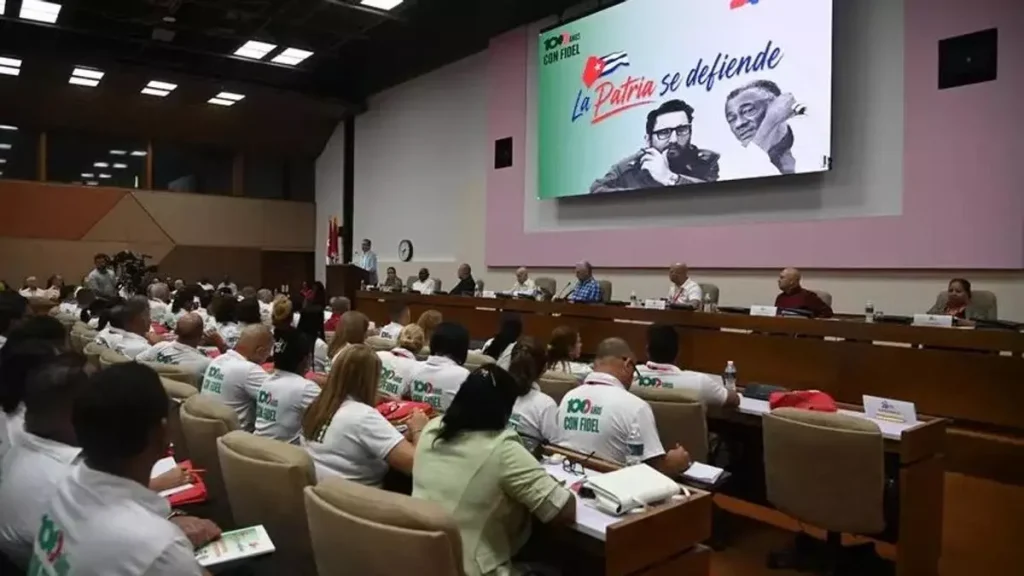
But there is no need to return to dense reading material, in an era when the attention economy stretches only as far as TikTok, a couple of Instagram videos, and some instant polarization on Facebook, to finally seal the Revolution’s end. The call for workers to applaud the list of 176 bets on capitalism – among them the sale of shares in the very companies they are supposedly owners of – now sets the closing tombstone on the harsh historical and existential vicissitudes that began in 1959, today into the void.
A round of applause, with which the working class commits suicide with North Korean-style energy at an emergency meeting of the Cuban Workers’ Confederation, is worth more than a thousand words.
The Party’s workers welcoming capital definitively closes the cycle of the Cuban Revolution. We may be glimpsing a Caribbean version of Rhenish capitalism, in which businesspeople and workers reach agreement on and for many things – except that German unions aren’t controlled by a politburo.
Then there’s the rhetoric. What those in power are saying, in their narrative poverty and lack of conceptual and dramatic force, falls squarely into the realm of schizophrenia and cognitive dissociation, with its parallel worlds, its alternative facts, and its processes of thawing old words, re-indoctrinating into new meanings, and freezing the poor new discourse. According to this account, the Revolution gets pregnant with capitalism in order to better give birth to communist society. So, on June 16, Cubans went to bed under the repression of the State of workers and peasants, and woke up on the 19th of that same month under the repression of the State of future shareholders. Why bother with democracy?
Faced with any scenario of ridiculous tragedies, we usually say of them that they would be laughable if they weren’t so tragic. But we Cubans find ourselves within the first global scenario in which the tragedy of real life and the guffaw provoked by the words of those in power appear simultaneously.
Translated by GH.
______________________
COLLABORATE WITH OUR WORK: The 14ymedio team is committed to practicing serious journalism that reflects Cuba’s reality in all its depth. Thank you for joining us on this long journey. We invite you to continue supporting us by becoming a member of 14ymedio now. Together we can continue transforming journalism in Cuba.