The Council for the Democratic Transition in Cuba demands its “own seat” at the negotiating table
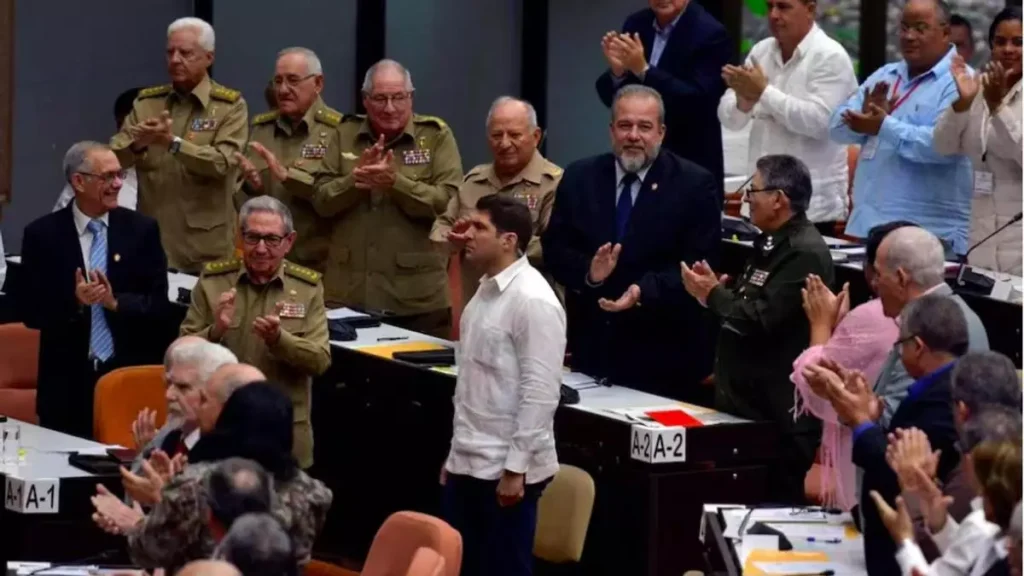
 14ymedio, Madrid, 21 April 2026 — The US State Department has officially confirmed that one of its senior officials had a private meeting with Raúl Guillermo Rodríguez Castro, grandson of Raúl Castro and known as El Cangrejo [The Crab], on the sidelines of the meeting held in Havana on April 10 between representatives of different countries.
A spokesperson for the agency confirmed to Café Fuerte what USA Today, citing anonymous sources, had reported in its Sunday article. “A senior State Department official also met separately with Raúl Guillermo Rodríguez Castro ( Raulito ) while he was on the island,” the spokesperson said, without providing further details about the American’s identity or the private meeting.
This Monday, Alejandro García del Toro, the deputy director general in charge of the US at the Ministry of Foreign Affairs, told the Cuban official press that there had indeed been a meeting between US and Cuban officials, although he denied that there was a two-week ultimatum to release high-level political prisoners, as USA Today had claimed hours earlier.
“A senior State Department official also met separately with Raúl Guillermo Rodríguez Castro (Raulito), while he was on the Island”
Washington, according to these leaks, requested these short-term releases as a goodwill gesture to continue negotiating other issues, including economic and political changes, permits to provide internet service to the population through Starlink, and responses to demands for the confiscations of the 1960s.
“During the meeting, neither side set deadlines or made any threatening statements, as has been reported by the U.S. press. The entire exchange was respectful and professional,” assured García del Toro. The official added that “the U.S. side was represented by Assistant Secretaries of State, and the Cuban side by the Deputy Minister of Foreign Affairs.”
However, Castro’s grandson only holds military rank—he is an Army colonel—and serves as his grandfather’s personal security detail, without any official political position. His behind-the-scenes involvement in the negotiations with the US was nonetheless implicitly confirmed when he appeared seated behind Foreign Minister Bruno Rodríguez during the press conference and address in which Miguel Díaz-Canel reported on the talks on March 13.
García del Toro also said on Monday regarding these meetings that the Cuban side prioritizes the energy issue, which it considers an act of economic coercion and punishment of the population. “It is also blackmail on a global scale against sovereign states, which have every right to export fuel to Cuba, under the rules that govern free trade,” he added. The official maintained that the topic of the talks “is a sensitive matter that, as we have said, we are handling with discretion.” This point has generated debate in the official media among supporters of the regime, who believe that as long as the press in the US leaks information, the Cuban side will always be at a disadvantage.
As news continues to trickle out on both sides of the Florida Straits, the Cuban opposition is asserting its right to a seat at the negotiating table. In a statement released Monday, the Council for Democratic Transition in Cuba (CTDC) insists that any talks on “change, democratization, openness, stability, governance, or the nation’s future should not be reduced to an exchange between two governments.”
Now that “a delicate and potentially significant political moment is opening up” for the country, “the real nation, not just the official one, must be represented in them in a visible and legitimate way.”
The organization, chaired by Manuel Cuesta Morúa, said that “the complexity and challenges of the present and future exceed the capacity of States to deal with them” and that, now that “a delicate and potentially significant political moment is opening up” for the country, “the real nation, not just the official one, must be represented in them in a visible and legitimate way.”
“Cuba is not just its state. Cuba is also its citizens, its civil society, its families, its political prisoners, its religious communities, its professionals, its reformers, its pro-democracy civil society and community, its entrepreneurs, and its diaspora,” the statement says.
The CTDC adds that this negotiation cannot be “an arrangement between elites, useful for managing situations, but insufficient to open a legitimate, stable and lasting way forward” and demands a table with a “public, brief and verifiable” agenda; “plural representation of civic and democratic sectors”; and a “non-violent, serious and solution-oriented” method, in addition to international accompaniment that “recognizes the right of Cuban society to have its own voice, without replacing it.”
______________________
COLLABORATE WITH OUR WORK: The 14ymedio team is committed to practicing serious journalism that reflects Cuba’s reality in all its depth. Thank you for joining us on this long journey. We invite you to continue supporting us by becoming a member of 14ymedio now. Together we can continue transforming journalism in Cuba.