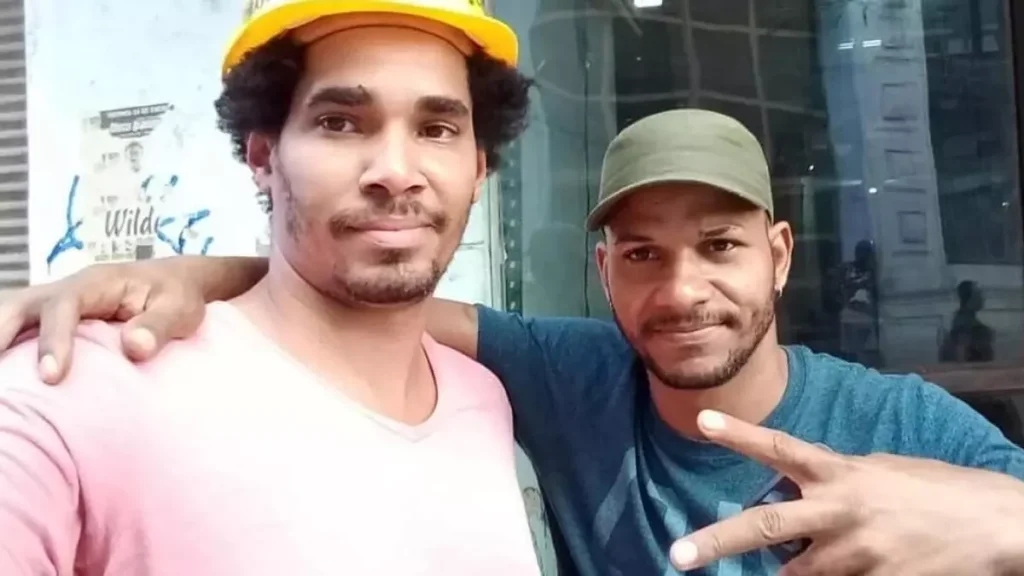
Actress Adela Legrá Dies in Santiago de Cuba

The star of Manuela and Lucía left a unique mark on national cinema


Adela Legrá was, in her own right, the quintessential Cuban peasant woman. / Excerpt from Lucía (1968)

14ymedio bigger14ymedio, Havana, 2 January 2026 — Adela Legrá’s intense gaze in Lucía (1968) is one of the most recognizable images in Cuban cinema. Early Friday morning the actress, discovered by Humberto Solás in the mid-1960s and who left a unique mark on national cinema, passed away in Santiago de Cuba. She was 86 years old when she died, and her name will forever be linked to two essential films: Manuela (1966) and Lucía.

Humberto Solás found her in Baracoa while preparing a medium-length film for a competition organized by the Cuban Institute of Cinematographic Art and Industry dedicated to the guerrillas. He wasn’t looking for an actress in the usual sense of the word, nor someone capable of “composing” a character. He needed a face and a body that would sustain the story without filters, without learned gestures. That same aspiration would be formulated years later by Robert Bresson, one of the great masters of modern cinema, in his book Notes on the Cinematographer (published in 1975), when he wrote: “What I am looking for is not acting, but presence. Not actors who act, but human beings who are.”

Adela Legrá embodied this idea almost literally. Her performance was not based on psychology or expressive calculation. There was something more direct, more physical about her. There was no clear distance between the woman and the character: the camera simply followed her. The rage, pain, or determination did not seem “acted”; they emerged as part of the same vital impulse. She was, in her own flesh, the quintessence of the Cuban peasant woman. continue reading

Her performance was not based on psychology or expressive calculation. There was something more direct, more physical about it.

This led to the creation of Manuela (1966), a film shot with formal freedom, handheld camera, and a method that allowed for improvisation. In it, Legrá moved with uncommon naturalness. Her energy was raw, sometimes overwhelming, and her direct gaze avoided any complacency.
Two years later, Solás called on her again for the third episode of Lucía. Considered one of the best works in the history of Cuban cinema, it is a classic that has transcended decades and is still studied today.

Throughout her career, Adela Legrá appeared in many other films, including Rancheador (1976), El brigadista (1978), Aquella larga noche (1979), Polvo rojo (1981), Miel para Oshún (2001), and Barrio Cuba (2005).

With her death, Cuban cinema loses an irreplaceable actress. Her gaze remains, and will always remain, present. Her body will lie in state in the coming hours at the El Calvario funeral home in Santiago de Cuba, according to the state-run media outlet Cubadebate.

Translated by GH

____________

COLLABORATE WITH OUR WORK: The 14ymedio team is committed to practicing serious journalism that reflects Cuba’s reality in all its depth. Thank you for joining us on this long journey. We invite you to continue supporting us by becoming a member of 14ymedio now. Together we can continue transforming journalism in Cuba.

Cuba: The Year Is Going Down In Flames

The burning of the effigy once again brings together satire, catharsis, and tradition in neighborhoods of Sancti Spíritus

The burning of the effigy of the old year is not exclusive to Sancti Spíritus or Cuba, but on the island it has acquired a very particular character. / 14ymedio

14ymedio bigger14ymedio, Mercedes García, Sancti Spíritus, January 1, 2026 – As evening falls on December 31st, in some neighborhoods of Sancti Spíritus, it is already clear that the year won’t pass in silence. Among scraps of wood, old clothes, cardboard, and empty bottles, the effigies of the “old year” begin to take shape—those makeshift figures that traditionally serve to concentrate frustrations, jokes, and collective catharsis before being set ablaze. There is no manual or single design: all it takes is a human-shaped body and the certainty that, when it burns, something symbolic will also go with the flames

In one of the doorways of the neighborhood, a mannequin stands as if guarding the street. It wears worn boots, blue pants, and—a far from innocent detail—a white sweater with the phrase “I Love This Island” printed next to a Cuban flag. The irony is obvious. In a country marked by mass exodus and social weariness, that message seems less like a slogan and more like an open question. “We made it like that on purpose,” a neighbor confesses as he adjusts the wire around its neck. “Loving the country doesn’t mean you don’t want to burn away all the bad things that happened,” he clarifies, listing everything from the long blackouts of 2025 to the chikungunya that left him with a sore knee.

In a country marked by mass exodus and social fatigue, that message seems less like a slogan and more like an open question / 14ymedio

A few meters further on, two nearly identical mannequins share the sidewalk. Both have exaggeratedly inflated bellies, short arms, and a rigid posture reminiscent of government officials: all belly, no brains. No explanatory sign is needed. Passersby look at them, smile, and whisper. Political satire finds a rudimentary but effective outlet here, protected by the alibi of tradition.

The burning of the effigy of the old year is not exclusive to Sancti Spíritus or Cuba, but on the island it has taken on a very particular character. Here it is mixed with local humor and the need for catharsis. Burning the effigy is a way of saying goodbye to the bad: the shortages, the lines, the broken promises, the exorbitant prices, and also the accumulated fears.

As night falls, when the street darkens continue reading

and someone lights a match, the atmosphere changes. The fire catches quickly. Flames devour the clothes, the wood crackles, and the effigy, seated in an old metal chair, is enveloped in an orange light that illuminates the nearby facades. There is applause, nervous laughter, and the occasional sarcastic comment. It’s not a solemn bonfire; it’s more of a domestic ritual, improvised, but full of meaning.

Political satire finds a rudimentary but effective channel here, protected by the alibi of tradition. / 14ymedio

While the effigy burns, in other parts of Cuba others perform their own rituals. At midnight, many throw buckets of water from their front doors to “wash away the bad.” Others, more optimistic or desperate, walk around the block with an empty suitcase, convinced that this will attract a trip in the coming year. Every gesture, however small it may seem, is a gamble on hope.

When only ashes and a lingering smell of burnt fabric remain, the street regains its calm. The effigy is gone, but the gesture remains. In Sancti Spíritus, as in so many places across the country, burning the effigy of the old year doesn’t change reality overnight, but it allows for something equally necessary: ​​to say, without speeches or slogans, that there was too much weight to carry and that at least tonight, the decision was made to release it into the fire.

____________

COLLABORATE WITH OUR WORK: The 14ymedio team is committed to practicing serious journalism that reflects Cuba’s reality in all its depth. Thank you for joining us on this long journey. We invite you to continue supporting us by becoming a member of 14ymedio now. Together we can continue transforming journalism in Cuba.

Cuba, The Never-Ending Crisis

Three determining factors shape the scenario for 2026: institutional deterioration, external isolation, and political stagnation

The epidemiological crisis exposed a healthcare system trapped between material deterioration and public distrust. / EFE/ Yander Zamora

14ymedio bigger14ymedio, Havana, January 1, 2026 –In 2025, Cuba reached December exhausted, with the feeling of having lived through a year too long for so little breath. The epidemiological crisis laid bare a healthcare system trapped between material deterioration and public distrust. Hospitals collapsed in the midst of the arbovirus epidemic, and the lack of medicines revealed that the country can no longer feign self-sufficiency or moral authority in the management of public health. Where there was once propaganda of medical prowess, today there are only wards without doctors and patients who must find supplies on their own.

Nor could tourism —once an economic lifeline—provide any relief. The sustained drop in visitors dragged down jobs, reduced income, and left hotel rooms empty.

On the political front, continuity has been the regime’s main line of defense, in a context marked by the exile of activists and, simultaneously, the deportation by the US of migrants linked to the government. Repression remained high, especially against the informal currency market and the digital news site El Toque, which has become a scapegoat for an economy increasingly dependent on the dollar.

The exodus of athletes continued, reflecting a country that is losing talent at the same rate as the decline of sports.

The exodus of athletes continued, reflecting a country losing talent at the same rate as the decline of sports, and, most dramatically, baseball. The blackouts, with several successive collapses of the national power grid, were more than just long hours without electricity each day: they became the everyday metaphor for a political project that doesn’t illuminate, only spreads darkness around it. Not even the new photovoltaic parks managed to alleviate the electricity crisis.

On the international stage, Havana faced increasing isolation and palpable nervousness in the face of Washington’s encirclement of Nicolás Maduro ‘s regime, one of its last remaining external pillars of support. Signals emanating from Caracas foreshadow turbulence and potential outcomes continue reading

that could leave the Cuban leadership without one of its most strategic allies.

Hurricane Melissa added a natural disaster to a year already marked by the erosion of institutions, unable to assist those affected, and the exponential growth of poverty, fueled by rampant inflation that primarily impacts food prices. Protests over the lack of electricity and water became an increasingly direct expression of popular discontent. Meanwhile, the military conglomerate Gaesa consolidated its economic and financial control by opening dollar stores selling food and basic goods.

Without a reformist roadmap, the population views the future like someone staring at the sea on a dark night: they cannot make out the shore, but they know it exists.

By 2026, the outlook appears even bleaker. Without a reformist roadmap, the population views the future like someone staring at the sea on a dark night: they can’t make out the shore, but they know it exists.

However, Cuban society has reached this point with something it previously lacked: a widespread awareness of its own strength, tested in the streets by the banging of pots and pans and cries of “Freedom!” This is not naive optimism, but rather an understanding that even in the longest nights there are cracks through which light can seep. And these cracks, opened by ordinary people, can mark the beginning of a change that no longer depends solely on those in power.

____________

COLLABORATE WITH OUR WORK: The 14ymedio team is committed to practicing serious journalism that reflects Cuba’s reality in all its depth. Thank you for joining us on this long journey. We invite you to continue supporting us by becoming a member of 14ymedio now. Together we can continue transforming journalism in Cuba.

Cuba: The Deaths That Marked 2025

A look at the year’s most significant farewells

This newspaper accompanied many farewells, convinced that remembering is also a way of narrating the present. / Collage

14ymedio biggerThroughout 2025, numerous farewells took place. The obituaries published during these 12 months in 14ymedio have not only been a record of the end of those lives, but also a way to contextualize the legacy they left behind. It is worthwhile now to take stock of those goodbyes, including the Cubans who passed away—those closest to us, those who directly touched the heart of the country—and international figures whose passing also left its mark on public debate

The death of Paulito FG in a traffic accident marked one of the most shocking moments of the year. An idol of popular dance music, his persona epitomized the transition from timba to the big stage, coupled with a remarkable professional ability to maintain contact with the public for decades. Alongside him, the passing of Edesio Alejandro brought to a close a fundamental era in Cuban film and theater music: a restless, experimental composer, capable of breaking molds in an increasingly narrow cultural landscape.

In acting and film, Mario Limonta and Luis Alberto Ramírez represented different generations, yet were equally recognizable to Cuban audiences. Ramírez also joined the tragic list of those who have died from the viruses circulating on the island, a public health crisis that marked 2025 and claimed several victims in the cultural world. The death of José Antonio Chávez, remembered for his impressive work with the Camagüey Ballet, was also attributed to this same cause.

2025 was the year in which these deaths forced us to look back, to measure trajectories and to ask ourselves what remains when the voices are silenced
Theater and film also lost Manuel Marzel, a discreet but constant filmmaker, and television said goodbye to Aris Teresa Bruzos, the endearing Evarista from Vivir del cuento, whose popularity made her part of the daily life of millions of Cubans.

In the field of visual arts, the death in Madrid of Waldo Balart marked the end of an era for one continue reading

of the most important abstract artists on the island and in the world, known for his kinetic style and conceptual rigor. Zenaida Armenteros, a key figure in Afro-Cuban culture, also passed away; her work as a researcher and promoter left a significant mark on the preservation of traditions.

The disappearance of Eduardo Torres Cuevas, historian and essayist, signified the loss of one of the most influential voices in official cultural thought. His work helped construct the historical narrative of the Revolution, and his death reopened debates about memory and power.

Independent journalism and the Cuban opposition also lost key figures. Manuel Ballagas, a controversial and exiled chronicler, left behind a body of work marked by denunciation and critical analysis of the system. Wilfredo Vallín, a lawyer and human rights defender, was a central figure in the creation of civic spaces outside state control, while the death of reporter Juan González Febles forced a rethinking of independent journalism.

In exile, Yndamiro Restano, a pioneer of opposition thought, and Luis Conte Agüero  an emblematic voice in Cuban politics and radio for decades, both died. They were joined by Salvador Lemis , a playwright and cultural promoter whose work was marked by the tension between the absurd, social metaphor, and the exploration of identity.

Among the figures directly linked to power, the death of Ricardo Cabrisas closed the chapter on one of the men who for decades “reassured” foreign investors and negotiators, the technocratic face of a system in crisis. Osmany Cienfuegos, brother of Commander Camilo, also passed away; his life was spent in official positions and gradually distancing himself from the center of power.

The year was also marked by the death of Pope Francis.

In exile, the death of Lincoln Díaz-Balart served as a reminder of the diaspora’s influence on American politics and the role of Cuban-American congressmen in Washington’s agenda toward Havana. Meanwhile, the painter Humberto Calzada left behind a body of work recognizable for its silent architecture and timeless interiors, where human absence becomes the central theme. Through stillness and formal rigor, the artist constructed one of the most robust visual poetics in contemporary Cuban art.

The year was also marked by the death of Pope Francis, a figure who, through his actions and words, influenced the relationship between Cuba and the Vatican and deepened a path of rapprochement with the Castro regime. Mario Vargas Llosa, an essential novelist and essayist whose ideas and controversies resonated for decades in Latin America, also passed away. His work was banned for decades from official publishing houses and public tributes on the island, although just a few days ago, the Ateneo de La Habana organized a literary discussion about the Peruvian writer for the first time, with the participation of Leonardo Padura.

The world of film and fashion lost some globally renowned names: Robert Redford, actor and director; Claudia Cardinale, an icon of European cinema; Diane Keaton, a role model for several generations; and Giorgio Armani, creator of an aesthetic that transcended the catwalk. In music, the death of Ozzy Osbourne brought to a close the story of one of rock’s most extreme figures.

From science and environmental activism, Jane Goodall left a legacy of research and defense of nature that transcended disciplines. In Latin American politics, the passing of Violeta Barrios de Chamorro and Pepe Mujica served as a reminder of two very different ways of wielding power, both influential in the region.

Thus, 2025 was the year in which these deaths forced us to look back, to measure trajectories, and to ask ourselves what remains when voices are silenced. In this exercise of memory, this newspaper accompanied many farewells, convinced that remembering is also a way of narrating the present.

____________

COLLABORATE WITH OUR WORK: The 14ymedio team is committed to practicing serious journalism that reflects Cuba’s reality in all its depth. Thank you for joining us on this long journey. We invite you to continue supporting us by becoming a member of 14ymedio now. Together we can continue transforming journalism in Cuba.

The Fábrica De Arte Cubano Denounces a Smear Campaign Encouraged by the Authorities

The cultural center attributes an alleged racist act to a misunderstanding on the part of its security staff.

14ymedio bigger14ymedio, Havana, January 1, 2026 — The Fábrica De Arte Cubano [Cuban Art Factory] (FAC) released a statement this Wednesday rejecting accusations of racial discrimination that circulated against it following an incident that occurred at the end of December. The cultural center maintains that the episode is part of a smear campaign launched after authorities prohibited a tribute to Celia Cruz for her centennial in mid-October

The incident occurred on December 26, when Alejandro Bridón Mesa reported on social media that he and two companions were denied entry to the Fábrica de Arte Cubano under the pretext of “right of admission,” without any explanation from security personnel. According to his account, while he was denied access supposedly because he is Black and Cuban, other people, especially foreigners, entered without difficulty, a situation he described as “humiliating.”

The denunciation spread rapidly on digital platforms, where it was shared by numerous users and generated a broad public debate about the application of the right of admission in cultural spaces.

The denunciation spread rapidly on digital platforms, where it was shared by numerous users

In the comments section of the original post, the Fábrica de Arte Cubano  itself added another element, noting that Bridón Mesa had visited the venue on previous occasions without incident. According to that message, after conducting internal inquiries, the young man was personally continue reading

contacted by musician and producer X Alfonso to offer explanations and apologies. The institution then reiterated that it is not a racist or exclusionary space and affirmed that the Fábrica de Arte Cubano “is and will continue to be everyone’s home.”

This Thursday, X Alfonso, founder and director of the cultural center, stated on his private social media accounts that a mistake had been made. In a particularly critical tone regarding the official smear campaigns, he wrote: “Don’t come at me with stories or official campaigns of empty rhetoric. For those with short memories: the absurd use of the right of admission is what many of us experienced for years at Kevin’s age, when we were denied entry to hotels, social clubs, or shops for reasons that weren’t ours.”

The artist wrote on social media, where he also explained that security personnel mistook the young man for someone known to have committed thefts on the premises and that the decision was not motivated by racial reasons. Furthermore, he asserted that the right of admission is used only to prevent access to “people with criminal records on the premises, whether for theft, harassment, disrespect towards the public or staff, or when they arrive visibly intoxicated or under the influence of drugs, endangering the safety of others.”

Fueling the controversy, the Cuban Institute of Music criticized the Cuban Federation of Music’s (FAC) response on social media and in official media outlets such as the State newspaper Granma and Cubadebate, deeming the justification given for the incident insufficient. At the same time, the Institute asserted that the event had been manipulated by external actors to discredit the institutions and sow division within the “Revolution.” According to the statement, several members of the National Center for Popular Music and the Institute itself personally visited Bridón to explain that the entire incident was nothing more than an arbitrary decision by an employee. According to this official version, Bridón was satisfied with the explanation.

Founded in 2014, the Cuban Art Factory is a multidisciplinary center that has established itself as one of the main cultural venues in the capital.

____________

COLLABORATE WITH OUR WORK: The 14ymedio team is committed to practicing serious journalism that reflects Cuba’s reality in all its depth. Thank you for joining us on this long journey. We invite you to continue supporting us by becoming a member of 14ymedio now. Together we can continue transforming journalism in Cuba.
The People of Matanzas, Cuba, Managed To Revive the Colla Festival This Year

Lacking state support, this celebration of Catalan origin was able to be organized thanks to a citizens’ initiative.

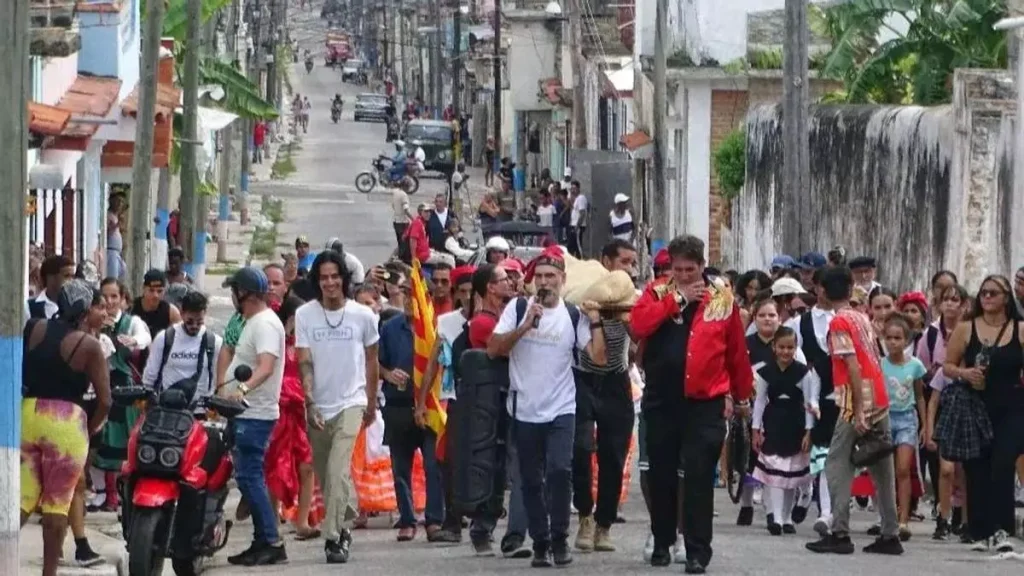
The tradition involves walking from Liberty Park to the hermitage and returning to perform the ritual of bread in sauce and wine at the old Spanish Casino. / 14ymedio

14ymedio bigger14ymedio, Pablo Padilla Cruz, Matanzas, December 31, 2025 – On December 14th, the Colla festival took place in the city of Matanzas. This celebration of Catalan origin was made possible this year thanks to a citizen initiative, without any government support. The traditional festival, almost as much a part of Matanzas as it is Catalan, consists of a pilgrimage from Liberty Park to the Monserrate Hermitage.

Among the participants was María Ester, a resident of San Gabriel Street. “I participate almost every year. Even at 68, I can still climb up to Monserrate, but I know that one day my body will say enough is enough,” she told 14ymedio as she walked with difficulty. “For now, even though I don’t have much Catalan in me, I go and enjoy the festival. It’s something that takes me out of my daily routine,” she added with a smile as she disappeared into the crowd.

The celebration is an ode to the city’s Catalan heritage and is the only festival of its kind in Latin America. / 14ymedio

The Colla festival is an identity symbol of Hispanicity in Matanzas; the celebration is an ode to the Catalan heritage of the city and is the only festival of its kind in Latin America.

During the pilgrimage, Lionel Orozco, the city’s curator, explained to 14ymedio that the term “colla” means group or gang in Catalan. “The people of Matanzas are the colla, symbolically, and the tradition consists of going from Liberty Park to the hermitage and returning to perform the ritual of bread in sauce and wine at the old Spanish Casino, now the Provincial Library.”

Orozco also addressed the current difficulties in maintaining the celebration. “Given the country’s situation, it’s difficult to uphold this tradition, especially since it’s based on bread, and we all know that bread is a luxury right now. However, the Catalan Association has found the strength to continue and has given us another year of this tradition. Without them, Matanzas wouldn’t be Matanzas,” he stated.

“You never know what will happen next year or if we’ll meet again on pilgrimage.” / 14ymedio

The festival was revived in 1981 and has since been maintained as part of Matanzas Culture Week, although its continuation has always been at risk. Gonzalo, a member of the Catalan Association and one of the organizers, explained some of the obstacles they have faced. “The pandemic put the festival on hold for two years. The condition of the chapel also limited us until its repair in 2009 and 2019, since it is a structure inaugurated in 1875 that was almost abandoned for many years,” he said.

“We depend on gastronomy and its offerings for family enjoyment, and also on culture and the artistic work of the new generations who keep Hispanic identity alive. You never know what will happen next year or if we will meet again on this pilgrimage,” he added. “That is why it is important to pass this tradition on to the younger generations and keep alive the pilgrimage and the Hispanic roots that define us.”

For now, amidst traditional Spanish dances, bread, and wine, the group ascends and descends the city streets, filling them with color. However, uncertainty remains as to whether this will be the last pilgrimage due to a lack of state support and health issues, circumstances that directly affect the roots, traditions, and identity of the people of Matanzas.

____________

COLLABORATE WITH OUR WORK: The 14ymedio team is committed to practicing serious journalism that reflects Cuba’s reality in all its depth. Thank you for joining us on this long journey. We invite you to continue supporting us by becoming a member of 14ymedio now. Together we can continue transforming journalism in Cuba.
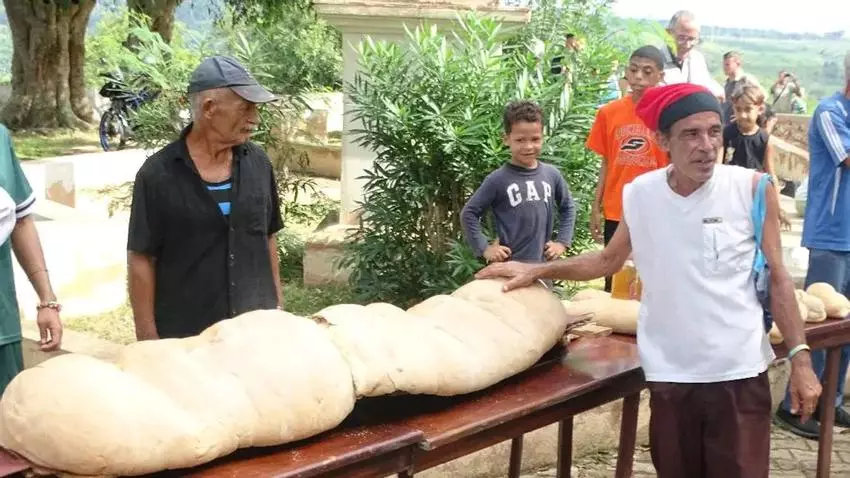
Whether to Buy Food or Medicine? The Dilemma for Cubans When They Stock Up at the Neighborhood Pharmacy

“The 1,000 pesos I had saved to buy a piece of meat are going to be spent on medicine,” says a retired woman in San José de las Lajas.

The pharmacy in La Micro is a small shop with worn walls and lighting that doesn’t dispel the gloom. / 14ymedio

14ymedio bigger14ymedio, Julio César Contreras, San José de las Lajas — At seven in the morning, the green gate of the pharmacy in the La Micro neighborhood already had a line that stretched around the corner. There was no sign announcing the arrival of medicine, nor an official announcement, but in San José de las Lajas, important news spreads by word of mouth with the speed of necessity. It only took someone saying “something came in” for many to leave the stove lit, the broom leaning against the wall, or a grandchild in the care of a neighbor, and head out with the folded card in their pocket. The scene, repeated so many times in recent years, took on a particular air of urgency last Monday: it wasn’t about buying, but about not waiting any longer.

“It’s been over four months since we last got captopril,” says Mabel, a second-grade teacher, referring to a blood pressure medicine, as she fanned herself with a notebook she carries in her purse. During that time, she’s been buying it on the street for 500 pesos per blister pack, an amount that eats up a good chunk of her salary. To be in line at the pharmacy, she left her students with a teaching assistant and practically ran out. “This isn’t about getting ahead of ourselves, it’s about not running out,” she explains. In front of her, a couple of women check their prescriptions again and again, as if the paper might vanish before reaching the counter.

The pharmacy in La Micro is a small shop with worn walls and lighting that barely dispels the gloom. Sales proceed with the usual slowness, and each customer seems to take longer to be served than the last. Outside, those waiting make themselves comfortable as best they can: sitting on the wall, standing under the asbestos roof, or leaning against the rusted window bars. Most are middle-aged and elderly, carrying that accumulated weariness that not even continue reading

good news can dispel.

“I even brought a prescription for amoxicillin, although they told me no antibiotics were allowed in,” Mabel says in a low voice.

“I even have a prescription for amoxicillin, although they told me no antibiotics were delivered,” Mabel remarks quietly. The complaint is echoed among those present: “Other establishments in town get their supplies first; we get what’s left over.” The usual suspicions of favoritism and cronyism also hang in the air, a constant murmur that no one can quite confirm but that is part of the scene. The distrust, like the queue, is now ingrained.

Zenaida, a 67-year-old retired architect, got her place in line at five in the morning and is still number seven. “The 1,000 pesos I had saved to buy a little piece of meat are going to go toward medicine,” she says without raising her voice. She suffers from several chronic illnesses and knows the cruel arithmetic of these times all too well: either she eats better or she sleeps without pain. “I thought nothing would come in until January. I’d rather spend the 31st with just rice and beans than spend the night awake because of my joints,” she confesses as she takes two 500-peso bills, crumpled from being kept for so long, out of her purse.

Inside the pharmacy, an employee rigorously controls access to the counter. Looking out the barred window, he repeats the directive: three prescriptions per person, no more. “As long as I’m here, there won’t be any disorder,” he warns, aware that some see each shipment of medication as a business opportunity. His vigilance contrasts sharply with the precariousness of the system he’s trying to maintain: few medications, too many needs, and a distribution chain plagued by theft, diversion, and lack of oversight, as documented in recent months by investigations into the deterioration of the public health system.

The scene becomes almost ritualistic. Every time someone leaves with a bag in hand, the others ask what they managed to buy, how much there was, what’s already gone. The inventory is rebuilt in real time: captopril, some clonazepam, a few painkillers. Nowhere near enough for everyone waiting, nor anything that will last long. “This is a respite, not a solution,” a retiree remarks, adjusting his cap and looking at the ground. “Now they might bring it back in March or April. That’s why I came running.”

The approach of the end of the year is the topic of every conversation. No one is talking about celebrations, but about survival.

The approach of the end of the year is the topic of every conversation. No one talks about celebrations, but about survival. In the queue, stories of expired prescriptions, months without treatment, and exorbitant prices on the black market intertwine. Some remember when the pharmacy was a place for quick errands and not a test of physical endurance. Others prefer not to remember.

In San José de las Lajas, as in the rest of the country, the shortage of medications has forced chronically ill patients to reorganize their lives around the scarcity. The pharmacy becomes a meeting point, a social barometer, a stage where the strain is measured. This Monday, the arrival of “a few” medications did not solve the problem, but it did raise a small, almost defensive hope: that of not being left completely unprotected.

As midday approaches and the queue begins to dwindle, some return home with the essentials; others, with empty hands.

____________

COLLABORATE WITH OUR WORK: The 14ymedio team is committed to practicing serious journalism that reflects Cuba’s reality in all its depth. Thank you for joining us on this long journey. We invite you to continue supporting us by becoming a member of 14ymedio now. Together we can continue transforming journalism in Cuba.

Granma Province, Cuba: “With No Propane To Cook the Little You Can Get, What Is There To Celebrate This December 31?”

Granma Province runs out of liquefied gas due to lack of availability at the Santiago de Cuba plant

In Sancti Spíritus, neighbors asked one another for charcoal to cook. / 14ymedio

14ymedio bigger14ymedio, Madrid, December 30, 2025 — It was timely for the Granma Province television station to ask the population about their experience without propane. The local television station published a notice on its Facebook page, previously provided by the Provincial Territorial Fuel Marketing Division, warning that due to the lack of availability of propane canisters at the Santiago de Cuba plant, there would be no sales “until further notice.”

The report took note of the number of criticisms sparked by the entity’s announcement and decided to ask residents to share their experiences. “How is this situation affecting your community? We invite you to share your experience in the comments.” Few posts by the station have generated such a volume of responses – more than 100 so far – when most comments are usually about the daily power outage report, with about 24 replies. It is fair to note, however, that on December 26, a video of the “celebration” of the 67th Anniversary of the Revolutionary Victory in the municipality of Río Cauto drew more than 300 complaints, mostly critical: “Give that town some quality of life, they are dying while still alive. You should be ashamed of such a charade celebrating something that has not existed for many years,” one of many posts read.

The message about the lack of propane has accumulated countless complaints that reflect the state of affairs in the eastern province. “Our situation is truly sad. The end of the year arrives and people are under the same stress we have endured all year: no electricity, no water, no cash, scarce food, a basic ration basket that is completely out of sync (today the 29th, the six pounds of rice and three of sugar that were announced still haven’t reached the ration store). And an apparent normality that gives the impression that no one with decision-making power has any idea what the people are living through. They don’t even explain anymore. We only see apologies for the inconvenience caused. ‘Company management appreciates…’ Where is the understanding? No one understands,” wrote one user.

“At my distribution point, number 78 in Santiago de Cuba, located in San Félix, since distribution began they have only delivered twice,” argued another. “In my community this is affecting us a lot, because this area is one of those hardest hit by power outages. This is like a deserted mountain: all you hear is the sound of axes chopping firewood. Hopefully continue reading

it will be restored soon. Happy New Year,” said another comment, somewhat more optimistic. Quite the opposite was a reader who retained not even a trace of the holiday spirit expected at this time of year: “How sad our lives are. No water, no electricity, no propane to cook the little that can be obtained. What is there to celebrate this December 31? And life goes on and nobody seems to care.”

“This is like a deserted mountain: all you hear is the sound of axes chopping firewood. Hopefully it will be restored soon. Happy New Year.”

The situation is discouraging, and not only in the eastern region, where yesterday another moment of panic was experienced when a fault on the “110 kV Renté-Santiago Industrial line, which supplies much of Guantánamo province,” disconnected that province from the National Electric System. The issue was resolved in a matter of minutes, but it has become impossible to tell when the grid is or is not connected. The state company was forced to clarify that once the line was repaired, “the electricity deficit in the province is due to lack of generation.”

While waiting to find out if the Antonio Guiteras power plant in Matanzas manages to reconnect properly to the system, the Island faces another day of energy shortages. Despite forecasts of very low temperatures for the end of the year, not exceeding 18 degrees Celsius (64.4 F), demand remains very high relative to the limited generation available. Expected availability during peak hours is just 1,570 megawatts, less than half of the country’s required 3,300 MW, so an impact of 1,760 MW is anticipated for that time slot.

The rest of the day should theoretically be better. Demand is much lower, at 2,100 MW, and although production is also limited at 1,420 MW, the maximum impact will be 950 MW. Breakdowns at unit 5 of the Mariel thermoelectric plant, unit 2 of Felton, and unit 6 of Renté add to the maintenance work on unit 2 of Santa Cruz and unit 4 of Carlos Manuel de Céspedes in Cienfuegos.

Nevertheless, the problems come mainly from distributed generation, which has 93 plants offline, totaling 1,039 megawatts on New Year’s Eve.

Translated by Regina Anavy

____________

COLLABORATE WITH OUR WORK: The 14ymedio team is committed to practicing serious journalism that reflects Cuba’s reality in all its depth. Thank you for joining us on this long journey. We invite you to continue supporting us by becoming a member of 14ymedio now. Together we can continue transforming journalism in Cuba.

Cuban Faces 2025: Generation Z in Cuba, Neither Silent Nor Submissive

This generational awakening, with its own particularities, has also begun to manifest itself in Cuba

Social media serves as a window through which many young people portray their lives on the island. / Facebook

14ymedio bigger14ymedio, Havana, 30 December 2025 —  In various parts of the world, Generation Z has begun to occupy a visible place in public life. Young people born in the late 1990s and early 2000s have participated in protests and social movements that have challenged governments, traditional leadership, and official narratives, from Peru to Indonesia, and including Madagascar, Kenya, Morocco, and the Philippines.

This generational awakening, with its own particularities, has also begun to manifest itself in Cuba. Far from the image of apathy that for years was associated with youth on the island, some young people have found ways to express their discontent and participate in public debates from their immediate surroundings or through digital platforms. Among the names that have gained visibility are Erlis Sierra and Ana Sofía Benítez, whose public statements have brought everyday problems to the forefront.

Sierra became visible after releasing a video in which he complained to officials of the municipality of Contramaestre about the power outages.

Erlis Sierra, a pediatrician residing in Baire, Santiago de Cuba, gained notoriety after posting a video in which he complained to officials in the municipality of Contramaestre about power outages, water shortages, and garbage accumulation, citing the Cuban Constitution to support his demands. Shortly afterward, two police officers arrested him at his home and took him in handcuffs to Santiago de Cuba, according to local residents. During his arrest, another video circulated continue reading

in which Sierra claimed to be “fine,” although some internet users pointed out that the recording appeared to have been made under the supervision of State Security.

The doctor’s mother, Ania Gómez Leiva, also spoke publicly, appealing for help in securing her son’s release. Neighbors reported a police presence in the area and warnings issued to those sharing information about the incident.

Ana Sofía Benítez has used digital environments as a space for reflection

Ana Sofía Benítez, for her part, has used digital environments as a space for reflection. Her publications describe common experiences of life in Cuba, such as limited access to printed books and reliance on online resources for studying and staying informed. Through these narratives, she has shown how young people of her generation face material constraints while developing strategies to adapt to them.

Social media serves as a window through which many young people portray their lives on the island. Audiences outside of Cuba closely follow this content, which offers a direct glimpse into the living conditions of the population. The hashtag #VivoEnCuba (I Live in Cuba) has gained prominence as a space where young creators document daily life. Some, like Frank Camayeris, achieved popularity before emigrating, while others continue to produce content from the country, such as Aprendedora (Learner), who recently narrated the arrival of Hurricane Melissa from her daily experience in Holguín.

See also: Cuban Faces 2025: The 14 Faces That Marked the Pulse of Cuba in 2025

____________

COLLABORATE WITH OUR WORK: The 14ymedio team is committed to practicing serious journalism that reflects Cuba’s reality in all its depth. Thank you for joining us on this long journey. We invite you to continue supporting us by becoming a member of 14ymedio now. Together we can continue transforming journalism in Cuba.
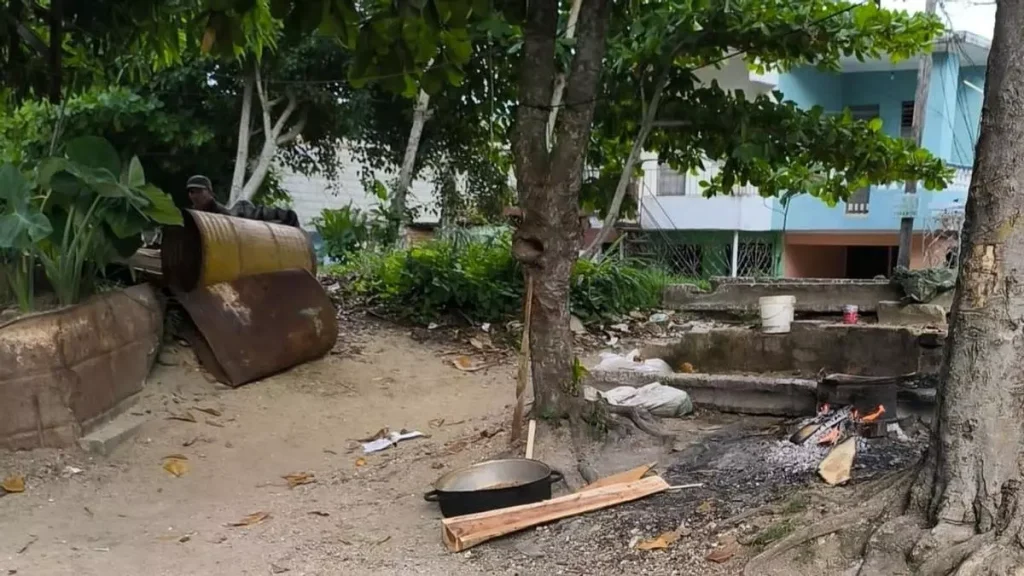
For “Stimulating Adverse Opinions” on Social Media, Cuban Prosecutor’s Office Is Asking for up to Nine Years in Prison

Authorities link the eight defendants to the Cuba Primero group and cite as evidence “the possession of materials related to the Universal Declaration of Human Rights”

Carlos Alberto McDonald Ennis, one of the accused, is experiencing a serious health condition that has deteriorated in prison / Facebook

14ymedio bigger14ymedio, Havana, 30 December 2025 —  Eight people from Las Tunas province could face up to nine years in prison for the crime of “propaganda against the constitutional order.” According to a report published Monday by the legal advice center Cubalex, the defendants have been held in pretrial detention since March and April 2024 awaiting trial for expressing political opinions on social media.

In its report, the NGO noted that it had access to the provisional conclusions presented by the Prosecutor’s Office before the State Security Crimes Chamber of the Provincial Court of Santiago de Cuba, in a document dated July 21, 2025 and signed by prosecutor Iany Fernández Jomarrón.

The indictment mentions Javier Reyes Peña, for whom the prosecution is requesting nine years in prison, as well as Adisbel Mendoza Barroso (eight), Guillermo Carralero López (eight), Carlos Manuel Santiesteban Saavedra (seven), Carlos Alberto McDonald Ennis (seven) – who is living with a serious health condition that has deteriorated in prison, without receiving adequate medical attention – Enrique González Infante (seven), Pedro Carlos Camacho Ochoa (seven) and Maikel Hill Ramírez (six).

The accusations are based on “interaction on social media, especially Facebook”

Authorities link them to the Cuba Primero movement, a group considered by the regime as “terrorist” and “criminal,” based in the United States, “which organizes, finances, provides means and carries out actions against the security of the Cuban State.”

According to the Prosecutor’s Office, the accusations are based on “interaction on social networks, especially Facebook, the recording and publication of videos in which the accused persons expressed political positions, the dissemination of critical content and the exchange with other users inside and outside the country, and the possession of printed materials and pamphlets, including materials related to the Universal Declaration of Human Rights.”

According to the Prosecutor’s Office, these actions were presented as aimed at “stimulating adverse opinions” and generating dissent regarding the Cuban political system, without any mention of violent acts or calls to violence in the charges. Furthermore, the document includes assessments of the defendants’ “moral and social conduct,” such as maintaining behavior “at odds with the revolutionary process,” elements continue reading

that—Cubalex emphasized—reinforce the “ideological, stigmatizing, and discriminatory nature of the charges.”

The case has involved the use of psychiatric evaluations, criminal records, and social assessments.

Cubalex warned that in the case, psychiatric evaluations, criminal records, and social assessments have been used “as elements of accusatory reinforcement, which can aggravate the situation of people in vulnerable contexts.”

Regarding the case of Carlos Alberto McDonald Ennis, due to his health condition (he suffers from hypertension, diabetes, pancreatitis, heart disease, and a malignant tumor in his nasal cavity), the NGO reported that his family has exhausted all available legal resources, including several habeas corpus petitions and requests to modify the precautionary measure, without receiving an effective response. This, it added, is compounded by “the absence of basic procedural guarantees,” such as the fact that the charges against him have not been clearly defined, he has not been notified of the evidence against him, and the legal time limit for the criminal proceedings has been unjustifiably exceeded, without any formal request or duly substantiated extensions.

This case exemplifies the use of the penal system in Cuba “as a tool of political repression”

Cubalex denounced that this case exemplifies the use of the penal system in Cuba “as a tool of political repression” and demanded the release of “all people criminalized for peacefully exercising their rights in Cuba.”

In November alone, according to the latest report from the same organization, 165 repressive incidents were recorded across all provinces of the country, in which at least 138 people were victims of some type of human rights violation that month. In many cases, these acts occurred after various spontaneous protests motivated by power outages, water shortages, the collapse of the healthcare system, and state neglect following Hurricane Melissa and the current chikungunya and dengue epidemic affecting the country.

____________

COLLABORATE WITH OUR WORK: The 14ymedio team is committed to practicing serious journalism that reflects Cuba’s reality in all its depth. Thank you for joining us on this long journey. We invite you to continue supporting us by becoming a member of 14ymedio now. Together we can continue transforming journalism in Cuba.

2025: The Year Food in Cuba Took On a Foreign Accent

Imported foods, more expensive and better, have displaced domestic products, which are increasingly scarce

Imported pork loin began the year at 900 pesos per pound and closed December at 1,200 / 14ymedio

14ymedio bigger14ymedio, Havana, Natalia López Moya, December 30, 2025 –If there was one thing Cubans learned in 2025, it was to read agricultural markets the way one checks the weather report: not to know whether it will rain tomorrow, but to calculate how much food might make it into the house before money evaporates. It was a year without respite for prices, and with a novelty that has ceased to be anecdotal and become part of the landscape: the definitive consecration of imported products in sectors that, until recently, were domestically produced.

Rice, pork, citrus fruits, onions, garlic, and even sugar finished the year having changed their accent. They went from homegrown to speaking English, Portuguese, or peninsular Spanish. The United States, Mexico, Panama, Brazil, and Spain made their way onto the Cuban table not out of gastronomic preference but from sheer necessity. Domestic products became scarce, irregular, or unviable, and the market responded with the logic it knows best: bring goods from abroad to take advantage of a desperate demand for food.

One product that sums up the year was rice, that household thermometer that determines whether there is lunch or only a single meal at night. At the Plaza Boulevard market in Sancti Spíritus, a pound of domestic rice started January at 150 pesos. By July it had reached 280 and, after a slight “breather” forced by state intervention attempting to regulate its price, December found it at 250 pesos. The price did not go down due to a production miracle, but because many private vendors chose to hide it or replace it with imported rice, conveniently outside any regulation. The result was simple: less domestic rice in sight and more sacks with foreign labels.

A pound of domestic rice started January at 150 pesos. By July it had already reached 280

That dynamic repeated itself over and over. Price caps, announced with the tone of a final order, ran into three hard-to-breach walls: the constant devaluation of the Cuban peso, unmet demand, and the obstinacy of merchants, who know full well that selling below costs is not altruism, but ruin. Faced with the choice of losing money or pleasing the authorities, many chose a third path: pulling their merchandise and selling it on the side, where there are no inspectors or ministerial resolutions.

A carton of 30 eggs, in private shops in Holguín, went from 3,000 pesos at the beginning of the year to 3,200 in December / 14ymedio

Black beans, another staple of the national plate, offer a similar lesson. At the La Feria de Los Chinos market in Holguín, they began the year at 400 pesos per pound. In August, supply briefly improved and the price fell to 320. But the relief was short-lived. December brought it back to 420 pesos, confirming continue reading

that in Cuba discounts are usually a parenthesis, not a trend. Imported beans, meanwhile, entered without asking permission from price caps and found their niche among those who prefer to pay more rather than never eat them.

Pork, historically the queen of the Cuban table, definitively lost its crown in 2025. In the Youth Labor Army markets in Havana, managed by the Armed Forces but with most stalls run by private vendors, imported pork loin began the year at 900 pesos per pound. By July it was already at 1,000 and closed December at 1,200. Domestic pork, battered by the lack of feed, theft, and the impossible costs of raising pigs, became a rarity. When it did appear, it did not always respect official prices, and when it did, it disappeared the next day.

Pork, historically the queen of the Cuban table, definitively lost its crown in 2025

Something similar happened with products that define daily cooking. Onions, for example, behaved like a financial asset. At the market at 19th and B, ironically known as La Boutique, in Havana, a pound began January at 350 pesos. By July it was already at 500, and December found it at 600. The smell did not change, but the origin did: increasingly imported onions, better presented, more attractive, and, above all, free of price caps.

A carton of 30 eggs, many households’ protein lifeline, also jumped. In private shops in Holguín it went from 3,000 pesos at the beginning of the year to 3,200 in December. It is not a spectacular increase, but it is persistent, and it adds to a context in which the average salary does not go up, pensions shrink, and any increase, however small, ends up hurting.

The reappearance of mandarins in private markets this year has been scandalous, not so much for their flavor, always pleasant and fragrant, but for their price: around 1,300 pesos per pound, equivalent to nearly half of an average monthly pension on the Island. The citrus fruit arrived from Peru after years of absence and provoked a mix of amazement, nostalgia, and disenchantment. Many Cubans, especially older ones, confessed it had been more than five years since they had seen mandarins for sale.

The scene became iconic: alongside U.S. onions and Panamanian garlic, imported mandarins are sold at central points in Havana with labels recalling their origin, attracting those who see them as a piece of lost flavor. Yet the price turns them into a painful paradox: what should be a return to freshness ends up being an almost unattainable luxury for many pockets.

Alongside U.S. onions and Panamanian garlic, imported mandarins are sold at central points in Havana.

Behind these figures lies a clear logic. The policy of price caps, applied selectively, ended up incentivizing precisely the opposite of what it intended. By regulating domestic rice and leaving imported rice untouched, a clear message was sent to the market: bring in what is not regulated. The result was an accelerated shift toward imported products, more expensive but available.

With bitter irony, many consumers learned to distinguish foreign brands without ever having left the country. Not out of cosmopolitanism, but because Spanish onions, U.S. rice, and Brazilian pork were, paradoxically, more stable than their national equivalents. In 2025, Cuba’s agricultural market did not just sell food: it sold a daily lesson in basic economics. And most people forcibly approved it.

Translated by Regina Anavy

____________

COLLABORATE WITH OUR WORK: The 14ymedio team is committed to practicing serious journalism that reflects Cuba’s reality in all its depth. Thank you for joining us on this long journey. We invite you to continue supporting us by becoming a member of 14ymedio now. Together we can continue transforming journalism in Cuba.

Seventeen Cuban Artists Remain Imprisoned, La Crema Leaves, and the Regime Rewards Amaury Pérez

The Observatory of Cultural Rights regrets that “young creators whose personal development has been cut short by political hatred” continue to be punished.

Cuban artists Luis Manuel Otero Alcántara and Maykel ‘Osorbo’ have been in prison for more than four years. / Facebook

14ymedio bigger14ymedio, Madrid, 30 December 2025 — At the end of 2025, 17 Cuban artists remain locked up in prisons on the island and ten more are serving sentences without imprisonment “as a direct consequence of their creative practice, their civic participation or their refusal to give up their own voice,” the Cultural Rights Observatory reported on Monday.

In a brief statement on its Facebook page, the organisation notes that “one of the most serious and persistent expressions of repression in Cuba [is] the imprisonment of citizens for exercising their freedom of expression, specifically young creators whose personal development has been cut short by the political hatred that characterises the Cuban Government”.

The observatory does not disclose the names of the individuals on its list, although on previous occasions it has referred to the most prominent cases, such as visual artist Luis Manuel Otero Alcántara and Maykel Castillo Osorbo, who were sentenced to five and nine years in prison in 2022. The former is due to be released this year, as they were arrested in 2021.

“One of the most serious and persistent expressions of repression in Cuba [is] the imprisonment of citizens for exercising their freedom of expression.”

Previous complaints have also cited the cases of Yasmany González Valdés, an activist and rapper sentenced to four years in prison for painting anti-government posters, and Wilmer Moreno Suárez, sentenced among the 11 July 2021 protesters in La Güinera (Havana) to 18 years in prison, whose stage name is Mister Will D’Cuba.

“Throughout this year, we have accompanied, documented, and denounced cases of artists imprisoned or continue reading

punished for political reasons, updating the situation of those who continue to face institutional violence, medical negligence, isolation, threats, and arbitrary punishments within the country’s prison system,” adds the Observatory.

In its post, it also accuses the authorities of putting pressure on the families of artists – as well as other prisoners – and of disrupting their careers and work.

“We will continue to name each artist, record each abuse and uphold the memory of those who resist from prison and those who do so under harassment in semi-freedom,” the platform claims.

Amid this bleak outlook, one person who has decided to put an end to the mere idea of returning to Cuba is Luis Alberto Viscet Vives, known as La Crema, from Santiago. The artist, who has thousands of followers thanks to his music denouncing everyday life in Cuba, had left for work in the Dominican Republic two weeks ago, leading many to speculate that he was going into exile.

Now, the singer has released his new video, Navidad en libertad (Christmas in Freedom), humorously recounting his change of life: “I left behind the power cuts, mosquito nets and filth. Goodbye, chikungunya,” read

Cuban Faces 2025: Leyanis Pérez, Queen of the Triple Jump

Her performance earned her recognition from national sports authorities as the best athlete of the year, along with boxer Julio César La Cruz

The young woman overcame a muscle strain that prevented her from competing in the 2020 Tokyo Olympics. / EFE

14ymedio bigger14ymedio, Havana, December 29, 2025 –  Cuban triple jumper Leyanis Pérez Hernández affirms that “life is a fleeting moment that must be seized,” and she did just that in 2025. At 23, she dominated the World Athletics Championships, surpassing Venezuelan Yulimar Rojas, retained her Diamond League title, and won the World Indoor Championships. This achievement earned her recognition from national sports authorities as the best athlete of the year , along with boxer Julio César La Cruz

Pérez’s achievements came at a time when Cuban sport lacked figures like five-time Olympic champion Mijaín López, judoka Idalys Ortiz, and sprinter Omara Durand, all retired, in addition to a series of failures in boxing, wrestling, baseball, and volleyball. The Pinar del Río native has revived track and field, which had been battered by defections.

The road has been fraught with setbacks. After a disappointing fifth place at the 2024 Paris Olympics, Pérez won gold at the World Indoor Championships in Glasgow. She started 2025 with a second-place finish at the Miramas Athletics Meeting, consistently achieving jumps exceeding continue reading

14 meters.

Behind Pérez is coach Ricardo Ponce, who has focused training on exercises to help the triple jumper break the 15-meter barrier. She achieved this goal at the Puma Meeting in Guadalajara (2024); however, a slight tailwind exceeding the permissible limit (2.3 m/s) prevented her from validating the record.

“You have to make many sacrifices, but nothing surpasses the satisfaction of surpassing yourself and winning a medal,” the triple jumper stated last September.

Pérez has focused on technical details with her left leg. Ponce says the young woman is ready to jump 15.20 meters. Although 15.30 meters would be even better. “You have to make many sacrifices, but nothing beats the satisfaction of surpassing yourself and winning a medal,” the triple jumper stated last September. This year, she also graduated with a degree in Physical Culture.

The road hasn’t been easy for Pérez. The young woman overcame a muscle strain that prevented her from competing in the 2020 Tokyo Olympics. “Accepting that I was there, and not competing, was devastating for me,” she told the same media outlet. At that moment, her coach took the tall, 1.88-meter (6’2″) athlete and assured her that “everything was going to change, that life would go on.”

The triple jumper, who lives in the Cuba Libre popular council, known as El Rancho, in the municipality of Pinar del Río, began to stand out internationally in 2022: she won the Ibero-American Championship in Alicante (Spain) and placed fourth in the final of the World Championship in Eugene (USA).

At the 2023 Pan American Games, she won the gold medal with a jump of 14.75 meters. She also reached the podium at the World Athletics Championships, taking home a bronze medal with a jump of 14.96 meters on her first attempt. Her personal best was 14.98 meters, achieved in July of that year at the Central American and Caribbean Games. Now, she aspires to win an Olympic medal.

Pérez told AFP last September that “when you’re in Cuba, you just have to follow the existing legacy, train hard to uphold it.” The young woman recalled that in her early days, “the triple jump scene was already well-established; there were great triple jumpers and long jumpers in my country, so you have no choice but to go out there and give it your all.”

See also: Cuban Faces 2025: The 14 Faces That Marked the Pulse of Cuba in 2025

____________

COLLABORATE WITH OUR WORK: The 14ymedio team is committed to practicing serious journalism that reflects Cuba’s reality in all its depth. Thank you for joining us on this long journey. We invite you to continue supporting us by becoming a member of 14ymedio now. Together we can continue transforming journalism in Cuba.

Cuban Faces 2025: Laura Gil, the Minister’s Daughter Who Demanded Transparency in Her Father’s Trial

The daughter of the convicted former minister broke her silence, appealing to the Constitution of the Republic and its recognition of “freedom of expression for all citizens”

Laura María Gil González was praised for her role as Director of Innovation and Development at Caudal. / Facebook

14ymedio bigger14ymedio, Havana, December 25, 2025 – The Facebook post made on July 3, 2023, by Laura María Gil González, daughter of former Minister of Economy and Planning Alejandro Gil Fernández, recently sentenced to life imprisonment, continues to receive congratulations. At that time, she announced her appointment as Director of Innovation and Development at Caudal SA, the insurance and financial services group—comprised of no fewer than eight companies, including Cubacontrol, dedicated to inspection—belonging to the military conglomerate Gaesa. A high-ranking position, as is typical for relatives of the Cuban nomenklatura

Her father had already been detained for nine months for “serious errors committed in the performance of his duties” when Laura María’s name appeared in the official press in an article praising the “financial strength and security” of the state conglomerate for which she works . “Laura María Gil González, Director of Innovation and Development at Caudal, explained that each company in the group specializes in a specific service,” Cubadebate, quoting her as saying: “For example, Cubacontrol and Intermar provide inspection services. The consulting firms Canec, Conas, and Interaudit offer appraisal and auditing services, while ESEN and ESICUBA are the insurance companies. Asistur is an insurance brokerage firm.”

Neither she nor her mother, Gina María González García—who was held for a time in a safe house along with her husband—said a word about the legal proceedings against Alejandro Gil. Then, on November 1st, after 20 months without any news of his whereabouts, the Prosecutor’s Office announced that he was being charged with “espionage” and continue reading

other serious corruption offenses .

On November 1, after 20 months without any information about his whereabouts, the Prosecutor’s Office announced that he was being accused of “espionage” and other serious corruption crimes.

And then, Laura Gil spoke out. She did so through her Facebook wall and in several posts, demanding a fair, public, and open trial for her father. She broke her silence by invoking the Constitution of the Republic and its recognition of “freedom of expression for all citizens,” something that was immediately criticized by hundreds of commenters on the post, since it is a right that the regime denies to its dissenting citizens.

Gil González ironically celebrated the “highly efficient” implementation of the Transparency and Access to Public Information Law, “with unprecedented consistency,” adding that “small details remained unresolved, fueling public speculation.” She then addressed the espionage charge against her father, noting that “small details” were missing: “What did he do? Which country or countries are we referring to? Since when? What were his communication channels? What did he receive in return? Where did he hold his meetings? In what settings? With whom? Under whose direct orders? What information did he reveal? What measures did he propose to the country on the express orders of another state? What evidence do they have? What was his pseudonym?”

In one of her posts, the young woman also asserted that her father remained steadfast in his defense and would not acknowledge, “under any circumstances,” any crime he was accused of “that was not duly verified.” Her plea, which was followed by another post addressed to the program Con Filo—unusually discreet in its coverage of Gil—was ignored. The former minister would be tried behind closed doors by the State Security Crimes Chamber in a court in Marianao , Havana, in two separate trials: one lasting four days, for espionage, and another, two weeks later, for “money laundering, continued falsification of public documents, illicit economic activities, continued illegal trafficking of national currency, foreign exchange, precious metals and stones, and smuggling.”

He was defended by lawyer Abel Solá, a prestigious jurist with experience in cases of crimes against state security, who will predictably have appealed the sentence.

He was defended by lawyer Abel Solá , a prestigious jurist with experience in cases of crimes against the security of the State, who will predictably have appealed the sentence.

It was the former minister’s sister, María Victoria Gil, who revealed that he was accused of spying for the United States, and that behind the purge was none other than the Prime Minister, Manuel Marrero.

Laura Gil has remained silent on all of this. She has only made one brief post since then. “My little princess is my whole world,” she wrote, referring to her three-year-old daughter. It remains to be seen whether she will dare to openly break with the regime that sheltered her family and that, like Saturn, ended up devouring them. The road to Damascus for the former minister’s daughter still seems long.

See also: Cuban Faces 2025: The 14 Faces That Marked the Pulse of Cuba in 2025

____________

COLLABORATE WITH OUR WORK: The 14ymedio team is committed to practicing serious journalism that reflects Cuba’s reality in all its depth. Thank you for joining us on this long journey. We invite you to continue supporting us by becoming a member of 14ymedio now. Together we can continue transforming journalism in Cuba.

Cuban Faces 2025: The 14 Faces That Marked the Pulse of Cuba in 2025

Each one, from their own place, has influenced the public conversation or embodied a profound dimension of this turbulent year

Here, then, are the unwitting or chosen protagonists of a tough and crucial year. / 14ymedio

14ymedio bigger14ymedio, Havana, December 24, 2025 — Every December, 14ymedio presents the faces that have stood out in Cuba during the year. Some reflect the face of power, others that of exhaustion or hope. Between blackouts, trials, hurricanes, viruses, and exoduses, the country hasn’t changed much, but the protagonists are different. This year, 2025, was, more than ever, a mosaic of crises and reinventions: politics showed its most cynical side; the eastern part of the island, devastated by Hurricane Melissa, revealed the country’s most vulnerable image; and on the margins of daily life, journalists, migrants, and athletes once again gave these months their own unique character

The 14 faces we present here defy easy categorization. There are officials who rose rapidly through the ranks, political prisoners whose resistance sustained many, and migrants who, even from afar, shape the island’s reality with their remittances, phone calls, and calls to action. Each, from their own unique position, has influenced the public discourse or embodied a profound dimension of this turbulent year.

These are faces that speak of decay—the deterioration of institutions, basic services, and family economies—but also of ingenuity and adaptability. Looking at them together is like peering into a snapshot of the country: some appear because of their exercise of power; others, because of the cost of confronting it. Some became visible by contributing to the crisis; others, by being victims of Cuba’s collapse.

Choosing them was not an act of sympathy or condemnation. Rather, it is about recognizing how these figures—diverse, contradictory, and distant from one another—decisively influenced the emotional and political climate of 2025.

Choosing them was not an act of sympathy or condemnation. Rather, it is about recognizing how these figures—diverse, contradictory, and distant from one another—decisively influenced the emotional and political climate of 2025. Among them are those who tried to maintain the framework of the State despite the evident erosion of its structures; those who paid for their dissent with imprisonment or forced exile; and those who made their way in sports, civic engagement, or social media.

2025 was the year of visible fractures: healthcare, electricity, food, and morale. It was also the year in which some voices managed to cut through the noise, from those who predicted endless blackouts to those who denounced abuses, including those who challenged the official narrative from exile or from a mobile phone. These faces, more than a list, form a map. Each one contributes a fragment of truth, a facet of the country that cannot be narrated from a single perspective.

Here, then, are the unwitting or chosen protagonists of a difficult and crucial year. Some will remain at the center of the stage in 2026; others will conclude their cycle this December. But all of them, without exception, leave an unmistakable mark on Cuba’s recent memory. Through them, the complete story can be told: the story of those who rule and the story of those who resist.

The 14 faces of 2025

1. Repressors returned to Cuba, Melody González

2. Exiled by the Cuban regime

3. Laura Gil, the daughter of the minister who demanded transparency in her father’s trial

4. Yosvani Rossell García, the body as a form of denunciation

5. José Jasán Nieves, the totí [blackbird] of economic chaos

6. Inés María Chapman, the engineer who wants to bring order to chaos

7. Marta Elena Feito, the minister who denied poverty and ended up being devoured by it

8. Lázaro Guerra Hernández, the man of the blackouts

9. Tania Velázquez Rodríguez, president of Etecsa during the ‘tarifazo’ (price hike)

10. The students, who rose up against Etecsa were defeated

11. Leyanis Pérez, queen of the triple jump

12. Juan Reinaldo Pérez, the man who deepened the crisis of Cuban baseball

13. Generation Z in Cuba, neither silent nor submissive

14. Óscar Pérez-Oliva Fraga, the power of the Castro lineage