Each mountain of garbage reveals a country where ideological books end up mixed with broken appliances.
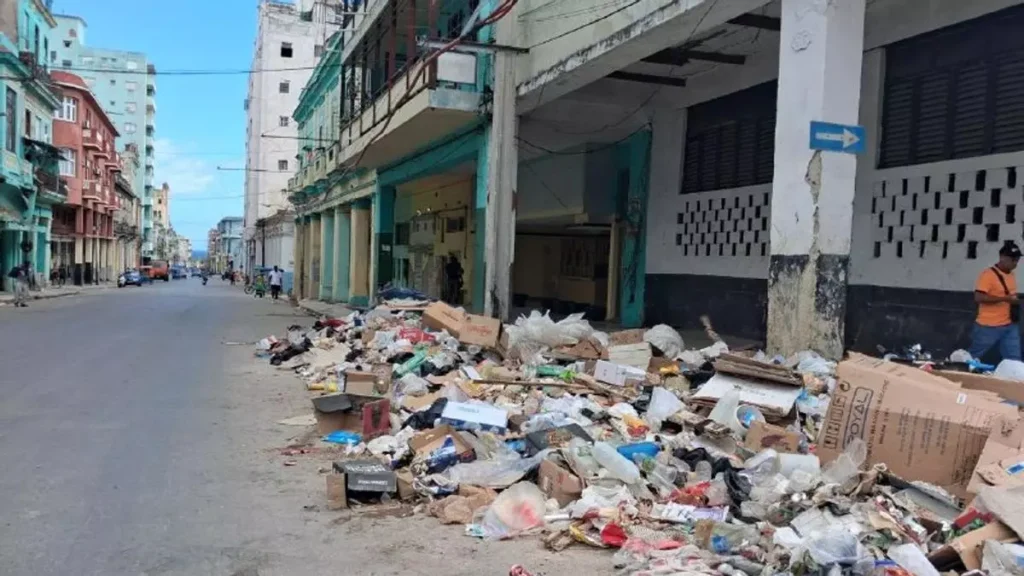
 14ymedio, Yoani Sánchez, Havana, May 7, 2026 / I pass by yet another mountain of garbage I encounter on the road, and it’s as if each piece of trash speaks to me. The true national narrative emerges from this waste that rots under the May sun and is carried by the wind or downpours through streets and avenues. There are countries that tell their history through their shop windows and museums, but here ours are narrated by our filth.
Years ago, the garbage dumps were littered with vegetable peels, rice husks, and even Granma newspapers. Now, among the trash, boxes empty of rechargeable flashlights, Chinese batteries, small solar panels, and portable generators are appearing. The Island of Darkness has begun to leave its mark even in the garbage. Each abandoned package speaks of a family that saved dollars for months to escape the blackouts, but also of the sacrifice of the emigrants who help illuminate the dark nights.
The boxes often still have the product photos printed on them: a lightbulb in the middle of a spotless room, a smiling couple as electricity illuminates a kitchen where nothing is ever lacking. The advertising for these appliances has a cruel edge in Cuba. The images on their packaging don’t just sell energy—I’d say energy—they also sell normalcy. They promise a quiet fan, refrigerated food, mosquito-free nights, and children doing homework under steady light. They promise a country that doesn’t exist.
Even stray animals have learned to read the transformation of our waste. The dogs and cats that roam around the garbage know that people are throwing away fewer and fewer edible items. Before, they found bones, leftover food, pieces of stale bread. Now they rummage for hours through nylon, damp cardboard, and plastic containers to find barely anything to eat. Inflation has also emptied the garbage piles of the remnants of our daily rations.
The “divers” know this better than anyone; those men and women who submerge half their bodies inside containers looking for something to eat or to feed a pig
The “divers” know this better than anyone—those men and women who plunge half their bodies into shipping containers looking for something to eat or to feed a pig. Most of the time they stumble upon bladeless fans, gutted televisions, open electric rice cookers, damp mattress stuffing, pieces of plastic, and scraps of cardboard. Some of these appliances were broken by the brutal power surges that accompany the return of electricity after a blackout.
But perhaps nothing is more symbolic than the discarded books. There they are, soaked by the rain and covered in mold: old manuals of Marxism, volumes of political speeches, complete collections of ideological propaganda, and even diplomas awarded “for outstanding participation in socialist emulations.” Sometimes files from state offices appear, bureaucratic papers carelessly tossed aside, and entire archives that no one bothered to destroy. As if even the authorities themselves had lost faith in their significance. Cuban trash no longer contains only material remains: it contains a part of the nation’s disillusionment.
However, amidst all this waste, small dreams also emerge. A box from an air conditioner bought in Panama that will barely turn on due to the lack of electricity. An empty perfume bottle brought from Miami that was never used in a club, because most are closed in this city. Box after box of European chocolates, stored for days before being thrown into the tank, which consumed a good portion of a month’s salary.
It is enough to look at the trash dumps to understand what this nation eats, what it has lost, what it desires, and what it has stopped believing in.
Previous Havana Chronicles:
Under a Picture-Postcard Blue Sky, the Country is Crumbling
Fatigue Barely Allows One to Enjoy the ‘Lights On’ in Havana
Dollars, the Classic Card, and a Havana Without Tourists
A Journey Through the Lost Names of Havana
The Shipwreck of a Ship Called “Cuba”
Havana Seen From ‘The Control Tower’
In Havana, the Only Ones Who Move Are the Mosquitoes
Reina, the Stately Street Where Garbage is Sold
Searching for Light Through the Deserted Streets of Havana
The Death Throes of ‘Granma’, the Mouthpiece of a Regime Cornered by Crisis
The Anxiety of the Disconnected Cuban
One Mella, Three Mellas, Life in Cuba Is Measured in Thousands of Pesos
It Is Forbidden To Leave Home in Cuba Today Because It Is a “Counter-Revolutionary Day”
Vedado, the Heart of Havana’s Nightlife, Is Now Converted Into a Desert
Havana, in Critical Condition
______________________
COLLABORATE WITH OUR WORK: The 14ymedio team is committed to practicing serious journalism that reflects Cuba’s reality in all its depth. Thank you for joining us on this long journey. We invite you to continue supporting us by becoming a member of 14ymedio now. Together we can continue transforming journalism in Cuba.