Those outraged by Etecsa’s rate hikes, many of them “the revolutionary vanguard,” gave the regime more than one headache this year.
 14ymedio, Havana, 28 December 2025– The Cuban government has managed to end 2025 without being overwhelmed by a turbulent front that took its breath away mid-year: the student movement. Governments around the world have known for at least a century that there is no group more dangerous to them than angry university students, from Soviet Prague to Mao’s Beijing, by way of Franco’s Spain and the pacifists against the Vietnam War. Those outraged by the state telecommunications monopoly Etecsa’s rate hikes — dubbed el tarifazo — many of them “the revolutionary vanguard,” gave the regime more than one headache this year when they erupted against the steep changes in the prices for internet access.
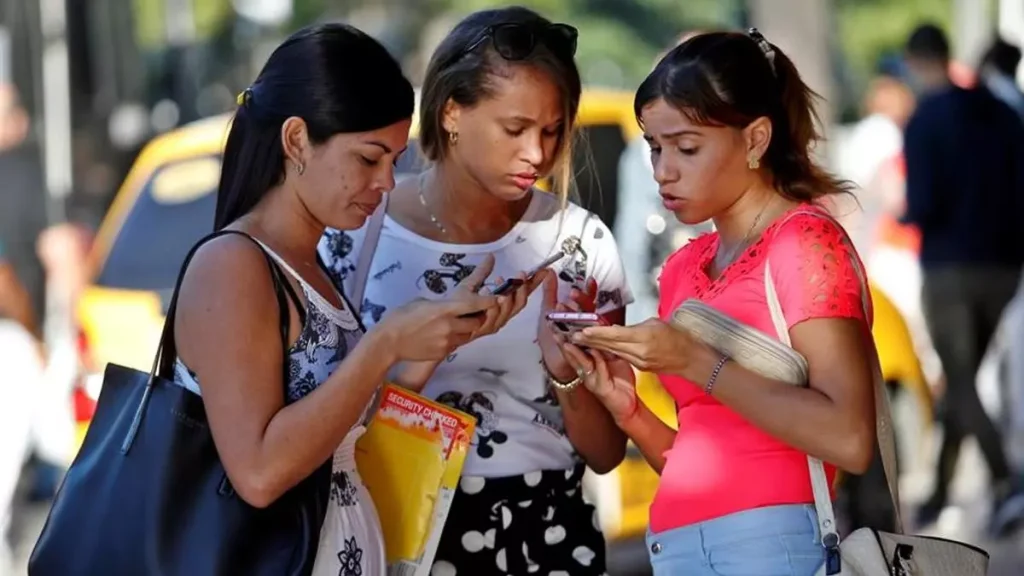
It all began on Friday, May 30th , because the Palace of the Revolution, sometimes, doesn’t do anything without a reason. With the weekend upon us and the end of the school year fast approaching, a piece of news broke the monotonous pattern of blackouts, inflation, and migration: the state telecommunications monopoly was updating its rates, and the increase was unprecedented, multiplying some prices by as much as thirteen. In short, top-ups in national currency were limited to 360 pesos per month, and packages purchased from abroad—that is, in foreign currency—were incentivized. A 7GB package, for example, cost more than the average monthly salary.
Not even a Friday could stem the tide of a tsunami that surged from the very heart of the Revolution. The Federation of University Students (FEU) at the Faculty of Mathematics and Computing of the University of Havana took less than half a day to issue its opinion: “It is a tremendous lack of respect for the Cuban people.” They were the ones initially most affected. Their need to access the internet was not just that of ordinary users—also terribly annoyed—as a means of communication or entertainment, but also that of a student who needs to find information, research, and practice.
“We consider Etecsa’s attitude untimely and imprudent,” the organization stated, which soon gained supporters from the fringes of the ruling party.
“We consider Etecsa’s attitude untimely and imprudent,” the organization stated, quickly gaining support not only from the fringes of the officialdom—such as Mariana Camejo, director of La Joven Cuba —but also from one of the most combative pro-Castro voices on social media, El Necio. Etecsa executives soon had to come out and justify themselves, trying to calm the waters with the golden rule: the blockade necessitates sacrifices, and if we want to modernize the network, we have to pay. The effect was precisely the opposite of what they intended. Seeing that there was no correction, the discontent began to spread like wildfire, and one after another, faculties at various universities across the country called for strikes in protest.
But opening a rift within the ruling party is no laughing matter. This outburst was followed by an internal battle between those who believed it was essential to make the state monopoly reconsider a regulation that was unfair to the population and aimed at further widening the gap between those who had access to a relative abroad willing to finance the expense, and those who thought it was essential to close ranks with the government against any “media manipulation [and] attempts to disrupt the normalcy of university life.”
While some were promoting meetings with Etecsa executives to find solutions, others were calling for a complete halt to classes until their demands were met. Things escalated to such a degree that the dreaded graffiti appeared on a wall of the University of Sancti Spíritus: “Down with the dictatorship.”
The government tried to pull out all the stops, using various programs to explain why the drastic increase in calls to order was necessary for Roberto Morales Ojeda, a member of the Political Bureau and Secretary of Organization of the Central Committee of the Communist Party. But the playbook proved ineffective in the face of each new challenge, to the point that law students from the University of Holguín—the birthplace of the Castros—filed a lawsuit against Etecsa , an unprecedented move in the country’s history. The students argued that the rate hike was “exclusionary, classist, and contrary to the law,” basing their argument on the Constitution, the Penal Code, and other norms of Cuban law. In other words: within the law. “Every jurist, whether already trained or in training, has the duty to wage battle against three giants: fear, injustice, and ignorance,” proclaimed one aspiring lawyer.
“Every lawyer, whether already trained or in training, has the duty to wage battle against three giants: fear, injustice, and ignorance,” proclaimed a budding lawyer.
The first two weeks of June were filled with university debates, both in person and online, and the students garnered support from doctors , artists, prominent professors , parish priests , and even the world-famous Spanish singer-songwriter Alejandro Sanz , who didn’t hesitate to come to the defense of the rebellious students. But this revolt came at a price: State Security soon began to harass these young people who, even while convinced that the Communist Party was the best and only possible governing body for the island, felt it was necessary to rise up against a decision they believed was wrong.
As the weeks passed, the fear of punishment, meetings with Etecsa, and a few minor concessions from the company gradually eased the discontent, which disappeared by the end of July without further consequences. Summer arrived , and the government, in the end, did not get its Vietnam.
See also: Cuban Faces 2025: The 14 Faces That Marked the Pulse of Cuba in 2025
____________
COLLABORATE WITH OUR WORK: The 14ymedio team is committed to practicing serious journalism that reflects Cuba’s reality in all its depth. Thank you for joining us on this long journey. We invite you to continue supporting us by becoming a member of 14ymedio now. Together we can continue transforming journalism in Cuba.