Cuban Faces 2025: Inés María Chapman, The Engineer Who Wants To Bring Order to Chaos

In a cabinet dominated by men who tend to talk about what isn’t working as if they were detached commentators on the disaster, she embodies the rare case of someone who still seems to believe in order, management, and responsibility.


There has been no shortage of speculation mentioning Inés María Chapman as a possible successor to Cuban President Miguel Díaz-Canel, especially since the economic, energy, and migration crises have accelerated Díaz-Canel’s decline in popularity. / Cubadebate

14ymedio bigger14ymedio, Havana, 26 December 2025 — In a country where inertia is state policy and improvisation an unwritten dogma, Inés María Chapman (Holguín, 1965) has built her public image around efficiency. A hydraulic engineer, methodical, and obsessive about spreadsheets and schedules, the deputy prime minister became one of the most visible—and most debated—faces of the Cuban government this year. In a cabinet dominated by men who tend to talk about what isn’t working as if they were detached commentators, Chapman embodies the rare case of someone who still appears to believe in order, management, and responsibility.

But that personal rigor has had to contend, time and again, with the apathy, arbitrariness, and institutional indolence that characterize the Cuban model. Her most talked-about episode in 2025 occurred in Manzanillo, where she went to oversee the grim reality of a city that barely manages to supply itself with water. There, before a crowd weary of promises, she was greeted with a cry that summed up more than six decades of frustration: “Lies!”

The video spread like wildfire. Chapman tried to maintain a composed demeanor, but public outrage cornered her. For some analysts, that moment marked a turning point in the public perception of the deputy prime minister: an official accustomed to “solving problems” from above faced the judgment of those below, live and on air. Her reputation as a ruthless administrator clashed with the reality of the country she helps to govern. Shortly afterward, she would be embroiled in another scandal when she shared a post criticizing the Cuban Art Factory for unveiling a star in honor of Celia Cruz on her centennial.

For some analysts, that moment marked a turning point in the public perception of the deputy prime minister: an official accustomed to “solving” from above faced live judgment from below

However, her inclusion among the Faces of 2025 cannot be explained solely by that incident. Within the small circle of power, Chapman has sparked interest for something scarce in the upper echelons of the Communist Party: technical expertise. A woman in a testosterone-fueled machine, disciplined in an environment that favors slogans, she has managed to build continue reading

a personal brand that, for some, places her among the potential presidential candidates. There has been no shortage of speculation mentioning her as a possible successor to Miguel Díaz-Canel, especially since the economic, energy, and migration crises have accelerated the president’s decline.

But Chapman faces a series of obstacles that, in Cuba, outweigh any résumé. She doesn’t belong to any of the historical families that control the country’s essential levers of power, a network of clans that distribute ministries, military enterprises, and embassies as if they were private inheritances. Moreover, on the island, where key decisions continue to be made by a handful of descendants of Europeans—white, with well-known surnames, and, in many cases, with light eyes—her race acts as a silent brake. Being a woman is another burden in a political elite designed by and for men who grew up under the iron grip of Castroism.

Furthermore, on the Island, key decisions continue to be made by a handful of descendants of Europeans.

Despite this, Chapman has learned to move with calculated precision. Quiet at times, expansive at others, she has known how to manage her silences, measure every gesture, and take advantage of every public appearance. In televised meetings, she usually stands out for her direct tone, for her apparent ability to say things bluntly, although never quite enough to openly challenge the power structure that sustains her.

Her presence in flooded neighborhoods, after burst pipes or at half-finished treatment plants, has made her the public servant who steps up when infrastructure collapses, which is almost always. The population, however, has learned that no inspection can undo decades of neglect. Hence, in Manzanillo, under the scorching sun and before a fed-up populace, her technical and methodical demeanor was met not with respect, but with the sharp cries of those who no longer trust anyone.

Even so, 2025 confirmed that Chapman remains a valuable asset to the government: disciplined, efficient, and reliable. A woman who doesn’t improvise — a rara avis — in a government that improvises daily.

See also: Cuban Faces 2025: The 14 Faces That Marked the Pulse of Cuba in 2025

____________

COLLABORATE WITH OUR WORK: The 14ymedio team is committed to practicing serious journalism that reflects Cuba’s reality in all its depth. Thank you for joining us on this long journey. We invite you to continue supporting us by becoming a member of 14ymedio now. Together we can continue transforming journalism in Cuba.
Cuban Faces 2025: Yosvany Rosell García, the Body as a Form of Denunciation

His case exposed the human cost of repression and the regime’s inability to offer answers other than punishment and silence.

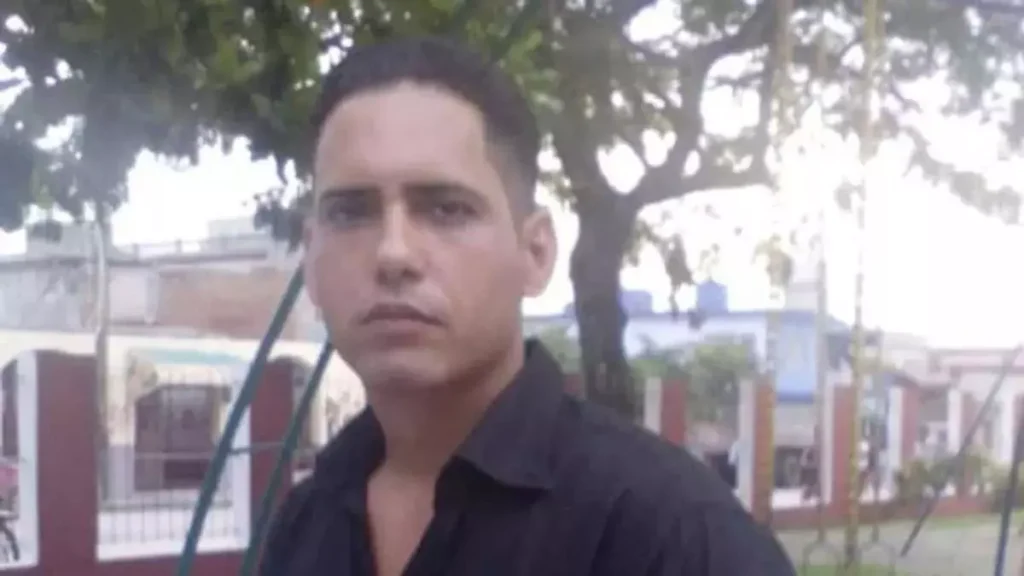
García Caso was admitted to the Lucía Íñiguez Landín Clinical Surgical Hospital with signs of multiple organ failure and accelerated deterioration. / Facebook

14ymedio bigger14ymedio, 25 December 2025, Havana —Yosvany Rosell García Caso, one of the many names associated with the Island-wide protests of 11 July 2021, became one of the most visible faces of Cuban political prisoners in 2025. His prolonged hunger strike, the extreme deterioration of his health, and the opacity with which the authorities handled his case brought the situation of prisoners of conscience on the island back to the center of public debate. His body, pushed to its limits, exposed the human cost of repression and the regime’s inability to offer solutions other than punishment and silence.

García Caso, 37, was arrested in Holguín on July 15, 2021, just four days after participating in the demonstrations that shook almost the entire island. Like thousands of other protesters, his arrest lacked even the most basic due process guarantees. He was charged with “sedition,” a serious offense that resulted in a draconian 15-year prison sentence. These sentences have been denounced by family members, activists, and human rights organizations as part of the political criminalization of those who exercise their right to peaceful protest in Cuba. Until then, Yosvany Rosell was a young welder, a father of three, just one more among so many Cubans dissatisfied with the rapidly deteriorating conditions in their country.

The hunger strike marked a pivotal moment in his life and in the public conversation about political prisoners in Cuba.

During his years of imprisonment, García Caso endured prison conditions that his family and advocates describe as degrading: prolonged isolation, mistreatment, constant surveillance, medical neglect, and arbitrary restrictions on communication with the outside world. In November 2025, his situation reached a critical point when he began a 40-day hunger strike , demanding his freedom and that of other political prisoners, as well as improved prison conditions.

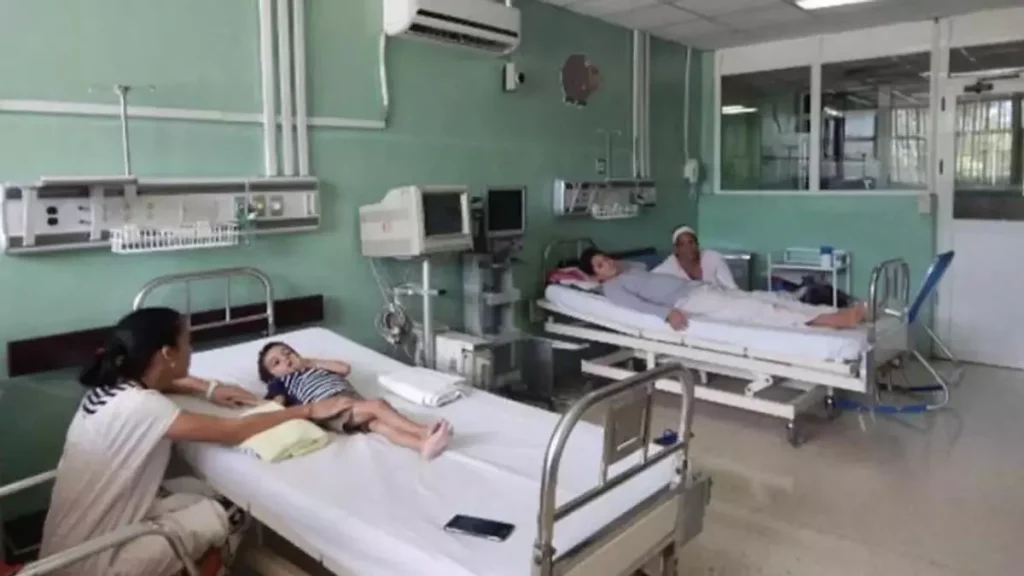
The hunger strike marked a pivotal moment in his life and in the public discourse surrounding political prisoners in Cuba. García Caso was admitted to the Lucía Íñiguez Landín Clinical Surgical Hospital with signs of multiple organ failure and continue reading

rapid deterioration, according to independent reports. His condition became a stark reminder of the extreme price of protesting in a system that does not fully recognize basic rights for dissidents.

His wife, Mailín Rodríguez Sánchez, has been one of the most visible voices denouncing not only the activist’s physical condition, but also the lack of transparency with which the authorities have handled his case. The family has stated that they were even denied access to his medical records and the results of tests performed during his hospitalization, which constitutes a violation of his right to health and personal security.

In the midst of the health crisis, García Caso wrote letters from his cell and from the hospital denouncing prison conditions and expressing that his protest was also a response to the injustice of the prison system and the lack of institutional channels for addressing citizens’ demands. His mobilization was not an isolated act of desperation, but a conscious decision in an environment that, for many political prisoners, offers no other avenues for being heard.

The hunger strike ended when authorities agreed to one of his main demands: transfer to solitary confinement, a disciplinary area within the prison that the activist had requested as a form of protest against the “continued imprisonment of all political prisoners.” Paradoxically, the concession came amidst a serious physical decline that left him on the brink of death.

After his release from the hospital, García Caso was returned to the Cuba Sí prison in El Yayal (Holguín), without prior notice to his family.

After his release from the hospital, García Caso was returned to the Cuba Sí prison in El Yayal (Holguín) without prior notice to his family. According to various reports, he continues to face adverse conditions, including poor nutrition, unsafe drinking water, and strict surveillance, which have negatively impacted his overall health.

His case has also resonated far beyond the island. Organizations such as the Inter-American Commission on Human Rights, Amnesty International, and several diplomatic missions have expressed concern about his condition and the general situation of Cuban political prisoners, emphasizing the need to respect fundamental rights. In exile and among sectors of international civil society, his name has been the subject of awareness campaigns and calls for action.

See also: Cuban Faces 2025: The 14 Faces That Marked the Pulse of Cuba in 2025

____________

COLLABORATE WITH OUR WORK: The 14ymedio team is committed to practicing serious journalism that reflects Cuba’s reality in all its depth. Thank you for joining us on this long journey. We invite you to continue supporting us by becoming a member of 14ymedio now. Together we can continue transforming journalism in Cuba.
Cuban Faces 2025: Exiled by the Cuban Regime

Releasing prisoners in exchange for their leaving the country functions as a mechanism to rid the country of critical voices.

Opposition leader José Daniel Ferrer on the day he was released from prison in January 2025. / X/@jdanielferrer

14ymedio bigger14ymedio, Havana, 24December 2025 — Ferrer and Robles arrived at their respective destinations in exile on the same day. The coincidence was not accidental; like so many Cuban dissidents in recent decades, both only regained their freedom after agreeing to leave the island. They, along with the Lady in White Aymara Nieto Muñoz, share a fate that has become a pattern in the official treatment of dissent: conditional release on forced exile, presented as “liberation,” but which in reality functions as a mechanism to rid the country of critical voices.

José Daniel Ferrer , a historic leader of the Patriotic Union of Cuba, UNPACU, was arrested on 11 July 2021, before he could participate in the popular protests on that day, and sentenced to four years and six months in prison. During his incarceration, he denounced isolation, beatings, torture, and extreme restrictions on communicating with his family, as well as constant pressure from State Security to abandon his dissent.

Ferrer was released from prison in January 2025, but his parole was revoked in April of the same year for alleged “breaches of obligations,” and he remained in pretrial detention for months. Finally, in October 2025, Ferrer was obliged to leave Cuba for the United States in forced exile. His departure was accompanied by his family and U.S. officials who oversaw his exit, while the Cuban regime issued an official statement presenting his departure as a voluntary act, without acknowledging the pressure and torture he had suffered.

Ferrer recounted in a letter from prison that he accepted exile “for the safety of his family” and because of the impossibility of continuing his activism on the island under constant surveillance.

Ferrer recounted in a letter from prison that he accepted exile “for the safety of his family” and because of the impossibility of continuing his activism within the Island under constant surveillance.

In the case of Luis Robles Elizastigui, known as “the young man with the placard,” his release in January 2025 also did not mean the possibility of staying in Cuba. After serving a five-year sentence imposed for holding a protest sign in 2020 in the middle of San Rafael Boulevard in Havana, and after enduring surveillance and sanctions within the prison, leaving Cuba, along with his mother —who went on a hunger strike to demand his release—and his son, was the only way for him to regain his personal freedom. continue reading

Also in 2025, Aymara Nieto Muñoz, a member of the Ladies in White and the target of multiple previous arrests, was forced to leave the island immediately after her release from prison. Convicted in 2018 of assault and property damage, she had spent years in various prisons, drastically complicating contact with her daughters. Her departure from prison directly to the airport, bound for the Dominican Republic and without being able to say goodbye to one of her daughters, was documented by international organizations as a case of forced exile resulting from political repression.

The exiles of Ferrer, Robles, and Nieto are part of a systematic pattern by the Cuban regime. Imprisonment is merely one stage in a broader process that culminates in the expulsion of dissidents from Cuba. International mediation has facilitated the transfer of those released to host countries and has thus helped justify the internal restrictions that prevent opposition members from remaining in the country. In this way, a significant portion of Cuban civic activism is forced off the island, becoming a diaspora by imposition rather than by choice.

See also: Cuban Faces 2025: The 14 Faces That Marked the Pulse of Cuba in 2025

____________

COLLABORATE WITH OUR WORK: The 14ymedio team is committed to practicing serious journalism that reflects Cuba’s reality in all its depth. Thank you for joining us on this long journey. We invite you to continue supporting us by becoming a member of 14ymedio now. Together we can continue transforming journalism in Cuba.
The Cuban Regime Has Ordered the Expulsion of Americans, According to the US Embassy

A diplomatic source expressed concern about the risk of nationals being imprisoned to be used in negotiations with Washington.

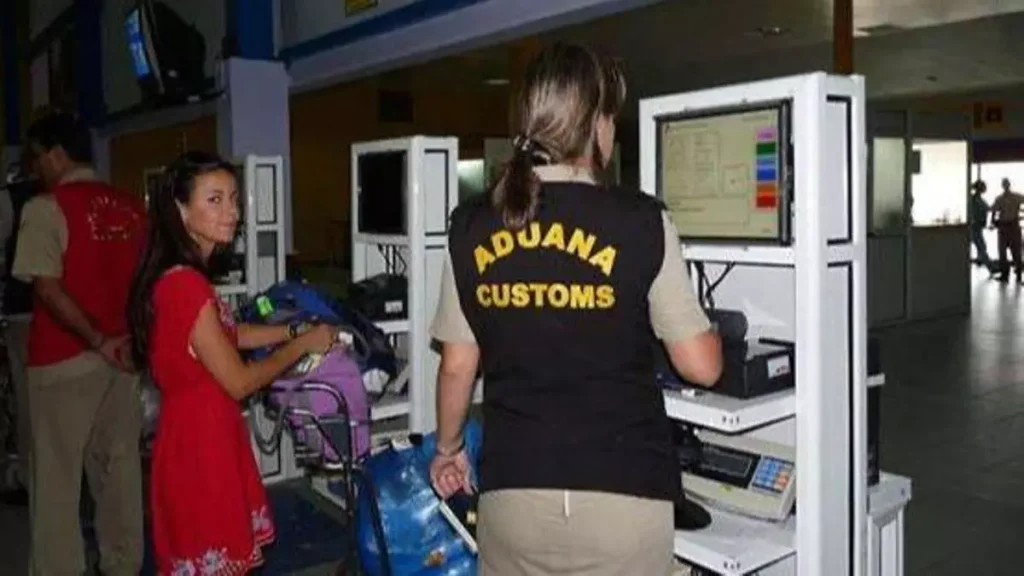
The US embassy recommended cooperating with customs authorities in the event of a search. / Cubadebate

14ymedio bigger14ymedio, Madrid, January 21, 2025 — The US Embassy in Cuba warned via its social media, on Tuesday, that it has received information about Americans being denied entry upon arrival on the island, as well as orders for nationals to “leave the country immediately under threat of detention.”

The diplomatic mission has not provided any examples to illustrate the situation and the alleged reasons, although a source close to the embassy has expressed “concern” about the risk of a repeat of what happened in Venezuela when the Chavista regime “imprisoned American citizens and used them as hostages to negotiate” with Washington.

The embassy points out that it cannot mediate in matters of entry and exit from Cuba, although it can provide consular assistance to US citizens who request it, and for this purpose reiterates its contact methods by phone and through social media.

The message has been classified as “routine” by the consular office, meaning it contains administrative and non-confidential information. It includes a list of rules to follow for those wishing to travel to the island, including obtaining a visa and subsequently checking for prohibited items at Customs, such as electronic cigarettes, satellite phones, and drones, among other devices. It also reminds travelers that the amount of cash that can be brought into Cuba without declaring it is set at $5,000 USD – or the same amount in Cuban pesos.

“Failure to comply with Cuban immigration and customs laws may result in confiscations, severe penalties, or continue reading

detention,” it emphasizes. It also urges travelers to cooperate fully with any police or immigration checks. “Remain calm and follow all instructions. Be courteous and professional,” it adds.

The message has not been linked to any known prior reports or complaints of Americans being denied entry or expelled from the country, although two shipments of US humanitarian aid recently arrived in eastern Cuba, specifically in Holguín and Santiago de Cuba. The kits contained primarily food, hygiene, and water packages for victims of Hurricane Melissa, which struck the island in November.

According to the parties involved, Caritas Cuba has been in charge of receiving and distributing the aid, although international organizations such as Catholic Relief Services and Caritas Germany have participated in both operations, supporting logistics and financing.

US Secretary of State Marco Rubio announced the shipment of aid, valued at three million dollars, on Tuesday the 13th, while the Cuban government – ​​which said it accepted the donation, as it was funded by the contributing population – criticized the Trump administration for not officially announcing the shipment, which it said it learned about through the Catholic Church.

____________

COLLABORATE WITH OUR WORK: The 14ymedio team is committed to practicing serious journalism that reflects Cuba’s reality in all its depth. Thank you for joining us on this long journey. We invite you to continue supporting us by becoming a member of 14ymedio now. Together we can continue transforming journalism in Cuba.
Health Authorities Investigate a Possible Hepatitis Outbreak in Ciego De Ávila

So far there are no official data on the cases under study

For more than six months, the Island has been facing outbreaks of hepatitis and arboviruses. / Granma

14ymedio bigger14ymedio, Havana, January 21, 2026 – Health authorities in Ciego de Ávila reported this Tuesday, through official media, that they are investigating several suspected cases of hepatitis detected in different municipalities of the province.

The information was confirmed by Dr. José Luis López González, deputy director of Epidemiology at the Provincial Center for Hygiene, Epidemiology and Microbiology, who explained that after the first patients with symptoms compatible with the disease were detected, the protocols established by the health system were activated.

However, no official figures have been provided on how many people are under investigation or which areas may be the most affected. According to the official, samples are being taken and laboratory analyses conducted to identify the type of hepatitis involved and determine its possible origin.

At the same time, technical teams are carrying out investigations in the communities where the patients live, with the aim of identifying common risk factors. Among the hypotheses being considered are problems with the water supply or deficiencies in food handling, frequent causes continue reading

of digestive- transmission diseases on the Island.

No official figures have been provided on how many people are under investigation or which areas may be the most affected

For more than six months, the Island has been facing outbreaks of hepatitis and arboviruses; in 2025, the health situation has been the most critical since the time of Covid. This situation has overwhelmed the hospital and funeral systems. According to estimates by the Cuban Citizen Audit Observatory, the epidemic may have caused around 8,700 deaths, a figure far higher than that officially acknowledged. In light of this scenario, foreign governments, including Spain’s, recommended that their citizens not travel to the Island without prior vaccination.

The situation is well known in every corner of the Island: garbage piling up for days, dirty streets, constant failures in water and electricity supply, a poorly nourished population, and a general deterioration in living conditions. Amid the economic and social collapse the country is experiencing, this scenario has become the perfect breeding ground for the spread of disease.

As investigations into this possible outbreak continue, the Government called on the population to step up personal hygiene measures, such as frequent handwashing, drinking boiled or chlorinated water, and proper food preparation. It also recommends seeking medical attention if symptoms appear, such as yellowing of the skin and eyes, fever, nausea, or abdominal pain.

Translated by Regina Anavy

____________

COLLABORATE WITH OUR WORK: The 14ymedio team is committed to practicing serious journalism that reflects Cuba’s reality in all its depth. Thank you for joining us on this long journey. We invite you to continue supporting us by becoming a member of 14ymedio now. Together we can continue transforming journalism in Cuba.
China Sends Cuba $80 Million in Aid, Rice, and Aspirin

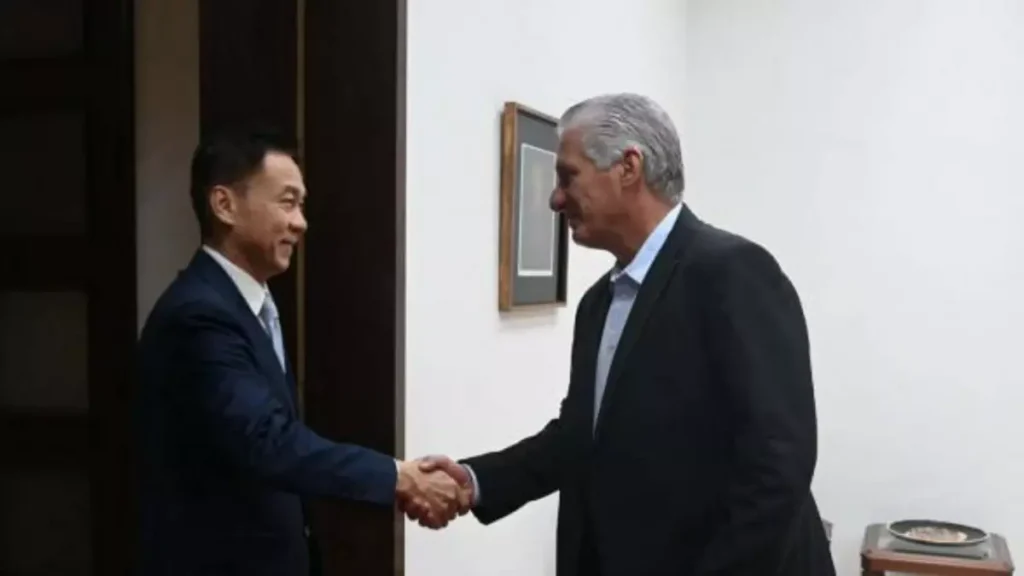
The Chinese ambassador says the business model for the photovoltaic parks donated by China is being developed and modified

The Chinese ambassador met this Tuesday with Miguel Díaz-Canel to convey information from his government. / Granma

14ymedio bigger14ymedio, Madrid, January 21, 2026 – There are no precise details about China’s new financial aid for Cuba, although the amount and its main destination are known. The package is valued at $80 million for “the acquisition of electrical equipment and other urgent needs.” The ambassador himself, Hua Xin, met with President Miguel Díaz-Canel to inform him that he had received “instructions from his government to convey this information to the Cuban side,” the official State newspaper Granma reports.

The diplomat explained that this proposal is the result of meetings held between authorities from both countries, especially Foreign Minister Bruno Rodríguez and China’s Special Envoy for Latin American and Caribbean Affairs, Qiu Xiaoqi. He also cited Vice Prime Minister and Minister of Foreign Trade and Foreign Investment Óscar Pérez-Oliva Fraga, and the Minister of Energy and Mines, Vicente de la O Levy.

The parties agreed, said Hua Xin, to “designate an executive company” for this task, which explains the meetings with Pérez-Oliva.

What little the information reveals suggests that both were key to the aid, since China has decided to change the method under which projects are being carried out using the donations of 200 megawatts of photovoltaic capacity and 5,000 solar panels for homes in hard-to-reach areas. continue reading

The parties agreed, said Hua Xin, to “designate an executive company” for this task, the reason for the meetings with Pérez-Oliva.

In March 2025, the authorities announced that the Island planned to build 22 photovoltaic parks with a Chinese donation, seven of which already had “the initial endowment to begin construction,” although it was indicated they would contribute 120 MW. The project now under discussion is apparently independent of the 92 solar parks being built under contract with two Chinese companies. China has not specified, however, why it decided to “modify the method” for developing the projects.

In addition, after yesterday’s meeting with the Chinese ambassador, Díaz-Canel highlighted the “intense activity” being carried out by Hua Xin, making specific mention of the donation of 60,000 tons of rice that will arrive from China in the coming weeks. This Monday, Santiago de Cuba and Havana each received an initial delivery of 2,400 tons, with a ceremony held in Havana.

The Cuban leader also spoke of “Phase Four of the digital transformation program being carried out with Chinese support, everything that has been achieved in the high-definition television project and other technologies in which progress has been made.”

The last time Díaz-Canel was in China, in September 2025, few concrete agreements became public, unlike his previous trip in 2022, when he secured a donation of $100 million.

However, the president did bring back a biopharmaceutical collaboration for a new, 81-milligram aspirin, a drug used as a daily therapy to prevent heart disease and strokes. The medication would reach Cuba through “the transfer of technology from Medsol Laboratories to the Chinese company Hubei C&C, in Wuhan.”

Cuba received the first shipment on Tuesday; the boxes were shown but not the quantity. The drug is “intended to meet the demand of the Basic List of Medicines,” BioCubaFarma indicated.

“This mechanism,” the company adds, “uses part of the profits generated by sales of PPG [Cuban Polycosanol, a natural drug], the flagship product of the Cuban entity involved, to ensure the stability of the supply of this key medication for the prevention and treatment of cardiovascular diseases.”

Translated by Regina Anavy

____________

COLLABORATE WITH OUR WORK: The 14ymedio team is committed to practicing serious journalism that reflects Cuba’s reality in all its depth. Thank you for joining us on this long journey. We invite you to continue supporting us by becoming a member of 14ymedio now. Together we can continue transforming journalism in Cuba.
Sentenced to Five Years for Disrupting ‘The Natural State of Tranquility and Security That Characterizes’ Cuba

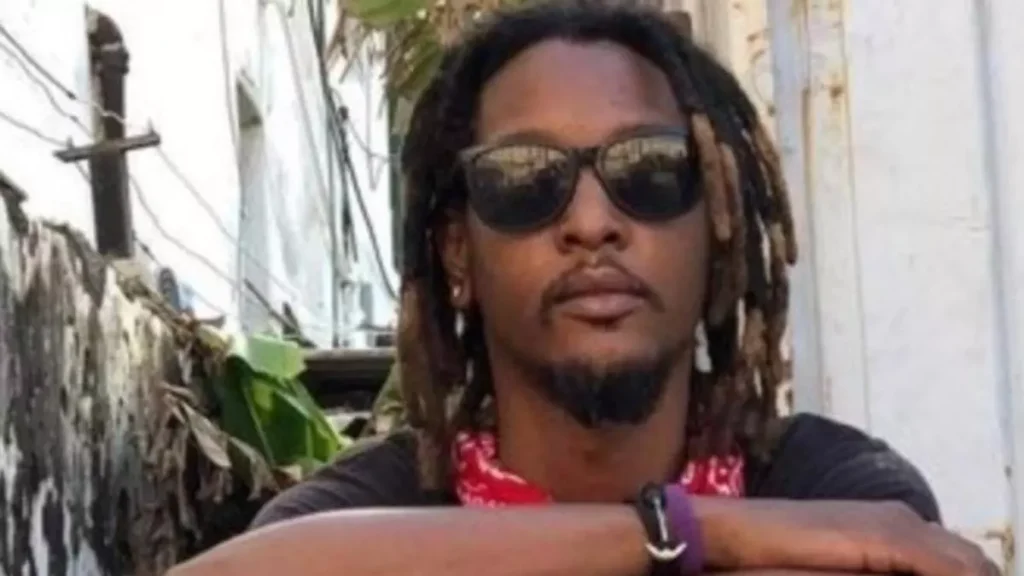
Rapper Nando OBDC was sentenced for painting “counter-revolutionary phrases” such as “Cuba First in the streets for human rights” on a sheet.

Rapper Fernando Almenares Rivera, aka ‘Nando OBDC’. / Facebook

14ymedio bigger14ymedio, Havana, 19 January 2025 — Rapper Fernando Almenares Rivera, known as Nando OBDC, was utimately sentenced to five years in prison for the “intentional and consummated crime of propaganda against the constitutional order, as a direct perpetrator.” This is stated in the sentence that has just been delivered to his mother, Eva Rivera, and which 14ymedio has had access to.

Signed in Havana on December 22 by the judges of the State Security Crimes Chamber Kenia Reyes Lara –the rapporteur– Jesús Pérez Benavides, Patricia González Vera, Gil Amado Payne Hernández and Simón Mario Reyes Balmaceda, the sentence reduces by one year the prosecutor’s request for prison – which was six years – but retains the same Orwellian tone in the account of the “proven facts.”

Thus, it is taken as fact that Almenares received “instructions” from the Cuban-American Armando Labrador Coro, “an active member and president of the counterrevolutionary organization called Cuba Primero” – to which Daniel Alfaro Frías José Antonio Pompa López and Lázaro Mendoza Garcías belong, who were sentenced to nine, eight and five years in prison, respectively, last October – with which “he maintains relations and contacts through its members, on a date not specified but prior to and close to the month of August 2024.”

The confirmation that he was the author, in the legal document, borders on graphology

According to the judges of the People’s Court, this organization instigated the rapper to paint “counterrevolutionary phrases on pieces of white fabric and place them where they could be seen by passersby, with the purpose of provoking social unrest, disturbing public peace, and creating discontent among the population, thereby stimulating actions against the established social order in the country.” The ruling states that they paid Nando OBDC $200 for this purpose.

The phrases, painted “with a pinkish substance,” read “Cuba First in the streets for human rights,” “We want change now, Cuba First,” and “Cuba First in the streets.” The confirmation that he was the author, in the legal document, borders on graphology.

According to the “forensic document examination report,” the sentence states, as in that comic scene by the Marx Brothers, “it is concluded continue reading

that the handwritten texts were made by the accused, given the degree of elaboration, the leftward inclination, the form of the mixed movements, and, in particular, the ascending and descending disproportion of the lower strokes of the capital letter A, the location of the middle stroke with respect to the baseline of the writing of the capital letter A, the situation of the middle stroke of the capital letter B with respect to the baseline of the writing, the ascending rightward inclination of the semi-oval of the capital letter P, the straight upper stroke of the capital letter R, as well as the arched shape located in the final stroke of the capital letter R.”

However, although the judges state that it was verified that Almenares was at the Bar Feline event on the date the incident allegedly occurred, the owners of the establishment and the organizers, according to the same text, “do not remember him there because many people were present.” The court deemed this “irrelevant,” explaining in a convoluted manner that “during the oral proceedings, as is his right, he stated that he was on a ship at that time, which demonstrates his intention to evade justice.”

“They also got all the details wrong, his age, his parents’ names.”

Almenares’ mother is particularly bothered by this last point, although she insists that “everything in the document is a lie.” She continues, displeased: “They also got all the details wrong—his age, his parents’ names.”

Among the evidence considered by the judges was the record of the young man’s cell phone, through which “his link with the Cuban-American counterrevolutionary Armando Labrador Coro could be determined,” and the testimony of “witness Roberto Manuel Escalona, ​​who stated in the oral trial that he brought money from abroad to the accused without knowing the senders, but that the last time he gave him the sum of 200 USD, an amount that coincidentally is equal to that promised by Armando Labrador to the accused if he carried out the acts for which he is being tried.”

Similarly, the sentence links Almenares to “different counterrevolutionary groups” such as the independent media outlets Radio Martí and Diario de Cuba, as well as the Cuban Youth Dialogue Table, Cubalex and Cuban Democratic Directorate.

Another issue considered by the court is that they did not find a “recognized employment relationship” and that “he maintains an unfavorable social conduct by associating himself with criminal elements in the locality and with elements disaffected from the revolutionary process based both in Cuba and abroad,” although they exempt him from criminal records.

The court condemns him for painting on those sheets, based on the strict Constitution, “taking into account the degree of social harm of the act committed by the accused”

However, the court condemns him for painting on those sheets, based on the strict Constitution, “considering the degree of social harm of the act committed by the accused, due to the consequences it would bring to the economic and social stability of the country and the peace of the members of society, by putting up posters in public with a clear message that the inhabitants should oppose the Cuban social process and take to the streets, which would provoke protests, violence and a rupture of the natural state of tranquility and citizen security that characterizes our country.”

The actions of Almenares Riveras, they continue, “are in total opposition to what is established in Article 1 of the Supreme Law which states ‘Cuba is a socialist and social justice state, democratic, independent and sovereign, organized with all and for the good of all as a unitary and indivisible republic, founded on the work, dignity, humanism and ethics of its citizens for the enjoyment of freedom, equity, equality, solidarity, well-being and individual and collective prosperity’.”

The sentence does not specify in which prison he will serve his time, but until now the rapper was in the Cuba Panamá prison, located in Güines, Mayabeque, which houses inmates with HIV/AIDS. His mother has publicly denounced his continued confinement there, given that he does not have the disease, as well as the deplorable sanitary conditions of the prison.

At the end of July, Nando OBDC went on a hunger strike to protest being held incommunicado in prison. The musician’s activism had been under scrutiny by the authorities for some time. In November 2021, he was summoned to the Seventh Unit of the National Revolutionary Police for his social media posts.

____________

COLLABORATE WITH OUR WORK: The 14ymedio team is committed to practicing serious journalism that reflects Cuba’s reality in all its depth. Thank you for joining us on this long journey. We invite you to continue supporting us by becoming a member of 14ymedio now. Together we can continue transforming journalism in Cuba.
Cuba Operates a Digital Surveillance System Against Dissent, Prisoners Defenders Reports

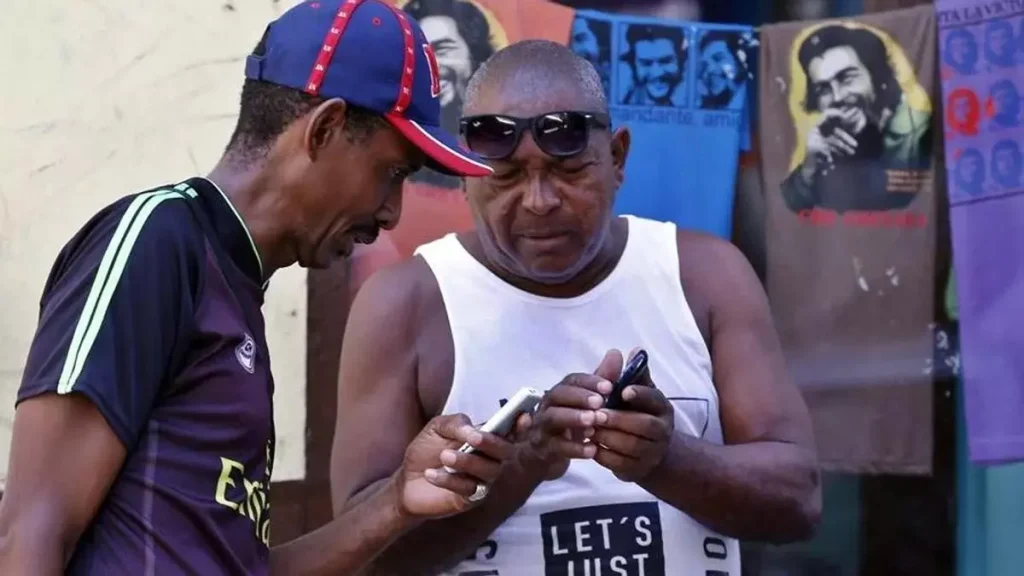
Some 46.5% of those surveyed by the NGO stated that they suffered direct interference with their communications in messaging applications

The NGO identified 10 surveillance patterns, including “cyber-patrolling,” selective internet outages, and “coercive digital intrusion.” / EFE

14ymedio biggerEFE (via 14ymedio), Madrid, 20 January 2026 —  Cuba has consolidated a digital surveillance system designed to “neutralize dissent” based on “punitive” laws, spyware and other means of technological intrusion, according to the First Comprehensive Report on Digital Surveillance in Cuba by the organization Prisoners Defenders.

In the document, based on 200 testimonies from victims inside and outside the country, the NGO accuses the Cuban government of operating under a “Big Brother” logic – referring to the all-powerful character in George Orwell’s novel 1984 – in order to dismantle “independent social, civic and political networks, as a form of subjugation.”

During the presentation of the report, held this Tuesday remotely, the president of Prisoners Defenders, Javier Larrondo, lamented the level of “self-censorship” that the cyber-surveillance system has caused on the Island.

“The level of self-censorship is tremendous, the terror among the population of posting on social media or even talking on WhatsApp.”

“The level of self-censorship is tremendous, the terror among the population about posting on social media or even talking on WhatsApp,” he denounced.

The report highlights that 46.5% of respondents stated that they suffered direct interception of their communications on messaging applications, such as WhatsApp, and that the content of their conversations was mentioned by the police during interrogations or arrests without warrants.

“It is not a temporary technical phenomenon, but a central component of a political control model,” the text emphasizes.

Along those lines, the report documents that virtually all respondents (98.5%) have suffered “sanctions or threats” because continue reading

of the content of their digital conversations or publications.

Among the 200 testimonies, the presence of activists (51%), relatives of political prisoners (33.5%) and independent journalists (15%) stands out.

The NGO’s investigation identified 10 surveillance patterns, including “cyber-patrolling” (systematic observation of publications and communications), selective internet shutdowns, and “coercive digital intrusion.”

“These practices eliminate any reasonable expectation of privacy”

This last practice consists of forcing victims to unlock their phones without a court order, an action that affected 65.5% of the sample.

Once access is obtained, according to the report, the authorities not only review the information, but also intercept private communications on messaging applications (reported by 46.50% of respondents).

After the intrusion, it is common for victims to detect sessions opened from unknown locations (49.5%).

Another key finding in the text is the blocking of internet access, a phenomenon experienced by 77.5% of respondents. These outages mostly coincided with events such as protests or symbolic dates, such as the anniversary of the Island-wide anti-government protests of 11 July 2021.

“These practices eliminate any reasonable expectation of privacy. This pattern demonstrates that private communications are not protected in Cuba. Surveillance operates without controls, without judicial authorization, and without clear limits, directly violating the right to privacy, intimacy, and freedom of expression,” criticized Caren Herrera, legal director of the organization.

On the other hand, the NGO also criticized the “instrumentalization of the law,” pointing to regulations such as Decree-Law 370 and the new Penal Code. These laws, it stated, allow for the imposition of hefty fines and the confiscation of equipment for disseminating information contrary to “the public interest,” a term the organization describes as “vague and discretionary.”

____________

COLLABORATE WITH OUR WORK: The 14ymedio team is committed to practicing serious journalism that reflects Cuba’s reality in all its depth. Thank you for joining us on this long journey. We invite you to continue supporting us by becoming a member of 14ymedio now. Together we can continue transforming journalism in Cuba.
Ukraine Reveals the Names of 54 More Cuban Mercenaries Killed in the Russian Invasion

The dates reveal spikes in deaths on specific days, suggesting the participation of Cuban contingents in intense operations.

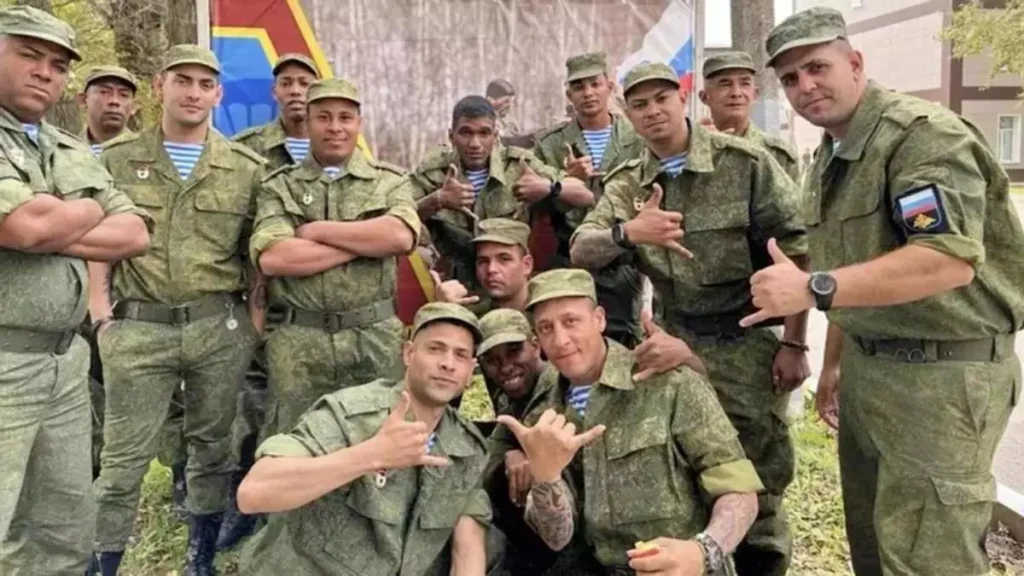
According to Ukrainian intelligence, 20,000 Cubans have been recruited as mercenaries by the Russian side since the war began / Alain Paparazzi

14ymedio bigger14ymedio, Havana, January 20, 2025 —  Ukraine has released a new list of 54 Cuban mercenaries killed in battle who were serving in the Russian Army. The names were revealed last Friday by the Quiero Vivir [I Want to Live] Center,  an office created by the Ukrainian government to receive surrenders from Russian and foreign soldiers.

In a post , he clarified that “this is not an exhaustive list of Cuban mercenary losses, but only of those whose deaths we know with certainty.” The document includes names, ranks, units, and dates of death, primarily in Donbas and Zaporizhia.

The dates reveal spikes in deaths on specific days, suggesting the participation of Cuban contingents in intense operations. On June 22, 2024, for example, six Cubans died in combat on the same day. Another group of five died on June 17. The data also shows that 39 deaths were recorded last year and 15 in 2024. continue reading

Regarding the contracts signed, most were signed in 2024, with 44, while in 2023 there were six and only four in 2025.

The average age of these 54 mercenaries was 41.7 years. Of these, 32 fell into two age ranges: between 26 and 35 years old, and between 46 and 55.

According to the records, the average age of these 54 mercenaries was 41.7 years. Of these, 32 fell into two age ranges: between 26 and 35 years old, and between 46 and 55. There were also three fighters who were under 25 and eight who were over 56.

The Center stated that they “died with weapons in their hands 10,000 kilometers from home” and launched a harsh critique of the Cuban government and its silence regarding these deaths: “Their names are known in both Moscow and Havana. However, you will find no honors, no mourning, and no public mention of these people. No patriotic speeches are given about them, no monuments are erected in their honor, and they are not mentioned in the newspapers.”

It also condemned the disparity in treatment between the Cubans in the Russian Army and the 32 Cubans who were part of Nicolás Maduro ‘s security detail during his capture by the United States on January 3. “Cuban authorities declared a national holiday and day of mourning,” it added, after the government dedicated two days to honoring these militiamen, who were repatriated from Venezuela, with a media campaign that included televised coverage of their arrival and funeral.

According to Ukrainian intelligence reports, at least 20,000 Cubans have been recruited as mercenaries on the Russian side since the war began in February 2022, more than 1,000 of them with documented names and contracts. According to Kyiv, Havana is the second largest supplier of mercenaries to Moscow, after North Korea.

At least 20,000 Cubans have been recruited as mercenaries by the Russian side since the war began in February 2022.

In October of last year, figures provided by Ukrainian intelligence (GUR) to the Kyiv Independent publication spoke of 96 Cuban mercenaries who had died in hostilities or were missing.

According to Ukrainian military intelligence, most of them arrive in Russia attracted by construction jobs advertised on social media, which offer lucrative salaries of over $2,000. The process is carried out through private intermediaries, many of them Cubans residing in Russia.

This covert complicity of the Cuban government led Ukraine to vote against the United Nations resolution that called for the lifting of the US embargo against the island last October.

Ukrainian Foreign Minister Andriy Sibiga explained his vote and criticized the Cuban authorities’ “inaction” in the face of Russia’s “massive” recruitment of mercenaries. Speaking on X, he said, “This gesture is not sudden. It has serious motives. We recall the Cuban president’s wish for Putin’s ‘success’ in his war of aggression against Ukraine. We heard him perfectly.”

In the same message, he clarified that the vote was not “against the Cuban people: we respect their right to live in prosperity. It is against the inaction of the Cuban authorities in response to the mass recruitment of Cuban citizens by the Russian occupation army.”

____________

COLLABORATE WITH OUR WORK: The 14ymedio team is committed to practicing serious journalism that reflects Cuba’s reality in all its depth. Thank you for joining us on this long journey. We invite you to continue supporting us by becoming a member of 14ymedio now. Together we can continue transforming journalism in Cuba.
Cuban Journalist Jorge Fernández Era Released After a 16 Hour ‘Kidnapping’ by State Security

The writer left at 3 pm to make his peaceful protest, which he did every 18th, and by midnight there was no news of his whereabouts.

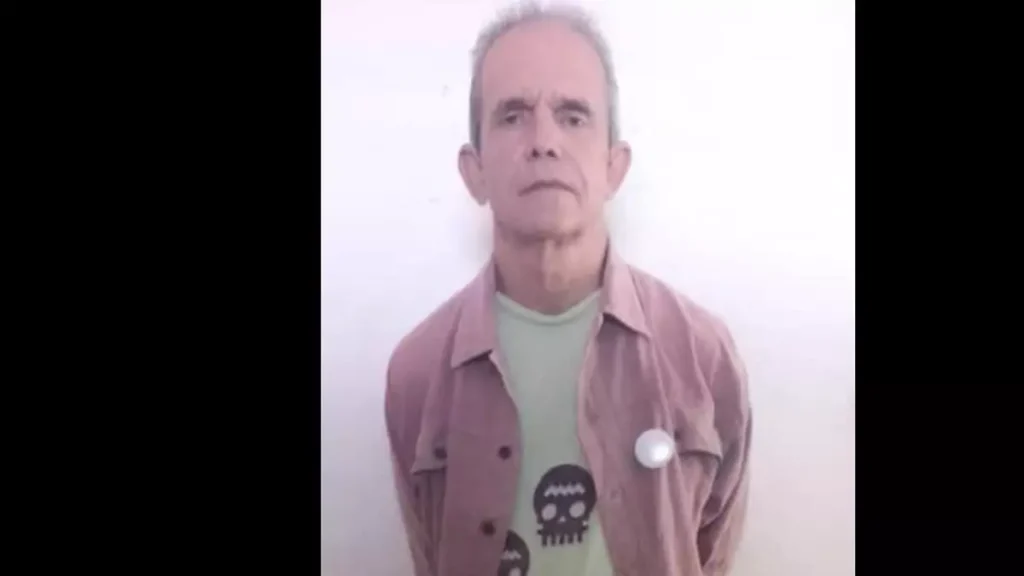
Image shared by Jorge Fernández’s family. This is what he was wearing when he left home this Sunday. / Facebook

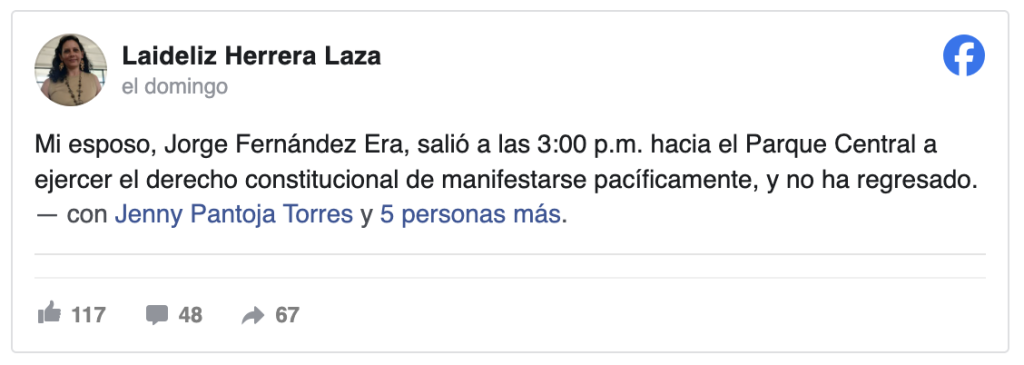
14ymedio bigger14ymedio, Madrid, January 19, 2025 —  Writer Jorge Fernández Era was detained for 16 hours, from 3 a.m. Sunday until 7 a.m. Monday, as he confirmed after his release. The activist had been missing since leaving his home Sunday afternoon to participate in the peaceful protest he holds on the 18th of each month. Although State Security has intervened on previous occasions to prevent him from participating in this activity, this time none of his family or friends had been able to locate him by calling police stations in Havana. His wife, Laideliz Herrera, announced the news in a Facebook post shortly after 7 p.m.

“My husband, Jorge Fernández Era, left at 3:00 pm for Central Park to exercise his constitutional right to peacefully demonstrate, and he has not returned,” she alerted.

Activist Jenny Pantoja later shared the same concern, adding that her attempts to locate him were proving fruitless. “Several of us have called the police stations and they tell us he’s not at any of them, that he doesn’t appear in the system. We know how you and the State Security operate. You put activists and opposition members in jail and don’t continue reading

register them. That’s why they don’t appear in the National Repressive Police (PNR) system,” she denounced.

Pantoja, visibly upset, warned the authorities of the consequences if the situation continued. “I’m just telling you: release him, or you’ll have to deal with many more people detained, and the situation will become much more complicated,” she added. The message also included a reference to
the information released this Sunday regarding the approval of “plans and measures for the transition to a State of War.”

“We don’t believe in a State of War, because that’s the phase Cuba has been living in for a long time now: total repression and no constitutional guarantees,” Pantoja retorted.

Other Cuban activists and opposition members had joined their demands, including the professor and intellectual Alina Bárbara López, who began these peaceful demonstrations, which Fernández Era joined in April 2023. The academic started this activity precisely as a result of the writer’s arrest that year and decided to do it periodically, every month in Matanzas, due to the political situation in the country, which has meant, both for her and for those who have decided to support her, several arrests in the last two years.

López also faces trial for contempt, disobedience, and assault, crimes for which the prosecution is seeking a four-year prison sentence. But this hasn’t stopped her from continuing her protests, and just yesterday she was able to hold one in Matanzas. At midnight, knowing that Fernández Era was still missing, she warned: “If we don’t hear from him tomorrow, we will act accordingly, with civic responsibility and determination.”

Activist Miryorly García was able to demonstrate this Sunday, writing on social media, “about the deplorable state of the Cuban nation and the need for change that will return sovereignty to the Cuban people.” The editor has been leading a campaign for days demanding amnesty for Cuban political prisoners, a campaign that has garnered over a thousand signatures.

“Solidarity has been criminalized, but it is a matter of humanity to defend our brother or sister, daughter or son, mother or father, wife or husband, relative, neighbor or friend, fellow citizen. We must transform the shame of silence into the power of empathy, rise above fear, and let the punishment become inspiration,” he reminded everyone yesterday in a post in which he insisted on the importance of joining this demand despite the legitimate fear among the population. “Nothing changes if we continue doing the same thing. It is, despite the consequences, about changing ‘How long?’ to ‘Enough is enough.’ Because if we unite, we won’t fit in the prisons; we are more,” she urged.

Last December, Jorge Fernández Era was also arrested during his monthly protest, this time in Matanzas, but he was located by his family in the usual way and released a few hours later. On several of the many occasions the writer has been arrested, he has denounced mistreatment, including his arrest in July 2025 , when he was beaten by a lieutenant colonel from the Zanja police station in Havana.

____________

COLLABORATE WITH OUR WORK: The 14ymedio team is committed to practicing serious journalism that reflects Cuba’s reality in all its depth. Thank you for joining us on this long journey. We invite you to continue supporting us by becoming a member of 14ymedio now. Together we can continue transforming journalism in Cuba.

No News of One of the Two Cuban Women Travelling on the Train That Crashed in Spain

Tamara Valdés remains missing, while Daniela Arteaga is hospitalised in Córdoba and out of danger.

Tamara Valdés and Daniela Arteaga, both Cuban nationals, were travelling on the Alvia train from Madrid to Huelva.

14ymedio bigger14ymedio, Madrid, 20 January 2025 — There is no news of Tamara Valdés, the 39-year-old Cuban woman who disappeared after the train accident that occurred on Sunday night in Spain when two high-speed trains collided after one of them derailed. The accident has claimed the lives of 41 people so far, although the death toll could rise dramatically, as two carriages from one of the trains have not yet been lifted.

Tamara Valdés had been living in Huelva for several years. In that Andalusian province, the final destination of one of the trains, she lived with her husband Ramón Montón, who spoke to the local press on Monday while trying to locate her. “I’m very nervous, I still haven’t been able to locate her, it’s taken me three hours from Huelva, I’ve been rushing a bit. My wife was on the Alvia train, I spoke to her 20 minutes before the accident. She almost missed the train,” he said yesterday while waiting at the municipal booth in Adamuz (Córdoba), the town closest to the scene of the accident.

So far, the identity of another Cuban woman who was travelling on the same train has been confirmed. Daniela Arteaga was much luckier, according to her mother, who said early on Monday morning that she was out of danger. The 28-year-old graduate of the Higher Institute of Design had received a scholarship from the International University of Andalusia (UNIA) and had just arrived in Madrid, where she took the train to Huelva. “She is in a serious but stable condition,” María de la O Barroso, director of the UNIA’s Ibero-American Headquarters in La Rábida, told the Spanish press.

The 28-year-old graduate of the Higher Institute of Design had received a scholarship from the International University of Andalusia (UNIA) and had just arrived in Madrid, where she took the train to Huelva.

“She was travelling on the train covering the Madrid-Huelva route and suffered several broken ribs and head injuries,” a friend of the young woman told OnCuba News. According to his account, Arteaga was very happy to have secured a place on the postgraduate course in Communication and Audiovisual Education, as well as to be going to Spain, where she has no family.

The course director informed the students of the situation via email. “Today has been a very sad day for Huelva and for our master’s programme. The train accident in Adamuz has filled all of Spain with sadness, especially our province,” wrote Ignacio Aguaded. “Our student Daniela Arteaga, who arrived yesterday from her native Cuba, excited to begin the academic project of her life, was trapped in a pile of wreckage. Now, she continues to fight for her life in a hospital in Córdoba,” he added. continue reading

The rector of the institution, José Ignacio García Pérez, travelled to the Reina Sofía Hospital in Córdoba to visit her, along with other UNIA executives. “We hope to have her back in Huelva soon, where she will be cared for like family.”

The Cuban Embassy in Spain stated on Monday that it has confirmation that three Cuban citizens were travelling on the trains, one of whom is hospitalised – presumably Daniela Arteaga – and two have been discharged, whose identities are unknown.

The hospital is expecting a visit on Tuesday from King Felipe and Queen Letizia, who have just arrived from Greece to attend the funeral of an aunt of the Head of State. There they will meet with survivors, relatives of the victims and teams of psychologists and rescue workers, together with the First Deputy Prime Minister, María Jesús Montero, and the President of the Andalusian Regional Government, Juanma Moreno.

On the ground, work continues to lift the carriages. This morning, new heavy-duty cranes arrived, which are expected to help with the complicated task of accessing the carriages. In addition, 27 forensic scientists from six Andalusian provinces are involved in identifying the bodies, many of them using DNA from the families.

The accident has led to a large-scale emergency operation, the suspension of several rail connections and an investigation to clarify its causes. The number of fatalities in the train derailment has reached at least 41, with a total of 122 people treated for injuries, including 117 adults and five children. At this time, 39 people remain hospitalised.

The accident occurred at 7:50 p.m. when the last two carriages of a train belonging to the Italian company Iryo, travelling from Madrid to Malaga, derailed. At that moment, an Alvia train belonging to the state-owned company Renfe, travelling from Madrid to Huelva, was travelling on the adjacent track and was hit.

The accident occurred at a lower than normal speed (both vehicles were travelling at just over 200 kilometres per hour compared to the 350 kilometres per hour they can reach) and on a straight section of track. In addition, the Iryo train had passed an inspection just four days before the accident, so the investigation is focusing on the infrastructure to rule out any possibilities.

Furthermore, the Iryo had passed an inspection just four days before the accident, so the investigation is focusing on the infrastructure to rule out any possibility.

The Railway Accident Investigation Commission (CIAF) has determined that it will be necessary to analyse “the rails at the point where the derailment began” in a laboratory and inspect the running gear of the Iryo train in a workshop following the railway accident. It will also “extract data from the legal recorders on board both trains” and “information on the records of traffic through Adamuz in the two days prior to the incident”, as well as inspect “the running gear of other trains that previously passed through that point.

Condolences have poured in from all over the world, including Cuba. The Minister of Foreign Affairs sent a message via his Twitter account on Monday in which he made no mention of the Cuban victims. “We deeply regret the train accident in Spain, which has caused numerous deaths and injuries. We express our heartfelt condolences to the Spanish government and people, especially to the families and friends of the victims,” he said.

Miguel Díaz-Canel did the same a few hours later. “Heartfelt condolences to the Government and people of Spain for the victims and injuries caused by the derailment of two trains. All our solidarity at this sad time.”

Translated by GH

____________

COLLABORATE WITH OUR WORK: The 14ymedio team is committed to practicing serious journalism that reflects Cuba’s reality in all its depth. Thank you for joining us on this long journey. We invite you to continue supporting us by becoming a member of 14ymedio now. Together we can continue transforming journalism in Cuba.

Castro and Chávez, a Criminal Association

The teachings of Castroism have led the Venezuelan autocracy to implement a social control very similar to that of Cuba.

There have been many complaints about the control exercised by Cuban Armed Forces officers over Venezuelan armed forces / ‘Cubadebate’

14ymedio bigger14ymedio, Pedro Corzo, Miami, 18 January 2025 — The deaths of several dozen Castro henchmen in Caracas irrefutably testifies to the close alliance between the dictatorial systems of Cuba and Venezuela, a league in which the Nicaraguan dictatorship of Ortega-Murillo is directly involved, despots who have decided to release political prisoners in an attempt to alleviate the pressure that the current hemispheric conditions allow us to appreciate.

It is true that Venezuela has provided invaluable support to Cuban totalitarianism in the form of oil, the hiring of slave laborers, and international backing, but the Castros have also passed on, first to Hugo Chávez and then to the thankfully imprisoned Nicolás Maduro, their vast knowledge of activities related to repression, espionage, and a little-discussed aspect: the strategy to develop such that the majority of the politically dissatisfied population emigrates with the aim of reducing the opposition and obtaining income from abroad.

There have been numerous reports of the control exerted by officers of the Cuban Armed Forces over Venezuelan military institutions. Personnel of various ranks hold authority at Fort Tiuna, the most important military center, while instructing intelligence and counterintelligence services on how to neutralize and even arrest potential conspirators within military units.

Castroism is equally responsible for drug trafficking as are Maduro and Diosdado Cabello.

It must be pointed out that the teachings of Castroism have led the Venezuelan autocracy to implement a social control very similar to that of Cuba, characterized by sectarianism, discrimination and citizen distrust, culminating in a generalized hopelessness, in my opinion, the most tragic legacy of any dictatorship. continue reading

The links between the despots of both countries have been so deep that the most devastating butcher of Castroism, Ramiro Valdés, has been a frequent visitor to Venezuela with the aim of setting up the logistical base that Chavismo needed to survive, so it is easy to infer that the Castro agents located in that country have had a notable participation in the management of the drug trafficking that was handled by the Soles cartel.

Castroism is just as responsible for drug trafficking as are Maduro and Diosdado Cabello, especially if we recall the accusations of Fidel Castro’s close relationship with several of the drug kingpins of the eighties and nineties and other recent ones, which allege that the totalitarian regime tried to cover up its criminal activity with the execution of General Ochoa and other high-ranking officers.

It is widely known that the Americas Department, one of the totalitarian regime’s agencies dedicated exclusively to the subversion and destabilization of democracies, throughout its existence and under the direction of Manuel Piñeiro, alias Barbarroja, sought the necessary resources in drug trafficking when it was short of funds. Carlos Lehder, imprisoned for over thirty years in the United States for drug trafficking, told Radio Marti: “I was invited by the communist government of Cuba, by the Castro dictatorship, to Cuba, to establish a conduit, a line, a route for trafficking cocaine to the United States.”

The Castro henchmen who died on January 3rd in Caracas were not the only ones of their kind to be killed in defense of the worst

Furthermore, I believe it necessary to remember that the Castro henchmen who died on January 3rd in Caracas were not the only ones of their ilk to be killed defending the worst. Fidel Castro always longed to subjugate Venezuela, although it was Hugo Chávez, a traitor to his country, who handed it to him on a silver platter.

The first known Castroist hitman killed in that country was Antonio Briones Montoto, one of the invaders of Machurucuto.

Castro’s interest in imposing his fundamentalism on the hemisphere was constant, but two countries, unfortunately for them, exerted a fatal attraction on the Cuban despot: Venezuela and Colombia.

Castro’s interest in Venezuela was evident in his trip to Caracas in January 1959, when he tried to convince the esteemed democrat Rómulo Betancourt to align himself with his proposals, an objective he failed to achieve because Betancourt saw through him completely, while millions of Cubans were captivated by the tyrant. From the very beginning of the Cuban Revolution, hundreds of Venezuelan insurgents were trained and equipped with weapons and money from the island; however, the Castros’ support did not destroy democracy. It was Hugo Chávez and Nicolás Maduro who brought it down, and all of them together have been involved in drug trafficking.

____________

COLLABORATE WITH OUR WORK: The 14ymedio team is committed to practicing serious journalism that reflects Cuba’s reality in all its depth. Thank you for joining us on this long journey. We invite you to continue supporting us by becoming a member of 14ymedio now. Together we can continue transforming journalism in Cuba.

The Cuban Regime Is Not Honoring Its Dead, It Is Using Them

The glorification of the fallen allows them to impose a forced pause on internal debate.

The regime turns the dead into symbolic shields to protect itself from its own fractures. / Cubadebate

14ymedio bigger14ymedio, Yunior García Aguilera, Madrid, 17 January 2026 — “Propaganda works by appealing to emotions, not reason.” This phrase, attributed to Noam Chomsky, sums up the political moment in Cuba following the deaths of 32 Cubans in Venezuela. More than a tragic event, the episode has been transformed by the regime into a carefully orchestrated display of pathos to regroup, silence dissent, and revive an internal obedience that had been eroding for some time.

The political events celebrated on the island in honor of the fallen are not conceived to convince the outside world. Nor do they seek international credibility or aspire to whitewash a narrative that much of the world has already dismissed. The “performance” is directed inward, at the Party structures, the mid-level cadres, the weary militants, and the officials who in recent months have begun to waver. Hence Miguel Díaz-Canel’s call to “close ranks,” a new battle order.

Michel Torres Corona and Gabriela Hernández, presenters of the propaganda program Con Filo, have barely managed to conceal their enthusiasm for the current situation. In a Facebook Live broadcast, they both boasted about the regime’s supposed ability to mobilize its supporters and hailed Díaz-Canel’s speech as “the best he has given” to date. The scene was completed by the systematic blocking of users whose opinions differed from their own. Far from any sign of restraint, the two appeared exultant, as if the tragedy had arrived at the perfect moment to revive a political optimism that had been waning for some time.

The regime enters this period after one of its worst years in terms of internal cohesion. The accelerated deterioration of the economy, persistent inflation, the collapse of basic services, and the energy crisis have undermined not only social support but also morale within the apparatus itself. Added to this were corruption scandals and political blunders that were difficult to conceal, such as those involving Marta Elena Feitó, the fall from grace and subsequent conviction of Alejandro Gil, and the mysterious continue reading

resignation of Homero Acosta—episodes that opened unprecedented cracks in the discourse of unity and discipline.

The capture of Nicolás Maduro revealed not only that the regime was lying, but also that its military apparatus was incapable of fulfilling the mission that, in theory, justified its presence on foreign soil.

For the first time in a long time, criticism was coming not only from exile or the open opposition, but also from areas traditionally aligned with the system. Officials, state economists, academics close to the government, and long-time activists began to express reservations, unease, or disillusionment. The combination of material hardship, endless blackouts, and the spread of disease in a country lacking medicine finally eroded the “revolutionary” mystique.

In this context, the deaths of the 32 Cubans in Venezuela appear as a political opportunity. Outside of Cuba, the impact has been minimal. The international community knows that Havana repeatedly denied the presence of Cuban troops on Venezuelan soil. The capture of Nicolás Maduro revealed not only that the regime was lying, but also that its military apparatus was incapable of fulfilling the mission that, in theory, justified its presence on foreign soil. For most external observers, the Cuban casualties are just another chapter in the opaque and deeply discredited relationship between Havana and Caracas.

Within Cuba, however, pathos does work. The glorification of the dead allows the regime to impose a forced pause on internal debate. “This is not the time for criticism,” is repeated, as if mourning demanded obedience and emotion nullified the right to think. Sacrifice, elevated to a moral category, thus becomes an argument to justify repression, reinforce control, and delegitimize any questioning as a lack of respect for the “heroes” or an act of treason.

Abel Prieto has even confessed, without shame, how they use pathos for the benefit of official propaganda.

At the same time, the intensive use of pathos offers a mobilizing cause, something the regime had lost. When there were no more credible achievements or promises to rally the masses, the cult of the fallen provides an epic narrative of emergency. It matters little that the facts are uncomfortable or that the narrative rests on omissions and contradictions. In the logic of propaganda, emotion supplants reason.

Another official who has shamelessly confessed how they exploit pathos for the benefit of official propaganda is Abel Prieto. In statements to the press, the former advisor to Raúl Castro described how he was at the memorial “from early on,” how he saw “the families crying” in front of the coffins, and how the people “crowded together, even in the rain,” before drawing an explicit political conclusion: “This profound pain strengthens our anti-imperialism, our anti-fascism.”

It is clear that his words contain neither private grief nor respect for silence, but rather a classic agitprop operation, dedicated to collecting, displaying, and transforming emotions into ideological fuel. The melodramatic scene—tears, coffins, rain, crowds—is not narrated to understand a tragedy, but to demonstrate that suffering produces “unity.” When Prieto concludes by asserting that Cuba is “stronger” thanks to the loss, the attempt at manipulation is blatantly exposed.

The Cuban regime is not honoring its dead: it is exploiting them. It is turning them into symbolic shields to protect itself from its own internal divisions. And in that gesture lies an implicit admission of weakness, because only those who lack solid results or legitimacy need to repeatedly resort to pain and sacrifice to maintain their grip on power.

____________

COLLABORATE WITH OUR WORK: The 14ymedio team is committed to practicing serious journalism that reflects Cuba’s reality in all its depth. Thank you for joining us on this long journey. We invite you to continue supporting us by becoming a member of 14ymedio now. Together we can continue transforming journalism in Cuba.

The Cuban Regime Prepares for the ‘War of the Entire People’

Instead of dialogue, Havana bets on the rhetoric of confrontation and updates its “plans and measures for the transition to a State of War”

By turning neighborhoods, communities, and citizens into an active part of the defensive apparatus, the doctrine transforms civilians into legitimate targets under the rules of war. / Facebook / Central Army

14ymedio bigger14ymedio, Havana, January 18, 2026 — The approval of the “plans and measures for the transition to a State of War,” announced tersely by the Cuban state press, marks a new turn in the regime’s confrontational rhetoric at one of the most fragile moments in the island’s recent history. With no details, no dates, and no public explanations, the National Defense Council once again resorted to one of the most extreme notions of Cuba’s political-military apparatus, historically associated with scenarios of external threat and, above all, with the suspension of any margin of civilian normalcy.

The note published by Cubadebate merely reports that the decision was taken “in compliance with the activities planned for Defense Day” and as part of the “War of the Entire People.” There is no reference whatsoever to the practical implications of this step, nor is it indicated whether this is a theoretical exercise, a partial drill, or a scenario the government considers plausible in the short term. It is also unclear whether it is being formally instituted or whether it is simply a review of protocols to be applied if and when a decision is made.

Cuban law formally reserves the declaration of a State of War to the National Assembly or, failing that, to the Council of State, while the president and the National Defense Council concentrate the real and operational direction of the process. This legal architecture allows the regime to activate states of exception with scant parliamentary oversight and no public transparency, reinforcing the centralized and militarized nature of power in times of crisis. It implies the highest degree of militarization of the country, the subordination of civilian structures to defense bodies, and the possibility of restricting rights and freedoms that are already quite limited.

The so-called War of the Entire People, according to the definition found in EcuRed and in official Cuban military doctrine, is a strategic conception formulated by Fidel Castro that deliberately blurs continue reading

the boundary between combatants and civilians. Under this approach, in the face of a large-scale military aggression, not only would the Revolutionary Armed Forces and the Militias act, but the entire society would be incorporated into the war effort, with functions assigned by territory and no clear distinction between military defense and civilian life.

The forced militarization of the civilian population contravenes the principle of distinction set out in the Geneva Conventions

From the perspective of international humanitarian law, this conception is problematic. The forced militarization of the civilian population contravenes the principle of distinction enshrined in the Geneva Conventions and reiterated by bodies such as the International Committee of the Red Cross, which establishes the obligation to protect the civilian population and separate it from military objectives.

By turning neighborhoods, communities, and citizens into an active part of the defensive apparatus, the doctrine not only exposes civilians to direct combat risks, but transforms them into legitimate targets under the rules of war, effectively nullifying their civilian status and shifting onto society the human cost of a strategy designed by the political-military power.

The term State of War has appeared since the early years of the revolutionary regime and is linked to moments of greatest international tension. During the October Crisis of 1962 [called in the United States “The Cuban Missile Crisis”], although it was never formally proclaimed, the country was de facto placed in an equivalent situation: general mobilization, absolute control of information, and the total suspension of ordinary civilian life.

Later, the notion reappeared explicitly in Cuban military doctrine and in legislation associated with national defense. The National Defense Law and the regulations of the Defense Council establish that, in the face of a scenario of external aggression or imminent threat, the country may transition to a State of War, which activates a strictly military chain of command and grants extraordinary powers to the Executive.

In practice, this figure serves to justify exceptional controls over the population, the economy, and internal mobility. It is not merely about preparing for an armed conflict, but about reinforcing political control in contexts of crisis.

The announcement by the Defense Council comes amid a regional escalation following the capture of Nicolás Maduro by U.S. troops in Caracas, a strategic blow that has left Havana without its main political and financial ally. The official confirmation that dozens of Cuban military personnel and agents were operating in Venezuela, even within the security ring of the deposed leader, revealed an involvement the regime had repeatedly denied.

Cuba’s population faces a daily emergency that already resembles a state of war, with prolonged blackouts, crumbling infrastructure, extreme shortages of food and medicine, and outbreaks of preventable diseases

Since then, Cuba’s top leadership has reappeared in public wearing military uniforms, intensified its anti-imperialist discourse, and revived a besieged-fortress narrative that seemed worn out even to its own propagandists. The Defense Council itself, chaired by Miguel Díaz-Canel, has remained in permanent session since the onset of the Venezuelan crisis.

The tutelary presence of Raúl Castro, who “was kept informed” of the meeting and described it as “good and efficient,” reinforces the idea that key strategic decisions continue to pass through the historic military apparatus, beyond formal titles.

While the regime speaks of war, the population faces a daily emergency that already resembles a state of war, with prolonged blackouts, infrastructure in ruins, extreme shortages of food and medicine, outbreaks of preventable diseases, and inflation that devours wages and pensions. The repatriation of the remains of 32 Cuban military personnel killed in Venezuela during the capture of Nicolás Maduro was used as an emotional catalyst to reactivate an epic discourse that contrasts brutally with the precariousness of daily life.

The State of War, in this context, functions more as a political instrument than as a response to a concrete threat. It serves to rally the elite, justify closing ranks, divert attention from economic collapse, and warn citizens that any protest can be interpreted as an affront to national defense.

It is unknown which sectors would be mobilized, what economic measures would be activated, or what impact it would have on civilian life. That lack of information is part of the design, because keeping the population in uncertainty is also a form of control.

At the same time, the regime insists that it is willing to engage in “dialogue” with the United States, as long as it does not entail political concessions. However, the recourse to a State of War suggests the opposite: a bet on confrontation and on the survival of power at any cost.

Translated by Regina Anavy

____________

COLLABORATE WITH OUR WORK: The 14ymedio team is committed to practicing serious journalism that reflects Cuba’s reality in all its depth. Thank you for joining us on this long journey. We invite you to continue supporting us by becoming a member of 14ymedio now. Together we can continue transforming journalism in Cuba.

Bitchat, the Cuban Network That Doesn’t Go Through the State Monopoly Etecsa

The rise of the application in contexts of censorship raises the question of its possible role in a Cuba with expensive, unstable and monitored internet.

Can the offline app Bitchat alleviate the limitations Cubans face due to censorship and poor infrastructure? / 14ymedio

14ymedio bigger14ymedio, Natalia López Moya, Havana, January 17, 2026 – On a dusty sidewalk in Kampala, Uganda, a young man says there’s something that can connect him with his friends even if the government shuts off the internet: an app that works without mobile data or Wi-Fi. It’s called Bitchat, it was created by Jack Dorsey, the co-founder of Twitter, and it has gone from being a virtually unknown tool to a digital lifeline for many people living under governments that increasingly resort to internet blackouts as a response to internal crises.

What is happening in Uganda is similar to what recently occurred in Iran, where Bitchat downloads surged after massive internet outages during popular protests. Both cases raise questions about the tool’s usefulness in countries like Cuba. On the island, web browsing is also plagued by high costs, a deteriorating infrastructure, and recurring censorship.

Unlike apps like WhatsApp, which rely on an active internet connection, Bitchat operates through a Bluetooth mesh network. If one phone doesn’t have internet access, it can send messages to a nearby phone, which in turn relays them to another, and so on, until the message reaches its destination. There is no login, no phone numbers that can be blocked by the government, and no direct dependence on phone providers. This technology is reminiscent of old community radio stations, but adapted to the digital age.

That same pattern of blackouts to control information at critical moments for the regime is repeated in Cuba

In Uganda, this tool has become especially valuable in the lead-up to the elections held this Thursday. The government cut off web access, limited mobile services, and restricted communication precisely when citizen organization was crucial for monitoring potential fraud. In that country, Bitchat has rapidly climbed the download charts, with thousands of users turning to the app to continue reading

exchange text and voice messages, while social media has been silenced by the authorities.

A similar phenomenon was observed in Iran starting in late December, where internet blackouts during social protests forced citizens to seek alternatives to conventional platforms. Reports from several data researchers indicate that Bitchat downloads tripled in the Persian nation, according to Reuters, precisely during the days when the web browsing block was tightened.

That same pattern of blackouts to control information at critical moments for the regime is repeated in Cuba.

Internet access on the island has been, from its inception, a territory of political control, but also an unstable and expensive service. In 2025, following a price increase imposed by Etecsa, the country’s sole telecommunications company, many Cubans saw the cost of connecting skyrocket. The price hike meant that access to data packages went from being a moderate economic barrier to a serious obstacle for large segments of the population.

Beyond the costs, the infrastructure remains inadequate. Telecommunications towers suffer frequent outages; the signal degrades easily, and the browsing experience is often disrupted, even without direct state intervention. On key days, such as December 10, Human Rights Day, or immediately after the mass protests of 11 July 2021, the authorities implemented deliberate internet shutdowns that affected activists, independent journalists, and ordinary citizens.

Technically, Bitchat works well in environments where phones can get close to each other and form small community networks.

During those days, digital communication became intermittent or disappeared altogether, complicating the transmission of information and the coordination of those seeking to share photos, videos, or simple messages to reassure their families outside the island. In this context, the emergence of tools like Bitchat offers a glimmer of hope. Can this offline application alleviate the limitations Cubans face due to censorship and inadequate infrastructure?

The answer isn’t simple. Technically, Bitchat works well in environments where phones can be close together and form small community networks. In street protests, neighborhood meetings, or small towns dense enough for devices to relay messages to each other, its use can be effective. A student in El Vedado could send a text to a friend in the El Cerro neighborhood if there are enough intermediaries. A group of activists could coordinate the points of an agreement without relying on data or Wi-Fi.

But the app has clear limitations: physical distance remains a factor. The Bluetooth signal has a range of between 10 and 100 meters, depending on the power of each device. In sparsely populated urban areas, such as many neighborhoods on the outskirts of Havana and Santiago de Cuba, it would be impractical without a large concentration of users or a deliberate community strategy of “nodes” to relay messages.

Even so, Bitchat’s appeal lies in its simplicity: it doesn’t require personal accounts, it isn’t easily registered on servers that can be blocked, and its decentralized network makes it harder for a government to disrupt it through conventional internet censorship mechanisms. It is, in essence, digital resilience.

Perhaps Bitchat’s true value lies not in replacing the large global networks, but in rewriting the map of what is possible.

For many Cubans, however, the challenges aren’t limited to being able to exchange texts during a blackout or an intentional service interruption. The established groups and relationships on social networks like Facebook and Instagram make most of the population highly dependent on these channels for communication and less inclined to explore other options. In computer and gaming communities, the search for independent and less crowded paths is common, but activism and independent journalism need to explore less controlled tools more effectively and consistently.

On the other hand, while Bitchat might be useful during periods of total internet outages, it doesn’t replace more established methods for live video streaming and reporting on protests, which require higher bandwidths. “Being able to send messages without internet is better than nothing,” says a reporter from Havana, “but to document abuses, record interviews, or transmit visual evidence, we still depend on connections that are often unavailable.”

However, the examples of Uganda and Iran show that where authorities block the internet in response to political tensions, Bluetooth networks become part of the citizen response. In Cuba, with its combination of prohibitive costs, fragile infrastructure, and tactical censorship, tools like Bitchat could serve as a complement to maintain basic communication among close-knit groups.

Perhaps Bitchat’s true value lies not in replacing the major global networks, but in rewriting the map of what’s possible when the fragile threads of the conventional internet break. For a mother who wants to know if her son is alright in Marianao when the internet goes down across Havana, being able to send an offline text can be the difference between a night of anxiety and one of relief.

____________

COLLABORATE WITH OUR WORK: The 14ymedio team is committed to practicing serious journalism that reflects Cuba’s reality in all its depth. Thank you for joining us on this long journey. We invite you to continue supporting us by becoming a member of 14ymedio now. Together we can continue transforming journalism in Cuba.