Dagoberto Valdés and his colleague Yoandy Izquierdo are in the same situation; Major ‘Ernesto’ has not given any explanation
Dagoberto Valdés (left) and Yoandy Izquierdo (right), members of the Center for Coexistence Studies, were detained at the headquarters of the Technical Investigations Department (DTI) in Pinar del Río. / Facebook / Coexistence
14ymedio, Havana, January 23, 2025 — Catholic intellectual and activist Dagoberto Valdés Hernández was arrested this Friday by State Security agents at his home in Pinar del Río, in an operation that also involved police officers. The arrest was reported by the Center for Coexistence Studies (CEC), an organization Valdés has led for more than two decades and which has become one of the most enduring spaces for independent civic thought in Cuba.
According to information released by Convivencia, the operation was led by Major Ernesto, a State Security officer who “handles” that organization. The officer arrived at Valdés’s house accompanied by a police patrol and took him away without explaining the reasons for the arrest or where he was being taken. Since then, members of the CEC have tried to locate him at Police Headquarters and at the State Security offices in Pinar del Río.
The arrest wasn’t limited to Valdés. Shortly afterward, Yoandy Izquierdo, a member of the Community Relations team , went to the headquarters of the Technical Investigations Department (DTI) in Pinar del Río to inquire about Valdés’s situation. There, he was received by Major Ernesto himself, who proceeded to arrest him: “You’ve saved me a trip, because I was just about to come looking for you too.” Izquierdo had left his phone with some friends before being detained at that DTI headquarters, located at kilometer 4 on the road to San Juan y Martínez.
A central figure of the Cuban Catholic laity, Valdés has been for decades a benchmark of critical thinking not aligned with power
Convivencia confirmed to this newspaper that both Dagoberto Valdés and Yoandy Izquierdo are being held at that police facility. The manner in which the arrest was carried out once again highlights a recurring practice of the Cuban repressive apparatus: detention without a warrant, without formal notification to the family, and without information about the detainees’ legal status. It is unknown whether this is a case of enforced disappearance continue reading
of short duration, a tactic designed to sow uncertainty, intimidate those around them, and prevent an immediate public reaction.
Dagoberto Valdés is not a new name in the files of State Security. An agricultural engineer by training and a central figure in the Cuban Catholic laity, he has been for decades a leading voice of critical thought not aligned with the regime. First through the magazine Vitral in the 1990s, and later through Convivencia, Valdés has promoted a discourse centered on human dignity, citizen participation, and the need for a peaceful and democratic transition in Cuba. This combination of structured thought, moderate language, and persistence has proven particularly uncomfortable for the regime.
The harassment against him and his team has been systematic. Interrogations, police summonses, veiled threats, smear campaigns, and temporary detentions are all part of the repertoire used against the center. On several occasions, Valdés has been stopped on the road, detained for hours, and subjected to interrogations focused on his international connections, the magazine’s funding, and the center’s contacts with other civil society actors. None of these actions have resulted in legal proceedings, but they have served to maintain constant pressure.
Since its founding, the Convivencia Studies Center has been committed to analyzing Cuban reality from a pluralistic perspective, addressing topics such as the economy, education, culture, and citizens’ rights.
This Friday’s arrest comes amid a tightening of political control and growing intolerance toward any form of autonomous organization. While the government insists on its discourse of “unity” in the face of the economic and social crisis, coupled with fears of military actions similar to those carried out by the US in Caracas, repression against critical voices, including those advocating dialogue and non-violence, is intensifying.
In recent days, other prominent figures in the critical press and intellectual circles have experienced a similar ordeal. Journalist Henry Constantín, director of La Hora de Cuba, was released after being detained and held incommunicado for 44 hours in Havana. A few days later, writer and columnist Jorge Fernández Era was detained for 16 hours, also with his whereabouts unknown, after going out to carry out his monthly civic protest.
Since its founding, the Center for Coexistence Studies has been committed to analyzing Cuban reality from a pluralistic perspective, addressing topics such as the economy, education, culture, and civil rights. Its texts, seminars, and proposals have avoided the language of direct confrontation, which has not prevented the authorities from taking radical measures against the project. For State Security, simply thinking about Cuba outside the official narrative constitutes a threat.
On social media, activists, intellectuals, and believers have expressed their concern and demanded Valdés’s immediate release. This reaction, however, has once again been met with the usual wall of official silence.
____________
COLLABORATE WITH OUR WORK: The 14ymedio team is committed to practicing serious journalism that reflects Cuba’s reality in all its depth. Thank you for joining us on this long journey. We invite you to continue supporting us by becoming a member of 14ymedio now. Together we can continue transforming journalism in Cuba.
Human Rights Council calls for end to repression following protests
The state response to peaceful protests has resulted in the deaths of thousands of people, including children, and a large number of injuries. / EFE
EFE/14ymedio, Geneva, 24 January 2025 — The UN Human Rights Council on Friday approved a resolution demanding that Iran end extrajudicial executions, enforced disappearances, torture and other abuses committed against peaceful protesters. In the vote, Cuba aligned itself with the regimes that rejected the text, a position that once again places Havana on the side of states accused of covering up or minimising serious human rights violations.
The resolution was adopted after a special session held in Geneva to discuss the repression unleashed in Iran since late December. The document “deeply deplores” the human rights situation in Iran, where the state’s response to peaceful protests “has resulted in the deaths of thousands of people, including children, and a large number of injuries,” according to the approved text.
The Council also urges the Iranian authorities to ensure that no one is sentenced to death or executed for crimes that do not reach “the threshold of the most serious,” and explicitly prohibits the imposition of capital punishment for acts committed before the age of 18. The resolution also stresses the need for all criminal sentences to be handed down by “competent, independent and impartial” courts, a requirement that clashes with repeated allegations of summary trials and proceedings without guarantees.
As part of the measures, the Council extended the mandate of the Independent International Fact-Finding Mission on Iran for two years, requesting an urgent investigation into abuses committed during recent protests, including the executions of demonstrators and the systematic repression of dissent. continue reading
Only seven countries voted against: Cuba, China, India, Indonesia, Iraq, Pakistan and Vietnam.
The text was approved with 25 votes in favour from the 47 members of the Council, including Bolivia, Chile, Colombia, the Dominican Republic, Ecuador, France, Italy, Japan, Mexico, the Netherlands, Spain and the United Kingdom.
Only seven countries voted against it: Cuba, China, India, Indonesia, Iraq, Pakistan and Vietnam.
The vote came after more than three hours of debate in a body from which the United States and Israel withdrew last year.
Havana’s vote reignited criticism from organisations and activists who question the legitimacy of a state with a sustained history of internal repression holding a seat on the Council. Several NGOs point out that Cuba does not allow peaceful demonstrations, criminalises dissent, imprisons opponents for political reasons and lacks independent courts.
For these groups, the presence of governments that systematically violate the fundamental rights of their citizens not only erodes the credibility of the Council, but also turns its debates into an exercise in double standards where perpetrators judge and acquit other perpetrators.
Translated by GH
____________
COLLABORATE WITH OUR WORK: The 14ymedio team is committed to practicing serious journalism that reflects Cuba’s reality in all its depth. Thank you for joining us on this long journey. We invite you to continue supporting us by becoming a member of 14ymedio now. Together we can continue transforming journalism in Cuba.
The lack of official transparency prevents us from knowing the true extent of the abuses documented.
The most vulnerable groups are political prisoners, people of African descent, and those suffering from chronic illnesses. / EFE
14ymedio, Havana, 24 January 2025 — The human rights situation in Cuban prisons was once again highlighted in December 2025. According to the monthly report by the Cuban Prison Documentation Centre (CDPC), an independent organisation based in Mexico, at least 61 human rights violations and the death of one prisoner in state custody were recorded during that month. The data, compiled from testimonies from family members, direct complaints and monitoring of individual cases, confirms the persistence of abuse, medical neglect and arbitrary punishment within the island’s prison system.
The report identifies 48 prisoners affected by these violations, including seven women and 41 men. Although the figure is already alarming, the organisation itself warns that it is an underestimate, due to the lack of access to prisons, surveillance of prisoners and their families, and the criminalisation of any attempt at independent documentation. In this context of opacity, each complaint involves additional risks for those who make it.
Among the most serious cases documented in December are those of Yosvany Rosell García Caso and Leoncio Rodríguez Ponce, who are being held in prisons in the eastern provinces of Holguín and Las Tunas. Both have suffered multiple violations, especially after going on hunger strike to protest against their conditions of detention. Far from addressing their demands or assessing their state of health, the prison authorities chose to transfer them to other prisons, a common practice used as a form of punishment and isolation. continue reading
The violations recorded by the NGO are grouped into 30 different categories, revealing the extent of the abuses.
The report also laments the death of Yaciel Antúnez Antúnez, who was being held in the territorial prison for people with HIV in the province of Villa Clara. According to the documentation collected, the death was related to a sustained lack of medication and the absence of timely medical care. This case adds to other deaths that have occurred in recent years in Cuban prisons, many of them associated with untreated chronic diseases, malnutrition or prolonged medical negligence.
The violations recorded by the CDPC are grouped into 30 different categories, revealing the extent of the abuses. The most recurrent were harassment and repression, followed by poor living conditions in prison, denial of medical care, problems with food, restrictions on communication with the outside world, and the use of punishment cells. In practice, these categories overlap and create a systematically degrading environment for prisoners.
Complaints about material living conditions paint a critical picture: insufficient, poorly prepared or rotten food; shortages of drinking water; deteriorated infrastructure; lack of mattresses and bedding; constant presence of rodents and insects; and epidemic outbreaks without effective health control. Far from being exceptional, these conditions are part of everyday prison life and directly affect the physical and mental health of inmates.
The violations recorded in December were documented in 33 prisons and detention centres in 14 provinces of the country and in the special municipality of Isla de la Juventud.
Added to these shortcomings are reprisals against those who report them. The report documents restrictions and surveillance of communications with family members, arbitrary suspensions of calls and visits, transfers to punishment cells, forced transfers to prisons far from the place of residence, and physical abuse by guards. In many cases, threats serve as a deterrent to prevent further complaints and isolate the most active or “problematic” prisoners.
The violations recorded in December were documented in 33 prisons and detention centres in 14 provinces of the country and in the special municipality of Isla de la Juventud, confirming that these are not isolated incidents or problems concentrated in a specific region. The geographical spread of the complaints points to structural failures in the Cuban prison system and a policy of control that prioritises discipline and punishment over basic rights.
The CDPC also emphasises that certain groups are particularly vulnerable within prisons. These include people imprisoned for political reasons, people of African descent and those suffering from chronic illnesses. In many cases, these conditions of vulnerability accumulate, increasing exposure to abuse, medical negligence and arbitrary sanctions.
The organisation insists that the Cuban state’s lack of transparency is a major obstacle to understanding the true extent of what happens behind prison walls. The absence of official statistics, the refusal to allow access to independent observers, and the persecution of activists and family members who denounce abuses prevent effective oversight and encourage impunity.
Translated by GH
____________
COLLABORATE WITH OUR WORK: The 14ymedio team is committed to practicing serious journalism that reflects Cuba’s reality in all its depth. Thank you for joining us on this long journey. We invite you to continue supporting us by becoming a member of 14ymedio now. Together we can continue transforming journalism in Cuba.
Between power vacuums and diplomatic maneuvers, the fate of the country hangs in the balance.
Dismissing María Corina Machado was, we now know, a political blunder and a childish emotional outburst. / 14ymedio
14ymedio, Federico Hernández Aguilar, San Salvador, January 22, 2026 -Reducing geopolitical threats to the US—that is, limiting the influence of Iran, China, and Russia (probably in that order)—is reason enough for someone like Donald Trump to order the removal of a dictator in South America. Nicolás Maduro was a prime candidate for a swift removal without the need for any military invasion. And that’s exactly what the Republican president did, removing the missing piece to better control the chessboard.
With the fall of Hugo Chávez’s successor, however, a whole new range of possibilities opens up. We already know that Trump lacks democratic credentials and even the slightest scruples to conceal this deficiency. We also know that his temperament is volatile, his ego colossal, and his thirst for power astounding. He has no qualms about saying what he thinks because he has never needed to think about what he says. His limits, as he himself has stated, depend on what he calls his “own morality,” an assertion that will surely be a topic of debate among psychotherapists and legal philosophers in the years to come.
But Donald Trump, like any politician lacking statesmanship, does have fears. He fears real challenges to his power. And he also possesses a keen sense for understanding when that power might truly be challenged. The midterm elections next November exert a real pressure on the president, because by then he must present tangible achievements on nearly every front his excesses have opened up. continue reading
But Donald Trump, like any politician lacking statesmanlike qualities, does have fears.
And it is precisely here that democracy in Venezuela can take root: in that small crack between unbearable narcissism and electoral realism. If figures like Marco Rubio have managed to push their boss down the path of a surgical and successful coup, they are now obligated to propose the long process of democratic restoration as a noble and lasting legacy. Not because Trump cares about Venezuelans, but because he cares about what posterity will say about him.
And a resounding failure in Bolívar’s land is not only now a possibility—not to mention a terrible legacy—but the rhetoric emanating from the White House has already made this harsh reality palpable for many observers, both within Venezuela and around the world. The time has come for the empty, boastful rhetoric to give way to pragmatism and skill, even for Trump’s own benefit.
Dismissing María Corina Machado as a key player in the Venezuelan transition was, as we now know, a political blunder and a childish emotional outburst (with a Nobel Prize to boot). However, as expected, someone finally told Trump that his tantrum would have consequences. Machado will have to return to Caracas and lead the reconstruction of her country, whether with the approval or the reluctance of the US president.
Long before that, it is true, the dangerous power vacuum left by Maduro must be filled. The remaining Chavistas, currently embodied by Delcy Rodríguez, are the necessary scapegoat for this purpose. Without someone like her, dismantling the oppressive structure in Venezuela would necessitate a military occupation in the short or medium term. And nobody wants that. Not even Trump; least of all his voters.
But restoring order in the barracks is very different from governing toward democracy. That task cannot be carried out by any figure from the fallen regime, among other things because none of them understand the meaning of the rule of law, separation of powers, or accountability. Whoever Washington negotiates with to oversee this period must know that their mission has an expiration date.
But restoring order in the barracks is very different from governing towards democracy.
Following the stabilization phase that will prevent the country’s collapse, the US will then have to provide on-the-ground protection and support to the legitimate opposition that defeated Maduro at the polls in July 2024, hopefully sooner rather than later. This support should be shared with other neighboring countries in the region. An overwhelming US presence is inadvisable.
Recognizing these fundamental conditions is the basis for a successful transition. If the US has truly chosen to guide the initial stability, with the promise of building the foundation for a full democracy, then Rodríguez’s role is merely instrumental, while Machado’s is essential. But until that happens, the Chavista past must now bear the risks of the necessary dismantling.
The release—not merely the release of political prisoners—is non-negotiable, as is the disarmament of the motorized armed groups under Diosdado Cabello’s command. Those who remain defiant must have their options limited: join the Colombian guerrillas on the border, attempt a futile internal military resistance, or go to prison. The important thing is that each remnant knows what they stand to gain if they challenge Delcy Rodríguez’s interim presidency.
At the same time, the opposition’s social base must receive the right messages, not more confusion. As Andrés Izarra, a former member of Chávez’s cabinet, wrote, “Trump’s triumph was taking Maduro out of the car while it was moving and getting in himself.” True. The problem is that not only has the car continued moving, but this vehicle—called Venezuela—has only one possible destination: democracy. Any other destination is a collision… and it will be fatal for whoever is on board, even if their last name is Trump.
__________________
COLLABORATE WITH OUR WORK: The 14ymedio team is committed to practicing serious journalism that reflects Cuba’s reality in all its depth. Thank you for joining us on this long journey. We invite you to continue supporting us by becoming a member of 14ymedio now. Together we can continue transforming journalism in Cuba.
Bone remains from 5,500 years ago provide new clues about the evolution of a global pathogen
Ancient DNA provides unique information about past microbial infections. / HHMI Tangled Bank Studios
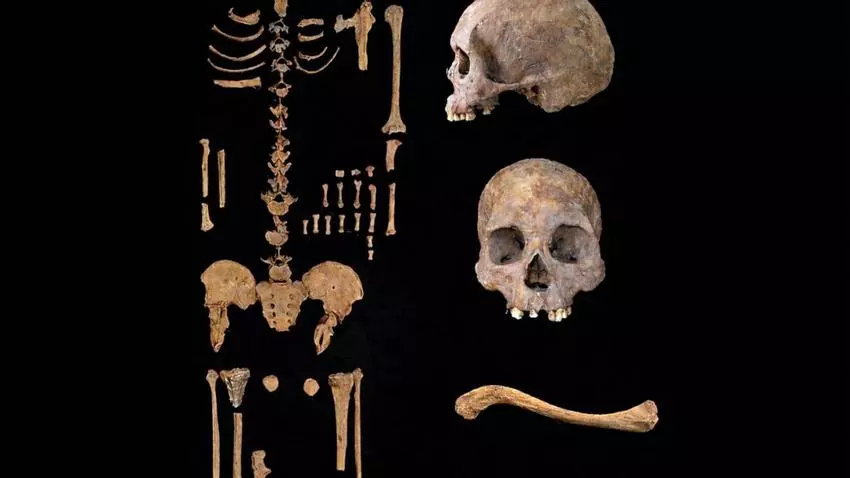
14ymedio, Federico Kukso/SINC Agency, January 24, 2026 — Some 5,500 years ago, a hunter died about 30 kilometers southwest of what is now Bogotá, Colombia. He wasn’t tall—barely five feet three inches—and was a little over 45 years old, a considerable age for his time. Following the rites of his people, his family placed his body in a rock shelter that, centuries later, would be called Tequendama I.
No one knows this man’s name, what his voice sounded like, or the exact cause of his death. The only thing scientists have been able to confirm, after meticulous paleogenetic analysis, is that his skeleton held a secret all that time. “To our surprise, we found DNA from the bacterium Treponema pallidum, responsible for several diseases such as syphilis, yaws, and bejel, in a leg bone,” Colombian archaeologist Miguel Delgado, one of the authors of the research, told SINC.
In a study published in the journal Science, this researcher from the National University of La Plata (Argentina) and a team of Italian, American, German, and Swiss geneticists reveal that this is the oldest known molecular evidence of this pathogen in humans on a global scale. The finding redefines what was previously known about one of the infectious diseases that has most affected populations worldwide. continue reading
“Understanding the evolutionary history of this disease helps us to understand it in depth,” adds Delgado, known for his study of the peopling of the Americas. “It allows us to better understand its manifestation and its current spread.”
The Tequendama I archaeological site is located in the Bogotá Savannah in the eastern highlands of Colombia, a region that played a key role in the early human expansion in South America. Since 1969, archaeologists like Gonzalo Correal Urrego have recovered stone tools, rock art, animal bones, and hundreds of well-preserved human remains there, some dating back as much as 12,000 years. Among them is the bodyof this 1.58-meter-tall man, identified as TE1-3.
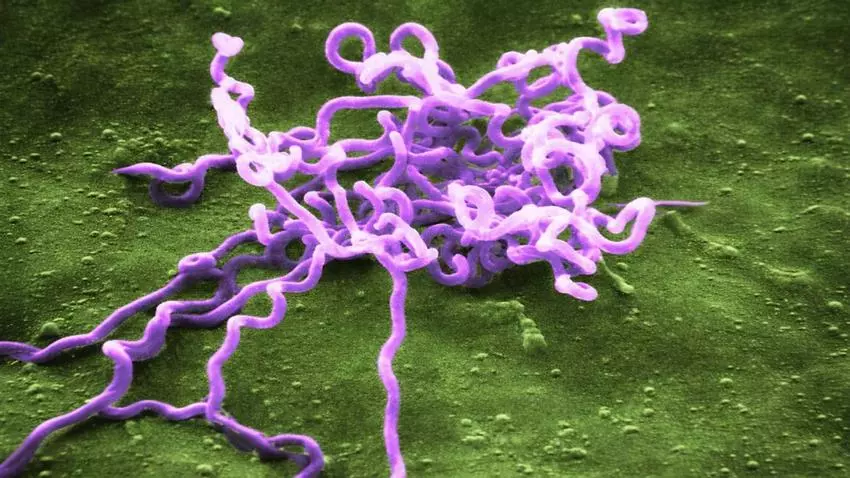
False-color electron microscope image of the spiral bacterium ‘Treponema pallidum’, which causes syphilis. / David Cox | CDC
Radiocarbon dating indicates that he lived approximately 5,500 years ago. There are no clear signs as to the cause of his death: no evidence of violence or complex diseases. “It was probably a natural death, a consequence of an extremely harsh lifestyle and a poor diet,” the archaeologist suspects.
The discovery of this bacterium’s DNA was, in a way, fortuitous, scientists explain. To reconstruct the evolutionary history of populations and the diseases they suffered, paleogeneticists usually examine DNA preserved in the inner ear or teeth, where the greatest amount of prehistoric genetic material is preserved. “However, when we took the samples, we had neither teeth nor a skull,” notes Delgado, a scientist at CONICET in Argentina.
After obtaining a license from the Colombian Institute of Anthropology and History (ICANH) – the regulatory body for archaeological heritage in Colombia – the researchers decided to take the risk and sent samples of this hunter’s tibia to different laboratories to perform ancient DNA analysis.
First, they sent the sample to the Human Paleogenomics Laboratory of German biological anthropologist Lars Fehren-Schmitz at the University of California, USA. Then, they sent it to the Population Genomics Group of paleogeneticist Anna-Sapfo Malaspinas at the University of Lausanne, Switzerland. Upon sequencing the material, the scientists noticed a type of DNA that did not belong to the individual, but rather to a helical bacterium: Treponema pallidum.
“It was truly surprising,” says molecular anthropologist Elizabeth A. Nelson of Southern Methodist University in Dallas, one of the authors of the article. “Recovering DNA from ancient pathogens is always a challenge, and Treponema pallidum is particularly difficult to detect. This is because, during the stages of skeletal lesion formation, the pathogen is usually present in the body at very low levels.”
This discovery extends the complex evolutionary history of this pathogen: it is three thousand years older than the human remains with T. pallidum found on the southeast coast of Brazil – reported in 2024 – and five thousand years earlier than the arrival of Europeans to the continent.
It is also one of the sexually transmitted infections that causes the most concern.
The geographic origin, evolution, and spread of treponemal diseases—each caused by subspecies of the diverse Treponema family of microbes —remain one of the most persistent debates in the history of infectious diseases. Without treatment, syphilis can lead to devastating neurological consequences: blindness, deafness, mental disorders, and even death.
It is also one of the sexually transmitted infections that causes the most concern: according to the World Health Organization, its global incidence is increasing year after year. Yaws, on the other hand, primarily affects the skin and bones and is transmitted through direct contact in warm, humid regions. Bejel and pinta, meanwhile, cause mouth ulcers and bone lesions.
Where and when the pathogens that have affected human societies first appeared remains a great mystery. Recent technological advances and reduced sequencing costs have enabled unprecedented study of the evolution of bacteria, viruses, and parasites.
In particular, research into ancient DNA (aDNA) of pathogens provides unique information about past microbial infections. This genetic material acts as a time capsule: it possesses remarkable stability, can be analyzed even after millennia, and allows us to observe how pathogens have genetically changed over time.
“The field of ancient DNA took off with the arrival of high-throughput sequencing in 2008,” recalls Argentine molecular biologist Nicolás Rascován, from the Pasteur Institute in Paris. “In 2011, the genome of an ancient pathogen was recovered for the first time from archaeological samples: that of the bacterium Yersinia pestis, responsible for the plague. It was then that the study of past diseases through DNA sequencing gained momentum.”
“By studying the DNA of ancient pathogens, we can trace their evolution as they developed.”
From that moment on, the burgeoning science of paleogenomics made it possible to reconstruct the deep history of the pathogens responsible for human infectious diseases, such as tuberculosis (Mycobacterium tuberculosis), smallpox (Variola virus), and hepatitis B (HBV). Various studies show that these infections emerged around 6,500 years ago, coinciding with the beginning of close contact between humans and domesticated animals, a change that increased the risk of zoonosis, that is, the transmission of pathogens from animals to people.
“By studying the DNA of ancient pathogens, we can trace their evolution as they developed,” explains Italian computational biologist Davide Bozzi of the University of Lausanne. “This can give us insights into how pathogens adapted to infect humans or how they became virulent. This knowledge is an essential first step in understanding and controlling the emergence of new viruses and bacteria or the reemergence of past diseases.”
In the spring of 1495, the French king Charles VIII invaded the Kingdom of Naples, driven by his desire to become emperor. After a brief period of success, his mercenary troops began to succumb to an invisible enemy: a disfiguring disease previously unknown to the world. Medical chronicles of the time describe fever, widespread skin eruptions, genital ulcers, intense bone pain, and a high mortality rate.
The French called it “the Neapolitan disease.” For the Italians, it was “morbus gallicus” (French disease). The Russians knew it as “the Polish disease,” and the Poles, “the German disease.” For the inhabitants of Flanders and North Africa, it was “the Spanish disease,” while for the Spanish, it was “the buboes.”
Within a few months, the disease spread across Europe along military and trade routes, leaving many survivors with neurological damage and permanent deformities. Today, this episode is considered the first documented historical record of syphilis in the Old World.
Some believed it was divine punishment. For astrologers, the epidemic was a consequence of two solar eclipses and the conjunction of Mars and Saturn. Others, however, blamed the sailors who returned from America with Christopher Columbus in 1493. “It is possible that 15th-century syphilis was the first globalized emerging infectious disease and a harbinger of all subsequent ones, from HIV/AIDS to COVID-19,” say anthropologists Molly K. Zuckerman and Lydia Bailey of Mississippi State University.
The term syphilis was coined only in 1530 by the Italian physician and poet Girolamo Fracastoro, in his poem Syphilis sive Morbus Gallicus (Syphilis, or the French Disease). In it, the shepherd Syphilius offends the god Apollo and, as punishment, unleashes a plague that ravages his people. The disease is named after him.
“It is possible that syphilis in the 15th century was the first globalized emerging infectious disease and a harbinger of all subsequent ones, from HIV/AIDS to COVID-19.”
Since then, several competing hypotheses have sought to explain its origin. The “Columbian hypothesis” maintains that syphilis was already widespread in the human populations of the Americas before the European conquest. The “pre-Columbian hypothesis,” on the other hand, states that the bacterium T. pallidum circulated in Eurasia during the medieval period and possibly earlier, but was mistaken for other diseases. The current consensus is that it was present on both continents, but in the Americas, a variant evolved into venereal syphilis. European contact would have accelerated its rapid global spread.
“The question of the origin of disease has been raised for centuries because people wanted to blame someone,” notes anthropologist Nasreen Broomandkhoshbacht of the University of California. “These narratives are harmful; they can be used to justify violence and the dehumanization of entire groups of people.”
Since its discovery in 1905, this bacterium has intrigued microbiologists, especially because it cannot be cultured in the laboratory. In 1943, penicillin revolutionized the treatment of syphilis. In 1998, its entire genome was sequenced. At the time, it was thought that this achievement would pave the way for the development of preventative vaccines. That has not happened.
Ancient T. pallidum DNA, identified in the tibia of this hunter-gatherer who lived 5,500 years ago in Colombia, provides valuable clues to understanding the evolution of the disease. By comparing this genetic material with that of modern strains of the same pathogen, it is possible to trace the changes it has undergone over time. In this case, phylogenetic analysis reveals that the genome of this bacterium corresponds to a previously unknown branch of Treponema pallidum, which diverged before the common ancestor of the current subspecies.
Although it clearly falls within the T. pallidum species, the TE1-3 strain exhibits remarkable genetic diversity and is distinct from modern strains. “What we found cannot be classified as syphilis,” cautions Broomandkhoshbacht.
False-color electron microscope image of the spiral bacterium ‘Treponema pallidum’, which causes syphilis. / Colombian Institute of Anthropology and History (ICANH)
“Syphilis, bejel, and yaws are very different diseases, and all are much more closely related to each other than to the pathogen we described in our research. We now know that in the past there was an even greater diversity of these pathogens, which could mean there was even greater variation in their behavior. Historical records of syphilis show that it has changed dramatically over the last 500 years, so even if what we found was a direct ancestor of syphilis (which it isn’t), we could assume that it behaved quite differently,” he adds.
The findings also suggest that T. pallidum predates the emergence of agriculture in the Americas. “This individual lived about 5,500 years ago, in a Middle Holocene hunter-gatherer community, long before the intensification of agriculture or the demographic changes of the colonial era—two factors often associated with the spread of infectious diseases,” Nelson adds.
In contrast, the TE1-3 lineage appears to be linked to the social and ecological conditions typical of hunter-gatherer societies: high mobility, interactions in small communities, and close contact with wild animals.
Even so, scientists find it striking that the remains of the studied individual show no visible signs of disease. “We cannot determine whether the absence of skeletal pathology reflects an early or latent phase of the infection,” they state.
Many questions remain unanswered. “We still don’t know how this ancient lineage was transmitted, whether animals played a role as reservoirs in the past, or whether the pathogen we identified represents an early or extinct lineage,” explains Elizabeth Nelson.
In addition to continuing their research in Colombia, the scientific team is expanding the scope of their work southward into the Andes, in collaboration with Peruvian colleagues. “To understand how the Treponema lineage identified in Tequendama evolved, it is essential to study other individuals over time and in different regions,” says anthropologist Lars Fehren-Schmitz. “Likewise, to better understand the ecology of diseases, research should not be limited to the remains of human ancestors, but should also extend to the analysis of animal remains.”
____________
COLLABORATE WITH OUR WORK: The 14ymedio team is committed to practicing serious journalism that reflects Cuba’s reality in all its depth. Thank you for joining us on this long journey. We invite you to continue supporting us by becoming a member of 14ymedio now. Together we can continue
The ruling brings to an end two appeals in a case that combined economic crimes, leaks involving Venezuela, and espionage.
If Gil was a spy, he was one with inexplicable freedom. / Cubadebate
14ymedio, Havana January 24, 2026 – The Supreme People’s Court (TSP) ruled this Friday to uphold the two guilty verdicts against Alejandro Gil Fernández, former vice prime minister and former Minister of the Economy of Cuba, including life imprisonment for espionage. The decision, confirmed to 14ymedio by sources close to the case, definitively closed the avenue of appeal filed by the defense in both the espionage case and the case file grouping a dozen crimes linked to corruption.
According to the court’s notification to the parties, the appeals lodged against the sentences handed down after the trial held last November, in a double hearing, were not admitted. On December 8, the TSP itself had announced the verdicts: life imprisonment for espionage and 20 years in prison for crimes such as embezzlement, bribery, tax evasion, and money laundering.
Gil was removed from his posts in February 2024 and, barely a month later, authorities announced his arrest and the opening of a judicial investigation for “serious errors.” In November, the Office of the Attorney General of the Republic formally charged him with eleven crimes, although it was the charge of espionage that marked a qualitative turning point in the case and elevated it to the level of “treason to the homeland.”
In an official statement, the TSP said that the former minister “deceived the leadership of the country and the people he represented, thereby causing damage to the economy,” and that he violated protocols for handling classified information, removed it, and made it “available to the enemy’s services.” For the judges, these acts justified a “severe criminal response,” as they constituted “the most serious of crimes.”
The case takes on a greater political dimension because of the mention of Venezuela in the indictment
Gil’s downfall has no recent precedent. A close figure to President Miguel Díaz-Canel and a member of the Political Bureau of the Communist Party of Cuba, until recently he was one of the most visible faces of the cabinet. His tenure was associated with the implementation of the Tarea Ordenamiento [Ordering Task], the 2021 monetary reform that eliminated the dual currency and ended up causing a sharp devaluation of the peso, runaway inflation, and the current de facto dollarization of the economy. He was also responsible for opening—within limits—space for small private businesses and for applying unpopular adjustment measures, such as raising fuel prices by up to 400%.
However, beyond the official narrative, the case takes on a greater political dimension because of the mention of Venezuela in the indictment. Information leaked to which this outlet had access reveals that the prosecution argued Gil had spied for U.S. intelligence services, delivering sensitive information that directly affected continue reading
the strategic relationship between Havana and Caracas.
The report, signed by Edward Roberts Campbell, chief prosecutor of the Directorate for Combating Corruption and Illegalities, states that the former minister allegedly provided classified data to “an unidentified agent, but presumably belonging to the CIA,” thereby compromising “Venezuelan national security.” The leaked information reportedly included bilateral economic transactions, oil agreements, financial triangulation schemes, the deployment of Cuban medical brigades, and even details of Cuban support in cybersecurity and counterintelligence to Nicolás Maduro’s regime.
The indictment goes even further, including alleged personal data on Maduro himself, his family, his residence, assets inside and outside Venezuela including in Cuba, and details of the security ring made up of Cuban military personnel from the Ministry of the Interior and the Revolutionary Armed Forces. All of this was presented as an operation intended to “undermine Venezuelan sovereignty and overthrow its legitimate president.”
The emphasis on Venezuela and on an alleged “internal traitor” aligns with the narrative of confrontation with Washington
Nevertheless, the very development of the case leaves gaps that are difficult to ignore. According to testimony consulted by 14ymedio, in August 2022 it was planned that Díaz-Canel himself would meet with Maduro, but State Security recommended that Gil go instead, due to the “high level of trust” placed in him. The meeting took place at the Miraflores Palace and was widely publicized by the official press of both countries.
The subsequent chronology is even more contradictory. If, as official programs maintain, Gil had been under investigation since at least 2020, it is hard to explain why in 2022 and 2023 he was authorized to travel at the highest level, accompanying Díaz-Canel on a tour of China, Algeria, Russia, and Turkey, and being designated Cuba’s sole representative to the United Nations General Assembly in New York.
A source with access to the prosecution’s case admits that they do not know whether the allegations related to Venezuela were proven with conclusive evidence during the trial. “I cannot say that it was demonstrated that Gil delivered sensitive information to the CIA, nor that those facts supported the life sentence,” the source notes.
The international context adds another layer of interpretation. The emphasis on Venezuela and on an alleged “internal traitor” coincides with the narrative of confrontation with Washington under the administration of Donald Trump, which has opted to tighten pressure on the allies of Caracas and Havana.
Thus, the trial of Alejandro Gil not only seals the downfall of the most powerful official purged in at least 15 years, but also exposes the internal tensions of a system that, in the face of economic collapse and international isolation, appears to need visible culprits. If Gil was a spy, he was one with inexplicable freedom; and if he was not, his sentence illustrates how far power can go when it decides to protect those who operate at the highest levels.
Translated by Regina Anavy
____________
COLLABORATE WITH OUR WORK: The 14ymedio team is committed to practicing serious journalism that reflects Cuba’s reality in all its depth. Thank you for joining us on this long journey. We invite you to continue supporting us by becoming a member of 14ymedio now. Together we can continue transforming journalism in Cuba.
Reuters and Politico cite high-level sources on an imminent escalation of pressure from Washington to block any delivery of crude to the Island.
According to one of the sources cited by Politico, “energy is the key to killing the regime, and this will happen in 2026.” / X
14ymedio, Havana, January 24, 2026 – The possibility that Mexico may halt or reduce oil shipments to Cuba has ceased to be a diplomatic rumor and has become an internal debate within the government of Claudia Sheinbaum. According to a Reuters investigation, three high-level sources confirmed that the Mexican executive branch is assessing whether to maintain, reduce, or suspend crude supplies to the Island, amid fears of direct retaliation from the United States under President Donald Trump.
The U.S. outlet Politico goes even further, citing “three sources familiar with the plan” and asserting that the White House is considering invoking the Helms-Burton Act to “impose a total blockade on oil imports by Cuba.” According to one of the sources quoted by the outlet, “energy is the key to killing the regime, and this will happen in 2026, with a 100% probability.”
The interruption of Venezuelan shipments, following the forced immobilization of oil tankers in December and the capture of Nicolás Maduro, has left Mexico as the main fuel supplier to a country mired in prolonged blackouts and a deepening energy crisis. “Mexico has become the last lifeline,” one of the Reuters sources acknowledged, describing the impact any change in that country’s oil policy would have.
Beyond geopolitical calculations, the impact is already being felt on the streets of Havana. A private transport operator consulted by 14ymedio describes a scene repeated across different parts of the capital: “Yesterday, of all the gas stations I saw, the only one with a line was on Vía Blanca, because it’s the one assigned by the government. None of the three in Guanabacoa had fuel.”
Although President Sheinbaum has publicly defended the shipments as “humanitarian aid” and part of long-term contracts, concern is growing within her cabinet about the political cost continue reading
of that stance. “There is a real fear of antagonizing Trump just when Mexico needs room to negotiate with Washington,” another official told the agency.
The cost of defying Trump could be too high at a moment of maximum bilateral tension.
That room is crucial. Mexico is seeking to renegotiate aspects of the USMCA trade agreement with the United States and Canada, while also trying to convince Washington that it is acting decisively against drug cartels. In that context, the oil reaching Cuba has become an uncomfortable issue. Trump has been explicit: in a message posted on his Truth Social network on January 11, he said there would be “no more oil or money for Cuba.” For several members of the Mexican cabinet, those words are a direct warning.
According to Reuters, the issue was even raised during a recent phone call between Trump and Sheinbaum. Two sources indicated that the U.S. president asked directly about crude shipments and the presence of thousands of Cuban doctors in Mexico. Sheinbaum’s response was to insist on the humanitarian nature of the oil and the legality of the health agreement. Trump, the sources add, did not explicitly demand a suspension, but made his displeasure clear.
Officials consulted by Reuters expressed concern about the growing presence of U.S. Navy drones over the Gulf of Mexico. Flight-tracking data, circulated by local media, show at least a dozen Northrop Grumman MQ-4C Triton drone missions over the Bay of Campeche, following routes similar to those of tankers carrying Mexican fuel to Cuba. “It’s impossible not to read that as a message,” one source admitted.
At the same time, Trump has intensified his rhetoric against Mexico, claiming the country is “run by the cartels” and suggesting the possibility of ground attacks. Sheinbaum has offered greater judicial cooperation, including the extradition of nearly a hundred kingpins, but has also drawn a red line against any unilateral military action. “The fear is that a decision about Cuba could get mixed up with the security and sovereignty issue,” another official explained to Reuters.
Within the Mexican government, the debate is far from settled. Some voices argue that maintaining the supply is a moral obligation and an investment in regional stability. “Cutting off oil could lead to a humanitarian catastrophe in Cuba and trigger mass migration toward Mexico,” one source warned. Others, by contrast, caution that the cost of defying Trump could be too high at a moment of maximum bilateral tension.
The regime clings to its economic and political model while the White House insists that Cuba “is failing of its own volition.”
Data show that the volume sent to Cuba does not affect Mexico’s industry. Between January and September of last year, Pemex exported to the Island about 17,200 barrels per day of crude and 2,000 barrels of refined products, worth roughly $400 million. “It’s little oil for Mexico, but vital for Cuba,” Sheinbaum summarized this week in defending that solidarity, adding that it “does not have to disappear.”
The fuel shortage not only paralyzes private transport but has also dried up the informal market, a traditional pressure valve in times of crisis. “My neighbor sells gasoline. I just asked him and he says he doesn’t have any. I ask how much it costs and where I can get it. He tells me it’s pointless; there isn’t any even on the street,” the driver tells 14ymedio, resigned to a scarcity that no longer allows shortcuts.
The lack of electricity has turned bakeries with generators into some of the few regular food supply points. “You should see what the bakeries are like at night. It’s the only thing there is to eat, and only because they have generators,” he explains. Bread, often stale and rationed, has become the last guarantee against blackouts and shortages.
In Cuban neighborhoods, waiting is not measured in barrels or millions of dollars, but in hours spent in lines, nights without light, and increasingly empty tables. The regime clings to its economic and political model while the White House insists that Cuba “is falling by its own choice” and maintains that the country should “reach an agreement before it’s too late.”
Translated by Regina Anavy
____________
COLLABORATE WITH OUR WORK: The 14ymedio team is committed to practicing serious journalism that reflects Cuba’s reality in all its depth. Thank you for joining us on this long journey. We invite you to continue supporting us by becoming a member of 14ymedio now. Together we can continue transforming journalism in Cuba.
The oil tanker Mia Grace, which was heading to Cuba from Africa, will instead go to the Dominican Republic
Pots and pans bang in Havana in protest against blackouts of up to 13 hours
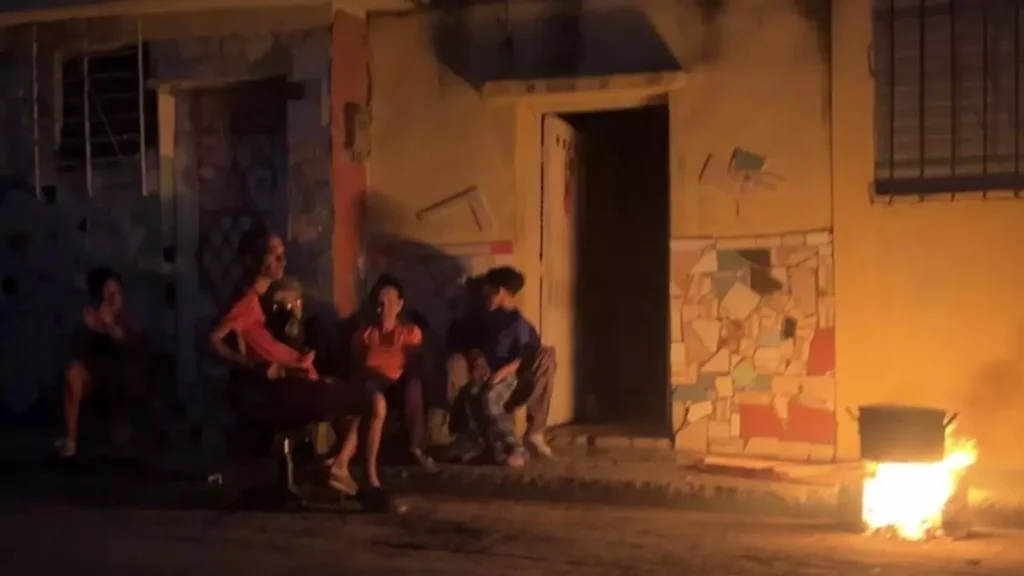
A family cooking with kerosene on a Havana street. / 14ymedio
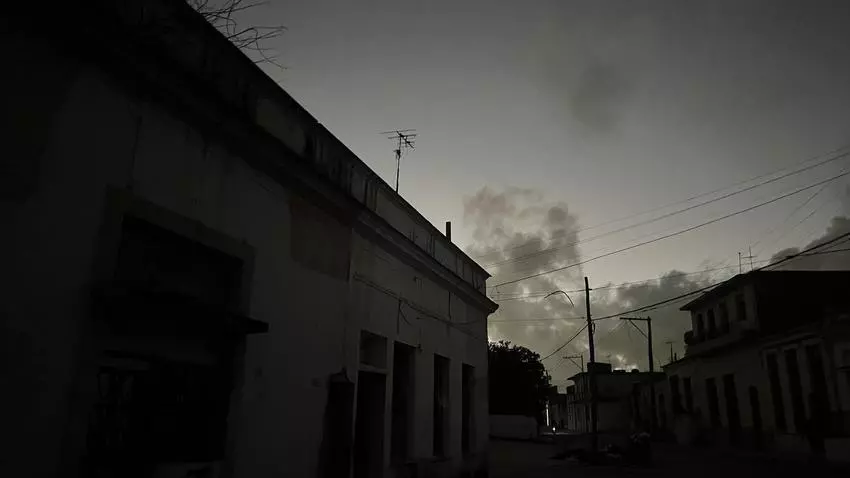
14ymedio, Havana, Darío Hernández, January 23, 2026 – Havana experienced a totally dark day this Thursday, Diana, a second-year veterinary student went the entire day without eating. There is no gas left in her home, where she lives with her elderly grandparents, she tells 14ymedio. “They say pots were banging. I didn’t have the strength to listen or to bang a pot myself though I certainly felt like it,” the young woman says. “To make matters worse, I had an exam today and was hungry, because there comes a point when bread doesn’t fill you up, and it’s not that cheap either. I don’t know where this is going, but I’m exhausted.”
Irma, a 40-year-old Facebook advertising promoter, recounts her ordeal: “The power goes out and the connection disappears. I caught a cold going out onto the balcony looking for a signal and hanging laundry at night, because the clothes pile up, and when the electricity comes back, it’s rush, wash, make rice, iron the kid’s uniform.” The woman says her sister, a seamstress, is pulling her hair out because she doesn’t have light to work. “They give her power for one hour during the whole day. If this keeps up, she’ll have to sleep during the day and work at night. And the worst part is that it seems like you-know-who doesn’t care.”
“Here people live however they can. Many skip meals and baths; they resign themselves,” says a resident of Guanabacoa. “Yesterday the pots were banging in several areas here, and really loud. We’ll see what happens when the heat arrives, and on top of all this is the lack of sleep.”
“Here people live however they can. Many skip meals and baths; they resign themselves.”
On the streets at night, cooking in doorways lit by candles or by the glow of a cigarette, there are neighbors who take it with as much humor as they can. “I have no electricity, I have no soap,” sings a young woman almost melodically, to the tune of Juan Gabriel, continuing: “I have no money and nothing to give.” continue reading
Several municipalities in the capital reported more than nine hours in the dark, such as Marianao, where the power was cut at 3:00 pm and by midnight they were still without electricity. In the La Güinera neighborhood of Arroyo Naranjo, residents reported up to 13 hours without power, and in La Lisa there were protests with pots and pans. “I just confirmed by a video call that they restored electricity a few minutes after the demonstration. So, a word to the wise is enough,” said journalist Mario Pentón.
Mercedes and Antonio, two retirees who live alone, couldn’t cook their peas on Tuesday until 11:00 pm, when the power finally came back after 14 hours. “It was enough to drive you crazy,” says the man, an accountant when he was working; his wife was a doctor. However, “on Wednesday the blackout was even worse.”
The fuel shortage is also evident at gas stations. Since January 10, the Ticket system has not provided the list of the 24 gas stations open in eastern Havana, which could indicate that they are all closed. The list for the western sector is still being issued; this Thursday, 5 of the 14 stations there remained open.
Several municipalities of the capital reported more than nine hours in the dark, such as Marianao, where power was cut at 3:00 pm and by midnight they were still without electricity. / 14ymedio
Meanwhile, on the informal market fuel prices are rising at a dizzying pace. In Holguín, local sources report that a liter of gasoline has reached 1,200 pesos and a can of kerosene up to 15,000. In Havana, some users say they can find gasoline on the black market for 1,000 pesos per liter, although in most places prices range between 700 and 750. In Sancti Spíritus, the product is cheaper: five liters of “kerosene for the stove,” a resident explains, cost between 1,850 and 1,900 pesos; that is, between 370 and 380 per liter.
The situation is not easing, and the ship on the horizon fades away. In a strange twist of events, the Mia Grace, the tanker that was heading to Cuba from Togo to deliver some 314,500 barrels of diesel or 280,500 of fuel oil, according to University of Texas expert Jorge Piñón, has changed course. Geolocation data that this week indicated its departure from the port of Lomé with an expected arrival in Havana on February 4 have been modified.
The vessel, flying the flag of the Marshall Islands, now appears off the coast of Guinea after having departed on January 13 from Takoradi (Ghana), with destination Río Haina (Dominican Republic), where it is due to arrive on February 2. It is unknown why the route detected last Monday by Piñón has changed. He was alerted to the tanker’s destination and told 14ymedio that it could be a “spot purchase” by the state company Cubametales, sanctioned by the United States, “through a European intermediary.”
The expert noted that “Togo does not refine oil, but it exports refined petroleum products and has extensive logistics and maritime transit infrastructure.” Now the origin points to a port in Ghana, located about 500 kilometers from Lomé.
Most significant is that as of this week the UNE has stopped reporting the deficit by type of energy.
Ghana’s oil industry has consolidated in recent years as one of the most flourishing, along with gold, although it is still a mid-level African crude power, especially compared to Libya, Nigeria, or Algeria. The latter country, which maintains excellent relations with Cuba, has contributed a small amount of oil to the Island, but only around two million barrels annually, the equivalent of 18 days of national consumption.
After nearly reaching a 2,000-megawatt (MW) deficit during peak hours on Thursday—well above the announced 1,775 MW—a similar shortfall is expected this Friday. Officially, the Electric Utility (UNE) has forecast 1,970 MW, but even during average hours the figures are staggering, with 1,200 MW affected. This is almost unheard of in a context where solar parks are operating correctly. This Thursday the 49 parks generated 3,186 MWh, with a maximum output of 711 MW. These figures are enough to imagine what would happen if they were not contributing at all.
The thermoelectric plants are constantly going in and out, as if they spent the day revolving through a turnstile. This Thursday, the electric company’s posts announcing shutdowns were so numerous that users could take no more. “All those shutdowns are aimed directly at the people. Thank you very much for your efficiency,” one responded bitterly. Announcements of “offline” and “back on the system” multiplied, prompting some darkly humorous comments amid the desperation. “Whoever runs the UNE’s profile must enjoy their job; they work more than anyone else at the company. Incredible incompetence,” someone remarked.
Most significant is that as of this week the UNE has stopped reporting the deficit by type of energy. This Friday’s breakdown indicates breakdowns at units 5 and 8 of the Mariel thermoelectric plant (CTE), unit 3 of the Carlos Manuel de Céspedes CTE, units 5 and 6 of Nuevitas, and unit 2 of the Felton CTE. Under maintenance are unit 2 of the Santa Cruz del Norte CTE and unit 4 of the Carlos Manuel de Céspedes CTE, totaling 466 MW out of service in thermal generation. But there is a complete absence of data on the shortfall due to fuel, a figure that has been reported for months and generally exceeds 1,000 MW.
Translated by Regina Anavy
____________
COLLABORATE WITH OUR WORK: The 14ymedio team is committed to practicing serious journalism that reflects Cuba’s reality in all its depth. Thank you for joining us on this long journey. We invite you to continue supporting us by becoming a member of 14ymedio now. Together we can continue transforming journalism in Cuba.
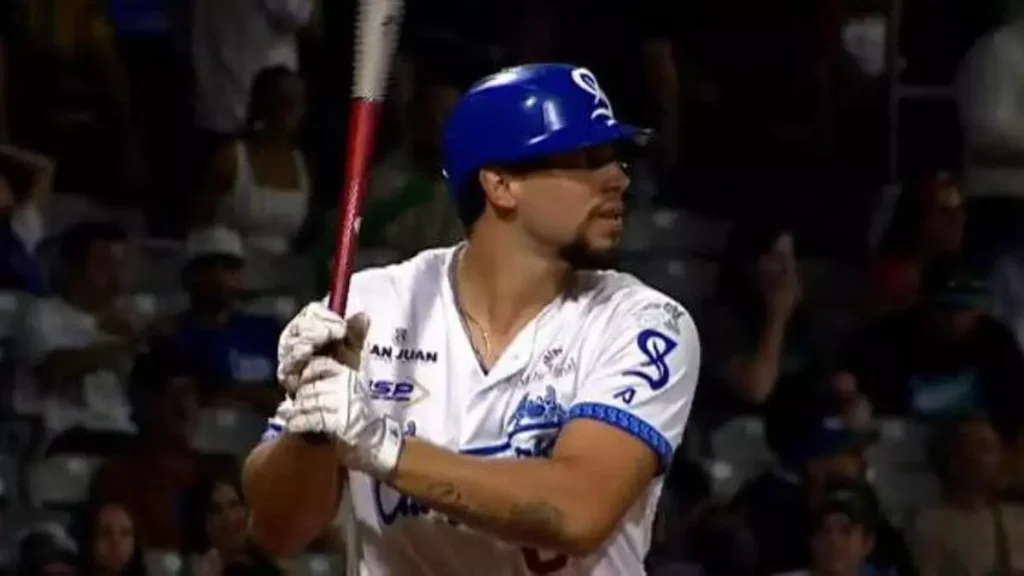
With the Cangrejeros, winners of the winter league, he was selected as the Most Valuable Player
Yohandy is the son of Cuban ballplayer Andy Morales, famous for his decisive home run against the Baltimore Orioles. / Screenshot / X
14ymedio, Matanzas, Andy Lans,January 23, 2026 – On January 20, the Cangrejeros de Santurce were crowned champions of Puerto Rican winter league baseball. Standing out on that team as Finals Most Valuable Player (MVP) was Yohandy Morales, son of Cuban ballplayer Andy Morales, renowned for his decisive home run against the Baltimore Orioles.
Had Andy Morales not hit that crucial home run to steer Team Cuba to victory over the Baltimore Orioles in a 1999 exhibition series, it might have been more difficult for him to sign with the New York Yankees in 2000 after escaping the island by boat. Had Andy Morales not taken to the sea in search of freedom, the life of his son Yohandy Morales, born in Miami in 2001, might have been different, and had Andy not had the opportunity to sign with Major League Baseball franchises in the United States, his experience might not have been the same in guiding Yohandy’s athletic path. Today, Yohandy is a Minor League player with the Washington Nationals.
So, in a way, if Andy Morales had not hit that home run against the Orioles, you might not be reading this article about his talented offspring.
Yohandy is trending in Puerto Rico after being crowned champion and named Finals MVP of the winter league. The lanky 24-year-old, capable of playing both first and third base, was a key piece in the Cangrejeros’ six-game victory over the Leones de Ponce in a best-of-nine championship series. Santurce thus captured its 17th title, while the Cuban American experienced a pivotal moment in honing his talent. continue reading
He posted an impressive .395 batting average in 44 official at-bats.
It is no small detail that MLB Pipeline has ranked Yohandy 21st on the Washington Nationals’ Top 50 Prospects list for 2025. Andy Morales’s son has climbed to the Triple-A level within the organization and has also received invitations to Spring Training.
But why dwell on what Morales Jr. accomplished in the Puerto Rican league? The right-handed slugger joined the team when the 2025–2026 regular season was already well underway and, even so, recorded an impressive .395 batting average in 44 official at-bats. He added eight extra-base hits, including a home run, and six runs batted in: outstanding numbers that confirmed his consistency as a contact hitter.
In the postseason, Santurce faced the Criollos de Caguas in the semifinals before being crowned champions against Ponce. Across both stages of the championship, Yohandy Morales led in hits, collecting 17 for a .386 batting average, paired with a .471 on-base percentage (OBP), eight RBIs, and six extra-base hits. Of his 12 games in the playoffs, the most memorable was Game 3 of the final, in which he went 2-for-3 with a home run, a double, three RBIs, and a hit-by-pitch.
The fact that Yohandy can perform in Caribbean baseball, where the game is played “hotter” and pressure is often greater than in the Minor Leagues, sets an encouraging precedent for his professional future.
Translated by Regina Anavy
____________
COLLABORATE WITH OUR WORK: The 14ymedio team is committed to practicing serious journalism that reflects Cuba’s reality in all its depth. Thank you for joining us on this long journey. We invite you to continue supporting us by becoming a member of 14ymedio now. Together we can continue transforming journalism in Cuba.
Díaz-Canel highlighted the “enormous significance” of the visit due to “the timing.”
Castro sent warm greetings to Vladimir Putin. / Estudios Revolución
14ymedio/EFE, Havana, 21 January 2026 — Raúl Castro met on Tuesday with Russian Interior Minister Vladimir Kolokoltsev, who is also a police general. The official press published images of the meeting, in which the former Cuban leader “conveyed warm greetings to President Vladimir Putin.”
During the meeting, which was attended by General Lázaro Alberto Álvarez Casas and the Russian ambassador to Havana, Viktor Koronelli, there was talk of the “excellent bilateral relations” between the two countries.
The same idea was emphasised by President Miguel Díaz-Canel, who highlighted the “enormous significance” of the visit due to “the timing of it,” according to the Presidency.
The same idea was emphasised by President Miguel Díaz-Canel, who highlighted the “enormous significance” of the visit due to “the timing of it,” according to the Presidency.
In a meeting with the Russian minister, Díaz-Canel pointed out the “greater complexity” of this moment, as well as “a situation greatly impacted by the events of 3 January in Venezuela,” when the United States carried out a military attack on Caracas, resulting in the capture of President Nicolás Maduro and the death of 32 Cuban soldiers.
The island’s leader recalled that during Kolokóltsev’s previous visit in November 2023, Cuba was “facing the intensification of the blockade, a widespread media smear campaign and the impact of its inclusion on the spurious list of countries allegedly sponsoring terrorism,” and stated that “all of that remains in place today.” continue reading
“This visit is yet another expression of the sensitivity of the Russian Federation, the party, the government, the armed forces and you yourself. There is sensitivity, understanding of our situation, and a willingness to help and cooperate,” Díaz-Canel stressed.
He also emphasised “the relevance” of this visit amid “the complex global situation”.
The Russian minister’s arrival on the island comes amid escalating tensions between Havana and Washington following the US military operation in Venezuela.
Russian President Vladimir Putin said last Thursday at the Kremlin that Moscow stands in solidarity with Cuba for “its determination to defend its sovereignty and independence”.
“I would like to emphasise that Russia and the Republic of Cuba enjoy truly strong and friendly relations. We have always provided assistance to our Cuban friends and continue to do so,” said the Russian leader.
‘I would like to emphasise that Russia and the Republic of Cuba enjoy truly strong and friendly relations. We have always provided assistance to our Cuban friends and continue to do so.”
At the start of his schedule in Havana on Tuesday, Kolokóltsev laid a wreath at the mausoleum dedicated to 69 young Soviets who died in Cuba between 1960 and 1964 during collaborative missions, according to reports by the island’s state media. He also paid tribute to the Cuban soldiers who recently died in Venezuela.
In March 2025, Havana and Moscow signed a military cooperation agreement that lays the groundwork for “facilitating the development and strengthening of military cooperation” between the two countries, as well as “providing the legal basis for defining the objectives, areas and modalities” of this bilateral collaboration.
Russia has been a political ally of Cuba since the Soviet era of the Cold War and is one of its main trading partners. Both sides have highlighted their ties as a “strategic partnership”.
The bilateral relationship has grown even closer in recent times as the island experiences its worst economic crisis in three decades, with shortages of basic goods and spiraling inflation, exacerbated by structural weaknesses in its production and recurring failures in its electricity system.
Russia also had a Strategic Partnership and Cooperation Agreement with Venezuela, which, however, has not served to prompt Moscow to intervene in favour of Maduro other than to launch the occasional criticism of the US operation.
Translated by GH
____________
COLLABORATE WITH OUR WORK: The 14ymedio team is committed to practicing serious journalism that reflects Cuba’s reality in all its depth. Thank you for joining us on this long journey. We invite you to continue supporting us by becoming a member of 14ymedio now. Together we can continue transforming journalism in Cuba.
The agreement opens a new era of strategic cooperation in the Arctic and regional defence matters.
Trump explained that he will not impose the tariffs that were scheduled to take effect on 1 February.
EFE (via 14ymedio), Davos, 21 January 2025 — US President Donald Trump announced on Wednesday an agreement with NATO Secretary General Mark Rutte on Greenland, which will be “very good for the United States and all NATO countries,” and suspended the threat of tariffs from 1 February against eight European countries.
In a post on his social media platform Truth Social, Trump also announced “further discussions” on the “Golden Dome” missile defence system with regard to Greenland, adding that more information would be provided as the discussions progressed.
Following a very productive meeting with the Secretary General of NATO, we have established the framework for a future agreement regarding Greenland.”
“Following a very productive meeting with the NATO Secretary General, we have established the framework for a future agreement regarding Greenland and, in fact, the entire Arctic region. This solution, if implemented, will be very beneficial for the United States of America and for all NATO countries,” he said.
Trump explained that, “based on this understanding,” he will not impose the tariffs that were scheduled to take effect on 1 February, which he had threatened to impose on eight European countries, including Germany, France, and Denmark, that participated in military exercises on the Arctic island.
He also specified that Vice-President JD Vance, Secretary of State Marco Rubio and Special Envoy Steve Witkoff, along with any other necessary individuals, “will be in charge of the negotiations” and will “report directly” to him.
Translated by GH
____________
COLLABORATE WITH OUR WORK: The 14ymedio team is committed to practicing serious journalism that reflects Cuba’s reality in all its depth. Thank you for joining us on this long journey. We invite you to continue supporting us by becoming a member of 14ymedio now. Together we can continue transforming journalism in Cuba.
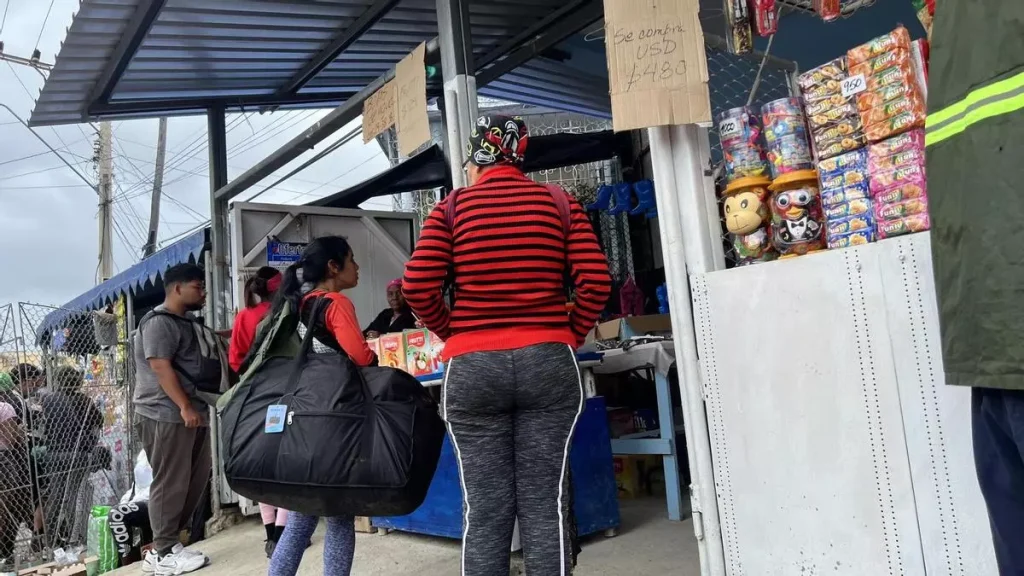
Economist Pedro Monreal points to the failure of the floating exchange rate created by the government a month ago in its latest attempt to revalue the national currency
At the La Cuevita market in San Miguel del Padrón (Havana), the dollar was being bought at 480 CUP. / 14ymedio
14ymedio, Holguín/Sancti Spíritus, Havana, Miguel García, Mercedes García, and Darío Hernández, January 22, 2026 – Just over a month after the official floating exchange rate went into effect, promising to revalue the national currency, the dollar has soared to 500 pesos in some parts of Cuba, such as Holguín. That is 10 CUP more per USD than the rate reported this Thursday by the independent platform El Toque (490) in its daily tracking of informal-market currency trading.
This was confirmed by a resident of Holguín who owns the electric tricycle he uses for work, whose electronic control box burned out. When he asked about prices, a private seller told him it cost $190. “I asked him what that was in pesos, because I didn’t have USD and had no way to get them, and after insisting that he preferred dollars, he told me the dollar was at 500 pesos.”
At the same time, mipymes [‘MSMEs’ — micro, small and medium-sized private enterprises] in the eastern city have raised prices for basic goods such as cooking oil, spaghetti, and chicken. “Starting this week, it’s going to be huge,” a Holguín resident laments ironically. Some merchants argue that inflation is precisely due to the new price of the dollar. “Due to the rise of the USD, there may be some price changes in certain products, but it’s nothing serious; we’re making an effort to keep prices as fair as possible,” they promise in a WhatsApp group.
“It’s not at all fair. They say they made the last purchase at one price for the dollar, but the next one will more expensive, so they’ll have to raise prices”
“Can you imagine? It’s not at all fair. They say they made the last purchase at one price for the dollar, but the next one will be more expensive, so they’ll have to raise prices,” the same woman says. continue reading
In Sancti Spíritus, most informal stalls are offering the dollar at the rate reported by El Toque, 490 CUP, but according to a source in the city, “there’s a mipyme that’s taking it at 500.” Meanwhile, in Havana, in most neighborhoods the dollar can be found at 490 pesos, but two days ago, at the La Cuevita market in San Miguel del Padrón, it was being bought at 480.
That same Tuesday, Cuban economist Pedro Monreal documented the failure of the most recent exchange-rate measures, comparing them to preparations for the “war of the whole people,” announced after the capture of Nicolás Maduro by the U. S. in Caracas and the death of 32 Cuban soldiers in the operation. “Exactly one month passed between the announcement of a new official floating exchange rate and the notification of the analysis and approval of plans and measures for the ‘transition to a State of War’ in Cuba,” tweeted the specialist, who lives in Spain. “So far, the floating rate is fighting a losing battle.”
For now, Monreal continued, the peso “has depreciated 3.9% against the USD under the floating rate, failing to meet the government’s expectation that the ‘new official foreign-exchange market’ would help restore the purchasing power of the national currency.”
In effect, when the Central Bank of Cuba (BCC) launched without prior notice an official floating exchange rate on December 18, to be added to the other two operating in the country: one at 1×24 for centralized state allocations for goods and services deemed essential, and another at 1×120 for certain “entities with the capacity to generate foreign currency,” such as tourism. The government presented it as the start of a transformation of the foreign-exchange market aimed at “bringing order” to the economy and moving toward future monetary unification.
In practice, however, the Island entered an even more complex stage of exchange-rate segmentation amid the worst economic crisis in decades. It quickly became evident that the population was ignoring the official rate, which was paradoxically very close to El Toque’s, against which the government had waged a harsh propaganda campaign months earlier, and they continued exchanging dollars on the informal market.
The peso “has depreciated 3.9% against the USD under the floating rate, failing to meet the government’s expectations”
In the following weeks, it could be seen that at state-run currency exchange offices (Cadeca), where dollars are virtually nonexistent and where the dollar was theoretically selling this Thursday at 457.92 pesos, only elderly people came to collect their pensions.
On January 9, yet another policy was added to the already convoluted exchange-rate market. The BCC opened a banking channel allowing private mipymes to legally purchase foreign currency through banks, but under very strict rules.
Thus, purchases by these private entrepreneurs can only be made based on the new floating rate, only once a month, and without being able to choose the amount. The amount is calculated by the bank by taking the average of what the mipyme deposited into its tax account over the previous three months, using only half of that money and converting it at the floating exchange rate in effect at the time.
In practice, this means that if a mipyme has had low or irregular income, it will be able to buy very few dollars, even if it urgently needs them to import raw materials, pay for services, or fulfill contracts. And if the business is just starting and does not yet have an income history, it could simply be left out altogether.
The BCC also made it clear that the entire process would be “bankarized.” Cuban pesos must be debited from the tax account, and the purchased foreign currency can only be deposited into the economic actor’s own foreign-currency account. No cash, no informal transfers, and no room for maneuver. Before approving the transaction, the bank will review the client’s identity, accounts, and the origin of the funds, as part of the controls that currently weigh on any economic activity on the Island.
Translated by Regina Anavy
____________
COLLABORATE WITH OUR WORK: The 14ymedio team is committed to practicing serious journalism that reflects Cuba’s reality in all its depth. Thank you for joining us on this long journey. We invite you to continue supporting us by becoming a member of 14ymedio now. Together we can continue transforming journalism in Cuba.
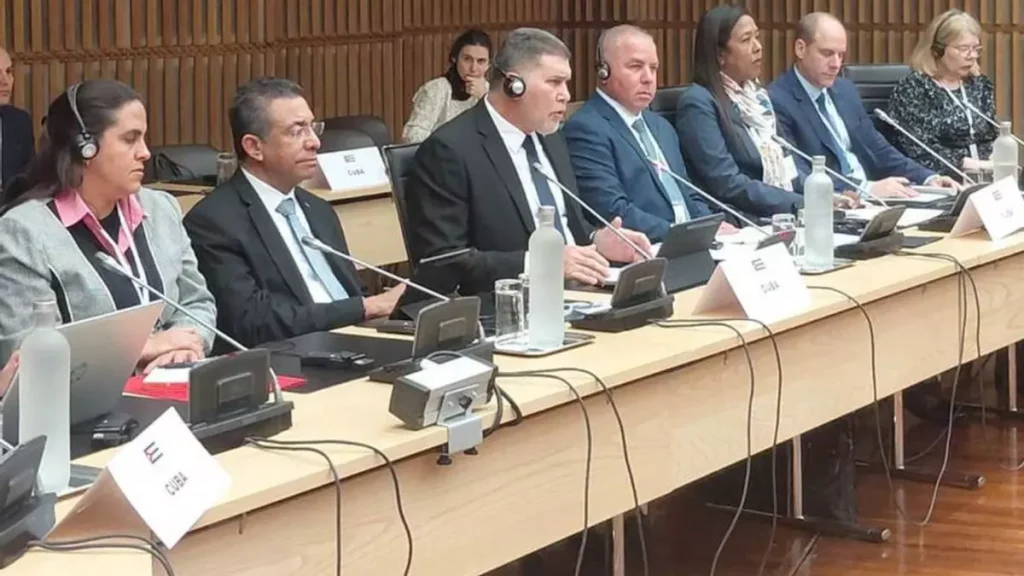
The countries acknowledge the Island’s efforts and highlight the importance of maintaining “the ties achieved”
The Cuban delegation met in the French capital with representatives of the Paris Club. / PL
14ymedio / EFE, Havana, January 22, 2026 – The Cuban government met with its main creditors in the Paris Club to take stock of the agreement signed a year earlier to restructure its debt payments.
According to a note in the official press, the delegation, headed by Vice Prime Minister Oscar Pérez-Oliva, met in Paris with representatives of more than a dozen countries that acknowledged the Island’s “efforts” to comply with its debt repayment commitments.
The Cuban side laid out the “complex” economic and financial situation facing the Island, which it attributed to six decades of U.S. sanctions, “a policy intensified to unprecedented levels since Trump’s return to the White House in January 2025.”
The Paris Club agreed with Cuba, the note says, on the importance of maintaining “the constructive ties achieved” over the past year.
In January 2025, the Cuban authorities and the Paris Club agreed to modify the terms of the 2021 and 2015 agreements in light of Cuba’s inability to meet its obligations. continue reading
The Cuban authorities and the Paris Club agreed in January 2025 to modify the terms of the 2021 and 2015 agreements in light of Cuba’s inability to meet its obligations
In a statement, the group of creditors indicated that the new pact offered Havana “more favorable conditions to address its economic and financial difficulties in the coming years,” as well as the possibility of “preserving” the financial relations between the parties.
In 2015, Cuba signed a historic agreement with the Paris Club, which forgave $8.5 billion of a total debt of $11 billion, with Havana committing to repay the remaining amount in installments through 2023.
However, following partial defaults in 2019 and 2020, the Island declared itself unable to make the corresponding payments and requested a two-year moratorium on a total of about $200 million in overdue payments. The Paris Club agreed only to delay the deadlines by one year, though with the possibility of renegotiation.
In mid-2021, the parties agreed on an additional extension for the commitments undertaken in 2015, but Cuba’s economy has only continued to deteriorate at a rapid pace.
The Paris Club includes Australia, Austria, Belgium, Canada, Denmark, Finland, France, Italy, Japan, the Netherlands, Spain, Sweden, Switzerland, and the United Kingdom.
In addition, the Island has substantial debts with other states, as well as countless private companies from various countries.
Translated by Regina Anavy
____________
COLLABORATE WITH OUR WORK: The 14ymedio team is committed to practicing serious journalism that reflects Cuba’s reality in all its depth. Thank you for joining us on this long journey. We invite you to continue supporting us by becoming a member of 14ymedio now. Together we can continue transforming journalism in Cuba.
According to The Wall Street Journal, Washington is trying to replicate what was done in Venezuela with Delcy Rodríguez
Some analysts believe it will be very difficult to find someone on the Council of Ministers willing to break with the regime. / Presidency
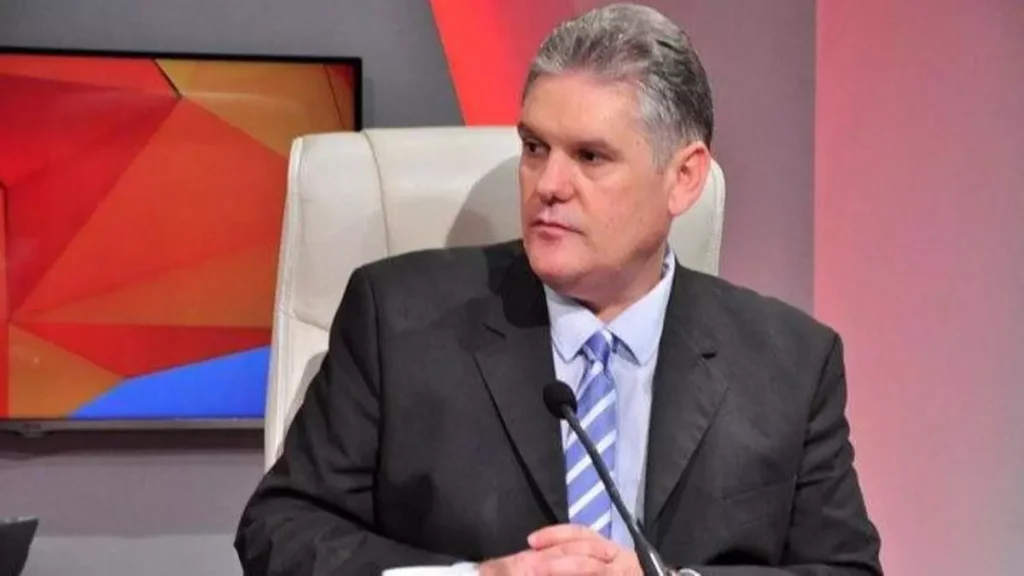
14ymedio, Madrid, January 22, 2026 – The administration of Donald Trump is looking for its Cuban Delcy. As revealed exclusively by the New York–based Wall Street Journal (WSJ), White House sources say the U.S. government is seeking a high-ranking official on the Island capable of reaching an agreement with Washington before the end of the year. The move would replicate what happened in Venezuela, although several analysts believe that finding a “traitor” in Cuba could be very complicated.
“These guys are much tougher nuts to crack,” Ricardo Zúñiga, a former U.S. official who was key to the “thaw” and also worked with the Trump administration, told the newspaper. “No one would be tempted to collaborate with the United States.” The expert had already expressed a similar view to The New York Times in a report speculating about that option. In the same piece, Michael Bustamante, a professor of History at Florida International University, said: “Cuba is much more of a one-party state, something Venezuela never was.”
According to the WSJ, there is a sense of encouragement in Trump’s inner circle after managing to remove Maduro from power, which is spurring them to continue against the Cuban regime, weaker than ever after the loss of its preferred partner. “In meetings with Cuban exiles and civic groups in Miami and Washington, they have focused on identifying someone within the current government who realizes what is coming and is willing to reach an agreement,” a U.S. official told the New York daily.
“In meetings with Cuban exiles and civic groups in Miami and Washington, they have focused on identifying someone within the current government who realizes what is coming and is willing to reach an agreement”
These words align with the message Trump posted on his social network, Truth, on January 11, when he urged the Island’s regime continue reading
to reach an agreement “before it’s too late.” It was the same day he said there would be no more oil or money for Cuba and that talks with Havana were already under way. President Miguel Díaz-Canel and Foreign Minister Bruno Rodríguez categorically denied any dialogue and also reiterated through official media that this is U.S. propaganda aimed at sowing distrust.
The WSJ maintains that Trump is not in favor of “past regime-change strategies” and prefers any option other than a military one. “As in Venezuela, this could look like an escalation of pressure, while at the same time indicating that the White House is open to negotiating an exit,” said its source.
The U.S. has assessed the state of the Cuban economy as catastrophic, something that could worsen due to the lack of oil. The electricity deficit this Wednesday approached 2,000 megawatts, more than 60% of national demand, although this has not prevented Mexico from continuing to send crude to the Island. Among the theories most cited by analysts is that Pemex has been exporting sporadic amounts and not regular shipments like Caracas, so cutting that flow is not as indispensable. Moreover, a complete fuel shortage would cause the Island to collapse, with a possible mass exodus as a consequence, something Washington wants to avoid at all costs.
But beyond oil, the U.S. has set its sights on Cuban medical missions, the sector that still provides the regime with its largest revenues. Although the amount has fallen sharply since the cancellation of Mais Médicos in Brazil, there are still lucrative contracts abroad that Washington is trying to cancel by threatening to suspend visas for authorities who sign such agreements. The strategy has already succeeded in some Caribbean countries, such as Jamaica, the Bahamas, and Grenada.
“The rulers of Cuba are incompetent Marxists who have destroyed their country and have suffered a major setback with [the capture of] Maduro, whom they are responsible for supporting,” commented a White House official, who insisted on the idea of an agreement.
The State Department has also stressed that it is a matter of national security for the Island “to be governed by a democratic government and to refuse to host the military and intelligence services of our adversaries.”
The newspaper reviews some of the failed U.S. attempts to bring down the Castro regime, “including the CIA-backed Bay of Pigs invasion in 1961, to a severe embargo imposed in 1962, which became stricter over time,” although it has been eased by authorizing the export of all kinds of food to the Island.
“Cuba is a Stalinist one-party state that bans political opposition and where civil society barely exists, while Venezuela has an opposition movement, protests, and elections that used to be frequent”
The WSJ believes this reinforces the view that a negotiated exit is the only option, but it does not appear optimistic in that regard. “Cuba is a Stalinist one-party state that bans political opposition and where civil society barely exists, while Venezuela has an opposition movement, protests, and elections that used to be frequent,” the article notes.
The text also discusses how recent events in Venezuela have energized Cuban-American lawmakers, who dream of an immediate end to the regime and make no effort to hide it by posting memes on social media showing Marco Rubio himself driving a convertible through a renewed Havana.
Nevertheless, it insists that the Island’s government “has demonstrated great mastery in repressing dissent among an impoverished population” and recalls that there have been only two significant mobilizations in more than 60 years: the Maleconazo of 1994 and the Island-wide protests of 11 July 2021, known as ’11J’.
As for the warlike fervor displayed by the Island’s authorities, former Democratic congressman Joe García told the WSJ: “It’s theater. It’s a country that can’t collect its garbage and pretends it’s preparing for a conflict with the neighboring superpower.”
Translated by Regina Anavy
____________
COLLABORATE WITH OUR WORK: The 14ymedio team is committed to practicing serious journalism that reflects Cuba’s reality in all its depth. Thank you for joining us on this long journey. We invite you to continue supporting us by becoming a member of 14ymedio now. Together we can continue transforming journalism in Cuba.
In a cabinet dominated by men who tend to talk about what isn’t working as if they were detached commentators on the disaster, she embodies the rare case of someone who still seems to believe in order, management, and responsibility.
There has been no shortage of speculation mentioning Inés María Chapman as a possible successor to Cuban President Miguel Díaz-Canel, especially since the economic, energy, and migration crises have accelerated Díaz-Canel’s decline in popularity. / Cubadebate
14ymedio, Havana, 26 December 2025 — In a country where inertia is state policy and improvisation an unwritten dogma, Inés María Chapman (Holguín, 1965) has built her public image around efficiency. A hydraulic engineer, methodical, and obsessive about spreadsheets and schedules, the deputy prime minister became one of the most visible—and most debated—faces of the Cuban government this year. In a cabinet dominated by men who tend to talk about what isn’t working as if they were detached commentators, Chapman embodies the rare case of someone who still appears to believe in order, management, and responsibility.
But that personal rigor has had to contend, time and again, with the apathy, arbitrariness, and institutional indolence that characterize the Cuban model. Her most talked-about episode in 2025 occurred in Manzanillo, where she went to oversee the grim reality of a city that barely manages to supply itself with water. There, before a crowd weary of promises, she was greeted with a cry that summed up more than six decades of frustration: “Lies!”
The video spread like wildfire. Chapman tried to maintain a composed demeanor, but public outrage cornered her. For some analysts, that moment marked a turning point in the public perception of the deputy prime minister: an official accustomed to “solving problems” from above faced the judgment of those below, live and on air. Her reputation as a ruthless administrator clashed with the reality of the country she helps to govern. Shortly afterward, she would be embroiled in another scandal when she shared a post criticizing the Cuban Art Factory for unveiling a star in honor of Celia Cruz on her centennial.
For some analysts, that moment marked a turning point in the public perception of the deputy prime minister: an official accustomed to “solving” from above faced live judgment from below
However, her inclusion among the Faces of 2025 cannot be explained solely by that incident. Within the small circle of power, Chapman has sparked interest for something scarce in the upper echelons of the Communist Party: technical expertise. A woman in a testosterone-fueled machine, disciplined in an environment that favors slogans, she has managed to build continue reading
a personal brand that, for some, places her among the potential presidential candidates. There has been no shortage of speculation mentioning her as a possible successor to Miguel Díaz-Canel, especially since the economic, energy, and migration crises have accelerated the president’s decline.
But Chapman faces a series of obstacles that, in Cuba, outweigh any résumé. She doesn’t belong to any of the historical families that control the country’s essential levers of power, a network of clans that distribute ministries, military enterprises, and embassies as if they were private inheritances. Moreover, on the island, where key decisions continue to be made by a handful of descendants of Europeans—white, with well-known surnames, and, in many cases, with light eyes—her race acts as a silent brake. Being a woman is another burden in a political elite designed by and for men who grew up under the iron grip of Castroism.
Furthermore, on the Island, key decisions continue to be made by a handful of descendants of Europeans.
Despite this, Chapman has learned to move with calculated precision. Quiet at times, expansive at others, she has known how to manage her silences, measure every gesture, and take advantage of every public appearance. In televised meetings, she usually stands out for her direct tone, for her apparent ability to say things bluntly, although never quite enough to openly challenge the power structure that sustains her.
Her presence in flooded neighborhoods, after burst pipes or at half-finished treatment plants, has made her the public servant who steps up when infrastructure collapses, which is almost always. The population, however, has learned that no inspection can undo decades of neglect. Hence, in Manzanillo, under the scorching sun and before a fed-up populace, her technical and methodical demeanor was met not with respect, but with the sharp cries of those who no longer trust anyone.
Even so, 2025 confirmed that Chapman remains a valuable asset to the government: disciplined, efficient, and reliable. A woman who doesn’t improvise — a rara avis — in a government that improvises daily.
COLLABORATE WITH OUR WORK: The 14ymedio team is committed to practicing serious journalism that reflects Cuba’s reality in all its depth. Thank you for joining us on this long journey. We invite you to continue supporting us by becoming a member of 14ymedio now. Together we can continue transforming journalism in Cuba.

 14ymedio, Havana, January 23, 2025 — Catholic intellectual and activist Dagoberto Valdés Hernández was arrested this Friday by State Security agents at his home in Pinar del Río, in an operation that also involved police officers. The arrest was reported by the Center for Coexistence Studies (CEC), an organization Valdés has led for more than two decades and which has become one of the most enduring spaces for independent civic thought in Cuba.