The Chinese ambassador says the business model for the photovoltaic parks donated by China is being developed and modified
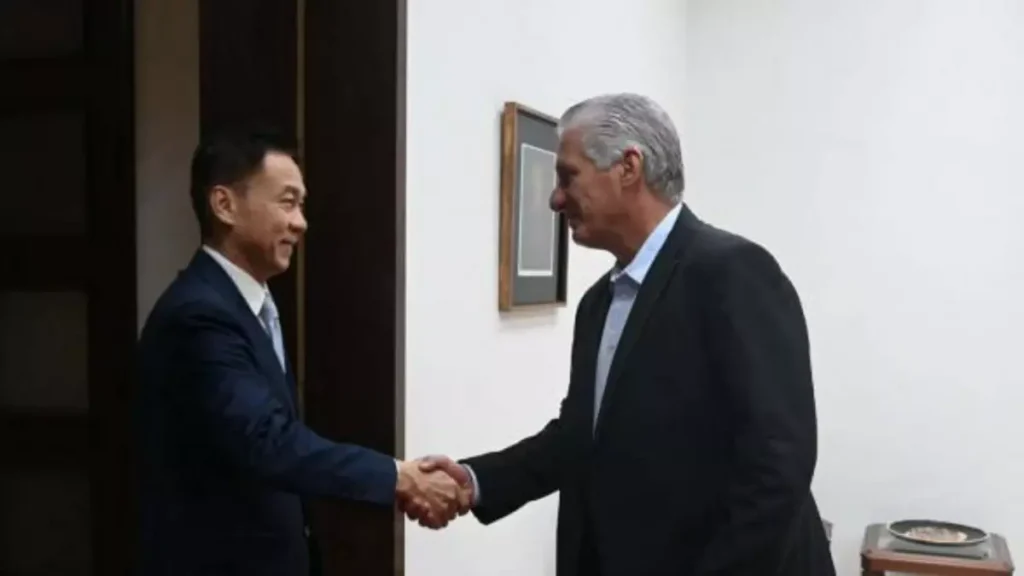
 14ymedio, Madrid, January 21, 2026 – There are no precise details about China’s new financial aid for Cuba, although the amount and its main destination are known. The package is valued at $80 million for “the acquisition of electrical equipment and other urgent needs.” The ambassador himself, Hua Xin, met with President Miguel Díaz-Canel to inform him that he had received “instructions from his government to convey this information to the Cuban side,” the official State newspaper Granma reports.
The diplomat explained that this proposal is the result of meetings held between authorities from both countries, especially Foreign Minister Bruno Rodríguez and China’s Special Envoy for Latin American and Caribbean Affairs, Qiu Xiaoqi. He also cited Vice Prime Minister and Minister of Foreign Trade and Foreign Investment Óscar Pérez-Oliva Fraga, and the Minister of Energy and Mines, Vicente de la O Levy.
The parties agreed, said Hua Xin, to “designate an executive company” for this task, which explains the meetings with Pérez-Oliva.
What little the information reveals suggests that both were key to the aid, since China has decided to change the method under which projects are being carried out using the donations of 200 megawatts of photovoltaic capacity and 5,000 solar panels for homes in hard-to-reach areas. The parties agreed, said Hua Xin, to “designate an executive company” for this task, the reason for the meetings with Pérez-Oliva.
In March 2025, the authorities announced that the Island planned to build 22 photovoltaic parks with a Chinese donation, seven of which already had “the initial endowment to begin construction,” although it was indicated they would contribute 120 MW. The project now under discussion is apparently independent of the 92 solar parks being built under contract with two Chinese companies. China has not specified, however, why it decided to “modify the method” for developing the projects.
In addition, after yesterday’s meeting with the Chinese ambassador, Díaz-Canel highlighted the “intense activity” being carried out by Hua Xin, making specific mention of the donation of 60,000 tons of rice that will arrive from China in the coming weeks. This Monday, Santiago de Cuba and Havana each received an initial delivery of 2,400 tons, with a ceremony held in Havana.
The Cuban leader also spoke of “Phase Four of the digital transformation program being carried out with Chinese support, everything that has been achieved in the high-definition television project and other technologies in which progress has been made.”
The last time Díaz-Canel was in China, in September 2025, few concrete agreements became public, unlike his previous trip in 2022, when he secured a donation of $100 million.
However, the president did bring back a biopharmaceutical collaboration for a new, 81-milligram aspirin, a drug used as a daily therapy to prevent heart disease and strokes. The medication would reach Cuba through “the transfer of technology from Medsol Laboratories to the Chinese company Hubei C&C, in Wuhan.”
Cuba received the first shipment on Tuesday; the boxes were shown but not the quantity. The drug is “intended to meet the demand of the Basic List of Medicines,” BioCubaFarma indicated.
“This mechanism,” the company adds, “uses part of the profits generated by sales of PPG [Cuban Polycosanol, a natural drug], the flagship product of the Cuban entity involved, to ensure the stability of the supply of this key medication for the prevention and treatment of cardiovascular diseases.”
Translated by Regina Anavy
____________
COLLABORATE WITH OUR WORK: The 14ymedio team is committed to practicing serious journalism that reflects Cuba’s reality in all its depth. Thank you for joining us on this long journey. We invite you to continue supporting us by becoming a member of 14ymedio now. Together we can continue transforming journalism in Cuba.