‘Che’ Guevara’s Daughter Attacks Small/Private Businesses and Accuses Them of ‘Facilitating the Entry of Drugs’ Into Cuba

Aleida Guevara March believes that the solution to inflation that she attributes to the private sector is to regulate prices


Aleida Guevara March currently directs the Che Guevara Studies Center in Havana. / The New Morning

14ymedio bigger14ymedio, Madrid, 13 May 2024 — Aleida Guevara, the eldest of the children of Ernesto Che Guevara and his wife Aleida March, declares war on micro, small, and medium-sized businesses (MSMEs) in an interview with the Italian media Il fatto quotidiano published this Saturday in which she accuses the private sector of favoring drug trafficking. “MSMEs entail security risks, because they can facilitate the entry of drugs or other illicit goods into the country. Controls must be intensified by the CDR (Committees for the Defense of the Revolution),” asks the daughter of the Argentine guerrilla.

Her biggest criticism, however, is not such businesses in particular, however, but the increase in inequalities, which she attributes to them. “Although the initial objective was not wrong, that is, to import raw materials from abroad to produce goods in Cuba and resell them at cheap prices, these activities are creating problems because many times they directly import goods purchased in dollars, which when converted to pesos cost too much for the Cuban people,” she argues.

A pediatrician by profession, Guevara does not hesitate to make some recommendations on how to solve this economic problem that, in her opinion, the private sector has created, although the recipe is not new: “Regulating prices, above all,” she believes. “Teachers, doctors… need higher salaries, but the first thing is to regulate prices,” she resolves. Furthermore, she calls on the Government to act immediately. continue reading

A pediatrician by profession, Guevara does not hesitate to make some recommendations on how to solve this economic problem that, in her opinion, the private sector has created

Guevara, 63, “continues to practice medicine without abandoning my role as Cuba’s de facto ambassador to the world,” the newspaper quotes. Not in vain, in the interview she announces that in February she participated in the World Social Forum in Nepal representing the Island and that at the end of this May she will be in South Korea. “It is the first time they have invited a communist to speak,” she says, smiling, although she does not reveal the event to which she is invited.

Seoul and Havana announced in February of this year the reestablishment of their relations, which were broken in 1959 with the arrival of Fidel Castro to power, and this same Monday they confirmed the beginning of formal negotiations for the reopening of embassies. The years had slightly softened the situation – especially since the stage known as “the thaw,” during which tensions between the US and Cuba relaxed – and in 2016 some economic exchanges in technological and energy matters began, but the diplomatic scenario remained intact.

With the new context, the South Korean presidency announced that there were potential areas of collaboration and referred specifically to the island’s natural resources, but also to other areas, such as biotechnology and research.

With regards to the analysis of the current economic situation of the Island, Guevara does not use hot towels in the description. “We are experiencing a brutal economic crisis,” she says. However, that analysis is, to say the least, wrong. “We had to get our own vaccines, because no one gave them to us or sold them to us,” she says. The explanations as to why Cuba developed its own vaccines have been given by the Government itself, the health authorities and the directors of the medicine companies.

“We had to get our own vaccines, because no one gave them to us or sold them to us”

Havana declared that the cost of vaccines on the free market was too high, while developing its own formula allowed it to save money, to immunize the population, although perhaps later than other nations but at a greater pace, and guaranteed “sovereignty.” In addition, Cuba rejected joining the Covax international cooperation mechanism, whose objective is to provide vaccines to low-income countries thanks to donations from the richest and different organizations.

Although the system failed in part due to the slow pace of delivery of doses, Havana could not foresee this when it flatly refused to be part of Covax. Finally, the Island did receive vaccines from one of its partners, China, which provided the Sinopharm formula with which some Cubans were immunized.

Guevara also deviates from the truth when she analyzes the problems of tourism, which she insists “has not returned to pre-pandemic levels because the world has not recovered. We are in a general crisis situation and travel prices are high,” she adds.

The reality is that at the beginning of 2024, the World Tourism Organization declared the crisis in the sector after Covid-19 over, after 88% of the 2019 figures were reached in 2023. In general terms, looking globally, tourism numbers have already far exceeded the levels of that date. In Europe, Spain closed the year with 1% more international travelers than in 2019. On the continent, Mexico and the Dominican Republic show record numbers while Cuba sinks.

Guevara regrets the loss of foreign currency that this means for the country and its contribution to the depreciation of the peso – “which is no longer backed by the convertible peso,” she laments – but she trusts that China and Russia will provide new travelers to facilitate the recovery of the sector.

“If I talk about Fidel I get emotional”

The daughter of the Argentine guerrilla does not miss the opportunity to make clear the influence of the leader of the Revolution in her life – “if I talk about Fidel I get emotional” – and extrapolates it to all Cubans when she maintains that many miss him, but praises the figure of his current successor not so much for what he does but for occupying a space that, for her, is impossible to fill. “There is no point in making comparisons: replacing Fidel is too difficult, simply staying in his place is a heroic act.”

For herself, she calls on the people to support the president and remembers that the Constitution approved in 2019 is the result of a popular process. “Therefore, there is no going back: the Cuban Government is a government of the people, not of the elites.”

____________

COLLABORATE WITH OUR WORKThe 14ymedio team is committed to practicing serious journalism that reflects Cuba’s reality in all its depth. Thank you for joining us on this long journey. We invite you to continue supporting us by becoming a member of 14ymedio now. Together we can continue transforming journalism in Cuba.

The Mother of Two Protesters From Caimanera Denounces Inconsistencies on the Part of the Prosecutor’s Office During the Trial

 Victoria Martínez insists that the accusatory testimonies are full of contradictions and have sanctioned relatives who provide versions different from the official one.

Victoria Martínez narrated in detail the operation full of intimidation with which the political police guarded the trial / Capture / CubaNet

14ymedio bigger14ymedio, Havana, 18 May 2024 — The trial that began last Wednesday against the young people who protested against the Government in 2023 in Caimanera, Guantánamo, “is rigged.” The complaint was made on social networks by Victoria Martínez Valdivia, mother of two of those prosecuted for public disorder, instigation to commit a crime, and attacks, alleging that there are inconsistencies in the statements provided by the Prosecutor’s Office.

In a video shared by CubaNet, the mother of Luis Miguel Alarcón Martínez and Felipe Octavio Correa Martínez, who each face six-year sentences and had an oral hearing this Wednesday in the Municipal People’s Court of Niceto Pérez, maintained that the statements of the witnesses against the six defendants do not coincide with statements made a year ago.

Additionally, she pointed out that her daughter was fined for no apparent reason after testifying in favor of the detainees due to an alleged inconsistency between her current testimony and the one she offered a year ago, when the process began. In contrast, four other people who also testified, but against the young people, and who at the beginning of the trial maintained different stories than those they had originally given to the Police, did not receive any sanction. continue reading

The activist recounted how the Prosecutor’s Office alleges that her daughter, who testified on behalf of her brothers and the rest of the detainees, had accused them of the charges

“They read her (the testimony) from a year ago, where she did not agree with the statement, because (she maintained) that she had said that the boys, mainly her brother Luis Miguel, had said: ‘down with the dictatorship,’ ‘down with the Government’. And she says, ‘no, at no time did I say that my brother said that,'” Martínez Valdivia said.

The mother also confirmed that the activist and independent journalist Yeris Curbelo Aguilera was intimidated by State Security last Wednesday, so that he left immediately after he arrived at the courthouse with the intention of covering the case. The courthouse is about 45 minutes from the city of Caimanera.

The mother (and activist) also said that the trial lasted eight hours and reiterated that at all times she was surrounded by a strong military operation that controlled each of the aspects surrounding the process, as 14ymedio reported this Friday, and remarked on the prohibition of using cell phones under threat from the political police.

In an interview with Diario de Cuba, Martínez Valdivia alleged that the defense did a good job in front of the court, despite not having good communication with the family members. “I consider that the lawyer made a good defense, even though I had distrusted of him based on the little communication we have had this year,” she emphasized.

The trial against the six young people for whom the Prosecutor’s Office requests sentences ranging between nine and four years

The trial against the six young people for whom the Prosecutor’s Office requests sentences ranging between nine and four years, is part of the regime’s response to the anti-government protests that in May 2023 shook the municipality of Caimanera, to demand freedom and a dignified life for the population of the area, close to the United States military base in Guantánamo.

From the beginning, the demonstration faced an aggressive response from the Government, which did not hesitate to use force to repress the protests by sending the so-called “black berets” (Special Forces) into the streets, and cutting off access to communications.

The campaign to discredit those who took to the streets continues to this day thanks to the official media, which tries to reduce the events to an “unusual demonstration” of a few dozen people with signs of having consumed “alcoholic beverages.” The same accusation, to which is added that of “promoting chaos,” appears in the prosecutor’s petition released by the relatives of the detainees.

____________

COLLABORATE WITH OUR WORKThe 14ymedio team is committed to practicing serious journalism that reflects Cuba’s reality in all its depth. Thank you for joining us on this long journey. We invite you to continue supporting us by becoming a member of 14ymedio now. Together we can continue transforming journalism in Cuba.

The Trial Against the Caimanera Protesters in Cuba Begins Behind Closed Doors and Under a Strong Security Operation

Those prosecuted are accused of public disorder, instigation to commit a crime and attack

Hundreds of Cubans took to the streets to protest asking for “freedom” in Caimanera, Guantánamo, on May 6, 2023 / Capture

14ymedio bigger14ymedio, Havana, 17 May 2024 — The trial against the Caimanera protesters for the crimes of public disorder, instigation to commit a crime and attack began this Wednesday behind closed doors and under a strong security operation that protects the surroundings of the Municipal People’s Court of Niceto Pérez, in the Guantanamo province.

The activist and independent journalist Yeris Curbelo Aguilera tried to cover the case but was intimidated by State Security so that he would leave immediately. The reporter shared his testimony through an audio that was broadcast through the Facebook page Presos Políticos de Cuba [Cuban Political Prisoners] where he briefly chronicled the situation outside the court.

“I went to Niceto Pérez but when I arrived [there was] a tremendous police and State Security operation. As soon as they saw me get out of the car, the mobilization and more intensified, against me,” he explained. “They pounced on me, they got on top of me and the head of State Security in Caimanera, Lieutenant Colonel Giovanni Rafita, and others, told me that I could not enter the court.”

The activist and independent journalist Yeris Curbelo Aguilera tried to cover the case but was intimidated by State Security

However, a few minutes later, after being harassed and remaining in the crosshairs of the political police, they finally asked the journalist to leave under the threat of charging him with the crimes of disobedience and contempt. continue reading

The trial is taking place a year after the anti-government protests that shook the municipality, next to the United States naval base, where the protestors demanded freedom and a dignified life for the population of the area. This sparked a violent response from the regime that did not hesitate to send to the streets groups of Black Berets — as the elements of the National Special Brigade of the Ministry of the Interior are known — to repress the participants and try to limit the events to an “unusual demonstration” of a few dozen people.

This Wednesday, at the start of the process against those detained for the protests, sitting on the bench of the accused was Daniel Álvarez González, who is facing the harshest sentence with a nine-year prosecutor’s request for the crimes of “public disorder” and “instigation to commit a crime,” reported Martí Noticias.

He was followed by Luis Miguel Alarcón Martínez, whom the authorities seek to imprison for six years accused of “public disorder” and “attack.” Álvarez González and Alarcón Martínez remain under precautionary prison measures at the Guantánamo Complex.

The rest of those involved in the process remained free on bail. Among them are Rodolfo Álvarez González, Freddy Sarquiz González and Felipe Octavio Correa Martínez, all three with a prosecutor’s request for six-year sentences for public disorder and attack. Completing the list is Yandris Pelier Matos, who faces four years for public disorder.

The document against the detainees, which was released by some relatives, indicates that on May 6, 2023, Daniel Álvarez González and Luis Miguel Alarcón Martínez began shouting slogans such as “Down with Díaz-Canel,” “Down with the Revolution,” with signs of having consumed “alcoholic beverages” and with the aim of “promoting chaos.”

According to the Prosecutor’s Office, the six accused young people maintain “reprehensible” behavior, but none of them have a criminal record

According to the official story, their calls incited other residents to accompany them, according to the Guantánamo Public Ministry, which states that they even tried to overpower law enforcement to avoid arrests. According to the Prosecutor’s Office, the six accused young people maintain “reprehensible” behavior, including participating in illegal games and dog fighting, in addition to being unemployed. However, none of them have a criminal record.

“It is a closed-door trial, that is what I am aware of so far,” Victoria Martínez Valdivia, mother of two of the protesters, explained to Martí Noticias this Wednesday. One of her sons suffers from mental retardation and was still brutally beaten by police agents. “Let’s see what happens, [in court] we are the accused, three witnesses for each one and two closest relatives. The last contact I had with the lawyer, [said that] he had prepared the defense for the boys,” she added.

In the court hearing held this Wednesday, not only family members of the accused participated, but also defense witnesses, as well as some police officers and government officials, who testified against the defendants.

____________

COLLABORATE WITH OUR WORKThe 14ymedio team is committed to practicing serious journalism that reflects Cuba’s reality in all its depth. Thank you for joining us on this long journey. We invite you to continue supporting us by becoming a member of 14ymedio now. Together we can continue transforming journalism in Cuba.

A Spanish Bank Leaves Cuba as a Russian Bank Opens Offices in Havana

The two documents, signed by the head of the BCC, represent the end of one era and the beginning of another / 14ymedio

14ymedio bigger14ymedio, Havana, May 1, 2024 — Two resolutions adopted by the Central Bank of Cuba (BCC) have become a symbol of the financial future towards which Havana seems to be moving. In a announcement published on Tuesday in the “Official Gazette,” the bank indicated that it has accepted a request by Spain’s Banco Bilbao Vizcaya Argentaria (BBVA) to close its branch in Havana and is allowing the Russian bank Novikombank to open an office in the Cuban capital.

According to international agencies, BBVA is exploring a possible merger with Banco de Sabadell, another important Spanish financial institution. Sabadell itself has had an office in Cuba since 1995.

The Cuban nwebsite “Proyecto Inventorio” reported that BBVA asked to close its office shortly after the death of Eduardo Pellicer Ramírez, its sole employee in Havana. It claims, “The shuttered office, which officially had only one employee until 2023, oversaw BBVA’s interests in Cuba. These include actions on behalf of Aurea S.A. (49%), the leasing agency which collects the rent (in the millions) from GAESA’s Lonja de Commercio office building.” The rest of its business is with Havana’s Office of the Historian

According to international agencies, BBVA is exploring a possible merger with Banco de Sabadell

As for the agreement with Novikombank, it is not without political implications. Not only does it represent a step towards closer relations between Havana and Moscow, the bank is also under sanctions imposed by the United States after Vladimir Putin’s invasion of Ukraine. continue reading

Four members of its board have been placed on a sanctions list and the institution itself was disconnected from the Swift banking system by the European Union and the United Kingdom. The U.K. also froze its assets in Britain, claiming it would be benefitting from or even supporting the Kremlin through its involvement in businesses with ties to industries strategically important to the Russian government.

Under the supervision of BCC, it will operate as a “correspondence office” with Russian entities authorized to do business with Cuba. However, it will be “prohibited from directly engaging, either actively or passively, in banking or financial operations of any kind,” the document states. Among its functions will be “managing, promoting or coordinating the business operations of its parent company, in freely convertible currency (MLC) with entities established within the country’s borders.”

The resolution also notes that the Novikombank office in Havana will have to “submit its books along with any documents and other information that [BCC] official might request.”

Novikombank’s office in Havana will also have to “present its books for review”

Spain as well as Russia have both enjoyed privileged banking relationships with Havana. In July 2023 the BCC took the unprecedented step of approving an application submitted by Alto Cedro Finanzas Internacionales, a Madrid-based company which had been operating on the island since 2020, to become a cooperative bank.

At that time, Alto Cedro was prohibited from providing its services to the then recently legalized micro, small and medium-sized businesses (MSMEs) without expressed authorization by the BCC. Founded in 2020 with 3.5 million euros in assets by the Spanish magnate Javier Botín — a member of the family that manages the prestigious Banco Santande, for which he serves as an “outside consultant” — the company operated in Cuba as an international non-banking institution. In 2023, its directors asked Havana for a license to broaden its scope.

The corporation received authorization to open accounts in hard currency and Cuban pesos, receive and grant loans, manage risk and even “monitor its debtors.” It was also allowed to provide financing using the various existing modalities, export and import operations of goods or services and investments.”

The high-level Cuban official responsible for facilitating the 2002 conversation with Alto Cedro was Ricardo Cabrisas, then vice-president of the Council of Ministers. The atmosphere for talks was ideal since Spanish prime minister Pedro Sanchez had travelled to Havana in 2018 for several reasons, among them to open doors to more investors from the Iberian peninsula.

As for Russia, financial rapprochement was always a substantial component of Havana’s alliance with Moscow. In December the BCC officially adopted the Russian payment system Mir, an alternative to Visa and Mastercard, that the Kremlin launched in 2016 to avoid economic sanctions.

“This move is an indication of the good financial relations between the two countries, which contribute to the economic development of the nation,” Prensa Latina said at the time. Since the tightening of sanctions against Russia, Cuba has encouraged the use of Mir banking cards and a increasing reliance on Russian banks.

____________

COLLABORATE WITH OUR WORKThe 14ymedio team is committed to practicing serious journalism that reflects Cuba’s reality in all its depth. Thank you for joining us on this long journey. We invite you to continue supporting us by becoming a member of 14ymedio now. Together we can continue transforming journalism in Cuba.
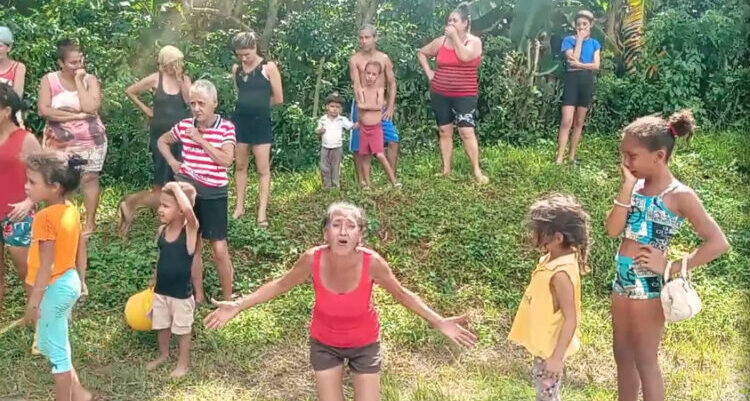
Popular Protests Have the Cuban Regime Backed Into a Corner / Cubanet

Mothers protesting in Maisí, Guantánamo Province, Cuba (captured from YouTube)

Cubanet, Luis Cino, Havana, 27 March 2024 — More than a few Cubans in exile are skeptical about the scope and effectiveness of the current protests by the Cuban population. They belittle them, arguing (in agreement with the official narrative) that the demonstrations are only about food and electricity, and that to calm them down will take only bestowing a little rice and beans from the state reserves, reducing the blackouts a little, blasting some reggaeton from loudspeakers, and hauling in the kegs to dispense beer on tap.

Many who think this way are disgusted and scared when they see protesters in flip-flops, the men without shirts, yelling vulgarities and expletives against Cuban President Miguel Díaz-Canel. They cannot conceal their elitism and contempt for what they consider to be easily-manipulated mobs of hungry rabble, politically illiterate. Thus, they betray a dissociation from reality and an arrogance as great as that of the leaders of the Castro succession.

If it is true that six decades of dictatorship have eroded societal values and civic sensibilities, and managed to keep many Cubans in a state of confusion and degradation, the populace overall has had enough of so much misery and oppression, and will not be meekly herded back into the fold.

The women and men who took the streets to protest are demanding freedom, because that is what they need to live with dignity–not only food, water, and electricity, as those trickster-bosses who try to hide the will of the people would have us believe. continue reading

There is room for agreement with those who speak of the need–now and in the future, if we aspire to democracy and not banana-republic anarchy–for the protesters to have leaders who can present a coherent political program as an alternative to the regime. But we cannot look down on those who, since July 11, 2021 (11J), in their own way and within their range of possibility, have been resisting the government with demands that, within a totalitarian state, inevitably become political.

The sum total of protests documented since 2021 by the Cuban Observatory of Conflicts produces a statistic that until very recently would have been inconceivable: 12,972. And that number will only increase.

Ordinary men and women, many of them illiterate, who demand to live as human beings, are managing to back the regime into a corner — something which the pro-democracy opposition did not achieve in decades.

We must humble ourselves and, however painful it may be, recognize that those of us who were endowed with civility and a certain intellectual baggage, opposing the regime since the 1990s, have failed in our efforts. We
have done so without knowing the job, improvising as we went, with a high level of idealism, without explicitly proposing to take power; all the while denouncing the abuses of power, and struggling to open spaces for democracy in the very smallest chinks feasible, as happened with the Varela Project, the high point of the opposition. And throughout, with a high toll of beatings, imprisonments, banishments, and even murders.

But we were unable to fully connect with the average Cuban. How were we going to reach a blackmailed, frightened population, who after decades of indoctrination and ideological manipulation, was sick of harangues and rejecting anything that smelled of politics? To top it off, this population was subjected to a constant bombardment of defamation against the oppositionists, who had no right of reply via any of the media in service to the State.

Everything conspired against opposition movements. And it was not only the repression. It was also the lack of resources and the ill-use or embezzlement by unscrupulous elements of the little that there was available; insufficient or poorly directed international support; internal disagreements and conflicts due to inflated egos and roles — often fomented by undercover State Security agents; the vices and tricks of Castroism transplanted to the opposition camp; the opportunists and imposters opposition to obtain a refugee visa.

Today, leaders who were moral role models are missed, such as Oswaldo Payá, Laura Pollán, Vladimiro Roca, Elizardo Sánchez, and Gustavo Arcos Bergnes.  

José Daniel Ferrer, Félix Navarro, and dozens of other oppositionists are in jail. Hundreds more have been forced into exile.

But currently, the regime has to face the daily demands of a people who are fed up with abuses and lies. Because the government has no solutions to offer, these protests will continue. And the people, unlike the stubborn bosses, have learned lessons from 11J.

In his article, “The art of protest in Cuba”,  Omar López Montenegro explains, “Neo-Castroism stopped being the only referent in the life of Cubans and, therefore, the whole false mythological construction undergirding it fell apart — including stereotypes such as ‘nobody can fix this thing, but nobody can do away with it, either,’ and so many others that for years nourished a culture of apathy and acceptance of injustice as an inevitable evil. The people what changes, they want them now, and they want them as a result of their own actions, not regime accommodations or miraculous intervention by third parties.”

Translated by: Alicia Barraqué Ellison

A Total of 95,500 Cubans Have Received the U.S. ‘Humanitarian Parole’

This April, 17,870 migrants from the Island entered U.S. territory; in the first four months of the year, 81,191 entered

A Cuban mother and daughter received ’humanitarian parole’ in April / Facebook/Mario J. Pentón

14ymedio bigger14ymedio, Havana, May 17, 2024 — Up to 95,500 Cubans have benefited from the Humanitarian Parole Program promoted by the Biden administration since its entry into force in January 2023. Of these, up to April, there were already 91,100 Cubans in the United States.

Data offered in a statement by the Office of Customs and Border Protection (CBP) confirm that migrants from the Island are the third nationality to benefit from this program, surpassed by Haiti, with 184,600, and Venezuela, with 109,200.

After ending Title 42 – a rule created by the Donald Trump Administration for the return of migrants during the pandemic – Washington decided in January 2023 to offer applicants from Cuba, Haiti and Nicaragua a special permit or “humanitarian parole,” which it had previously initiated with Ukraine and Venezuela. continue reading

Data from the Office of Customs and Border Protection (CBP) confirm that the Island’s migrants are the third nationality to benefit from humanitarian ’parole’

The update to April’s migratory data was announced a few days after humanitarian parole was denied to Liván Fuentes Álvarez, former president of the Municipal Assembly of the People’s Power. His flight permit was revoked just as he was about to board a charter airline that would take him to the United States, Martí Noticias journalist Mario J. Pentón reported.

Despite the fact that a source confirmed to the same media that they do “everything possible so that those who are members of the repressive apparatus of the Cuban regime cannot benefit from measures that are designed to help the Cuban people,” some members of the Communist Party have entered the United States through the parole program.

14ymedio denounced the case of Misael Enamorado Dager, who served as the first secretary of the Communist Party in Santiago de Cuba between 2001 and 2009, and now resides in Houston, Texas, after entering the country under humanitarian parole, as reported by the influencer Niover Licea on social networks.

Yurquis Companioni, a counterintelligence agent in Sancti Spíritus, also entered the United States through the southern border – after traveling the route from Nicaragua to Mexico – thanks to his sister, who already lived in the U.S. and was his sponsor for a six-year parole.

The Office of Customs and Border Protection also announced that in the month of April, 17,870 Cubans arrived in the United States. Although the figure is lower than the 19,566 who entered in March, the total number of migrants from the Island in the first four months of 2024 is 81,191, which represents more than double the 34,253 registered in the same period in 2023, and 12,782 fewer than in 2022.

In April, the United States allowed the entry of 41,400 migrants at the border crossings with Mexico through the online application CBP One. The total number has reached more than 591,000 since the system was introduced in January 2023.

In April, the United States allowed the entry of 41,400 migrants at the border crossings with Mexico through the online application CBP One

“As a result of greater surveillance, migration on the southwest border has not been increasing, reversing previous trends. We will continue to monitor migration patterns, which are constantly changing,” said Troy Miller, acting commissioner of the CBP.

The acting commissioner of the CBP, Troy Miller, said that the deployment of a greater number of Border Patrol agents has contributed to the “decrease” in the number of arrests on the border between the United States and Mexico. “We will continue to monitor migration patterns, which are constantly changing,” the statement added.

The Biden Administration also stressed that as part of the new restrictions, asylum will be prohibited to people who pose a risk to national security,” to those convicted of a serious crime, to those related to terrorism and to those who are “considered a danger to the security of the United States.”

Previously, the determination of eligibility for asylum was given at a later stage in the process, upon determining the merits of asylum applications, detentions and expulsions.

Translated by Regina Anavy

____________

COLLABORATE WITH OUR WORKThe 14ymedio team is committed to practicing serious journalism that reflects Cuba’s reality in all its depth. Thank you for joining us on this long journey. We invite you to continue supporting us by becoming a member of 14ymedio now. Together we can continue transforming journalism in Cuba.

Cuba Receives 23 Rafters Returned by the United States and 545 From Several Countries in 2024

Three of those returned were on parole at the time of leaving the Island

The Governments of Havana and Washington have a bilateral agreement so that all migrants arriving by sea to U.S. territory will be deported to the Island  / EFE

14ymedio biggerEFE/14ymedio, Madrid, 14 May 2024 — Cuba received 23 rafters returned by the United States Coast Guard Service (USCG) onTuesday, for a total of 545 Cuban irregular migrants deported from several countries in the region so far in 2024, official media reported. These migrants – 20 men and three women – were intercepted by the U.S. authorities after participating in two illegal exits from the island through the western port towns of Cárdenas and Mariel, according to a report released by the Ministry of the Interior.

Three of those returned were on parole “for compliance with criminal sanctions at the time of leaving the Island and will be placed at the disposal of the corresponding courts for the revocation of said benefit,” it emphasizes.

It also reports that two others are under investigation as “alleged committers of criminal acts” who were investigated before their illegal exit. continue reading

Another two are under investigation for “alleged commission of criminal acts”

With this return operation, there are now 39 return operation carried out from different countries in the region with a total of 545 people in 2024, the report specifies. Last year, from Mexico alone, 774 Cubans were expelled, according to a source from Mexican Migration officials, under the category of “assisted returns.”

The governments of Havana and Washington have a bilateral agreement so that all migrants arriving by sea to US territory are deported to the Island.

Also, deportation flights resumed in April 2023, mainly for people considered “inadmissible” after being held on the border with Mexico.

Some 22,946 Cubans arrived in the United States last January, according to a report from U.S. Customs and Border Protection Office (CBP).

The CBP added that in the first four months of fiscal year 2024 – which began on 1 October 2023 – 86,139 Cubans have arrived in the United States.

Since the beginning of this year, Cubans have also been returned on commercial flights from the Cayman Islands, the Bahamas and the Dominican Republic.

Translated by Regina Anavy

____________

COLLABORATE WITH OUR WORKThe 14ymedio team is committed to practicing serious journalism that reflects Cuba’s reality in all its depth. Thank you for joining us on this long journey. We invite you to continue supporting us by becoming a member of 14ymedio now. Together we can continue transforming journalism in Cuba.

The US Criticizes the ‘Outrageous’ Sentences Imposed on the Nuevitas Protesters in Cuba

Undersecretary Brian A. Nichols pointed out that the incident is evidence of the “continued repression of the Cuban Government.”

The trial of those who took to the streets in Nuevitas has once again put the severity of the Island’s courts in focus / X

14ymedio bigger14ymedio, Havana, 30 April 2024 — The Undersecretary of State for Western Hemisphere Affairs of the United States, Brian A. Nichols, described this Monday as “outrageous” the sentences imposed by the Cuban courts on those who demonstrated in Nuevitas, Camagüey, in August 2022. In his account on X, the senior official denounces the ’inconceivable’ and ’continued repression by the Cuban government” against those who “struggle for their rights and basic needs.”

This week, the Provincial Court of Camagüey sentenced 13 Cubans to prison sentences between 4 and 15 years for going out to peacefully protest in the streets of Nuevitas. At that time, the Island was going through one of the peak moments of its energy crisis, fueled by shortages, heat and long blackouts.

Nichols, who published his post on the matter in English and Spanish, alluded to the severity of the sentence, which he described as “harsh.” The Cuban Government has not yet responded to the high official nor has it summoned the US diplomatic staff in Havana to “ call their attention,” as happened last March, after the protests in the east of the country. Then, the Cuban Foreign Ministry blamed the United States for instigating the demonstrations in Santiago de Cuba and other cities. continue reading

Exemplary sentences against those who take to the streets are a common practice of the regime, but they intensified after 11 July 2021, when massive protests broke out to which Havana responded with police repression, arbitrary arrests and judicial punishments.

 Fray Pascual Claro Valladares “tried to hang herself” in the Cerámica Roja prison in Camagüey

The trial of those who took to the streets in Nuevitas has once again brought into focus the severity of the Island’s courts and the serious consequences, on a personal and family level, that they have brought for those involved. A dramatic example is that of Fray Pascual Claro Valladares, who “tried to hang herself” in the Cerámica Roja prison in Camagüey, after learning of her sentence. Her mother, Yanelis Valladares Jaime, also prosecuted for sedition, was acquitted “due to insufficient evidence.”

Mayelín Rodríguez, the young woman who broadcast the protests on Facebook, received the highest sentence, 15 years. The charges: “continued enemy propaganda” and “sedition.” For his part, José Armando Torrente, accused of the crimes of sedition, attack and resistance, was sentenced to 14 years. Jimmy Jhonson Agosto and Ediolvis Marin Mora, both found guilty of sedition and sabotage, will spend 13 years in prison.

The majority of those prosecuted were sentenced to 10 years in prison for sedition, the crime par excellence that was also used in the convictions of the protesters of 11 July 2021 (’11J’). Along with Fray Claro Valladares, this is the case of Davier Leyva Vélez, Keiler Velázquez Medina, Menkel de Jesús Menéndez Vargas, Frank Alberto Carreón Suárez and Lázaro Alejandro Pérez Agosto.

For his part, Yennis Artola del Sol received a sentence of 8 years in prison for “continued enemy propaganda,” and Wilker Álvarez Ramírez, a sentence of 4 years for concealment.

The Cuban Observatory for Human Rights (OCDH) issued a statement this Saturday in which it condemns “in the strongest terms” the resolution of this trial, which took place during two days in January.

____________

COLLABORATE WITH OUR WORKThe 14ymedio team is committed to practicing serious journalism that reflects Cuba’s reality in all its depth. Thank you for joining us on this long journey. We invite you to continue supporting us by becoming a member of 14ymedio now. Together we can continue transforming journalism in Cuba.

‘Propaganda Artist’ Tours Havana’s Agricultural Markets

On the eve of May 1, posters fill everything from state stalls to ’MSMEs’ connected to the regime

With a black marker and leaning on a weak cardboard, the “compañero” drew slogans / 14ymedio

14ymedio bigger14ymedio, Juan Diego Rodríguez, Havana, 30 April 2024 — With a cap, backpack and the gestures of an artist, a “compañero” – it is not known if sent by the Party or the municipal government – ​​walked around the agricultural market on 17th and K, in Havana, on Tuesday morning. With a black marker and leaning on a flimsy piece of cardboard, he drew a slogan, “Long Live May 1!”, surrounded by flourishes and shading.

Without paying much attention to the “propaganda artist,” the campesinos in charge of selling took the posters and hung them in their sales stalls. The scene, which is repeated every year on the eve of May 1st — Workers’ Day — was reminiscent of the Czech politician Václav Havel’s mockery about daily life in a dictatorship: the guajiro uses the sign not because he cares about what it says, but because it is a talisman to scare away the inspectors.

Neither the fuel crisis nor the “war economy” have prevented the Government from planning a May 1st in style. The date, the parade – which will be attended by hundreds of foreign “guests” – and the barrage of propaganda are one of the trademarks of the Island’s regime, whose cameras record the event to show the world its supposed popular support. continue reading

In several MSMEs in the capital, as well as in private businesses or companies that can afford it, there are no squalid signs like those on 17th and K but rather colorful banners. Showing their adherence to the system that allows them to exist and marching in its support is also a guarantee of survival. For their part, the Propaganda offices of the Communist Party, dedicated to printing signs and flags for these dates, have orders “a flor de piel.”

Showing their adherence to the system that allows them to exist and march in its support is also a guarantee of survival / 14ymedio

The official press has made its usual display of preparations. In Havana, for example, no one will be able to park their car on any of the streets that lead to the so-called Anti-Imperialist Platform of the Plaza de la Revolución. In Sancti Spíritus, the Communist Party newspaper published maps and diagrams, so that no workplace would be missed during the “proletarian anniversary,” and promised “recreational and cultural activities” to entertain those who go to the parade.

Tomorrow, all the media repeat, the workers of Havana will “demand” two things: that the United States remove Cuba from the list of countries that sponsor terrorism and that it end the blockade. Raising wages or solving the chaos of the economy can wait.

____________

COLLABORATE WITH OUR WORKThe 14ymedio team is committed to practicing serious journalism that reflects Cuba’s reality in all its depth. Thank you for joining us on this long journey. We invite you to continue supporting us by becoming a member of 14ymedio now. Together we can continue transforming journalism in Cuba.

’14ymedio’ Is Preparing a Special For Its Tenth Anniversary On May 21st. Participate!

On May 21, 2014 at 8 am our newspaper was born. / Julio Llopiz

14ymedio bigger14ymedio, Havana, 17 May 2024 — Next Tuesday, May 21, 14ymedio turns ten years old. From the Editorial Team of this newspaper we are preparing a special in which we will remember some of the best (and worst) moments of this decade. But we don’t want to be nostalgic. We also look to the future and the next challenges that we have to face, as an environment and as a country.

To do this, we open the page to our readers, without whose support we would never have gotten here, and we ask them a question:

What do you think we have contributed to the Cuban information landscape in these 10 years and what more can we give?

We ask you to send us your answers and comments to the email contacto@14ymedio.com so that your opinion can also be the protagonist of our special.

Thanks for joining us.

____________

COLLABORATE WITH OUR WORKThe 14ymedio team is committed to practicing serious journalism that reflects Cuba’s reality in all its depth. Thank you for joining us on this long journey. We invite you to continue supporting us by becoming a member of 14ymedio now. Together we can continue transforming journalism in Cuba.

Cuba’s University of Oriente Is Alarmed After Studying the ‘Migrant Dream’ of Children

Among the primary school children investigated, to whom “the dynamic of the five wishes” was applied, the majority responded first: “leave the country.”

Terminal 3 of the José Martí International Airport in Havana / 14ymedio

14ymedio bigger14ymedio, Havana, 30 April 2024 — The “migrant dream” of Cubans is under the magnifying glass of researchers at the Universidad de Oriente, in Santiago de Cuba. The official press dedicated an article this Tuesday to reviewing the “concern” of academics over a series of factors that keep the province in demographic check: the youth stampede, the aging population, high infant mortality and low fertility.

After collecting data on migration among students from five schools of different studies, the Department of Psychology of the Santiago university identified multiple “atypical situations,” as they describe the fact of leaving the country. The study was launched as part of a Migration Research Project, and although it does not offer figures, it does draw revealing conclusions.

The consequence for the young people who stay is total “demotivation for studies”

The battalion of “sociologists, educators, journalists, social and economic communicators, psychiatrists” under the command of Dr. Raida Dusu, head of the project, noted that Cuban families have suffered serious “alterations.” Adolescents and young people – who emigrate more frequently – “replaced” their family role of “studying” or “building identity” to become the family “providers,” a role that would normally belong to their parents.

The exodus “modifies life projects,” affects “friendship and couple relationships” and “transforms the ways in which development tasks are faced at certain stages of life,” Dusu warned. The consequence for the young people who remain is total “demotivation for studies.” When questioned about their achievements, says the academic, the adolescents’ response is that they are “waiting to emigrate.” continue reading

Dusu gives an even more eloquent example. Among the primary school children investigated, to whom “the dynamic of the five wishes” was applied, the majority responded first: “leave the country.”

Many children dream “of a reality that they do not have” and use future migration “as a defense mechanism known as fantasy.” When referring to their life projects, the adolescents of Santiago de Cuba “visualize themselves in another place” and talk about plans only possible outside the country.

The academic says that she has noticed “identity confusion” and little certainty when it comes to answering “where do they see themselves” in the future. “When one does not fulfill a development task, the life cycle is difficult, life projects are not determined because the desire to emigrate does not give space for this,” she adds.

In fact, Dusu says, when plans to emigrate fail or are delayed, children and adolescents are the first to experience frustration. There is “observable depression” in the cases that the Universidad de Oriente has studied, “conflicts” and “psychopathological repercussions.” Minors are often victims of “anxiety and quarrels” with those who stay or, via telephone, with their emigrated relatives.

The academic says that she has noticed “identity confusion” and little certainty when it comes to answering “where do they see themselves” in the future

Cuba has become a country of “transnational” and “dispersed families,” Dusu concludes, without daring to mention the reasons why people from Santiago emigrate (not only abroad, but also to the west of the Island), or to attribute any responsibility to the Government. Many “abandon their careers and jobs to wait for that realization.” Others “stop working thanks to the remittances they receive.”

For Dusu, the émigré lives in “sweetened, magnified” scenarios and not in reality. They need to “take the opportunity of the present,” she argues, and not risk everything for “the idea of ​​prosperity outside the place of origin.”

The only figures that Sierra Maestra cites about this situation are those of the National Office of Statistics and Information (Onei), which it accuses of being “out of date.” Santiago, the second most populated province in Cuba, had 1,040,897 inhabitants at the end of 2022. It took one year – in December 2023 – for the figure to drop to 1,034,786. In that year only 5,230 people from Santiago died. The others left. “The rhythm of the numbers,” the newspaper states, will produce “incalculable consequences.”

____________

COLLABORATE WITH OUR WORKThe 14ymedio team is committed to practicing serious journalism that reflects Cuba’s reality in all its depth. Thank you for joining us on this long journey. We invite you to continue supporting us by becoming a member of 14ymedio now. Together we can continue transforming journalism in Cuba.

Cuban Political Police Interrogate Dagoberto Valdés About an Alleged ‘Operation’ Against the Regime

The academic was detained by two patrol cars on the Pinar del Río highway when he returned from Havana

The intellectual denied being involved in violent acts to sabotage May Day / Facebook / Dagoberto Valdés

14ymedio bigger14ymedio, Havana, May 1, 2024 — Cuban academic Dagoberto Valdés was detained this Tuesday night by State Security agents during a trip from Havana to Pinar del Río, where he lives. Valdés, the director of the Center for Coexistence Studies and one of the center’s members, Yoandy Izquierdo, were taken along with the driver of the vehicle in which they were traveling to a police station in Pinar del Río, according to what Valdés and Izquierdo denounced in a joint note published on social networks.

Both were returning from a church meeting in the capital and around 9:30 at night, on the highway to Pinar del Río, near the Calero bridge detour, they were “intercepted” by two Police vehicles. “In addition to the two police patrols, there were State Security officers, Major Ernesto and Lieutenant Colonel Manuel,” the publication clarifies.

According to the activists, the agents took away the passengers’ identification documents and the driver’s driving license, and everyone’s cell phones. “When we were taken out of the car, they explained that we were going to be taken to the PNR (National Revolutionary Police) station in Pinar del Río for a document review. They put a PNR officer in the car in which we were traveling and we received the instruction to follow patrol 142, while patrol 112 followed us.” continue reading

When they arrived at the station, another counterintelligence officer who identified himself as Alejandro “interrogated the driver”

When they arrived at the station, another counterintelligence officer who identified himself as Alejandro “interrogated the driver” about his ties to Valdés and Izquierdo, the route they had taken, and the reason for the trip to the capital. “The driver related the reality of the events: he had dropped us off at one church and picked us up at another,” the publication says.

Valdés, for his part, was interrogated by the two agents who detained him on the highway who alleged that the arrest had occurred as a result of “information” received about a possible “operation” by the detainees to sabotage state events for May Day.

“The lieutenant colonel asked if I knew Ibrahim Bosch, president of the Republican Party of Cuba, based in Miami. According to the officer, Bosch is a notorious terrorist who has called for violent acts within Cuba during the May Day celebrations and who had said that they could count on Dagoberto in Pinar del Río,” said the intellectual, who explained that he denied any link with Bosch and with any violent action.

The agents linked Valdés and Izquierdo’s trip to Havana with Bosch’s call and a column written by the director of Convivencia about Workers’ Day. These “coincidences” led them to “proceed that way,” since “their job is to doubt.”

The officers assured that there was no problem with the detainees continuing to go wherever they wanted and, after keeping them separated from each other at the station, they returned their documents and cell phones and let them go. They also reminded Valdés that the arrest does not exempt him from attending the Pinar del Río Immigration Office this Wednesday, where he was summoned by “Major Ernesto” himself a day before.

The development of May Day has kept the authorities on edge

The development of May Day, a day that the regime takes advantage of to display the “support” of the island’s workers for its management, has kept the authorities on edge. In addition to the arrest of Valdés and Izquierdo, other figures on the Island have suffered surveillance by the political police. This is the case of the journalists of this newspaper, Yoani Sánchez and Reinaldo Escobar, who have remained without an internet connection since Tuesday.

This Wednesday morning the Police prevented the opponent Guillermo Fariñas, leader of the United Antitotalitarian Forum, from leaving his home in the city of Santa Clara, as dissident Martha Beatriz Roque confirmed to this newspaper. Roque, a former prisoner of the Black Spring of 2003, also woke up with her internet access service cut off.

Another recent case of State Security repression of intellectuals and journalists is the arrest of Camagüey-based reporter José Luis Tan Estrada, who was transferred to Villa Marista, the political police headquarters in the capital, last Friday, when he was traveling from Camagüey to Havana.

Since his arrest, Tan Estrada has only been able to communicate once with activist Yamilka Laffita (Lara Crofs), who reported his situation. Several activists and international organizations have called for his release.

____________

COLLABORATE WITH OUR WORKThe 14ymedio team is committed to practicing serious journalism that reflects Cuba’s reality in all its depth. Thank you for joining us on this long journey. We invite you to continue supporting us by becoming a member of 14ymedio now. Together we can continue transforming journalism in Cuba.

An Expert From the Cuban Regime Defends ‘El Toque’: ‘The Economy Is Not a Game for Propagandists’

Manuel David Orrio del Rosario, former Cuban State Security agent, believes that there is a campaign against the media that does not correspond to economic science

The State lacks foreign currency and the population demands it in large quantities, one of the main causes of the rise in exchange rates in the informal market / 14ymedio

14ymedio bigger14ymedio, Madrid, 13 May 2024 — The emphasis of the Cuban regime in its campaign against El Toque, which it accuses of manipulating the dollar exchange rate in order to agitate the population and as part of the US “hybrid war” against Cuba, is not convincing if science is applied. The latest to demand that “the truth be seen face to face” is Manuel David Orrio del Rosario, an economist, former spy and retired journalist who collaborates with some left-wing media, such as the anti-capitalist Kaosenlared. The expert points out that, in this dispute, he — “a defender of the Cuban socialist project” — can only be “with the truth and economic science.”

Orrio defends the professionalism with which El Toque calculates and disseminates its popular currency exchange rate in the Cuban informal market and offers an implacable argument: “Economy is a science, not a game for improvisers, crude propagandists or unwary people who fall into their traps.”

Before beginning his dissertation, the expert develops the importance of choosing reality even if it means giving “weapons to the enemy” and he does so by quoting words from a kind of holy Castro-communist trinity: Fidel and Raúl Castro, first, and Lenin himself if still doubts remain.

Orrio del Rosario describes El Toque as an opposition media outlet, and admits that it may or may not be financed by the United States while noting that, “like it or not” it is a reference thanks to its reports on the exchange rate. Some 407,000 people follow it on Facebook, compared to the 2,600 followers of El Dato, the page with which Cuban officialdom calls to counteract the medium. “Perhaps here appears the deep reason for the campaign; although, it seems, the ‘ideologues’ have a shortage of economists,” he says ironically. continue reading

Orrio del Rosario describes ‘El Toque’ as an opposition media outlet, admits that it may or may not be financed by the United States and notes that, “like it or not” it is a reference

The expert regrets that the Government, instead of trying, if it can, to provide solutions to the rampant problem it has with inflation and the informal currency market, insists on “attempting to discredit it through propaganda. In particular, this ‘enemy’ character is insisted upon and the attempt is made to discredit the scientific nature of El Toque’s reports regarding the informal exchange rate,” he adds.

He also reproaches the Government for having done nothing more than mentioning, while not implementing, an alleged program of economic macrostabilization and “correcting distortions,” also mocking what he considers a “señora distortion: the Creole laxity of official exchange rates.” Furthermore, he goes so far as to cite Marxism itself to question government theses. “A good question, by the way, is how economic laws which, among other great economists Karl Marx analyzed ‘in detail’, can be subverted from a computer.”

Orrio del Rosario presents very interesting data, such as the explanation offered by the economist Juan Triana Cordoví in the comments of Silvio Rodríguez’s blog Segunda Cita, in which he pointed out that two official organizations have verified the proper functioning of the El Toque method. “CEEC (Center for Studies of the Cuban Economy) invited the Center for the Study of Complexity (Center for Complex Systems, Faculty of Physics of the UH) to do an exercise on this exchange rate using very sophisticated instruments and its results were that the methodology used by El Toque is perfectly valid; it responds to the available data and its assumptions (statements of purchase and sale intention). They even applied it to other markets and it gave results within the parameters.”

Citing this, Orrio wonders why the Government deliberately ignores its “most prominent economists” and, although he never says it, one can read between the lines that he considers the current leadership completely incapable of responding.

“Monetized, gentlemen propagandists, means that the deficit is financed by issuing currency… without the support of a supply”

It is also perceived when he refers to the Cuadrando la Caja [Squaring the Box] program on March 24. This space, which, in his words, “no self-respecting Cuban economist misses,” was very explicit at that time: the three experts present concluded that the monetized fiscal deficit is the cause of inflation.

“Monetized, gentlemen propagandists, means that the deficit is financed by issuing currency… without supply support,” he says, and recalls that a fiscal deficit of 18.5% of the gross domestic product (GDP) has been programmed for 2024, compared to at the recommended 3-5%.

Appearing on that Cuadrando la Caja program was the former Minister of Finance and Prices in 1994, José Luis Rodríguez, who in the middle of the Special Period had to take charge of reducing the deficit and who in the program strongly recommended that all efforts be made to repeat the strategy. “Economic policies in Cuba’s current circumstances must be directed, among other necessary paths, to trying to reduce this fiscal deficit because we cannot sustain it over time,” he urged.

Economist Joel Ernesto Marill Domenech, also present, agreed with his colleagues and stated that “if there is more national currency and fewer dollars, the exchange rates have to reflect that relationship. If they do not do it formally (…) these imbalances are channeled through informal channels.”

Orrio – who emphasizes that “El Toque was not even mentioned in that Cuadrando la Caja” – also reviews the resume of Pavel Vidal, one of the main experts of the medium, and questions whether he wants to compromise the “academic prestige and credit” that “with all due respect, gentlemen propagandists: don’t you think that this man does not fit the label of mercenary?”

The journalist also recalls that in August 2023 the currencies fell in price – the dollar from 250 to 215 pesos – and ’El Toque’ reported it

The journalist also recalls that in August 2023 currencies fell in price – the dollar from 250 to 215 pesos – and El Toque reported it, highlighting that it has gained the trust of those who follow its reference rate because “on the street it has proven to be credible, beyond the fact that the self-fulfilling prophecy and herd behavior are manifested in the speculations of the Creole informal market.”

So much so, that even economists who admit the possibility that their information is partially manipulated, such as Alejandro Peñalver Mauri and Oscar Fernández Estrada, ask for measures that have no relation to the virtual, from taking charge of publishing an informal “official” exchange rate for the Central Bank of Cuba to stop “evading its responsibility and failing to fulfill its function of guaranteeing the existence of a formal market, even though it could do so.”

Finally, Orrio del Rosario explains why he considers that the regime is engaged in this campaign. “Is it intended to apply the media strategy of distraction, as Noam Chomsky says?” he asks himself. This technique “consists of diverting the public’s attention from important problems and changes decided by political and economic elites, through the technique of a deluge or flood of continuous distractions and insignificant information,” he explains. And he illustrates it with an example.

The Government allocates around 35% of the year’s total investments to tourism and only 6% to agriculture and 3% to livestock. And he sows suspicion: might not the one who defends a disproportionate investment in the hotel sector be the most interested in diverting attention to other issues and offering an external enemy? The theory is on the table, and its author only describes himself, again at the end, as a “journalist, with Truth and Economic Science.”

____________

COLLABORATE WITH OUR WORKThe 14ymedio team is committed to practicing serious journalism that reflects Cuba’s reality in all its depth. Thank you for joining us on this long journey. We invite you to continue supporting us by becoming a member of 14ymedio now. Together we can continue transforming journalism in Cuba.

Cuba Seeks To Confront the Food Debacle With Capital From the United States and Spain

Industrial food production on the Island fell 66.7% between 2018 and 2023

Pork is one of the foods with the greatest drop in availability, at 91% / EFE

14ymedio bigger14ymedio, Havana, 14 May 2024 — Asphyxiated by the food crisis, the Cuban Government sent the president of the Chamber of Commerce, Antonio Carricarte, to Spain this week to convince several businessmen to invest in food production on the Island. At the same time, a group of congressmen and farmers from the United States traveled to Havana to confirm their “willingness” to expand commercial exchanges.

Carricarte, who toured with several MSME [micro/small/medium sized business] owners through several cities in northern Spain such as Santander, Guipúzcoa, Lugo and A Coruña, assured that his interlocutors had shown interest in contributing to Cuban food production, since they understood the “difficulties” Cuba is going through.

Asked by the press, the senior official did not reveal which MSMEs had accompanied him on the journey. He limited himself to stating that his delegation was made up of ten companies that he described as a “public-private partnership.”

The tour, he added, aims to attract small and medium-sized Spanish companies to develop projects for “pork, milk, egg and chicken production,” a topic that interested the businesspeople he spoke with. In addition, he addressed other topics related to information and communication technologies. continue reading

Galicia is the seventh autonomous community in Spain that sells products to Cuba, which represents 4% of total Spanish exports

For his part, the president of the Galician Confederation of Businessmen, Juan Manuel Vieites, pointed out that the visit of the Cuban delegation of businesspeople constitutes an “opportunity” to “see first-hand” that country with commercial ties with Galicia.

Galicia is the seventh autonomous community in Spain that sells products to Cuba, which represents 4% of total Spanish exports, which mainly include capital goods, automobiles, as well as foodstuffs such as fats and oils, dairy products, fish and meat.

Meanwhile, this Monday in Havana Cuban officials received a group of agricultural businesspeople and members of congress from the United States, invited to attend the 5th Agricultural Conference between Cuba and the United States, which was inaugurated at the Hotel Nacional in Havana.

“The foundations have been laid to be able to analyze and propose new work projects that satisfy the needs of both parties and expand our commercial relations to a higher level,” said the president of the Agricultural Business Group of Cuba, Orlando Linares, at the opening. He alleged, following official rhetoric, that the main obstacle to the development of the Island is the ’blockade’*.

Meanwhile, the president of the United States-Cuba Agricultural Coalition, Paul Johnson, expressed his desire that the meeting be a setting for mutual listening, as well as learning and returning with concrete actions such as a trade agreement.

“We are here to solve common problems and improve our relationships in the agricultural sector”

The debacle of the Cuban food industry is no secret. Figures offered last week by Cuba’s National Office of Statistics and Information (Onei) allow the quantification of the collapse suffered in just five years: industrial food production fell by 66.7% just between 2018 and 2023.

Among the data revealed, the drop in pork stands out, which is of great importance in the Cuban diet, and which went from 149,400 tons to 13,300, a 91% drop in five years.

Rice fell 90%, from 272,800 tons to only 27,900. The last five years were also disastrous for coffee and milk, essential in the national culture, and which registered drops of 51% in the case of coffee and 90% in regard to evaporated milk, while the production of whole precooked frozen food fell 49.6%.

The production of bread has dropped from 493,700 tons in 2018 to 326,300 in 2023, a 34% drop, a fact aggravated by its being a basic and essential product. Looking at the decline of each of the 23 foods analyzed in the official report in detail, reveals that beef fell 58%, cheese 52%, canned tomato 76.5% and unsalted butter 76%, just to mention a few more. Only canned meats (33%) and lobster tail (20%) show smaller drops.

*Translator’s note: There is, in fact, no US ‘blockade’ on Cuba, but this continues to be the term the Cuban government prefers to apply to the ongoing US embargo. During the Cuban Missile Crisis the US ordered a Naval blockade (which it called a ‘quarantine’) on Cuba in 1962, between 22 October and 20 November of that year. The blockade was lifted when Russia agreed to remove its nuclear missiles from the Island. The embargo had been imposed earlier in the same year in February, and although modified from time to time, it is still in force.

____________

COLLABORATE WITH OUR WORKThe 14ymedio team is committed to practicing serious journalism that reflects Cuba’s reality in all its depth. Thank you for joining us on this long journey. We invite you to continue supporting us by becoming a member of 14ymedio now. Together we can continue transforming journalism in Cuba.

The United States Revokes the Humanitarian Parole of a Former Senior Official of the Cuban Regime

Before requesting refuge citing humanitarian reasons, Liván Fuentes Álvarez was part of the regime’s leadership.

Díaz Canel and Fuentes attend to the press after the passage of Hurricane Ian / Screenshot of a video uploaded by the Presidency to X in 2022

14ymedio bigger14ymedio, Havana, 13 May 2024 — The United States immigration authorities denied entry to their territory to Liván Fuentes Álvarez, president of the Municipal Assembly of Popular Power on the Isle of Youth between 2019 and 2022, who had previously been granted humanitarian parole.

As confirmed by Martí Noticias, the former official was informed of the revocation of the permit just at the time of boarding a charter flight to the United States.

“We take the security of our country very seriously and we will do everything possible so that those who are members of the repressive apparatus of the Cuban regime cannot benefit from measures that are to help the Cuban people,” a government source who requested not be identified told the media.

While he was in office, on Isla de la Juventud, Fuentes showed himself to be a staunch defender of the regime, as witnessed not only by the official images with President Miguel Díaz-Canel but also by some of his publications on networks.

This is not the first time that members of the People’s Power and the Cuban Communist Party have taken advantage of the humanitarian parole program created by the Joe Biden Administration in January 2023 to try to stop the flow of illegal migration from Cuba, Haiti, Venezuela and Nicaragua.

On the contrary: quite a few agents of the Havana regime have been admitted to the United States, where they live, work and, many of them, vote. Examples of this, compiled by this newspaper, are Misael Enamorado Dager, former first secretary of the Communist Party in Santiago de Cuba between 2001 and 2009, and Yurquis Companioni, a counterintelligence agent in Sancti Spíritus.

____________

COLLABORATE WITH OUR WORKThe 14ymedio team is committed to practicing serious journalism that reflects Cuba’s reality in all its depth. Thank you for joining us on this long journey. We invite you to continue supporting us by becoming a member of 14ymedio now. Together we can continue transforming journalism in Cuba.