Mexico Fails To Fulfill Its Promise To Send Cuban Doctors to the State of San Luis Potosí

In the state, a shortage of specialists and a shortage of medicines prevail, an opponent denounces.


Cuban doctors upon their arrival in Mexico on May 4 / Embassy of Cuba in Mexico

14ymedio bigger14ymedio, Mexico City, 21 May 2024 — More than two years after Mexico formalized its hiring of Cuban doctors, none of the 929 specialists who have arrived in the country have been sent to San Luis Potosí. Thus, “the lack of adequate access to basic medical services and the shortage of drugs persists,” denounced Aranzazú Puente Bustindui , an opposition candidate for a local council, in an interview for the newspaper Código San Luis.

Puente Bustindui lamented that the emergence of IMSS-Bienestar, the free health organization created by the Government of Andrés Manuel López Obrador for 23 states in the country, has affected Mexican doctors.

President Andrés Manuel López Obrador, who presumes to create a health system like that of Denmark, has not filled the doctor’s positions with Cuban specialists, as he promised in April 2023.

In April of this year, specialists from twelve areas of the Ignacio Morones Prieto Central Hospital reported that deficiencies in infrastructure, services and payments affected their work. continue reading

Aranzazú Puente Bustindui denounced “the lack of adequate access to basic medical services and that the shortage of drugs persists” 

The shortage of doctors was a problem that was intended to be solved with the arrival of specialists from Cuba, with Governor Ricardo Gallardo insisting in 2022 on the hiring of these doctors.

Gallardo insisted that, due to the lack of personnel, the then head of health services, Daniel Acosta Díaz de León, not only had to address administrative issues, he has also had to cover the lack of doctors in the operating room. He also said that there were only two neurosurgeons in the entity, a claim that was refuted by the state College of Medical Profession, stating that there were 32 neurologists and 30 neurosurgeons.

This Monday, the College stated that due to “inadequate working conditions, low salaries and insecurity,” doctors have sought other employment options. “A lot of personnel are needed, especially in Health Centers far from the capital of Potosí,” accepted Antonio Chalita Manzur, president of the College of the Medical Profession.

Of the healthcare workers who have arrived in Mexico, 109 were sent to Nayarit and another 52 to Guerrero. The rest of the Cubans are found in Baja California Sur (51), Campeche (51), Chiapas (12), Colima (86), Michoacán (71), Hidalgo (39), Oaxaca (68), Quintana Roo (31) , Sonora (60), Tamaulipas (15), Tlaxcala (105), Veracruz (25), Yucatán (3) and in Zacatecas (68).

____________

COLLABORATE WITH OUR WORKThe 14ymedio team is committed to practicing serious journalism that reflects Cuba’s reality in all its depth. Thank you for joining us on this long journey. We invite you to continue supporting us by becoming a member of 14ymedio now. Together we can continue transforming journalism in Cuba.
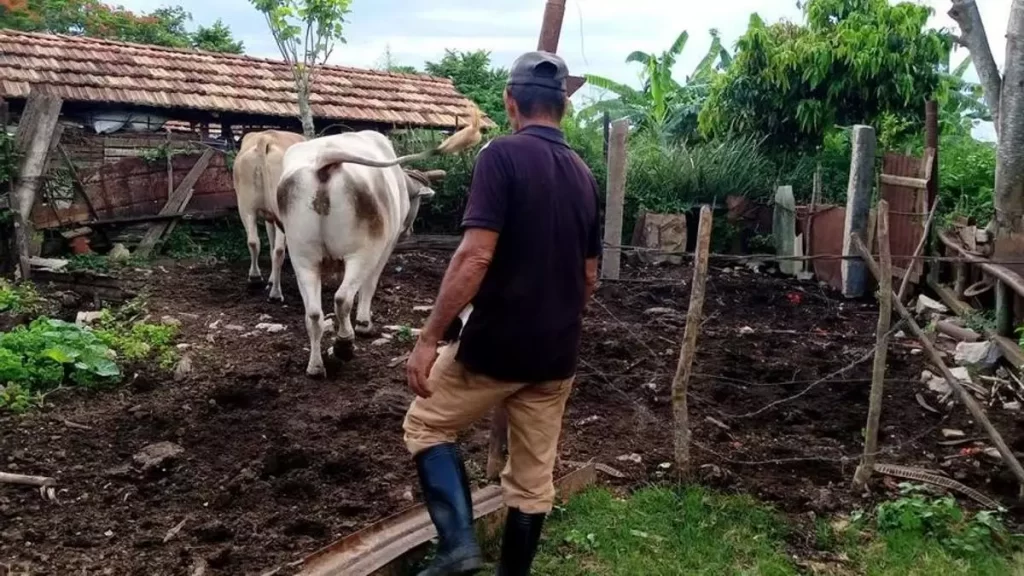
Cuba Produces a Third of the Cow’s Milk It Obtained in 1989 and 60 Percent of the Meat

The sector’s executives pilfered the information in a television appearance in which they offered “we have to” as the only response to the problems.

85% of the producers are private. / 14ymedio

14ymedio bigger14ymedio, Madrid, May 17, 2024 — The situation of livestock farming was nothing short of a joke, hours after learning that the sector’s products were the ones that rose the most in price last month, when this Thursday’s State TV Roundtable announced that the topic to be discussed In the evening program would be why production is not growing and what is being done to change this. If someone sat down to listen to the answer to these questions, the only thing they found was something similar to Aesop’s fable known as “The Milkmaid’s Tale.

When we solve these two problems (food and water) that will be expressed in reproductive health in the livestock and this will give more production,” said Yoandry Beltrán Pérez, vice president of the Livestock Business Group. It was not necessary to think much to get there, the question is how it is going to be resolved and the answer offered by Beltrán and his boss, Alain Rodríguez León, was the usual “we have to.”

“We have to transform the living conditions of the people involved in livestock production,” was the first wish expressed. He was referring to an alleged investment to restore 30 ranchers’ houses this year, although the project covers a total of 155. “We have to promote the planting of cane and protein plants,” he continued, alluding to Fidel Castro “who left us that legacy” thanks to which there are 15 seed farms in different provinces. continue reading

“We have to conserve food for dry periods, that is, take advantage of the six rainy months in the country, from May to November

“We have to conserve food for the dry periods, that is, take advantage of the six months that we have rainy weather in the country, from May to November,” he added to the list, which also gained weight with another aspiration, more specific in In this case: “We are trying to change the energy matrix.” This could supply water not only to the dairy farms, but also to provide it in other places where the animals can drink it whenever they want.

The blackouts affect the feeding of livestock, which is why the official expressed a new “we have to,” this time referring to the search for independence of water supply systems. “This cannot be achieved in a day, but it is where we have our sights set.”

While the authorities continue to think about what they and others have to do, the sector has been sinking for more than 30 years. Beltrán himself recognized this when he said that it is the obligation of the group (created as such in 2015) “to stop the decrease in the [number of dairy cows], which has had a decrease since the Special Period,” and “it has not been able to be stopped” The president, Rodríguez León, also admitted the “decrease,” but failed to put figures on it.

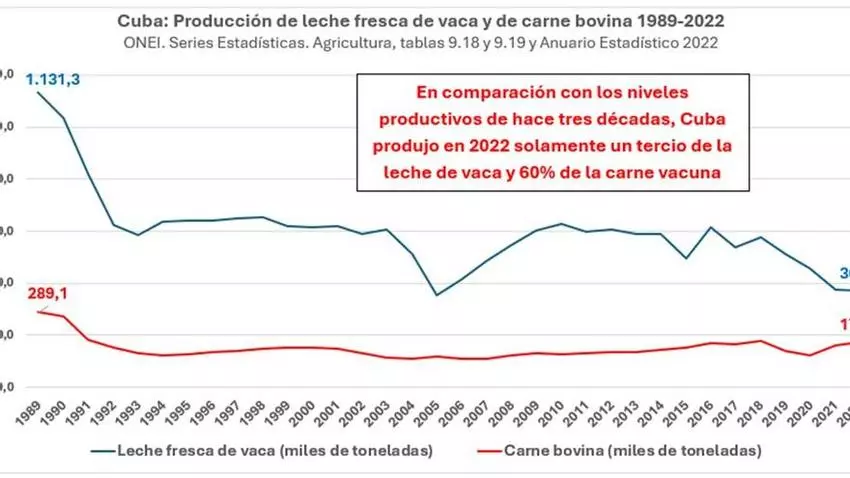
They had been left moments before by the economist Pedro Monreal, who warned of the situation on his X account. “They announce the Round Table today with the Cattle Business Group (Gegan) to explain the ‘business structure’, ‘why doesn’t production grow’ and ’what has to be done to transform the situation?’ Before they come out with any story, it is worth looking at one piece of information.” The tweet is accompanied by a graphic that illustrates the debacle.

Production of milk and meat in Cuba. / Pedro Monreal / Onei

In 1989, 1,131,300 tons of fresh cow’s milk were produced on the Island, compared to 369,000 tons in 2022, 67% less. When it comes to meat, the drop is less abrupt, but the drama is also evident. It went from 289,100 tons to 172,300, 40% less. In other words, in 2022, 60% of the meat and a third of the cow’s milk that was achieved in the late 90s, when Cuba was still recovering from the Special Period, was produced.

The president of the livestock group, who gave countless figures from the business organization chart, referred to the updating of the livestock registry that is being carried out. To date, he stated, visits have been made to 30,000 ranchers and more than 10,000 illegalities have been detected, although he stressed that the objective is not to penalize anyone, but rather “to have greater control of the number of animals, to know the living conditions of producers, the availability of water, roads and other infrastructure.”

Among the most striking data presented during the program is the low amount of losses reported by the director. At the end of 2023, 20 companies lost 336,188,516,400 pesos, while a profit of 16,431,100 pesos was achieved. As of today, however, only four remain negative, with 5,752,800 pesos. The reason could be in the small real power of the State in the sector, since 85% of the producers are private, as Beltrán Pérez himself indicated. “We must go to each farm and conscientiously enforce what is approved in the Livestock Promotion and Development Law in the country,” he concluded.

 85% of the producers are private, as Beltrán Pérez himself indicated. “We must go to each farm and enforce compliance.”

Also participating in the program were Ramón Denis García, General Director of the Research Center for the Animal Improvement of Tropical Livestock (CIMAGT), and César Liván Franco Camacho, General Director of the Venegas Livestock Company, who gave the keys to the success for his farm. Both praised the “historic leader” who, the first to speak described, “had the vision of developing science, coupled with the country’s agricultural development.” It is not exactly the sector to boast about, but the expert boasted of the scientific-technical tasks aimed at changing the situation, apparently without much success in the last 30 years.

Franco Camacho said that bank loans were vital to move the Venegas company forward, with its 22 dairy farms that are supplied with large-capacity tanks. “We have been serious with them in payments and we have no overdue loans. With these credits we also help producers in marketing with the purchase of sweet potatoes and cassava, among others,” he said.

Although he had just found one of the keys to the national economic collapse, not leaving debts, he ended up getting lost again in the discourse that will not fix the sector’s problems. “Livestock must be worked with love (…) we have created a science group in livestock, with people who love it, to search for solutions that can be taken into account towards its development. And since the Comandante [Fidel Castro] dedicated the last years of his life to showing us the way to plant animal food, that is what we work for,” he concluded.

____________

COLLABORATE WITH OUR WORKThe 14ymedio team is committed to practicing serious journalism that reflects Cuba’s reality in all its depth. Thank you for joining us on this long journey. We invite you to continue supporting us by becoming a member of 14ymedio now. Together we can continue transforming journalism in Cuba.
Cuba Breaks the World Record for Simultaneous Dancers in a Casino Wheel

The judges evaluated this event held on ‘Cuban Son Day’ / EFE

14ymedio bigger14ymedio, Havana, 6 May 2024 — Cuba broke the world record this Sunday by bringing together the largest number of people simultaneously dancing casino style and surpassing the number of choreographic wheels, dancing in unison to the beat and cadence of the son, a musical genre with origins and tradition in Cuba.

More than 1,500 people successfully passed the casino dancing test for nine minutes in squares and parks in the provincial capitals and municipalities throughout the country, according to preliminary data from the judges who evaluated this event held on Cuban Son Day.

The international project ‘Returning to the Son Dancing Casino’- coordinated through the Ministry of Culture – led to this initiative which finally met the goal of replacing Venezuela in the world record of popular and sports dances that country has held since 2022. continue reading

La Piragua, an emblematic site for the Havana dancers, was the epicenter of the capital’s event that brought together hundreds of casino dancers

La Piragua*, an emblematic site for Havana dancers, was the epicenter of the capital’s event that brought together hundreds of casino dancers (casineros) with a white and blue dress code.

The months-long preparations for the casino dancers represented long hours of rehearsals, visits to dance academies, as well as training of the people in charge of their organization.

The dance competitions were also recorded. From the west: Artemisa, Pinar del Río and Matanzas, from the eastern side: Santiago de Cuba, Holguín, Guantánamo and Granma, and the central cities of Cienfuegos and Camagüey.

The casino arose spontaneously in Cuba at the end of the 50’s during the last century as a form of entertainment for the couples dancing together or in a collective circle with a mixture of steps, variants and figures from an entire chain of Cuban ballroom dances that preceded it, such as urban Havana son and chachachá.

The casino emerged spontaneously in Cuba at the end of the 50’s during the last century as a form of entertainment for couples dancing together or in a collective circle

The casino wheel appeared when couples began to interact with one another, even swapping partners during the dance, made up of two or more duets that perform choreographic evolutions under the orders of a leader.

It was danced for the first time on the circular floor of Havana’s Club Casino Deportivo, and that is where the name of this style of social dance comes from, which has maintained its popularity and preference among Cubans, and the reason it is considered a contender to form part of the nation’s cultural heritage.

The international boom of this dance since the late 70s was a determining factor in the spread of casino dancing outside Cuba’s borders, where it has thousands of followers in the Americas, the Caribbean and other areas of the world where it is recognized as “Cuban salsa”.

*Translator’s note: La Piragua is a large plaza-type open space along Havana’s Malecon overlooked by the Hotel Nacional.

Translated by Norma Whiting
____________

COLLABORATE WITH OUR WORKThe 14ymedio team is committed to practicing serious journalism that reflects Cuba’s reality in all its depth. Thank you for joining us on this long journey. We invite you to continue supporting us by becoming a member of 14ymedio now. Together we can continue transforming journalism in Cuba.


The Cuban Opposition Platform D Frente Reforms Its Organizational Chart and Announces Its First Convention

D Frente [D Front] brings together various actors who oppose the Díaz Canel Government / EFE
14ymedio biggerEFE (via 14ymedio), Havana, May 20, 2024 — One of the main opposition platforms in Cuba, D Frente [D Front], announced this Monday a reform of its organizational chart and the date of its first convention to “continue advancing” in “democratic change,” “the establishment of the rule of law” and “citizen sovereignty” on the Island.

The organization reported in a statement the creation of eight work teams where there will be well-known Cuban opponents and experts, who reside inside and outside the country, among whom are: Manuel Cuesta Morúa, Eugenia Gutiérrez, Carmelo Mesa-Lago, Mauricio de Miranda, Marthadela Tamayo, Elena Larrinaga, Elsa Litsy Reyes and Julio Antonio Fernández Estrada, among others.

The objective of this change, the statement adds, is to “empower and strengthen the institutions” as a means to facilitate the achievement of the political objectives of the opposition to the Cuban regime.

The opposition platform reported that it plans to organize “in the near future” its first convention, in both in-person and virtual formats, to which they will invite the media, institutions and the general public.

D Frente emerged in 2022 to bring together different groups and individuals from the opposition political spectrum and with the common objective of refounding Cuba on the bases of liberal democracy. It is currently made up of 14 organizations and 120 individuals.

____________

COLLABORATE WITH OUR WORKThe 14ymedio team is committed to practicing serious journalism that reflects Cuba’s reality in all its depth. Thank you for joining us on this long journey. We invite you to continue supporting us by becoming a member of 14ymedio now. Together we can continue transforming journalism in Cuba.

First There Was Email

I feel deep gratitude for being able to contribute, from the press, to the construction of a democratic and free society as the first step towards inevitable political change.

Havana Bay captured at dawn from the editorial team of ’14ymedio’ / 14ymedio

14ymedio bigger14ymedio, Yoani Sánchez, 21 May 2024 — At first it was email. At dawn on the 21st of May 2014, when the first cover of 14ymedio was published, most of the content that could be read on this digital site had traveled through email. Now, accustomed to having a web browsing service on our mobile phones, and despite the poor quality of the connection, it is difficult to remember how a newspaper was made without being able to connect directly to the Internet. But that is how it all started.

During the months and years following that birth, the alarm clock in our house was always set for three in the morning. At that time, through Nauta’s mailbox, we received the first articles published each day in the official press, the technical and editorial support of our team in Madrid and the headlines from numerous sites that, through RSS [Really Simple Syndication], gave us a vision of which topics and news was going to mark the beginning of the editorial day.

Even for those of us who had created blogs practically offline and posted blindly on Twitter, updating and nurturing this journal was an extremely complicated and exhausting challenge. We had, of course, the compensation of the words of encouragement from the readers, the gradual growth of the audience, the mentions and links to our work in the pages of other media, the enthusiasm of the reporters on the street and the usual insults from Cuban oficialdom, which blocked our website from the first moment.

Like our nation, which long ago stopped being contained on an Island, this newspaper spans both sides of the borders, it is a child of the globalization of the Cuban issue

Continuing to publish during those extreme moments would not have been possible without the support of colleagues who, outside the Island, especially in Spain, were our eyes and our hands to keep the newspaper alive. That symbiosis between the inside and the outside gave shape, personality and style to the medium that turns a decade old this Tuesday. Like our nation, which long ago stopped being contained on an Island, this newspaper spans sides of the borders, it is a child of the globalization of the Cuban issue.

After those initial days came the hardest part: working steadily, raising the quality of our articles and gaining the trust of Internet users. To avoid becoming a ‘rag’, to avoid the attempts of groups or movements to make us spokespersons for their initiatives, to evade police sieges and operations around our Editorial Office in Havana and to not lose our sanity in the exercise of independent journalism under a regime allergic to freedom of the press has also been part of the challenges of this decade.

In December 2018, with the arrival of the internet access service on mobile phones, it seemed that, at least from a technological point of view, our informative task would become more bearable. But the frequent service cuts, intermittent or massive, that seek to censor or penalize clients of the state telecommunications monopoly, have kept access to the global web like a possibility surrounded by uncertainty and obstacles.

In two decades, most of those journalists who joined in the effort to move this medium forward emigrated. Those who remained on the ground had to, in numerous cases, assume pseudonyms to protect themselves and redouble precautions to avoid reprisals from the political police. From an ecosystem of independent publications based on the Island, we have compiled a short list with fewer exponents than there are fingers on a hand.

’14ymedio’ continues to be censored on national servers and it is a rare month in which we do not suffer the suspension of our mobile phone service

Now, the clock that marks the beginning of the day rings in our home at five in the morning. Email has long ceased to be our main way to find out what is happening inside and outside Cuba, the country that seemed asleep from social protests has experienced the historic popular demonstrations of 11 July 2021 and several important aftershocks. 14ymedio continues to be censored on national servers and it is a rare month in which we do not suffer the suspension of our mobile phone service on designated dates or due to some opposition call.

Ten years later, the reporter colleagues who search out, confirm and amplify on the streets the information we publish about this Island, the editors who are the main pillar of each content that comes out, together with this servant, we remain committed and enthusiastic about maintaining this open window to deep Cuba. Personally, I must add that I feel deep gratitude for being able to contribute, from the press, to the construction of a democratic and free society as the first step towards the inevitable political change.

Over the course of the next 10 years, I hope that the country will have achieved that objective and that 14ymedio will finally be accessible to all Cubans, without interference by the State in the citizens’ right to information.

____________

COLLABORATE WITH OUR WORKThe 14ymedio team is committed to practicing serious journalism that reflects Cuba’s reality in all its depth. Thank you for joining us on this long journey. We invite you to continue supporting us by becoming a member of 14ymedio now. Together we can continue transforming journalism in Cuba.

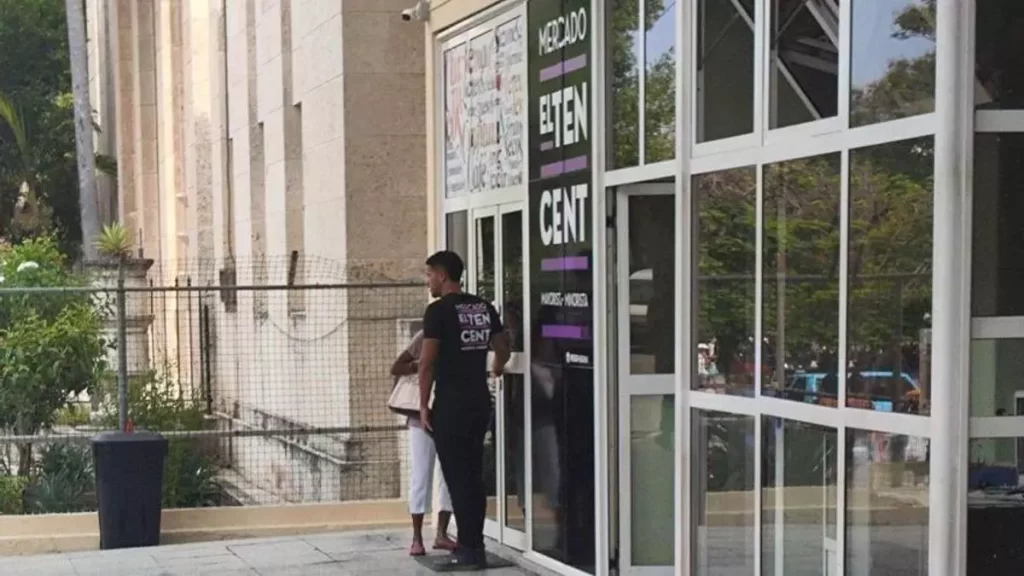
Nothing At the New Ten Cent Store in Havana is Available for Ten Cents, Only for Hundreds or Thousands

Curious locals waiting outside the store / 14ymedio

14ymedio bigger14ymedio, Natalia López Moya, Havana, May 20, 2024 — The new store at 704 Carlos III Street in Central Havana has been causing quite a stir. It opened today with an array of merchandise worthy of New York or Los Angeles and with prices to match. Though it is managed by a private company, it shares its premises with a state-run pharmacy.

With Cuba in the middle of a sweltering heat wave, the clean windows, newly installed signage and the promise of air-conditioning were enough to attract some curious onlookers this morning. In a nod to one of the most iconic Havana stores of the 1950s, the store’s management company, Mexohabana, has repurposed the Ten Cent brand name for its storefront.

In addition to a wide assortment of cheeses — they range from the well-known gouda to mozzarella to the exquisite parmesan — the store also sells oatmeal cookies, chorizo, Iberian ham and numerous products labeled “made in USA.”

“It’s obvious this is for people with money,” said a neighbor from a nearby building who had been eagerly anticipating this day. Local residents have been waiting for the store to open for two months, since the beginning of March, when word began to spread that the existing state-owned establishment would be sharing its space with a private one.

“It came out very nice and it looks like they invested a lot of money on the decor. If feels like you’re entering another country,” said the woman, who ultimately left empty-handed. Near her, a man was buying two one-kilogram packages of rice, some sliced ham, some ground cumin and some wheat bran crackers. For the few items that easily fit inside his medium-sized shopping bag, he spent more than 4,500 pesos. continue reading

“Nothing here costs ten cents. It’s all hundreds or thousands,” said another customer, who was buying a small lighter for 400 pesos. Those with more money to spend received a complimentary Chupa-Chupa* on opening day. But as one of the employees pointed out, it would cost 50 pesos if they wanted another.

“It all looks very American. There are lots of jams, dressings, sauces and cookies,” one woman told her friend, who preferred to wait outside because the place was already packed with people. “The service is good,” she reported back, “but from the moment you walk in they start asking you if you want something. I was feeling a little pressured. I’d rather have more time to look around before I decide.”

What was obvious to anyone entering the store was that the the Ten Cent name is just a marketing gimmick. This establishment bears no relationship to the low-cost subsidiaries of the North American parent company, F. W. Woolworth Company, that were so popular in Havana in the first half of the 20th century. The only thing that remains of their attractive prices is the memory.

The part of the building that still operates as a drug store seemed like the far side of the moon on Monday compared its neighbor. While the pharmacy’s employee responded with a negative monosyllable to anyone who dared inquire about medications for blood pressure, allergies or nerves, a sign at the adjoining private business urged customers to “eat and drink for life is short!”

Their respective clientele were also very different. While the people mulling outside Ten Cent sported imported clothing and footwear, sunglasses and even a hint of perfume, those headed to the dispensary were in much more modest clothing and carried worn-out bags over their shoulders. A few inches apart, the social differences were all too glaring.

“And what’s this?” asked an elderly man as he happened upon the new private-sector business. The man, who had not walked through the building’s wide covered arcade for months, was amazed at “the resources devoted to this.” But even astonishment was not enough motivation for him to check it out. “Why go in only to leave empty-handed?” he asked.

Two teenagers passing by could not resist the temptation. For a few brief minutes inside Tent Cent, they were able to escape the intense heat outside. They cast their eyes over the well-stocked shelves and salivated over the steaks and ground meat, which they had probably never seen in quite this way in their entire lives. The also laughed at a slice of blue cheese that was worth several thousand Cuban pesos.

*Translator’s note: A Spanish-brand lollipop.

____________

COLLABORATE WITH OUR WORKThe 14ymedio team is committed to practicing serious journalism that reflects Cuba’s reality in all its depth. Thank you for joining us on this long journey. We invite you to continue supporting us by becoming a member of 14ymedio now. Together we can continue transforming journalism in Cuba.
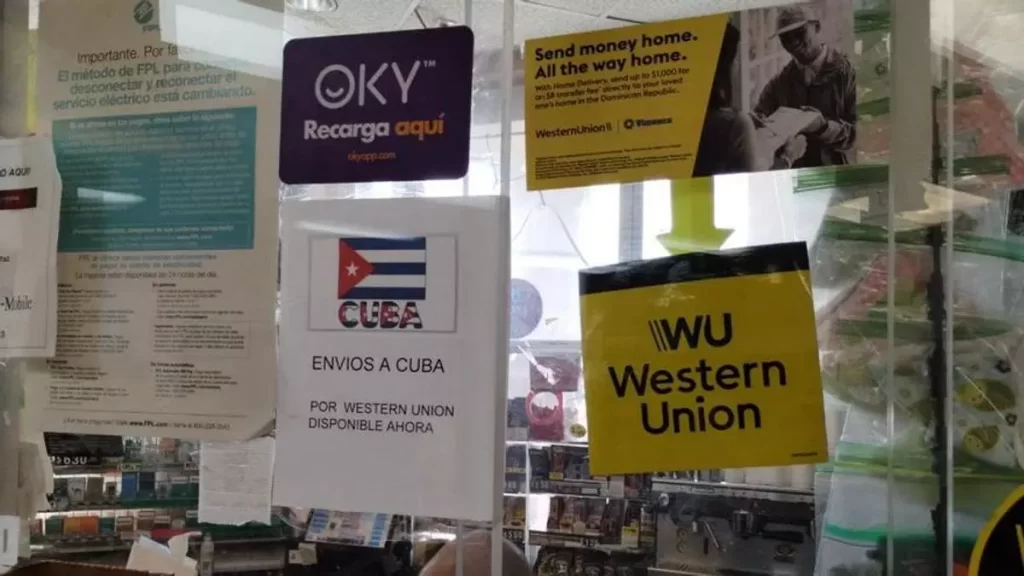
Western Union Resumes Remittances to Cuba Without Explaining Why It Suspended the Service

Although in a statement the financial company announced the operations are “with immediate effect,” at the moment they are only available from Miami and Hialeah

A Western Union office in Miami, Florida / 14ymedio

14ymedio bigger14ymedio, Havana, 9 May 2024 — Service from the United States to Cuba by Western Union is again possible as of this Thursday. In a statement, the financial company announced that “in coordination with its counterpart, Orbit SA,” it resumes remittances to the Island “with immediate effect.”

Although the notice states that operations can be carried out both in any office in the United States and through the mobile application, from a branch in Florida 14ymedio was told that, if a shipment is going to be made, it is advisable to do it from the application or specifically from some office in Miami or Hialeah, “so as not to have inconveniences, since not everywhere is accepting them.”

As was the case since the financial institution restarted operations in January 2023 , and after a two-year interruption, the limit per transaction will be $2,000 and must be applied to a card or an account at Banco Popular de Ahorro, the Bank Metropolitano or the Bank of Credit and Commerce (Bandec). Likewise, the service “is limited solely to consumer money transfers,” WU said in its statement.

“We understand that our service is a crucial connection between those living in the United States and their family living in Cuba,” said Rodrigo García Estebarena, president of WU for North and Latin America, without explaining the reasons why operations were suspended, at the end of last January. continue reading

“We understand that our service is a crucial connection between those living in the United States and their family living in Cuba”

Those were the same days that the Government paralyzed the entry into force of the new fuel prices due to an alleged “cybersecurity incident.”

Without mentioning that “incident” or even the remittances, Banco Metropolitano released a statement on February 1 in which it warned that it was having “technical difficulties.” Widespread suspicion about the hack, which, according to official sources, had affected the marketing system of Cimex, a corporation belonging to the military conglomerate Gaesa, increased among Cubans when the then Minister of Economy, Alejandro Gil Fernández, was dismissed.

On February 9, the Director of Communications, Brad Jones, wrote to this newspaper from the company’s Headquarters in Denver (Colorado), to say that the date of April 1, which had been provided to 14ymedio by employees of two offices in the United States for the reestablishment of remittances to the Island, was not correct.

After apologizing for the confusion, which it blamed on the fact that “someone in the customer service department” may have given “incorrect information,” the firm asked for an official statement to be released: “Western Union is experiencing technical difficulties in the processing part of our operations that have caused a temporary suspension of services between the United States and Cuba. The company is supporting its counterpart [the Cuban financial company Orbit] to resume services between the two countries as soon as possible.”

Later, when 14ymedio asked about the new requirements, Jones insisted, without referring to any date: “Our services remain suspended due to technical problems with the processing of transactions from the United States to Cuba. We are working with the counterpart to help them resolve these problems as quickly as possible.”

This Thursday, without any prior announcement, the “problems,” never made known, have been resolved.
____________

COLLABORATE WITH OUR WORKThe 14ymedio team is committed to practicing serious journalism that reflects Cuba’s reality in all its depth. Thank you for joining us on this long journey. We invite you to continue supporting us by becoming a member of 14ymedio now. Together we can continue transforming journalism in Cuba.
Roberto López, Former Cuban Political Prisoner, Dies After Years Living on the Streets of Cádiz

López was many things: son of a bodyguard of Ernesto Guevara, musician with Pablo Milanés and Silvio Rodríguez, combatant in Angola, political prisoner in Cuba and exiled in Spain

Roberto López in the vehicle that served as his home in an open field in Cádiz. / The digital voice

14ymedio bigger14ymedio, Madrid, 9 May 2024 — Rarely does the Spanish press report on the death of a homeless person, but this week it happened. It started in Cádiz and has reached television stations based in Madrid. The deceased was the Cuban Roberto López and before living on the street he was many things: son of a bodyguard of Ernesto Che Guevara, musician with Pablo Milanés and Silvio Rodríguez, combatant in Angola, political prisoner in Cuba and exiled in Spain.

He arrived there in 2011, as a result of the release agreement between the Church and the Cuban regime mediated by the Government of José Luis Rodríguez Zapatero. López did not belong to the well-known Group of 75, detained in the Black Spring, but he joined a last group of 11 prisoners led by Néstor Rodríguez Lobaina, president and co-founder of the Cuban Youth Movement for Democracy, declared a prisoner of conscience by Amnesty International, and he was on a hunger strike at that time.

Since then he lived in Cádiz. “I came to Spain because I was given subsidiary protection and international protection. We were guaranteed housing and money for four years. But I never received anything,” López had told the press. continue reading

“I came to Spain because I was given subsidiary protection and international protection. We were guaranteed housing and money for four years. But I never received anything”

According to the media La Voz Digital , Roberto had reached out to different organizations, but never received a response. Health problems came: pneumonia, pneumonia, a broken hip, pain in one leg… He went to Santiago de Compostela and Huelva, but ended up returning to Cádiz, where he earned a living teaching music, until alcoholism was slowly destroying him.

“A professional musician, he was left in a state of absolute precariousness,” said Miki Carrera, spokesperson for the Nadie Sin Hogar [No One Without a Home] association, which sporadically helped the musician. The NGO called for a tribute in his memory at the doors of Cádiz City Hall on April 7, one day after the Puerta del Mar Hospital certified his death due to complications from a foot injury.

After the pandemic, when he had already sold all his musical instruments, he lived for a while in a vehicle that the Asociación Personas Sin Hogar Con Derechos [Association of Homeless People with Rights] (PESHO-DE) got him. “Inside he had a cot to sleep on and his few belongings. For him it was a palace,” Milagros Fernández Bey, one of the people closest to the Cuban in recent times, tells television.

When he was not protected, Roberto López was afraid. “More than one person kicked him,” laments Fernández Bey, from PESHO-DE, who accompanied the Cuban for the last year trying to rescue him from the situation in which he found himself.

“We Cubans are of a different kind,” he used to say, according to an emotional farewell text that his friends have published on social networks. When he was a child he played with Guevara’s children, because of his father’s work, as part of Guevara’s security team. Fernández Bey claims that López had told him that Fidel Castro himself separated him from his father, whom he left for dead for five years. Until one day they asked him to go to a government building, they told him not to be scared and, when he opened a door, his father appeared. “I told the anecdote through tears,” he says of the incident.

Fernández Bey affirms that López had told him that Fidel Castro himself separated him from his father, whom he left for dead for five years

Although he trained to be a refrigeration engineer, his music studies caught him and led him to share the stage with several members of the new Cuban trova, including Pablo Milanés and Silvio Rodríguez, but he ended up going to Angola as a combatant.

“I’m not a snitch. Before revealing our positions they had to kill me,” said the artist, who in 1982 ended up joining the Cuban opposition and going to prison for being considered “anti-Castro.” There he spent ten years, which, however, seemed more tolerable than the detoxification center where he was in Cádiz.

“Once I asked him how he had been able to endure ten years in a Cuban prison, who knows what that’s like, and not be able to endure the discipline of addiction treatment. He told me that in prison you earn your place and the respect of the guards, but that in the treatment centers he could not tolerate the humiliation and undignified treatment to which they subject you,” says José, also from the NGO that cared for him.

“Perhaps,” he wonders, “they are measures that should be considered changing, because they are therapeutic, rehabilitation and reintegration centers. Measures that do not consist of ’at the slightest chance, you’ll go out on the street’, because there is more tolerance in nursery schools. It is clear that the dignity of a human being is as far as he can endure. Perhaps Roberto’s fell to the minimum, suffering the inclemencies of life on the street and the lack of humanity.”

____________

COLLABORATE WITH OUR WORKThe 14ymedio team is committed to practicing serious journalism that reflects Cuba’s reality in all its depth. Thank you for joining us on this long journey. We invite you to continue supporting us by becoming a member of 14ymedio now. Together we can continue transforming journalism in Cuba.

Supported by His Friends, Cuban Activist Leonardo Romero Negrín Is Released

Opponents and independent journalists, with police operations and communications cut off due to Independence Day

Several friends stood outside the police unit demanding the release of the young man who was fined for an alleged crime of public disorder / Facebook / Alina Bárbara López Hernández

14ymedio bigger14ymedio, Havana, 20 May 2024 — Activist Leonardo Romero Negrín was released this Monday afternoon after spending several hours under arrest at the Dragones police station, in Old Havana. A group of friends stood outside the unit demanding the release of the young man who was fined for an alleged crime of public disorder.

“Leo is not alone. In this era, no one is any longer when confronted with violence and arbitrariness. Thank you to everyone who reported, shared and was waiting in front of the police station,” academic Alina Bárbara López Hernández wrote on her Facebook account.

The arrest on Monday morning of Romero Negrín was part of the police operations that the Cuban regime deployed this May 20, as part of the repressive actions for the 122nd anniversary of the founding of the Republic of Cuba in 1902 and that also included telephone cuts and surveillance around the homes of activists and independent journalists.

Romero Negrín was a physics student at the University of Havana when he was arrested on April 30, 2021, on Obispo Street for walking with a sign that said “Socialism yes, repression no.” During the mass demonstrations of 11 July 2021, he was apprehended once more and was also beaten. Accused of “public disorder,” he was released after six days, but since then he has never ceased to be harassed by the political police. Carolina Barrero, also an activist, who denounced the arbitrary detention on Monday recalls from Spain, “Leo is one of those young people who, against all odds, stayed in Cuba and tries to make his little piece of land a better country.” continue reading

“Family and friends have little news of him but we know that his detention is political”

He is not, however, the only one who suffers harassment nowadays. 14ymedio’s editorial staff in Havana remains, since this Sunday, with connection problems, and early this Monday a police operation was underway on the ground floor of the building where it is located.

According to various organizations, independent journalist Boris González Arenas and opponents Fernando Palacio and Eroisis Gonzales are also held incommunicado. Dissident Manuel Cuesta Morúa and activists María Elena Mir Marrero and Marthadela Tamayo are in the same situation. Yamilka Lafita, known as Lara Crofs, denounced having a police operation on her doorstep, in the capital.

The repressive deployment by the authorities began yesterday. Activist Agustín López Canino denounced the heavy police operation around his home in the neighborhood of El Globo, in Calabazar, Havana.

The regime has made itself felt with repressive acts days before the 122nd anniversary of the founding of the Republic of Cuba back in 1902. Wilber Aguilar Bravo, father of political prisoner and protester, Walnier Luis Aguilar Rivera, denounced on Saturday the regime’s harassment against him and his family and claimed on his social media platforms: “They say that no one is repressed for thinking differently.”

Similarly, writer and journalist Jorge Fernández Era was harassed by two police officers who took him to a patrol car when he left his house to throw away the garbage, and asked for his ID card to identify him.

“Leo is charged with disobedience after being arbitrarily detained by State Security.”

“I start arguing. They are so dishonest that they do not accept that the target of such a deployment is me. They are just, as they put it with absolute cynicism, ‘doing their job’,” he explained. After the exchange of words, the officers threatened to charge him with contempt and to arrest him with the use of force.

This act of repression is their fear, Fernández Era wrote, “of me calling the president a liar, a president who makes fun of us on TV and calls us ‘vandals’. They are afraid that I will denounce what they are doing to Alina [Bárbara López Hernández], the cowardly and inhuman punishment that my son and my family pay for my actions, that I will demand that they stop the repression against those who oppose so much shit that it does not fit in a garbage container. ”

Translated by LAR

____________

COLLABORATE WITH OUR WORKThe 14ymedio team is committed to practicing serious journalism that reflects Cuba’s reality in all its depth. Thank you for joining us on this long journey. We invite you to continue supporting us by becoming a member of 14ymedio now. Together we can continue transforming journalism in Cuba.
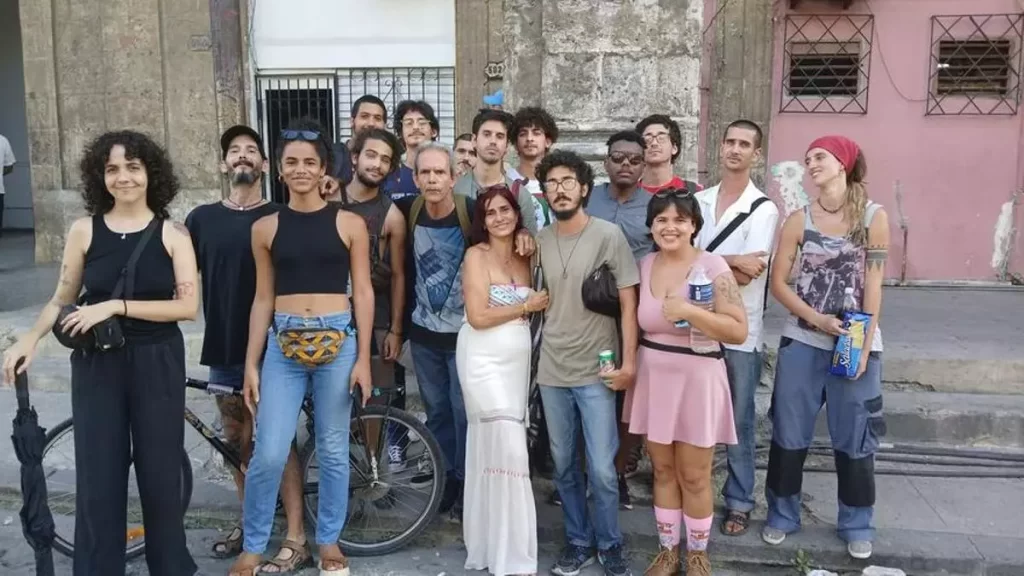
Mexico Finances the Cuban Dictatorship by Paying So-Called Doctors Inflated Salaries

The leader of the conservative opposition details his accusations against López Obrador´s Government.

Mexican Senator Julen Rementería also criticized the hardships experienced by the Health sector/ Courtesy of Senator Rementería’s office.

14ymedio bigger14ymedio, Mexico, May 19, 2024 — The Government of Mexico is secretly financing the Cuban regime through the importing of doctors since the COVID-19 pandemic, according the leader of the National Action Party (PAN in Spanish) in the Senate, Julen Rementería, speaking on Wednesday.

According to the data provided by the leader of the main opposition party in the Upper House, the sponsorship is achieved thanks to the inflation of the salaries granted to Cubans hired in Mexico under the Health system payroll. He suggested that this employment relationship could be a facade to carry out other activities in the country since there are no documents that support the Cubans’ medical training.

The Cuban government is “paid up to 144,000 Mexican pesos (approximately USD 8,734) per month for each person who comes from Cuba because we cannot even say that they are doctors because they do not prove it with any document. What lies behind it? Well, the financing, from Mexico to a dictatorship, to that of the island of Cuba,” he added at a press conference. continue reading

An investigation by 14ymedio revealed in February 2023 that the Government of the Island will pocket USD $2,042 per month for each specialist and USD $1,722 for the services of a general practitioner

The Veracruz senator harshly criticized the visit of Zoé Robledo, director of the Mexican Institute of Social Security, to Havana, where on May 13 he held a meeting with President Miguel Díaz-Canel to “strengthen health cooperation.” That commitment is interpreted as an attempt to reach the goal of 1,200 doctors agreed with Havana – 768 Cubans have arrived so far – before the end of Andrés Manuel López Obrador’s six-year presidential term in four months.

Rementería expressed his disagreement with this announcement after considering that “they are taking away a salary from Mexican doctors” without, in his opinion, being transparent about the reason for the decision ordered by the nation’s president himself, after making an agreement with the Cuban regime. “There are 51,000 Mexican doctors who are unemployed, and are we going to ask Cuba for doctors?” he reproached.

14ymedio documented last April how Mexican doctors belonging to the Health Institute for Welfare were fired before the arrival of a group of colleagues from Cuba. The island’s health workers were assigned to establish a base on the mountain of Guerrero, which was a stronghold of the guerrillas in the 1970s and currently faces a growing wave of insecurity with cartels, such as the Familia Michoacana or Guerreros Unidos, fighting over drug routes with bloodshed and fire.

Rementería urged López Obrador’s Administration to curb the importing of Cuban doctors, especially because so far neither of the two governments has publicly explained their employment situation. Nor has it responded to accusations of practicing a form of “modern slavery,” according to reports published by several organizations, such as Prisoners Defenders, which point to the withholding by the authorities in Havana of up to 90% of the salaries allegedly paid to its aid workers.

The PAN member’s denunciations against the alleged financing of the Cuban regime come just a few days after the opposition candidate for the Presidency, Xóchitl Gálvez, promised to cancel the bilateral agreement should she win the elections on June 2.

Translated by LAR

____________

COLLABORATE WITH OUR WORKThe 14ymedio team is committed to practicing serious journalism that reflects Cuba’s reality in all its depth. Thank you for joining us on this long journey. We invite you to continue supporting us by becoming a member of 14ymedio now. Together we can continue transforming journalism in Cuba.

The Number of Political Prisoners Reached 1,100 in April, According to the NGO Prisoners Defenders

The figure includes more than a dozen of the cases reported in the previous month.

The statement adds that 225 people – mostly convicted of participating in the July 11, 2021, anti-government protests – have been charged with sedition / Screen capture

14ymedio biggerEFE/14ymedio, Madrid, May 17, 2024 — The NGO Prisoners Defenders (PD) reported Friday that at the end of April, it registered 1,100 people imprisoned for political reasons in Cuba, more than a dozen more than those included in its previous monthly report.

The organization, based in Madrid, explained that in April it added 13 people considered political prisoners to its list and that five others left the registry after full compliance with the sanction or measure imposed.

The report, published on the NGO’s website, explains that 30 minors – the minimum criminal age in Cuba is 16 – remain on the list of prisoners. Of these, 27 are serving sentences and three are being criminally prosecuted.

PD denounced that “15 of the minors have already been convicted of sedition,” with an average sentence of five years of liberty deprivation, most of them under the regime of “home confinement or forced labor without internment.” continue reading

15 of the minors have been convicted of sedition, with an average sentence of five-year imprisonment 

The statement adds that 225 people – mostly convicted of participating in the anti-government protests of 11 July 2021 – have been charged with sedition, and at least 222 have already been sentenced to an average of ten years in prison.

According to PD, there are also 118 prisoners (including several who are transgender) who “still have political and conscience convictions .”

“All trans women of conscience in prison have been and are imprisoned among men, which is also the case with common trans prisoners, who thus suffer indescribable situations among men based on their gender identification,” denounced PD.

The NGO added that it identified “297 prisoners with serious medical pathologies without adequate medical treatment,” it also confirmed that “all are suffering from various medical pathologies due to lack of food, mistreatment, a repressive environment and lack of appropriate medical care for all of them.”

Recently, Prisoners Defenders sponsored the Foreign Affairs Committee for the Spanish Congress of Deputies to present a non-legislative proposal “regarding the possible evidence of human trafficking and modern slavery in Cuba’s collaboration missions abroad .” In a session attended by 35 deputies, the proposal was approved by a minimum margin, with 18 votes in favor and 17 against.

____________

COLLABORATE WITH OUR WORKThe 14ymedio team is committed to practicing serious journalism that reflects Cuba’s reality in all its depth. Thank you for joining us on this long journey. We invite you to continue supporting us by becoming a member of 14ymedio now. Together we can continue transforming journalism in Cuba.

The Bishop of Camagüey in Cuba Prohibits Ringing the Bells During Blackouts

This decision is attributed to the pressure on the Church from the Communist Party of Cuba to undermine the initiative of the priest of Esmeralda, Alberto Reyes.

The Bishop of Camagüey Wilfredo Pino Estévez / arzobispadocamaguey.com

14ymedio bigger14ymedio, Havana, 19 May 2024 — The bishop of Camagüey Wilfredo Willy Pino Estévez prohibited Father Alberto Reyes from continuing to ring the bells of the Esmeralda parish as a symbolic protest against the blackouts in that municipality, sources close to the Catholic Church confirmed to 14ymedio, attributing this decision to pressure from the Cuban Communist Party to undermine the religious initiative.

“For the good of the Church and Father Alberto,” Willy issued the warning, sources say, and was “clear” in prohibiting this form of protest. The decision comes a few hours after the 30 bells that rang in Esmeralda on Friday night went viral on networks and were remarked on in independent media. As Reyes published on Facebook, the bells were for the “agonizing death of our freedom and our rights, the suffocation and collapse of our lives.”

The pressures from the PCC Religious Affairs Office, headed by Caridad Diego, are constant, but in the last three years, after the demonstrations of 11 July 2021, they have intensified, especially with the prohibition of processions and celebrations in numerous churches for fear of new protests. continue reading

A source from the archdiocese of Havana stated at the end of last April, after a proposal for dialogue from the Conference of Catholic Bishops of Cuba (COCC) expressed by its secretary, Ariel Suárez, became known, that at the diocesan level “the tension” with the Cuban Communist Party (PCC )“is worse than ever.” The same source asserted that relations between the regime and the Church continue to be “timid” and that, in any case, as he insisted, “the Government is very tense.”

Alberto Reyes, one of the most critical voices of the Catholic Church against the regime, had said that ringing the bell in the middle of the blackout was “a way of calling for the necessary dawn in our land sunk in night” and, furthermore, he intended to awaken a people he considered “domesticated.”

Reyes has been one of the ecclesiastical actors most harassed by State Security through warning calls, acts of repudiation and threats of judicial prosecution. In an interview given in July 2022 to 14ymedio, the cleric stated that the Cuban Government “has more than demonstrated its inability to build a society that is not only prosperous, but also capable of responding to the most basic aspirations of human beings.”

____________

COLLABORATE WITH OUR WORKThe 14ymedio team is committed to practicing serious journalism that reflects Cuba’s reality in all its depth. Thank you for joining us on this long journey. We invite you to continue supporting us by becoming a member of 14ymedio now. Together we can continue transforming journalism in Cuba.

Priest Alberto Reyes Rings the Bells of His Cuban Parish in Protest Against the Blackouts

The ringing broke out in the darkness of the small town of Esmeralda, with less than 30,000 inhabitants, in Camagüey

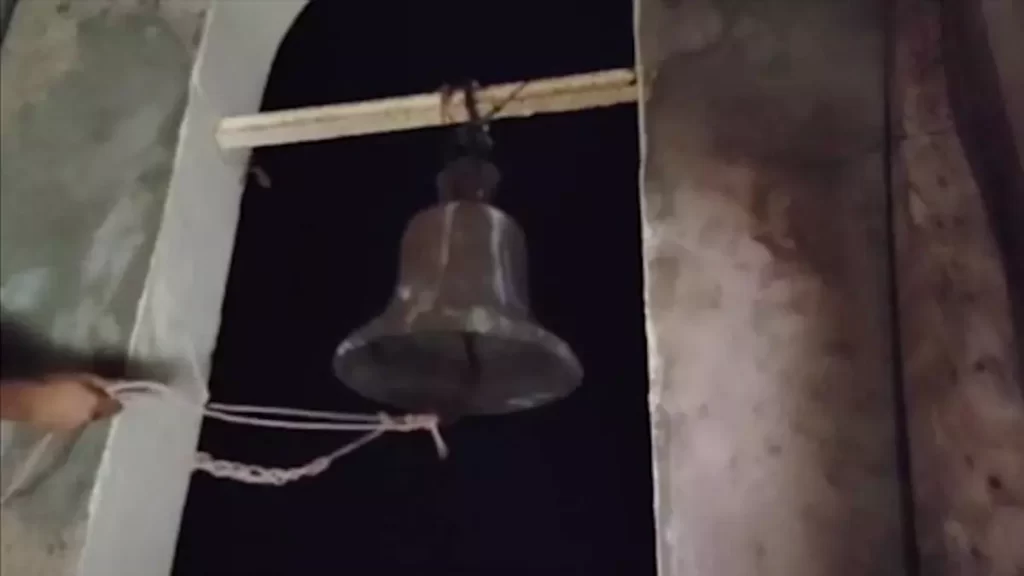
In a video sent to this newspaper, the priest’s hand can be seen activating the bell, which hangs from a thin piece of wood from the parish tower / 14ymedio

14ymedio bigger14ymedio, Havana, 18 May 2024 — The bells of the Esmeralda parish, in Camagüey, tolled this Friday during the blackout. The warning of the Catholic priest Alberto Reyes was fulfilled, who promised to protest with 30 bells against the “agonizing death of our freedom and our rights, the suffocation and sinking of our lives,” represented, according to him, in the constant electrical outages that overwhelm the population.

The ringing broke the darkness of the small town of less than 30,000 inhabitants where the priest, one of the most critical voices of the Catholic Church against the regime, exercises his ministry. In a video that Reyes sent to this newspaper, the priest’s hand can be seen activating the bell, which hangs from a thin piece of wood from the parish tower, while another shot, taken from outside, shows the town plunged into total darkness.

Solemn and spaced, the peals – similar to those played during a funeral procession – are, the priest said this Friday on Facebook, “a way of calling for the necessary dawn on our land sunk in night.” With this gesture of continue reading

symbolic protest, which Reyes describes as “a voice lost in the loneliness and nothingness” of the Island, he intends to awaken a people that he considers “domesticated.”

“We are a people who have been convinced that, no matter what we do, nothing will ever change. “We are a people imprisoned in many ways, to which our captors, before the minimal reaction of protest or search for liberation, have responded with the brutality of those who are not willing to give in, even if they see us languish and die slowly,” he said this Friday.

He denounced the repression of protests that characterizes the regime and criticized the passivity of Cubans in the face of the hundreds of political prisoners who remain in prisons. He urged people to carry out gestures of “peaceful resistance,” such as abandoning official institutions, removing posters in favor of the system in private homes, educating their children to “reject duplicity” and using “the paths that one can find.”

Reyes, who remains in the country despite harassment from State Security, is part of a group of priests and nuns who have not hesitated to openly express their criticism of the Government. This position has brought him difficulties not only with state authorities, but also with ecclesiastical authorities.

____________

COLLABORATE WITH OUR WORKThe 14ymedio team is committed to practicing serious journalism that reflects Cuba’s reality in all its depth. Thank you for joining us on this long journey. We invite you to continue supporting us by becoming a member of 14ymedio now. Together we can continue transforming journalism in Cuba.
Abandoned for Years, El Golfito in Alamar to Reopen in Early Summer

A girl who was playing among the ruins of a miniature castle died when the structure collapsed

Visitors to El Golfito will be able to purchase everything in pesos / 14ymedio

14ymedio bigger14ymedio, Pedro Espinosa, Alamar (Havana), May 18, 2024 — Were it not for the fact that all Havana residents know what they are, one might think the ramps at El Golfito – once an important recreational center in Alamar – was an archaeological site. The work that a government construction crew has been carrying out for several weeks is very similar to what Indiana Jones’ colleagues would do: dusting, rebuilding, plowing and removing overgrown vegetation after many years of neglect.

When a veteran journalist with “Tribune de la Habana” wrote a column last year complaining about the deterioration of El Golfito, it immediately called attention to the situation. He posed a question to officials, asking if — even for a country in crisis — money could not be allocated to communal spaces. “Would it cost so much to fix these recreational centers that would allow the public to have a more active cultural life?” he wondered. “The answer is yes.”

The good economic news that the columnist was hoping for seems to have arrived. Rolando, one of the construction workers on the site, describes El Golfito and its miniature golf course as “a community project” that will be reopen “at the beginning of the summer.” continue reading

It was time, Rolando believes, that something was done with that area, where the ruins of El Golfito are just one of many

“Entry will be 200 pesos for those over 12 years old and free for the little ones. The entire offer will be in pesos,” says the man. In the surroundings of El Golfito – where the ramps can already be seen and the holes have been cleared – there will be “a cafe, a snack bar, swings, a seesaw and we are planting plants.”

It was time, Rolando believes, that something was done with that area, where the ruins of El Golfito are just one of many. Abandonment has been costly. “Several years ago,” he says, “a little girl who was playing in one of the ’little castles’ died because the structure collapsed.” Rolando does not know the details of the case, but one of his colleagues, who overhears the conversation, reprimands him: “You are talking too much.”

Rolando’s partner follows his scolding with an argument in support of the brigade: “Look what we’re doing,” he says, pointing to the grass and the fence they are putting up around the perimeter of the small field. At the moment, there is little progress and the place still looks like an excavation.

Another invasion, that of trash dumps, has been affecting the health of those who live by the sea for several years / 14ymedio

Beyond El Golfito, still in Cojímar, next to the beach, several ruined structures with a futuristic appearance still rise. These are old circular kiosks, now dilapidated, where food and soft drinks were previously sold to bathers. “I remember the cafe, the sellers of cold cuts, peanuts, the palm frond umbrellas, the filler sand that this piece of reef received every year to make our lives more bearable,” the official journalist reported longingly in her article.

Another invasion, that of trash dumps, has been affecting the health of those who live by the sea for several years. Bottles, plastic bags, pieces of clothing and all kinds of rubbish now take the place of the sun loungers and umbrellas of yesteryear. Of the bathers, no trace. Cojímar and Alamar, two names that evoked a sunny Havana of beaches, have ended up as “salty” as the fisherman whose failure Hemingway recounted.
____________

COLLABORATE WITH OUR WORKThe 14ymedio team is committed to practicing serious journalism that reflects Cuba’s reality in all its depth. Thank you for joining us on this long journey. We invite you to continue supporting us by becoming a member of 14ymedio now. Together we can continue transforming journalism in Cuba.

Cuba: ‘The Only Eastern Country in the Heart of the West’

Jorge Ferrer presents ‘Between Russia and Cuba’ in Barcelona. Against memory and oblivion.

Jorge Ferrer and Iván de la Nuez, at the presentation of ‘Between Russia and Cuba. Against memory and oblivion’, in La Central de Barcelona / 14ymedio

14ymedio bigger14ymedio, Yaiza Santos, Barcelona, 17 May 2024 — The history of the link between Cuba and the Soviet Union, and what this meant for the world in the years of the Cold War, is well known. However, until now no one had related the intimate implications it had for several generations of Cubans. Especially those young people who, sent to study in Moscow, witnessed glasnost and Perestroika, waited for the change to be echoed in their country and ended up exiled.

The task of explaining this “very strange link,” between a Caribbean island and the icy lands of the USSR, in the words of Ricardo Cayuela, director of the Ladera Norte publishing house, was far surpassed by Jorge Ferrer in Between Russia and Cuba, Against Memory and Oblivion, which he presented this Thursday at the La Central bookstore in Barcelona.

The essayist and art critic Iván de la Nuez, resident in Spain for more than 30 years and presenter of the event, described the book as “huge, tremendous, extraordinary,” going beyond narrating the “life that every Cuban could have had.” The three lives – related in the three parts that make up the volume, are that of the grandfather Federico, a police officer under Batista exiled in the United States in 1968, when Jorge Ferrer was a baby; that of the father Jorge, a preeminent apparatchik at the National Bank of Cuba; and that of himself. In reality, says De la Nuez, the three lives are “at least 21”: seven, like cats, for each one. continue reading

But this is not, as it might seem, a memoir – and hence the subtitle – but rather an unclassifiable hybrid, as the author claims he likes to consider himself. “There is a memory gap in the world we live in,” he said at one point during the presentation. De la Nuez elaborated on the same idea, saying that “memory is often made of lies, and this is a book that seeks the truth.”

This is not, as it might seem, a memoir – and hence the subtitle – but rather an unclassifiable hybrid, as the author claims he likes to consider himself

For this purpose he undertook arduous research about his grandfather, his father and his own life in Moscow, where he arrived with his father as a teenager. It is in that part where he hit a wall, Iván de la Nuez emphasized: he wanted to get his file from the psychiatric hospital where his father forcibly confined him at the age of 16 for drug problems, but, in post-Soviet Russia he found that “that file is not open.” In that building, larger than the Kremlin, not only the mentally ill but also dissidents, like the poet Joseph Brodsky himself, were punished.

Both Cubans spoke about the term hypernormalization, from the Russian Alexei Yurchak, to refer to that moment in the USSR before its fall, and what it meant to live the socialist “experiment.” That “life without intimacy or seclusion” left room, however, for secrets, just like those that Ferrer tries to bring to light from his family.

Between Russia and Cuba is also, De la Nuez said, the book “by a translator” – as Ferrer is for authors such as Vasili Grossman, Svetlana Aleksievich, Iván Bunin or María Stepanova – “a book that translates the world for us” and aims for an impact. The experience of the Cuban in exile, like them, cannot be, in the opinion of the art critic, subordinated to the past. “If we spent all the time saying where we came from and denouncing it, we would have no way out.”

Faced with the idea of ​​Cuba that is usually held outside its borders, of a certain multiculturalism and folklore, De la Nuez indicates, in short, that Ferrer is right in finding the true uniqueness of the Island, “which no other country in the world has”: to be “the only Eastern country in the heart of the West.”

____________

COLLABORATE WITH OUR WORKThe 14ymedio team is committed to practicing serious journalism that reflects Cuba’s reality in all its depth. Thank you for joining us on this long journey. We invite you to continue supporting us by becoming a member of 14ymedio now. Together we can continue transforming journalism in Cuba.