Different Strokes in Havana / Regina Coyula

I would like not to commit a blunder and put myself in tune with the times, and instead of talking about layers of the onion, say that any city, any society, resembles also a multi-system disc where the tracks spin and re-write themselves without affecting the various files among them.

After this rhetoric, Havana these days is a city whose manifest decay has cross-dressed into a vintage beauty; tourists, with cameras that a Cuban doctor could not buy with an entire year’s salary, wander around taking a picture of a ’54 Chevrolet here, a collapse there or a smiling, chubby, dark, cigar-smoking woman with the sound track from Chan Chan or Guantanamera.

Another refined and glamorous Havana perfumes the air conditioning of trendy new places open to the heat (warmth, no need to exaggerate) of the Raulist reforms. With restaurant licenses, operating in practice as bars open until dawn, the celebrity has found there an ideal space; also firm managers, successful private workers.  Foreigners do not make up the majority in these places.  A happy and unworried gathering of women without any ugly, fat, old or poor ones, accurately calculate at a glance the value of their potential companions. continue reading

My son, a very worthy specimen of masculinity, was “disqualified” at Esencia Habana, one of these places in Vedado where, for a bottle of Smirnoff vodka that sells in a Miami liquor store for 20 dollars, they charge without a blush 63.2 CUC (more than $65 US).

A friend of Rafa who lives there came for four days to the wedding of a friend of his girlfriend.  It was the girlfriend’s first visit after her departure as a girl, and she was reunited with her childhood friends, almost all university students, and they suggested the place.

Rafa was the rare one with his casual attire among those long-sleeved shirts tucked into the pants, the dress shoes and the catwalk dresses.  The girls danced to the rhythm of Justin Bieber, Pitbull or Gente D’Zona, while they made faces before their latest generation iPhones and Samsungs whose only advantage in Cuba is the flash.  My son felt the separation, but it did not matter to him because he and his friend had a ton of things to talk about.

They next day they were to meet again, this time at a more calm place but based on the advice of the friends of the girlfriend, they went to Espacios, another of these places in the “miky” fashion*.  Rafa said goodbye after a while: “Bro, it’s not my scene, I’m leaving.” His friend understood, and I, though they who aspire to a life of luxury may criticize me, I felt very comfortable with the idea that, in the rewritable disc of Havana, my son is in the file of the rare.

*Translator’s note: A comment from a Lonely Planet site defines “miky” (or “miki”) as follows: Miki is the opposite of “freaky” (friki). It’s Cuban youth slang for go-with-the-flow youth following trends, meaningless fashion music (salseros, regetoneros etc) and are not really “special” or doing anything thoughtful. Freakies on the other hand see themselves as “deeper”, with opinions, “quality” and more rebellious. Mikis are deemed by their “adversaries” are shallow, uneducated and daft, while freakies are seen by mikis as snobbish intellectual brats.

Translated by mlk.

17 December 2013

Puzzling Raul Castro in Santiago / Luis Cino Alvarez

HAVANA, Cuba, January, http://www.cubanet.org – General Raul Castro’s speeches are becoming increasingly puzzling. One does not know if he is playing at being Chinese, or playing Russian Roulette.  Before, at least, he used to save us the fright, by letting us know when he was going to make a joke. Now not even that.

It’s not that he was being a ventriloquist, but his speech this past January first in Cespedes Park in Santiago de Cuba, more than his harangues of seven years ago, when he assumed power, seemed like those of Fidel Castro.

The general president assured us that the Revolution continues the same as when it triumphed 55 years ago, with no other commitment than to the people.

And one does not know how to understand this, because if that which some still call “the Revolution” broke its commitment some time ago to anyone, it was precisely to the people, abandoned to their luck in this save yourself if you can… if you are of the elite. continue reading

The commitment will be to Fidel Castro, and the historical leadership, that supra-institutional meritocracy, to the generals, to the orthodoxy, but to the people?

What is the commitment to the people by a government whose methods for updating the economic model, however much they may deny it, increasingly resemble the shock therapy of savage capitalism that came disguised as whatever, without capital or markets, and what is worse, without political freedoms nor the right to say boo?

What commitment is it by a government that, thinking only of its revenues, takes black market prices as the standard and declares illegal the survival mechanisms of an increasingly destitute people?

Of what value are the promises of a petty blackmail system that beats a retreat, that slowly and painfully dissolves in the hot air of the Guidelines of the Sixth Congress?

What does it have to do with the people, the sloppy capitalism of a State as mercantile as that of the absolute monarchies that we faced?

This speech by the general-president, in which he advances backwards, reminded me of the “call” to the Fourth Congress of the Communist Party that the army general made when he was Number Two, in March 1990. Then we understood little and badly. When finally the bloody congress was held, in October 1991, it was all exactly contrary to what was expected. And now we know the consequences.

Many years have passed, and he who was Number Two now is Number One. And it is not good for a ruler to miss so many opportunities.

luicino2012@gmail.com, Cubanet, January 6, 2014

Translated by mlk.

The New Cuban Rich / Ivan Garcia

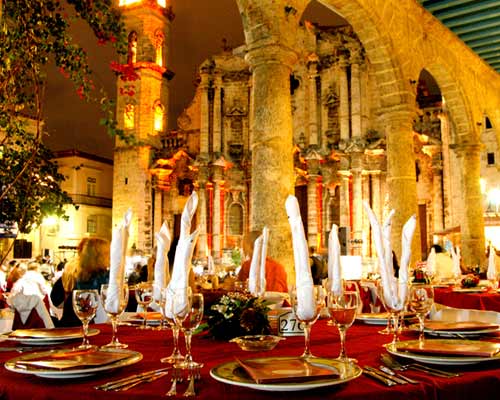
Plaza de la Catedral, festooned for the Year End Grand Dinner and which some new Cuban rich must have attended. *See below for dinner menu.

They are not as ostentatious as the new Russian rich who buy compulsively and empty the shelves of Marbella. Nor do their lifestyle and expenses have to do with a Qatar millionaire who for pure pleasure buys a bankrupt European soccer club.

The new Cuban rich have a different stripe and behavior. “There are several castes. There are the life-long privileged: ministers, managers of healthy businesses or generals who have exchanged the olive-green uniform for a crisp white guayabera. They may eat shrimp and drink Spanish red wine,” says an ex-official.

In his opinion, it is a very special class. “It is accessed by family genes, loyalty or sycophancy. But it is an exclusive preserve. Depending on their rank, these revolutionary burghers may have a yacht or even a Hummer.”

A person who knows about power says they usually go to Ibiza or Cancun on vacation. “They are above the law and the Constitution. By divine decree, they can have cable antennas, internet at home and several cars. They don’t need to turn off the air conditioning to save energy, and when the dollar was prohibited, the supposed enemy’s banknotes were in their wallets.” continue reading

There were and still are other kinds of “rich.” People call them “flowerpots.” It is a colorful fauna of petty thieves with white collars who swipe a few million pesos and abound in various levels of government ministries.

“They carry the party card for convenience or pull you into a lecture replete with revolutionary slogans. This caste has learned how to spin the system,” says a lady who was a servant in the home of a manager.

Common and ordinary Cubans know that they ride in State cars, with gasoline from the State and that they steal from the State. That they invest in family businesses. And under the mattress they keep dollars and euros, among other currencies. “The most intelligent defect on an official trip and with stolen money set up a discreet business in Florida,” asserts the ex-official.

The man on the street also knows that the number of private entrepreneurs who are earning quite a bit in their businesses is rising. Also, that in Cuba there exist the “body smugglers.” People who have always lived on the margin of the law. Selling drugs, brand name clothes, pirated perfumes, houses or cars.

And with the money saved, the ’body smugglers’ open a cafeteria or rent rooms to foreign tourists for 30 dollars a night. Other privileged people are the rich “de flay,” that is, “the Cubans who thanks to remittances sent by relatives in Miami, who in order to sustain the way of life of these bloodsuckers, often have two jobs,” says a retired teacher.

They all, from the olive-green caste to the rich “de flay,” demonstrate the difference from that vast majority of the population that eats a hot meal once a day and relieves the heat with a Chinese fan.

The new rich can afford the luxury of dining three times a week in a private restaurant and paying 150 CUC for a set menu at the Plaza de la Catedral in order to eat delicacies and await the new year listening to Isaac Delgado.

Some envy them. But, in general, Cubans accept the new rules of the game. They see well that their neighbor may have a business, make money and stay at a Varadero hotel.

And that the State may sell cars and permit you to travel abroad. They applaud the elimination of the absurd double currency and ask for better salaries, with the hope that someday they too might eat in expensive restaurants or visit Cayo Coco.

What people reproach is the hypocrisy of the regime’s leaders. That they speak in the name of the poor while they live and dine like the new rich from Russia. That’s why, when many Cubans see Raul Castro, it seems to them that they are observing Vladimir Putin. Maybe it is an optical illusion.

*Dinner Menu — In 2012 the set menu cost 100 CUC per person (about $110 US), but in 2013 the business Habaguanex raised it to 150 CUC, a worker’s salary for seven and a half months. What was offered on the menu would have filled the stomachs of the residents of any block from Central Havana, Marianao, Arroyo Naranjo or San Miguel del Padron.

Welcome cocktail: Creole mojito or San Francisco (without alcohol). Large chef’s assortment plate: mixed salad of fillet of beef, fired pork bun a la Camagueyana, marinade of three cheeses and cured ham crepes. First plate: main: Tower of turkey and glazed fruits, green and black olives over marinated vegetables. Main plate: Center cut beef tenderloin with extra virgin olive oil, plum and rosemary sauce and Crianza Cabernet wine. Side dish: Creamed potatoes.

Variety of rolls and breadsticks accompanied by pate with cheese flavored with basil and pimento. Desserts: Cheesecake and guava with candied apple and coffee caramel sauce. Assortment of Spanish nougats and good luck grapes. Brews: Cuban coffee and varieties of tea.

Beverages of your choice all night: Mineral water, fruit juices, soft drinks and national beers, white, rose, red and sparkling wines, anejo rum, whiskey and from Cuban mixology, Mojito, Cuba Libre, Cubata and Habana Especial. Also: Mixed grill of pork, turkey and roasted vegetables, creole stew with red mangrove, three kinds of paella (shrimp, rabbit or vegetable) and grand cake flambe with cognac. As amusement, a Magnum of champagne opened with a saber.

Ivan Garcia

Translated by mlk.

11 January 2014

Legacies of Castroism: The Destruction of the Sugar Industry / CID, Victor Ariel Gonzalez

On December 10, 1868, Carlos Manuel de Cespedes liberated the slaves of his sugar center La Demajagua and invited them to join him in the fight for Cuban’s independence. The Cry of Yara was the beginning of the 10 Years’ War.  These are the ruins of Demajagua.

The great capitals of the Cuban economy were forged within the sugar industry.  This last one and all its surrounding areas constituted a basic feature of the country’s culture, of its identity.  The formation of the Cuban nation is closely linked to sugar production in that it served to form a Creole aristocracy, which with the passage of time was differentiated from the Spanish mother country, still holder of political power on the island even while in the economic sphere it began to lag behind her thriving colony. continue reading

Such was the Cuban economic boom that the railroad arrived here before it did in Spain. And although perhaps core values were still lacking in the insular society, obviously the necessary base of capital equity was created in order to emerge as an independent nation.

Cuba become on of the world’s principal sugar producers, and certainly one of the Latin American nations with the greatest density of railways.  The industry was so strong that it survived devastating wars (rebel military campaigns razed sugar fields in order to destroy the Cuban economy as part of the Spanish empire) and later flourished when it declared itself a republic.  In short, there were centuries of development that preceded the million-dollar harvests of the 50’s during the 20th century, which were the most profitable reported in the country’s whole history. With the Revolution which shook all the country’s institutions in 1959 came the death sentence for the sugar industry which took some decades to execute.  The centralized economy was the principal obstacle against which Cuba’s widest productive line had to fight, making this latter a loser.

A fundamental part of this period is the Messianic nature of Fidel Castro who, without knowing enough about anything — except what is necessary for maintaining absolute power — proposed fantastical projects such as the “10 Million Ton Harvest ” which turned into a spectacular failure: not even 9 of the 10 million tons of sugar initially proposed were reached; besides, the price in the world market fell, and the cost of production was immense, converting the Harvest of the 70’ (as it is also known) into one of the most inefficient of all time.

All that happened later resulted in the closure of almost all the sugar refineries at the national level, which was concluded at the beginning of the present century. Meanwhile, thousands of workers were fired, many communities turned into ghost towns and sugar for consumption began to be imported.

It only took 50 years to dismantle a 100-year old industry, Cuba’s largest. As a contradiction, the price of sugar in the world market has risen during recent years, as has the price of products derived from it.

Regrettably, the case in question has not been a lone example of the destructive legacy of Castro-ism. One need only go out onto the city streets to see the decay that covers everything. The Cuban economy is nothing on the world level, and the misery cannot become worse as it has permeated the soul of the Cuban nation.

By Victor Ariel Gonzalez

Source:  Bloqueo informativo al pueblo cubano, suplemento de La Nueva República

Translated by mlk.

12 January 2014

They Threaten to Take Farmers’ Lands / CID

In a meeting held December 28, 2013, at the CCSF Rigoberto Fuentes cooperative in the San Juan y Martinez municipality in the Pinar del Rio province, the directors threatened to take land from farmers if they do not participate in the monthly assembly and in the political events convened by the Cuban Communist Party (PCC).

Some of the many problems that the cooperatives face throughout all the national territory is the low participation of their members in the assemblies that are held every month in order to offer a solution to the problems that the farmers present.

The farmers have lost interest in these meetings because no solution to their problems is presented, and they realize that everyone agrees that the problems are just going to end up in a drawer.  They are simply tired of listening to the same lying discourse. continue reading

Another phenomenon is the low participation by members of the enterprises involved in the production of tobacco and the Small Farmers National Association (ANAP), because although there are people who have another standard of living because of the positions they occupy, they know perfectly that they have lost credibility and have nothing to offer.  They are afraid when they confront farmers and have no answer to the problems presented in these assemblies.

That’s why they have threatened to take land from the farmers who do not participate in the assemblies and political events.  They know that is the only tool they have to be able to continue with all their domination, thus the land will continue to be unproductive and the farmers will still be under the yoke of a group of people who have decided to support the Castro dictatorship, in this way they have managed to find a way to continue humbling the Cuban people.

By Rolando Pupo Carralero, Western Coordinator CID

10 January 2014

Translated by mlk.

They Neither Accepted the Charges Nor Paid the Fines / CID

Yilian Lucia Orama and Alexander Rodriguez, her husband–activists for the Independent and Democratic Cuba party (CID) in Santa Clara–were detained at 2 pm January 8 in the municipality of Camajuani, Villa Clara province.

Yanisbel Valido Perez, delegate from CID in the province, reported via telephone that the activists traveled to that municipality with the purpose of buying a pair of shoes and on their return were arrested by ten uniformed police officers who demanded to search them in the public roadway.  As both refused they were transferred to a police station by Cesar, a repressive agent.

After they were stripped of their clothes and absolutely nothing was found, each was fined 30 pesos, national currency, for charges of “Public Disorder,” that is, for not letting themselves be searched in public.  The CID activists did not accept the charges and refused to pay the fines after they were freed.

Translated by mlk.

12 January 2014

The “Murderous Law” Which Allows Many Cubans to Eat / Manuel Cuesta Morua

Havana, Cuba,November 2013, www.cubanet.org.– The Cuban Adjustment Act generates a lively controversy on both sides of the Straits of Florida. For the government it is the cause of indiscriminate exodus by Cubans to wherever, and for some of the exiles it constitutes the best escape valve which the regime utilizes to ease its tensions. Another sector inside as much as outside of Cuba considers it a means directed at protecting Cubans from a double abandonment: territorial and by the State.

Curiously this last sector is the only one that demonstrates a nationalist sense when defending the measure. In effect, protecting its nationals in any circumstance shows a vision and foundation that is appropriate for nationalism over ideology and that deserves to be applauded.

This regardless of abuses of the law.  It is true that we Cubans have been taking advantage of this law in two ways: as political refugees, which is not true in a great number of cases, and as a source of economic sustenance for our families, which explains why many Cubans avail themselves of the law to search for an economy that the Cuban regime does not permit to be built. And the effects, it is clear, have been debilitating. continue reading

Here then is a dual judgment: about the responsibilities for the situation created and about the responsibility of States to protect their own nationals. These two responsibilities fall on the Cuban government. The right question should be, in turn, the reasons why Cubans leave the country.

And the appropriate response, on the part of the Cuban government, should be to to applaud a law that protects its own citizens. It should not appear that the United States protects Cubans more than their own State. No national State should protest when its citizens are well received by another nation. Especially when half of the resources with which it operates originate in the United States.

On the other hand, the protests originating in the United States against the law are not consistent. It seems to me that it was always clear that those who avail themselves of the Law are not necessarily political refugees. In any case, one could suffer political persecution for trying to stay in the United States, if one were returned to the island, but very few cases qualified in the strict political sense of persecution by a State. For those cases there exists a political refugee category that the United States grants in Havana.

My analysis ends then with these two ideas: the political refugee category as much as the Cuban Adjustment Act deserve to be discussed but for reasons beyond those offered. The political refuge should be discussed so that it is granted to those who really deserve it. The Cuban Adjustment Law should be revised in light of the immigration changes that both countries have introduced in relation to Cubans.

That dual overhaul can facilitate an immigration regulation that answers the interests of both nations, the reality of family ties on both sides of the conflict and the protection of Cuban nationals in quite difficult economic and social circumstances. But to eliminate the Cuban Adjustment Act would be counterproductive for the legal control of the migratory flow. In the end, for good or bad, Cuba and the United States have shared and it seems will continue sharing a common special destiny. A fact that, paradoxically, the Cuban government itself recognizes when it implores, almost cries, for the elimination of the economic embargo, which is not a blockade.

Manuel Cuesta Morúa

Cubanet, 28 November 2013

 Translated by mlk.

Spanish post
29 November 2013

Detentions and Beatings for Dissidents in Guantanamo / Luis Felipe Rojas

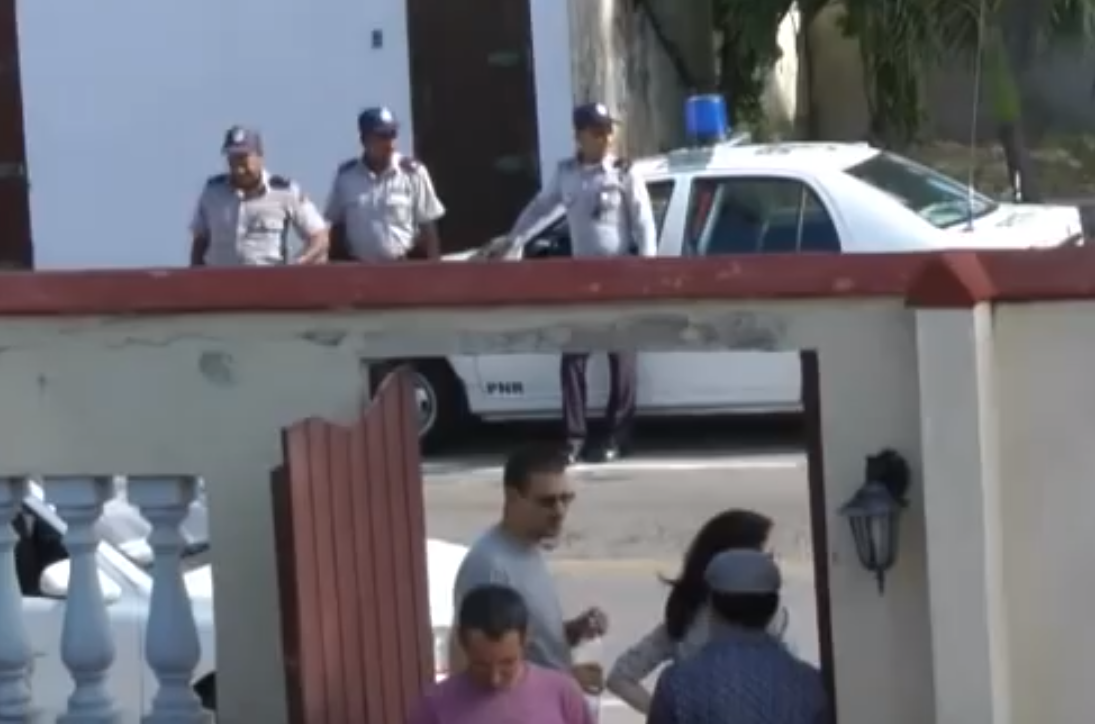
Last December 24, as a reverse Christmas gift, officials of the National Revolutionary Police (PNR) arrested human rights activists Yordis Garcia Fournier (Youth Movement for Democracy) and Yobel Sevila Martinez (Eastern Democratic Alliance – ADO) in the city of Guantanamo.

They told reporters from Palenque Vision that they there were brutally beaten and harassed in the presence of a high official of the so-called State Security.  I personally know Yordis as well as Yobel, I know of their humility and bravery, of the commitment they have to Cuban freedom.  In the case of Garcia Fournier, he finished a one-year and some months sentence for a supposed “insult” to authorities in 2008.  Sevila Martinez, like several members of the ADO, has an enormous string of arrests and beatings, ordered precisely by those who say “take care of the public order.”

Translated by mlk.

Note: this video is in Spanish:

27 December 2013

On the Bad Death of a Good Man / Orlando Luis Pardo Lazo

PLASTIC TEARS

Orlando Luis Pardo Lazo

In the Boniato jail, in Santiago de Cuba, a physically impaired man, a common prisoner (for me no prisoner is common), Norge Cervantes, blind, said in farewell to Antonio Villarreal, one of the 75 prisoners of the Black Spring with which Fidel Castro reacted to the Varela Project:  ”The tears that run down my cheeks are from the heart, because I have plastic eyes.”

Antonio Villareal was found dead in Miami last Saturday December 28.  Day of the Innocents, may this noble child of sixty-something years who was tortured to the hilt in Cuba rest in peace. Even losing control in stages over his more basic reflexes, like controlling his urination. And his tears. He spoke with many crying inside and out of Cuba by telephone or on camera, but his olive green tormentors never managed to break him. That is why they savaged him.

Of course, nothing like that will happen to us. We are healthy and in control. We triumph, as Miami already triumphed and very soon Havana will triumph. Miami, a city largely shaped from Havana, in order to complete its historic role that after 2014 will rush to it: saving the Castro Revolution, managing a future enterprise for its militarized white collar mafioso. Putinism unaided. continue reading

There is nothing that the Cuban government does that is not marked by death (hence its true power in perpetuity). The liberation of the 75, for example, already drags with it with several deaths, including that of Laura Pollan, who would still be with us if those “liberations” had not occurred, because she alone knew how to defend herself much better from the assassin plot that took her life from behind and cremated her in order to leave no evidence.

Cardinal Jaime Ortega is architect of all these forced deportations and complicit in the string of crimes to which he in person is giving the consummatum est.  The Castros just supply the labor.

It is speculated that it was a suicide and soon the press will pardon him because Antonio Villareal had “mental problems” or “was sick in his nerves.”  Killing oneself is not a symptom of mental illness, but of spiritual strength: It is a blow to the arrogance of God or the senselessness of Nothingness. If he killed himself, it is because Miami deserved it. But, in any case, there exists not the least evidence that it was a suicide. Menaced or sick, what is a fact is that we Cubans had abandoned him, even from Havana.

We Cubans are all like that blind prisoner, but in reverse. Our tears are plastic, like the eyes with which we look without seeing.

Translated by mlk.
Note: The following video is in Spanish.

30 December 2013

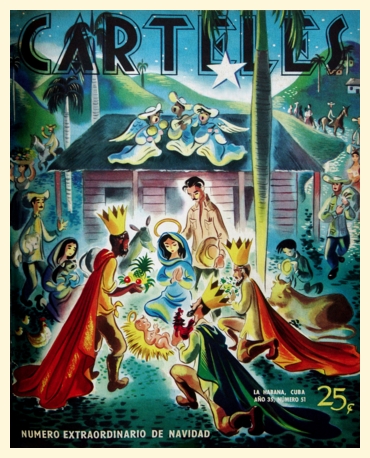
Christmas in Cuba has no Carols, but Villains in Power

The majority of the Cuban community will celebrate Christmas and the advent of the new year, unaware that a political prisoner, David Piloto Barcelo, is serving his punishment in the worst conditions, for defending his unobjectionable right to choose a president, to openly criticize government conduct, to protest, to demonstrate, to join the party that better fits him, etc.

Possibly also, the majority of Cubans will die without testing the state of rebellion and liberty that being an activist in opposition to the dictatorship offers.  Piloto Barcelo practices it daily, his screams against the henchmen that mistreat us day after day in the prisons, could be heard in Prison 1580.

From my barracks, some thirty meters away from his, with several walls and roofs in between, his voice arrives full of truths against the executioners in each arbritray action or appearance.  His protest is constant, all in spite of his precarious health. He contracted tuberculosis in their cells, and not even that condition has impaired his upright posture as permanent opponent. His crime: demonstrating on “Revolution Plaza” and throwing leaflets demanding the freedoms of which they deprive us. continue reading

Some days ago Piloto Barcelo was transferred to Cinco y Medio Prison in Pinar del Rio. That is another punishment that he will have endure far from his family. What is left, because after the State Security threatened his mother, she suffered a heart attack, and it killed her. Now his sister will have to travel to that distant place in order to provide him with what is necessary to survive, because otherwise we die.

And it is not that being happy or eating turkey on Christmas is a crime; may those happy ones who manage it multiply until all Cubans can do it in their own land; but do not forget that someone suffers for you at this moment, and that he is also summoned, from wide ranging possibilities, to fight and give tribute to these human beings that have preferred the sacrifice before the pleasure.  And that self denial is for the good of all, because when Cuba is free, we will enjoy it equally.

Not forgetting Piloto Barcelo, Sonia Garro, Ramon Munoz, Armando Sosa Fortuny, Marcelino Abreu Bonora, Ernesto Borges Perez, Madelaine Lazara Caraballo Betancourt, Makiel Delgado Aramburo, Ivan Fernadez Depestre, Angel Frometa Lobaina, Allan Gross, Bismark Mustelier Galan, Ángel Yunier Remón Arzuaga, to mention only a few of those among hundreds of prisoners confined plus those who are on parole and make the humiliating list of  political prisoners of the Regime recently “distinguished” for safeguarding Human Rights on the UN Council.

Even so, to everyone Merry Christmas and Happy New Year!

Angel Santiesteban-Prats

Lawton prison settlement.  December 2013.

Translated by mlk.

30 December 2013

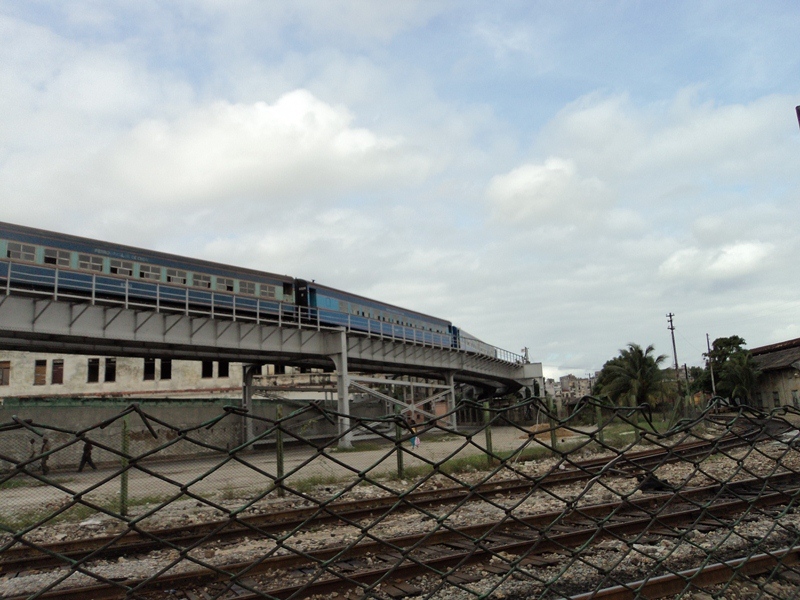
Life and Death of Cuban Railways / Ernesto Garcia Diaz

They wait for days in La Coubre Station for a ticket

Havana, Cuba, December 27, www.cubanet.org – In Havana’s Central Railway Station, they were fumigating — against the Egyptian aedes mosquito — with passengers inside (children, pregnant women, old people), violating all health standards.  And don’t mention freshening up.  They charge a dollar to use the bathrooms.  And even paying, the bathrooms do not have soap or toilet paper.

The self-employed cleaner told us:  “Some time ago the bathrooms lacked water, they were disgusting, they put a bucket for discharge, we washed them without faucets, the broken toilet bowls, the blocked urinals, we rehabbed the service, but we did have to watch that, because they stole even the brooms from us.”

The disaster of the railways

Almost 20 percent of Cuban trains do not leave or arrive on time. Train departures have been reduced. We asked, “How many trains run from Havana to Santiago de Cuba?” continue reading

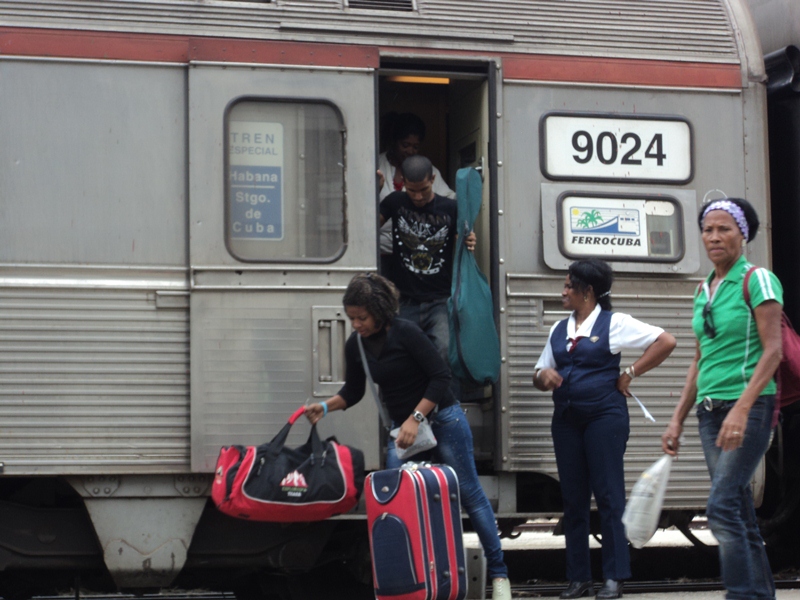
“There are two trains, one regular and the other special, every three days,” the girl at the counter told us. “Today an extra leaves for Santiago De Cuba at 11 at night. The special from Santiago runs in December on the 24th, 27th and 30th at 6:27 in the afternoon, and the regular leaves on the 25th, 28th, 31st at 4:00 pm.”

The tickets to Santiago de Cuba have to be reserved in La Coubre Station, some 700 meters from the Central Station.  But those going to provincial town be careful! The regular train stops in some municipal stations, but the special to Santiago is express, it only stops in the provincial capitals.

And as the trip from Havana to Santiago lasts 15 hours, prepare to be hungry! They sell a few preserves in the cars, they run out fast. Vendors of bread rolls climb on at the stops with whatever. The railways do not offer drinking water, either. Bring your water. And if you can, bring a bottle for urinating, because the bathroom of the car may be overwhelmed, or worse, closed.

The same information employee, laughing, told us: “I prefer to urinate in a bottle.”

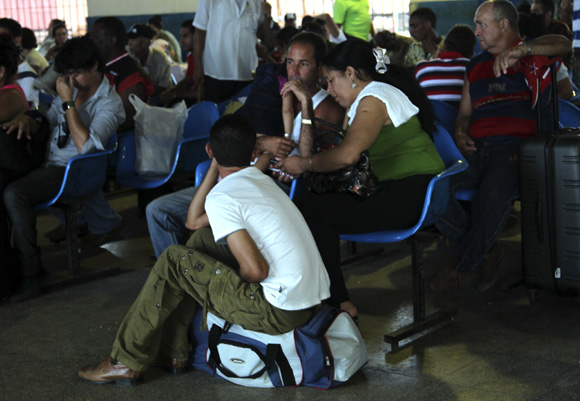
In La Coubre Station, under a fiber cement roof, a sign announced:  “There are no reservations until January 4.”  If you decide to travel, you have to go to the waiting list and sign up.  With luck they will sell you a passage in five days. For those who spend days sprawled on the floor, grumpy, the worst still awaits, boarding a dirty, stinky car, and suffering a tortuous trip.

One on the waiting list commented: “I’m going to Guantanamo, I have been here three days, I have number 500 in the second round, I’m not going today either.” Passenger number 2 added: “I am signed up for Guantanamo, but I am going to Santiago de Cuba. There is no other.”  Another told me, “I’m going to Guantanamo, I spent four days on the list, to be able to go today, I almost had to live and sleep here, but it’s the only way of hoping to spend New Years with my family.  And I almost have no money to arrive with; here, in the terminal, the food is very expensive, to eat I’ve used what little I had.”

In 2012, the railway transported 9.9 million passengers.  More than a million fewer than in 2005.

Special Havana-Santiago train.

Cuba was the second country in America to have a railway. On November 19, 1837, the first section from Havana to Bejucal was inaugurated. In 1859, the capital counted on streetcar service.  A decade later, the railway reached Calabazar, Santiago de las Vegas, Marianao, Cardenas, Jovellanos.

In the first decades of the 20th century, the island would complete the line from downtown Havana to Santiago de Cuba, with secondary branch lines to Pinar del Rio, and even la Bahia de Guantanamo. And it had an electrified network, the little Hershey train, which linked the Cuban capital with the city of Matanzas.

Elevated at the entrance to Havana.

In 1959, the trains were the soul of sugar production, they gave life to towns and cities. They went to almost all corners of Cuba.

In 1961, the revolutionary government nationalized the railways. In a few years, the Cuban rail network which extended over 12,060 kilometers was reduced to 8,367 km.

In Cuba, the official press does not report — except in cases of death — railway accidents.  The Castro administration turned the shining gem of Cuban railways into a true disaster.

Ernesto García Díaz

December 26 2013 / Cubanet

Translated by mlk

28 December 2013

The Sats Refugees / Camilo Ernesto Olivera

Havana, Cuba, December, www.cubanet.org — It was after 10 am Saturday, December 7.  The patrol car of the PNR (National Revolutionary Police) braked at my side, a few meters from where I live.  The uniformed officers got out of the car, and one of them asked me for my identity card.  With no further explanation, they pushed me against the patrol car, searched me, and put me in handcuffs.  Then they put me in the vehicle.

For almost an hour, we rolled through various zone of Mariano and La Lisa.  In an area near 100 Street and 51st, a Suzuki motorcycle approached.  The driver, dressed in civilian clothes, face hidden in the helmet, told the uniformed officers:

“Take hiim to Melena del Sur.”

After 5 pm I managed to return home.  It was growing dark when Antonio Rodiles called me by phone, and I told him what had happened.  A little later I was entering his house with a backpack loaded with necessities for surviving as a refugee there in the following days.  Like me, other members of the work team of Estado de Sats were coming together in the next hours. continue reading

When I arrived, Walfrido Lopez was polishing the details of the conference about means of communication and human rights.  The First International Meeting about Human Rights and Accords of the UN was due to open on the 10th.  Kissi Macias, wife of Luis Eligio, from OMNI, was there too, editing videos sent by various personalities.  At dawn on Sunday, Boris Larramendi arrived directly from Club Fabio, together with Ailer and Antonio who presented their concert there on Saturday night.

By that time, the news about detentions of activists and members of independent civil society was shaking the whole country.  On Sunday the 8th, Dixan, Sats collaborator, could not leave his house, and if he did, he would be sent to Vivac, detention center for political cases located in Calbazar.  Antonio and Ailer went to look for him, and a traffic patrol car, obeying orders from a motorcycle rider, intercepted them and then tried to capture them at the door to Rodiles’ house.  The police officers confiscated the car’s authorization document, and warned Antonio not to go out driving the car again.  Fortunately, now Lia Villares and her husband Luis Trapaga were sheltered together with us.  By that time, the wall of DSE (State Security) troops and uniformed police officers from the PNR (People’s Revolutionary Police) intensified.  By pure miracle, and with the darkness of night in his favor, David from OMNI passed through it and arrived at the house.  Also, Claudio Fuentes, Regina Coyula and the journalist from Hablemos Press Pablo Marchan jumped the fence.

On Monday we were 19 refugees.  The next days were of entrenchment, deep fellowship, and survival.  Also of much tension and stress, especially in the hours that followed the detention of Antonio, Walfrido, Calixto Ramon and Kissi on the 11th.  State Security surrounded the house, even on the ocean side.  The providential downpour that closed the area during the first hours of that night prevented greater evils. They were obliged to dismantle the repudiation platform that had been retrofitted with a powerful audio system.  The participation of two popular dance music groups was expected:  Arnaldo and his Talisman and Elito Reve and his Charangon.

Several stalls for the sale of rum and beer had been set up.  Evidently, the intention of the DSE was to ply with alcohol the “mass” of concert attendees and then use them in order to hide their civil troops among them, and to attack Rodiles’ house.  The suitable cloak  of night helped them to justify the witches’ sabbath. While it was raining, Boris Larramendi gave a concert of “pure blood,” and David of OMNI offered his own to welcome the return of the detainees at the stroke of 7 pm.

The silence that the ruling champions of the “Cyberwar” have kept during these days is a clear symptom of the demoralization in which their bosses of the DSE (State Security) find themselves.  A small group of refugees in Sats curbed the bullying of a corrupt and decadent regime.

December 23, 2013 / Cubanet

Translated by mlk

Christmas Divided / Tania Diaz Castro

Havana, Cuba, December 24, www.cubanet.org — As a good predictor of the future, this man forecast that Christmas would not be necessary in a socialist country.  He knew since then that there would be no victuals and much less family for the days of celebration.

It is noteworthy that in the Population and Household Census carried out in September 2012, from which definitive results were recently offered, the National Office of Statistics and Information has not included in its questions how many of us Cubans are distant from our families.

Without any doubt any of the 11,167,325 inhabitants of the Caribbean archipelago suffers that pain.  So it is difficult in more than three million Cuban homes in the country, to be able to evoke these Christmas days happily, if those we love are not present since we opened our eyes to the world. continue reading

Even the dictators themselves Raul and Fidel, generals and colonels, representatives of all the new social class — human beings after all — are not exempt from that suffering.

Sonia and Pedro Yanez, my neighbors from across the street, are those who suffer more.  Two years ago their oldest son went in a boat and what remains for them is the same idea of leaving.

Much more these mothers from Santa Fe, who lost their sons in a sea infested with sharks.

Even I myself, with my only three sons scattered across the world, because they cannot live in Fidel’s Cuba.

Those of us older than 70 suffer most from the collapse of the Cuban Christmas. We remember the Christmas Eve dinner, always with family, the marvelous dawning of the Day of Kings, where we discovered in a corner of the room the toys that the invisible mythological kings left us with so much affection, the year’s end, when grandmother threw into the street a pail of old water so that good luck might enter the house.

They were times when we could dream, in which hope had still not been lost, which hope disappeared when the Commander arrived and ordered it to stop, hope that has revived again in spite of repression and draconian laws.

That’s why, this December 24, I am going to toast my sons, my father who walked alone through the streets of Miami before dying, my mother, who did not want to tell me that communist tyranny had killed Christmas so that the divine fantasy might disappear from the mind of civilized Man, my dissident friends, whom I remember with love, my last sweetheart, polititical prisoner for more than 20 years who some day will return.

23 December 2013/Cubanet

Translated by mlk

Currency Unification: Causes and Limits / Dimas Castellano

The road to exit the crisis is clear; what is lacking is the political will to travel it. Among the partial reforms the government of Raul Castro announced was the enforcement of a timeframe for measures to eliminate the dual currency, implemented following the loss of Soviet subsidies.  A look back at the topic helps to identify some of the causes and limitations of the announced timeframe.

In the period between the two great wars of independence that took place in the second half of the Cuban 19th century, the Island became the first country to exceed a million tons of sugar, of which more than 90% was exported to the United States.  That permitted the neighboring country to impose on Spain the reciprocal trade agreement known as the McKinley Bill, through which was established the free entry of Cuban sugar into that nation.

At the same time there was a high concentration of land ownership, especially in American companies.  In that condition of economic dependence, at the end of Spanish domination, the occupation government introduced the dollar as the basic monetary standard, which was imposed until the disappearance of the other currencies (French, Spanish, Mexican), which explains the presence of the dollar in the first years of the Republic born in 1902. continue reading

In that context, with the nationalist purpose of diminishing the dependence with respect to the American dollar, the government of General Mario Garcia Menocal dictated in 1914 the Law of Economic Defense, which gave birth to the national currency. That law established a gold standard as the monetary unit with the same weight and purity as the dollar. So, from a nationalist decision emerged the first version of dual currency in Cuba, which lasted until the ’50’s of the last century.

In a different way, in 1991, the disappearance of the Soviet Union provoked the loss of the enormous subsidies based on ideological relations, which overlapped decades of inefficiency of the Cuban model.  That fact, united with the depression in sugar prices, drove the country to a profound structural crisis baptized with the euphemism Special Period in Times of Peace. In answer to the crisis, the Cuban government, instead of undertaking a profound reform aimed at achieving a proper and efficient economy, defined a strategy aimed at saving the model and maintaining power. With that goal it introduced several contingency measures.

In 1993 the Basic Units of Cooperative Production were created, by which a beneficial interest in idle state land was given to workers; farmers markets and self employment were authorized; tourism and foreign investment were introduced; family remittances from abroad were admitted; possession of the dollar was decriminalized, and, in 1994, its free circulation was authorized, giving rise to the current dual currency.

As one might appreciate, the dual currency introduced in 1914 was motivated by reasons diametrically opposed to what happened in 1994. The first created the introduction of a national currency parallel to the dollar, the second legalized the dollar as a parallel to the national currency.

The road and political will

The causes that led to the dollarization in 1994 have their roots in the first revolutionary measures, whose declared goal was the disappearance of all commercial relations and, with them, the disappearance of money.  In 1960, all domestic and foreign banking entities that existed in Cuba were nationalized, in 1961 they were centralized in the hands of the State, while the direction of those activities was placed in the hands of the revolutionaries from the armed struggle.

The same thing happened with figures whose conception of the economy differed from those of the leader of the revolution, as happened with the economist Felipe Pazos Roque, founder and first president of the National Bank of Cuba since its foundation in 1948, who in spite of abandoning that responsibility because of his position against the Coup of 1952 and being named again as head of that institution in 1959 was replaced some months later by commander Ernesto Guevara.

The course of the process was more or less the following: the dollar was introduced in 1994; the convertible peso (CUC), a second national currency as an alternative to the dollar and the same value as the dollar, was created; in 2004 the circulation of the dollar was eliminated; then a tax of 10% was imposed on the dollar, and the CUC was re-valued relative to the dollar by 8%; in March of 2011 the original one-to-one value was resumed but the 10% tax remained. In summary, the duality was maintained thanks to which Cuba is the only country in the world with two national currencies, neither of which is really convertible.

The dollarization and the dual currency, besides magnifying social differentiation, increased the loss of value that the Cuban peso already had, one of whose manifestations was the expressed inflation in prices on the black market, the drop of wages and the discouragement of production.

Cuban currency, a representation of money, lost or reduced its functions as a means of value, an instrument for acquisition of goods, a means of accumulation of wealth, an instrument of liberation from debt and a means of payment. That’s why monetary unification, even if it constitutes an essential step for the current or for any other Government, will not resolve the current structural crisis, due to the fact that Cuban currency is not backed by the Gross National Product, that is to say, by the sum of goods and services that permit it to resume its functions and to be compared with foreign currencies.

The way out is in prioritizing productive efficiency, for which domestic and foreign investment is required, which would provide the country with capital, technology and markets, which in turn demands a new Law of Investments and the elevation of current salaries, which do not manage to cover more than one-third of basic necessities.  But as one can only distribute what is produced, the Government faces a complex contradiction: without increases in salaries, Cubans are not ready to produce, and without production, it is impossible to raise salaries, which will make monetary unification by itself futile.

In short, a comprehensive project that includes the decentralization of the economy, permits the formation of a middle class, removes the obstacles that stop production and restores citizens’ rights and liberties is missing. The road is clear, what is lacking is the political will to travel it.

Translated by mlk.

Taken from: Diario de Cuba
17 December 2013
What do Cubans Hope For in the New Year? / Ivan Garcia

b12951-620x330December is a month of epilogues.  2013 brought new things for Cubans.  After the 14th of January, those born on the island could travel abroad without so much government oversight.

Even the dissidents.  Although with exceptions.  Opponents, hostages of the Black Spring of 2003 who are considered by the olive green-autocracy as being on parole, cannot leave Cuba.

In business new legal concepts have emerged.  Service cooperatives have been created and the State leases premises to individuals.  In the Mariel port there will be a special zone with a different wage and tax system.

In 2013 Hugo Chavez and Nelson Mandela died.  The two had repercussions on the island.  If Mandela is on an altar, the death of the Venezuelan leader brought worries.

And if the national industries work and do not produce extensive blackouts, it is thanks to the agreement that Chavez initialed with Fidel Castro, by which Cuba pays with doctors and advisors for more than 10 thousand barrels of oil a day.

And although Chavez does not have even a trace of Mandela’s symbolism and the people on the street are not loyal to that social experiment that the Bolivarian called as 21st Century Socialism, typical human selfishness to not lose benefits make many Cubans, simply to keep the status quo, prefer the unseemly Nicolas Maduro.

Maybe Maduro would get votes in Cuba than in his country.  And when people have lived 12-hour periods without light and someone offers it to them, in spite of Venezuela being mired in chaos and Caracas being a jungle of violence, people are capable of voting for Satan.

In 2013 Cubans continued on their own.  News of the protests in Kiev, the gag law in Spain, the re-election of German Chancellor Angela Merkel, the global electronic espionage by the United States denounced by the analyst Edward Snowden or the apprentice dictator of North Korea executing his uncle, passed almost unnoticed.

Through illegal satellite antennas, SMS or those that pay 4.5 convertible pesos for an hour of internet — finally commercialized in 2013 — people prefer to be up to date on the latest record by their favorite singer, to see Brazilian soap operas, the films that are chosen for the Oscar, to see who will win the Soccer World Cup, to see the games of LeBron James’s Miami Heat or MLB baseball games in which Yasiel Puig or Arnoldis Chapman are playing.

Although for three years Cubans have enjoyed more economic liberties and now can stay in a hotel, buy or sell a house or get a car, in relation to political matters, people prefer to stay on the sidelines.

The ready arrests of dissidents, beatings of the Ladies in White or the acts of repudiation they keep watching from the sidewalk across the street.

The opposition continues being a particular clan.  They say and write things that the majority desire or lack, but the average Cuban sees it from as a great a distance as an Australian tourist.

In the syndicate meetings they get mad about the miserable salaries and ask out loud for a change in the system.  But if you suggest creating an independent syndicate, they look you up and down as if you were a strange insect.

Ask any Cuban what he wants for 2014 and he will tell you a better life for himself and his family.  Earning a decent wage and being able to eat breakfast, lunch and dinner every day.

The workers for their own account want more autonomy, a wholesale market, lower taxes and less State interference.  That 3D cinemas return and cheesy shops re-open.

The dissidents long for the Castro era to end.  For Cuba to enter the ring of democracy.  And that liberties be respected.

They have spent decades demanding it.  But they dedicate very little time to political proselytizing of their neighbors, which is whom they must convince.

Ivan Garcia

Translated by mlk.

20 December 2013