The Triton flew over Cuban territory without problems while the general’s letter was intercepted at the Miami airport and its carrier returned to the Island
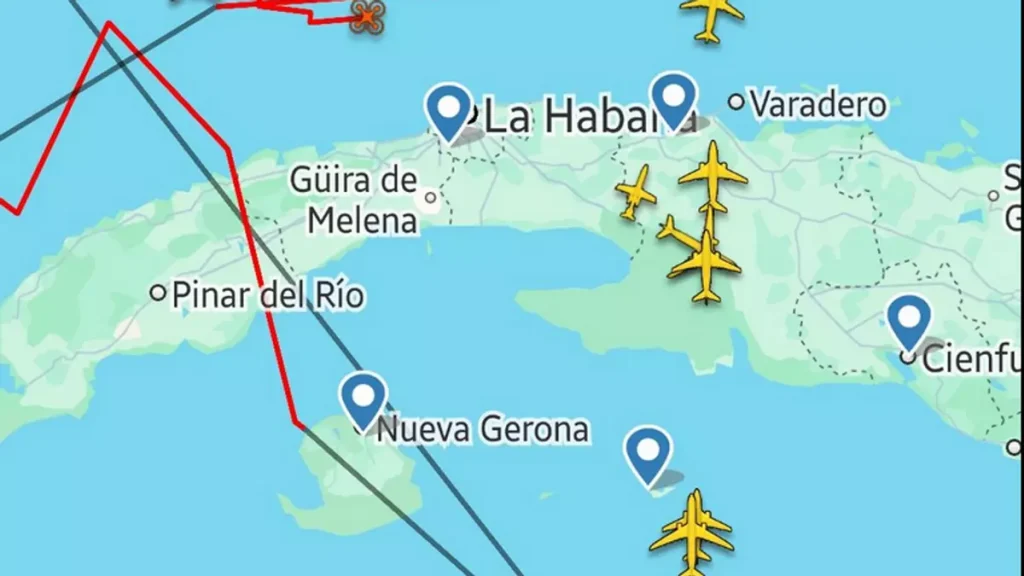
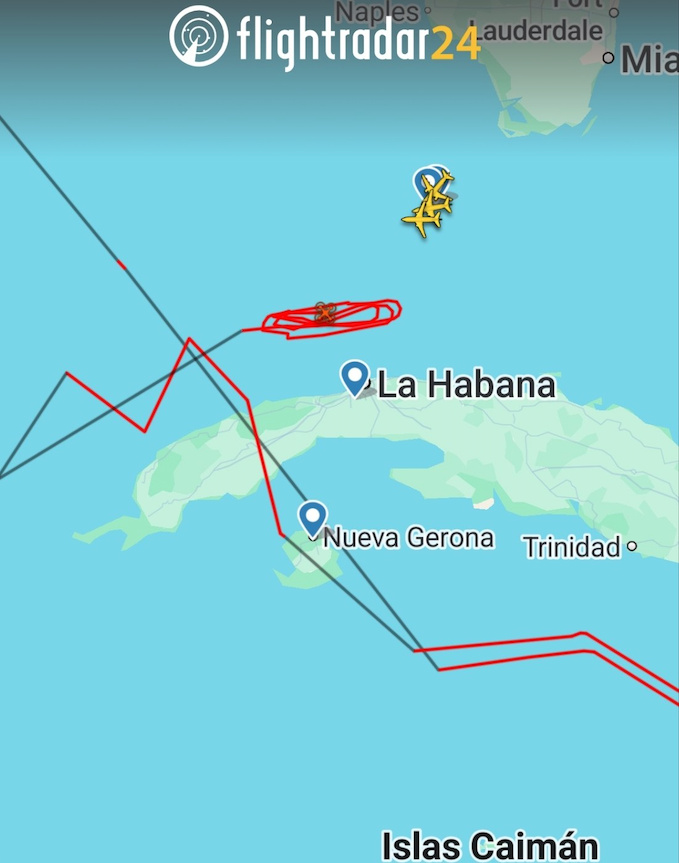
 14ymedio, Madrid, April 17, 2026 – A Northrop Grumman MQ-4C Triton reconnaissance drone from the United States Army carried out a surveillance mission of more than 12 hours along both coasts of Cuba on Thursday night. The aircraft has drawn the attention of numerous intelligence analysis websites, although most identify the flight patterns as “typical of reconnaissance over the Caribbean.”
The drone flew at about 49,000 feet in altitude and crossed Cuban territory, from north to south and back again, at the level of Pinar del Río and the Isle of Youth.
The aircraft is part of the deployment that the United States began in January as part of intelligence and surveillance operations in the Caribbean, which included, along with these drones, military vessels, spy plane flights such as the RC-135 Rivet Joint, and P-8A Poseidon aircraft. In addition, in February a surveillance balloon known as the Tethered Aerostat Radar System (TARS) was added, located in the Florida Keys, about 145 kilometers from Havana and at an altitude of 2,500 meters.
The drone flew at about 49,000 feet in altitude and crossed Cuban territory, from north to south and back again, at the level of Pinar del Río and the Isle of Youth
At that time, expectations were already very high, at a moment of extreme tension between the United States and Cuba and just days after the capture in Caracas of Nicolás Maduro, which was preceded, precisely, by a deployment with a MQ-4C Triton. These aircraft usually accompany P-8A Poseidon planes and, since the end of 2025, have carried out constant surveillance operations from Puerto Rico or Florida toward the coasts of Venezuela.
The situation repeated itself yesterday, precisely one day after reports emerged claiming that the Pentagon has intensified plans for a possible intervention in Cuba and just hours after Miguel Díaz-Canel said that U.S. “military aggression” is a real possibility.
“We do not want it, but it is our duty to prepare to avoid it and, if it were unavoidable, to win it,” said the Cuban leader in his speech this Thursday marking the anniversary of the proclamation of the socialist character of the Revolution, in which he maintained that the regime’s priority is “dialogue.”
After the month of March, during which the idea took hold that talks between Washington and Havana were moving in the right direction, in recent weeks the signals have gone in the opposite direction. This Thursday The Wall Street Journal (WSJ) independently verified information first reported two days earlier by Martí Noticias, according to which a Cuban businessman in the luxury car rental sector and closely linked to the regime attempted to deliver a letter to the U.S. president at the request of Raúl Rodríguez Castro, El Cangrejo [The Crab], grandson of former president Raúl Castro.
According to the reports, Roberto Carlos Chamizo González arrived in Miami with a letter from Raúl Castro’s grandson in an attempt to bypass official channels and avoid the State Department. The letter, whose contents have not been seen by the media, reportedly in a format similar to a diplomatic one and with a seal, proposed economic and investment agreements, as well as the lifting of sanctions, and warned that the regime was preparing to repel a U.S. military invasion.
The WSJ could not determine why the messenger was detained, but it did confirm that a Customs agent confiscated the letter and sent him back to the Island. It has also not been able to determine whether the letter reached the White House, which declined to comment on the matter.
“The Cubans appear to be trying to bypass Rubio and send a clear message directly to Trump”
“The Cubans appear to be trying to bypass Rubio and send a clear message directly to Trump,” Peter Kornbluh, co-author of Back Channel to Cuba: The Hidden History of Negotiations between Washington and Havana, told the U.S. outlet. “This attempt suggests that they no longer trust Rubio to be an impartial interlocutor and want to appeal directly to the president to resolve the growing crisis.”
Ricardo Herrero, executive director of the Cuba Study Group, stated that “trying to bypass Rubio while he is secretary of state is foolish and doomed to fail. It is even worse to resort to an unknown person with no personal relationship with the president, which makes it seem even more absurd.”
Meanwhile, at a meeting of the Western Hemisphere subcommittee of the U.S. Congress, Michael Kozak, a senior State Department official, avoided revealing whether Washington is maintaining ongoing negotiations with Havana. Asked by Florida lawmakers on the matter, the official limited himself to responding: “If you want to get anywhere with talks of this kind, they are not conducted in public.”
Translated by Regina Anavy
______________________
COLLABORATE WITH OUR WORK: The 14ymedio team is committed to practicing serious journalism that reflects Cuba’s reality in all its depth. Thank you for joining us on this long journey. We invite you to continue supporting us by becoming a member of 14ymedio now. Together we can continue transforming journalism in Cuba.