Barriers Because of Indolence / Rosa Maria Rodriguez

Several years ago we often heard talk in the Cuban media about architectural barriers. Eliminating them is a goal injected some years ago in our national actions and lexicon by the teams of town criers from the government, who have tuned their radar pay attention to campaigns undertaken by international agencies like the UN, FAO, UNESCO, WHO, PHO, etc., in order to blow their own horn without muting their propaganda and showing those entities and the world the achievements of the 50-year revolution.

Since childhood I have heard reference to the immodesty of people who praise themselves, using the phrase: “they doh’t have a grandma.”  Such lack of humility corresponds in many respects with the boastful conduct of the Cuban government.

The eradication of architectural obstacles is a consideration that many countries have incorporated into their urban aesthetic and laws, and they quietly implement them out of respect for the mothers who travel the streets with their baby strollers, the physically disabled who cross in wheelchairs and the rights and quality of life of others in general.

Here they made of that project a cloying campaign with which they saturated — among other always present historical-political themes — our communications media and showed it on television with such enthusiasm that it seemed a native initiative. The lack of information is a blindfold that limits the capacity of Cubans to freely think and discern.

The aspiration, in Cuba, of fixing in pitfalls of the streets and sidewalks in our neighborhoods is great, but it advances little and badly.  Of course there are exceptions, but generally the ramps that they put on the corners to climb to the sidewalks constitute an obstruction themselves because of how misshapen and badly made they are.

And don’t mention the number of broken sidewalks that we have seen in different parts of our city for decades!  They symbolize the architectural barriers because of indolence that belie and disprove the good will of the leaders of this subject.

It seems that the authorities quickly grabbed this international baton  to direct the orchestra of bungling and mediocrity, but they noticed later that the project required the investment of great quantities of cement, an important exportable item for the state for years.

In short, that campaign initiated years ago in our country, like so many other matters, became more tall story than movie.  It is regrettable that they have converted all of Cuba into a country of obstacles.  That’s why we don’t stop advocating for the project of eliminating physical, moral and legal obstacles that impede the travel of Cubans through our streets, but also of all those that cloud our senses, blind our comprehension of the world and prevent us from inserting ourselves, in full use of our sovereign faculties, in the concert of the world’s democratic countries.

Translated by mlk.

5 December 2013

The Electrical Re-Involution / Rebeca Monzo

In 2005, the then president and prime minister of our planet appeared before TV cameras in order to explain to the population the benefits of the hitherto despised home appliances, which from that moment would be distributed in all the country by household through the infamous Ration Booklet.

Refrigerators, air conditioners, “Queen” pots, rice cookers, personal water heaters, energy saving light bulbs, electric burners, in sum, a series of home appliances manufactured and imported from the People’s Republic of China.

I remember that, when in the 1970’s I moved to Nuevo Vedado, I had an electric stove with three burners and an oven, acquired in Paris in my diplomatic years, and each time I went to buy products with the Ration Booklet in the market that I was assigned to, they talked to me about consuming too much electricity.

Three decades later, the same people who reprimanded me came to offer to exchange my old but magnificent 1949 Admiral refrigerator for a Chinese one, which according to them would consume less. Of course I refused, because you had to give up the perfectly functional one you possessed, without getting a cent of its value, as if it were scrap, and pay an exaggerated price for the new one.

Fortunately, I maintained said negative response on repeated occasions, until they got tired and insisted no more. All those people who fell in the trap of the new appliances are regretful, because they broke after a while and there are no parts with which to fix them, but they still have to continue paying for them.

The same thing has happened with all the low quality Chinese equipment: mountains of aluminum and twisted cables fill the shelves and warehouses of the famous consolidated workshops without them being able to be repaired for lack of replacement parts.

It is shameful that some commission from the National Assembly has to spend so much time and saliva talking about “Queen” pots and broken appliances, in a country where there are so many urgent problems, like the bad state of schools and hospitals, the almost non-existent sugar production, the lack of basic necessities in the stores, problems with milk production, potatoes, in sum, with everything that is vital for the population. Gentlemen, certainly it shames the National Assembly that you have to air issues as ridiculous as the broken electric pots, already obsolete.

I believe that the decision I made three decades ago, not to be dazzled by the “electric re-involution” and not to go into debt buying those Chinese products, was most wise. My old Admiral refrigerator, decorated by me, continues cooling like a charm, and I do not owe a cent to the State.

Translated by mlk.

20 December 2013
Cuba: Diplomacy and Repression / Ivan Garcia

cuba-damas-644x362-620x330While General Raul Castro, a president handpicked by his brother Fidel, squeezed the hand of the United States’ leader Barack Obama at the State funeral of Nelson Mandela in Johannesburg, the special services and combined forces of the police mounted a strong operation around the home of dissident Antonio Rodiles, director of the Estado de Sats, a project where diverse political and civic strands that coexist in the illegal world of Cuban opposition come together.

Also on December 10, while the headlines of the dailies of the world media highlighted on their front pages the leaders’ unprecedented handshake, the hard guys of the State Security were repressing activists in the eastern region of Cuba and detaining some twenty Ladies in White in Havana and dozens of opponents in the rest of the country.

All this happens under the indifferent gaze of ordinary Cubans, whose central objective is to try to get two plates of food to the table each day. Neither for the corner grocer, the individual taxi driver or people waiting for the bus at a busy stop was the greeting newsworthy.

The regime knows that an elevated percentage of the population remains in the bleachers, observing the national political panorama. What is of the people is to subsist, emigrate or see the way to set up a small shop that permits one to earn some pesos.

Meanwhile, the olive green autocrats clamor to negotiate. But with the United States. It does not matter to them, for now, to sit down to dialogue with an opposition that has unquestionable merit: the value of publicly dissenting within a totalitarian regime.

It has paid its price. Years in jail, exile, and repression. But neither the right which it should enjoy — of being considered a political force — nor the acts of repudiation and beatings, have cemented a state of favorable opinion within a majority of citizens disgusted with the lousy governmental management by the Castros for 55 years.

Here is the key.  By being focused on the exterior, the dissidence does not count on popular support, on men and women who before the regime’s gross injustices throw themselves into the street to protest.  That weakness is what permits the authorities to not take it into account.

I do not believe one owes a handshake to a ruler who represses those who think differently.  This December 10 the Universal Declaration of Human Rights, of which Cuba is a signatory, turns 65.

No high flying political strategy has paid off after a series of steps that democratic countries have taken trying to push Cuba.

Neither the Ibero-American Summits or leading CELAC pro tempore have impeded the Havana Government in continuing to repress the dissidents with laws and physical violence.

Fidel and Raul Castro have dismissively mocked everyone and everything.  They initialed the Economic, Cultural, Political and Civil Rights Pacts in February 2008, and later did not ratify them.

Cuba is the only country in the western hemisphere where the opposition is considered illegal.  And the only nation that does not hold free elections to elect its presidents.

Cuba is not a democracy.  Obama well knows it.

If behind that handshake, the second in a half century by a president of the United States (the first was that of Bill Clinton with Fidel Castro at the Millennial Summit in New York, September 6, 2000), there exists a discrete message about future negotiations to repeal the embargo or improve relations between the countries, ordinary people and a sector of the dissidence would not see it as a bad thing.

Maybe the greeting does not come to be something more than ceremonial and isolated.  Or maybe a change of policy by the White House.  The gringos have always been very pragmatic.

In a serious negotiation, both sides must give.  The bad news is that the regime feigns change, but continues repressing the opposition.  Diplomacy on one hand, clubs on the other.

Ivan Garcia

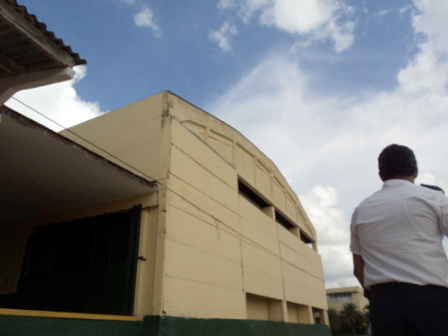
Photo:  One of the Ladies in White detained Tuesday, December 10, during a peaceful demonstration for the Day of Human Rights on the downtown corner of 23 and L, Vedado, Havana.  Taken by ABC.

Translated by mlk.

17 December 2013
Living in a Shelter: The Tragedy of Thousands of Cubans / Lilianne Ruiz

HAVANA, Cuba, December 2013, www.cubanet.org – The poverty in which most Cubans live — and to which they adapt, thanks to the meticulous mechanisms of power that 54 years of State terror have imposed — is not an insurmountable fate.  It would be enough for the Cuban government to respect all human rights, opening the political and economic game, in order to improve the living conditions of the island’s inhabitants.

Misery is aggravated when one has neither a place to live nor economic resources to rent, build or buy a house.  It is estimated that, in the Central Havana municipality alone, 6,201 families (24,584 people) are affected by the uninhabitable condition of their dwellings.  Of that number, only 125 families are located in the so-called transit communities: collective shelters, as they are known in Cuba.

But those figures do not shed light on what it means for a family to live sheltered. One must cross the threshold of figures in order to see up close the true face of the tragedy.

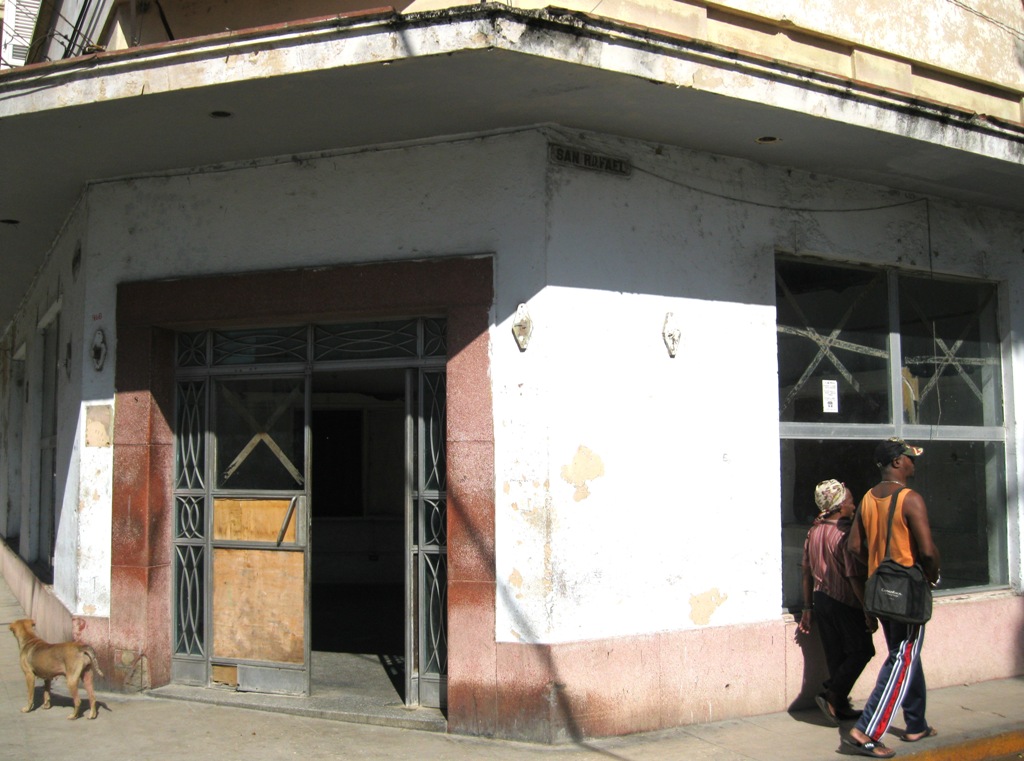
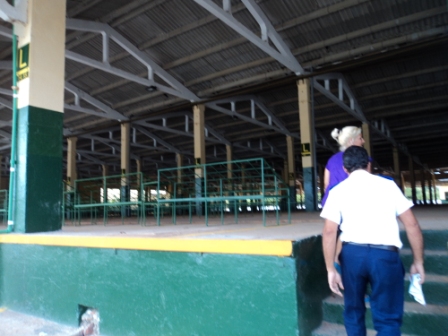
The “Collective Shelter” of San Rafael 417 in Central Havana

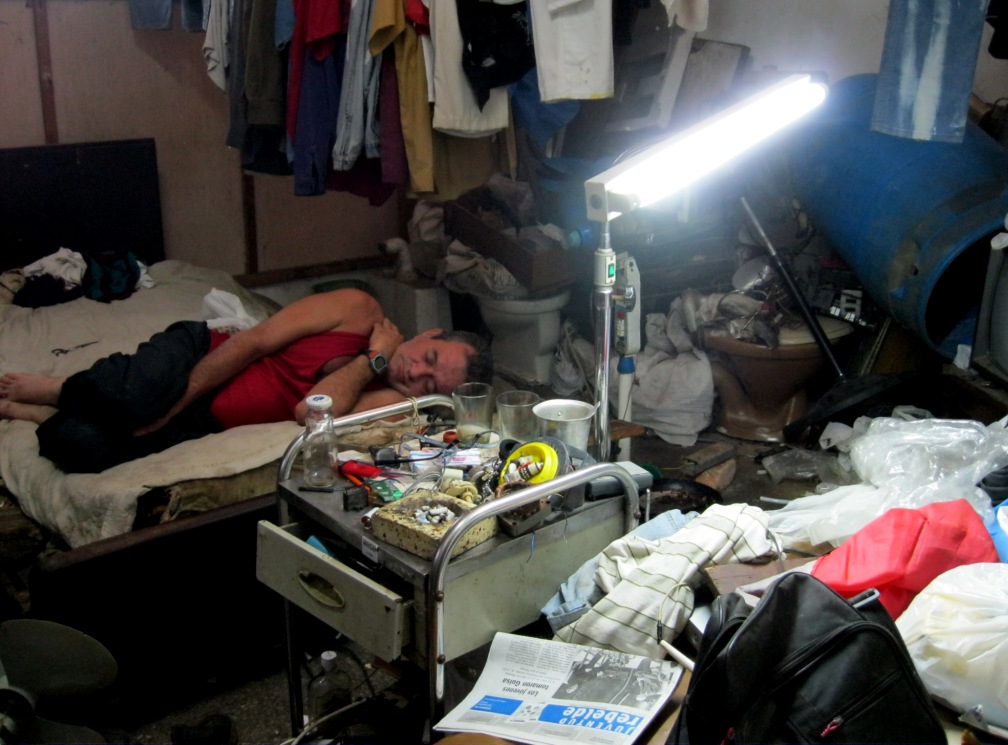
According to those who live there, the building previously housed a factory for sanitary napkins (intimates in the Cuban language).  Decrepit posters with some communist slogans are not missing. The hall is divided into different rooms where the belongings of those who have come to stop in this site are grouped. What seems to be the bathroom is in fact a latrine. Nor is there seen anywhere a sink with running water.

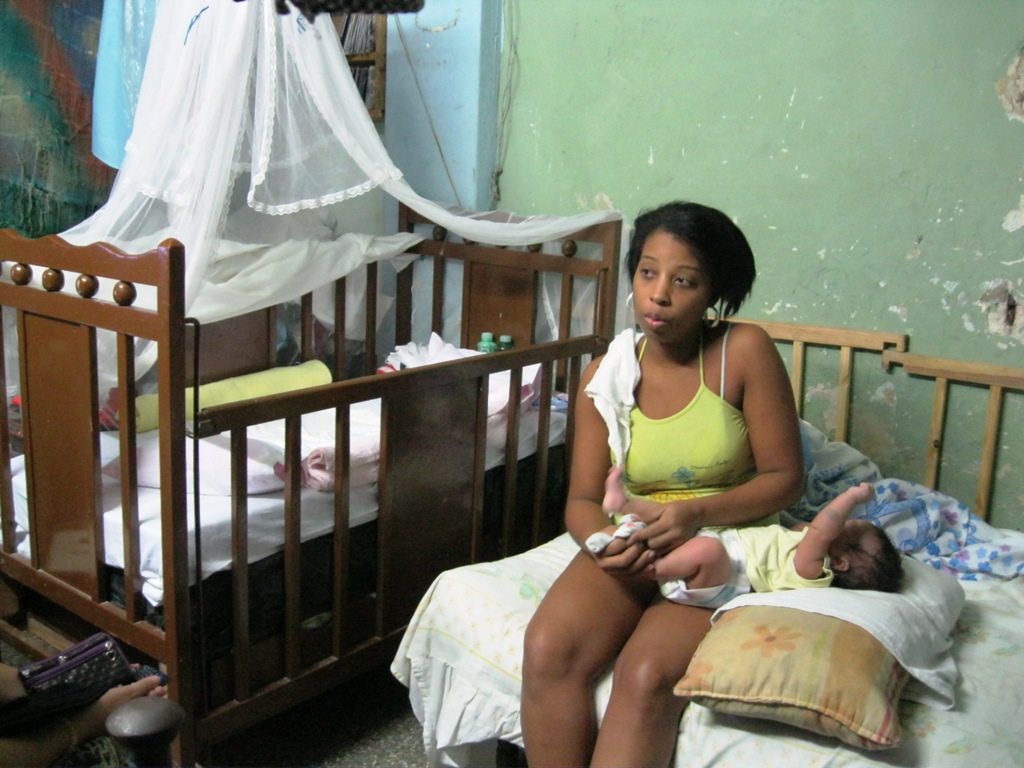
Iverlysse Junco is 29 years old. The door of the little room of wooden planks where she lives with her husband and four children creates a false illusion of privacy. Everything looks poor and ugly, but it is impressive to see the white of the diapers that cover the cradle of her baby born a month ago. She has not neglected her personal appearance in spite of the fact that she is not expecting anyone; she keeps her dignity in the cleanliness and order that she maintains in the 4 x 4 meters where they live.

Six years ago they left a tenement in danger of collapse. The room has not a single window. The first thing that she shows us behind a curtain is another sliding wooden plank that gives onto the street.

“When we came it was completely closed, but one day I could not endure any longer the lack of air and I grabbed a saw in order to make that opening,” she says.  “The bad thing is that now my husband and I cannot leave together, because one of us two has to stay in order to make sure no one enters and takes our things. They came to assess a fine against me, for nothing less than for altering the facade.  But I told the district delegate that they are very familiar with my situation.”

On an improvised kitchen counter is a pair of electric burners where she does everything: from cooking to boiling the diapers, as is customary among Cuban mothers who have no way to pay for the luxury of disposable diapers, which involves a greater cost than a month’s salary.

The baby is cold as a consequence of the humidity: she has to hang out clothes there inside. The water she asks of a neighbor on the block. He lets them fill the buckets that they then carry to a little tank in the corner of the room. That limited water has to serve them for washing, mopping, cooking and bathing in the same room. Part of everyone’s routine every day is to keep the deposit full. But with other needs there is no arrangement; they have to urinate and defecate in a bucket dedicated to that purpose and then go out to pour it down the drain in the street.

“Everything is hard here. The most difficult is getting up in the morning and having to be watching the people to be able to go out to dispose of the bucket. I cannot not have the bleach for cleaning and the freshener.”

Her husband works in demolition, which is why she is aware of the quantity of collapses that occurs, especially when it rains.

“When do I leave here? The collapses are going to continue because Havana is falling down.”

Although Iverlysse and her husband work a lot, they see themselves reduced to total dependency on the State. In a collectivist system, which condemns private property and the free market, the hypothetical solution is that, not with one’s own effort, but with collective work, the Junco family will get a house in which to live.

In practice, society has submitted to state control and planning.  The happiness of the Junco family depends then on their file being privileged in the eyes of the official, who next December 20 will have to decide if, among the 900 cases that are presented in the whole of the Havana province — after prioritizing the “cases” that have spent 20 years sheltered, hoping — theirs qualifies as sufficiently affected by an extreme situation.

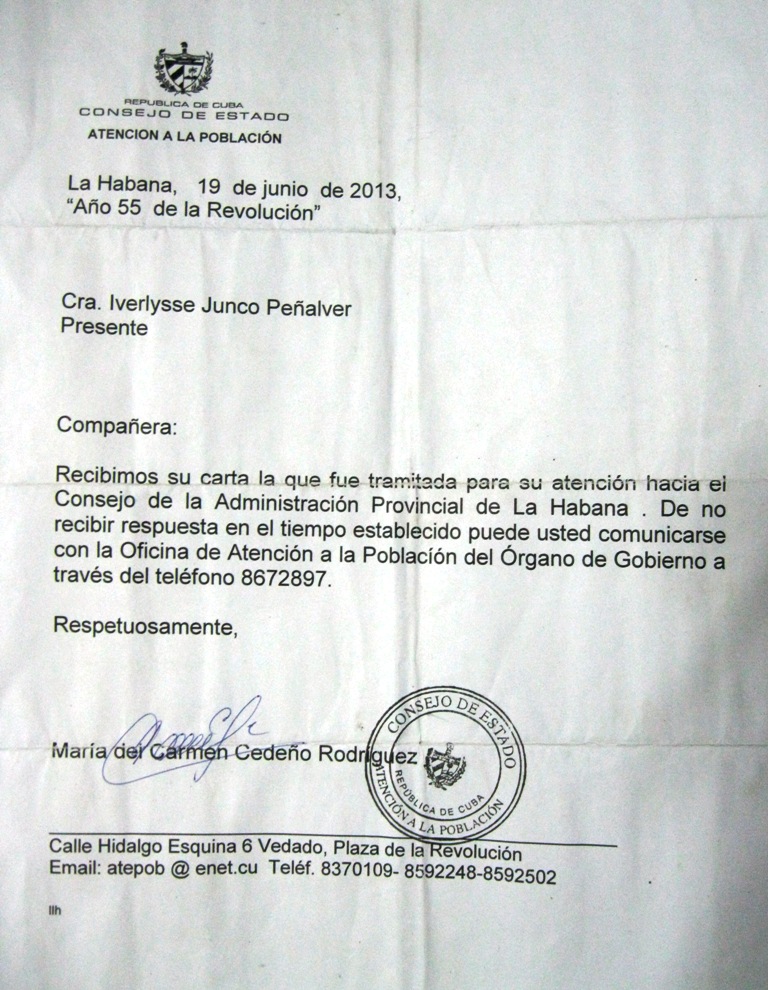
“I have already gone to the Province (Office of Dwellings) and to the government. Three times I went to Revolution Plaza and seven times I wrote letters to the State Counsel.  On all those occasions the answer was:  You have to wait.  There are worse cases than yours. What can be worse than this?” Iverlysse asks herself.

The statistics about the numbers of sheltered people and those waiting to become sheltered, were offered by the Municipal Unit of Attention to the Transit Communities (UMACT) of the Central Havana municipality by a person who requested anonymity. The number of the 900 cases that will be presented next December 20 was provided by a housing worker who also wanted to withhold his name.

December 15, 2013/ By Lilianne Ruiz.

From Cubanet

Translated by mlk.

The Human Rights Party in Cuba / Angel Santiesteban

The great specialty of Cuban journalists is to inflate balloons, darken with dust clouds the reality of what happens in the archipelago, and, in passing, to lick the feet of the dictators.

The most outstanding in this work are those who write for the Granma newspaper, who were chosen for it precisely: manipulable beings who practice a profession that they denigrate, disrespect, and who some day will come to form part of the anthology of the unremarkable.

Oscar Sanchez Serra, in the publication last Friday on the 6th of this month, in the official press of the Communist Party, talking about the Universal Declaration of Human Rights, has once again demonstrated, by the cynicism with which he refers to the Magna Carta — our Constitution — calling it “dreams and illusions,” how disgusting it is to him to mention it.

For the Castro government, it has been a stumbling block for the more than half century that they have exercised its flagrant violation, like all dictators, of course. No economic achievement (there are none), nor social, justifies the least deprivation of Universal Rights, whether they comply with them all or violate them.

The hack believes that hiding in the historic calamities that happened in the world might justify those in our own country, and so, in that spectrum of examples that he mentions, like the Second World War until the more recent ones in Iraq and Libya, and world prostitution among other examples, he entertains the readers and makes them forget those that they violate before our eyes and remain silent about, like the beatings and arrests of the Ladies in White and the abuses against the opposition, in spite of recognizing that “Our little country is not paradise.”The reporter never mentions, I suppose out of respect for ridicule, that Cuba recently became part of the United Nations’ Human Rights Council; he does not even hint at national problems, hiding behind the manipulative machinery that the system exercises in the methods of revealing, in the best style of Nazi propaganda in the time of Hitler, and wears himself out citing what happens in the hemisphere, something like asking why ask for human rights for Cubans if the same thing happens in other parts of the world.  And with cynicism he jokes about the United Nations’ Magna Carta.

Really more than a journalist he lets himself be seen as an agent of State Security in the most humiliating service to the dictatorship.  It was like a prelude to what happens in the days preceding the commemoration of December 10th, International Day of Human Rights.

The arrests of the brave and peaceful Ladies in White once more occur for dozens of days before.  Recently, on her arrival at the airport from Europe, the leader Berta Soler was abused, harassed and abducted to be taken in an official car which left through one of the side doors, and so to avoid her being received by her daughter and her husband Angel Moya (who on parole after being sanctioned in the Black Spring, forming part of those 75 opponents of the totalitarian regime, that remain standing as flags against the regime).

The abuses, outrages and detentions of the Ladies in White, are only the gasoline that fuels their silent protests, while they walk with gladioli in their hands.

How much shame that journalist must feel who endorses the governmental abuses! Because it is not worth mentioning, comparing it with those semi-literate men and women who operate as henchmen, and are the instruments of punishment against the opposition, one supposes that it is not the case, that there exists a difference, at least you would want that; now we speak of supposed journalists, professionals who should love their profession, at least they should above all, and not in exchange for largesse, by miserable others, and accept pandering to a system that grows increasingly impossible to sustain.

Again the Human Rights party in Cuba will be held with the pain of the opponents who expose their bodies to be beaten and confined in punishment cells, and unfortunately, also, to be attacked under the complicit silence of the corroded people, thanks to the terror imposed by the State, of those who live within and outside of the country, almost in their totality, because of institutional fear that assures and occupies itself with punishing all who confront it.

Those within fear losing their work, their children’s education; those outside fear reprisals against family members that they left behind, and then that they would be refused the opportunity to come visit them.

While that silence happens, women and men, legitimate children of this people, weary of famine, face each other in their streets demanding democracy.  The Ladies in White endure the beatings and vexations.

The space Estado de Sats will try to fulfill the program in a plural meeting in Havana in order to discuss the destiny of the future Cuba where all Cubans participate.

The members of the UNPACU will end up confined, some with open cases and sent to prison, others returning home with fractures.

That is the daily reality of the opposition on the island.  Except that, in that same instant that the beatings and arrests occur, others see a film, open a beer, and watch their children eat ice cream, satisfied, they think that now they achieved their rights and now done their duty by Jose Marti!

Angel Santiesteban-Prats

Lawton prison settlement.  December 2013.

Translated by mlk.

10 December 2013

Danger, collapse! / Alberto Mendez Castello

PUERTO PADRE, Cuba, November, www.cubanet.org — The latest collapse in this city, that of the carpenter’s shop El Nivel, and the next that presumably will occur, that of the Plaza Hotel, make the residents of Puerto Padre ask themselves:  How long will this town destroy itself without the government doing anything to stop it?

Of the five hotels that used to be, only two are still in service, Villa Azul and Campana.  Comodoro and Plaza remain closed, falling to pieces, and of Colon there remains only a foundation.

The Sierra, one of the best restaurants that was, remains scrapped, as Hurricane Ike left it in the early morning of September 8, 2008.  And The Vaquerito, a cafeteria that used to offer various dishes at affordable prices to people of low income, also had to close its doors given its calamitous state.

In the same city center, the shoe store has already come tumbling down, and the principal repair of the Hospital Docente Guillermo Dominguez, today in the worst state of sanitary health, fails to materialize.

“As of today we cannot say that we have the resources to undertake these projects,” said the president of the Municipal Assembly of Popular Power, Miguel Jorge, interviewed by local television last week.

Mr. Jorge’s claim is a fallacy: Puerto Padre does generate financial resources capable of achieving its restoration, but they are not going to wind up in the municipal chests but at other lofty bodies of Power.

Nothing serves better than this example: in the same city center where the mentioned collapses have occurred, and where others will occur for lack of undertaking urgent repairs, seven “hard currency collection stores” (TRDs) — as these State stores are called — are operating.  In one of those, for certain the smallest, they have daily sales in excess of three thousand five hundred convertible pesos.

This small TRD alone annually collects more than a million and a quarter convertible pesos, with only the work of three employees.  And the profits of a TRD are well-known: “With what I sell in a day, they can pay me my salary for a year with money left over,” an employee told me on condition that I not reveal his name to the press.

Thousands of Puerto Padre residents live abroad, mainly in the United States, and except for stingy people forgetful of their origins, they all send help to their family members, in many cases old people, who, without the remittances from their relatives, would remain malnourished if not dead if they relied on food rations.

Food, clothes, shoes, domestic appliances and construction materials are sold at prices much higher than the realistic sales figures, producing earnings which, if only a part of them were spent on the municipality, today Puerto Padre would not present, in most places now, this image of a bombed city.

In addition to having the Antonio Guiteras headquarters, the major sugar producer in Cuba, Puerto Padre counts on another privileged “industry”: that of the remittances.

But while their absent children send heavy sums from abroad in convertible currency, a great part of which is going to wind up in the cash registers of the TRDs, the city collapses, without the authorities doing anything to stop it.

Remember this a crime against humanity.  The historical legacy of people is not only destroyed by action, with bombs, but also by omission, on the part of those who have the responsibility of preserving it for new generations, and yet they remain with arms crossed, while the cities collapse.

Notices warning “Danger, collapse!” are not rare in this city.  Hopefully those posters soon will have no place in Puerto Padre, and the Plaza Hotel will not end up in ruins as did our emblematic Hotel Colon.

Hopefully. We children of this town work for that, those of us who remain here, and those who left, and no one, through whatever powers they may possess because of their cannons and tanks of war, is entitled to divert the channel of our sweat to add gold braid to their uniforms.

Translated by mlk

27 November 2013

The Political Police Intensify the State of Siege Against Martha Beatriz Roque

The siege situation against political opposition leader Martha Beatriz Roque Cabello has reached extreme tension.  Today her apartment continues cordoned off by the State Security (political police) and supposed neighbors insult her through a megaphone, calling her “traitor” among other affronts.

In a telephone conversation with this Paper, the pro-Human Rights activist and former prisoner of the so-called Group of 73, exhibited an alarming state of nerves. They do not let her move from there and they do not let anyone pass to visit her. On her door they have placed a photo of Fidel Castro and another with the five Cuban government spies who form part of the Castro campaign.

Neighbors who visited her yesterday at 6 in the afternoon told her that they could not permit counterrevolutionaries to go to her house because that damages the elderly and children.

Martha Beatriz wants to pursue a legal claim on the grounds that what they are doing is unconstitutional.  A lawyer has already interviewed her.

In the midst of her desperation, she has asked that if they do not leave her in peace, they should return her to jail, since, she says, she is a prisoner in her own home.

Today eleven members of the Cuban Community Communicators Network, an independent press agency that she organizes, were arrested.  These reporters were trying to get to her house.  Of the eleven arrested, six were taken to the Guanabacoa township and released. Of the other five nothing is known.

It also transpired that the political opposition leader Arnaldo Ramos Lazurique, recently arrested when he visited Roque Cabello, was freed at the Dragones police station.

What they are doing now to Martha Beatriz brings to mind the sad episodes that occurred in Cuba in 1980, when citizens who were leaving the country forever were persecuted, beaten, stoned, humiliated openly in public and their houses were besieged.

Cubanet, November 27, 2013

Translated by mlk

“With The Misery that We Have in This Countr”: Listening to Citizens Unburdening Themselves / Gladys Linares

“The transition now is taking place in the most important place, that is, in the soul and mind of Cubans, frustrated and disillusioned by so many broken promises.”
Oscar Espinosa Chepe

Havana, Cuba, November, www.cubanet.org — Every day the discontent of the people becomes more evident. It is not unusual for strangers to take advantage of any forced waiting to let off steam about their own problems, and in many cases, shared problems.

So, now it is customary to hear complaints and curses against the government at bus stops, in lines at the bodega, the butcher shop, the bakery, and in line at the medical clinic.

For example, in line at the clinic, one Saturday at midday, the following scene took place.

The almost thirty seats of the waiting room of the 30th of November Polyclinic  were practically full, because there was only one doctor on duty.  The really needy patients stayed, with no other option than to arm themselves with patience, but some left, figuring that they would not get out of there in two hours.

Catalina had no other option than to do like the former because she urgently needed a prescription and already at the Lawton Polyclinic they had “steamrolled” her: that doctor showed her her pitiful supply of three prescriptions, which, she said, demanded that they economize, so if it was not urgent…

And here the woman was now, waiting, like another twenty-odd people, for her turn.  After a while, a man of about fifty years of age arrived, aching, and asked who was last in line, so he would know his place, in a bad humored voice because of the number of people.

When a woman told him that there was only one doctor on duty, the man answered her that it was natural, if all the Cuban doctors are in Venezuela, Bolivia, Brazil or Haiti, or in whatever country except Cuba.  That is why so many clinics are closed and lines are so long in the ones that are open.

A very correct and well dressed young man intervened, who added that, it seems, the medications have gone with the doctors.  Another agreed, convinced that the same thing had happened to medical devices, judging by the news of NTV, in which they often spoke not only of medications freely shared, but entire hospitals donated by Cuba to those countries.

A girl asked where the Government gets what it gives, since when you go to a hospital, there is almost never anything with which to do tomography, nor a plate, nor a blood analysis, to which the gentleman replied that surely it has to do with donations which, instead of delivering them to the Cuban people, for whom they are managed, the Government uses them to earn followers in all of Latin America. Those present were in agreement that that was criminal, with the misery that we have in this country.

And so, between complaints and opinions — that if Maduro goes down the same road, that if medical attention that is worth it in Cuba is that of Cira Garcia or what the Venezuelans receive — time was passing.  Suddenly, another doctor with a foreign appearance arrived, who a little later opened the other consultation room.

Coincidentally, it was this one to whom Catalina was assigned when her turn arrived.  The woman entered with fear that this time too they would refuse her prescription, but by luck the complete opposite happened.  This doctor had an enormous bundle of them, and did not hesitate to give one to her and another to the gentleman who “slipped” in to ask for it.

Catalina left the clinic very happy, because now she could continue with her treatment.  On passing through the waiting room, she heard the patients who were continuing to unburden themselves: that if my cousin was a prisoner in UMAP for having long hair and listening to the Beatles, that if “this guy” is a cheeky one, so much that he prohibited them, and then to send him to make a statue of Lennon and to say that “he too is a dreamer,” that if the scarcity is in agriculture, because in the hotels and in the houses of the “pinchos” — the nomenklatura — nothing is lacking, that what they are going to do to recover the investment of those who had set up video rooms, that they commanded them all to shut down their businesses overnight, instead of giving them a license. . .

And for background music, Juan Gabriel on the laboratory’s mp3 and a blast of water falling from a tank on the roof.

Translated by mlk.
27 November 2013

Havana Smells Very Bad / Victor Ariel Gonzalez

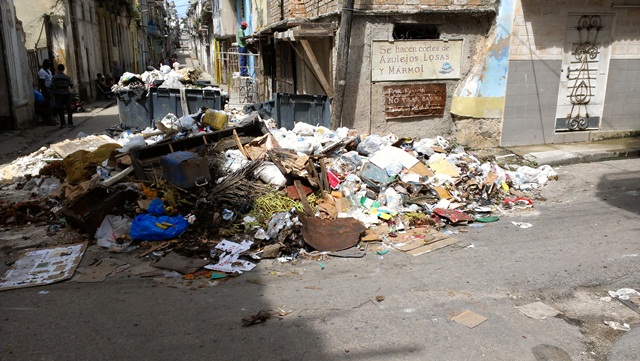
Havana, Cuba, November 2013, www.cubanet.org – In Cuba there exists no consumer society.  Or heavy industrial activity.  The quantity of debris should not be frightening. But the treatment of waste is troubling, because it pollutes the country and promises to future generations.

There exists no appropriate policy for dealing with the debris.  And if it is true that Cuban reality demands a solution for more urgent problems, where the trash goes, it should not be left behind.

The frowned upon dumpster divers

In homes, work centers, dumpsters on the streets, everything that is thrown in the trash falls in the same compartment where glass or metal or biodegrables are not distinguished. The whole lot ends up at the landfills, where the trash is not classified or its treatment facilitated.

One of the effective ways of contending with trash is recycling.  In Cuba it is a task of extreme difficulty.  There is no education nor political will directed to the necessary separation of wastes.  Moreover, the State hinders the process.

An example of that is the negative attitude towards “divers,” who are dedicated to searching for empty beer and soft drink cans to sell to raw materials recovery companies.  These individuals are frowned upon by the government in spite of the fact that their labor is ecologically laudable and they are socially useful since they have honest work.

Beyond not separating trash, the system does not even recognize the work of those who could be called “little aluminum businesses.”

If other discarded materials also gave business, there is no doubt that the waste recovery industry would rapidly flourish and contribute to the city’s improvement.

Fire at the big dump

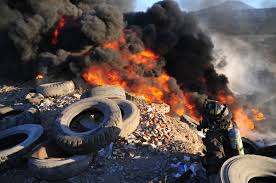
From the heights of one of the faculties of the Superior Polytechnic Institute, Jose Antonio Echeverria observed how a dense column of smoke rose, born in the entrails of the big dump of Avenue 100.  The toxic spectacle was nothing new: the uncontrolled combustion of debris would be dragged by the wind to the classroom of the university grounds.  The students in class there were going to inhale however much undesirable chemicals the fire generated.

Only after many sinister — and repeated — complaints was the cause of the fire removed, giving certain treatment to the wastes.  The decomposition of large quantities of organic material can generate sufficient heat to unleash accidental fires.

The fire out, the bad odor of the Dump of Avenue 100 continued flogging the surrounding population.

The first mistake is to locate an enormous landfill in the middle of Marianao township, near well traveled areas, but of course, quite distant from the Havana neighborhoods where the country’s ruling class lives.

Lack of containers

Another of the problems is the lack of trash containers and the irregularities in collection.  Parts and fuel are stolen from the garbage truck, as they are from all state vehicles.  Garbage cans are also vandalized.  Their wheels are ideal for making street vendor carts.  Wastes accumulate for days on the corners.

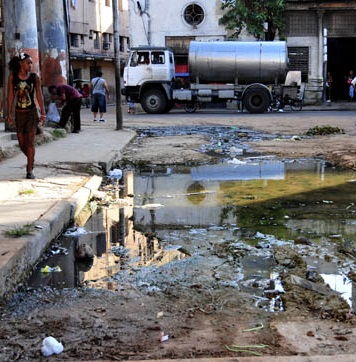
Not to mention sewer networks.  The growing population has made the water collection and treatment system collapse.  And the construction going up lacks the most basic technical standards.  Entire communities are found with a deficient and even non-existent sewerage.  Sewer water runs through the streets or seeps into the lower soil, contaminating springs, while the toxic wastes in rivers and oceans destroy various ecosystems in their wake.

The lack of control, the accumulation of trash and the deterioration of water treatment systems contribute to the fact that in Cuba there exists the danger of a widespread epidemic.  Signs of the health crisis have already started to be seen:  the resurgence of illnesses that were eradicated from the country indicates that the filth that surrounds us will have disastrous consequences.

By Victor Ariel Gonzalez

Cubanet, November 26, 2013

Translated by mlk

Attorneys in Service to Castroism / Ernesto Garcia Diaz

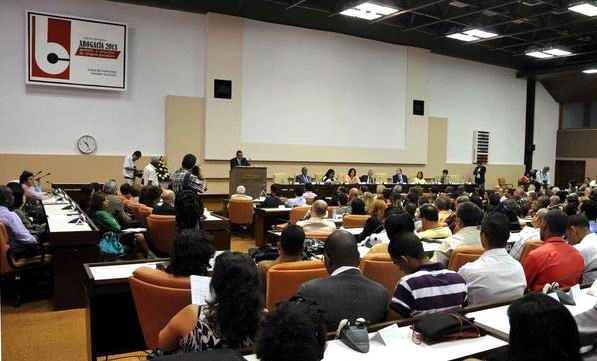
Havana, Cuba, November, www.cubanet.org — Last November 21 the “2013 International Advocacy Congress” concluded in Havana.  The event was sponsored by the National Organization of Collective Law Firms of Cuba (ONBC). At its opening, Homero Acosta, secretary of the State Counsel, was present, and doctors Joao Maria Moureira de Sousa and Hermenegildo Cachimbombo, Attorney General and president of the Order of Attorneys of the Republic of Angola.  According to the official press, the conclave included the participation of 400 Cuban delegates and 17 foreign countries.

In the event, the Attorney General of Angola, holder of a professor’s chair in Law, gave a keynote lecture about “The importance of ethics and professional conduct of lawyers,” noting that “The attorney is considered by some as a defender of the bad and by others as a professional essential to the full development of the State and society. . . He must comport himself ethically, cultivate moral values and principals.”  So it seems that this professional came with the purpose of teaching habits, skills of courage and ethical values that Cuban lawyers have lost in the exercise of trial defense or in the representation of their clients.

Obviously, the Angolan Prosecutor, coming from the emergent third power of the African continent, rich in petroleum, diamonds, gold and other natural resources, was not interested in the binding central theme of “the economic rights of those who lost a family member and the sick or mutilated veterans of the international war of Angola.”

The president of the ONBC, Ariel Mantecon, did likewise. True to the Castro pattern, he said that his organizations focuses “On the Cuban juridical context in considering access to defense as a constitutional right, making possible the immediate presence of this in the criminal process.”  Deceptive words when, precisely this year, and in the month of October, the opposition Cuban Commission on Human Rights and National Reconciliation (CCDHRN), reported about the 909 arbitrary detentions, the highest number in 18 months; and his organization does not make fair use of Habeas Corpus against the Detentions by the Castro Regime.

Even if Advocacy 2013 focused its topics on core aspects of modern societies, this group servile to the Castro regime has done little in the face of complaints that the Inter-American Commission of Human Rights makes which sent letters to the Cuban government in order to have an opinion on this part, in cases that take place constantly and are not responded to by the Cuban communist regime and sometimes even, the answers come in empty envelopes, according to the said Commission, or official answers arrive that far from answering the cases that are exposed to them, they oppose:  “You all do not have authority or any jurisdiction to inquire about the cases for which you solicit us.”

Likewise Rene Gonzales, ex-convict for the crime of espionage against the United States, who took part in the event in order to get to know the attendees as they are “his brothers” and to teach them ethical norms of loyalty to the regime, and not his confrontation over the factual limitation of individual liberties in Cuba.  He should have told them that Cuban ex-agents are treated respectfully and enjoy good health and feeding.  In contrast with those that are prisoners in Cuba for fighting for individual freedoms and respect for human rights. Maybe Rene is not familiar with Cuban fighters like the Ladies in White who are detained and left deprived of resources in areas and towns far from their homes as a new punishment practice of Castros?

In summary, the Congress served to raise funds on which the regime feeds: it strengthened the control structure between the executives and the member lawyers of the guild; just as it ratified the servile role of the ONBC supervised by the Ministry of Justice and watched by the Department of Organization of the Central Committee of the Communist Party, without really being an “autonomous national institution and of social interest.”

By Ernesto Garcia Diaz

Cubanet, November 26, 2013.

Translated by mlk

A Repentant Former Gunman / Michel Iroy Rodriguez

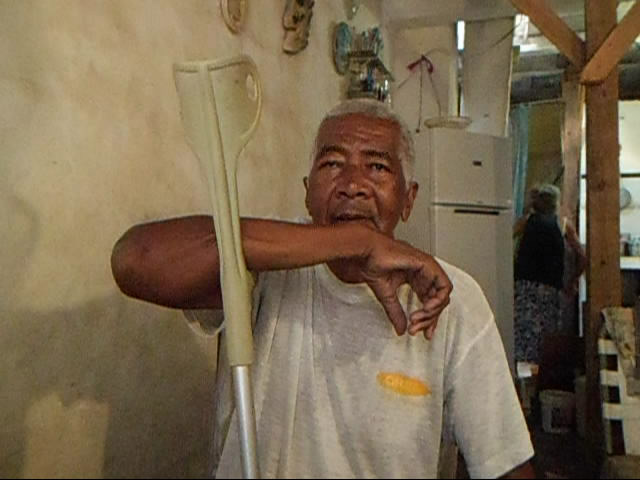
Havana, Cuba, November 2013, www.cubanet.org.  — Juan Lazaro Avila Herrera, physically impaired (his right leg is lame) regrets having belonged in his youth to a firing squad at the La Cabaña Fort.

When he served in the Association of Rebel Youths, at only 18 years of age, he was attracted to belonging to the firing squads.  He remembers that along with him, a group of 23 youths, aged between 16 and 20, were captivated.

According to him, sometimes the executioners seized rings and other items from the people shot.

Once he was accused of counterrevolution and taken to the Principe prison.  He says that during the trial he was so scared that he defecated in his pants.  He thought he would be shot, but he was absolved. In spite of that, after he left jail, for a week he had to go sign in every day at a police unit.

“I was infiltrated into a counterrevolutionary band and participated in several operations.  In one of them I arrested a priest, from whom we confiscated in the basement of the church explosives and weapons plus a map where the places were marked that would be blown up,” he recounts.

He says he is remorseful for having been at the point of killing a man named Jose Diaz when he arrested him in his home, where they took him with 14 AKs and several Makarov pistols.  “I put the pistol to his forehead and squeezed the trigger. If I did not kill him it was because the weapon jammed,” he said.

He served as investigator for the Ministry of the Interior (MININT) in the Guanabacoa police unit, dealing with cases of car theft and rape in the area of the beaches to the east of the capital.  He remembers that one time, when he was investigating a case of the rape of a young girl of 12 years of age, he was outraged and beat the arrestee he was interrogating with the butt of his pistol.

Avila also belonged to the Merchant Marine. He says he has transported weapons and sugar to several countries, among them Angola, Nicaragua and Honduras.  He says that in this latter country, 10 thousand tons of sugar were sent once, which were not for the Honduran people but were transported to a North American boat which was found lying alongside his boat.

“It was a mistake to have dedicated almost all my life to the Revolution. I ask myself all the time what did I fight for,” he told this reporter.

Avila Herrera retired with a pension of 279 Cuban pesos (slightly more than $10 US).  He lives in a dwelling that is a hallway with kitchen and bath. He decided to tell his story to the independent press because he is very disappointed in the government he served and for which he was willing die and kill.

Michel Iroy Rodriguez, yeikosuri11@gmail.com

Cubanet, November 21, 2013

Translated by mlk

Mummies Against Prostitutes: The Last Revolutionary Combat / Jose Hugo Fernandez

Havana, Cuba.  November, www.cubanet/org — The prostitutes of Havana never inspire as much pity as when we see them accompanied by those mummies of European and US Stalinism who today constitute their VIP clientele.  Really you have to have a heart of stone not only to go to bed with such a stinky and gassy old fogy but even to barely endure his proximity.

As soon as they disembark on the Island, without shaking off the dust of the road, these old gentlemen feed their spirit going to the Plaza de la Revolution and the Che sanctuary in Santa Clara.  Then, invariably, it is time for dessert.  So they get naked in Obispo Street in Havana, around Central Park or on La Rampa, in pursuit of our little hookers, the last flashes of the beacon of America.

“What a waste, buddy,” exclaim the gentlemen from around here on seeing them bargaining, while the women whisper, teasingly, and the oldest ones are scandalized at “the turns life has taken here.”  But they continue on their way, business as usual, confident, it seems, that they have left respectability in safekeeping, beyond the sea, along with their ancient wives.

If it were possible to take into account decency or common sense when dealing with this wildlife, you would have to ask why, at least, they do not attempt to take the prostitutes to some place apart, where they would be waiting for them without the need to expose themselves so boldly to absurdity and ridicule.  But that’s not how they are.  It is obvious that they have resolved to enjoy as God commands their last revolutionary orgy, now that only the devil knows the sacrifice that it cost to organize it, gathering for years the remnants of their salaries as retirees.

What a pity that there are no statistics that reflect how many casualties the worldwide revolution has suffered as a consequence of the heart attacks provoked by these encounters between the mummy veterans and our mud blossoms of the Fidelist legacy. In any case, they would say they’d died for socialism, if they managed to say anything, before shutting their trap, in the end, forever.

“Old age is an incurable disease,” Terentius warned us.  But it may be that he was not right, at least in this situation.  I believe that my grandmother was more accurate, and did not agree that people lose shame as they age because now nothing matters to them.  He who has no shame in old age — she used to say — never had any.

José Hugo Fernández

Cubanet, 21 November 2013

Translated by mlk.

Havana’s El Trigal Market Reappears / Ernesto Garcia Diaz

MERCADO-EL-TRIGALHavana, Cuba, November, www.cubanet.org — The Cuban regime, in pursuit of “unleashing the productive forces,” has established, through Law Decree No. 318/2013, the new “Rule About the Commercialization of Agricultural Products in the provinces of Artemisa, Mayabeque and Havana.”  The communist leaders say that this new regulation is directed to eliminate the mechanisms that hinder the process of agricultural commercialization, as well as the “quest to make it more dynamic, efficient and flexible.”

The official newspaper Granma circulates, with optimism, various articles about this new Commercialization System which will begin to function this coming December.  The Havana population receives the news with despair and reservations, because it does not see substantial changes in the scarcity of food, their high prices, or the lack of quality and variety.

Producers continue to be circumspect because although the regulation permits the sale and purchase of the surplus once the contracts with the State have been fulfilled, the control and Statism that the regime maintains make them doubt that this will happen.  Also because the State does not sell them the necessary equipment to assure the safety of their products to their final destination.

It is reasonable to remember that during the decade of the ’80’s, in the capital of the Island, three farmers market hubs operated: Berroa, Ocho Vias and El Trigal. These centers have been led by the Council of the Administration of Provincial Popular Power of Havana and the ministers of Interior Commerce and Agriculture.

For many years, the commercial organization created facilitated the illegal markets or “black market,” which occasioned crimes of larceny, theft and diversion of resources, with the consequent loss of millions.  Audits and inspections by the Agricultural Ministry and other State agencies have reflected excessive costs and alleged losses.  El Trigal, not a few times, was implicated and closed for said causes.

On the other hand, on the esplanade of 114th Street and the Pinar del Rio Highway, belonging to the Marianao township, a wholesale agricultural market functions in the open, attended by productive methods, points of sale and brokers. This structure, headed by Colonel Samblon, will close in December, and has not been exempt from acts of vandalism and a regulated commercial organization.

The peculiar and striking thing is that the colonel mentioned, converted into the president of the non-agricultural cooperative who will operate the El Trigal market, will head that center under the supervision of General Colás, according to what I was able to learn there.

The farmer’s market will offer to sellers and buyers a night service between six in the afternoon and six in the morning.  To that end, it will rent spaces for the sale of merchandise.  The entry (as much for trucks as for persons), the loading and unloading, the weighing and other secondary services will be leased and collected by the cooperative.

Also, the competitors will be obliged to leave the market at six in the morning with their unsold merchandise in tow, in order to get in a new line and enter the enclosure again at six in the afternoon.  An agonizing way of marketing, conserving and preserving perishable products in an installation whose refrigerators are not operational!  In the daytime they will weigh the trucks that come from the provinces, for their distribution to the basic units or network of markets.

It is anecdotal to remember when the communist ex-dictator Fidel Castro Ruz, in August 1960, before 600 cooperative coordinators, said, “Now we enter a higher level, now we enter into a new project, a new purpose, a new aspiration: the aspiration to diversify agriculture.”  The ex-leader, with his “development programs,” years later destroyed the productive and industrial base of the Cuban economy.  Will we now be journeying through the dreams and deliriums of the General President?

In summary, the new commercial organization that the regime tried to implement will enrich the cooperative businessmen of military ancestry, at the expense of producers, private sales representatives and the people, who will continue enduring the experiments of the dictatorship of the Castro brothers.

Ernesto Garcia Diaz

Cubanet, November 12, 2013

Translated by mlk

The Ideology of Prohibition / Luis Cino Alvarez

Havana, Cuba, November, www.cubanet.org — With regards to the absurd and prudish limitations imposed on some students by the Communications Faculty, Elaine Diaz recently wrote on her blog:  “. . . the policymakers are scandalized by things from the students as if the Revolution were going to fall apart next week. They should ask themselves what kind of Revolution falls apart for so little.”

The answer is simple: a revolution like that of Fidel Castro, which long ago stopped being one in order to become a racketeering and mean dictatorship, which, if it has managed to continue in power for 54 years, it is precisely because it fears everything different, it is closed tight and does not waver in repressing a fractious student who thinks with his head like the Ladies in White, who, for the henchmen of State Security are all the same: dangerous enemies of a revolution so fragile that it cannot tolerate anything that differs one iota from official decrees.

Besides, in their aberrant paranoia, they fear books, songs, visual arts, blogs, Facebook and the Internet in general.  And also 3D films.  The private mini-theaters whose projections have been prohibited without it mattering that the people lose money that they have invested or that they will be left without work. They alleged that these theaters had never been officially authorized, so they did not even give them time to close.

There the fools who thought that prohibitions had been left behind for ideological reasons!

Some think that behind the prohibition on 3D cinemas, as in the case of clothing imported from Ecuador or Miami and sold by individuals, is the desire of the State to eliminate competition by those individuals.  But let’s not fool ourselves:  the reasons are more ideological than merely commercial.  As ideological as when in the ’60’s they prohibited North American music and by extension British also, The Beatles included, no less.

The prohibition on mini-theaters was seen coming.  Several days ago, a long article (3,260 words) in Rebel Youth, the newspaper of the Communist Youth, showed the official preoccupation with it.  It cited Fernando Rojas, vice minister of Culture, who accused these cinemas of showing video to promote “frivolity, mediocrity, pseudo-culture and banality.” In spite of the vice minister declaring himself in favor of regulation before prohibition, finally the regime decided on the latter.

So, once more, a handful of meek and submissive eggheads, on behalf of their obsolete, uneducated bosses without a drop of class, who have Haitianized and what is worse, barbarized, the country, claim the right to be the arbiters of cultural quality and good taste.

It is not that the cultural commissars are wrong when they say that banal and low quality products prevailed in these cinemas.  But those products are not very different from the films and pirated series that pass for Cuban TV or that are shown in the few and deteriorated State theaters that remain.  Because the high brow cinema (ay, Huxley) that some foreign correspondents say is seen in Havana is quite scarce.  Only arthouse and films of a certain quality are seen on some television programs, in a few film festivals to which very few go and in the Festivals of the New Latin-American Theater, which keeps getting worse and which now, without Alfredo Guevara, it remains to be seen what will happen.

The commissars’ interest in cultivating our taste (always within the moral and ideological coordinates of the system) in order to make us “the most cultured people on the planet,” for lack of organicity and coherence, but above all sincerity, has failed down the whole line. From the punks who slide down the shell of the University for All, the ballet, the symphony and chamber music, jazz and arthouse theater. They prefer reggueton, Manga comics and films about vampires and Jackie Chang.  And if they have the money, “to put on the spectacles” they prefer to see Avatar and Ice Age in 3D.

The prohibitions are not going to manage to tidy up Cubans or cultivate their taste. They will only make their lives more boring and miserable. Particularly those of the young. Maybe the bosses think that they will be easier to control so. To hell with their ideas!

Luis Cino Alvarez, luicino2012@gmail.com

Cubanet, November 10, 2013

Translated by mlk

Disrespect for the Dead / Josue Rojas Marin, Cuban Law Association

Josue Rojas Marin

The brother of Juan Miguel Herrera Machado died some years ago, and on exhuming him, he found that the remains of eleven of his loved ones had disappeared from the family vault.

Given the horrendous knowledge he headed to the cemetery administration, where through the manager he learned that the vault now had another owner.  He immediately went to the National Revolutionary Police (PNR) and filed a complaint.  Some days passed with no answer, so he went again and found Prosecutor Leonardo Moreno Torres, of the township of Nuevitas, Camaguey, who oversaw the unit, and again related to him the events.  Months passed without a reply.

Devoted to his purpose, he approached the Chief of Prosecution of the township and who told him that by dealing with an atypical case he had to wait for a special process, that he saw no crime in what he related.  He again waited some more months, until he sought the free service of our Cuban Law Association and we took on his complaint.

In the medium term a criminal process was initiated against those responsible and they were sarcastically sentenced to light penalties.  Today we confront a second phase in the case because the tribunal did not rule on the location of the remains and the Prosecution which had the constitutional duty to carry out the investigations seems to have no interest in giving an objective answer to Juan Miguel in spite of his constant demands.

Translated by mlk

8 November 2013