The Silent Successes of the Cuban Dissidence / Ivan Garcia

Gustavo-Arcos-Bergnes-620x330Before the olive-green autocracy designed economic reforms, the peaceful, illegal opposition was demanding opportunities in small businesses and in the agricultural sector as well as repeal of the absurd apartheid in the tourist, information and technology spheres that turned the Cuban into a third class citizen.

General Raul Castro and his entourage of technocrats headed by the czar of economic reform, Marino Murillo, were not the first to demand changes in national life. No.

When Fidel Castro governed the nation as if it were a military camp, the current “reformers” occupied more or less important positions within the army and the status quo.

None raised his voice publicly to demand reforms. No one with the government dared to write an article asking for immediate economic or social transformations.

If within the setting of the State Council those issues were aired, we Cubans did not have access to those debates. The tedious national press never published an editorial report about the course or changes that the nation should have undertaken. continue reading

Maybe the Catholic Church, in some pastoral letter, with timidity and in a measured tone, approached certain aspects. The intellectuals who today present themselves to us as representatives of a modern left also remained quiet.

Neither did Cuban followers of Castro-ism in the United States and Europe question the fact that their compatriots on the island had no access to mobile telephones, depended on the State for travel abroad or lost their property if they decided to leave the country.

Who did publicly raise a voice was the internal dissidence. Since the end of the 1970’s, when Ricardo Bofill founded the Committee for Human Rights; in addition to demanding changes in political matters and respect for individual liberties, he demanded economic opportunities and legal changes in property rights.

Independent journalists have also, since their emergence in the mid-90’s and, more recently, the alternative bloggers. If the articles demanding greater economic, political and social autonomy were published, several volumes would be needed.

Something not lacking among the Cuban dissidence is political discourse. And they all solicit greater citizen freedoms, from the first of Bofill, Martha Beatriz’s, Vladimiro Roca’s, Rene Gomez Manzano’s and Felix Bonne ’s Fatherland is for All, Oswaldo Paya’s Varela Project, to Antonio Rodiles’ Demand for Another Cuba or Oscar Elias Biscet’s Emilia Project.

The local opposition can be criticized for its limited scope in adding members and widening its community base. But its indubitable merits in the submission of economic and political demands cannot be overlooked.

The current economic reforms established by Castro II answer several core demands raised by the dissidence. No few opponents suffered harassment, beatings and years in prison for demanding some of the current changes, which the regime tries to register as its political triumphs.

The abrogation of absurd prohibitions on things like the sale of cars and houses, travel abroad or access to the internet has formed part of the dissidents’ proposals.

Now, a sector of the Catholic Church is lobbying the government. A stratum of intellectuals from the moderate left raises reforms of greater scope and respect for political differences.

But when Fidel Castro governed with an iron fist, those voices kept silent. It will always be desirable to remind leaders that Cuba is not a private estate and that each Cuban, wherever he resides, has the right to express his policy proposals.

But, unfortunately, we usually ignore or overlook that barely a decade ago, when fear, conformity and indolence put a zipper on our mouths, a group of fellow countrymen spent time demanding reforms and liberties at risk even to their lives.

Currently, while the debate by the intellectuals close to the regime centers on the economic aspect, the dissidence keeps demanding political openings.

One may or may not agree with the strategies of the opponents. But you cannot fail to recognize that they have been — and continue to be — the ones who have paid with jail, abuse and exile for their just claims.

They could have been grandparents who run errands and care for their grandchildren. Or State officials who speechify about poverty and inequality, eating well twice a day, having chauffeured cars and traveling around the world in the name of the Cuban revolution.

But they decided to bet on democracy. And they are paying for it.

Iván García

Translated by mlk.

6 February 2014
The Sputnik that got on Fidel Castro’s Nerves / Tania Diaz Castro

The Soviet magazine was prohibited.  Goodbye goose who lays the golden eggs. The Special Period arrived.

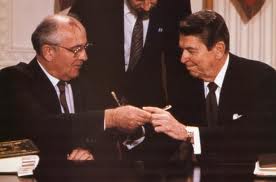
Mikhail Gorbachev and Ronald Reagan

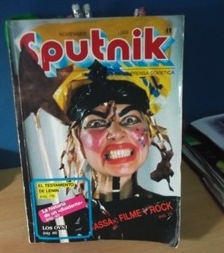
HAVANA, Cuba — The last Soviet SPUTNIK magazine that circulated in Cuba, corresponding to the month of November 1988, was the one that got on Fidel Castro’s nerves. In it, an extensive article by Yelizaveta Dabrina recounts the details of the last years of Vladimir Ilich Lenin during his illness, the will where he exposed the reasons for which Joseph Stalin ceased to be Secretary General of the Central Committee and in which he practically proves that a dispute between Stalin and the wife of Lenin could have hastened the death of the Bolshevik leader.

The Magazine SPUTNIK, whose name comes from the satellite that the Soviets put in orbit in 1957, could only survive for 24 years, as in 1991 it was definitively shut down after the collapse of the USSR. It was considered the counterpart of the famous Reader’s Digest from the United States, and although it was published in seven languages, it was imported to very few countries, principally because of the bad quality of its texts and its lousy translations. continue reading

To the surprise of many, with the advent of Perestroika and Glasnost, SPUTNIK was transformed into a news outlet that everyone looked for in order to learn the reality about what was happening in the USSR.

The last Sputnik magazine that circulated in Cuba

There began to appear on its pages stories that the Soviet Communists would have never approved:  repression of dissidents, freedom the common Soviets had to say what they thought, the reasons for Soviet invasions, the bad quality of their products, economic difficulties, prohibited films, the image of the communist bureaucrat, etc.

It was remarked in Cuban newspapers of the time that when Fidel Castro saw a full color photo of Mikhail Gorbachev seated next to Ronald Reagan in the Kremlin on May 30, 1988, in SPUTNIK Magazine number 11, all hell broke loose in the main office of the Cuban Communist Party Central Committee.

One of the first decisions he made, on sensing the disintegration of the USSR, was to order an inventory of food crops, “in case he had to feed them in case of war” and to approve 28 austerity measures for saving hard currency.

On exactly August 4, 1989, the Granma newspaper published an article entitled “An Urgent Decision,” where it explained why the circulation of SPUTNIK, Moscow News and others had been suspended, although since November of the year before, with the last November issue, it already was impossible to acquire the Magazine at that time, the one most coveted by Cubans anxious for liberty. SPUTNIK’s new thinking was clear: The Castro regime had to resolve its economic problems without outside help. It had lost its godfather forever.

Cubanet, February 4, 2014,

Translated by mlk.

Goodbye to the Self-employed Worker / Gladys Linares

caption
Dragones and Galiano after prohibition of imported items — photo by Gladys Linares

HAVANA, Cuba, January, www.cubanet.org — For the majority of us, January generally is a month of privations. For decades people often have been heard lamenting in the first days of the year about how difficult their situation is, but never like now. This 2014, according to some, the scarcity is felt more than at other times.

Many think that this is due, in great part, to the arbitrary measure applied to self-employed workers since the November 2, 2013, news brief in the Granma newspaper announcing the prohibition of the sale of articles imported or acquired in the state commercial network. In addition, it gave a brief term of 59 days (until December 31) for liquidating merchandise. This order caused the failure of many of the self-employed because in spite of having good demand from the population, the term was not sufficient.

One of the damaged sellers — who did not want to identify himself — had a license as a producer-seller of several items for the home. A great portion of his merchandise was acquired through a friend who travels to Ecuador. For three years inspectors visited him, always looking for a way to find some fault, but they never told him that he could not sell imported items. continue reading

Another one injured used to sell clothes imported at the Virgen del Camino fair; she commented — anonymously — that although she is unionized, she did not approach the union because it answers to the Government. Also, she adds, “If I make a claim, I stand out; better to keep selling behind closed doors.”

Many times the Government tried to blame shortages on the self-employed who “monopolized” the stores in the absence of a wholesale market. Nevertheless, in the opinion of the great majority, now the falsity of this hypothesis has been demonstrated because after the new prohibition, the shelves of stores, kiosks and state containers are emptier than before.

With the fever of self-employment, Havana came to life. Fixing and painting dwellings and facades and taking advantage of idle or under-used spaces for new cafeterias, small restaurants, second-hand shops, or kiosks, hanging cheerful posters of all kinds advertising offers and causing the comings and goings of onlookers and customers, it is indisputable that those who began to test their luck changed the urban landscape.

Among those new places, the Caridad fair came to be one of the most attended in Central Havana. It is located on the corner of Dragones and Galiano, on land equipped by the Government for renting to self-employed but that today is found vacant given that the majority of the stands were devoted to the sale of imported items.

Space equipped by the State, now empty -- photo by Gladys Linares
Space equipped by the State, now empty — photo by Gladys Linares

But the sellers are not the only ones hurt with this measure. These self-employed meet many needs of the people who now have nowhere to go because historically the State has not be able to provide us with certain products.

One of the affected clients is a neighbor who needed two water faucets, but since the sellers of plumbing supplies in Lawton closed their businesses, he had to go to Central Havana to see if he could find some. On returning in the afternoon, tired from walking and without faucets, he commented: “The stores are empty, the stands and kiosks, ’bare.’  First they authorized the self-employed to sell and now they prohibit them. In short, as Cantinflas* would say, ’There are moments in life that are truly momentous.’”

*Translator’s note: Cantinflas was a hugely successful Mexican comedic actor, on the level of a “speaking” Charlie Chaplin (Chaplin called him “the best comedian alive”).

Cubanet, January 31, 2014,

Translated by mlk

Goodbye to a Summit to Forget / Ivan Garcia

cumbre-celac-en-cubaIf you walk through the marginal and mostly black neighborhoods of Havana, you will not hear people talking about integration, inequality, human rights, democracy or freedom of expression.

They are hard neighborhoods. Their priorities run toward having containers full of potable water: it’s been decades since the precious liquid arrived in their precarious dwellings through the obsolete pipes.

Residents of these slums, like Gerardo, who pedals a bike-taxi 12 hours a day through Central Park environs, feel satisfied when they have food for a week, deodorant, tooth paste and detergent.

Poverty in Cuban is not just overwhelmingly material. It is also mental. A sine qua non for a wide segment of the population. It does not matter if you proudly hang an engineering or law degree in the living room of your house.

The system designed 55 years ago by Fidel Castro has been a champion in socializing poverty. For almost everyone. He is to blame for salaries being symbolic and unworthy.

But the worst is not the crude material poverty that shames you when, for example, you travel through one of the more than 60 destitute neighborhoods, real slums, that arm themselves on a night on the outskirts of the city. continue reading

The big problem for the majority in Cuba is that they do not have legal tools for changing the state of things. That’s they way it is. And people know it.

That’s why the solution for many is to emigrate. Or to do political juggling acts, pretending to applaud the official discourse, legal snares and to steal all they can on their jobs.

The wear and tear of a regime that still governs after five decades of economic failures disgusts a growing segment of the citizenry.

It is already known that in autocratic Marxist societies networks of commitments, information censorship, fear and police effectiveness are woven in an effort to contain the internal dissidence.

But the power of Fidel Castro, almost absolute until the 1980’s. has been eroding. Now the people do not keep quiet about their disagreements or unease about the State’s gross mismanagement.

Today on the island, in any line, park, corner or public transport, you hear racy criticism of the Castro brothers. And an interminable list of complaints. Nevertheless, those querulous debates go no further.

A high percentage of the population does not trust the mechanisms of government. People power is a mere adornment. Letters to a newspaper, a minister or any Central Committee office that attends citizen complaints do not usually solve or manage the disparate problems raised.

For some years Cuba has been living in a time out.  Many believe that the solution to societal and economic structural problems is biological, and that they will be resolved by magic, when the Castros die.

As bad as they live and for lack of a future, a wide segment of Cubans is indifferent to meetings like the recently completed CELAC Summit. They feel like a tropical political comedy.

In the modern world forums and meetings between nations abound and lack concrete actions and practices. Right now, politicians of the whole world live at a low ebb. They have not learned to manage the needs and desires of their people.

On the American continent corruption and extreme neo-populism abound. To their credit they are democratically elected presidents. Except Cuba. A contrasting difference.

Also striking is the anachronistic discourse of the Cuban regime when compared with that of other regional politicians.

The speeches of the island’s representatives seem like outputs from the age of the dinosaurs. You listen to how Pinera, Humala, Santos or Rousseff openly express needs that affect their countries and their tangible bet on democracy and human rights.

Raul Castro, out of focus in his inaugural speech, analyzed poverty, inequality and other phenomena in Latin America as if Cuba did not also suffer from them. He tried to seem like a teacher holding class for a group of students.

The future of the world is increasingly of blocs. It is positive that Latin America is seen as an inclusive entity. The great merit of the Second Summit was declaring Latin America a Zone of Peace.

But there are many challenges ahead. The continent continues to be the most unequal and violent region on the planet. Caracas, Michoacan or Tegucigalpa are true slaughterhouses.

Neither can one get around the tendency of the governments of Ecuador, Venezuela or Nicaragua to reform the Constitution at their convenience. It creates a harmful precedent: that of politicians endorsed by institutions saturated by colleagues and buddies from the party that are perpetuated in power.

Demagoguery floats in several nations of the region. Political honesty and frankness is a rare bird.

It is not possible that none of the 31 governors that were at the Summit in Havana, elected in democratic plebiscites, with opposition parties and free press, have not questioned the Cuban regime about its lack of freedoms and its repression of the dissidence.

Like a Russian doll, the olive-green autocracy tries to regenerate itself and govern without respect to the democratic clauses of CELAC.

If they are committed to integrating the Cuba of the Castros into the Latin American and Caribbean community, ethically, some leader should let them know. And not exactly in a quiet voice.

Iván García

Translated by mlk.

3 February 2014

CELAC for Cubans: Indifference and Repression / Ivan Garcia

48-600x330For Zoila, 38-year old nurse, the Second Summit of the Community of Latin American and Caribbean States that is now going on in Havana adds up to “politically correct” speeches, banquets and photos.

“It’s more of the same. They talk about poverty, integration and social inclusion while in Cuba inequality grows. It is a cheeky that our president Raul Castro speaks about those topics. He should blush, in country where people have salaries of less than 20 dollars a month. The worst part is not earning little money, the food shortages or their high prices, the worst part is that we have no way of changing the state of things,” points out Zoila, at a bus stop in Vedado.

Osniel, 33 years old, bartender at a bar that sells exclusively in foreign currency, while he prepares daiquiris and mojitos, unenthusiastically and from the side watches a flatscreen installed on the premises, which broadcasts news about the roll out of the CELAC Summit.

“Whether they are Latin Americans, from the Americas or from ALBA, these summits are only useful for presidents and foreign ministers, who take advantage of them to talk face to face. For everyone else they are ineffective. There’s a lot of talk about eliminating poverty, respecting human rights, and creating grandiose economic projects. But with the passage of time, it almost all stays on the drawing board,” the barman emphasizes.

On the streets of Havana, it is increasingly difficult to find people who are optimistic or who are not angry. The Diario de las Américas spoke with some twenty citizens about the Summit’s news interest. continue reading

For sixteen it is a real annoyance, and four said that after 55 years, they are used to it. “It is what Castro’s boat* brought,” says Eugenio, 73 years old, retired.  The Cubavision channel dedicates 12 hours a day to the Summit.  ”There’s no option but to rent films and soap operas. Or change to the sports channel; I don’t like baseball or soccer, but I prefer it over seeing such people giving speeches,” confesses Onelia, 56, housewife.

“The oven is not ready for the cakes. The news that started the year, the astronomical prices of cars for sale, has created too much distress. Then this optimistic discourse from the national press that contrasts with the hard reality that most of us live. In Cuba it seems that there are two planets. One artificial, highlighted by the government media, and the real one where disenchantment and uncertainty about the future worry many,” says Rogelio, 47, bank employee.

While the television harps on news about the Summit, Junior and a group of friends, after each ingests two Parkinsonil pills, buy a bottle of Mulata rum for 5 cuc, a week’s salary for a professional. They drink it all, to see if they can “change their bodies.”

“That ’molar’ (speech) does not interest me. The horde of old men in charge of Cuba does not notice that they are boring. Since I was born, in 1994, the same ’size’ (spiel), that if the Yankees, that if the ’blockade’ (embargo). But we continue the same or worse, above all the young. Without a future and ’stuffing tremendous cable’ (going through hardship). We escape taking pills with rum,” says Junior, hairless in the style of Brazilian soccer player Neymar.

Without intending it, Bruno Rodriguez was the one who knew best how to define the air of apparent political placidity that lives in the Summit. In a press conference, the Cuban foreign minister emphasized that he had never seen in an international forum an air of such harmony and consensus as he observed in Havana.

For the common Cuban, it all seems rehearsed. If there were discrepancies, they aired them discreetly. “It is shameful that the attendees of the Summit in their pronouncements have tried not to displease a host who is a dictator,” says a taxi driver.

Certainly, one has to chalk up a political goal for General Raul Castro. Not even his brother Fidel could agree with or attenuate the critics of his regime at international events held during the time that he was head of the country.

Whatever their ideological tendencies, the regional politicians seem like disciplined children. All facing the gallery. That strategy of extending the red carpet for the olive-green autocracy leaves the Cuban dissidence increasingly alone and isolated.

As of the moment of this writing, no one had met with opposition figures. Not even Jose Miguel Insulza, secretary general of the OEA. The ridiculous level of commitment by Latin American democrats to a handful of women and men who claim political space and freedom of expression left the road clear for State Security forces to harass the opposition, independent journalists and human rights activists.

Jorge Olivera, 52-years-old, reporter, writer, and ex-prisoner of the Group of 75, on the night of January 23 two counterintelligence agents warned him not to participate in any dissident events during the Summit.

“They were emphatic. They told me they were not going to permit parallel meetings during the Summit. The cynicism of the Latin America politicians attending the event is worrying. No one has made a gesture or wanted to meet with us. They have a double standard. They speak and demand democracy, including in the CELAC charter, and they look away when it comes to the Cuban dissidence,” says Olivera.

A parallel forum sponsored by the Argentine organization CADAL (Center for the Opening and Development of Latin America) and dissidents on the island probably cannot be held due to the strong repression. They did not even permit the director of CADAL to enter the capital.

Manuel Cuesta Morua, co-sponsor of the forum, was detained in a Miramar police unit. The mobile phones of numerous opponents were cut off and others were not permitted to leave their homes or provinces. Dozens of arrests of activists were reported all over the island.

In Cuba, depending on who looks, the glass is half full or half empty. And there is not only one reality, but many and very different.

But it would be presumptuous to say that the harangues of the regime or the debates in the Summit are a news priority for the common people. Rather it is the opposite.

Ivan Garcia

Photo:  Before and during the CELAC summit, the main avenues and streets of Havana were taken by police officers like this one, of the special brigade, who are distinguished by the black uniform and always walk with a dog.  The photo, by Lazaro Yuri Valle Roca, was taken very close to Havana’s Central Park.

*Translator’s note: Fidel Castro and his associates started the Revolution by sailing on a small yacht from Mexico to Cuba. The yacht was purchased from an American who had named it “Granma,” which subsequently became the name of one of Cuba’s provinces and the country’s daily newspaper.

Translated by mlk

29 January 2014

No Effort Will Perk up the Cuban Economy / Angel Santiesteban

The new container terminal in the Mariel Special Development Zone. REUTERS/Desmond Boylan

Not a thousand ports like Mariel and its development zone will be able to enliven the Cuban economy. A government which for more than half a century uses a great part of its finances to prepare for a war that never arrived, and which instead of taking advantage of that unique opportunity when it existed — the Soviet Union and the rest of the socialist bloc that maintained us without caring what we invested in — squandered those billions on the work of Fidel Castro, the worst administrator in the history of any national economy, sowing guerrillas in America, carrying out civil wars, instituting misfortune and thousands of death, instead of investing in agricultural and industrial development.

No prosperous economy will be able to exist as long there is not full freedom and demilitarization of all sectors at all levels.  No prosperous economy will be able to exist while the people do not have basic rights and there is no respect for individual thought.  A prosperous economy will not be able to exist while the opposition is disrespected.

The health of a country, and any human yearning, is in listening to the diversity of opinions, in the discussion of the parties for the improvement of the same end.

In 1980 the Mariel port was for everyone the symbol of liberty. Large portions of the best and worst of our society departed through Mariel, essentially the result achieved in 20 years of imposed socialism.

Today it is meant to form part of a development zone for the national economy in particular and of Latin America in general, but that depends only on Raul Castro inserting himself into the concert of nations of the 21st century, where there is no room for dictatorships but political and economic processes that truly help guide serious progress in all senses, beginning — of course — with respect for Human Rights, and for that, he must sign the UN Accords.

Hopefully the Secretary General of the United Nations, Ban Ki-moon, will insist on that urgent point for the people of Cuba and for the world. No one will get more from that gesture than the dictatorship itself and the purse of the Castro family, which for many years has prepared for its future as high-class millionaires. As long as these advances in rights do not occur, there will be no future prosperity.

Angel Santiesteban-Prats

Lawton Prison Settlement. January 2014.

Translated by mlk.

1 February 2014

No One Wants to Talk About CELAC / Lilianne Ruiz

Police on the Malecon -- Havana -- internet
Police on the Malecon — Havana — internet

HAVANA, Cuba — The morning of the 28th, there were fewer people on the street than any other Tuesday.  Also it was notable that the flow of cars on a street as central as 23rd, in El Vedado, had diminished.

Who can find out what is in the heart of the Cuban people, subjected to political propaganda 24 hours a day?

The Malecon, almost deserted.  Two twenty-somethings talk about the Summit of Latin American and Caribbean States (CELAC) as an opportunity for Latin American integration. They speak of the collective, not of the individual. They said that it is about “an opportunity to show the world how much we have tried to rectify some things.”

A man of 40 complains that beer is missing and he associates it with the international event.

Going down O street, another man of 30 laments that the host only tries to fix how Cuba presents itself and accepts that there is another invisible part in permanent crisis. He is not aware of the alternative Forum that the opposition was going to hold that same day.

No one agrees to say his name.

Also on O street, between 15th and 17th, there is an artisan fair, selling the same things as always: pieces of wooden sculpture, costume jewelry of nickel and bone, stamps with the Cuban flag, berets and t-shirts printed with the Korda photo of Che Guevara. But no seller wants to talk to me of his expectations with respect to CELAC. Only one customer, a native, says that he hopes the economic situation will improve.

Leaving the fair, a lady signals me to look some meters away at a man dressed in plainclothes who does not move from the corner. She explains to me that he is part of the State Security force that watches over the CELAC Summit. Every once in a while the man gets out a radio transmitter-receiver and speaks; he seems to be reporting what is happening around him. For a minute I think that I am going to meet with Manuel Cuesta Morua in the dungeons of the Fifth Police Station.

Young women, dressed in the olive-green uniform of the Ministry of the Interior and orange vests, appear on some corners, alternating with the uniformed officers of the PNR (People’s Revolutionary Police). These latter are not too remarkable because they are a daily presence in the streets, patrolling.

A system that requires individuals to deny themselves to be able to survive, in a society that punishes non-conformists, is being irrigated with the impunity that it is granted by 33 regional heads of State, the secretary general of the UN, Ban Ki-Moon, and the Organization of American States, Jose Miguel Insulza, silent about the indefensible situation in which the Cuban people live in matters of civil and political, economic, social and cultural rights.

The internal opposition had conceived of Democratic Forum II in International Relations and Human Rights, as an event parallel to the CELAC summit, a Forum that yours truly should attend. The political police incarcerated the leaders and organizers, and in that way the project was dismantled.

According to information offered by the Cuban Commission of National Human Rights and Reconciliation (CCDDRN), more than 200 arrests have been reported in the last days, some in the nature of house arrest and others in police jail cells, throughout the whole Island.  In all the cases it is about arbitrary detentions to restrain free movement or to impede the activists from meeting.

If they insist on selling again the idea of socialism as a panacea for eradicating poverty, Cubans from the Island have something more to show the world: not only the devastated country, police control, State violence, but also our souls which have been still more poor — practically incapable of understanding and defending themselves — after 55 years without the desired liberty.

Cubanet, January 29, 2014, Lilianne Ruiz

Translated by mlk.

Raul’s Reforms Turn us Into Lice / Jose Hugo Fernandez

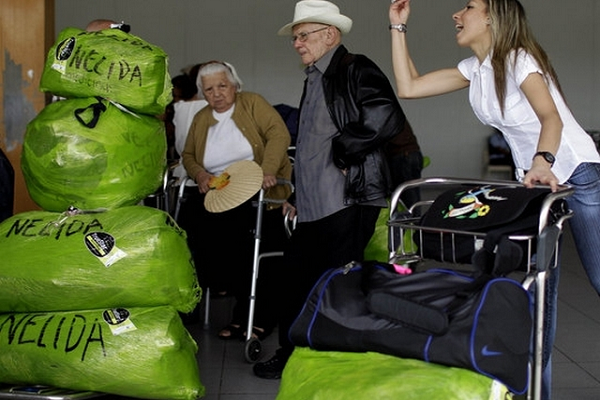
Cuban-Americans arrive at Havana; photo taken from the internet

HAVANA, Cuba — The announcement of new email and internet navigation services that directives of ETECSA — the state (and only) telephone company in Cuba — have just made public confirms the regime’s tendency to design each measure of its “progressive reforms” having always as their objective the Cubans of the diaspora.  In recent times not even a single economic liberalization has been produced that is not based on the money of Cuban emigres, and the success of which does not depend entirely on them.

The circumstance is paradoxical: those whom our bosses obliged to flee from the country have become not only one of the main sources of economic sustenance for its power, but also the cornerstone of a new political strategy with which they today try to clean up their image before the world.

Any barely awake observer could take the fact as a key in order to understand the failure of the Revolution. And not only that. Also to corroborate the outrageous nature of the so-called Raulist reforms, delineated in order to manipulate international opinion, while they exhibit scorn and disrespect towards Cubans, whether they live on or outside of the Island. continue reading

Should we then reject the measure?  Each with his skin makes drums.  I approve it, in spite of the regrets. And in agreement with the first reactions that I have observed in my surroundings, it seems that there are many in my case.

That leads to another paradox: in the same way in which our bosses adapted the people to depend almost absolutely on their guardianship, today, now that the systemic crisis keeps them from continuing to adopt us as foolish children, they pass the hot potato to emigration. “But, look, only in respect to economic dependency, without making any allowances in the political field, and counting a priori on those who here or there are going to come along for the changes without changes that they (the political elite) are planning.”

A friend, with whom I conversed about the matter, commented in jest that the best thing that President Obama could do right now to support our aspirations for democracy and progress is to sign an exceptional decree giving salary increases for all Cubans who live in the United States.

It is a joke that also contains a paradox, and a very serious one. Thanks to that delusional decree signed by Obama, emigrants and exiles could continue being the support of the Raulist “progress” which, sooner rather than later, will turn against the regime itself, because each step, however minimal and mediocre it may be, opens a gap through which people from here look, explore and know the real world, something that without a doubt will end up changing their expectations.

That, it is clear, should not keep us from visualizing a last paradox, or two, the saddest:

1) It’s unfreakingbelievable that after confronting the drama that emigration or exile implies, those on the other side have to break their backs in order to supply even the minimum necessary for the relatives who remain here.  2) It shakes this metamorphosis that they have imposed on Cubans on the island: we’ve been transformed from from measly parasites of the State to useless parasites of our loved ones.

We now know that the Cubans of the future will not be like Che, but will we be able to avoid in time becoming like lice, after having permitted parasitism to become a trait of our national identity?

Cubanet, 29 January 2014, Jose Hugo Fernandez

Translated by mlk

Queen-Brand Pots, Chinese Refrigerators and the Little Gas Cylinder / Gladys Linares

Hornilla-casera-de-carbón_foto-cortesía-de-la-autora-300x200HAVANA, Cuba, January, www.cubanet.org — With the change of domestic appliances in the so-called energy revolution devised by Fidel Castro, there began for us a series of problems that each day gets worse.

We were warned to exchange old Russian refrigerators and air conditioners, or American ones from the pre-“revolutionary” era, for Chinese equipment supposedly of lower energy consumption, payable through a bank credit that people are paying off still today.

During that period they also sold, in certain locations, fans, water heaters, electric stoves, rice and multipurpose cookers (the so-called Queen brand pots), at the same time that electric rates were increased.  The gas sale cycle for these families was extended to six months for each 20 pound drum (the so-called “little balls”) “just in case some day the electricity flow is interrupted,” which happens quite frequently.

Due to their poor quality, these pieces of equipment quickly broke, and the shortage of replacement parts has obliged Cuban families to adopt different alternatives in order to be able to cook.  Some do it with charcoal; others buy a gas cylinder on the black market. continue reading

Such is the case of Erlinda, who has prepared a little charcoal stove although she complains that sometimes it is difficult to get one; with much difficulty it can be bought on the black market.  She says that now she knows the cause of its scarcity: according to what she read in the Granma newspaper of January 14, charcoal is an export item.

Refill hose for cylinders  -- photo courtesy of the author
Refill hose for cylinders — photo courtesy of the author

For some, the quota of gas is not sufficient, but they don’t have the money to buy a cylinder on the black market, so they try to get a “shot” (the residue) from a neighbor or friend, almost always emptying one drum to another with the appropriate hose, a dangerous operation that has caused more than one explosive accident costing lives and homes.

A while back, one afternoon, Raudel, a gas courier, tried to help a neighbor in this procedure, and although he did the maneuver in the doorway, someone who was passing at that moment lit a cigarette and everyone ended up in the burn room of the Calixto Garcia hospital.

When Raul Castro, in his speech on December 13, 2012, announced that he was increasing the production of petroleum and gas, a rumor began to circulate that its sale would be freed from the rationing system.  But what no one expected is that in order to consume gas by the pound he would have to enter into a contract with the State to rent, for 500 pesos, an empty cylinder, and only with this could he then get it filled for a price of 130 pesos.

During the eighth legislature of Parliament, the deputies Attention to Services Commission voiced the difficulties presented by the electric domestic appliances and recognized that more than 80% were in disuse.

Near Barrio Obrero, gas transport -- photo courtesy of the author
Near Barrio Obrero, gas transport — photo courtesy of the author

As a “solution” to this problem, the State widened access to the bank credits in CUC, applying the prevailing exchange rate (25 Cuban pesos for 1 Cuban Convertible Peso, or CUC) so that those affected might buy their appliances again and undertake more debt, although they also have the “option” of buying the unrationed gas through contract with the State.

On learning the news, a friend exclaimed:  “I don’t know why they are surprised, if this bloodsucking Government takes a step, or makes a change, or applies a measure, it’s only to suck our blood!”

Cubanet, January 29, 2014, Gladys Linares.

Translated by mlk.

Calle Obispo: Look But Don’t Touch / Jose Hugo Fernandez

Two old men play the guitar, and she passes the hat.

HAVANA, Cuba, January, www.cubanet.org — If the caviar leftists from abroad saw what their eyes can see in Cuba, and not only what they want to see, a walk through Old Havana would suffice for them to discover the impassable class wall that the regime has raised between them and our common people.  They do not even need to cover all the historic town.  It will be sufficient for them to walk two or three blocks along Obispo.

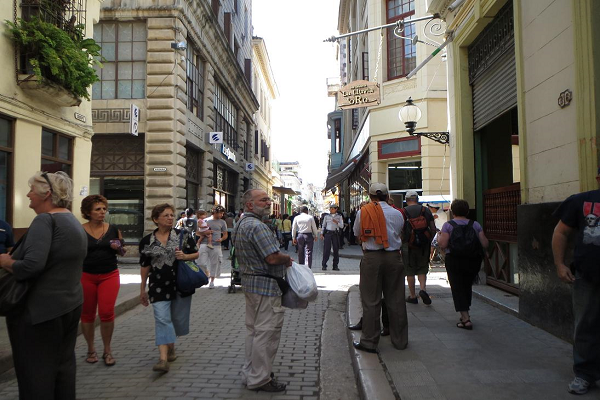
As well as the most prominent tourist corridor, this street is the most populous on the Island.  In no other place do foreign visitors and humble Cubans converge in such a large scale and physically close way.  It seems obvious that the regime, through its viceroyalty in Old Havana, is taking advantage of the history of Obispo as a very busy commercial artery, in order to use it as a propaganda showcase, set aside to disguise the shameful ghetto that common citizens suffer from their status as zoo animals who are barely observed at a distance by visitors.

But it happens that here too the habitual clumsiness of our bosses surfaces. Being the point of closest proximity between Habaneros and visitors, Obispo offers an unequaled occasion to test the abyss the separates them.

Along its twelve blocks, from the banks of the bay to Monserrate, besides being the Cuban street with the greatest number of police spies, it is a unique commercial boulevard. Nevertheless, almost all of its stores sell in foreign currencies. So that the role of the Habaneros is to serve as decorations, placing themselves picturesquely at the site, going to look or looking at those who look, but without being able to touch, because nothing is within reach of their pockets. Also, in some cases, they go with the hope of getting something from the tourists. continue reading

On Obispo there are 39 stores, but none sells in the national currency. There are a dozen restaurants, of which only one accepts the money that Habaneros are commonly paid on their jobs. There are dozens of bars, cafeterias, trinkets, kiosks, almost all dedicated to commerce in “hard currency.” There are barely any self-employed and some small state shops where one can buy (in Cuban pesos) light food of the worst quality.

Beggars and fighters for pesos

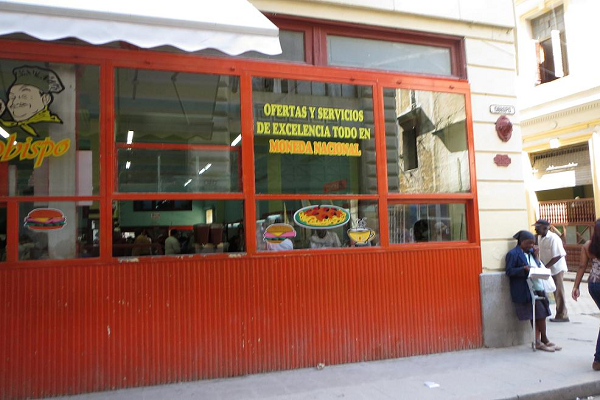
On the corner of Havana there is a type of market and dining room for poor people (the only one in Obispo), which is an authentic dump, dark, dirty, with an interior atmosphere of oppressive misery.  On its facade they have written a kind of ad that is a coarse joke, as much for its consumers as for the tourists:  “Bargains and services of excellence.  All in national currency.”

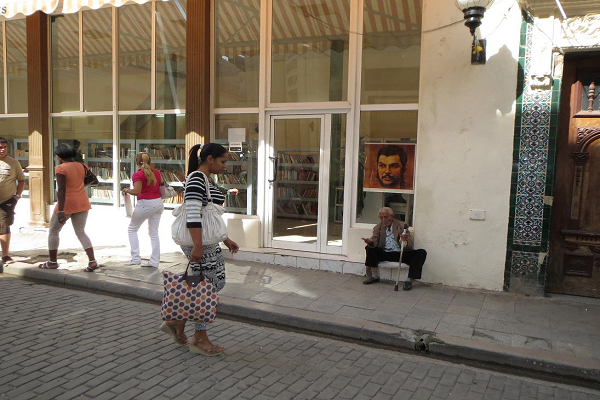
Only the beggars and fighters for pesos exceed the number of police and tourists on this historic street, which dates from the 16th century, the first in Havana to be paved and also the pioneer in street lighting.  In the current number 462, between Villegas and Aguacate, there lived the illustrious philosopher and priest Felix Varela, in a house where today a small library and a souvenir kiosk for tourists share space.  Also celebrities like Ernest Hemingway, who wrote part of his novel For Whom the Bell Tolls in the Ambos Mundos hotel (Obispo and Mercaderes), spent the night here.

The center of what was called “the little Habanero Wall Street,” Obispo conserves some of its former headquarters, like the current building of the Ministry of Finances and Prices, from 1907, considered the city’s first “skyscraper;” or that in which the first Spanish-American photographic studio was inaugurated (no. 257, between Cuban and Aguiar).  Other historic buildings of this street are currently museums:  the numismatic, the mural painting, natural sciences, the goldsmith, and even the museum of the CDR, which is all a monument to hate.

Especially popular since the 19th century for its commercial establishments, fashion houses, boutiques, confectioners, renowned pharmacies, restaurants, bars, hotels, cafes…  Obispo has not stopped being the place most frequented by Havana residents.  It’s just that today, by the work and grace of the viceroyalty of Old Havana, far from being what it was, it has become a street of infamy.

Photo journalism by Jose Hugo Fernandez


Yesterday perhaps he wanted to be like Che…

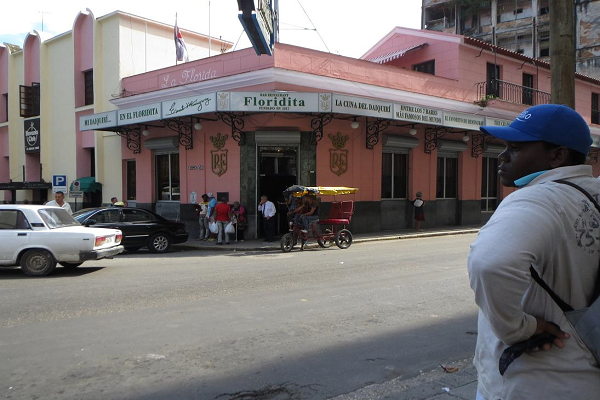
Cuna del Daiquirí, a la entrada de Obispo

Cradle of the Daiquiri, at the entrance of Obispo

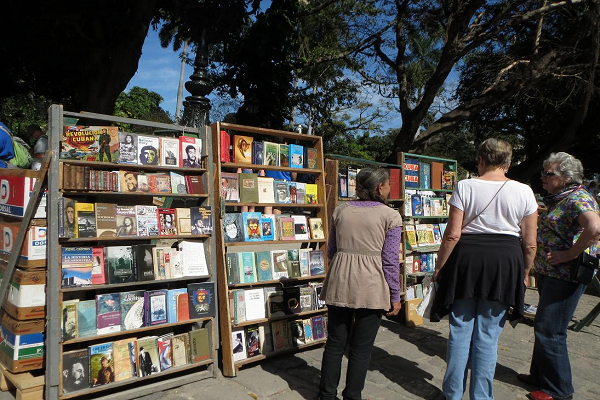
Muy politizada la venta de libros en la mayor librería a cielo abierto, Plaza de Armas, al final de la calle

Very politicized the sale of books in the biggest open air bookstore, Plaza de Armas, at the end of the street.

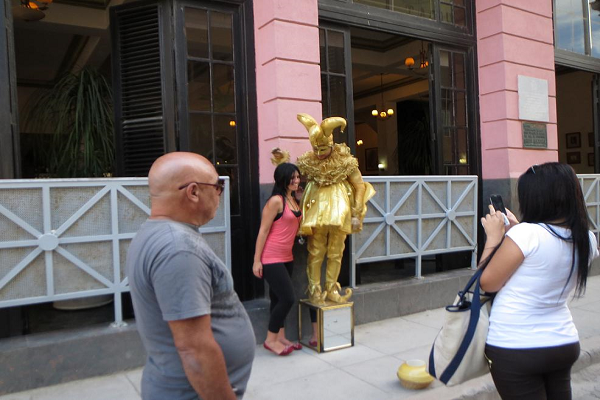
En Obispo también hay "estatuas humanas"

In Obispo also there are “human statues.”

La calle Obispo está llena de policías

Obispo Street is full of police.

Nunca llegó a rascar el cielo el primer rascacielos de Cuba

The first skyscraper of Cuba never got to scrape the sky.

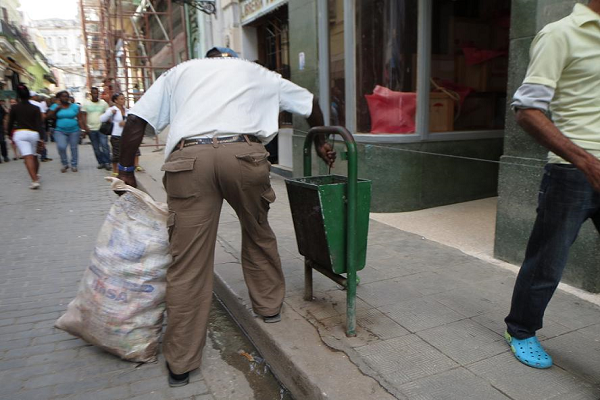
Recogedor de latas vacías

Empty can collector

Único mercado en Obispo para habaneros de a pie

The only shop in Obispo for common Habaneros.

January 24, 2014 / Jose Hugo Fernandez

Note:  The books of this author can be acquired at the following addresses:  http://www.amazon.com/-/e/B003DYC1R0 and www.plazacontemporaneos.com

Translated by mlk.

Detained Half an Hour on Marta Beatriz’s Stairway / Lilianne Ruiz

Community Communicators' Network on the ground floor of the building -- Courtesy of Marta Beatriz
Community Communicators’ Network on the ground floor of the building — Courtesy of Marta Beatriz

HAVANA, CUBA — This last Wednesday, I was walking quickly through Belascoain, disgusted by the odor of urine from the doorways. Every once in a while a peddler called his wares. On arriving at Zanja, crossing the street, the area was deserted. Three men in plainclothes blocked the door of building 409, where Marta Beatriz Roque Cabello lives.

I tried to ignore them and continued. The door was locked.

“Where are you going?”

“Who’s asking?”

The man, with an eastern accent, responded while putting in front of my eyes an identity card with initials in red: DSE.

“State Security Department, my dear,” he said with that lack of professionalism that one cannot imagine.

He did not clarify what it was all about. He again asked me the first question, and I told him that I was going to see Marta Beatriz Roque.

He took my identification and led me inside the building. He called one of his minions, a black man about two meters tall and more than 50 years of age, whom he called “brigade-ist.” And he told him, “Keep her here, she cannot go up to see Martha Beatriz.”

A thermos of coffee on one of the steps of the wide staircase betrayed the complicity of some neighbors with the political police.  Two uniformed policewomen appeared on the scene.  The “brigade-ist” charged one of them with watching me. continue reading

Escalera-de-Martha-Beatriz-Roque_dos-mujeres-policías_foto-tomada-de-internet-300x200I tried to find out what had happened to the boys of the Communicators Network, which was supposed to meet like every Wednesday in the home of Marta Beatriz, director of the group. The answer could be assumed, but getting a statement from the authorities is always the most difficult. I did not get one.

Beginning last November 19 there has been a police blockade around Roque Cabello and the group of community reporters who from their locations in 9 provinces report on events that affects the lives of common Cubans: collapses, evictions, disasters in medical care, and social security. All these testimonies absent from the massive official medial, monopolized by the State.

In all, the members of the Network come to 127. They have a common denominator: They are not afraid; at least this situation has not managed to paralyze them. They have managed to get people to tell their stories with their complete names and photographs! Sometimes even their personal address.

They have a bulletin entitled Hairnet which is published every fifteen days. Hairnet is printed and distributed clandestinely within Cuba.

Other digital sites like Cubanet, MartiNoticias, Diario de Cuba, Miscelaneas de Cuba and Primavera Digital publish their accounts. They have served other independent reporters by identifying items of interest.

Precisely, I had gone there in order to write about the boycott, the physical attacks, acts of repudiation, arbitrary detentions of them; perpetrated by the political policy with the collaboration of some neighbors of the building. The only thing that I could do was try to obtain more information.

I again asked the uniformed policewoman about the members of the Network.

“Are they detained?”

“I do not know. I cannot explain it to you.”

“Can I make a telephone call?”

“No.”

I asked her if she had no doubts that what she was doing was correct.

“You’re going to convince me that what Marta Beatriz is doing is fine?” she asked me.

It seemed to me that she doubted.

“What do you think that Marta Beatriz does?  It’s not going to be the bad thing they have told you,” I said at my own risk.

I got no answer. I went on to explain to her that citizen journalism is a right protected by the Universal Declaration of Human Rights, and that if she was not familiar with the document, I told her that in the civilized world anyone can express his opinions, even against official policy and not be bothered for it. Much less by the police, charged with protecting the tranquility and freedom of citizens.

She ordered me to shut up. A commotion ensued that made the second woman police officer come down the stairs. Until this moment, she had been on the landing obviously in order to impede Marta Beatriz from leaving her home.  The two policewomen and I were arguing with raised voices when we saw Marta Beatriz taking photos on the stair landing. One of the women ran after her, jumping the stairs.  She shrieked, “Stupid, get in the house and don’t even stick your head out!”

They opened the door each time some neighbor entered or left. The terrifying thing was seeing how the tenants greeted the police or simply moved along.

That made me think that, indeed, we would not have to wait to become a majority in order to obtain constitutional recognition.

Marta Beatriz Roque Cabello directs the Cuban Community Communicators Network.

After about 30 minutes, they took me to a patrol car. On arriving at the traffic light of Calzada del Cerro and Rancho Boyeros, they handed me my identity card and I understood that I could go home, when the same policewoman who argued with me said with gritted teeth:

“Freed today.”

On arriving home I called Marta Beatriz.  She told me that that day they had detained 16 people at the door of her home; 15 journalists plus a server.  But those were freed in places as distant as the “La Monumental” highway or the municipality of Caimito in the former Havana province (today Mayabeque).  They left me, I do not know why, at the corner of my house.

January 24, 2014 | 

Translated by mlk.

Uprooted Population Accepts Denigrating Employment Rules / Juan Juan Almeida

Since General Raul Castro formally occupied the throne of Cuban power February 24, 2008, he publicly promised to clear a series of obstacles and assured in a highly theatrical ceremony the creation of a kind of hospital where the infirmities of a worn out country that has been sold egalitarianism could be healed and where for more than half a century the human beings belonging to whatever gender, age, ethnicity or religion have not managed to become equal.

Alfred Adler, the Austrian founder of individual psychology, said that the superiority complex that accompanies the supposedly distinguished social classes is simply an effort to compensate for true, hidden feelings of inferiority.

So, as was expected, such an illusory path towards national progress, rather than advances, brought a significant regression in the social reality and needs of a people.

Our country is sick and in a terminal state. The palliative medicine called political reforms is nothing more than a tendentious manipulation that failed with the emergence of a class, or better said a claque; and with it, an unchecked increase of stale inequalities that already were abysmal. continue reading

Obviously, it is not my idea in this article to criticize those so vilified rich, because I have already said many times that, new or old, it seems to me very fine, and I don’t see anything bad or arrogant or offensive in the fact of having money or quantifying wealth.

I refer to those other characters that have launched a paladar — a small private restaurant — or made a hostel of their houses. A new group of entrepreneurs who on earning with their businesses, as if by magic they inherit a certain governmental arrogance and believe themselves deserving of it.

There is something that we all believe but on certain occasions we do not want to hear. The satisfaction of our material needs only finds fulfillment provided that they are repaid with educational and cultural growth.

In Cuba we are living in a curious, vertiginous and singular period of change in social relations. A new paragon, a new structure, where this group of people who through boredom, imitation or because of the illusion of uncertainty, adopt the old customs of institutional mistreatment and bet on an archetype of entrepreneurial behavior worthy of dead magnates, in which democracy is reduced to a facade, or a ridiculous and incongruent word-of-the-day incapable of convincing the whole of society.

The abuse, unacceptable from any point of view, cannot nor should it treat people as property; the worst is that as a dark metaphor that encloses an open ending, the Cuban workers, members of an uprooted population, with low self-esteem and victims of oppression, turn these injustices into the order of the day and accept denigrating rules of work with long days, miserable wages, intellectual debasement and sub-human conditions, as if it were about a model of neo-slavery.

Translated by mlk.

21 January 2014

The Car in Cuba: To Die With Face to the Sun or to Live With Eyes Closed / Juan Juan Almeida

If you have some years like I do, you will remember that some time ago, trendsetters, while they publicly occupied radically conflicting positions on the big billboards of the ideological scene, coexisted embraced in the comfort of the only and non-proletarian star of Mercedes-Benz.  Beautiful symbol that still today represents a kind of category for those who are anchored to the era of the World War and “the Cold War.”

In Cuba, the hunger to buy a status symbol doesn’t mean the brand of the Teutonic giant, but any car with the flavor of liberty and air conditioning.  The gentlemen “upstairs” well know that under the publicized slogan of “updating the model,” more than achieving the dreams of a sacrificed people, is to make money off them.

The Cuban government eliminated the uncomfortable restriction that demanded an official permit to acquire a vehicle, but in exchange, the prices are astronomical. Before this new measure, the privilege of having a modern and private car was only within the reach of a certain number of workers, a limited group of high officials (this includes friends, girlfriends, lovers, brown nosers, relatives), famous artists and elite athletes. continue reading

Prices might infuriate, but not scandalize.  Experience has shown me that there is nothing easier in our archipelago than to die facing the sun, or to live with eyes closed.  Cuba is a captive market without second options.  As the days pass, Cubans will accustom themselves to this new level of “anti-life.”  Did something happen in the afternoon in which without warning they raised the prices of milk, electricity, water, soap, beer, and gasoline?

The wheeling and dealing in used cars, whether of second or seventh hand, will continue functioning and hybrids will be imposed.  Permit me to clarify that the Cuban hybrid car is not conceived in that classic conceptual format that you know, which combines a combustion engine with an electric one.

It is a work of art, a colossus of the industrial gothic; which to achieve, primarily you have to acquire a circulation permit for a non-existent or hopeless car; then resolve by any means possible an authorization to buy a rebuilt motor for this supposed automobile that only appears on paper.  With that paper, the motor and some indulgent gratification, known as a bribe, which never hurts, get another authorization to buy a body in the path of what one day were rental cars for tourists; and finally, with everything in order and a magician, this Frankenstein is assembled that, simply said, broadly speaking, sounds ugly but is beautiful.

The new cars, without doubt, will be sold, including the Peugeot 508 for 262,000  dollars.  Someone has to show off, and for that there is everything; presumptuous officials, artists, athletes, new style self-employed, repressed with dollars under the mattress, and of course, the kings of the dawn.  In short, the speculation of Havana.

I do not believe that any businessman, nor the buzzards of “Cuban-American merchandising” that are now taking their baby steps of sending cars (stolen, new or used) from Miami to some nearby port, in order to then locate them in Havana, inspired in this apparently anarchist measure, and excited about the car show, might be able to travel and sell cars on the island to everyone who wants to buy.

In the emerging car business of Cuba it is not the market but the State who will dictate guidelines. An old government tactic called plunder with iniquity.

Translated by mlk.

10 January 2014

The Fate of the Six Cubans of El Dorado / Juan Juan Almeida

Today, although motivated by shaking the walls with the scoop in the competitive world of information, knowing that six Cuban citizens are bogged down in Bogota facing the possibility of being returned to Cuba moves me.

Angel Barrios Cabrera (33), Eudardo Roldán López (39), Greysi Padrón Basulto (27), Yoanker Paradela (30), Brian Betancourt (41)  and Nayip Mayo Horta (31), without pursuing the fate of Icarus, in order to escape from the island and from Minos, decided to jump and fly on a sea of uncertainty to Ecuador, a county that even with all documentation in order, did not permit them to enter.

It is true that at any border, immigration officials have the last word to permit us access or not to the territory on arrival; but it is noteworthy that this pattern of behavior with regards to the return of Cubans is becoming habitual. continue reading

So habitual that it now raises suspicion and even smells of the existence of a prosperous but incipient business destined to finance the updating of the new Cuban economic model.  I cannot guarantee it; but the lack of evidence and the obvious increase of the flow of returned Cubans is food for thought, and a lot.

Rejected in Quito, and taking advantage of the return trip to Havana, they decided to stay in Colombia and after days stranded in the El Dorado international airport, this Saturday, January 11, Bogota extends them a safe conduct permit to enter the country for 10 days, valid starting this Monday, so that they can go out, move through the city and reside temporarily in one of the refugee centers of the ACNUR, an agency of the UN.

Here it should be noted that when I spoke to one of them, whose name I do not say because as my grandfather used to say, “A deal is a deal, and respecting it is gentlemanly,” he told me that a good Samaritan Cuban had gotten them toiletries, clothes and food. Bogota is a very cold city inhabited by warm and supportive people.

He also told me that this immigration waiver will allow them this week to prepare and present the refugee claim before the Colombian Chancellery, and in this way get an extension of the document that will permit them to stay in that country for a period of two or three months.

I believe it’s quite clear that the fact that the Colombian authorities have granted this kind of safeguard is only a step which, of course, is thoroughly appreciated, but it does not mean that they have granted them refugee status.

In my personal opinion, it is a simple political measure by Bogota, with the clear intention of not affecting relations between the governments of Colombia and Cuba, besides not obstructing the peace process that curiously and opportunely just resumed in Havana after a recess taken by the negotiating parties and the good reason of the December holidays.

On ending my long and often interrupted telephone conversation with one of the six Cubans, he asked him to please call his mother in Cuba, and so I did.  After conveying the good news and all the rest, I was surprised by the reply of a woman who with incredible strength answered, “You tell him. . . that I will miss him like crazy; but not to give up and to fight, only in this way are dreams achieved.”

Translated by mlk

16 January 2014

The Cuban Government Mocks its Citizens / Anddy Sierra Alvarez

The Cuban government reaffirms to its citizens that transformations are directed towards psychological oppression, and at the same time it mocks Cubans as a way of demonstrating absolute power.

The law approved in January 2014 by the Cuban president — the sale of automobiles — reveals the great achievements that will be realized in 2014 by the present governing system.

With the development of approved prices for the acquisition of an automobile ranging up to a quarter of a million (250 thousand dollars) the news caused many capital residents laughter and disappointment for those who were planning to buy a car in better and more current condition.

One of those affected, Reinier Corrales, 45 years old, resident of Arroyo Naranja, considers that he sold his Toyota at 18 thousand convertible pesos (CUC) in order to improve by another more modern one.

“And now what do I do,” anguished Corrales asks, “I planned to trade up and not even my house is worth what the government wants for a 2013 car,” he says.

Reinier and many others have been affected by this decadent and brutal situation of supersonic price manipulation that the government has established through 55 years of totalitarian power. continue reading

If some fortunate one were to decide, the gain would be for them three times greater than the wholesale cost, and I am sure that it would not exceed 50 thousand dollars.

Currently it is the main topic on the streets.  Cubans have stopped worrying about food and have focused on whispering and debating opinions on the topic in question.

Maybe State Security has not noticed Cubans distracted a little from their daily economic distress by what many repeat, “What will I buy myself. . .?”

Translated by mlk.

17 January 2014