The José Martí power plant was taken out of service, like many others in the national electricity system, due to obsolescence and lack of maintenance.
The authorities said that the two tanks, their access pipes and the spill containment trays were in total disuse / Girón
14ymedio, Havana, 23 May 2025 — The authorities of Matanzas have not explained why they never “gave a destination” to the 500 cubic meters of fuel stored for ten years in two tanks of the old José Martí thermoelectric plant, which this Thursday suffered a leak. The latest official press report, published early this Friday, explains that it has not yet been possible to suction the mixture of fuel oil and crude stored there since 2015, which now threatens to spill into the bay.
Located in the industrial zone of Matanzas, the José Martí power plant was shut down, as were many others in the national electricity system due to obsolescence and lack of maintenance. It is not explained why that amount of fuel was kept there; according to the newspaper Girón, it was used to start up the plant.
The authorities said that the two tanks, their access pipes and the spill containment trays were in total disuse. According to Román Pérez Castañeda, director of the Antonio Guiteras thermoelectric company, which has jurisdiction over the ruins of the Martí, “certain actions” had been taken to extract the oil, but they were not successful.
The contents of the tanks ended up pouring into the tray this Thursday, and the official press published shocking images. The substance, of remarkable viscosity, occupies all the surface around the tanks. “Something may have gone wrong with the tank body itself or with the access pipes,” said Castañeda, who has so far given no satisfactory explanation for both the disaster or the fact that this continue reading
amount of fuel was stored and available.
Several actions are now being undertaken to “minimize the risks of a disaster,” an unsettling phrase given that the Supertank Base that burned down in 2022 is not far from there, and two years later a tank of the Guiteras itself burned. An attempt is being made to prevent a similar fire in the Martí, and rock material has ben brought with a view to making a trench and pressurized steam has been fired to decrease the viscosity of the crude oil and facilitate its extraction.
That the fuel will eventually spill into the bay is one of the scenarios envisaged, judging by the report from the authorities. They have therefore taken unspecified measures to “reduce the damage to the Matanzas frog population,” a task for the fire brigade.
As a sort of nostalgic note the authorities have recalled that the Martí was once a jewel of the national electrical system. It was the “most reliable block” before its exit from the grid in 2015, and “one of the most efficient,” as well as operating with domestic crude.
On Friday morning, Girón merely said that the extraction “progresses.” Other official reporters have commented on the news to emphasize that it is “oil for non-commercial use” and that, as the journalist José Miguel Solís said, the leak was only a “scare.”
Shaken by the recent energy disasters in Matanzas, many readers have asked questions: “How many years has it been out of use? Why do these tanks store that dangerous residue? What if there was no lightning rod? Was it a short-circuit? Or negligence? What was the cost of the dangerous disaster of not so long ago? Aren’t the tanks checked and serviced regularly? And don’t firefighters inspect those hazardous areas or other areas that are their concern? And, my friends, one wonders how long this will go on.”
Translated by Regina Anavy
____________
COLLABORATE WITH OUR WORK: The 14ymedio team is committed to practicing serious journalism that reflects Cuba’s reality in all its depth. Thank you for joining us on this long journey. We invite you to continue supporting us by becoming a member of 14ymedio now. Together we can continue transforming journalism in Cuba.
The Cuban capital is the most affected by emigration, in addition to registering an infant mortality rate of 10.2 per thousand, the highest in the country.
Cuba’s average age continues to rise, and in 2024 it increased by two-tenths compared to the previous year. / 14ymedio
14ymedio, Madrid, 23 May 2025 — That the mortality rate in Cuba is higher than the number of births is nothing new. The population growth been negative for years and there is no possibility of reversing it, given that the average age continues to rise. In 2024, it increased by two-tenths of a percentage point compared to the previous year nationwide, but the situation in the capital is particularly dire.
Havana recorded 27,864 deaths last year, approaching three times as many as births, which were 10,783. In total, the province ended December with 1,749,970 inhabitants, a total of 64,237 fewer than in 2023. Of this figure, 47,156 were due to emigration, according to data published this Friday by the National Office of Statistics and Information (ONEI).
As if that wasn’t bad enough, infant mortality also hit the capital hard, with 10.2 per thousand births, Havana leads the country with the saddest rate and drags the Island-wide figure down to the 7.1 announced at the beginning of this year, despite Sancti Spíritus achieving a commendable and surprising 3.6.
All provinces have high negative migration balances, both abroad and in total.
The figures, which appear in the report on demographic indicators for Cuba and its territories, confirm that the island closed 2024 with 9,748,007 inhabitants. However, a recent independent study reduced that figure to eight million, a total of 307,961 fewer than the previous year. Of these, 128,098 were deceased, while 251,221 were lost to emigration.
This is a well-known but worrying indicator, as all provinces show high negative migration rates, both abroad and overall. Havana, for example, once again stands out for its outward migration rate, with a rate of -36.1 per thousand (only Isla de la Juventud exceeds it, with -36.5). This figure is tempered by the share of migration that is to other provinces, leaving the continue reading
capital with a total migration rate of -26.5 per thousand leaving the Island.
The opposite is true for the eastern provinces of Granma, Santiago de Cuba, and Guantánamo, which have rates of only -16, -17, and -18 per thousand for emigrants leaving to go abroad, but their internal migration rates raise the figure to -22.4, -22.6, and -26.6, respectively. Overall, Isla de la Juventud, Camagüey, and Cienfuegos are the provinces with the largest emigrant populations, while Pinar del Río has the highest rate of citizen retention, despite having a migration rate of -20 per 1,000.
The figures for the increases in the mean and median ages are also rising. In 2023, it was 42.2 compared to 42.5 in 2024, while the median (the most common) has risen from 44.1 to 44.5. Although the difference seems minimal, it shows a constant increase, clearly due to the low birth rate and high emigration of people of working age. There is absolutely no province where the average age is less than 40 years, with Artemisa and Guantánamo being the youngest (both at 40.1) and Cienfuegos and Villa Clara the oldest, at 44.9 and 44.5 years, respectively.
In the eastern part of the island, fewer young people have the opportunity to emigrate due to the higher poverty rates.
Regarding the crude birth rate, Guantánamo again displays a double-edged sword: it has the highest number of births—9 per thousand—followed closely by Santiago de Cuba, with 8.9. This also reveals that fewer young people have the opportunity to emigrate, a result of the higher poverty rates in the eastern part of the island.
For its part, Havana is the province with the fewest births per thousand inhabitants, with 6 births per thousand. Sancti Spíritus and Cienfuegos follow, with 6.1 and 6.2, respectively.
Regarding overall mortality, the capital stands out again, reaching a rate of 15.6 per 1,000, presumably due to its aging population and despite having more and better healthcare facilities. Villa Clara, with 14.8, is close, while Guantánamo has only 9 deaths per thousand, a consequence of having a younger population.
Authorities have repeatedly lamented Cuba’s low birth rate, although they compare it with other developed societies and cite women’s emancipation as the underlying cause. However, in those other countries, in-migration cushions the population decline and aging. On the island, however, in-migration is almost nonexistent.
In the midst of a demographic disaster that worsens year after year, the government has yet to implement any measures capable of stemming the flow, and experts wonder how long the remaining social system in Cuba will be sustainable without new blood to feed it.
COLLABORATE WITH OUR WORK: The 14ymedio team is committed to practicing serious journalism that reflects Cuba’s reality in all its depth. Thank you for joining us on this long journey. We invite you to continue supporting us by becoming a member of 14ymedio now. Together we can continue transforming journalism in Cuba.
“We remain unsheltered, homeless, and seeing no real progress in the reconstruction of our building.”
El hueco que ocupaba Prado 609, entre el hotel Saratoga y el edificio Yoruba, en La Habana, este martes. / 14ymedio
14ymedio, Juan Diego Rodríguez/Olea Gallardo, Havana, May 6, 2025 — A massive police presence could be observed around the former Saratoga Hotel and an adjacent building on Tuesday, three years after an explosion destroyed both structures and left forty-seven people dead. The resources employed by authorities to monitor the site on the anniversary of the accident were inversely proportional to the attention given to the demands of the evacuated residents, who took advantage of the opportunity to publicly express their grievances.
“As a resident of 609 Prado Street, I am posting this message to denounce the complete neglect of the victims by authorities,” writes Bárbara del Carmen Tenreyro Pérez on her Facebook page, summing up the situation of the building’s former residents. “We have been unsheltered and homeless for the last three years, and have seen no real progress in the reconstruction of our building.” In fact, residents say, work has been at a standstill for the last six months.
What remained of the building after the explosion was demolished in May 2023. A few months later, the government assured residents they would be able to return to their homes in 2025, claiming they would be rebuilt in the same location. “What they promised were just empty words. The official date for the building’s completion.
Nor has there ever been a full explanation of what happened. Authorities initially attributed the incident to possible leaks in the hose of a tanker truck that was supplying liquefied natural gas to the hotel at the time of the explosion. An investigation was promised but no findings were ever released. “What is most painful is the silence,” said Tenreyro. “No one tells us anything, no one helps us, no one responds to our concerns.” Her post included several photos showing the scene before and after the incident.
Using the same images to illustrate her own comments on the situation, Katherine T. Gavilán writes, “Another May 6th [has come around] and they are still homeless. Some have decided to leave the country while most are still living in Villa Panamericana. The relatives of those killed in the incident and everyone else are still awaiting the results of an investigation but there continue reading
is no news.”
Gavilán notes that, two years ago, families who had been living in the building’s twenty-seven apartments were informed that “they would be able to return to their homes by August 2025.” She adds that residents delivered letters to the local government, the National Assembly and the hotel’s owner, the Business Administration Group (GAESA), last year.
GAESA, the owner of the hotel, told residents that it “had nothing to do with matter”
GAESA, a business conglomerate run by the Cuban military, has owned the hotel since 2016, when it was seized from Habaguanex, a business subsidiary of Havana’s once all-powerful Office of the Historian, headed by the late Eusebio Leal. According to Gavilán, GAESA told residents that it “had nothing to do with the matter.” They received no response from the other two government entities other than to say that “the person in charge of the issue was the Havana government’s head of construction.”
Gavilán adds, “A little less than a month ago, one of the residents, acting on behalf of the entire building, requested a meeting with Namán Morales, the official in charge. Morales’s aide said she would discuss the matter with him and would call back in a few days. The following week, the aide said that she had not been able to speak with him. Gavilán got the same response fifteen days days after her initial contact.”
If the authorities had taken any steps, we would have heard about it. It has been well over a year since they have given us any information,” she complains, adding that none of the various government agencies responded to letters that one resident delivered to them in person.
“Initially, they provided a bus for us here but took it away because there was no fuel
They tried to deliver another letter to the Communist Party Central Committee on Monday but were unable to do so due to lack of transportation from the area where they are being housed. “Initially, we had a bus. It took us from the Villa every day and brought us back in the evening. But they took it away because they they didn’t have the fuel to keep it running,” she says.
The biggest problem in Villa Panamericana is not transportation, however, but running water. “Here, water here is only available here one or two times a day, for an hour. That’s when we have to fill tanks, jars and plastic jugs to last us the whole day. It’s what we use for the bathroom, for bathing, cooking, cleaning, for everything.”
Living conditions for the former residents vary, along with their complaints. “One neighbor had a swarm of rats. To shut her up, they sent an exterminator but no one fixed the furniture the rats had been eating. Others have had serious problems with leaks. Others with termites, even in the doors and windows.”
Work stopped last November, “after they poured the foundation,” she says. “There was never an explanation as to what caused the accident. They have never given us that information and we’re tired of asking for it.”
Residents were told that “construction would begin on February 24 and would be completed by December 25, that the building would go up quickly. Now look at where we are.” Work has been stalled since November, “after they poured the foundation,” she says.
A photo posted by residents on social media on Tuesday shows a hole in the foundation of 609 Prado Street, with bare concrete and stacks of rebars left here and there. Gavilán estimates it was taken in late December or early January” from the roof of the adjoining building, the Yoruba Cultural Association of Cuba. “No one else has been able to take photos [since then] because they covered up that little hole.”
A hole of the slab of 609 Prado Street as seen from the rooftop of the Yoruba Building Facebook
Located a few yards from Havana’s Capitol building, the site would normally be considered very desirable. Before the explosion, several families made money by renting out rooms to tourists but have been unable to do so for the last three years. The move to East Havana has not only deprived them of this economic opportunity, it has also completely cut them off from the retail network they relied upon and from the schools their children attended.
Meanwhile, reconstruction on the iconic Saratoga has also come to a standstill. Almest, a real estate developer affiliated with the the Armed Forces ministry, was tasked by the government to carry out the work in conjunction with an an unnamed French company, widely believed to be based in the city of Bouygues and to have worked on the construction of twenty-two luxury hotels on the island.
On the first anniversary of accident last year, Cuban architect Luis Ángel Gil, who now lives in Spain, shared a proposal on social media for renovating the hotel. He proposed a new name, Kairós Saratoga, after the classical Greek words for “opportune moment.”
His basic idea was that the building would act “like a horizontal opening” so that “users would not feel enclosed by walls and could enjoy the excellent views the site has to offer.” To achieve this, he proposed incorporating “a vertical park” that would serve as “a natural extension of the existing public space,” enveloping the building and “strengthening the connection between architecture and nature.”
This proposal, ignored by authorities like the still unknown plan that officials might have, seems to being lying dormant in a drawer somewhere.
____________
COLLABORATE WITH OUR WORK: The 14ymedio team is committed to practicing serious journalism that reflects Cuba’s reality in all its depth. Thank you for joining us on this long journey. We invite you to continue supporting us by becoming a member of 14ymedio now. Together we can continue transforming journalism in Cuba.
Imagen de uno de los videos compartidos en redes mostrando la protesta del miércoles en Bayamo, Granma. / Captura
14ymedio, Havana, May 22, 2025 — Facing rising temperatures and a daily 1,500-megawatt energy shortage, Cubans are again taking to the streets in protest. The latest demonstration took place Wednesday night in Bayamo (a town in Granma province) and in Santiago de Cuba.
In videos posted on social media, several people can be heard shouting, “We want electricity; we want food.” Martí Noticias reported the protest took place in Bayamo’s Jabaquito neighborhood. “This could explode again at any moment because we still don’t have electricity,” a local resident told the Miami-based newspaper.
“Police intimidation now in Bayamo. Access to Jabaquito Road is closed. People in the streets. Firefighters also brought in for reasons unknown. Right now protesters from different parts of the city still taking to the street,” read one post on X that also included images.
“People in the streets. Firefighters also brought in for reasons unknown”
Thus far, there have been no reported arrests. This is not the case in Santiago de Cuba where, according to Mayeta Labrada, residents were banging pots and pans in protest. They can be heard chanting”food and electricity” in a darkened video recorded by the US-based journalist from a building in the city’s Micro 9 neighborhood.
On Thursday, state media in Santiago de Cuba reported that a shipment of donated rice and pasta had arrived the night before and would be distributed soon to a limited number of towns in the province. It did not continue reading
indicate whether or not this was being done in response to the protests. The shipment is intended to fulfill the monthly ration quota for March, which is now two months overdue.
“The distribution prioritizes ensuring access to basic foodstuffs at a time of scarcity, benefiting families in municipalities such as Santiago de Cuba, Palma Soriano, Mella, Contramaestre and Guamá, who will receive one kilogram of rice per person,” the local newspaper “Sierra Maestra” reported. Meanwhile, each consumer in Tercer Frente, Songo-La Maya, San Luis, and Segundo Frente will receive one kilogram of pasta.
The article described this as a “humanitarian action” and an effort by the local government to alleviate the economic and food hardships affecting the population.” It also alluded to the age-old enemy, the “economic blockade.”
In Pinar del Río, the “difficult electrical energy situation” means that the “National News” program is broadcast only on the radio
“Despite structural limitations, the provincial government is looking for alternatives to mitigate the impact of the crisis, though challenges such as insufficient local production and reliance on international aid persist,” the article states. “The population hopes that these measures will be complemented with longer-term solutions that strengthen the region’s food autonomy.”
Meanwhile, residents in Pinar del Río’s Hermanos Cruz neighborhood (popularly known as El Calero) took to the streets. “The strange thing is that a July 11th doesn’t happen every day,” said a resident of Sancti Spíritus, alluding to the massive protests that occurred on that day in 2021. Power outages in the area have been relentless. “Maybe depression is getting the better of us. That is also paralyzing,” he adds.
“No electricity all morning” was the message from one resident of Camajuaní, a town in Villa Clara province where the power is off longer than it is on. “I couldn’t sleep all morning but I couldn’t go to work either. I am dying of exhaustion,” she says.
In Pinar del Río, the “complex electrical energy situation” is affecting reception of the region’s television signal to such an extent that, on Wednesday, “National News” could only be heard on local radio. Yesterday, the national television interview program “Mesa Redonda” (Roundtable), whose theme that day turned out to be the electricity shortage, also had to be broadcast on the radio.
Once again, the Cuban Electricity Union is forecasting a 1,570-megawatt power outage for Thursday, almost the same as yesterday’s 1,578 megawatts.
____________
COLLABORATE WITH OUR WORK: The 14ymedio team is committed to practicing serious journalism that reflects Cuba’s reality in all its depth. Thank you for joining us on this long journey. We invite you to continue supporting us by becoming a member of 14ymedio now. Together we can continue transforming journalism in Cuba.
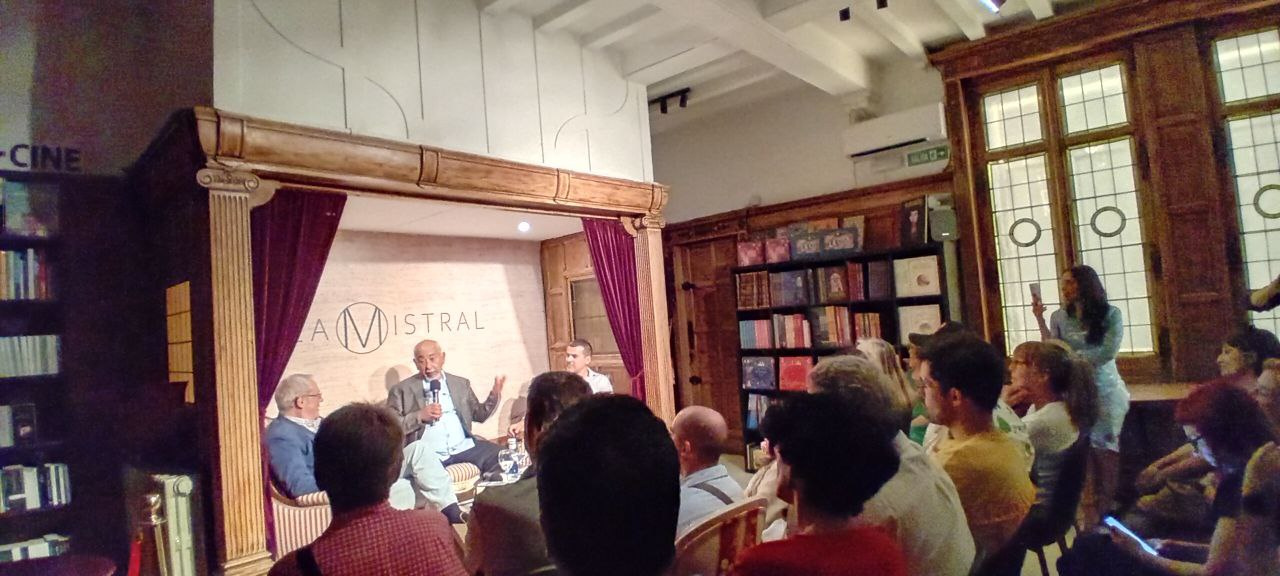
Leonardo Padura presented his book this Wednesday at La Mistral, a few meters from the Puerta del Sol in Madrid / 14ymedio
14ymedio, Yunior Garcia Aguilera, Madrid, 22 May 2025 — Madrid starts the week in full swing with Cuban literature. On Tuesday, Carlos Celdran presented his book -with two plays- at the Arenales bookstore. A day later, Roberto Carcassés presented his first novel at El Argonauta, while Leonardo Padura attended the presentation of Un camino de medio siglo: Alejo Carpentier y la narrativa de lo real maravilloso, at La Mistral. Despite the coincidence, the audience filled all the seats.
Padura shared a table with Luis Rafael Hernández, director of the publishing house Verbum, and the Spanish critic and professor Fernando Rodríguez Lafuente, former director of the Cervantes Institute. The conversation was a kind of meeting between the living and the dead, a contest between the marvelous and the harshly real, but also a confession of the fears that have accompanied generations of Cuban writers.
Winner of the Princess of Asturias Prize for Literature (2015), Padura does not hide Carpentier’s influence on his work, even though his colleagues joked that every writer should “erase the traces of his referents”. Carpentier himself used to say that “writers should not talk about their masters, so that the seams do not show.
The label of the Latin American boom has also been applied to Borges and Carpentier, without much nuance. The result: theoretical confusion and the lumping together of different literatures. continue reading
In 1978, Padura wrote a review of La consagración de la primavera, which El Caimán Barbudo subtitled “Más realismo que maravilla” (More realism than wonder). “It was already a novel in which the ’marvelous real’ didn’t work in the same way; you had to look at things from a different point of view,” he explained. But critics continued to work with the same aesthetics, the same categories. The label of the Latin American boom was also applied to Borges and Carpentier, without much nuance. The result: theoretical confusion and the lumping together of different literatures.
Padura drew a clear line: magical realism accepts the fantastic as an indistinguishable part of reality; marvelous realism, on the other hand, presents the magical from a logical, almost rational approach.
The research underlying this essay began in the midst of the Special Period, when access to information in Cuba was a titanic task. To write The Man Who Loved Dogs, he had to rely on friends with free Internet access who downloaded PDF files from abroad. “We’re talking about 2006 or 2007. Imagine what it was like before,” he said.
“In the 1990s, I wrote like a madman in order not to go crazy,” he confessed without laughing. And he recalled that when he gave the essay to Carpentier’s widow, “there were things she didn’t like because she was very jealous, very widowed.”
Thanks to this research, he was able to better understand Carpentier’s concept of history, his vision of space and, above all, his interpretation of the concept of revolution, which Padura considers “very saccharine” and with which he admits to disagreeing. He also told an anecdote that illustrates the biographical ambiguity of the author of The Century of Enlightenment: for fear of being deported during the Machado regime, Carpentier claimed to have been born at 14 Maloja Street in Havana, when in fact he was born in Lausanne, Switzerland. “All in all,” added Padura, “he is the most Cuban Swiss-born writer one can imagine.”
“The writers of the 1970s who survived wrote in fear. And later generations have not been completely free of it.”
In addition to Carpentier, the author revealed three other great references: Vargas Llosa, Cabrera Infante – “who taught me to write in the Havana language” – and Manuel Vázquez Montalbán – “who showed that it was possible to write police literature that was, above all, literature”. “I’ve been wanting to write a note for about two years, and I couldn’t do it while Vargas Llosa was alive, because it might seem like I was buttering him up” he joked.
The writer recalled that his years as a student at the university were marked by a power that demanded “a Marxist understanding of history”. In addition, the culture of the island suffered the ostracized death of two “phenomena” of world literature: Virgilio Piñera and Lezama Lima.
“It was very difficult” – Padura admitted – “something that has deeply affected Cuban literature is fear. People wrote with fear. The writers of the 1970s who survived wrote with fear. And later generations have not been completely free of it.”
Translated by Gustavo Loredo
____________
COLLABORATE WITH OUR WORK: The 14ymedio team is committed to practicing serious journalism that reflects Cuba’s reality in all its depth. Thank you for joining us on this long journey. We invite you to continue supporting us by becoming a member of 14ymedio now. Together we can continue transforming journalism in Cuba.
Inspectors no longer spread terror with their fines and evictions in illegal settlements.
While some houses resemble more of a crumbling shack, others have solid block walls / 14ymedio
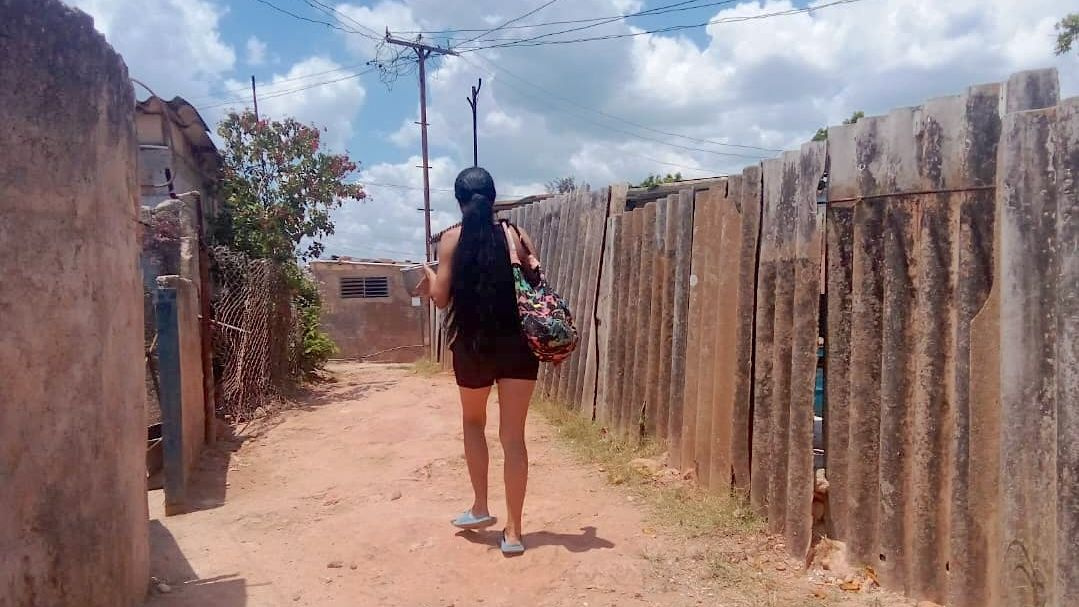
14ymedio, Julio César Contreras, Matanzas, May 11, 2025 — Walls made of rusted sheets of metal and roofs that would not withstand a hurricane comprise most of the houses in the illegal settlement that has been growing at the entrance to the city of Matanzas, near the industrial area. Its residents, mostly from the eastern part of the country, cling to the land, despite the lack of basic infrastructure in this area near the Balcon del Yumurí, in the Dubrocq neighborhood, popular council of Versalles.
The “llega y pon” [literally,’arrive and put’] began to be erected more than a decade ago in silence, avoiding the eyes of the inspectors of the dreaded Institute of Physical Planning that, until 2021, sowed terror with its fines and evictions among residents of illegal settlements. “I arrived at this place when there were only two settlements constructed by easterners, near the old School of Trades,”says Juan Carlos, who fled from the poverty of his home province, Guantánamo.
With his own hands, Juan Carlos started cleaning up a piece of land in an area that was covered with garbage. He cleared, removed pieces of metal, leveled the ground and became a bricklayer in the process. The son and grandson of fishermen, who had grown up among fish nets and poor catches, he quickly established himself as a builder raising his own house. It was small and fragile, but it was his.
“The materials to build always have to be bought under the table. There are so many people here who do not have the resources and have had to settle for building a room made of wood and cardboard,” says Juan Carlos.”But the main thing is that they have somewhere to live. They will improve it continue reading
over time,” he adds. With a housing deficit that, in 2024, was estimated throughout the island at more than 850,000 dwellings, having a roof over your head is almost a privilege in Cuba.
Many residents in the”llega y pon” don’t settle for improvising a home and living badly inside / 14ymedio
Juan Carlos, like many other residents in the “llega y pon”, does not settle for improvising a home and living badly inside. While some houses look more like a shack about to collapse, others show solid brick walls, small terraces and wooden or metal shutters for the breeze. Social differences also arise in the neighborhood. Those who have arrived from other places in the province of Matanzas have more contacts to improve their homes. Those from the east of the country and the elderly live in the most precarious homes.
Yorelbis is one of those from Matanzas who came to the area pushed by the overcrowding in his parents’ house in Pueblo Nuevo. A State worker, he had been waiting for years for a subsidy to purchase construction materials that had been promised at his work center. The money never arrived. The State resources to build a house began to run out, and the young man, married with a pregnant wife, decided not to wait any longer.
Like Juan Carlos, Yorelbis picked out a piece of land. He built the foundation of the house and erected the outer walls with bricks recovered from collapsed buildings or bought on the black market. Finally, he divided the interior with cardboard and wood to have two rooms and a tiny dining room that also serves as a kitchen. Seen from the outside, there is no plaster on the facade, and some of the rebar sticks out just where the asbestos-cement tiles that cover the dwelling begin.
“When you arrive for the first time you feel like you are at the end of the world. There is no asphalt, and the dust gets inside you through your ears. On the other hand, the power never goes out, because we are fed by the electric line that goes to the industrial area,” says Yorelbis. It gives us an illegal power supply, and no family in the settlement pays a cent.” Although we are far from the city, here it seems we have what we need,” says the young man showing a few liters of vegetable oil he has for sale.
Entrepreneurship is also gaining ground in the neighborhood. There are several private cafes, and shops that offer cheap clothing appear here and there. There is no ration store, but there are plenty of merchants who advertise bags of bread rolls or the popular ice-cream sandwich that children make a fuss over and that empties parents’ pockets. The inspectors barely approach, perhaps because of fear or because they intuit that the residents of the area inhabit a feral universe where the law and fines accomplish little.
The smile of pride for his home on Yorelbis’s face dissolves when he lists the disadvantages of living in an illegal settlement
The smile of pride for his home on Yorelbis’s face dissolves when he lists the disadvantages of living in an illegal settlement. One of the main obstacles is the lack of an identity card with the address where he actually lives. ” We still have the papers at my parents’ house and that complicates our lives a lot,” he admits. ” Getting my pregnant wife looked after in the nearest clinic was a headache, and when the child grows up, we will see how we can enroll him in school.”
The neighborhood has been growing and is full of children. While much of Cuba suffers from an aging population, the Dubrocq “llega y pon” has many families with young children. The women carrying babies, the strollers as they go along the rough and unpaved road and the cries of newborns coming from some houses give the area a childlike cheerfulness.
But this striking presence of children also highlights one of the problems that most affects the area: teenage pregnancy. In the province, the fertility rate for the 15-19 age group is 51.5 per 1,000 women. In the poorest neighborhoods, the figures are even more alarming, with consequent problems of maternal malnutrition, low birth weight, school dropout and family material insecurity.
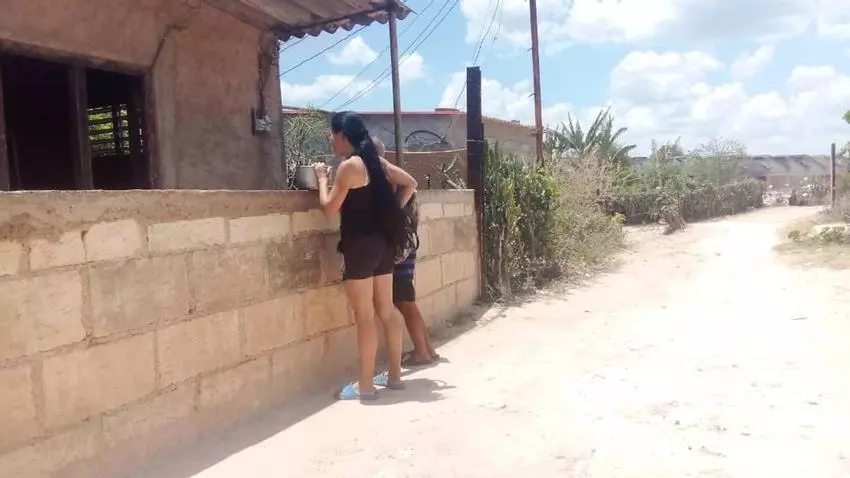
In the group of those arriving from the east of the country, many also bring their young children. “I came here from Bayamo with my two small children, because my brother left the country and gave me this room,” Yanelis tells this newspaper. Yanelis lives in a modest house made of metal sheets that were once destined to become cans. ” At least I don’t get wet when it rains,” she says.
In the group of those arriving from the east of the country, many also bring their young children / 14ymedio
Yanelis, however, does not hide her concern that she has not managed to change the address of her identity card. ” I have been able to keep my children studying with the help of the school principal, but I do not know how long that will be possible.” Although the regulations are strict to enroll a student in a school, some directors turn a blind eye or facilitate the admission of undocumented students into classrooms, aware of the serious housing problem in the country.
Like most of her neighbors, Yanelis has a long list of dissatisfactions ranging from water supply problems in the area to the insecurity that spreads between its crowded alleys as soon as night falls and the lack of recreational places for children and teenagers. However, also like many of the residents in the Matanzas settlement, she feels that this piece of dry land and precarious houses is finally her home.
Translated by Regina Anavy
____________
COLLABORATE WITH OUR WORK: The 14ymedio team is committed to practicing serious journalism that reflects Cuba’s reality in all its depth. Thank you for joining us on this long journey. We invite you to continue supporting us by becoming a member of 14ymedio now. Together we can continue transforming journalism in Cuba.
Regarding the regime’s criticism of his tours around the island, Hammer said at a press conference in Miami: “There’s nothing in the Vienna Convention that doesn’t allow that.”
14ymedio, Madrid May 23, 2025 — Mike Hammer, head of the US mission in Cuba, will continue to work as he has done in the months that he has been in office, touring the Island and approaching people. He insisted on it at a press conference held this Friday in Miami, Florida, which was broadcast live on social media.
With the affable style that characterizes him, addressing the half-dozen media in the room, he began the event by thanking “the press that does its job, in a democracy where there is freedom.” Before submitting to questions, he reiterated the line followed by the current government of Donald Trump in its policy towards the Island, headed by Secretary of State, Marco Rubio, and based on two pillars: “a return to a hard policy towards the Cuban regime” and “support for the Cuban people.”
Regarding the former, he gave as an example the sanctions announced last Wednesday on three judges and a prosecutor who intervened in the arbitrary trial of Luis Robles Elizástigui, “the young man with the banner,” stating that “there will be more. It’s a beginning, not an end,” he reiterated at question time. “This administration is determined to punish the repressors. There will be consequences for their actions, and I can’t reveal more measures that are coming but they will come, I can assure you.” continue reading
“What we don’t want to see is repressors walking around the streets of South Beach sipping their mojitos”
Regarding the errors that may be made in identifying repressors to punish them, or unjustly denying visas or residence to certain people, he acknowledged that there may be some but that they will continue with the tightening of the law. “What we don’t want to see is repressors walking around the streets of South Beach sipping their mojitos. That can’t be, it’s not fair for Cubans who want to come legally to the United States,” he said. “The Cuban people also tell me that it hurts to see repressors enjoying the good life here in the United States. How can it be, if we are the ’great enemy’, that every Cuban wants to come to the United States?”
The second pillar of US foreign policy towards Cuba has to do, he clearly stated, with his journey through the country. He has been, he said, in all the provinces, “from the west, in Pinar del Río, to the other end, the east, in Guantánamo.” And what he has heard from the majority, “almost all people, even some of the State machinery, is that the Revolution has failed.”
The diplomat continued: “There is no electricity, you see the blackouts, there is a shortage of fuel, there is a shortage of food, there is a shortage of medicines, and people recognize that the Cuban regime is responsible, which has nothing to do with any policy of the United States.”
“Those in the Regime who want to accuse us of one thing or another should listen to their own people”
“Those in the Regime who want to accuse us of one thing or another should listen to their own people,” he said, referring to the criticism he received from the Cuban government, which has described his conduct as “disrespectful”, “contrary to the rules of international law”, “unwise” and “interventionist”.
Hammer recalled his career of more than 36 years, in which, among other destinations, he was in Chile and the Congo. “As I said to the Cuban regime, I did the same thing in those countries, go out and meet people, talk to them. There is nothing in the Vienna Convention that prohibits this.”
In fact, he indicated, about Cuban diplomats on US territory, “they do it. They travel all over the United States meeting with whomever they want. Well, I’m doing the same thing; there’s nothing wrong with it.” Regarding the obligation, recently imposed by the US on these Cuban diplomats to give advance notice of their movements, he clarified that he seeks “reciprocity. It is not that they cannot go, it is that they have to notify.”
“Obviously there’s a lot of movement, you see the Ladas everywhere”
He also wondered, at various times: “What are they afraid of, if I am a simple head of mission?” He further reported that there have been threats to people not to meet with him, but that despite this, he continues to encourage them: “Keep on meeting with us, we appreciate the support.”
Asked if he does not fear that there may be an “out-of-control incident” on his tours or that they may “limit his movements,” he replied that he is not concerned about the constant surveillance he assumes is there. “Obviously there is a lot of movement, you see the Ladas everywhere. If we turn right, they turn right. I don’t like to go left – he joked – but well, if we do go left, they come with us. They are filming me constantly.”
That, he says, doesn’t matter to him: “We are saying what we are doing, it’s totally transparent.” What he is concerned about is that they have seen calls on social networks by the authorities for “trolls” and “militants” to “come and disturb” or “interrupt” their trips. It’s something, he said, “you have to keep an eye on.”
“Any state has a responsibility to protect any foreign diplomat, and I am sure that the Cuban government will comply with this.”
“In cases where the regime does not want to accept them from the United States, it has to look for other options”
About the case of two Cubans with criminal records deported to South Sudan José Manuel Rodríguez Quiñones and Enrique Arias Hierr- about which the US administration has not been entirely clear, Hammer said he was aware and very familiar with the reality of South Sudan, as he was a special envoy for the Horn of Africa. “Every month there are deportation flights to Havana. We present a list, the regime reviews it, and so far they have accepted it. In cases where the regime does not want to accept them from the United States, it has to look for other options, but it is the responsibility under international law that they receive Cuban citizens.”
The journalist who inquired about the subject asked again if what he was saying is that the Government of Havana refused to receive these two compatriots, and the head of mission avoided giving details: “I prefer the answer to be given by the State Department.”
“Is Cuba a failed state?” asked another journalist, to which he replied that it is not for him to give an answer, although an opinion was allowed: “If you have hotels where there is air conditioning for foreigners and not for your people, you are not responding to the needs of your people.”
In his speech, the diplomat also called for the release of all political prisoners and defended visiting their families: “You have to give them a little support, and they appreciate it.” And he added, “It’s unusual that someone can’t go out and express themselves in peaceful protests. In all countries of the world, more or less, that can be done. That José Daniel Ferrer and Félix Navarro, who had been released, should be imprisoned again, why? Because José Daniel is feeding his community? That has nothing to do with meeting me. They know what we talk about, they have heard everything.” He also alluded to Luis Manuel Otero Alcántara and Maykel Castillo Osorbo: “Why are they afraid of some artists?”
Finally, he spoke of the entrepreneurs he has visited, especially “micro-entrepreneurs” and, above all, women, about whom he argued that they are “people who want to earn a living because there is no other way” and have “a spirit we all share here. It is worth supporting them, especially because the State does not do so.”
Translated by Regina Anavy
____________
COLLABORATE WITH OUR WORK: The 14ymedio team is committed to practicing serious journalism that reflects Cuba’s reality in all its depth. Thank you for joining us on this long journey. We invite you to continue supporting us by becoming a member of 14ymedio now. Together we can continue transforming journalism in Cuba.
“I look out the door and it makes me feel so sad. The streets are empty. Nothing remains of the youth, everyone is gone.”
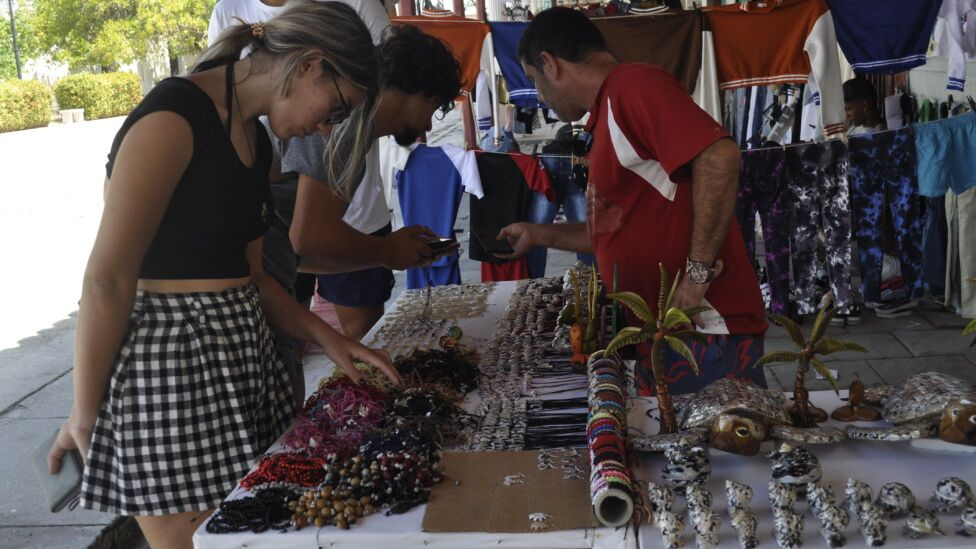
Craftsman Gerson Gonzalez waits on a customer at his stall where he sells handicrafts made from local products. / Dariel Pradas/IPS
Dariel Pradas/IPS via 14ymedio, Gibara, April 27, 2025 — On Saturday, May 19, the closing night of Gibara’s annual International Low-Budget Film Festival,* the lights suddenly went out. After a week of festivities, the abrupt power outage signaled a return to normalcy for the 70,000 residents of this city in eastern Cuba.
According to 59-year-old Hilda Freyre, there are usually two power outages a day in her hometown, each lasting six hours. An outage can sometimes last longer if there is an unforeseen problem in the electrical system.
However, there were no power outages during the five days of the town’s film festival. Dozens of tents were erected along the bay, with vendors selling food and drinks to local residents and visitors.
“I still cannot believe it. Electricity all day long!” says Freyre.
Behind a large sign bearing the name Gibara, the small Cuban coastal town in Holguín province can be seen. / Courtesy of the Gibara International Festival of Low-Rise Cinema/IPS
Many of the vendors at the festival are from out of town and come here for the economic opportunities the event provides. After they dismantle their stalls and go home, supplies fall, prices rise to their previous levels and Gibara reverts to its typically slow pace.
“I get very sad when I look through the door. The streets are empty. There are no young people on the streets and everyone has left,” says Freyre, continue reading
whose son has been living in the United States for eight years.
Gibara — also known as Villa Blanca de los Cangrejos (White Village of the Crabs) because of the shellfish that were once harvested here — is the capital of a larger district with the same name. It is located is located 771 kilometers east of Havana, in the province of Holguín.
Its decline is evidenced by the fact that a large part of its population lives off remittances sent by their relatives in other countries.
Tourism, which represents another important sector of the local economy, relies almost entirely on Cuban Americans who vacation here in the summer or at year’s end, and on the weeklong film festival, when state-run hotels and private homes fill up with film enthusiasts.
“During the festival, Gibara is a special place but not during the rest of the year. So far, it hasn’t become the tourist destination aspires to be,” says Gibara resident Jaquline Tapia, the province’s director of culture.
” I get very sad when I look through the door. The streets are empty. There are no young people on the streets and everyone has left”
Last year, Cuba experienced a decline in the number of foreign visitors. According to the National Office of Statistics and Information, this number fell to 90.4% in 2023, the worst figure since 2007, not counting the COVID-19 pandemic in 2020 and 2022, which impacted global tourism.
While there has been no recent report on the number of visitors to Gibara, the decline is clearly being felt in this provincial town, which offers tourists a more urban experience than the seaside experience typical of large hotel chains.
“Unfortunately, a decade has been lost due to the country’s bad decisions regarding tourism,” says local filmmaker Armando Capó. He points out that visitors more often stay in Guardalavaca, a tourist hub east of Gibara and located 52 minutes away by car. They avoid Gibara because, he says, “there’s no electricity, no food, nothing.”
Gibara is not the only small town in this Caribbean island nation to experience a temporary economic boom due to a sudden influx of foreign visitors. However, it may be the only one whose tourism sector is periodically revived due to a single event like a film festival.
In an interview with local media in late January, Prime Minister Manuel Marrero, who serves as Gibara’s representative in Cuba’s National Assembly, discussed the need to reverse the region’s economic decline by reducing the fiscal deficit, which in 2024 had grown by more than 30 million pesos ($250,000 at the official exchange rate of 120 pesos to the dollar).
“Unfortunately, a decade has been lost due to the country’s bad decisions regarding tourism”
When tourism is in decline, the town’s finances often follow suit. It has been this way for many years.
In 1927, the country had one of the worst sugar harvests in its history. Gibara, which — like the rest of Cuba — had depended on the sugar industry to drive its economy, switched its focus to tourism.
A village that had been known for crab fishing became somewhat of a seaside resort, using its local culture as the draw. It touted its local culinary tradition, which relied heavily on fish and shellfish, as well as handicrafts made from seashells and other sea-borne materials that washed ashore.
“Gibara has been an artisanal powerhouse for many years. Wonderful handicrafts have always been made here for sale to visitors. Fishing has also been a tradition we inherited from our ancestors,” says 72-year-old Robiel Jomarrón, the owner of a fishing boat.
The town grew in this way until the Cuban revolution in 1959, after which a shipyard and a fishing base were built. Subsequently, the number of foreign visitors who could enter the country was limited by government policies and later by sanctions the United States imposed on Cuba.
“Gibara has been an artisanal powerhouse for many years”
According to Capó, whose documentaries deal with the history and customs of his hometown, tourism in Gibara began to slowly dry up in the 1990s after the fall of the Soviet bloc and the decline of virtually all of the country’s industrial base. It began to see some growth after the launch in 2023 of the Low-Budget Film Festival, which is now held annually .
The year’s festival featured more than 500 entries from some thirty countries. Filmmakers compete for prizes in various categories in a competition films — both completed and in-progress — in a competition whose rules limit the cost of production.
“The festival transformed Gibara. It put it on the map,” says Capó.
Four state-owned hotels and dozens of privately owned restaurants and rental properties have been built since 2003.
In 2014, the influx of foreign visitors began to rise exponentially thanks to the resumption of diplomatic relations between Cuba and the United States during the administration of U.S. president Barack Obama. That year, 62-year-old Jorge Luis Rodríguez opened a restaurant, La Cueva Taina, in Gibara.
With typical Gibara dishes and locally sourced ingredients found within one-kilometer radius, the business has grown both in physical size and in reputation. Today, with little tourism, it survives thanks to the festival and Cubans visiting from overseas.
“If we’re talking about native cuisine, the best example is northeastern Cuba. Things are at at a standstill now but we’re holding on because we already have a reputation,” says Rodríguez.
“When the weather clears up, we’ll go out. Otherwise, it’s not worth it because it’s our livelihood. We try to catch enough fish to bring home food and money”
By Saturday the 19th, the sea had been rough for two consecutive days, with no sign of a letup. No fisherman dared to set sail in his boat.
“When the weather clears up, we’ll go out. Otherwise, it’s not worth it because this is our livelihood.. We try to catch enough fish to take home and to sell,” says Sam, a fisherman who asked this that his last name not be mentioned.
But with weather this bad, we can’t do that,” adds Frank, another fisherman.
Most of Gibara’s fishing activity takes place on the high seas, where the local waters meet the Atlantic Ocean. Boats must travel several miles out to sea and return in less than thirty-six hours. This requires higher levels of fuel consumption than in the country’s other fishing areas.
Private vessels, which are associated with a fishing union affiliated with the local port, used to get state-subsidized fuel. However, for about a year now, they have gotten nothing and often have to buy it on the open market at inflated prices.
A fisherman displays freshly caught fish on a dock at the Gibara Bay port. / Jorge Luis Baños/IPS
However, the local government sets a price cap on the fish sold to consumers, making it very difficult for a fishing business to remain profitable.
“They cap the price of fish but fuel never drops to a reasonable price. I manage by plowing ahead. What’s bad is that you can go out and not catch anything. That’s a debt that keeps growing. It’s more a matter of luck than anything else,” Frank complains.
While fishermen try their luck at sea, artisans try their luck in the world beyond Gibara’s city limits.
“This is an artisanal town,” says 48-year-old Gerson González, who has worked as a craftsman for more than two decades. “Eighty percent of local craftspeople travel around, going to other places to sell their wares, things which are only made here.”
With the close of this year’s film festival, the busy sales season has come to an end. Many artisans will leave for other provinces or find temporary employment.
González fondly recalls the days when tourism was booming and he was selling year round. He has not lost hope, however, that that the glory days will return.
For filmmaker Armando Capó, his town is an example of how culture and traditions can transform the economy of a place.
Translator’s note: “Cinema pobre” (literally “poor cinema”) is a term coined by Cuban director Humberto Solás to describe independently produced work by filmmakers using their own limited financial resources.
____________
COLLABORATE WITH OUR WORK: The 14ymedio team is committed to practicing serious journalism that reflects Cuba’s reality in all its depth. Thank you for joining us on this long journey. We invite you to continue supporting us by becoming a member of 14ymedio now. Together we can continue transforming journalism in Cuba.
The parents were defending their son, who deserted the military service and faces a four-year prison sentence.
The situation of the pastors was denounced this Friday by the Cuban Observatory for Human Rights and the Alliance of Christians of Cuba / Facebook profile of Borja
14ymedio, Havana, May 23, 2025 — Evangelical pastors Luis Guillermo Borja and Roxana Rojas testified in a military trial for their son and dared to invoke God. This was enough, it seems, for the prosecution to request eight years in prison for both.
Their son, Kevin Lay Laureido Rojas, was forced into military service despite a medical opinion exempting him for psychiatric and orthopedic reasons. Failing to receive his medication in the unit, he fled. Now he faces four years in prison.
The prosecutor did not tolerate the mention of “divine justice” and ordered their immediate arrest
His parents, for declaring that what happened was “an injustice to men and to God,” were accused of contempt and disobedience. The prosecutor did not tolerate the mention of “divine justice” and ordered their immediate arrest. Borja remains in custody and incommunicado. Rojas, the mother, collapsed after the hearing from a pericardial effusion and was admitted to hospital. According to World Christian Solidarity, during her hospitalization she was harassed by a man dressed as a civilian who posed as a nurse.
This Friday, their situation was denounced by the Cuban Observatory for Human Rights (OCDH) and the Alliance of Christians in Cuba (ACC), who described what happened as an intolerable attack on human rights. They also called on international Christian churches, including the Assemblies of God, NGOs and democratic governments, to denounce the situation of the three citizens. continue reading
Just a year ago, Cuban Foreign Minister Bruno Rodríguez Parrilla was protesting strongly on X for the inclusion of Cuba in an American report on violations of religious freedom. He claimed that the country had an “exemplary record” in this matter. To reinforce the argument, Caridad Diego, head of the Office of Religious Affairs of the Central Committee of the Communist Party, assured that this freedom was “broad”, since the babalaos (Yoruba high priests) had been able to present their Letter of the Year and the Catholic priests celebrate their masses for peace.
There were 996 incidents against religious freedom documented in 2024 alone
However, in 2024 alone, the OCDH documented at least 996 incidents against religious freedom, from impediments to attending worship to fines for pastors of unrecognized churches and the refusal of religious visits to political prisoners. The Government systematically refuses to grant legal recognition and legal personality to independent congregations, directly affecting the more than 63 entities that make up the ACC .
Military service remains one of the regime’s most controversial practices. Although the Constitution defines it as a “sacred duty”, in practice it has been the scene of medical neglect, abuse, suicide and unexplained deaths. Last weekend, Léster Álvarez shot himself with his own rifle while passing his military service in Ariza prison in Cienfuegos. As in so many other cases, the silence of the uniformed power was absolute.
Campaigns such as “No to military service” promoted by activists and civil society organizations have gained strength in recent years, considering it an oppressive and dangerous system for Cuban youth. None of these voices has been recognized by the State media, but the clamor persists.
The Office of Religious Affairs exercises tight control over what can be preached and by whom
Article 57 of the Cuban Constitution recognizes freedom of religion. But, as in so many other fields, the letter is worth less than the context. The Office of Religious Affairs exercises tight control over what can be preached and by whom. Any religious expression not aligned with official discourse is systematically repressed.
The case of Borja and Rojas shows the growing deterioration in relations between the Church and the State. Some religious leaders-those who support government campaigns, celebrate patriotic events and avoid criticism- still pretend normalcy . But those who raise their voices against abuses, such as the ACC, are being persecuted head-on.
Various religious and civil society organizations inside and outside the country have condemned this new abuse. They do so knowing that the Regime rarely backs down. Although the Constitution is disguised as tolerance, the true sacred book of Cuban power remains Fidel Castro’s compendium of phrases. And in that text there is still a line about the churches that says it all: “They are the fifth column of the counter-revolution.”
Translated by Regina Anavy
____________
COLLABORATE WITH OUR WORK: The 14ymedio team is committed to practicing serious journalism that reflects Cuba’s reality in all its depth. Thank you for joining us on this long journey. We invite you to continue supporting us by becoming a member of 14ymedio now. Together we can continue transforming journalism in Cuba.
Water hyacinths thrive in contaminated spaces and in water where garbage is frequently dumped / 14ymedio
14ymedio, Mercedes García, Sancti Spíritus, May 22, 2025 — The Yayabo River, which suffers from 35 degrees of heat and a drought, has been reduced to a mere stream for weeks and is barely flowing. The undergrowth and garbage have blocked its course; the steam of summer in the tropics makes it impassable, and given the color of the water -a sickly yellow-, no one who wants to stay healthy would dare to bathe there or take his animals.
It doesn’t matter if you look at the Yayabo from the pedestrian bridge or from outside the city, the impression will be the same. Its poor vigor and the poor quality of its water affect the supply of a municipality that has always made its living -since colonial times- by making use of the river.
To clean the water, a powerful bulldozer would be needed to remove the heavy stalks
Now, a thick layer of water hyacinths (malangueta), an invasive and ecosystem-destroying species, covers the riverbed. Malangueta thrives in contaminated spaces and in waters frequently littered with garbage and waste of all kinds. In a country where little attention is paid to landfills, it is unlikely that the Yayabo will have the equipment to rid it of the persistent plague. To clean the water, a powerful bulldozer would be needed to remove the heavy stalks.
The water has not reached Sancti Spíritus for several weeks. The problem is common throughout the country and has to do not only with the drought but also with the blackouts. The lack of electricity prevents the pumping of continue reading
water from its various sources, including the river, and plunges entire neighborhoods into despair for not having the most basic resources or alternatives to obtain them.
El Tuinucú está también seco y con poco cauce. / 14ymedio
The Yayabo River feeds the aqueduct that sends water to the southern part of the city. The people in the north of the municipality have an easier time getting their water from the Tuinucú river, even when it is not at its best, while their neighbors depend on the condition of the Yayabo.
The power cuts and falling water levels prevent the residents from filling their tanks properly, and the authorities have warned that there are technical problems which have led to reduced pumping cycles in certain areas of the province, in particular the municipality of Cabaiguán.
Taking advantage of their proximity to the city’s water pipe, some neighbors get up at seven in the morning. If there is power, they extract some water for their tanks. It is a real privilege, governed by the chance of whether or not they live near the pipeline.
Many in Sancti Spíritus fear that the Yayabo will follow the same path as the Zaza reservoir
Many in Sancti Spíritus fear that the Yayabo will follow the same path as the Zaza reservoir, the largest in the country. It is affected not only by drought but also by frenetic fishing, invasive species and agricultural overexploitation of some areas that suck up the water and upset the balance of the reservoir.
But the flow of water or its availability is only one aspect of the problem. When it arrives at homes, it comes with a fishy smell and is very cloudy. It is the unmistakable aspect of stagnant water, and they have to think twice before collecting it and boil it many times before consumption.
Translated by Regina Anavy
____________
COLLABORATE WITH OUR WORK: The 14ymedio team is committed to practicing serious journalism that reflects Cuba’s reality in all its depth. Thank you for joining us on this long journey. We invite you to continue supporting us by becoming a member of 14ymedio now. Together we can continue transforming journalism in Cuba.
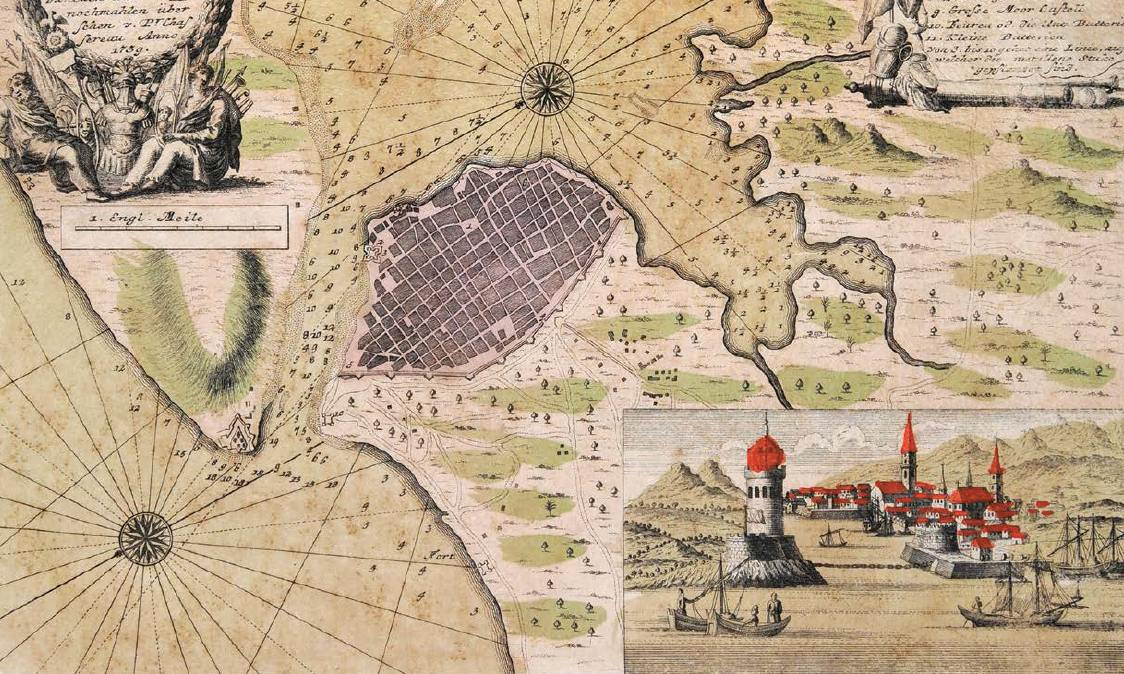
The sketch made by an English agent in 18th-century Havana sparked an invasion, a conversation, and a novel.
Map of Havana in ’Atlas of the English Colonies’, printed in Nuremberg in 1739.
14ymedio, Xavier Carbonell, Havana, 10 May 2025 – You have to go back to the moment in which Miriam Gómez, tormented by a husband who writes even after death, remembers a map “made by an English spy in the eighteenth century”, hanging in Alejo Carpentier’s office. Cabrera Infante looks at it and names a novel after it, but in the actual text he forgets all about it and prefers instead to evoke a Hemingwayesque print from 1778: ’A youth rescued from a shark’.
Distracted by Carpentier’s baloney, Cabrera Infante has time to examine more than one picture. He looks closely at the drawing of the sharks, but he also looks at an antique map of Havana, and perhaps then one of his famous pet phrases occurs to him: “The picture describes” or “In the picture can be seen”, which he uses in ’View of the Dawn in the Tropics’.
The strongest proof that the map existed – and now I feel like a scholarly theologian – is that very same book itself. In ‘View of the Dawn in the Tropics’ the novelist describes in great detail (amongst dozens of vignettes of violence in Cuba) the map that we’re looking for:
“I have here a map created a few days (or perhaps weeks or months) before the English attack on the island’s capital. As one can see, the map is quite crude but its task is well accomplished because the fortifications of Morro and La Cabaña are clearly shown, at the entrance to the bay, and then the fortifications in Havana itself of La Punta, Castillo de Atarés and Torreón de San Lázaro. You can see how the map distorts the city’s characteristics and those of its surrounding area. It’s believed that this map was created by an English spy”.
The mistakes are numerous but let’s just say that Cabrera Infante’s Havana is timeless and gloss over that
The mistakes are numerous but let’s just say that Cabrera Infante’s Havana is timeless and gloss over that. The British Invasion happened in 1762 and the maps that the fleet used were actually from a few years earlier, not continue reading
“weeks or months”. La Cabaña didn’t even exist then; it was just a hillock which in fact was strategically important at the time of the bombardment of Morro. Neither Atarés nor San Lázaro existed either. Cain only got it right with La Punta.
In one of his catalogues Emilio Cueto brings together 17 maps drawn up by English spies in 1762 alone. In earlier decades many others were drawn up, and a great quantity of sketches which were more or less precise, “crude” but useful for the invasion. Several of those maps were created from testimonies by “an experienced commander”.
In 1756, one of those high ranking commanders visited Havana. He was Charles Knowles, the naval governor of Jamaica, who, from first entering the bay began to make careful notes about the city’s defences. It was he who drew up the plan for the attack six years later. The maps used in the occupation were reproduced ad nauseum in British magazines to bring news of the battle.
The espionage became more intense as the invasion approached. In 2003, the translator Juliet Barclay brought to light two unedited documents in the magazine Opus Habana – a letter and a map – addressed to the Count of Egremont in 1760. Signed “your most faithful servant”, the text offered the coodinates of the port – “the base for all Spanish maritime forces in America”.
In the agent’s view, Havana was “almost oval, completely surrounded by stone and brick walls”
In the agent’s view, Havana was “almost oval, completely surrounded by stone and brick walls” and having a bay with “a narrow inlet”, as is seen in his sketch, somewhat inaccurately. It’s a little reminiscent of Cargapatache’s Map – a Portuguese bandit who left instructions to enter the Havana bay in the sixteenth century. For him, the bay was a kind of feminine belly and the ship had to be guided by two mounds which he called The Tits. Was this the map that Cabrera Infante saw? Barclay unfortunately doesn’t say where he got it from.
There’s no solution to the case until someone discovers where Carpentier’s drawings ended up. Cabrera’s “English spy” could be Knowles, or an anonymous Brit who escaped to England before the invasion, or any “experienced commander” who passed through the island. Or even some Cuban, because there was no shortage of collaborators when Havana was under English occupation.
Thumbing through Cueto’s catalogue leaves an investigator with a bunch of suspects’ names – people who drew or printed maps during those years: Pierre Chassereau, William Henry Toms, P. A. Rameau, J. Gibson, Andrew Bell, Giuseppe Pazzi… Which of them was our man in Havana? To find out, you’d need a metaphysical detective in the style of Oesterheld or Mœbius, an informer of the kind Infante and Carpentier talked about, a spy to spy on the spy that eluded us… and a better artist than he was.
Negative image of the city. / Xavier Carbonell
Translated by Ricardo Recluso
____________
COLLABORATE WITH OUR WORK: The 14ymedio team is committed to practicing serious journalism that reflects Cuba’s reality in all its depth. Thank you for joining us on this long journey. We invite you to continue supporting us by becoming a member of 14ymedio now. Together we can continue transforming journalism in Cuba.
Of the building built in the 19th century, only the facade remains, hiding rubble and piles of rubbish.
“If you look out at it from San Carlos Street, it seems like a bomb fell on top,” says a neighbor of the ISDi / 14ymedio
14ymedio, Juan Diego Rodríguez/ Yunior García, Havana/Madrid, 13 May 2025 — Although Havana – like almost all of Cuba – is today a catalogue of rubble, it remains particularly painful to see the ruins of what was once the Instituto Superior de Diseño Industrial (ISDi). The facade still resists, while its interior collapses under the weight of abandonment. Among the rubble and piles of garbage, the building sinks into its own history, converted today into a metaphor for a country that is also crumbling.
The remains of the ISDi, behind the fences, have created a microclimate of insalubrity. “One should by now be accustomed to building collapses, but this is impressive,” says Yamila, a former neighbor of the area, in statements to 14ymedio. “From the outside it looks strong, but if you look out at it from San Carlos Street it seems like a bomb fell on top. If this happened with the ISDi, what awaits the rest of this city?”
Yamila is worried about the coming rains. “This is going to become a breeding ground for rats and mosquitoes; look at the neglect there.” Shee is also afraid of another collapse or that the pile of garbage will clog the sewer and cause flooding. “I avoid going through this street at night,” she adds. “Imagine what can occur in the middle of a blackout. Anything could happen here.”
The building, originally a military hotel and club for officers of the Spanish Army, was home to the School of Cadets (1874-1878), the Asylum of continue reading
Widows and Orphans, the barracks of the General Staff during the First American Occupation and the Ministry of Health in 1940. In 1982, it was transformed into the headquarters of the Polytechnic Institute of Industrial Design, the predecessor of the ISDi.
Decades of idleness, poor renovations and lack of maintenance slowly condemned the property / 14ymedio
Its architectural, historical and educational value was unquestionable. But decades of idleness, poor renovations and lack of maintenance slowly condemned the property. In March 2022, the building was closed after an “architectural failure” was detected that endangered students and workers. Then, however, the official press was full of optimism: “The Revolution founded the universities and always accompanied them,” it said, as if words were enough to sustain cracked columns.
That speech fell apart in July 2024, when part of the interior facade collapsed. And in January 2025, another partial collapse left an elderly woman injured and four families without access to their homes. Although there were no fatalities, the symbolic impact was profound: not only was the building sinking but also a promise, an institution and an era.
More accurate were the words of the architect Lourdes Martí, founding rector of the ISDi until 1988, who in 2022 had launched a public complaint:
“What happened during these last 33 years? Was it never maintained again? What architectural fault is it that does not allow the restoration of the building, or part of the building? Do you want to destroy the building or eliminate the training of industrial and information designers? Are we witnessing the end of the country’s industrial development?”
The answer to his questions are not in a technical report but are on the face of Yamila, who looks at the rubble with resignation: “I feel very sorry for the kids who studied there. Do you think this will ever return to what it was? This will likely remain a place that is destroyed, for tourists to take pictures of or people to ’plunder’ little by little. Or they will turn it into a hotel. But it will never be a school again.”
Translated by Regina Anavy
____________
COLLABORATE WITH OUR WORK: The 14ymedio team is committed to practicing serious journalism that reflects Cuba’s reality in all its depth. Thank you for joining us on this long journey. We invite you to continue supporting us by becoming a member of 14ymedio now. Together we can continue transforming journalism in Cuba.
The organization believes that paying the doctors directly into their accounts does not solve anything, since the doctors will continue to deliver part of their salaries to the regime.
The presence of Cuban doctors causes discomfort among local health workers / La Prensa
14ymedio, Madrid, May 13, 2025 — Archivo Cuba, author of a report which determined that the government of the Bahamas paid up to $5,000 and $12,000 to the Cuban regime for each doctor sent to the archipelago on an international mission, has sent a statement expressing its position on the statements made by Prime Minister Philip Davis. The head of the Bahamian Executive said he would pay the health workers directly into their own accounts, which, according to the organization, “does not end the human trafficking and forced labor.”
Cuba Archive argues that the idea, expressed by Davis in The Nassau Guardian, “does not represent a real change of policy and will not stop exploitation” as it is documented that, “even when Cuban workers who are exported are paid ’directly’, they are still obliged to send a large part of their income to the Cuban government”.
The organization urges the Bahamas to hire workers directly, as well as nationals and foreigners, in addition to ceasing the intermediation of the Cuban government “or any of its entities or representatives.”
“Even when the exported Cuban workers are paid ‘directly’, they are still obliged to send a large part of their income to the Cuban government.”
On May 6, Philip Davis held a meeting with US Secretary of State, Marco Rubio, in which they discussed several issues that are of concern to Washington, including Cuban medical missions. “As you know, the issue of how Cuban doctors are compensated is something for which the Secretary of State has shown concern and raised a red flag,” said Bahamas press continue reading
secretary Keishla Adderley.
She was referring to the measure announced in February of this year by the US expressing its intention to restrict visas to officials from foreign countries involved in what it called “labor exploitation” of Cuban workers abroad, including health workers.
At last week’s meeting, Davis told the local press that he had explained the situation to US officials and denied that Cuban doctors were in a situation of labor exploitation. “We were able to communicate to them, and I think they were satisfied that we are not involved in forced labor as far as we know,” he said.
“If forced labor is occurring in our country with the Cubans, we have no record of it,” he added, while indicating that an exhaustive analysis was being carried out to determine whether there was any “element” of this type present in the employment relationship. “If we discover something like this, it will be corrected,” he said.
Davis argued that the payment method, through the Cuban government, is not extraordinary. The Prime Minister resorted to recalling how the US paid part of the wages of Bahamian seasonal workers to the UK before the islands became independent. “That is not an unknown concept or construct. But it is now considered an ingredient for forced labor. So, we will address that. To anyone we hire, we will say: ’Look, we’ll pay directly into your account’.”
Cuba Archive believes that this eventual solution does not imply any change in what is understood more as a message to the US State Department.
“Newly received information indicates that a Cuban official in Nassau, Amaury Gomez (who is probably listed as a “health worker”), has been collecting these remittances in cash. Cuban teachers have been instructed to start sending money by authorizing a fictitious online purchase linked to a Royal Bank of Canada subsidiary, RBC Dominion Securities, at 3250 Bloor Street West, Toronto, Ontario. Those who resist face deportation and other sanctions,” argues the organization, which counts 40 current members of the Cuban medical brigade and 130 Cuban teachers.
In the report, Cuba Archive reviews the figures of the agreements between the Bahamas and Cuba, estimated at $15.7 million annually by health workers and educators
In the report, Cuba Archive reviews the figures of the agreements between the Bahamas and Cuba, estimated at $15.7 million per year for health care and educators, plus travel, insurance, training and other items that it estimates at $17 million more annually.
According to the organization’s figures, “specialist medical advisers” are paid $12,000 a month and “biomedical engineers” $5,000, 92 per cent of which goes to the Cuban Government. In addition, Archivo Cuba states that during the pandemic, 50 Cuban nurses came to Nassau who worked without permission for half a year, of which only 10 treated patients with covid-19 for $750 per month, while the nurses that the country had hired directly were pocketing between $4,000 and $6,000.
For their part, Cuban teachers must pay 50% of their salary to the regime and, as with the health workers, must comply with strict rules, including avoiding relations with the local population and demonstrating against the embargo on the last Sunday of each month.
Translated by Regina Anavy
____________
COLLABORATE WITH OUR WORK: The 14ymedio team is committed to practicing serious journalism that reflects Cuba’s reality in all its depth. Thank you for joining us on this long journey. We invite you to continue supporting us by becoming a member of 14ymedio now. Together we can continue transforming journalism in Cuba.
The Storm Lake Police Department contributed to investigations of Cuban fraud in Iowa / Facebook / Storm Lake Police Department
14ymedio, Havana, May 12, 2025 — Former Cuban sergeant Yovany Ciero could be sentenced to life imprisonment and fined more than $10,000,000 after being convicted by a jury at a trial in Iowa. The state’s Attorney General’s Northern District charged him with almost 30 counts, including electronic fraud and money laundering, which caused the US government losses of $2.4 million, according to a statement issued on Friday.
Ciero is charged, in particular, with “three charges of electronic fraud, 23 charges of money laundering, one more for his participation in a monetary transaction with goods derived from a specific illicit activity and another for conspiracy to launder money.”
The 48-year-old man was working at a meat packing plant in Algona, Kossuth County in 2020, at the beginning of the Covid-19 pandemic. The jury found that Ciero fraudulently received loans granted by the US government through the Payroll Protection Program (PPP), a $2 billion package approved in the US Congress for individuals, health care providers, small businesses and heavily affected sectors of the economy.
For each fund fraudulently obtained by the applicants, usually of $20,000, the Cuban kept $3,000
The former military man submitted an application to the PPP, stating that in 2019 he was part of the group of affected self-employed entrepreneurs and whose gross income was approximately $100,000. “Ciero and more than a hundred Cuban immigrants obtained fraudulent PPP loans, when in fact they worked at the packing plant or elsewhere,” the statement said. continue reading
According to court file 24-CR-3013, which was detailed in a federal court in Sioux City, the Cuban was one of six “bundlers” in the fraudulent PPP loan scheme. His role was to recruit people from whom he obtained confidential information to fill in the applications and then shared it with others who submitted the fraudulent forms to PPP lenders.
Deputy federal prosecutors Timothy L. Vavricek and Daniel A. Chatham explained that Yovany Ciero and his wife received two loans from the PPP, which they used to buy a semi-trailer truck. In addition, for each fund fraudulently obtained by the applicants, usually of $20,000, the Cuban was left with $3,000. Investigations confirmed that the former sergeant “channeled the money into a money-laundering conspiracy.”
Ciero is the sixth former worker in an Iowa meat packing plant convicted under the PPP scheme.
The authorities also indicated that the former Cuban sergeant was denied a visa to enter the US legally. “Almost 20 years ago he crossed the border with Mexico” and after several years settled in Mason City, Iowa. Due to his crossing he was established in Colombia and Venezuela.
Translated by Regina Anavy
____________
COLLABORATE WITH OUR WORK: The 14ymedio team is committed to practicing serious journalism that reflects Cuba’s reality in all its depth. Thank you for joining us on this long journey. We invite you to continue supporting us by becoming a member of 14ymedio now. Together we can continue transforming journalism in Cuba.
Rodríguez assured that “fostering the best links” between China and Latin America is a “duty” for Cuba / EFE
EFE (via 14ymedio), Beijing, May 12, 2025 — Cuban Foreign Minister Bruno Rodriguez highlighted on Monday in Beijing the priority that his country gives to its ties with China, which he described as “special and strategic”, before the Fourth Ministerial Forum of China and the Community of Latin American and Caribbean States (CELAC) begins in the Chinese capital.
During a meeting with his Chinese counterpart, Wang Yi, Rodriguez said that “fostering the best links” between China and Latin America is a “duty” for Cuba, in an “exclusionary and dysfunctional international order”.
The Chancellor also stressed China’s “respect for international law” and “focus on development.”
The Chancellor also stressed China’s “respect for international law” and “focus on development.”
Rodriguez traveled to China from Russia, where he attended, with Cuban president Miguel Díaz-Canel, the celebrations for the 80th anniversary of the Soviet victory over Nazi Germany in World War II. continue reading
The Cuban leader met in the Russian capital with his Chinese counterpart, Xi Jinping, who considered that the ties between both countries are in a new “stronger” stage and advocated for “further deepening.”
During his meeting with Wang, Rodriguez referred to the meeting between the two leaders and stated that “he raised consensus and priorities that we will honor in implementing”.
The IV China-Celac Ministerial Forum will take stock of the Joint Cooperation Plan 2022-2024 and lay the foundations for a new roadmap to guide relations until 2027. Topics such as climate change, public health, education and digitalization will be at the center of the debate.
Between January and September 2024, bilateral trade reached $427.4 billion, an increase of 7.7% year-on-year
The event will take place at a time when China consolidates as the second largest extraregional investor in Latin America, behind the United States, and as the main trading partner of several countries in the region, such as Brazil, Chile and Peru.
In 2015, China set a target of $500 billion in annual bilateral trade and $250 billion in cumulative investment in the Latin American and Caribbean region ten years later.
According to official data, between January and September 2024, bilateral trade reached $427.4 billion, an increase of 7.7% year-on-year.
Translated by Regina Anavy
____________
COLLABORATE WITH OUR WORK: The 14ymedio team is committed to practicing serious journalism that reflects Cuba’s reality in all its depth. Thank you for joining us on this long journey. We invite you to continue supporting us by becoming a member of 14ymedio now. Together we can continue transforming journalism in Cuba.
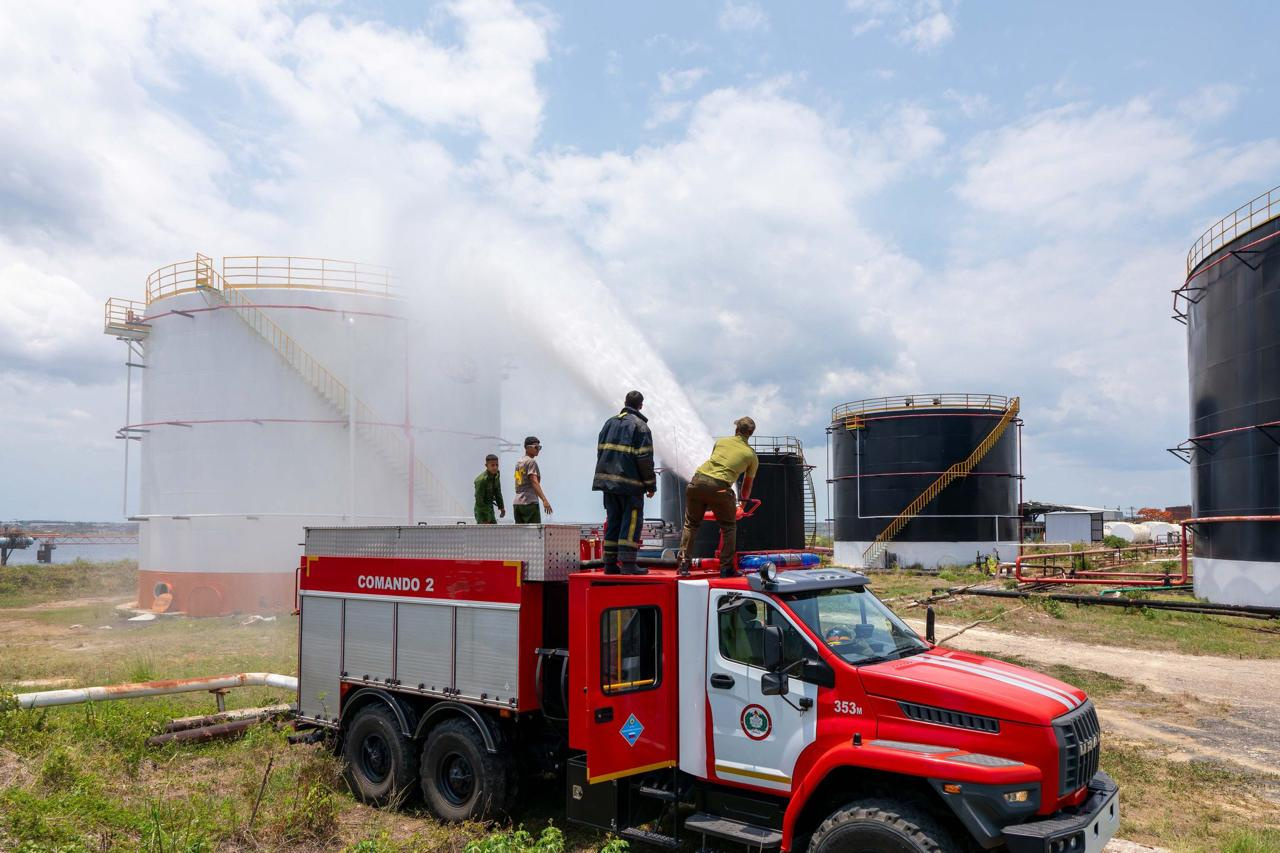
 14ymedio, Havana, 23 May 2025 — The authorities of Matanzas have not explained why they never “gave a destination” to the 500 cubic meters of fuel stored for ten years in two tanks of the old José Martí thermoelectric plant, which this Thursday suffered a leak. The latest official press report, published early this Friday, explains that it has not yet been possible to suction the mixture of fuel oil and crude stored there since 2015, which now threatens to spill into the bay.