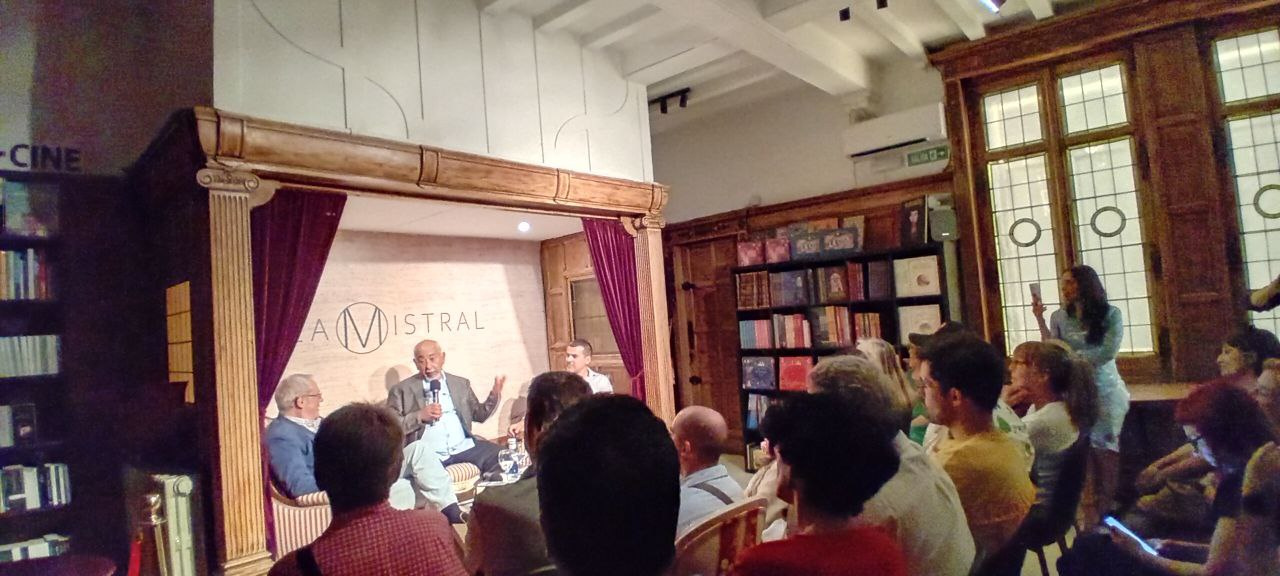
 14ymedio, Yunior Garcia Aguilera, Madrid, 22 May 2025 — Madrid starts the week in full swing with Cuban literature. On Tuesday, Carlos Celdran presented his book -with two plays- at the Arenales bookstore. A day later, Roberto Carcassés presented his first novel at El Argonauta, while Leonardo Padura attended the presentation of Un camino de medio siglo: Alejo Carpentier y la narrativa de lo real maravilloso, at La Mistral. Despite the coincidence, the audience filled all the seats.
Padura shared a table with Luis Rafael Hernández, director of the publishing house Verbum, and the Spanish critic and professor Fernando Rodríguez Lafuente, former director of the Cervantes Institute. The conversation was a kind of meeting between the living and the dead, a contest between the marvelous and the harshly real, but also a confession of the fears that have accompanied generations of Cuban writers.
Winner of the Princess of Asturias Prize for Literature (2015), Padura does not hide Carpentier’s influence on his work, even though his colleagues joked that every writer should “erase the traces of his referents”. Carpentier himself used to say that “writers should not talk about their masters, so that the seams do not show.
The label of the Latin American boom has also been applied to Borges and Carpentier, without much nuance. The result: theoretical confusion and the lumping together of different literatures.
In 1978, Padura wrote a review of La consagración de la primavera, which El Caimán Barbudo subtitled “Más realismo que maravilla” (More realism than wonder). “It was already a novel in which the ’marvelous real’ didn’t work in the same way; you had to look at things from a different point of view,” he explained. But critics continued to work with the same aesthetics, the same categories. The label of the Latin American boom was also applied to Borges and Carpentier, without much nuance. The result: theoretical confusion and the lumping together of different literatures.
Padura drew a clear line: magical realism accepts the fantastic as an indistinguishable part of reality; marvelous realism, on the other hand, presents the magical from a logical, almost rational approach.
The research underlying this essay began in the midst of the Special Period, when access to information in Cuba was a titanic task. To write The Man Who Loved Dogs, he had to rely on friends with free Internet access who downloaded PDF files from abroad. “We’re talking about 2006 or 2007. Imagine what it was like before,” he said.
“In the 1990s, I wrote like a madman in order not to go crazy,” he confessed without laughing. And he recalled that when he gave the essay to Carpentier’s widow, “there were things she didn’t like because she was very jealous, very widowed.”
Thanks to this research, he was able to better understand Carpentier’s concept of history, his vision of space and, above all, his interpretation of the concept of revolution, which Padura considers “very saccharine” and with which he admits to disagreeing. He also told an anecdote that illustrates the biographical ambiguity of the author of The Century of Enlightenment: for fear of being deported during the Machado regime, Carpentier claimed to have been born at 14 Maloja Street in Havana, when in fact he was born in Lausanne, Switzerland. “All in all,” added Padura, “he is the most Cuban Swiss-born writer one can imagine.”
“The writers of the 1970s who survived wrote in fear. And later generations have not been completely free of it.”
In addition to Carpentier, the author revealed three other great references: Vargas Llosa, Cabrera Infante – “who taught me to write in the Havana language” – and Manuel Vázquez Montalbán – “who showed that it was possible to write police literature that was, above all, literature”. “I’ve been wanting to write a note for about two years, and I couldn’t do it while Vargas Llosa was alive, because it might seem like I was buttering him up” he joked.
The writer recalled that his years as a student at the university were marked by a power that demanded “a Marxist understanding of history”. In addition, the culture of the island suffered the ostracized death of two “phenomena” of world literature: Virgilio Piñera and Lezama Lima.
“It was very difficult” – Padura admitted – “something that has deeply affected Cuban literature is fear. People wrote with fear. The writers of the 1970s who survived wrote with fear. And later generations have not been completely free of it.”
Translated by Gustavo Loredo
____________
COLLABORATE WITH OUR WORK: The 14ymedio team is committed to practicing serious journalism that reflects Cuba’s reality in all its depth. Thank you for joining us on this long journey. We invite you to continue supporting us by becoming a member of 14ymedio now. Together we can continue transforming journalism in Cuba.