“I look out the door and it makes me feel so sad. The streets are empty. Nothing remains of the youth, everyone is gone.”
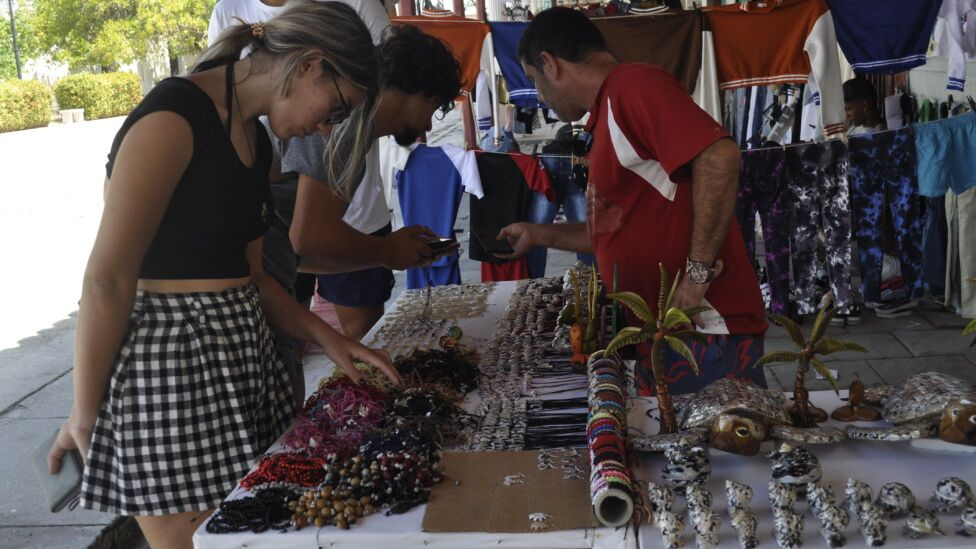
 Dariel Pradas/IPS via 14ymedio, Gibara, April 27, 2025 — On Saturday, May 19, the closing night of Gibara’s annual International Low-Budget Film Festival,* the lights suddenly went out. After a week of festivities, the abrupt power outage signaled a return to normalcy for the 70,000 residents of this city in eastern Cuba.
According to 59-year-old Hilda Freyre, there are usually two power outages a day in her hometown, each lasting six hours. An outage can sometimes last longer if there is an unforeseen problem in the electrical system.
However, there were no power outages during the five days of the town’s film festival. Dozens of tents were erected along the bay, with vendors selling food and drinks to local residents and visitors.
“I still cannot believe it. Electricity all day long!” says Freyre.

Many of the vendors at the festival are from out of town and come here for the economic opportunities the event provides. After they dismantle their stalls and go home, supplies fall, prices rise to their previous levels and Gibara reverts to its typically slow pace.
“I get very sad when I look through the door. The streets are empty. There are no young people on the streets and everyone has left,” says Freyre, whose son has been living in the United States for eight years.
Gibara — also known as Villa Blanca de los Cangrejos (White Village of the Crabs) because of the shellfish that were once harvested here — is the capital of a larger district with the same name. It is located is located 771 kilometers east of Havana, in the province of Holguín.
Its decline is evidenced by the fact that a large part of its population lives off remittances sent by their relatives in other countries.
Tourism, which represents another important sector of the local economy, relies almost entirely on Cuban Americans who vacation here in the summer or at year’s end, and on the weeklong film festival, when state-run hotels and private homes fill up with film enthusiasts.
“During the festival, Gibara is a special place but not during the rest of the year. So far, it hasn’t become the tourist destination aspires to be,” says Gibara resident Jaquline Tapia, the province’s director of culture.
” I get very sad when I look through the door. The streets are empty. There are no young people on the streets and everyone has left”
Last year, Cuba experienced a decline in the number of foreign visitors. According to the National Office of Statistics and Information, this number fell to 90.4% in 2023, the worst figure since 2007, not counting the COVID-19 pandemic in 2020 and 2022, which impacted global tourism.
While there has been no recent report on the number of visitors to Gibara, the decline is clearly being felt in this provincial town, which offers tourists a more urban experience than the seaside experience typical of large hotel chains.
“Unfortunately, a decade has been lost due to the country’s bad decisions regarding tourism,” says local filmmaker Armando Capó. He points out that visitors more often stay in Guardalavaca, a tourist hub east of Gibara and located 52 minutes away by car. They avoid Gibara because, he says, “there’s no electricity, no food, nothing.”
Gibara is not the only small town in this Caribbean island nation to experience a temporary economic boom due to a sudden influx of foreign visitors. However, it may be the only one whose tourism sector is periodically revived due to a single event like a film festival.
In an interview with local media in late January, Prime Minister Manuel Marrero, who serves as Gibara’s representative in Cuba’s National Assembly, discussed the need to reverse the region’s economic decline by reducing the fiscal deficit, which in 2024 had grown by more than 30 million pesos ($250,000 at the official exchange rate of 120 pesos to the dollar).
“Unfortunately, a decade has been lost due to the country’s bad decisions regarding tourism”
When tourism is in decline, the town’s finances often follow suit. It has been this way for many years.
In 1927, the country had one of the worst sugar harvests in its history. Gibara, which — like the rest of Cuba — had depended on the sugar industry to drive its economy, switched its focus to tourism.
A village that had been known for crab fishing became somewhat of a seaside resort, using its local culture as the draw. It touted its local culinary tradition, which relied heavily on fish and shellfish, as well as handicrafts made from seashells and other sea-borne materials that washed ashore.
“Gibara has been an artisanal powerhouse for many years. Wonderful handicrafts have always been made here for sale to visitors. Fishing has also been a tradition we inherited from our ancestors,” says 72-year-old Robiel Jomarrón, the owner of a fishing boat.
The town grew in this way until the Cuban revolution in 1959, after which a shipyard and a fishing base were built. Subsequently, the number of foreign visitors who could enter the country was limited by government policies and later by sanctions the United States imposed on Cuba.
“Gibara has been an artisanal powerhouse for many years”
According to Capó, whose documentaries deal with the history and customs of his hometown, tourism in Gibara began to slowly dry up in the 1990s after the fall of the Soviet bloc and the decline of virtually all of the country’s industrial base. It began to see some growth after the launch in 2023 of the Low-Budget Film Festival, which is now held annually .
The year’s festival featured more than 500 entries from some thirty countries. Filmmakers compete for prizes in various categories in a competition films — both completed and in-progress — in a competition whose rules limit the cost of production.
“The festival transformed Gibara. It put it on the map,” says Capó.
Four state-owned hotels and dozens of privately owned restaurants and rental properties have been built since 2003.
In 2014, the influx of foreign visitors began to rise exponentially thanks to the resumption of diplomatic relations between Cuba and the United States during the administration of U.S. president Barack Obama. That year, 62-year-old Jorge Luis Rodríguez opened a restaurant, La Cueva Taina, in Gibara.
With typical Gibara dishes and locally sourced ingredients found within one-kilometer radius, the business has grown both in physical size and in reputation. Today, with little tourism, it survives thanks to the festival and Cubans visiting from overseas.
“If we’re talking about native cuisine, the best example is northeastern Cuba. Things are at at a standstill now but we’re holding on because we already have a reputation,” says Rodríguez.
“When the weather clears up, we’ll go out. Otherwise, it’s not worth it because it’s our livelihood. We try to catch enough fish to bring home food and money”
By Saturday the 19th, the sea had been rough for two consecutive days, with no sign of a letup. No fisherman dared to set sail in his boat.
“When the weather clears up, we’ll go out. Otherwise, it’s not worth it because this is our livelihood.. We try to catch enough fish to take home and to sell,” says Sam, a fisherman who asked this that his last name not be mentioned.
But with weather this bad, we can’t do that,” adds Frank, another fisherman.
Most of Gibara’s fishing activity takes place on the high seas, where the local waters meet the Atlantic Ocean. Boats must travel several miles out to sea and return in less than thirty-six hours. This requires higher levels of fuel consumption than in the country’s other fishing areas.
Private vessels, which are associated with a fishing union affiliated with the local port, used to get state-subsidized fuel. However, for about a year now, they have gotten nothing and often have to buy it on the open market at inflated prices.

However, the local government sets a price cap on the fish sold to consumers, making it very difficult for a fishing business to remain profitable.
“They cap the price of fish but fuel never drops to a reasonable price. I manage by plowing ahead. What’s bad is that you can go out and not catch anything. That’s a debt that keeps growing. It’s more a matter of luck than anything else,” Frank complains.
While fishermen try their luck at sea, artisans try their luck in the world beyond Gibara’s city limits.
“This is an artisanal town,” says 48-year-old Gerson González, who has worked as a craftsman for more than two decades. “Eighty percent of local craftspeople travel around, going to other places to sell their wares, things which are only made here.”
With the close of this year’s film festival, the busy sales season has come to an end. Many artisans will leave for other provinces or find temporary employment.
González fondly recalls the days when tourism was booming and he was selling year round. He has not lost hope, however, that that the glory days will return.
For filmmaker Armando Capó, his town is an example of how culture and traditions can transform the economy of a place.
Translator’s note: “Cinema pobre” (literally “poor cinema”) is a term coined by Cuban director Humberto Solás to describe independently produced work by filmmakers using their own limited financial resources.
____________
COLLABORATE WITH OUR WORK: The 14ymedio team is committed to practicing serious journalism that reflects Cuba’s reality in all its depth. Thank you for joining us on this long journey. We invite you to continue supporting us by becoming a member of 14ymedio now. Together we can continue transforming journalism in Cuba.