From a Prison in Cuba, the Owner of the Havana ‘Costco’ Denounces Deception and Torture

Cuban-American Frank Cuspinera accuses his lawyer of colluding with State Security to “keep me in prison, defenseless.”


Frank Cuspinera was arrested on June 20, 2024, and his Diplomarket was closed / Facebook

14ymedio bigger14ymedio, Olea Gallardo, Havana, 28 May 2025 — Almost a year after his arrest and lack of information about his whereabouts, Frank Cuspinera, owner of the Diplomarket, the “Cuban Costco” of Havana, has reappeared. He did so through a handwritten letter from prison signed on May 21, whose authenticity was confirmed by a family member this Wednesday, hours after it was broadcast by the ‘influencer’ Alexander Otaola.

In it, he makes “an appeal to the international community, to international and human rights organizations,” as well as to the United States Department of State, “to intervene with Cuban institutions for the constant violations of my rights and the denial of legal guarantees for my defense by Cuban state institutions and their representatives.”

Cuspinera says that he was manipulated by Cuban State Security (DSE) and the Cuban judicial apparatus, “which were cruelly activated against me” and which managed, with “multiple falsehoods,” to accuse me” without the right to a defense. “They have limited my access to justice. I was denied my rights to communication and legal defense from the start,” he claims in the letter. continue reading

Cuspinera announces he will go on a hunger strike on June 1

Therefore, he announces that he will go on a hunger strike -“to plantarme [stand firm]” he specifies, using the term of political prisoners – on June 1. “I will be willing to go to extreme consequences,” he says, until his rights to prompt defense and bail are guaranteed, “to be able to prove the injustice.” The Cuban-American businessman says that there was “premeditation by the DSE in conspiracy with the DTI [Technical Directorate of Investigations] and other institutions, including my defense attorney, who has worked against me.”

“Everything was planned even before my arrest, on June 20, 2024, almost a year ago,” he continues, confirming the date spread on social networks and never mentioned by the government. In those days, the La Tijera Facebook page said that a State Security operative arrived at the supermarket – located at kilometer 8 1⁄2 of the Carretera Monumenta, in the neighborhood of Berroa, more than 10 kilometers east of the center of the capital – along with two buses carrying auditors from Gaesa (Grupo de Administración Empresarial S.A.), the conglomerate of the Armed Forces and owner of the land where the establishment was located.

A day earlier, in the WhatsApp group managed by Diplomarket, a message announced that they were “closed until further notice,” explaining: “We are having problems operating because our commercial license has to be renewed.” The app could still be visited and had a caption: “We are offline. Send us an email.”

“The Frank Cuspinera and Diplomarket case was premeditated and planned because it developed the private sector and was registered as a company in the United States”

The La Tijera post pondered, referring to Raúl Guillermo Rodríguez Castro, son of the late Luis Alberto Rodríguez López-Calleja and Déborah Castro Espín, and bodyguard of his grandfather, Raúl: “It seems that now El Cangrejo [The Crab, a nickname for López-Calleja], grandson of the dictator Raúl Castro, no longer needs his Miami figurehead Frank Cuspinera Medina.” The brief text also recalled that Cuspinera Medina was vice president of Las Americas TCC Corporation, based in Pompano Beach (Florida), and that for years he had been residing in El Vedado, where he had bought “a mansion thanks to his relationship with the dictatorial elite.”

The next day, La Tijera disclosed more details of the case from an email received. According to this anonymous source, the “Cuban military forces” intervened in the business of the Cuban-American, and both he and his wife have been “incommunicado” since that day, accused of “tax evasion, currency trafficking and money laundering.” These accusations, the email claimed, were “nothing more than a pretext for the regime to appropriate their assets.”

“The authorities waited until the closing of the day to break into the company and take everything, a sale that the owners had previously authorized themselves,” continued the text. On the day after these events, “they began to confiscate all the assets of his company and distribute them among the members of the Castro elite.”

La Tijera’s source framed the operation within a “repetitive pattern” in which “the Castro regime attacks those who try to create opportunities and prosperity outside of State control.” However, this was not the case of Cuspinera, well established on both sides of the straits of Florida for years.

In his letter from prison, Cuspinera does not mention any of these names, but he states: “The Frank Cuspinera and Diplomarket case was premeditated and planned because it developed the private sector, and as a company registered in the United States with approval and federal licenses that competed with Cuban State enterprises, it brought into question the reach of the blockade.” In this regard, he also does not specify what type of license he has from the US Office of Foreign Assets Control (OFAC), without which it is impossible to trade with Cuba under the laws of the embargo.

Las Americas TCC, among other activities, was in charge of supplying Diplomarket, inaugurated at the end of 2022

Las Américas TCC, among other activities, was responsible for supplying Diplomarket, inaugurated at the end of 2022. The supermarket, which before opening was already functioning physically for online shopping, started operating discreetly until a tweet by CNN correspondent Patrick Oppmann, who did not mention its name, focused on it almost a year later.

On that occasion, this newspaper visited the business and could see the strong surveillance to which it was subjected. In a first booth, they were taking the data of vehicles at the time of entry, and later there was another guard booth, before entering the store. At the door, two individuals looked everyone up and down, and a large screen showed the movement of the security cameras, placed everywhere. A regular customer called it a “military unit.”

Not even 12 months had passed when Cuspinera fell into disgrace, in a case that recalled the former Minister of Economy Alejandro Gil Fernández, arrested in March 2024, weeks after being dismissed for “mistakes made in the exercise of his office,” and about whom nothing has been known since.

When Diplomarket came to light it was not easy to find out who owned it, as the firm was not on the list of micro, small and medium-sized enterprises (MSMEs) approved by the Ministry of Economy and Planning, and the name of Cuspinera did not appear on the supermarket’s website.

“Of the crimes they charge me with, they have manipulated contradictory statements of workers, without their knowledge and contact”

On the other hand, he was listed as vice president of Las Americas TCC. Consulting specialized pages, this newspaper verified that he had been domiciled in the United States and in El Vedado (Havana). In 2021 he appeared as a “specialist” at a meeting between self-employed workers and the National Association of Economists and Accountants of Cuba.

That same year, his name also appeared in a letter sent by several Cuban entrepreneurs to US President Joe Biden asking him to lift the sanctions against the island’s government, which were damaging to their businesses. In the letter he was not listed as a member of Las Américas TCC but rather as part of Iderod Servicios Constructivos.

This last firm was not on the list of MSMEs of the regime, although a company with its name, Cuspinera SURL LVI, is listed as dedicated to “providing services of electronic commerce platform,” as a branch of Las Americas TCC.

The businessman does not name in his letter either Las Americas or Iderod but does present himself as a “citizen, lawyer, Cuban-American entrepreneur” of Cuspinera SURL [Unipersonal Limited Liability Company], both in Florida and in Havana, “under the Diplomarket brand, known as the Cuban Costco.”

Cuspinera also states that he will not try to “evade the action of justice, but only ask that I can defend myself”

The text does not detail the charges against Cuspinera, but he claims: “Of the crimes I am accused of, they have manipulated contradictory statements of workers, outside their knowledge and contact.” The employer claims that he was accused of crimes by workers who “may have been able to leave the country.”

He says that, among other vicissitudes, “they have confiscated millions of dollars in goods, equipment, money from purchases and bank accounts,” without giving him a copy of those seizures. And he claims that the authorities “do not show evidence of alleged fraudulent goods, evasions or amounts, misrepresenting and manipulating information” which, he says, would prove his innocence. In addition, he accuses the prosecutors: “They have taken my statements by deception, trickery and torture.”

“They have denied all possibility based on an absurd social injury, without proof (there is no such danger from me to society), and by manipulating my statements and those of my employees.”

The appeal by his defense attorney to Court Complaints and Petitions was “riddled with errors, lacking in available evidence and all with the purpose of keeping me in prison, defenseless. He did not allow me access to my file and prevented other defense attorneys from being able to act.”

Giving names, he points to “instructor Yisset Oliva Betancourt,” the provincial director of the National Office of Tax Administration (ONAT), Yoandra Cruz Dovales, and his official lawyer, Luis Alberto Martínez Suárez, for having “taken unlawful actions to hold me in provisional detention unlawfully, without defense.”

Cuspinera also states that he will not try to “evade the action of justice but ask that I can defend myself through a bond so that the truth about my responsibility and that of the institutions comes out.”

Before finishing his letter, in which he also says that his mother is ill with cancer, the entrepreneur reaffirms his intention to stand firm. “I am ready to go to extreme consequences with my hunger strike to prove my innocence,” he concludes, after having warned that “the organs of the DSE” cut off “any possibility of defense.”

Translated by Regina Anavy

____________

COLLABORATE WITH OUR WORK: The 14ymedio team is committed to practicing serious journalism that reflects Cuba’s reality in all its depth. Thank you for joining us on this long journey. We invite you to continue supporting us by becoming a member of 14ymedio now. Together we can continue transforming journalism in Cuba.

The ‘Reparto’, Musical Genre of Poverty in Cuba, Annoys the Regime’s Cultural Commissars

This style, “like rumba and son before it, was marginal until the market made it profitable,” complains ’Cubadebate’

The official fear is that, the “reparto” will become the musical chronicle of a country in total crisis, just as reggaeton did in the past.

14ymedio bigger14ymedio, Havana, 25 May 2025 — As a genre, musical style, or a breeding ground for certain social attitudes—such as aggression or sexuality— the “reparto”* is under scrutiny by Cuban cultural commissioners. Several reports and ministerial meetings have taken place in recent weeks to address this “issue,” and this Wednesday, Cubadebate also brought it into the spotlight.

The official fear, spoken in whispers and acknowledged by Randy Alonso’s digital channel, is that the reparto will become the musical chronicle of a country in total crisis, just as reggaeton did in the past. Born and raised in that crisis, the singers have made it their main theme. They were born in humble environments, and now their music is “consumed” by everyone, “even high-level professionals,” laments the text.

The only thing left is the “cultural battle,” a duty to which the Ministry of Culture seems committed without a clear strategy. For now, the official press is leading the debate, arguing that reparto may have once embodied a form of “resistance” against the hardships of daily life in Cuba. However, they now claim it has become a defining trait for any young person, reflecting the environment they navigate.

“Prohibit or apprehend” are the two terms of the equation that the Center for the Research and Development of Cuban Music has put forward to deal with the reparto and, in general, with all urban music. The state entity attributes external origins to the phenomenon, especially in Puerto Rico and Panama. continue reading

The ’reparto’ imitates “foreign patterns” with simple, repetitive electronic bases.

Like reggaeton in the past, they claim, the reparto imitates “foreign patterns” with simple and repetitive electronic bases. Cubadebate points to the controversial “repartero” Chocolate MC as the father of the genre and creator of its most recognizable characteristics: a repertoire born from the orality – and even vulgarity – of Cuban slums.

These characteristics have made Chocolate – currently imprisoned in the United States and the source of countless controversies, crimes and rumors, including that of his recent faked death – a very popular figure among young people.

With a “crude, sexualized and sometimes violent” repertoire, the reparto represents the normalization of vulgar Cuban language, according to musicologist Xiomara Pedroso. “They are the reflection of a society where the daily struggle is in every verse,” she assures. As an example, Cubadebate also quotes a single mother, interviewed in Arroyo Naranjo, who summarizes her opinion on the topics addressed by the reparto: “How can we criticize that they talk about sex or money if that is what is missing at home?

The official press also reaches a problematic conclusion: The reparto is popular because it sells. However, they do not explain who is selling or what rules determine the market in a country where the music industry — if the term is applicable here — does not function the same way as in the rest of the world.

It also claims that more than 90 percent of Cuban teenagers prefer reggaeton and that there are no significant differences in musical taste between young people in cities and in rural areas. Incomprehensibly, they invoke the increased consumption of Latin music on Spotify, which Cubans cannot access, and mention the growing popularity of singers such as Bad Bunny, Karol G, and Anuel AA.

Cubadebate’s handling of the disturbing notion of “official values,” to which the reparto seems to be alien, dictates that cultural spaces such as the Houses of Culture, Cuban Television, and the Lucas Awards should promote alternatives to a problematic musical genre. However, it is paradoxically in these spaces where representatives of the reparto are most promoted.

“A genre born in the slums is now heard in the Lucas. Like rumba or son before it, the reparto was once considered marginal until the market made it profitable,” complains the media.

“The ’reparto’, ’trap’ or reggaeton are not the problem per se; they are rather reflections of complex social realities.

The fact that last Wednesday’s report in Cubadebate was written by multiple authors seems to explain the coexistence of divergent views within the text. While the first part of the text appears to take a critical approach to the Reparto, the second part — which views the Reparto as a “symptom” — is surprising for its sympathetic paragraphs about what the genre represents.

“The reparto, the trap or the reggaeton are not the problem per se; they are rather reflections of complex social realities. Their content should not be seen as a lack of values, but rather as a consequence of deeper issues: the rise in poverty, the lack of opportunities, and the emotional exhaustion that weakens the ethical foundtions of society.”

The university magazine Alma Mater took a more open approach to the subject. Several days ago, it claimed that it had no intention of defending or criticizing the Reparto, but rather of gathering situations that bear its imprint on today’s Cuba.

It was, ultimately, a sarcastic portrayal of the repartero Bebeshito—as controversial as Chocolate—in which the intention was to synthesize the entire guild. However, Alma Mater subtly hinted at what appears to be the State’s true concern regarding reparteros.

It is not just a matter of ethics or civility, but also of relationships with small and medium-sized enterprises and private businesses, which favor the performances of these musicians. However, even here, the official press does not dare to settle its differences with a musical proposal that it criticizes as an institution, despite the fact that—on a personal level, and these texts are the greatest evidence of it—all its journalists listen to and enjoy it.

*Translator’s note: In Cuban music, “reparto” refers to both an urban genre influenced by reggaeton and the working-class neighborhoods where many of its artists originate. This link between music and social identity shapes its lyrics and cultural impact.

Translated by Gustavo Loredo

____________

COLLABORATE WITH OUR WORK: The 14ymedio team is committed to practicing serious journalism that reflects Cuba’s reality in all its depth. Thank you for joining us on this long journey. We invite you to continue supporting us by becoming a member of 14ymedio now. Together we can continue transforming journalism in Cuba.

Whatever the Government Says About Tourism, ‘The Locomotive Had a Flat Tire,’ Cubans Joke

The authorities hide the net income of that sector because it is insignificant.

The population sees the evidence: streets that were once crowded with tourists are now practically empty / 14ymedio

14ymedio bigger14ymedio, Madrid, May 29, 2025 — The deployment of Randy Alonso to defend the spoiled child of the regime, tourism in its lowest hours, is worthy. For the second day in a row, State TV’s Mesa Redonda [Round Table] show spoke the once-lucrative line to underline the same idea as on Tuesday: the great “contribution to the economy of the country and its social responsibility.”

This time the protagonist was Cubasol, the group of non-hotel services and State real estate that includes transport companies (Transtur), development of complexes (Cubagolf), shows (Turare), marina and nautical (Marlin), commercial (Caracol) and services (Palmarés). In the 59 minutes of the program, not a single word of interest was said, apart from knowing what each of these divisions is devoted to and some mention of projects of little concrete responsibility, being the most sleep-inducing for any spectator who could – with permission of the blackout – watch television.

The objective, more than anything else, is to try to sell an “opinion matrix” based on fiction and to hide the reality by anecdotes and fragmented notes,” pointed out the Cuban economist Pedro Monreal, who agrees with what was stated by 14ymedio. The expert dedicated a thread to the previous day’s program, visibly annoyed, in which he accused the authorities of not taking responsibility for the “disaster” and sending “their emissaries [who] avoided the official data.”

“The situation is very bad when it has been lower ranking officials who have hurriedly come out to squirm and cover up the disaster of tourism in Cuba”

“The situation is very bad when it has been lower ranking officials who have hurriedly come out to squirm and cover up the disaster of tourism in Cuba by replacing the old and discredited image of ’locomotive’ for that of ’cash register’,” he began. In his series of eleven messages, the expert recalled the main figures of tourism, falling since 2019 and in decline since 2021. “When they tell us on television that tourism generates ’a more direct flow’ of foreign exchange, they hide the fact that it is gross income and that net continue reading

income is not published (the most relevant data), after discounting the expenditure in foreign currency to operate and invest in tourism,” he says.

Indeed, the Cuban government has always kept secret, as this newspaper has pointed out on many occasions, the real figures for tourism, since the mere expenses generated by the sector are enormous, among other reasons because of the extreme need to import everything, from food to building materials and everything else imaginable as the country’s industry and manufacturing is in a state of collapse. Covering all these expenses could use up the returns of the sector, although it is impossible to know.

Thus, as Monreal points out, in order for Tourism to still have money to contribute to sectors like Health, Education and others, it would have to obtain an exorbitant income, “something unlikely with the low level of gross income (the only published data ).” The expert also provides information on how international economists measure tourism returns (Ghosh and Leontief multipliers, used in Input-Output models), which officialism has not given, replacing them with “generic mentions” or “anecdotes.”

“It could indicate intent to deceive or incompetence (or both)”

“It could indicate intent to deceive or incompetence (or both),” concludes the expert, who believes that if officials know the multiplier data and do not disclose it, perhaps it is because it is not so positive. “If the multipliers are not calculated and used, the incompetence would be enormous,” he says.

As the population, however enthusiastic it may be, knows what it sees, the reactions of the readers of Cubadebate to the written version of the Round Table on Tuesday seem conclusive: almost no one has been convinced, and some laypeople had already reached the conclusions set out by Monreal. “I would have liked, as a citizen committed to my country, for the Round Table to explain why so many hotels were built while there was a clear trend towards a decrease in international visitors. What is the real income of tourism? What are the profits obtained?” says one reader.

“It would be more convincing to say: ’for such year there was X entry in foreign exchange thanks to tourism’. And then, explain precisely how the percentages were distributed,” adds another.

The conversation generated in the program that Randy Alonso himself directs is active

Their doubts are shared by many others who consider them, at least, timely. “When the net profit is analyzed, it must exceed by far, in my opinion, the political cost of the Cuban reality and the income that would be obtained if the resources were allocated to other sectors,” said another. The conversation generated in the program that Randy Alonso himself directs is active, and readers have also contributed ideas about what is failing to stop travelers from coming to Cuba: the blackouts, the feeling of insecurity at night due to the lack of light, the infamous accumulation of garbage and the shortages in restaurants.

“No one doubts for a second that tourism is one of our fundamental sources of MLC [freely convertible currency], or that it ensures the productive linkage with other branches of the national economy and is a strong source of employment. However, what many question is why, knowing that our financial resources are not very broad, we continue to insist on large hotel investments, when the employment rate is falling and it is becoming more difficult to maintain the insurance and maintenance of hotels that already exist,” says another commentator.

It is the line that many opinions point out, more or less elaborated: that what was said at the Round Table may be valid for tourism in many countries, but on the island, now, it is not. As another user sums up: “The locomotive had a flat tire.”

Translated by Regina Anavy

____________

COLLABORATE WITH OUR WORK: The 14ymedio team is committed to practicing serious journalism that reflects Cuba’s reality in all its depth. Thank you for joining us on this long journey. We invite you to continue supporting us by becoming a member of 14ymedio now. Together we can continue transforming journalism in Cuba.

“Tourism Solves the Essential Problems of the People,” Insists the Cuban Government

Official media try to show that the foreign currency from this sector serves to develop the country.

The Palatino pipeline, which suffered a breakdown this Tuesday, supplies the area where the new Iberostar luxury hotel, the K tower, is located / 14ymedio

14ymedio bigger14ymedio, Madrid, May 28, 2025 — When the official media announced this Tuesday the topic to be discussed on the Round Table TV program, the title chosen was ’Cuban tourism: You are the destination’. The Cuban economist Pedro Monreal took it as a joke and pointed out, before providing data on the sector, that it was typical of a bolero. In fact, it is the claim of the most recent campaign of the Ministry of Tourism, and yesterday it came to light during the television program on the lips of the officials present. In the midst of a weary population, aware that tourism drains the coffers of the State without travelers arriving to fill them, it is increasingly important to convince them that the return on investment will come and will be for their benefit.

In that sense, the long preamble of Susset Rosales Vázquez, director general of Planning and Development of the Ministry of Economy and Planning, went directly to the subject. “What the Revolution does in tourism is simply solve the essential problems of the people,” she said, quoting Fidel Castro, a convert to the sector’s virtues only after the Soviets departed with perestroika.

To sum up, Rosales Vázquez launched a battery of miracles that tourism achieves in Cuba, starting with what she called fresh currency. “It permits the balance of trade, exports and imports, and finances the main priorities of the sector itself. It also, at the same time and very importantly, allows the financing of priorities in other sectors such as health, education and infrastructure, which have direct benefits for the population, society, communities…”.

It seemed like a joke when, among all that, she mentioned roads, drinking water, cars and taxis, and, best of all, electricity

The list of blessings was endless. He mentioned agriculture (for the supply of hotels and restaurants), airports, culture, heritage conservation and natural areas… everything that is improved for tourists has an impact on the continue reading

population, he said. And it seemed like a joke when, among other things, he mentioned roads, drinking water, cars and taxis, and, best of all, electricity.

“The enemies of the Revolution know what tourism represents for the vitality of our country and also for the prosperity of our people. That is why it is constantly under attack. Tourism is an engine, a strategic pillar for the economic and social development of the country,” he insisted.

If the state of everything he mentioned is an indication of the progress of tourism, it became more than clear what the result is of having empty hotels. And vice versa. And if what he intended was that the population assume tourism as a necessary sacrifice for the compensations, it is doubtful that he accomplished it.

To illustrate with an example the wonders that tourism can bring, the Round Table was attended by the vice president of the National Institute of Hydraulic Resources, Javier Toledo Tápanes. He was the only one present who offered data, although it may not be enough for the million Cubans who do not receive water regularly. One of the main objectives of the national hydraulic plan is to “guarantee the infrastructure for the development of tourism in the country,” said the official.

Twenty-seven new drinking water and waste water pumping stations and seven waste treatment plants have been built

As this doesn’t sound very good in a country with such high instability in the supply, Toledo explained – in his own way – that when a large project is undertaken to bring water to a hotel, it benefits all the neighbors. “A comprehensive analysis is made of the whole area, of the entire community, of all the population that could have problems with the service there. And the systems are designed on that basis, with an integral view of the problem,” he said, which roughly means that if you live in a remote area, say goodbye to having a good pipeline.

Thanks to his speech, however, it became clear that the sector takes on part of the budget for these works, which he called ’induced’. “Tourism provides important funding for many of these programs, which at certain times are not available through central financing and, above all, in technological matters, pumping and chlorination equipment, even in desalination plants,” he said.

According to his speech, in the last three years more than 125 km of large-scale pipelines, which did not exist before, and more than 350 km of supply networks have been implemented in the surroundings areas. Twenty-seven new drinking water and waste water pumping stations and seven waste treatment plants have been built: a total of 300,000 beneficiaries as a result of an annual investment of $300 million. The amount is “appreciable,” added the official, although less so in comparison to the population who still have no water when they turn on the tap.

Toledo announced several other new works, including a “macro investment” – without giving figures – for a transfer in Holguín that will have around 50,000 beneficiaries, including, he said, remote communities that receive the piped water. He also mentioned the construction of housing in Santa Lucía (Camagüey), which has required an investment in hydraulic works to contribute to the exploitation of this tourist center.

“We have bought with this currency a group of facilities for the producers, so that they can work in more comfort”

Among the many other interventions that are carried out in different provinces, he referred to the Palatino pipeline (Havana), whose first phase of expansion has been completed. “Tourism has financed several pieces of equipment to strengthen and allow the stability of water pumping this summer,” he said. The example was a bad one, because hours before, the breakdown of several rotors in this great pipeline had left the municipality of Plaza de la Revolución with little pressure.

There was time for several more speeches, from the camping managers and the Gran Caribe group to William Díaz Dueñas, general director of the Fruta Selecta Marketing Company, who gave some good news. According to him, he aims for 100% of his companies to supply directly to tourism, because the currency he receives gives a return for producers, with whom, he said, they have no defaults.

“We have bought with this currency a group of facilities for the producers, so that they can work in more comfort and thus have quality productions with an added value,” he concluded, in addition to announcing the possibility of opening in the coming months “a shop for the producer, with a group of inputs that these tourism revenues generate.”

Translated by Regina Anavy

____________

COLLABORATE WITH OUR WORK: The 14ymedio team is committed to practicing serious journalism that reflects Cuba’s reality in all its depth. Thank you for joining us on this long journey. We invite you to continue supporting us by becoming a member of 14ymedio now. Together we can continue transforming journalism in Cuba.

“We Are Going To Purge All Impurity in Our Institution,” Warns the Grand Master of the Cuban Masons

  • Mayker Filema Duarte calls those who removed him on Sunday “traitors.”
  • An inside source claims it was an attempted coup by the Supreme Council against the Grand Lodge.
“We have avoided war and we have been denied peace,” said Filema / 14ymedio

14ymedio bigger14ymedio, Havana, May 27, 2025 — In a statement dated Monday, May 26, Mayker Filema Duarte rejected his impeachment as Grand Master of the Grand Lodge of Cuba (GLC), agreed last Sunday by “a little more than one hundred” Masons on the island. During an extraordinary assembly, the Upper House – one of the most important judicial authorities of the fraternity – decided to dismiss him by a unanimous vote, accusing him of holding onto his office and acting with the support of the Communist Party of Cuba (PCC). In his place, Juan Alberto Kessel Linares was provisionally appointed until the general elections, scheduled for September.

In his text, Filema described what happened as an illegal and illegitimate act. He also said that the call made by Kessel and the president of the High Academy of Masonic Studies, Manuel Valdés-Menéndez Cuesta, constitutes a “grotesque violation of everything sacred,” as well as “another media blow and discredit to the image of our GLC before the profane world.”

He added that “once again the image of the GLC was wounded in its pride in public view by actions of traitors to their oaths of discretion and respect for our laws.” In addition, he compared the situation with what happened recently in the Dominican Republic, when, he said, the Supreme Council of Grade 33 separated itself in order to operate autonomously. In Cuba, the Supreme Council, chaired by José Ramón Viñas, who is critical of the regime, has repeatedly denounced the infiltration of State Security into the Grand Lodge, which threatens a schism.

“We will not leave the destinies of the institution to the whims of one man and a group of his followers”

“We will not give in to unconstitutional pressures,” he said. “We have avoided war, and peace has been denied to us, but we will purge all impurity in our institution,” he added, and “we will not leave the destinies of the institution to the whims of one man and a group of his followers.” continue reading

Filema had canceled the Upper House meeting scheduled for May 25, citing personal threats. Despite his absence and that of his officials, the representatives decided to proceed with the meeting and voted for his dismissal. Now they await the position of the Registry of Associations, a state entity responsible for regulating compliance with the statutes of associations in Cuba. This office, which has intervened several times in the Masonic crisis since last year, has been called a tool of the regime to meddle in the internal affairs of fraternal and religious institutions.

According to data provided by an internal source, there are currently 327 lodges in the country and a total of 48,000 members. Of these, only about 20,000 remain within the island, representing an exodus of more than 50% of registered Masons.

Due to the institution’s own hermeticism, the internal conflicts that Freemasonry has been going through since 2020, as well as the State Security maneuvers to control its membership, it is difficult to get an objective view of what is really happening. The emblematic building on Carlos III Avenue, headquarters of the GLC, is guarded by security forces and a patrol from the special brigade of the Ministry of the Interior. In addition, there were reports of internet cuts in the surrounding areas.

A source, who asked for anonymity, says: “What has happened is an attempted coup. There are two bodies in conflict: the Grand Lodge of Cuba and the Supreme Council of Grade 33. And although everyone is talking about politics, here the background is more profane. It is true that the regime has always wanted to destroy Freemasonry or at least control it. They must be enjoying themselves now, from the stands, watching us destroy ourselves.”

“There is another detail that nobody talks about,” adds the source, “it is no coincidence that every time the protests in Cuba break out, a scandal like this appears to divert attention.”

Filema rose in the Masonic hierarchy to occupy the position of Deputy Grand Master under the administration of Mario Urquía Carreño. After the resignation of Urquía in August 2024, amid a scandal over the disappearance of 19 million pesos, Filema temporarily assumed leadership of the GLC. His official appointment as Grand Master took place in September of the same year, during the annual sessions of the Upper Chamber.

Filema denounced the financial irregularities of the previous administration, including the embezzlement of millions of Cuban pesos

During his administration, Filema denounced the financial irregularities of the previous administration, including the embezzlement of millions of Cuban pesos. These actions were interpreted by some as an attempt to restore the integrity of the institution and by others as a threat. According to one of the sources consulted, “this was the trigger for the new schism between the GLC and the Supreme Council.”

Filema’s refusal to call elections and his endorsement by the Ministry of Justice – in particular by the director of associations, Miriam García – raised suspicions about his closeness to the regime. Some Freemasons and external observers accuse him of being a figure imposed by the Office of Religious Affairs of the PCC’s Central Committee, which “has compromised the autonomy of Cuban masonry.”

Another source interviewed comments: “It has become common in Cuba that we all accuse ourselves of being agents of State Security. In the case of Filema, I think it’s nonsense. He is the son of political prisoners and had a very difficult childhood. Those of us who have been close know that he does not have a favorable opinion of the regime. But when you have a responsibility like his, you are obliged to deal with them.”

“They have only one goal: to divide us”

“We have to see how the regime will play it. And Filema’s enemies are going to use any support he receives to shore up their speech about him. But it is naive to think that the regime really ’supports’ one figure or another. No, man, no! They have only one goal: to divide us. And they use our own conflicts, our egos and even our rejection of the regime to create suspicion and make us fight among ourselves,” he concludes.

However, it is undeniable that Filema does not enjoy sympathy within a considerable number of Cuban Masons. Opinions against him are piling up. One of his fraternity brothers commented to 14ymedio: “It was Miriam García herself, a Ministry of Justice official, who proposed postponing the date to the 25th. Some replied that this was interference. Then she said ’they’ wanted to ’help with the transport’ to bring in the Masons. Filema used alleged vandalism as an excuse to suspend the meeting, which was shown last Sunday not to be true. He does not want to give up power because State Security is telling him not to.”

Translated by Regina Anavy

____________

COLLABORATE WITH OUR WORK: The 14ymedio team is committed to practicing serious journalism that reflects Cuba’s reality in all its depth. Thank you for joining us on this long journey. We invite you to continue supporting us by becoming a member of 14ymedio now. Together we can continue transforming journalism in Cuba.
Santiago de Cuba’s Renté Power Plant Turns 59 and Is Barely Surviving

A “brigade” of 180 workers makes the spare parts to keep it standing.

Some of the workers at Antonio Maceo are as old as their parts / 14ymedio

14ymedio bigger14ymedio, Havana, 7 May 2025 — In 1966, when the first two of the Antonio Maceo thermoelectric power plants were installed on the Renté peninsula in Santiago de Cuba, experts predicted a useful life of about 35 years. Today, with 59 years of operation and full of patches and rivets, the plant barely works thanks to the workers, who manufacture 80% of the parts that keep it standing.

In an article that applauds the “effort and sacrifice” of the 1,500 workers at Renté, the official press gave details on Monday about one of the main thermoelectric power plants in the country. The Antonio Maceo not only doubles its expected useful life, but generates just 258 megawatts (MW), half of the 500 that it delivered in the 1980s, when the Soviet subsidy still gave oxygen to the economy of the island.

Although it started with two generating units in its foundation, by its golden decade it already had six. Of these, two are now standing, and a third, unit 5, is mortally wounded, although the workers say they are trying to get it going. The other three, which are not mentioned in the press, are deactivated.

The problems to keep the plant afloat are the same as in the rest of the thermoelectric power plants in the country

The problems to keep the plant afloat are the same as in the rest of the country’s thermoelectric power plants: the absolute lack of resources, spare parts and the currency to obtain them. Hence, according to the general manager of the plant, Jesús Aguilar, the workers’ inventiveness is the continue reading

“main strength” of the plant.

Although it is a demanding and dangerous job, the plant has employees as old as its parts. Arturo Laurence Richard, 82, is a genuine relic of the plant, where he has been working since the year it was set up: “The Renté has always been able to count on me, since 1966,” says the man who worked hand in hand with the Soviet engineers.

With units 3 and 6 more or less stable, the employees of the Antonio Maceo try to get the 5 out of its permanent breakdown. This Tuesday, along with the 1,510 MW of deficit expected in the country, the Electric Union placed it among those that were under “maintenance.” To do this, they warn, they must “overcome multiple obstacles, such as financing and material resources,” and once again the responsibility falls on the 180 members of the “manufacturing and recovery brigade for spare parts, those that replace imports and save millions.”

In addition to supplying energy to the national electricity system (SEN), specific industries of the eastern region depend on the Antonio Maceo, such as “the liquefied petroleum gas filling plant, sugar mills, hydraulic networks and systems, and even food production,” says the official newspaper Granma. And although the employees add that they do their best to keep the plant running, they know that it is not just up to them.

“Many say ’follow the blackouts’, that’s true, we are aware of it, but you have to be here to see the effort and dedication of our collective, which often literally moves here until service is restored in difficult conditions,” defend the workers of the power plant.

“They also face the harshness of the times, and it is very possible that, after hours working for the electricity of others, they will reach their homes and find them, as happens to any Cuban, in the dark,” explains Granma.

Although Granma avoids the matter, employees are also not taken care of by “wills of steel” as they should be, and many pass the days without the necessary means of work and security. There have already been cases of work accidents in the Renté but none in the last 15 years. However, the workers know the feeling: “When we lose a colleague for this cause, it is terrible in the work and personal sphere.”

Much younger, built in 1988 with French technology and the latest subsidies from the USSR, the Antonio Guiteras de Matanzas is the largest thermoelectric plant in the country and another one that, like its predecessor, has exceeded its useful life. At a critical point, the plant announced that it will stop this year for a capital repair postponed for two decades.

“The Guiteras’ rotors have not opened since that breakdown in 2004. So, do the math. Since 2004, only two capital repairs have been done,” according to a statement last March by Minister of Energy and Mines, Vicente de la O Levy, about the calamitous state of the plant.

The extensive repair challenges a rule that Ecured, the Cuban imitation of Wikipedia, leaves on its website: “Planned maintenance is carried out so that, of the 8,700 hours that the year has, it remains online about 8,000.” The failure, however, is not a surprise for Cubans, accustomed to the fact that the island’s ancient thermoelectric plants leave the SEN more and more often.

Translated by Regina Anavy

____________

COLLABORATE WITH OUR WORK: The 14ymedio team is committed to practicing serious journalism that reflects Cuba’s reality in all its depth. Thank you for joining us on this long journey. We invite you to continue supporting us by becoming a member of 14ymedio now. Together we can continue transforming journalism in Cuba.

Walls in Holguín, Cuba Scream ‘Down with Communism’

To make matters worse, the affront occurred in the Lenin neighborhood and the paint used to cover the graffiti was of poor quality.

Despite its visual harshness, the Lenin neighborhood seems like an urban oasis compared to the slums surrounding it. / 14ymedio

14ymedio bigger14ymedio, Miguel Garcia, Holguín, 19 May 2025 — The phrase “Down with Communism” could recently be seen scrawled on a wall of a dilapidated Soviet-style building in Holguín’s Lenin neighborhood. As usual, local officials reflexively attempted to cover it with a layer of faded reddish paint, as thin as the argument for the system they defend. As a result, the message remains plainly visible. Ironically visible. As though the wall, tired of silence, did not want to remain completely silent.

This neighborhood, built in the 1970s as part of an urban development scheme inspired by Eastern European model, is composed of functionalist reinforced concrete buildings with the aesthetic charm of a wet shoebox. Rather than a sign of neglect, their uniform ugliness is one of the hallmarks of an ideology that for decades distrusted beauty and was suspicious of any sign of individuality. Besides housing workers and their families, these complexes were designed to be a living testament to the “New Man,” who was expected to sleep in a beehive, eat from a ration book, and applaud standing up.

Despite its visual harshness, the Lenin district looks like an urban oasis compared to the surrounding slums. Just to the north, El Nuevo Llano stretches out like a warning, characterized by dirt roads, makeshift roofs, recycled pipes, and ditches that act as drainage canals. In contrast, the Soviet buildings appear almost poetic, albeit in dull-gray.

When graffiti like this appears, authorities launch an operation worthy of a tropical CSI spinoff

When graffiti like this appears, authorities launch an operation worthy of a tropical CSI spinoff. Calligraphy experts, State Security agents, and surveillance committees show up. They study the slant of a letter, the strength of a stroke, the depth of the spray. Section 5 of the Cuban Penal Code classifies crimes like these as “enemy propaganda,” with penalties of up to fifteen years in prison. Additionally, articles 263 to 266 treat continue reading

them as crimes of public disorder, as though a wall could disrupt order more than hunger or power outages.

The official response often goes beyond the superficial. In other instances, acts of revolutionary reaffirmation have been staged in front of walls that dared to think differently. In Havana’s Santos Suárez neighborhood, for example, children in headscarves marched, officials gave impromptu speeches and people chanted well-rehearsed slogans.

The name of the neighborhood was, of course, no conicidence. It’s called Lenin. And it was not done out of some municipal whim but out of doctrinal loyalty. Though it was Stalin’s cult of personality that got most of the bad press, it is worth noting that it was Vladimir Ilyich Ulyanov, a.k.a. Lenin, who established the repressive machinery of the Soviet state. He dissolved the Constituent Assembly, suppressed all non-Bolshevik press, legalized terror as an instrument of governance and created the Cheka, the seed of all future political police forces in the Communist bloc. He was also a pioneer in the art of turning utopia into dogma and dogma into prison.

What is written in anger is rarely erased with a brush. / 14ymedio

These days, when Cuba is holding congresses for peasants, replete with speeches and admonitions, it is also worth remembering the so-called “war-time communism” implemented by Lenin in the Soviet Union, a policy of forced requisitions of food from peasants. The result was hunger, revolts like the one in Tambov, and brutal repression that became a model for future generations of enlightened authoritarianism.

Though there is no proof that Lenin himself gave the order to kill Tsar Nicholas II and his family, he unapologetically took responsibility for the clandestine execution as head of the Bolshevik government. It was not justice that was important; it was the consolidation of power. Hence his famous quote, “Everything is an illusion except power.”

So it is an act of poetic justice — or at least irony— that a sign has appeared in Holguín’s Lenin neighborhood that bluntly reads, “Down with Communism.” A simple phrase, painted quickly, like someone leaving a mark on history from a forgotten corner. The regime attempted to erase it with its usual palette of opacity and repression. But as is often the case with walls, what is written in rage is rarely erased with a brush.

____________

COLLABORATE WITH OUR WORK: The 14ymedio team is committed to practicing serious journalism that reflects Cuba’s reality in all its depth. Thank you for joining us on this long journey. We invite you to continue supporting us by becoming a member of 14ymedio now. Together we can continue transforming journalism in Cuba.
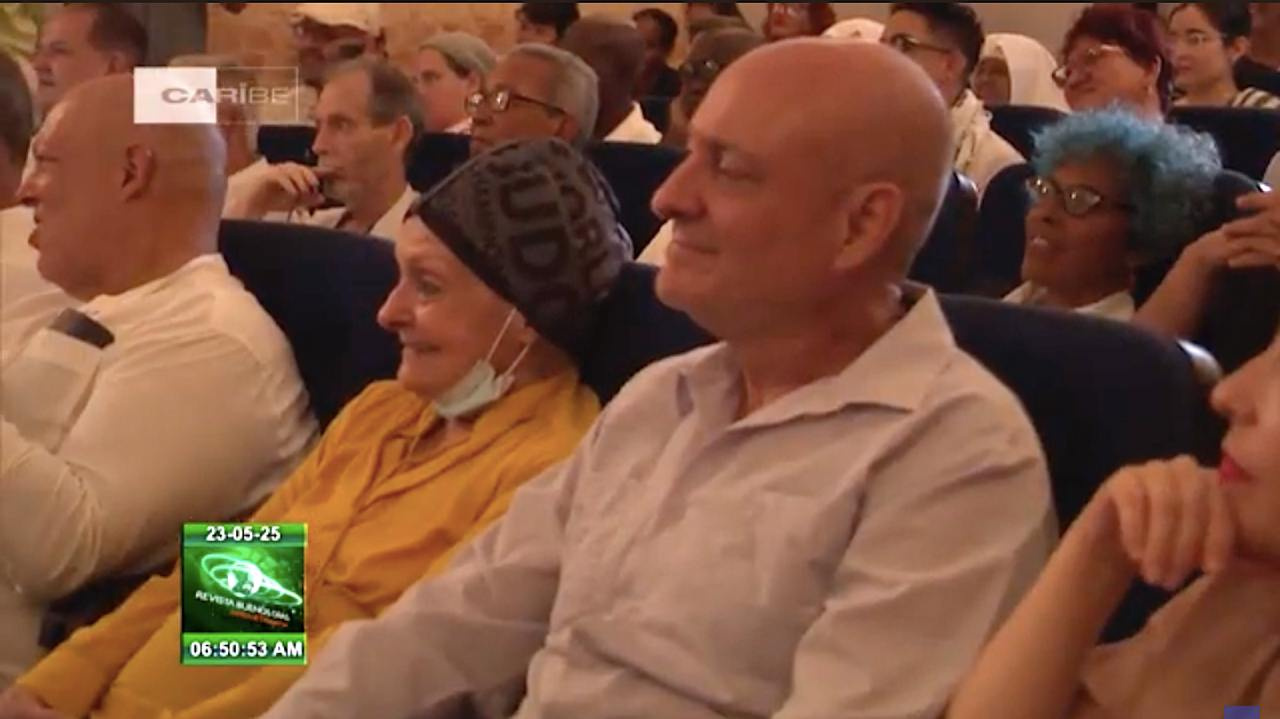
Fidel Castro’s Widow and Sons Make an Appearance on Cuban TV

Dalia Soto del Valle, away from the cameras since the death of the leader, was covered with a hat and mask.

Soto seated between two of her sons, Alexis and Alex Castro, during the commemoration of “Fidel and Religion.” / Canal Caribe

14ymedio bigger14ymedio, Havana, 24 May 2025 — Dalia Soto del Valle, Fidel Castro’s widow who has not been seen in public since the Cuban leader’s funeral in 2016, briefly appeared on Cuban Television on Friday along with several of her children. Their appearance during a talk by Brazilian priest Frei Betto in Havana lasted only a few seconds. Dressed in yellow, and wearing a skullcap and face mask, she looked decidedly unwell.

At her side were Alexis Castro, whose frequent posting on X abruptly ended last year “on the advice of doctors;” Alex Castro, the Cuban dictator’s longtime official photographer and father of Sandro Castro, the focus of multiple online scandals; and Antonio Castro, the former physician of the Cuban baseball team.

Except for Sandro Castro’s online antics and the occasional interview that Alex Castro gives to promote an exhibition or pay homage to his father, Soto del Valle and her sons have been almost entirely absent from the public eye.

Without identifying them, Cuban Television’s cameras briefly focused on them sitting in the audience during a celebration of the 40th anniversary of “Fidel and Religion,” a book-length interview Castro gave to Frei Betto in which the Cuban leader recalled his religious upbringing and summarized his stance on leftist Christian groups in Latin America. In his exchange with the Dominican friar, Castro made no mention of the Communist Party’s systematic persecution of the continue reading

Catholic Church and other denominations it has monitored since 1959.

The event took place in the Fidel Castro Center in Havana’s Vedado district. In addition to Soto and her sons, attendees included a number of religious figures with ties to the regime. Notable among them were Sava Gagloev, a Russian Orthodox priest with close ties to Patriarch Kiril and Vladimir Putin.

Published in May 1985, “Fidel and Religion”did not receive a commemorative edition or even a mere reprint to mark this anniversary. During the event, Betto had to make do with an old copy of his book from the Fidel Castro Center library.

The last time the Castro-Soto family was seen filmed was during Fidel Castro’s funeral in Santiago de Cuba. Dalia Soto and her children paid their respects at the dictator’s grave while relegating Fidel Castro Díaz-Balart — the first-born son from his earlier marriage to Mirta Díaz-Balart, the daughter of a prominent anti-Castro political family — to a minor role. That son committed suicide a year later.

Dalis Soto appears alongside a frail Fidel Castro in official photos taken during a visit by Pope Francis. Always a shadowy figure, she did not marry Castro until after the death of Celia Sánchez, his secretary, who was also rumored to be his lover. A native of Trinidad, Soto shunned public life. Her face was unknown to the public until the Special Period, when she discreetly began attending official events.

____________

COLLABORATE WITH OUR WORK: The 14ymedio team is committed to practicing serious journalism that reflects Cuba’s reality in all its depth. Thank you for joining us on this long journey. We invite you to continue supporting us by becoming a member of 14ymedio now. Together we can continue transforming journalism in Cuba.

Cuba’s Public Prosecutor’s Office Asks for Four Years in Prison for Professor Alina Bárbara López

The academic and her colleague Jenny Victoria Pantoja Torres reject the charges and denounce a politically motivated setup.

Lopez is surprised to be portrayed in the complaint as a “female version of Bruce Lee” / Facebook

14ymedio bigger14ymedio, Havana, May 26, 2025 — Almost a year after the events, the Cuban Public Prosecutor’s Office has presented its provisional conclusions in the case of dissident intellectual Alina Bárbara López Hernández and her colleague Jenny Victoria Pantoja Torres, accused of several crimes following an incident with Interior Ministry officials on June 18, 2024. The complaint was published by López herself on her Facebook profile, where she calls the process a “judicial farce” and denounces the political nature of her arrest.

According to the document presented by prosecutor Ana Lilian Caballero Arango before the Criminal Section of the People’s Municipal Court of Matanzas, it is requested that an oral trial be opened against both women, who will have to answer for the crimes of attack, disobedience and disrespect, according to the Cuban Penal Code.

The Public Prosecutor’s Office requests a joint sentence of four years’ imprisonment for López Hernández, replaced by correctional work without internment, in addition to a ban on leaving the country and other ancillary sanctions. In the case of Pantoja Torres, a three-year sentence is requested, also replaced by correctional work.

650 Cuban pesos for a damaged uniform and 5,000 pesos for hair extensions

Both must also repair alleged material damage to the officer who filed the complaint: 650 Cuban pesos for a damaged uniform and 5,000 pesos for hair extensions, according to the indictment.

López denounces that the text presented by the prosecutor is “badly written”, full of errors, and qualifies its content as a script of “action and violence” in which she herself is represented as a “female version of Bruce Lee.” According to the intellectual, the official narrative falsifies the facts continue reading

and conceals the real intent: repression against political dissent in Cuba.

“We were the ones beaten, attacked and treated like animals. I feared for my life that day”

“We were the ones beaten, attacked and treated like animals. I feared for my life that day,” wrote López, who claims to continue suffering physical consequences of the aggression, including inflammation of the inner ear, which causes balance problems and vertigo and can lead, in some cases, to hearing loss.

According to her account, both she and Pantoja were intercepted while traveling to Havana in exercise of their civil rights. The arrest, she says, was ordered by state security agencies, although the prosecutor tries to present it as an incident with no political connotation.

López questions the use of common crimes to cover up what she considers political persecution. “The infamous script of prosecutor Caballero Arango aims to strip what happened of its political nature, which is more than obvious,” she says. “It is a repeated strategy: transform the exercise of constitutional rights into common crimes in order to maintain that there are no political prisoners in Cuba”.

Also an essayist and university professor, she has been one of the most visible critical voices in contemporary Cuban thought. For several years, she has been systematically denouncing violations of fundamental rights on the Island and promoting dialogue and democratic transformation in the country.

“Dictatorships cannot disguise themselves as democracies, even if they try”

Although there is still no date for the trial, López warns that when it takes place, “it will be the 2019 Constitution that will sit, once again, in the dock of the accused.” The Cuban Constitution recognizes rights such as freedom of expression and association, but also establishes the irrevocable nature of the socialist, one-party system, which for the accused constitutes an unsurmountable contradiction.

“Dictatorships cannot disguise themselves as democracies, even if they try,” she says in her complaint, which ends with a call for solidarity: “We will need support and accompaniment in this shameful process”.

Alina Bárbara López and Jenny Victoria Pantoja have said that in the next few days they will publish a joint statement on their position regarding the prosecution’s charges.

Translated by Regina Anavy

____________

COLLABORATE WITH OUR WORK: The 14ymedio team is committed to practicing serious journalism that reflects Cuba’s reality in all its depth. Thank you for joining us on this long journey. We invite you to continue supporting us by becoming a member of 14ymedio now. Together we can continue transforming journalism in Cuba.
Cuban Postal Service Handles Billions of Dollars Worth of Shipments But Is Out of Stamps

If it weren’t for the Cubans abroad and their constant shipments of goods, the company’s workers would not have jobs.

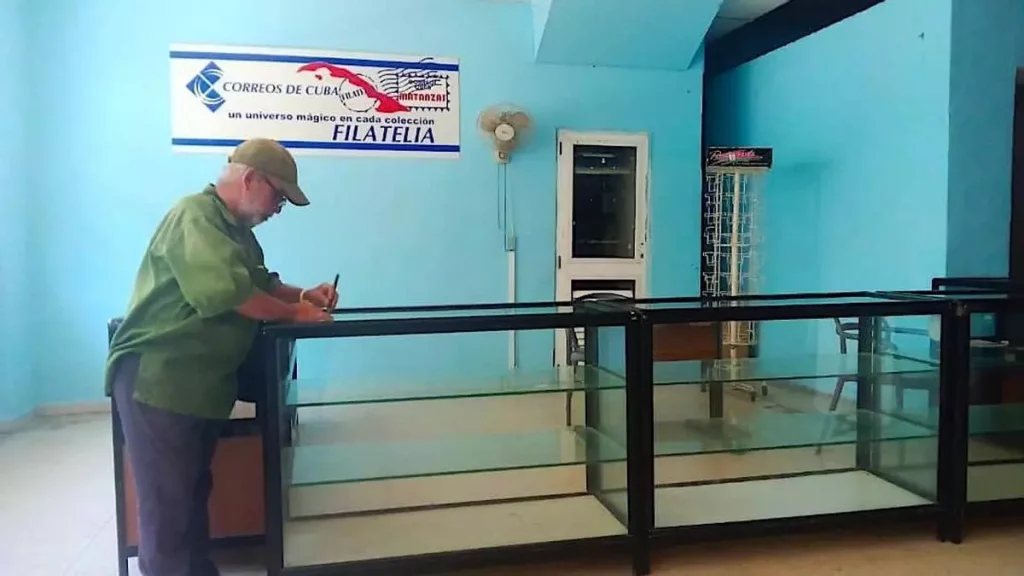
Post office customers usually only have one objective: to pick up packages sent to them by relatives overseas. / 14ymedio

14ymedio bigger14ymedio, Julio César Contreras, Matanzas, 24 May 2025 — In a city where people must wait in ever longer lines to buy things, it is surprising to see almost no one at local post offices. The lack of stamps and other supplies for mailing correspondence has turned these establishments into nothing more than pick-up locations for packages sent from abroad. Instead of letters and telegrams, these spaces are now filled with packages of powdered milk and medicine.

At the post office on Medio Street where, just a few years ago, lines used to begin forming early in the morning, it is now common to see workers looking bored. “No, we still don’t have stamps,” repeats one employee, who answers the same question dozens of times a day. “We’re suffering from neglect nationwide,” she says, pointing to the unreliable stamp supply as one of the most obvious signs of decline.

“It seems old-fashioned but some people still send letters, though most who come here need stamps to mail in some paperwork,” she adds. “A magical universe in every collection,” reads a sign pasted on the wall, intended to entice stamp collectors. Meanwhile, the display cases and shelves stand empty. There are no stamps, envelopes, or boxes to send to other provinces, much less glue, pens, or paper for anyone wishing to compose a letter on the spot.

Most people, who typically do not spend much time in here, have only one objective: to pick up packages sent to them by relatives overseas. “We have become a pick-up location and that is what keeps us open,” adds the employee. If not for the constant flow of packages from the Cuban emigre community, Cuba’s postal workers would be unemployed. In 2024 alone, continue reading

the agency received and processed 503,232 shipments from abroad.

“We’ve become a pick-up location, and that’s what keeps us open,” says one employee. / 14ymedio

Since 2021 the Ministry of Finance and Prices has assumed that Cubans will buy from abroad what the state does not import. So every three months the tariff on imported medications, cleaning supplies, food and electrical generators is suspended. All these products can enter the country duty-free provided they are not intended for resale. International parcel delivery has been one of the areas that has benefited most from this measure. The steady flow of shipments, however, has not had a spillover affect on the profits of other postal services.

“Some customers complain that we are out of stamps and they are completely right. All I can say is that we might get them sometime next week but I know perfectly well that there is no short-term solution,” the employee explains. One of those irate customers was complaining on Monday — shouting and slamming the door on his way out — after being told that, for weeks, the post office has been out of the 20-peso stamps he needs to mail some notarized documents.

“When we get stamps in those denominations, they come in small quantities and sell out immediately,” an employee at another, less centrally located and even less well-off post office explained. “The busiest days are when we have to pay pensions to retirees.” The employees themselves suggest that customers look for stamps on the black market. “They have everything there,” the employee said.

“I am looking for three 10-peso stamps. I need them urgently,” writes a desperate internet user in one of the many Facebook groups offering everything from household appliances to vacation packages. The request has garnered hundreds of responses in just a few hours. “I have 10, 20, and 1,000-peso stamps. I take transfers but you have to hurry. They’re running out,” says one of the informal stamp sellers.

To discourage scalpers, the Cuban postal service imposed strict rationing. “Sales will be limited to no more than three stamps per person in 10, 20, 40, 50, 125, 500 and 1,000-peso denominations. For five 5-peso stamps, the limit will be five stamps per person,” the postal service stated in an official announcement. But as with so many other controlled products, private brokers have found ways to circumvent the rules.

“They have contacts who are administrators and postal workers. When the stamps come in, they are the first to find out, even before the stamps make it to the sales counter,” complains a Matanzas resident. She grew tired of waiting and decided to buy the stamps she needed for a passport through informal channels. “I had to pay double. For the 2,500-pesos worth of stamps I needed, I ended up paying 5,000.”

Some customers, like 79-year-old Simón, who picked up a package at the post office on Medio Street on Monday, connect the dots and complain about the contradictions of the Cuban postal service’s monopoly. “They get thousands of packages every week. Our relatives abroad pay a high price for this service and sometimes they don’t even have a pen to sign the delivery form,” he explains. “Why don’t they invest all the money they earn from shipping into improving their other services?”

“We are not supplied with paper. What paper we do have has been brought in by workers themselves from home.” / 14ymedio

“We are not supplied with paper. What paper we do have has been brought in by workers themselves from home,” an employee complains. “Customers who want to send a letter or a package have to bring it in, ready to mail, because we don’t even have glue,” she explains. It seems as though the service is completely focused on receiving and processing items received from overseas but has forgotten about anyone who wants to mail something within the country or abroad.

“Not long ago I published a book and wanted to send a copy to my nephew in Spain but I haven’t been able to find a medium-sized envelope,” complains a local writer who once even had a post office box located at the entrance to his office. Those boxes, which once welcomed customers, have been abandoned. Some of their doors have been ripped off or their locks broken, a warning that a place that was once dominated by letters and telegrams is now only a delivery area for food, soap, and pharmaceuticals.

____________

COLLABORATE WITH OUR WORK: The 14ymedio team is committed to practicing serious journalism that reflects Cuba’s reality in all its depth. Thank you for joining us on this long journey. We invite you to continue supporting us by becoming a member of 14ymedio now. Together we can continue transforming journalism in Cuba.

Two Men Sentenced to 12 Years in Prison for Drugs in Santiago de Cuba

In another exemplary trial, in Las Tunas, a young man was sentenced to one year in prison for possession.

Both were being monitored by the National Anti-Drug Directorate “because of their continued illegal actions”/ 14ymedio

14ymedio bigger14ymedio, Havana, May 26, 2025 — The immediate result of the current “national exercise” against drugs -the third in six months in the country and the fifth in Havana- is, as in previous ones, the publicity for the exemplary trials that are being carried out. Both Periódico 26 and Sierra Maestra give an account of two of them.

The first, for which no date is given, was carried out in the Criminal Section of the Municipal Court of Las Tunas and sentenced a youth, 22, to one year’s imprisonment for possession of drugs: in this case, the synthetic cannabinoid popularly known as químico [chemical]. The sentence imposed on him was, according to the provincial newspaper, “the upper limit of the penalty framework for this type of crime.”

The second, held in Santiago de Cuba, was more serious. Two men aged 25 and 30 were sentenced to 12 years’ imprisonment for “offenses related to illicit drugs or substances with similar effects” in case number 28 of 2025.

Both were arrested by the police on the Central Highway at the Santiago municipality of Contramaestre

Both were arrested by the police on the Central Highway at the Santiago municipality of Contramaestre, reports Sierra Maestra, when they were traveling in a Transtur bus to Havana. They were found, the newspaper continues, “with 501 grams of cannabis sativa oil, commonly known as continue reading

marijuana, a digital scale with remains of the aforementioned plant and cash.”

According to the official newspaper Sierra Maestra, both were being monitored by the National Anti-Drug Directorate “because of their continued illegal actions. Despite their knowledge of the existing prohibitions in our country on the sale of drugs and their harmful consequences for health, they did not hesitate to commit the crime.”

A few days after the start of what they call the third National Exercise on Drug Prevention and Control, on May 18, the government reinforced this new campaign with a half-hour lecture by spokesman Humberto López on a program of Hacemos Cuba.

In it, the authorities revealed that, far from decreasing, narcotics trafficking and consumption continue to increase. The químico, they said, comes into Cuba in disposable diapers, energy-saving light bulbs and false suitcase bottoms, especially from Mexico. It is brought in by Cuban emigrants who live in that country and come to the Island for a visit.

Preliminary data on Havana are particularly worrying. There are 342 people charged with drug trafficking and consumption, most of whom are in pre-trial detention. There are 810 files opened by the Office of the Attorney-General of the Republic in connection with these crimes, committed in 74 “complex environments” in the capital.

In the same space, they denied an article that appeared in Escambray, according to which a new químico, more powerful than the one used by Cubans, would be circulating on the Island. Despite the fact that the report of the official newspaper of Sancti Spíritus included photographs of the product and testimonies from consumers, Colonel Héctor González Hernández, second head of the anti-drug section of the Ministry of the Interior, denied it. Broadly, he summarized, the químico remains “a synthetic cannabinoid made in clandestine laboratories abroad, mainly in the United States.” However, he admitted that among the 400 “formulations” detected, some could be “stronger.”

Translated by Regina Anavy

____________

COLLABORATE WITH OUR WORK: The 14ymedio team is committed to practicing serious journalism that reflects Cuba’s reality in all its depth. Thank you for joining us on this long journey. We invite you to continue supporting us by becoming a member of 14ymedio now. Together we can continue transforming journalism in Cuba.

Two Cuban Political Prisoners Awarded in Argentina for Their Defense of Human Rights

In addition to Lizandra Góngora and Alexander Fábregas, Venezuelan Carlos Julio Rojas and Nicaraguan Nancy Elizabeth Henríquez were also awarded.

The Center for the Opening and Development of Latin America recognized the activism of Cubans Lizandra Góngora and Alexander Fábregas / Collage

14ymedio bigger14ymedio, Havana, May 21, 2025 — The Cuban activist Alexander Fábregas, who was imprisoned in La Pendiente de Santa Clara, does not yet know that he received the 2025 Graciela Fernández Meijide Award for the Defense of Human Rights. The award, an initiative of the Center for the Opening and Development of Latin America (CADAL), also recognized the ’11J’ political prisoner, Lizandra Góngora.

“He is not aware yet; today I visited him, and when I left I learned that he had won the prize,” Fábregas’ mother, Luisa María Milanés, tells 14ymedio. The woman describes her 34-year-old son as someone who is currently extremely thin, “full of bedbug bites but strong in spirit and eager to keep fighting.”

The jury, composed of Rubén Chababo, Norma Morandini, Vicente Palermo, Inés Pousadela and Eduardo Ulibarri, evaluated the numerous applications received from Nicaragua, Cuba and Venezuela. This time the winners, in addition to Fábregas and Góngora, were the Nicaraguan activist Nancy Elizabeth Henríquez and the Venezuelan journalist Carlos Julio Rojas. All four have been through very complicated situations, including prison, “for the sole reason of peacefully defending” democratic ideals and principles. continue reading

Alexander Fábregas was recently convicted of uploading videos to social networks in which he “questioned the Cuban State system and attacked the country’s president”

Alexander Fábregas was recently convicted of uploading videos to social networks in which he “questioned the Cuban State system and attacked the country’s president.” Judgment 20/2025 of the Chamber for Crimes against State Security of the People’s Provincial Court of Villa Clara stated that the activist committed an offense of “propaganda against the constitutional order” by these acts.

The ruling noted that the defendant made several broadcasts on Facebook in which he advocated going out to protest, said civil disobedience “is a right, not a crime,” and asked for support for “political prisoners.” For all this, the court considered it proven that the condemned person made these publications “with the intention of encouraging people to undermine social stability and the socialist state proclaimed by the Constitution of the Republic.”

This is not the first time that Fábregas has been in prison for his activism.  His first arrest, for only three days – the maximum period without trial – for publishing a photo on social networks where he appeared with a sign that said: “No More Misery” took place in December 2020. Subsequently, he was arrested on the night of 11 July 2021 in his home, for transmitting on his social networks a call to go out into the streets of Sancti Spíritus to accompany the anti-government protests — subsequently referred to as ’11J’ — that shook the Island that day.

Lizandra Góngora was also among those condemned for participating in those demonstrations. In her case, the sentence amounted to 14 years in prison

Lizandra Góngora was also among those sentenced for participating in the demonstrations. In her case, the sentence amounted to 14 years’ imprisonment, and she is currently in a prison on Isla de la Juventud, far from where her five children live. Her detention in that prison has been considered a “cruel and ruthless tactic of the Castro regime in retaliation for her political opposition,” according to her brother, Ariel Góngora.

“I am very sad because I have not seen my children for four months since they moved me to this prison on Isla de Juventud, 160 kilometers from my home,” Góngora reported at the end of 2023. The activist was charged with the crimes of sabotage, robbery and public disorder during ’11J’ and received the highest sentence among all women sentenced for the same offenses.

The names of Góngora and Fábregas have been included on numerous lists of Cuban political prisoners, and several international organizations have demanded their immediate release.

Translated by Regina Anavy

____________

COLLABORATE WITH OUR WORK: The 14ymedio team is committed to practicing serious journalism that reflects Cuba’s reality in all its depth. Thank you for joining us on this long journey. We invite you to continue supporting us by becoming a member of 14ymedio now. Together we can continue transforming journalism in Cuba.

Hackers at the Service of the Spanish Government Placed Spy Software in Cuban Institutions

This is the Careto group, which infiltrated the networks of several countries.

Image of Careto distributed by Kaspersky, the cybersecurity company that detected it / Kaspersky

14ymedio bigger14ymedio, Madrid, 26 May 2025 — Almost anyone with an internet connection in Cuba was exposed to spying by Careto [Mask], a group of hackers from the Spanish government that operated in about 30 countries between 2007 and 2014, according to research. Although the existence of the malware was known 11 years ago, as revealed in a report from the cybersecurity firm Kaspersky, it was not until this May that at least three experts have directly pointed to Spanish authorities as responsible for the network.

“There was no doubt about it, at least none that was reasonable,” one of them told the American magazine TechCrunch. Kaspersky’s experts detected a spyware that attacked, between those dates, at least 1,000 Internet providers from 31 countries, among which the Government of Cuba was a priority.

The experts argued at that time that the interest was very possibly linked to the presence of up to 15 members of the ETA terrorist group in the country, a conclusion reached by seeing the profile of people attacked by the virus, linked to the Government of Cuba and a particular institution, which was never revealed.

The interest was very possibly linked to the presence of up to 15 members of the ETA terrorist group on the Island

The investigation began precisely with a member of the Cuban government who was infected and referred to as “patient zero,” which led to the discovery that Careto hackers attacked the network and specific government systems in Cuba, according to another former Kaspersky employee. This demonstrated “the attackers’ interest,” he said.

“Internally we knew who did it,” said one of the sources, adding that they had “high certainty” that it was the Spanish government. The other two continue reading

respondents endorse the same thesis and claim that one of the rules was to be careful when it came to revealing the links of some western governments in operations of this type. “It didn’t spread because I think they didn’t want to reveal the identity of a government like that,” a fourth former employee of the company added. “At Kaspersky we had a strict no-attribution policy. Sometimes it was strained, but never broken.”

The software, of a phishing type, was considered “one of the most advanced threats of the moment.” It was very stealthy and had the ability to steal conversations and “highly sensitive” data once it infected the computer, which arrived with emails supposedly coming from well-known media such as El País, El Mundo or Público, as well as recipes and political videos.

When a user clicked on one of the infected links, a code capable of piracy was installed on the computer

One of the former employees who has now spoken with TechCrunch said that among those links, some referred to ETA news or were about issues in the Basque Country, although the 2014 report did not include it. When a user clicked on one of the infected links, a code capable of piracy was installed on the computer while it redirected itself to a legitimate website so as not to arouse suspicion, according to the report.

This code contained several words in Spanish, among them the aforementioned Careto – colloquially used as a bad face – but also another that served to establish exactly the location of the network. This was the contraction ’Caguen1aMar’, which replaces ’Me Cago en el Mar’ [I shit in the sea], exclusive to Spain and not used in other Spanish-speaking countries.

Cuba was not the only target country. Indeed, other spies further confirmed the connection with Spain, including Gibraltar – a British colony located in the south of the Iberian Peninsula – Brazil, Morocco and some targets within the country itself.

Kaspersky, now asked, disconnects from the identification. “We don’t do any formal attribution,” a spokesman told TechCrunch. Meanwhile, the Cuban government has not answered questions from the media; nor has the Spanish Ministry of Defense. The investigated period affects the governments of José Luis Rodríguez Zapatero and Mariano Rajoy, although Careto returned to operating after 2014, presumably now disconnected from state authorities.

Careto stopped all operations when the report became known, even deleting their records, something “unusual,” according to experts

In Africa, the group’s malware was found in Algeria, Morocco and Libya; in Europe, it attacked in France, Spain and the UK. In Latin America, in addition to those already mentioned, Colombia and Venezuela were not spared either. Those affected were diverse and dispersed in all countries except for Gibraltar, Morocco, Switzerland and Cuba, where the target was a specific government institution.

In addition to attacking state institutions, embassies and diplomatic legations, Kaspersky pointed out intrusions by Careto, since 2007, into energy companies, institutions and activists; present on computers with Windows, Mac and Linux, as well as in code capable of attacking Android devices and iPhones. The malware could intercept internet traffic, Skype conversations, encryption keys (PGP) and VPN settings, take screenshots and get all the information from Nokia devices.

Careto stopped all operations when the report was known, even deleting their records, something “unusual” according to experts. The group went straight into the cyber spy elite. “You can’t do that if you’re not prepared,” one of the sources told TechCrunch. ” They destroyed everything, all the infrastructure, systematically and quickly. Boom! It simply disappeared.”

But it didn’t go away completely. Kaspersky found Careto again in 2019, 2022 and 2024, in an organization that had already been spied on in 2014 in Latin America, and another, this time new, in a central African country. Neither of them has been identified in this case. The tactics, techniques and procedures (TTP) are, they claim, extremely similar to those used a decade ago. However, more recent research suggests that it is no longer linked to the Government of Spain and warns that recent mistakes are small but fatal. “What entity was it? Who developed the malware? From a technical perspective, it is impossible to know,” two experts said.

This time the hackers broke into the email server of a Latin American victim, whose name has not been revealed, and then installed the malware, stealing all kinds of data. In the case of the African, another type of screen-capturing code was used. Despite being detected and making more mistakes than in their previous phase, analysts consider them very good, ahead of Lazarus Group (North Korea) and APT41 (China), or at the level of Equation Group and Lamberts (USA) or Animal Farm (France).

Careto is, for them, a “small threat, but one that surpasses in complexity those big ones. Their attacks are a masterpiece.”

Translated by Regina Anavy

____________

COLLABORATE WITH OUR WORK: The 14ymedio team is committed to practicing serious journalism that reflects Cuba’s reality in all its depth. Thank you for joining us on this long journey. We invite you to continue supporting us by becoming a member of 14ymedio now. Together we can continue transforming journalism in Cuba.
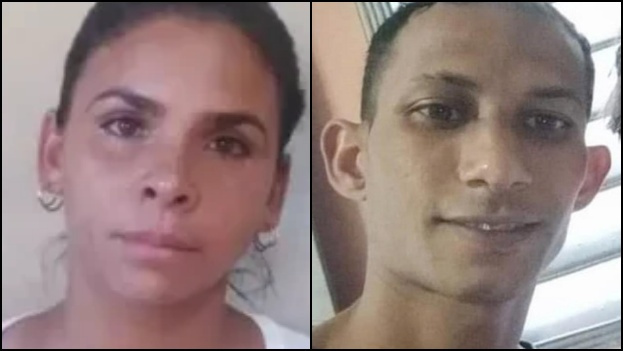
Cuban Hypertensives, Forced To Resort to the Black Market Due to Lack of Medicines

Relatives abroad, who pay for medicines and supplies that have disappeared on the island, are another source of relief.

The lack of blood pressure monitors and other resources in hospitals also affects health services / Granma

14ymedio bigger14ymedio, Havana, May 25, 2025 — Lidia is one of more than 2.5 million Cubans who are diagnosed with hypertension. Last week I heard a shop clerk in Havana say that the yogurt for which she had been lining up for several days was already gone, and she thought she was going to be one less number in the population statistics. After arriving at the polyclinic in her area with blood pressure through the roof, the response of the doctor on duty left her perplexed: “We have nothing here to help you.”

Days after the scare, and after promising her family that she would avoid “tantrums,”Lidia tells 14ymedio that the doctor herself was shocked when she confirmed, thanks to a photo taken by the patient on her blood pressure monitor, that her pressure had risen to almost 200 mmHg (millimeters of mercury). “She asked me how I got to the polyclinic and had me drink a glass of lemonade without sugar. Then she told me to ’keep doing it, because there are no medicines here’.”

In the absence of medicines, the doctor wrote down for Lidia the name of a drug recommended to control high blood pressure. “I found it on the black market, and the saleswoman told me that it was Colombian and that she did not know if it was any good. In the end I took it, and my blood pressure dropped so low that I almost fainted,” she recalls. continue reading

If Lidia had to resort to the black market it is not because she needed the Colombian pill at any cost

If Lidia had to resort to the black market it is not because she needed the Colombian pill at any cost. A simple Cuban-made enalapril or captopril would have been sufficient, but both pills have become extinct in the state pharmacies, and her first-aid kit has been depleted at the same rate.

At the risk of running into fake or adulterated medicines, she, like many other patients, has no choice but to turn to the black market, WhatsApp sales groups or Revolico’s Facebook pages to find what they are looking for.

A blood pressure monitor is 30 US dollars, an enalapril strip is 250 pesos or a captopril strip is 280; the prices that hypertensive patients find through informal channels are not easy to pay, especially when doses must be taken regularly. In fact, those with family abroad often ask their relatives to deliver the equipment and, periodically, the pills, to avoid being given faulty blood pressure gauges and medicines of dubious origin.

This request is not exclusive to patients. “We sent my sister, who is a doctor with almost 60 years in the profession, both the blood pressure monitor and the blood oxygen monitor from Miami, because they don’t even have them in the hospitals,” says Orlando, who has been in the US for several years.

Every time that Orlando can travel to Cuba or learns that someone he knows is planning a trip, he puts together a small package of medicines

Every time that Orlando can travel to Cuba or learns that someone he knows is planning a trip, he puts together a small package of medicines that, in addition to the always-needed ibuprofen, paracetamol and antacids, includes blood pressure medications. According to him, they are more expensive, but they guarantee that his relatives “are not taking weird things.”

The rates of hypertension in Cuba have skyrocketed in recent years, influenced by the unhealthy lifestyle on the Island, the limited possibility of having a healthy diet and the constant emotional stress of daily life with the long lines, blackouts and inefficient bureaucracy.

In 2010, according to a Cubadebate report from a health worker last March, 22.4% of the population were diagnosed with hypertension. Last year, with 2,494,098 patients, the figure had risen to 29.5 per cent. Of these, 21% were not “dispensarized”; that is, they did not receive regular medication.

On a smaller scale the numbers may be more alarming. In the municipality of Yaguajay, Sancti Spíritus alone, cases increased by 1,455 in the last year. In total, 13,474 residents of this territory suffer from hypertension, 35.8% of the population.

The health authorities explained to the official newspaper Escambray that among the factors influencing the disease some are not modifiable, but others are: “Those that cannot be modified include age, sex and inheritance, while those that can be modified include inadequate diet, sedentary lifestyle, obesity, smoking and alcoholism.”

Translated by Regina Anavy

____________

COLLABORATE WITH OUR WORK: The 14ymedio team is committed to practicing serious journalism that reflects Cuba’s reality in all its depth. Thank you for joining us on this long journey. We invite you to continue supporting us by becoming a member of 14ymedio now. Together we can continue transforming journalism in Cuba.

Summer is Approaching and Discontent Among Cubans is Growing

Many families feel they have nothing left to lose because they have hit rock bottom.

Protests in Caibarién, Villa Clara, in 2022, over blackouts. / Screenshot

14ymedio bigger14ymedio, Yoani Sánchez, Generation Y, Havana, 26 May 2025 — Summer has always been the most feared season of the year for Cuban authorities. In addition to the high temperatures that on the island begin in spring, there are the unpopular power outages and school holidays that strain domestic life. This year, the situation is especially complicated due to the fragility of the national energy system and the fuel shortage, which has extended blackouts to more than 15 hours a day in many parts of the country. July and August are approaching, and social anger is growing.

In recent days, street protests have been reported in Bayamo, Granma, and Santiago de Cuba. In images shared on social media, dozens of people can be heard shouting a direct demand: “We want electricity, we want food.” Engulfed in darkness, some banging pots and pans and others using only their throats, the protesters are merely the vanguard of a popular uprising that some feel is just around the corner. That perception that people are going to take to the streets appears every summer, but this one is different. Many families feel they no longer have anything to lose because they have hit rock bottom.

“They’re not asking for freedom,” criticized many internet users, mostly Cubans living abroad, upon seeing footage of the protests. While the demands for an end to the blackout and for some food to reach the rationed market seem very basic from the outside, inside the country they take on a profound political character. In a nation where all thermoelectric plants, oil imports, and the electricity service that reaches every home are in the hands of a state that monopolizes the energy sector, demanding the restoration of power seems extremely daring. continue reading

This same state structure manages the supply of food to the ration stores, handles the international market purchases of products distributed in the basic family basket, and is at the forefront of most economic decisions that result in more or less foreign currency to purchase everything from rice to eggs. Any vocal public demand for improving services and the amount of food that reaches homes is taken by the regime as a challenge. A government that doesn’t tolerate the slightest criticism sees such requests as a gesture of rebellion that it cannot allow.

As temperatures rise and the darkness of power outages spreads across Cuba, the police force is preparing to confront the summer protests. The memory of the social explosion of 11 July 2021, is still very fresh in the minds of the regime, and state institutions have already warned their employees that they must take to the streets to “defend the Revolution.” This is the same repressive strategy deployed around this time every year, and it is marked this time by greater nervousness among the political police in the face of a possible popular uprising.

On one side are the military, the police, and a well-oiled propaganda machine that portrays the dissidents as enemies; on the other are the desperate and hungry people, whipped up by that “General Summer” riding on the back of heat and despair.

________________________

Editor’s Note: This article was originally published in Deutsche Welle in Spanish.

____________

COLLABORATE WITH OUR WORK: The 14ymedio team is committed to practicing serious journalism that reflects Cuba’s reality in all its depth. Thank you for joining us on this long journey. We invite you to continue supporting us by becoming a member of 14ymedio now. Together we can continue transforming journalism in Cuba.