The sketch made by an English agent in 18th-century Havana sparked an invasion, a conversation, and a novel.
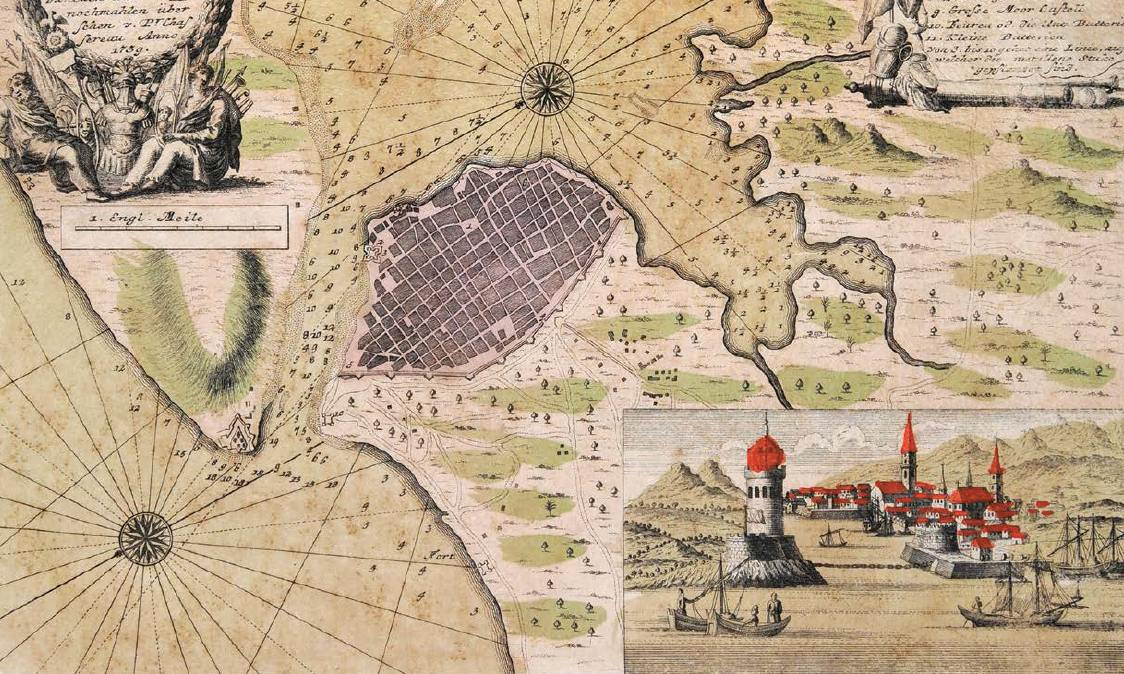
 14ymedio, Xavier Carbonell, Havana, 10 May 2025 – You have to go back to the moment in which Miriam Gómez, tormented by a husband who writes even after death, remembers a map “made by an English spy in the eighteenth century”, hanging in Alejo Carpentier’s office. Cabrera Infante looks at it and names a novel after it, but in the actual text he forgets all about it and prefers instead to evoke a Hemingwayesque print from 1778: ’A youth rescued from a shark’.
Distracted by Carpentier’s baloney, Cabrera Infante has time to examine more than one picture. He looks closely at the drawing of the sharks, but he also looks at an antique map of Havana, and perhaps then one of his famous pet phrases occurs to him: “The picture describes” or “In the picture can be seen”, which he uses in ’View of the Dawn in the Tropics’.
The strongest proof that the map existed – and now I feel like a scholarly theologian – is that very same book itself. In ‘View of the Dawn in the Tropics’ the novelist describes in great detail (amongst dozens of vignettes of violence in Cuba) the map that we’re looking for:
“I have here a map created a few days (or perhaps weeks or months) before the English attack on the island’s capital. As one can see, the map is quite crude but its task is well accomplished because the fortifications of Morro and La Cabaña are clearly shown, at the entrance to the bay, and then the fortifications in Havana itself of La Punta, Castillo de Atarés and Torreón de San Lázaro. You can see how the map distorts the city’s characteristics and those of its surrounding area. It’s believed that this map was created by an English spy”.
The mistakes are numerous but let’s just say that Cabrera Infante’s Havana is timeless and gloss over that
The mistakes are numerous but let’s just say that Cabrera Infante’s Havana is timeless and gloss over that. The British Invasion happened in 1762 and the maps that the fleet used were actually from a few years earlier, not “weeks or months”. La Cabaña didn’t even exist then; it was just a hillock which in fact was strategically important at the time of the bombardment of Morro. Neither Atarés nor San Lázaro existed either. Cain only got it right with La Punta.
In one of his catalogues Emilio Cueto brings together 17 maps drawn up by English spies in 1762 alone. In earlier decades many others were drawn up, and a great quantity of sketches which were more or less precise, “crude” but useful for the invasion. Several of those maps were created from testimonies by “an experienced commander”.
In 1756, one of those high ranking commanders visited Havana. He was Charles Knowles, the naval governor of Jamaica, who, from first entering the bay began to make careful notes about the city’s defences. It was he who drew up the plan for the attack six years later. The maps used in the occupation were reproduced ad nauseum in British magazines to bring news of the battle.
The espionage became more intense as the invasion approached. In 2003, the translator Juliet Barclay brought to light two unedited documents in the magazine Opus Habana – a letter and a map – addressed to the Count of Egremont in 1760. Signed “your most faithful servant”, the text offered the coodinates of the port – “the base for all Spanish maritime forces in America”.
In the agent’s view, Havana was “almost oval, completely surrounded by stone and brick walls”
In the agent’s view, Havana was “almost oval, completely surrounded by stone and brick walls” and having a bay with “a narrow inlet”, as is seen in his sketch, somewhat inaccurately. It’s a little reminiscent of Cargapatache’s Map – a Portuguese bandit who left instructions to enter the Havana bay in the sixteenth century. For him, the bay was a kind of feminine belly and the ship had to be guided by two mounds which he called The Tits. Was this the map that Cabrera Infante saw? Barclay unfortunately doesn’t say where he got it from.
There’s no solution to the case until someone discovers where Carpentier’s drawings ended up. Cabrera’s “English spy” could be Knowles, or an anonymous Brit who escaped to England before the invasion, or any “experienced commander” who passed through the island. Or even some Cuban, because there was no shortage of collaborators when Havana was under English occupation.
Thumbing through Cueto’s catalogue leaves an investigator with a bunch of suspects’ names – people who drew or printed maps during those years: Pierre Chassereau, William Henry Toms, P. A. Rameau, J. Gibson, Andrew Bell, Giuseppe Pazzi… Which of them was our man in Havana? To find out, you’d need a metaphysical detective in the style of Oesterheld or Mœbius, an informer of the kind Infante and Carpentier talked about, a spy to spy on the spy that eluded us… and a better artist than he was.

Translated by Ricardo Recluso
____________
COLLABORATE WITH OUR WORK: The 14ymedio team is committed to practicing serious journalism that reflects Cuba’s reality in all its depth. Thank you for joining us on this long journey. We invite you to continue supporting us by becoming a member of 14ymedio now. Together we can continue transforming journalism in Cuba.