Fiction, autobiography and art confirm the growing importance of publishing outside the island, while domestic production is disappearing.
 14ymedio, Havana, 8 February 2026 — January confirmed a trend that has been setting the pace in the Cuban publishing world for several years: while the diaspora’s catalogue continues to grow and diversify, domestic production within the island is declining. Novels, autobiographies and books dedicated to the visual arts were the genres that dominated the new releases in the first month of 2026, many of them promoted by independent publishers who have become the true mainstay of the island’s writers.
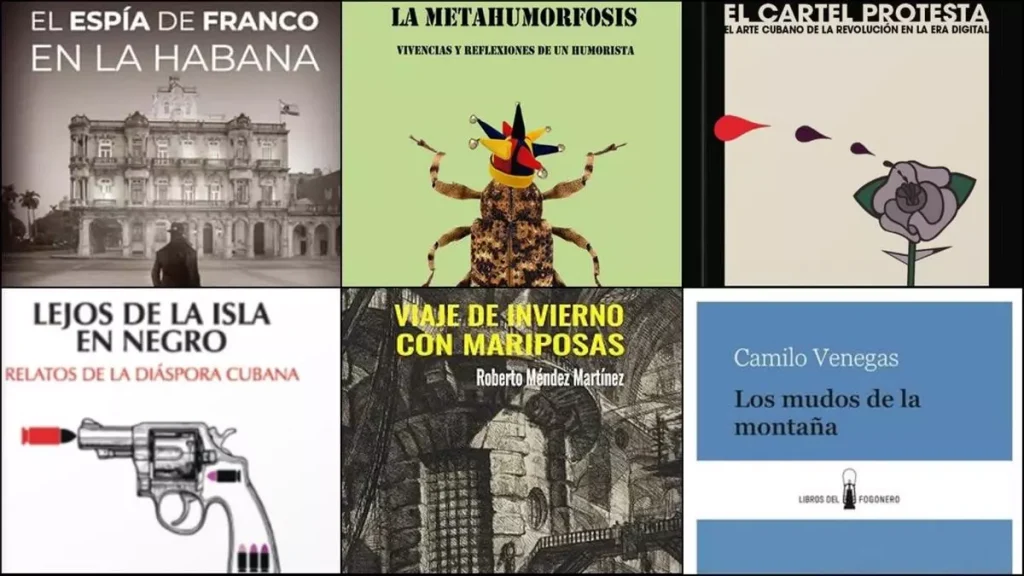
One of the releases that marked the beginning of this year was Viaje de invierno con mariposas (Winter Journey with Butterflies) by author Roberto Méndez Martínez, which has been added to the Ilíada publishing house catalogue. It is a mature, intense and reflective novel that addresses confinement not only as a physical experience, but also as an existential condition. Writer Amir Valle, director of the publishing house, has defined the book as “a deeply human and heart-wrenching dive into the limits of freedom,” highlighting its ability to turn prison into a metaphor for all the social, spiritual and political barriers that accompany the individual even outside the walls.
Also in January, Lejos de la Isla en Negro (Far from the Island in Black) was released. Relatos de la diáspora cubana (Stories of the Cuban Diaspora), was published by Ediciones Hurón Azul. This is the sixth volume in the Arte Impossible Collection and continues an anthological line that is now classic within Cuban crime and noir fiction. Edited by Rebeca Murga and Lorenzo Lunar, the book continues along the path opened up by Confesiones (Confessions, 2011), Isla en Negro (Island in Black, 2014) and Regreso a la Isla en Negro (Return to the Island in Black, 2022), but now shifts the focus to the geographies of exile.
The selection brings together authors from several generations, including Rodolfo Pérez Valero, Justo E. Vasco, Vladimir Hernández and Marcial Gala, and confirms how crime fiction has survived its ideological instrumentalisation in the 1970s to become part of the body of new Cuban narrative, without forced labels.
In the field of historical essays, January brought El Espía de Franco en La Habana (Franco’s Spy in Havana) by veteran journalist Pablo Alfonso.
Autobiography had its place in the spotlight with the expanded reissue of Metahumorfosis: Vivencias y reflexiones de un humorista (Metamorphosis: Experiences and Reflections of a Comedian) by writer and comedian Pepe Pelayo. Originally published in 2020 and now revised with five more years of experiences and reflections, the book is both a life story and a lucid essay continue reading
In the field of historical essays, January brought El espía de Franco en La Habana [Franco’s Spy in Havana] by veteran journalist Pablo Alfonso. Based on the so-called “Caldevilla papers,” the book reconstructs a little-known plot from the Cold War: the confidential reports that a Spanish diplomat sent to Francisco Franco’s regime from Cuba, revealing that Spanish intelligence knew in advance about the installation of Soviet missiles on the island. The volume reopens uncomfortable questions about the relations between seemingly antagonistic dictatorships and provides new clues to understanding the Missile Crisis.
Independent publishers have become the real mainstay of writers on the island.
Fiction once again turned to memory with Los mudos de la montaña (The Silent Ones of the Mountain) by Camilo Venegas, an author who has been very active recently and who also published the poetry collection Carta de porte (Letter of Carriage). Set in Cuba in the 1980s, the novel contrasts the cultural effervescence of Havana with the silence of the Escambray, a region marked by a war that is not talked about. Loosely inspired by Werner Herzog’s film Fitzcarraldo, the volume is a portrait of a country where history is rewritten over and over again with omissions and retouches.
The visual arts had a notable presence in new publications. Rafael Zarza. Toda la Corrida Artística, an essay by Hamlet Fernández Díaz, joined a growing catalogue of books dedicated to Cuban artists, a field that is clearly expanding outside the island. The volume reviews Zarza’s work from a comprehensive perspective, reaffirming the importance of these studies in preserving an artistic memory that today lacks the resources and institutional will to flourish in Cuba.
This overview was rounded off by El Cartel Protesta. El arte cubano de la revolución en la era digital (The Protest Poster: Cuban Art of the Revolution in the Digital Age), published by Ediciones Hurón Azul and written by Ernesto Menéndez-Conde and Luis Trápaga Brito. The book brings together more than three hundred works of rebellious graphic art that emerged on social media in the absence of a real public space and documents an artistic movement that is censored within the country. In critical dialogue with El Arte de la Revolución (The Art of Revolution, 1971) and with the tradition of Cuban posters from the 1960s, the work functions as an archive, a denunciation and a counter-narrative to official propaganda.
Translated by GH
____________
COLLABORATE WITH OUR WORK: The 14ymedio team is committed to practicing serious journalism that reflects Cuba’s reality in all its depth. Thank you for joining us on this long journey. We invite you to continue supporting us by becoming a member of 14ymedio now. Together we can continue transforming journalism in Cuba.