It is another sign of the Cuban regime’s concern over public discontent and pressure from the United States.
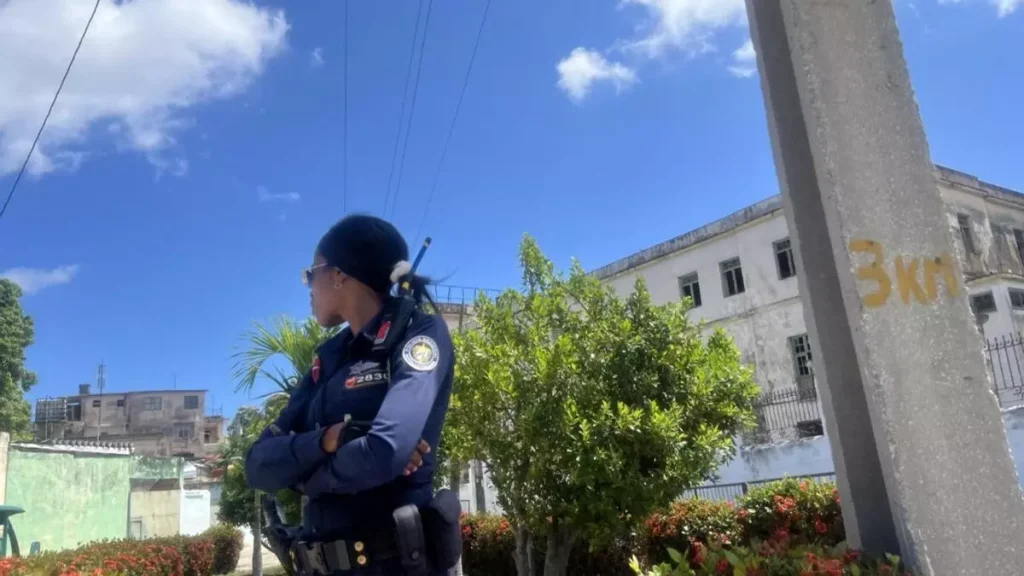
 14ymedio, Havana, February 6, 2026 – Cuba’s National Revolutionary Police published a call on social media this Wednesday aimed at young people between 18 and 35 years old to train as officers through a six-month basic police training course followed by an eleven-month upper secondary–level program. The initiative promises to graduate participants, through this accelerated training, with the rank of second lieutenant and also grant them direct access to a Bachelor’s degree in Law at police university campuses, without the need to take an entrance exam.
Reactions on social media were swift. “How things have changed. Fifteen years ago I really struggled to reach the second rank of non-commissioned officer through good behavior, but oh well, I wish the new ones success,” commented user Yanet Rivas on the official Facebook post. The call also sparked much more critical reactions, such as that of user Luciana de Lara: “I wouldn’t become a police officer even if I were crazy, because they go through the same hardships as the people and can’t say anything.”
As noted by Cuba x Cuba magazine, citing a similar call published in 1990 by the newspaper Juventud Rebelde, police training at that time lasted two years and was structured in two stages: a first year of common core training and a second year of specialization.
The loosening of requirements to enter the police force reflects the lack of demand to join the regime’s main repressive body, compounded by population decline. For more than four years now, following the repression unleashed after the nationwide protests of July 11, there has been a massive exodus of young people of working age. According to a study by independent demographer Juan Carlos Albizu Campos, Cuba’s population has shrunk by 24% in just four years.
The force’s poor image due to the arbitrariness of its actions and the ignorance of its members is also not negligible.
The force’s poor image due to the arbitrariness of its actions and the ignorance of its members is also not negligible. It is well known that in Havana most police officers—or “pitufos” [smurfs], as they are colloquially called—are young people, generally with limited resources, who arrive from the eastern provinces, often without even knowing the capital.
On January 28, for example, amid this escalation of repression against activists and independent journalists, Yoani Sánchez, director of this newspaper, was detained on the street by a young man in civilian clothes, no older than 25, who was unable to tell fellow officers his location when requesting backup.
In the midst of the deep structural and energy crisis gripping the country, the urgency to rapidly expand the police force is striking. This Thursday, at a press conference, Díaz-Canel stated that the country is preparing for a “wartime scenario,” asserting that the entire defense system and State institutions are gearing up in response to an alleged attempt at aggression, and announcing plans for political mobilization and communication designed for that context. According to a report published this Thursday by Prisoners Defenders, the Island is currently setting a historical record for political prisoners, with a total of 1,207, with 18 detained so far in 2026 alone.
Translated by Regina Anavy
____________
COLLABORATE WITH OUR WORK: The 14ymedio team is committed to practicing serious journalism that reflects Cuba’s reality in all its depth. Thank you for joining us on this long journey. We invite you to continue supporting us by becoming a member of 14ymedio now. Together we can continue transforming journalism in Cuba.