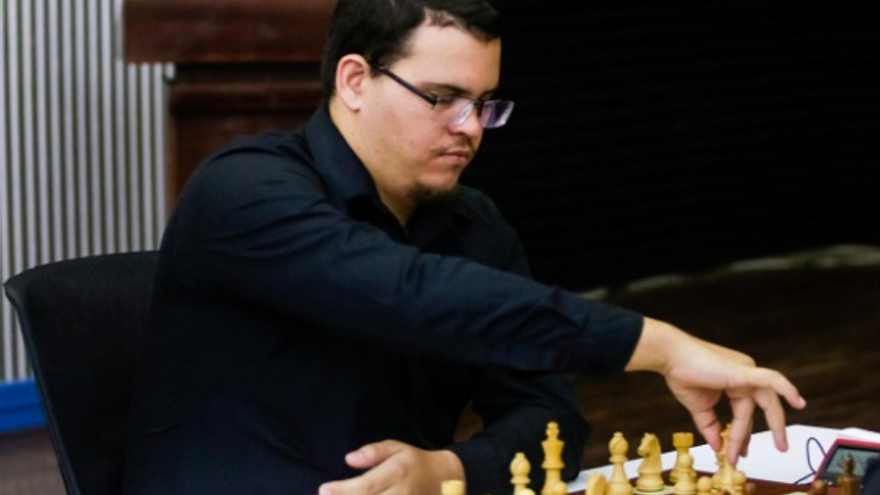
It was the fifth time that the avileño competed for the crown of Cuban chess. (Cubadebate)
14ymedio, Havana, 15 February 2024 — After a National Championship without sorrow or glory, Cuban chess now has a new leader. Luis Quesada, from Ciego de Ávila, was crowned after a tense mini tournament of quick games against the other two favorites, Omar Almeida – whose victory was almost taken for granted until the last moment – and Carlos Daniel Albornoz.
At the end of the tenth round of the tournament, held in Holguín, this Wednesday, Michel Díaz, from Las Tunas, demanded a review of his game against Almeida, and the referees declared it a draw. The decision cost the habanero an exhausting series of quick games against Albornoz, whom he dispatched without difficulty, and Quesada, against whom he failed in the second round. It was the fifth time that Quesada competed for the crown of Cuban chess.
Of the 26 registered competitors, Albornoz had accumulated 6.5 points after agreeing on draws this Wednesday with Lelys Martínez, the same as Almeida and Quesada. With 6 points, they were followed by Martínez and Dulan Berdayes, and by Kemel Gallo with 5.5, whose victory against Rider Díaz was more than fruitful: not only did he finish in sixth place in the championship, but he added 49 points to his Elo coefficient* – now 2,348 – and achieved his second International Master title. continue reading
The confrontation between Albornoz, Quesada and Almeida was seen coming from their triple draw this Tuesday
The confrontation between Albornoz, Quesada and Almeida was seen coming from their triple draw this Tuesday. The Cuban Chess Federation, which covered each segment of the competition, attributed to Almeida more chances of winning, although it did not rule out that Martínez or Berdayes could give a surprise on the ninth day.
“We remind you that if there is a draw in first place at the end of the match, they would have to play fast games; if there were two draws, they would play a match, and if there were more, then a mini-tournament,” the Federation warned on Tuesday.
As for the women’s section of the championship, which played its seventh round this Wednesday in Pinar del Río, it was also a surprise that Obregón beat Yersisbel Miranda, who had more chances of winning, according to the Federation. The Villaclareña, the current youth championship, is one of the favorites of the tournament and counts for 5.5 points.
The National Chess Championship of Cuba celebrates its 71st edition after a controversial invitation from the Federation to the emigrated chess players, who could participate on the condition that they disassociate themselves from the federations for which they currently play and only if they maintained a “respectful” attitude towards the regime after their departure from the country.
The National Chess Championship of Cuba celebrates its 71st edition after a controversial invitation from the Federation to the emigrated chess players
No prestigious player responded and the tournament began with 26 players who, despite having participated in international tournaments, have not gone into exile. Nationalized in the United States, Leinier Domínguez – the most outstanding Cuban player since José Raúl Capablanca and currently the eighth best chess player in the world – for whom the Federation said that there was the possibility of an “exception,” did not pronounce on the draconian conditions of the ruling party.
The one who did was Lázaro Bruzón, also a resident of the United States, who rebuked the Federation for assuming the right to decide what a “respectful attitude” was in a country whose government is the first to disrespect its citizens. Bruzón, who keeps the record for national titles – with six victories in the championship – was one of the most critical voices about the repression that Havana unleashed against the demonstrators of 11 July 2021.
Having ruled out those who were once representatives of the Island in elite tournaments, the Cuban Federation now has its eyes on Albornoz. Young and talented, the Camagueyan is one of the few masters of his age who can defend the Island in international competitions. The praise that the official press dedicates to him after each success is reminiscent of that once enjoyed by Domínguez and Bruzón, whom it now rejects.
* A comparative rating ststem for a player’s skill level. Translated by Regina Anavy
____________
COLLABORATE WITH OUR WORK: The 14ymedio team is committed to practicing serious journalism that reflects Cuba’s reality in all its depth. Thank you for joining us on this long journey. We invite you to continue supporting us by becoming a member of 14ymedio now. Together we can continue transforming journalism in Cuba.
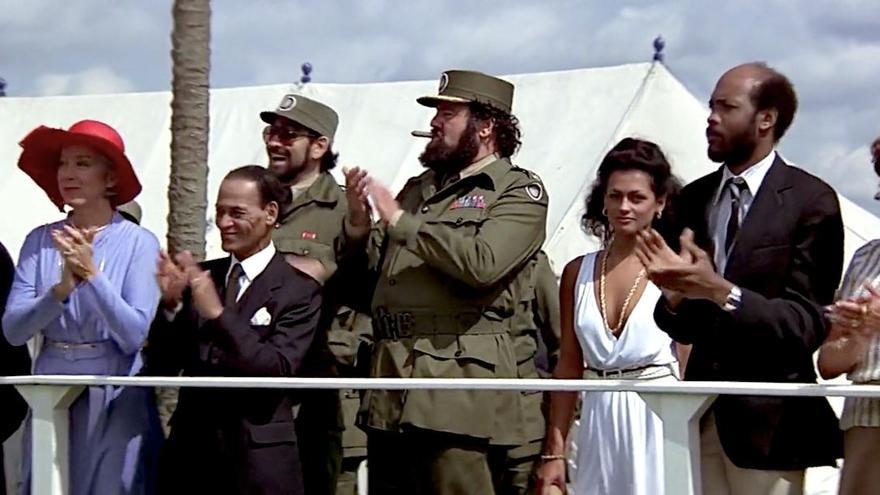
A still from Octopussy, a film in which 007 is on a mission to destroy a base in Cuba.
14ymedio, Xavier Carbonell, Salamanca, 11 February 2024 — Only once in my life have I been in the same city as James Bond. It was Havana. Or rather, a fake Havana that had a seaside promenade like the Malecón but no Morro Castle. It was actually the Spanish city of Cádiz, used as a stand-in for the movie Die Another Day.
While in Cádiz I returned to the capital of my imaginary country where 007 travels in search of a North Korean hit man who, improbably, wants to undergo a face change at a Cuban clinic. From La Caleta beach, where I smoked a cigar, Halle Berry emerges wearing a bikini — copied from one Ursula Andress wore in 1962 — while Pierce Brosnan spies on her with binoculars from a hotel bar.
Bond arrives in a cardboard Havana and walks into a cigar factory. It couldn’t be any other way. Cigars, old cars, women and drink – and that yellow hue that Europeans imagine when they think of the tropics – make Cuba the ideal hideout for Moscow’s men. There are Cuban flags, Young Pioneers, and posters with Camilo Cienfuegos on every wall along with decorative hookers. continue reading
The tobacco shop – actually Cádiz’ Mercado de Abastos – belongs to a certain Raoul (played by the Mexican actor Emilio Echevarría). To see him, Bond must use a password: Delectados. He wants to smoke this rare brand – also fake though the Dominicans did try to patent the name – which has not been produced since Castro took power.
Raoul, in suit and tie, waits for him on a terrace with views of the cathedral – of Cádiz, of Habana, or maybe Cabana, I don’t know where I am — and slips in an anti-tobacco message. To smoke Delectados you must have a license to die, not just to kill. Bond, who has been smoking cigars for decades, tells him that he is well aware of the risk. Delectados have a dangerous tobacco wrapper that “burns slow and never goes out.” Password accepted.
“We may have lost our freedom in the Revolution but we have a health care system second to none”
It is assumed that Raoul — a fervent communist, we later find out — is an informant for MI6, the British secret service, working as a sleeper agent in Castro’s court who ends up ratting out the North Korean. The terrorist, who is not a tourist – the joke is 007’s and sounds better in English – is at the Organs, a center for the study of a type of gene therapy to “extend the life of our beloved leaders.”
Raoul comments, “We may have lost our freedom in the revolution but we have a health care system second to none.” Bond raises his eyebrows. The viewer does too.
For more than fifty years and across twenty-five films, Cuba has always been part of the bizarre James Bond landscape. The impossibility of speaking ill of Castro in Castro’s fiefdom has been fertile ground for the imagination. If Cádiz is Havana, London is Santiago de Cuba and Puerto Rico is Guantánamo. Luckily, Miami has always been Miami.
Goldfinger confesses to 007 that, with his plans upended, he is left with only one option. “In two hours, more or less, we will be in Cuba”
In 1964, the evil millionaire Auric Goldfinger confesses to 007 that, with his plans foiled, he is left with only one choice. “In two hours or so I will be in Cuba.” If the tropical paradise had hosted Trotsky’s assassin, Ramón Mercader, a few years earlier, why not another Kremlin stalwart? But it was not to be.
After a mid-air struggle with Sean Connery, the original 007, Goldfinger ends up splattered on American soil. Bond is then able to fulfill his true, and highly criticized, mission: seducing Pussy Galore, a lesbian who has managed to fend him off the entire the film.
No one turns to James Bond in search of political correctness. However, the pressure to make 007 less macho, less of a smoker, less of an alcoholic, has borne fruit, as demonstrated in the 2021 film No Time to Die. His films even became self-critical. In 1995, when Judi Dench made her debut at the head of MI6, her first meeting with Bond is anything but warm. “I think you are a mysonginistic, sexist dinosaur, a relic of the Cold War.” And this was something said between friends.
Roger Moore, the actor who appeared in the most Bond films, was also an unrepentant Churchill cigar smoker and carried out several missions in Cuba – the fake Cuba. In 1982’s Octopussy, agent 007 enters and leaves the country illegally.
I have no idea if the film was ever screened in Havana but, if so, it will have stimulated the migratory imagination of many. Bond is there to destroy a military base run by a Cuban army general, Luis Toro, whom he assassinates. A conspiracy theorist would have a field day with that surname. In 1982, the chief of the General Staff was the very faithful Ulises Rosales del Toro. Everything ends in explosions and missiles.
Fidel Castro has been the most silent villain of all the James Bond films and in some ways has served as inspiration for all the others
Disguised in the ugly uniform of the Armed Forces, 007 finds the device that will take him out of Cuba: a Bede BD-5, the smallest plane in the world. He says goodbye to Bianca, a mulatta who helped him, promising her in his Bondian way, “I’ll see you in Miami.”
Watching the getaway is an astonished Fidel Castro, a kind of swarthy hippie who pushes everyone aside as he walks. A soldier with a Guatemalan or Salvadoran accent breaks the bad news to him: “The Englishman has escaped.” A few years later, Castro – the real one – saw fiction become into reality when the pilot Orestes Lorenzo hopped into a shiny MIG-23 belonging to the Cuban army and followed James Bond’s route.
Fidel Castro has been the most silent villain of all the James Bond films and in some ways has been the inspiration for rest. Head of a criminal network like Ernst Stavro Bloefeld, tropical dictatator like Dr. Kananga, frustrated scientist like Julius No, bloodthirsty soldier like Ourumov. What role has the comandante not played? Cuba has also provided its own cheap thug and Bond girl but that is a topic for another day.
____________
COLLABORATE WITH OUR WORK: The 14ymedio team is committed to practicing serious journalism that reflects Cuba’s reality in all its depth. Thank you for joining us on this long journey. We invite you to continue supporting us by becoming a member of 14ymedio now. Together we can continue transforming journalism in Cuba.
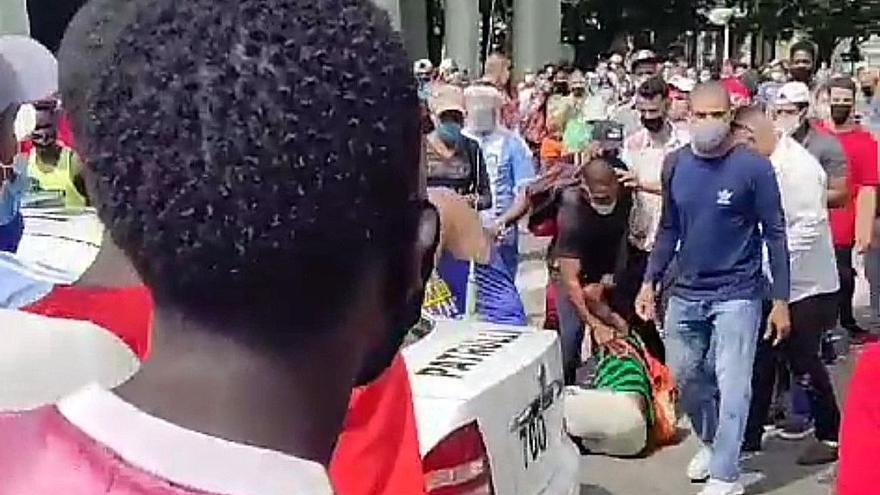
Images of the repression unleashed in Havana on July 11, 2021. (14ymedio/Capture)
EFE (via 14ymedio), Madrid, 14 February 2024 — The NGO Prisoners Defenders (PD) raised its count of the number of political prisoners in Cuba to 1,066 on Wednesday, after including three new inmates on its list in January. The organization, based in Madrid, indicated in its monthly report that, in January, ten political prisoners were released and removed from the list.
The document published on the NGO’s website said that there are 33 prisoners who are minors, of which 29 are serving sentences and four are being criminally prosecuted. The minimum criminal age in Cuba is 16 years old.
According to PD, “17 of the minors have already been convicted of sedition” with sentences of five years in prison. “Currently, most are under house arrest or doing forced labor without internment.” continue reading
Last month, three new inmates were added to the list and ten were removed
The statement added that 225 demonstrators have been accused of sedition, and at least 213 have already been sentenced to an average of ten years of deprivation of liberty each.
PD also said that there are 114 prisoners (including several transgender) who “still have criminal and political penalties.”
“All trans women in prison for political reasons are imprisoned among men, which also happens with common trans prisoners, suffering situations indescribable for their sexual condition,” the organization denounced.
Translated by Regina Anavy
____________
COLLABORATE WITH OUR WORK: The 14ymedio team is committed to practicing serious journalism that reflects Cuba’s reality in all its depth. Thank you for joining us on this long journey. We invite you to continue supporting us by becoming a member of 14ymedio now. Together we can continue transforming journalism in Cuba.
Cuban baseball player Jorge Soler will receive $14 million per season with the San Francisco Giants. (Instagram)
14ymedio, Havana, 13 February 2024 — Cuban baseball player Jorge Soler got a $42 million home run this Tuesday when he signed with the San Francisco Giants for the next three years. As journalist Francys Romero stated, he is the “first baseball player born on the Island to wear this uniform since Alex Sánchez (in 2005).”
Last November, the habanero gave up a salary of $13 million with the Miami Marlins. With more than six years in the Major Leagues, Soler opted for free agency. MVP Sports Group, his representative, moved the pieces, and there were rapprochements with the legendary San Francisco team, belonging to the Western Division of the National League.
With the Giants, Soler will pocket $14 million per season, which makes him the third highest-paid baseball player in the franchise, only below the Americans Robbie Ray ($23 million) and Michael Conforto ($18 million).
This outfielder left the Island in 2010, at the age of 18. His dream was to play for a Major League team, but his initial destination was Haiti, where he arrived on a raft with his father. In 2012, now in the United States, he got a contract with the Chicago Cubs and made his debut on August 27, 2014. continue reading
This outfielder left the Island in 2010, at the age of 18. His dream was to play for a Major League team
In 2016, he became part of the Kansas City Royals team. However, due to a series of injuries and inconsistencies he was downgraded and sent to the Minor Leagues, with the Omaha Storm Chasers. He returned in 2018 to Kansas, where, in 61 games, he recorded a batting average of .265, in addition to nine home runs. On July 30, 2021, Soler returned to the Atlanta Braves in exchange for Kasey Kalich.
In that same year, Soler was named the Most Valuable Player in the World Series, where the Atlanta Braves were crowned against the Houston Astros.
Jorge Soler has a record in the Major Leagues with a batting average of .243, a total of 736 hits, 170 home runs and 452 runs.
Soler’s agreement equals the one obtained in December last year by Lourdes Gurriel Jr. with the Diamondbacks. According to the magazine MLB, Gurriel has the option of renewal with the Arizona team for $14 million in 2027, and he can also consider new offers in 2026 and choose to leave the team.
Jorge Soler and Lourdes Gurriel Jr. thus move to the list of the highest-paid Cuban players, headed by José Abreu, who with the Houston Astros receives a salary per season of $19.5 million. Yasmani Grandal has a salary of $18.2 million with the Chicago White Sox. Yoan Moncada, who receives $17.8 million per season, is on the same team. Raisel Iglesias, with the Atlanta Braves, receives $16 million.
Translated by Regina Anavy
____________
COLLABORATE WITH OUR WORK: The 14ymedio team is committed to practicing serious journalism that reflects Cuba’s reality in all its depth. Thank you for joining us on this long journey. We invite you to continue supporting us by becoming a member of 14ymedio now. Together we can continue transforming journalism in Cuba.
Enjoy Travel’s corporate image was shared on its social networks in June 2023, on the occasion of the opening of its route between Barcelona and Havana. (Facebook/Enjoy Travel Group)
14ymedio, Madrid, February 13, 2024 — The Spanish company Enjoy Travel Group will establish direct charter flights between Madrid and Havana this coming summer. On Tuesday, the vice president of marketing and sales, Luis Jiménez, explained to Prensa Latina that an Airbus from the Plus Ultra company with 288 seats will be used. The route will be operational between June 29 and September 7, 2024.
The executive also said that they have made agreements with high-speed train companies in Spain – the state-owned Renfe and the private Iryo – to connect the provinces with Madrid for the flight to Havana. On the Island, the tour operator collaborates with large hotel companies such as Meliá, Iberostar, Blue Diamond and Kempinski.
This new route, he says, is based on the “success” of a similar route from Barcelona, which was operational last summer with a weekly frequency. In July 2023, Enjoy Travel was involved in some controversy by sponsoring the trip to Cuba of more than 20 Spanish influencers with the aim of encouraging foreign tourism to the Island, which, despite what the regime advertises, is not improving: in 2023, there were 2,436,980 international visitors, 42.8% less than in 2019 and 31% lower than expected. continue reading
The president of the Ibero-American Network of Accessible Tourism told the agency that Cuba “facilitates” the travel of “people with disabilities or reduced mobility”
Prensa Latina states, through Luis Jiménez, that the “accessible tourism” firm has been “a receptive vertical wholesale operator for more than 20 years, which now offers assistance and advice to the customer in Cuba 24 hours a day with several programs of tourism.”
The president of the Ibero-American Network of Accessible Tourism, Diego González, who is also an advisor to Enjoy Travel, told the agency that Cuba “facilitates” the travel of “people with disabilities or reduced mobility”.
The same tour operator offers “multi-destination” trips from Mexico with 15 weekly trips to Cuba.
The Plus Ultra airline is the same one Miguel Díaz-Canel used for his last international trips due to the lack of Cuban Aviation aircraft. The company is relaunching itself after complaints of alleged irregularities in a loan granted by the Spanish Government were shelved, and it is increasing its presence on the Island. Just last month, for example, it inaugurated a route between Poland and Cuba.
Translated by Regina Anavy
____________
COLLABORATE WITH OUR WORK: The 14ymedio team is committed to practicing serious journalism that reflects Cuba’s reality in all its depth. Thank you for joining us on this long journey. We invite you to continue supporting us by becoming a member of 14ymedio now. Together we can continue transforming journalism in Cuba.
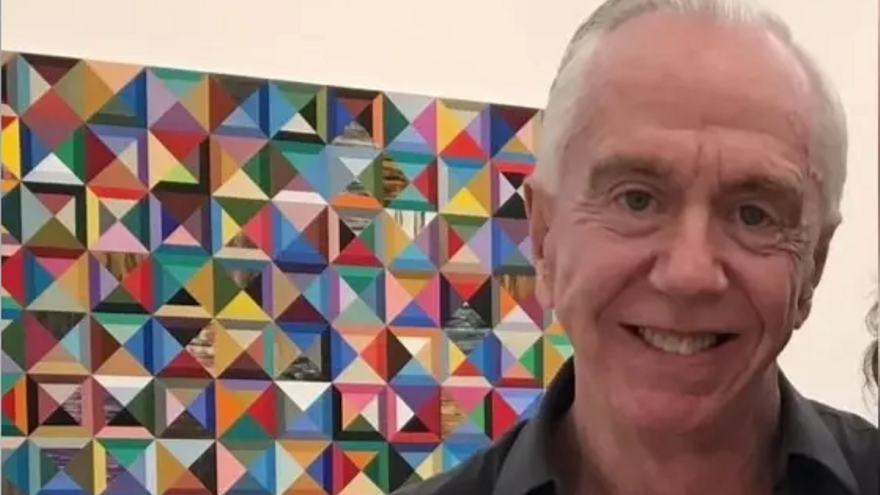
Sikkema left a trail of property and disputes on the island. (Instagram/Brent Sikkema)
14ymedio, Havana, February 10, 2024 — Brent Sikkema and his alleged killer met through a help-wanted ad. The American art dealer needed someone to look after his house in Havana’s Kohly neighborhood. Around twenty candidates responded to the job listing that Sikkema posted on the island’s best-known online classified ad site. Among them was Alejandro Triana Prévez, who got the job. He is now being detained in Brazil and has confessed to the murder of his former employer.
Sikkema, who was killed on January 14 in Rio de Janeiro, left behind a trail of property and disputes on the island. Trying to follow the art dealer’s footsteps around Havana at times feels like walking around in circles, or like trying to read a fuzzy x-ray of the small local art world.
Sikkema pioneered travel to Cuba when it was a destination off limits to American tourists, ultimately establishing a base of operations on the island. Back in the 1990s, he began creating a network of contacts who benefited from his love of the Caribbean, of art and of young men. After his murder, many of those he had favored chose to remain silent.
“He helped several people leave the island when the situation became difficult but, once overseas, some continued to live off the financial aid that he provided them”
“He helped several people leave the island when the situation became difficult. Some continued to live off the financial aid that he provided them even after they had left” says one of those who benefitted from the art dealer’s deep pockets and open wallet. “Several are Cuban like me. Almost all are young, attractive, have dark complexions and are involved, in one way or another, with the arts or acting. He lent us a hand.” continue reading
Bruno, as he prefers to be called for this article in order to protect his privacy, describes what he calls Sikkema’s modus operandi. “He really liked men who were athletic, dark-skinned and young, very young. I met him at a party that was being given at the house of a well-known Cuban movie actor. It was where the ’high society’ of the art world and Americans with money rubbed shoulders.”
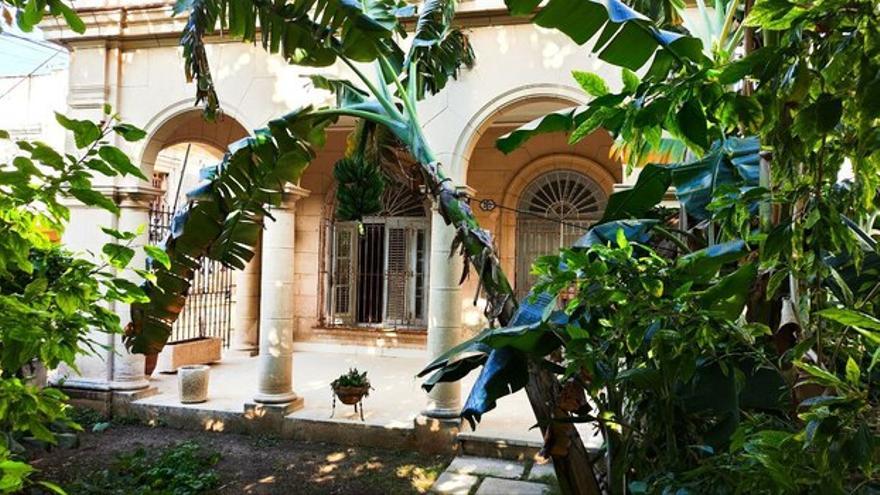
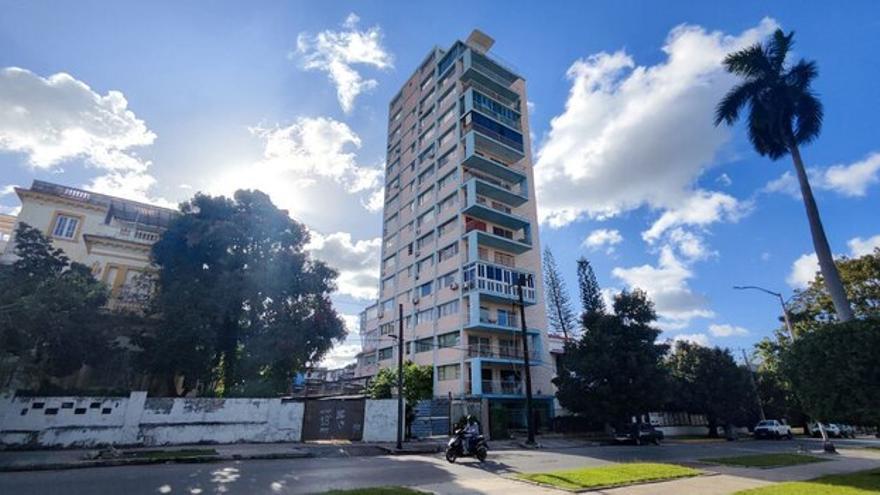
The mansion Sikkema bought for one of his lovers on I Street in Havana’s Vedado district. (14ymedio)
Several other such encounters gave Bruno a glimpse into Sikkema’s life in Cuba. “He got one of his first Cuban lovers, Carlos R. M., out of the country. First, he bought him a house in Vedado, on I Street, between 9th and 11th streets. But once [Carlos] decided to emigrate, they put it in the name of an uncle who really didn’t live in it. The man is very old and he only shows up on the deed.”
Due to legal restrictions on the ability of non-resident foreigners to acquire property on the island, the search for reliable front men to act as owners of his real estate purchases was a constant concern during Sikkema’s time in Cuba. On several occasions, he made the wrong bet. Bruno even believes that disputes over some of the properties may have contributed to Sikkema’s murder. “There was a lot of money at stake,” he says.
Bruno reports that the mansion — with its garden, stately portal, semicircular arches and solid columns that welcome the visitors — “is now being used as a warehouse for things that Brent had not yet placed in the other houses.” After Carlos R. M. moved to the United States, Julio César P. M., the director of one of the most prestigious art schools in Havana, looked after it for a time.
“Everybody wanted in on the action because he was known to be generous, though it was also known that he had HIV and had infected several of his lovers”
A network of young people with ties to the island’s the art scene wove itself around the gallery owner. “Everybody wanted in on the action because he was known to be generous. It was also known that he had HIV and had infected several of his lovers, though he did help them a lot. He paid for apartments in Havana, Panama, Mexico City and New York,” says Bruno
Young artists suddenly found their work being shown at exhibitions in the Big Apple. Painters who came out of nowhere were included in prestigious gallery catalogues. People working at Cuban institutions went from living in flimsy houses to living in palaces in desirable areas. All were recipients of the broad swath of gifts, perks and aid that Sikkema doled out.
With the gallery owner now dead, many of them are looking for ways to “freeze things, to keep properties and assets that don’t belong to them,” Bruno complains. The house on I Street was left to Julio César P. M. thanks to his close family ties to Alejandro P. B., a young artist Sikkema took under his wing, who has garnered media attention for his relationship with a famous Cuban actress.
Isolda, a friend of Sikkema who lives in Havana, reports that the mansion in Vedado is still in need of repairs requiring a sizable financial investment. “Just buying it must have cost a lot of money given its size and location,” she says. Isolda, who is very familiar with of the gallery owner’s business and personal affairs, was interviewed by 14ymedio in connection with a previous article on the murder.
“Everything in his life was moving very fast in recent years and he was increasingly using drugs. Before 2017 it was an occasional thing but later he was doing it was more and more”
“Everything in his life was moving very fast in recent years and he was increasingly using drugs. Before 2017 it was an occasional thing but later he was doing it was more and more. I don’t know how he bought something like that here in Havana,” she says. “I think he was depressed over the messy separation he was going through,” a reference to divorce proceedings with his Cuban husband, 53-year-old Daniel García Carrera, who has used Sikkema’s last name since the two were married and who Brazilian police believe planned the murder.
Matt, a New York friend of the couple whose name has been changed for this article, claims that it was Daniel who asked Brent for a divorce, that it was the art dealer’s frenetic lifestyle that led to the breakup. The couple had been married for fifteen years. “At first, they seemed happy and very content but then everything began to get complicated,” claims Matt.
The relationship also suffered from Sikkema’s frequent trips to Brazil, where he bought two houses, one of them the house in the Rio’s affluent Botanical Garden neighborhhood, where he was murdered. Sources close to the Brazilian police investigation report that Sikkema regularly frequented gay bath houses, “looking for young men to take home, promising them gifts and a better life.”
“He was looking rushed, nervous and sad during recent visits to Havana and claimed it was because of the divorce and because he saw little of his son”
Isolda describes Sikkema as looking rushed, nervous and sad during recent visits to Havana. “He claimed it was because of the divorce and because he saw little of his son, so I turned a blind eye to all the excesses because, otherwise, he was a man with a very good heart and we had to protect him from those who wanted to empty his wallet,” she says.
Isolda has no qualms including in that group of “opportunists and profiteers” a woman named Belkis Z. M., a university professor and cousin of Daniel who agreed to let the couple put the penthouse on G Street, between 19th and 21st streets in Vedado, in her name. Brent Sikkema bought the property for the couple’s now 13-year-old son. All attempts by 14ymedio to contact the cousin have, thus far, been unsuccessful.
“Brent bought the apartment to put it in their son’s name once he got Cuban citizenship but the paperwork was tied up at the Ministry of Foreign Affairs,” Matt explains. When Sikkema bought the property, there was nothing in Cuban law that addressed situations in which a child had two parents of the same sex. Daniel’s cousin offered to act as a front woman until the paperwork issue was resolved.
Her role as a straw buyer came with enormous benefits. “She and her husband, Javier L. F., were living in inhumane condtions in Camagüey, so Brent and Daniel first bought them a large house in that city and later a three-bedroom apartment on G Street in Central Havana, which they fully furnished,” says Isolda.
“Some months later they bought a colonial-era house with five bedrooms, two baths, an eat-in kitchen and a central courtyard in Pera Park, which they also completely furnished. Over the years, they gave her two electric scooters, clothes, shoes, food and medicine.” But financial support for the academic and her husband was not limited to real estate assets and consumer goods. “They paid for her husband’s trip to Europe, which was supposedly organized by the University of Havana, and a trip for her to Mexico, also university-sponsored.”
The building on G Street, in Havana’s Vedado district, where Brent Sikkema bought the penthouse apartment. (14ymedio)
“I think Belkis was protected in everything she did. Her husband’s position at the Study Center for the Improvement of Higher Education at the University of Havana and hers at the Heritage department meant both were very well-connected politically. The irony of all this is that most of the materials that professors in her department have were provided by Brent and Daniel, whom she later betrayed.”
In the midst of the divorce proceeding, which had begun a year earlier, Daniel traveled to Havana in January 2023 to ask his cousin to transfer title to the apartment in order to finalize the paperwork so he could get a license to rent it to foreigners. Belkis seems to have changed her mind, however, and demanded he pay her $20,000 to make the transfer. “She later wrote directly to Sikkema asking for even more, $50,000, to hand over the property,” says Isolda.
After one thing or another, Alejandra Triana Prévez decied to leave Cuba. He arrived in Brazil in 2022. Several sources independently confirm that he reestablished contact with Sikkema, and even visited him at the house in Rio, in July of 2023. “Evidence shows that the next time he was in that house was when he killed him. Security cameras show he waited outside for fourteen hours before going in,” says one.
Isolda states that, following Sikkema’s murder and Triana Prévez’ arrest by Brazilian police, Belkis quickly forwarded a message to several friends, which she had allegedly received in an email, telling her she would be killed if she did not hand over the apartment. “But, as far as we know, the police have not questioned her and she is trying to divert attention from the robbery she committed,” claims Isolda
Evidence indicates that the last time he was in the house was when he committed the murder.
Triana Prévez’s sister sent an audio recording to his lawyers in Brazil that the press there reported was intended as a testament to the young man’s character. In it, she describes him as someone who is “easily manipulated.” After his arrest, he told police that someone had put something in his drink at a bar before he committed the crime and that the murder was not his idea.
The investigation took a dramatic turn, however, after Brazilian media outlets reported on Friday that Triana Prévez had made a new statement claiming that Daniel Sikkema hired him to kill his husband in exchange for $200,000. The killer alleged that Daniel mailed him, from New York, a duplicate key to the house in Rio de Janeiro so he could slip in unnoticed.
Sources close to Daniel Sikkema have told 14ymedio that he denies everything, claiming that the key was sent to to the gallery owner himself and at a much earlier date, in April 2022. “It was sent by FedEx to a Brazilian named Fabio. Daniel ordered him to evict his cousin, who was staying at the apartment after maxillofacial surgery. They threw her out and changed the locks on the door,” one of the sources states.
Isolda, the gallery owner’s friend, cannot hide her dismay. “There are several people who have benefitted from this death,” she says. “People here in Cuba and in other countries with money, houses, cars and assets that do not belong to them. Now they look the other way, hoping this doesn’t affect them and that they will get to keep it all. There are many people who could have wanted him dead for any of those things.”
____________
COLLABORATE WITH OUR WORK: The 14ymedio team is committed to practicing serious journalism that reflects Cuba’s reality in all its depth. Thank you for joining us on this long journey. We invite you to continue supporting us by becoming a member of 14ymedio now. Together we can continue transforming journalism in Cuba.
Qatar is among the nations that pay well for Cuban medical cooperation. (Cubadebate)
14ymedio, Madrid, 13 February 2024 — That the Cuban Government keeps between 70% and 95% of what a foreign country pays for each health worker is not new, nor is it new that the regime alleges that part goes to cover the expenses of, among other things, Public Health. The novelty is in comparing it with the taxes that are paid in many European countries through a simplification that could be described as ignorance, if it were not for the fact that it is published by a media that knows what it is talking about.
The international pro-Castro channel Cubainformación, located in Spain, has released a video on Tuesday to talk about the “war against Cuban medical cooperation,” whose epicenter, it says, is in Mexico. The report explains that Cuban international missions are divided into several types: those that are entirely covered by Cuba, in the poorest countries, those that have the contribution of the two parties and, finally, those that are sent to countries with more resources, for which the Island receives a payment.
This amount includes, details the report, stipends and allowances for cooperating personnel, expenses (flights, lodging and maintenance), salaries and, finally, an amount that goes to the Public Health System. Cubainformation tries to ridicule “the media and contracting organizations” whom it considers allies of the United States in its “war” by mocking the different percentages that the Government retains. “The ’Cuban regime’ practices ’modern slavery’ or ’forced labor’ of its medical personnel because it ’retains’ more than 70% – or 75%, 80% or 95%, because there are different figures according to the imagination of the source – of the payment,” it jokes. continue reading
“Even accepting the figure of 70%, discounting the expenses assumed by the Cuban State, we would not be at a tax pressure much higher than that of Belgium, for example”
Then, however, it recognizes that “the data is difficult to verify,” but admits that it may be the least amount withheld compared to other countries. “Even accepting the figure of 70%, discounting the expenses assumed by the Cuban State, we would not be at a tax pressure much higher than that of Belgium, for example,” it concludes.
The surprising analogy comes from the opening of the video, which states that “in a country like Belgium, of the gross salary of a worker, 53% is withheld by the State” as taxes to cover social security and the public budget, and it adds that calling this a “business” of the Belgian Government is a joke. The comparison would reveal an amazing ignorance if it were not for the fact that the author is from Spain, a country where the tax system works like the Belgian one.
The 53% mentioned comes from the OECD (Organization for Economic Cooperation and Development) classification, which placed Belgium as the country with the highest taxes of the 38 countries that compose it. That indicator includes not only what employees contribute in terms of taxes, but also what companies contribute for them. But in addition, what workers pay of their gross salary is basically made up of contributions to Social Security and Personal Income Tax (IRPF).
The latter is paid progressively, according to a system of brackets established by law. A percentage is applied to each segment that increases according to the amount contributed, so it is not applied to the total salary. In addition, the personal income tax takes into account the circumstances of the worker, particularly if he or she lives alone and/or has children.
The tax is paid progressively, according to a system of brackets established by law
In summary, Cubainformation is comparing an average percentage – obviously there are Belgians paying more or less according to the personal case – which is the sum of the company and worker contributions in the country where the figure is the highest in the world, with the at least 70% applied to the total salary of any Cuban doctor abroad without distinction. In addition, it seems to the media that 70% “is not much higher” than 53%, despite being 23 points higher.
The highest tax bracket among the OECD countries is in Europe at 41.2%, while that of Chile is 13.5%. The highest in the United States is 37%; in return everyone enjoys an infinite number of public services ranging from health and education to garbage collection and transport. These services have such high overall quality that they are used by citizens regardless of their tax bracket. These countries, with the Nordics at the head, lead international rankings every year in terms of development index, well-being and minor inequalities, among others, despite the cyclical economic difficulties they can experience.
Aware of these aspects, with its headquarters in Spain (fifteenth highest tax bracket at 39.4%), Cubainformación compares them – simplifying – with what happens with the appropriation of the salaries of Cuban doctors abroad and forgets that, even accepting its version, the regime never details in a General State Budget (as these nations do) what it spends its income on.
The truth is, as the Government of Cuba itself reports, that more than 33% of the State budget goes to tourism investments
“Ending this income means preventing Cuba from buying or manufacturing medicines, repairing hospitals, importing medical technology or, simply, the economic improvement of cooperating personnel and their families,” continues the video.
The truth is, as the Government of Cuba itself reports, that more than 33% of the State budget goes to tourism investments. This is reflected in the public accounts of 2022, where it is seen that Health and Education together received a tenth of the investment dedicated to the construction of hotels and services linked to tourism. Specifically, in fact, only 2.1% was dedicated to Health and Public Assistance.
The video also addresses other issues, such as the vaccines sold to Mexico, which many of its citizens have openly rejected, the alleged lack of training of the health workers sent to other countries and the discomfort among the national professionals.
But the most disturbing thing is the rhetorical question that, curiously, it has answered minutes before. “How is it possible for a Government to be able to ’force’ 600,000 ’slaves’ to 165 countries, as Havana has achieved in these 60 years?” The author himself has already revealed the answer by talking about the payments made, as a stipend, by the governments that hire their services: “It means, de facto, multiplying their Cuban salary,” the one they receive when they are at home, which does not allow them to live with dignity.
Translated by Regina Anavy
____________
COLLABORATE WITH OUR WORK: The 14ymedio team is committed to practicing serious journalism that reflects Cuba’s reality in all its depth. Thank you for joining us on this long journey. We invite you to continue supporting us by becoming a member of 14ymedio now. Together we can continue transforming journalism in Cuba.
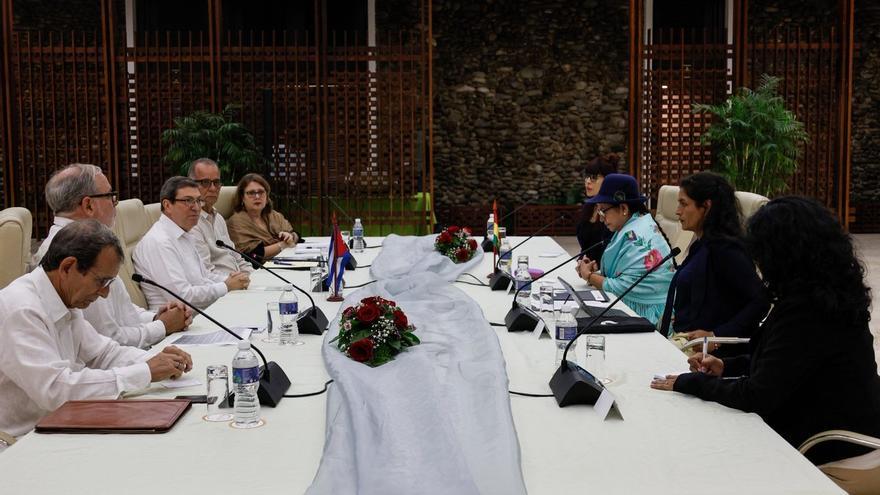
Meeting between the delegations of Bolivia and Cuba this Monday in Havana. (@BrunoRguezP)
EFE (via 14ymedio), Havana, February 13, 2024 — The Cuban Foreign Minister, Bruno Rodríguez, thanked his Bolivian counterpart, Celinda Sosa, on Monday, for the collaboration “in agri-food matters” and the donations of medicine and food to the Island, which is immersed in a serious economic crisis.
According to a statement from the Ministry of Foreign Affairs, the recognition was made during the official conversations held by both foreign ministers in Havana in the framework of Sosa’s first official visit to Cuba since taking office last November.
At the meeting, Cuba and Bolivia agreed on “the need to maximize economic-commercial relations and create mechanisms that generate new initiatives for their development,” the official statement said.
The agreements were also reviewed with bilateral political consultations, and “strategies were drawn up to continue strengthening and consolidating bilateral relations.” continue reading
At the meeting, Cuba and Bolivia agreed on “the need to maximize economic-commercial relations and create mechanisms that generate new initiatives for their development
Rodríguez also took advantage of the meeting to thank Sosa for “the Bolivian Government’s signs of solidarity, including the donations of food and medical supplies to our people.”
The meeting was held shortly after the Bolivian chancellor had a meeting with the president of Cuba, Miguel Díaz-Canel.
“We had a good meeting today with the Chancellor of the Plurinational State of Bolivia, Celinda Sosa. With the brotherhood that unites our peoples, we talked about what has been done but also about how much more we can do. I thanked her for the unbreakable love and solidarity of Bolivia,” Díaz-Canel wrote on social networks.
The visit, which had not been announced by Havana nor open to the international media, will conclude with a conference at the University of Havana entitled “Industrialization and the productive community social economic model.”
Translated by Regina Anavy
____________
COLLABORATE WITH OUR WORK: The 14ymedio team is committed to practicing serious journalism that reflects Cuba’s reality in all its depth. Thank you for joining us on this long journey. We invite you to continue supporting us by becoming a member of 14ymedio now. Together we can continue transforming journalism in Cuba.
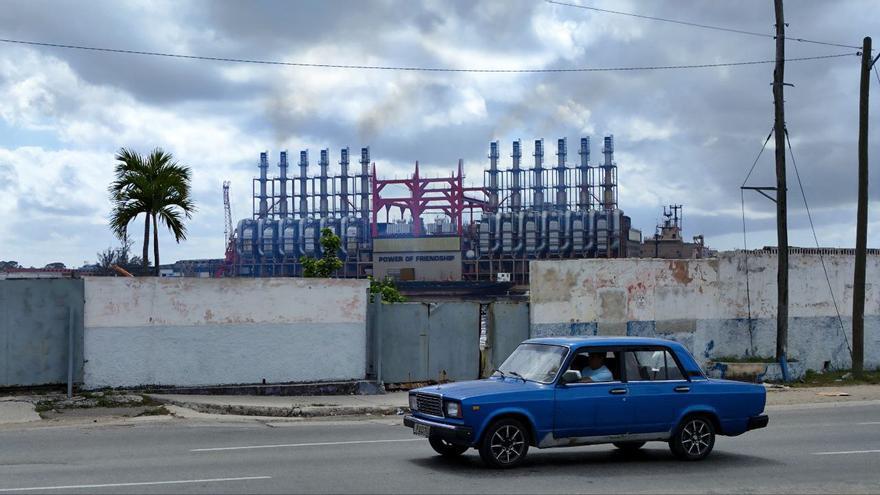
The UNE says that four generators of the ’patana’ (floating Turkish power plant) of Melones will come into operation for the peak hours. (14ymedio)
14ymedio, Havana 13 February 2024 — The generation deficit predicted by the Electric Union (UNE) broke a new record on Tuesday, with the announcement that 1,308 megawatts (MW) and up to 1,378 MW at peak hours will be missing. Cubans already know what that means: the climax of the energetic debacle after several weeks of blackouts, despite being in the coolest season of the year. Complaints have erupted on the company’s social networks.
According to the UNE, unit 2 of the Felton thermoelectric plant, in Holguín, and unit 5 of Renté, in Santiago de Cuba, are out of service due to a breakdown. Likewise, unit 8 of Mariel (Artemisa), unit 3 of Santa Cruz (Mayabeque) and unit 4 of Cienfuegos are under maintenance.
During peak hours, the company says, four generators of the Turkish patana [floating power plant] of Melones, located in Havana Bay, with 65 MW and 27 MW respectively, will come online. The system relies on these generators, but the sum does not even cover the deficit in thermal generation, which amounts to 338 MW. continue reading
On the UNE Facebook page, users do not let up on the company, which “every day (announces) less generation availability”
On the UNE Facebook page, users do not let up on the company, which “every day (announces) less generation availability,” with forecasts that fall short in the face of reality. This was the case on Monday, when the UNE reported a deficit of 1,033 MW that became 1,183 MW. “San Antonio de los Baños, as always, was at the forefront, from 8 pm to 12 am, and at 5 am we began the cycle again and are still waiting,” complained a netizen from Artemisa, alluding to the intense day of blackouts on Monday.
Residents in Granma, Holguín, Matanzas and Las Tunas provinces made similar claims and pointed out that “all of Cuba (is) turned off with the exception of the capital,” a complaint that has been spread among those who complain to the UNE that Havana is privileged while the rest of the country suffers up to 12 hours without electricity.
Other commentators, more sarcastic, announced the collapse of their plans for the celebration of Valentine’s Day on February 14 due to the blackouts. “They are going to give us a tremendous gift for the day of love and friendship,” said a reader.
The fuel crisis, with which the authorities justify everything from power cuts to the absence of food in the warehouses, was recently refuted by the British agency Reuters. With data provided from Venezuela and the monitoring of the transfer of oil ships to the Island, Reuters says that the amount of oil that passes through Cuba is more than enough to meet the demand.
According to the National Bureau of Statistics and Information, Cuba needs about 125,000 barrels per day (bpd) of fuel for electricity generation, gasoline and diesel. The country “has a constant national oil production of around 40,000 bpd that is used mostly for power generation, and it receives 56,000 bpd of crude oil and finished fuel from Venezuela, according to ship monitoring data provided by LSEG and documents from that country’s state company, PDVSA,” Reuters analyzes.
If to this is added the arrival of the 23,000 bpd from Mexico and another 10,000 bpd purchased from European countries, the Island would be receiving up to 129,000 bpd
If to this is added the arrival of the 23,000 bpd from Mexico and another 10,000 bpd purchased from European countries, the Island would be receiving up to 129,000 bpd, that is, 4,000 bpd more than its total consumption according to official data. The causes of the “alleged crisis” should be sought then, explains Reuters, in the failures of the infrastructure and internal logistics, as the expert from the University of Texas Jorge Piñón points out: of the three refineries in the country, only the one in Cienfuegos works, while those of Havana and Santiago de Cuba are shut down due to technical problems.
These problems are aggravated by the loss of hydrocarbon storage as a result of the destruction of the Matanzas supertanker base by the 2022 fire, which forces the distribution of the loads at several points on the island and on the ships themselves, until they can enter the refinery and be distributed.
Meanwhile, oil tankers continue to arrive in Cuba, including the Sea Hermes I, the Caribbean Alliance, the Sandino and the Pluto, which were reported this Tuesday in several ports, in addition to the Aquila and the Eco Fleet, announced for the coming days.
Translated by Regina Anavy
_______________
COLLABORATE WITH OUR WORK: The 14ymedio team is committed to practicing serious journalism that reflects Cuba’s reality in all its depth. Thank you for joining us on this long journey. We invite you to continue supporting us by becoming a member of 14ymedio now. Together we can continue transforming journalism in Cuba.
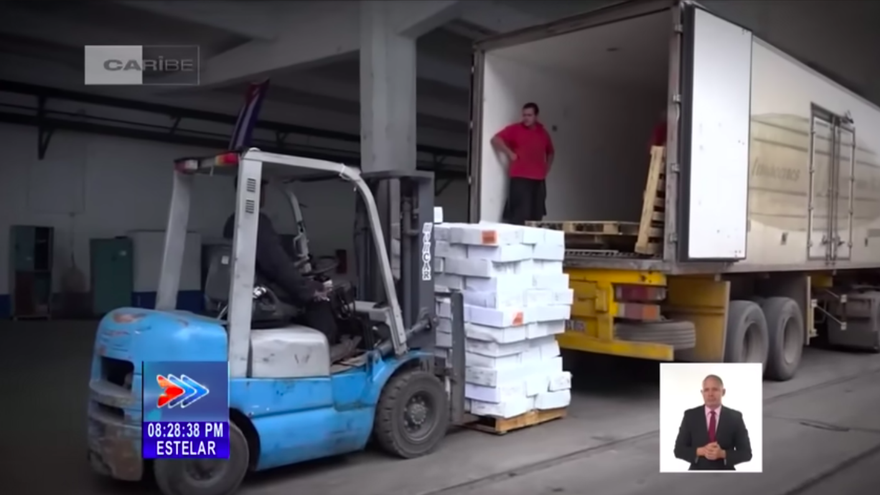
Investigators did their own calculations to determine how much chicken was missing, looking at footage from warehouse security cameras and checking temperature fluctuations in the coolers. (Screen capture)
14ymedio, Havana, February 10, 2024 — Black and white images, a voice-over reminiscent of a crime drama and suspenseful music. Cuban Television spared no effort reporting, in the most dramatic way possible, the alleged theft of 133 tons of frozen chicken from the Havana Food Marketing Company. According to police, thirty defendants – eleven of them in preventive detention – are linked to the incident.
Some 1,660 boxes of chicken from the American producer Tyson were discovered missing by the company’s auditing department, setting off alarm bells among managers, the report stated. Rigoberto Mustelier, the company’s director, discovered that 26 tons were missing and immediately, he claims, ordered an inventory and called the police.
Investigators did their own calculations to determine how much was missing, looking at footage from warehouse security cameras and checking temperature fluctuations in the coolers. They informed Mustelier that the shortfall was much greater, 133 tons to be exact, according to Lieutenant Olga Panque, who also appeared on television. continue reading
The night of the robbery — Cuban Television did not specify exactly when it took place — several “suspicious vehicles” were seen circling the perimeter of the warehouse
“It could be the basic basket of a medium-sized province,” commented Mustelier, and the report then noted that, if the public does not have chicken in the coming days, it knows whom to blame. “Shift bosses, technical support staff and unemployed people outside the company. Employees were involved,” said Lieutenant Colonel Rafael Galera, claiming the culprits removed official labels and replaced them with “others that they brought in off the street.”
The night of the robbery — Cuban Television did not specify exactly when it took place — several “suspicious vehicles” were seen circling the perimeter of the warehouse. The police reported that each box went for 3,800 pesos on the black market and that they were sold in the homes of people who posed as self-employed workers or employees of small private businesses.
An individual’s profits from the heist, they estimate, ranged from fifty to 200,000 pesos “depending on the level of participation.” Also, the person who served as company director at the time of the theft was fired.
After eight home searches of those involved, investigators seized computers, air conditioners, televisions, the refrigerators where the merchandise was stored along with three million pesos and an unspecified amount of dollars.
The public prosector is charging those involved with embezzlement, robbery, bribery, failure to preserve state property and receiving stolen goods. If aggravating circumstances are taken into account, those most responsible for the incident could be sentenced to as much as twenty years in prison.
“It will be a harsh sentence because the crime warrants it,” said a representative from the public prosecutor’s office on Cuban Television. “The historic moment in which we are living, the product in question and the public call for a decision of this nature.”
The report makes no attempt to downplay the moral of the story. “Those who stole the chicken from Room 414 faced very low temperatures but that was noting compared to the icy coldness of their consciences when they harmed the public.”
“There has already been a noticeable change in warehouse security” since the those responsible were arrested, the report claims
“There has already been a noticeable change in warehouse security” since those responsible were arrested, the report claims. The company’s new director assured viewers that things are now being done differently. “There is stricter control,” he said.
Several inconsistencies in the story did not go unnoticed by the readers of Cubadebate, where the report was published. “How could the official – Mustelier – think there were 26 tons when there were 133? The difference is sizable,” wrote one reader ironically, concerned that the numbers were exaggerated.
Others were harsher in their critiques. Someone else wrote, “A 133-ton shortage that affects the basic family basket. What a ridiculous way to steal 133 tons of chicken. And they can stop calling it ’basic.’ The Ministry of Domestic Commerce recently stopped using that term. It’s just the family basket because it doesn’t meet even basic needs.”
____________
COLLABORATE WITH OUR WORK: The 14ymedio team is committed to practicing serious journalism that reflects Cuba’s reality in all its depth. Thank you for joining us on this long journey. We invite you to continue supporting us by becoming a member of 14ymedio now. Together we can continue transforming journalism in Cuba.
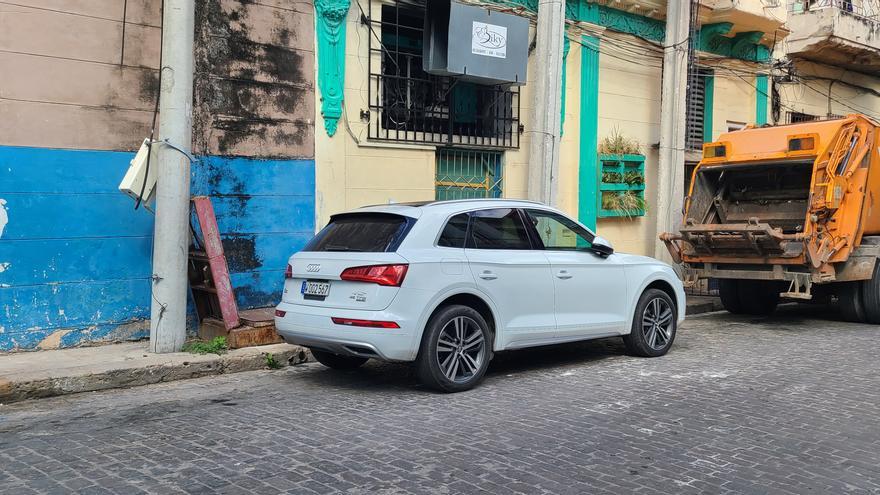
A garbage truck parked next to El Biky, on Concordia Street, in front of a luxury automobile. (14ymedio)
14ymedio, Pedro Espinosa, Havana, February 12, 2024 — The combination restaurant, cafe and dessert shop that make up El Biky, located at 412 Infanta Street, is less and less shy about flaunting its privileges. One of the most striking examples is the garbage truck that was recently parked alongside it, on Concordia Street, right in front of a luxury automobile.
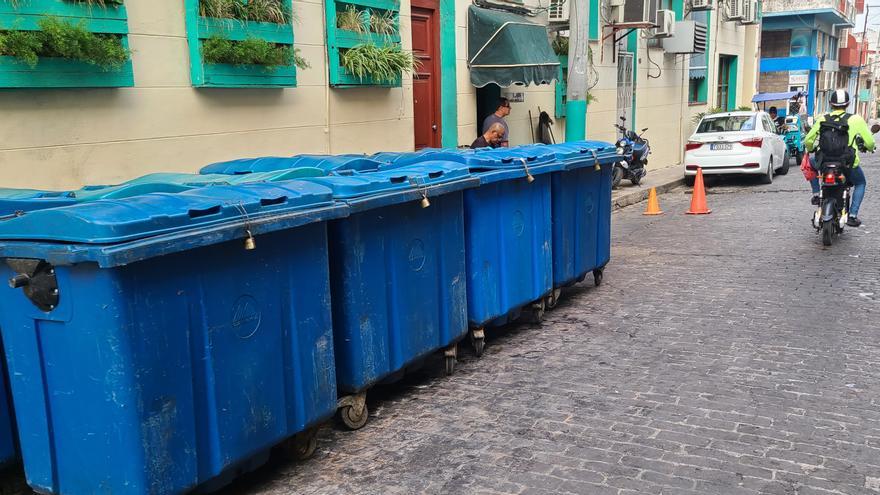
In contrast to the neighborhood’s other street corners, with their mountains of trash spilling out of their containers, El Biky’s are pristine. The restaurant has at its disposal no less than ten new, well-maintained garbage bins, all of them with locks to prevent the public from using them. This is especially paradoxical when it comes to comparing this “non-agricultural cooperative” (CNA) to a micro, small or medium-sized business (MSME), which — according to the regime — is “more commercial in nature while the former is “more social.”
Their prices, however, have never been for everyone. And though their desserts are still reputed to be the best in the city, that is not the case for their restaurant or their service. “For what it costs, you shouldn’t leave feeling starved,” says Lydia, who recently celebrated her wedding anniversary there with her husband. “A teaspoon of rice, a little bit of this, a little bit of that. They tell you it’s because it looks nicer, that refined people prefer small portions. It’s not about refinement or anything else. It’s about trying to steal your money and getting rich.” continue reading
The restaurant has at its disposal no less than ten new, well-maintained garbage bins, all of them with locks to prevent the public from using them. (14ymedio)
For Eduardo, the worst thing about the place is the service. “They’re not friendly. You feel as if they’re doing you a favor… The last time I ate there, the headwaiter walked around the room like he was on patrol, like a guard on a military base. It was intimidating.”
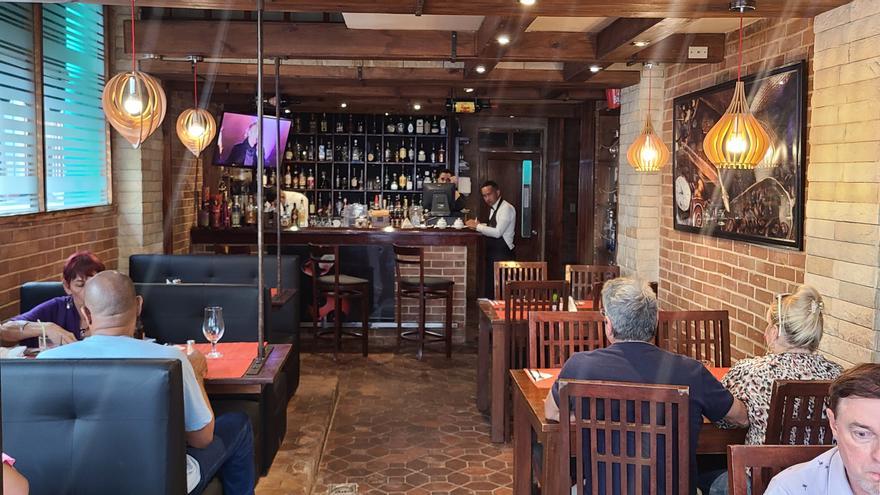
One need only step foot in the place on any given day to notice the controlling atmosphere and absence of friendly faces.
“The food is mediocre and has gotten worse over the years. And the portions are getting smaller,” explains one Havana resident who works as a tour guide and sometimes visits the place with his clients. “A good gauge of a restaurant’s quality here in Cuba is how fresh the salad is and, at El Biky, it’s generally not in great shape by the time it’s served. The dishes are sometimes cold, the sauces are obviously overheated, the rice dishes are mixed with leftovers that look like they’ve been around for several days… For me it is just a very well located fast-food joint.”
One need only step foot in the place on any given day to notice the controlling atmosphere of control and absence of friendly faces. (14ymedio).
Customers have also complained about prices and quality at a satellite branch that opened in September at the José Martí International Airport. There is no evidence the company was required to submit a bid and its employees wear uniforms with the logo of the state-owned Cuban Aiports and Aeronautical Services Company. (ECASA).
All these perks have raised suspicions about the owners since it opened in 2013. Local residents openly point to Mariela Castro but, in fact, the names of the four partners credited with starting the CNA have never been revealed.
____________
COLLABORATE WITH OUR WORK: The 14ymedio team is committed to practicing serious journalism that reflects Cuba’s reality in all its depth. Thank you for joining us on this long journey. We invite you to continue supporting us by becoming a member of 14ymedio now. Together we can continue transforming journalism in Cuba.
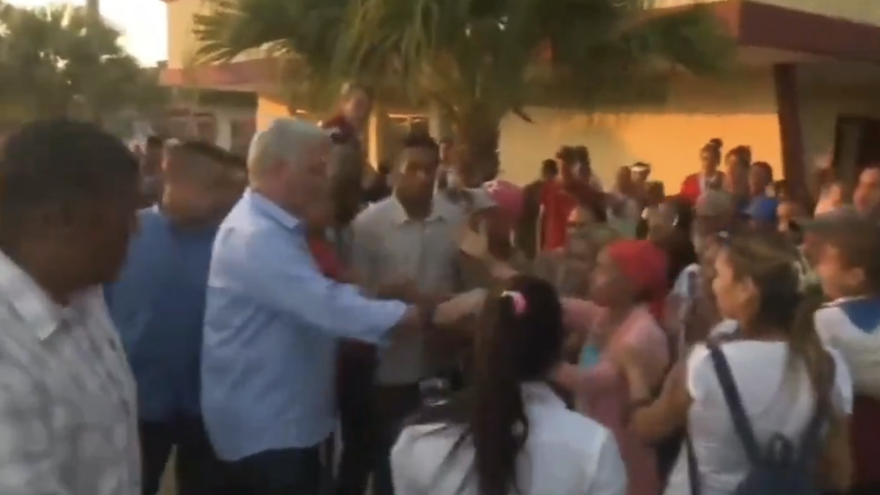
In the images, the Cuban president rushes to shake hands, always surrounded by a strict circle of security. (Screen capture)
14ymedio, Yoani Sánchez, Generation Y, Havana, 12 February 2024 — He narrows his eyes, jumps and puts his hands on his chest. He is not in the middle of a mystical ritual but in front of the television cameras that report the visit of Miguel Díaz-Canel to Cauto Cristo, in the province of Granma. “It was as if I had seen the god Fidel,” “I have goose bumps,” exclaimed the lady in a trance. She is followed by another who insists that the arrival of the first secretary of the Communist Party of Cuba is “a gift” from God and “a blessing” for a municipality forgotten by officials and the national media.
In the images, the Cuban leader is quick to shake hands, always surrounded by a strict security circle, to hug children and to point out that he is on the street at a time when his popularity is measured in very negative numbers, although without reliable surveys that put a figure on disapproval. Díaz-Canel has gone there, to convince the poor residents that with “popular participation” they can seek the solutions that Cubans so urgently need, he is seen saying in a video.
“Díaz-Canel, we adore you, son, we adore you!” shouts an enthusiast as the procession passes by to complete the mysticism of the moment
“Díaz-Canel, we adore you, son, we adore you!” shouts an enthusiast as the procession passes by to complete the mysticism of the moment. Each frame seems calculated, an altarpiece prepared for veneration, never for criticism. The seams cannot be seen: each testimony, location or statement must exude devotion and blind faith. There is no room for doubt because we have gone from idolatry calculated from above to the coarsest fanaticism. It is not even about pretending that it is real, just about displaying it even if the performance is absolutely grotesque. continue reading
When the dust from the tires of the official caravan is just a memory, daily miseries will continue to mark everyday life in Cauto Cristo. The “goose bumps” lady will complain in a sour tone that the rice did not arrive at the rationed market on time, the other fervent follower will say that this happens because “the president is not informed” and the young woman who strings together words with the speed of a machine gun will already be arranging her departure from the country through someone she knows in Miami.
Dressed in the suit of a supposed redeemer, only the nails of popular demand await Díaz-Canel. In a few days there will be no half-closed eyes or hands raised to the heart in Cauto Cristo. Instead of praise, insults and mockery will be heard in the streets of the Granma town, especially that harsh adjective* with which the president, whom no one elected at the polls, will go down in the history of this Island, but that no official media dares to utter. When they pronounce the six letters of that harsh adjective, they will not do so in a tone of exaltation but of disgust… almost certainly.
*Translator’s note: Yoani does not identify an adjective, but “Diaz-Canel singao” is a common graffiti in Cuba. Singao is commonly translated as ‘motherfucker’ or similar expletives.
____________
COLLABORATE WITH OUR WORK: The 14ymedio team is committed to practicing serious journalism that reflects Cuba’s reality in all its depth. Thank you for joining us on this long journey. We invite you to continue supporting us by becoming a member of 14ymedio now. Together we can continue transforming journalism in Cuba.
The new dancers define their style as contemporary, with a clear influence from modern Cuban dance and the folkloric and popular dances. (EFE)
EFE (via 14ymedio), Madrid, 11 February 2024 — Acosta Danza Yunior, the new artistic project of the prestigious Cuban dancer and choreographer Carlos Acosta, debuts this weekend with a presentation at the emblematic Martí Theater in Havana. The new youth group is made up of 10 dancers from 18 to 20 years old, graduates from the academy belonging to the company founded by Acosta in 2016 with an artistic style that combines contemporary movement and classical ballet.
The new generation is ready to perform, having completed a special curriculum for three years. The promoters point out that they will have their own choreographic repertoire and particular program of presentations.
They also define their style as contemporary, with a clear influence from Cuban modern dance and the folk and popular dances of the Island, without disdaining the technical touch of classical ballet.
For their first season, ’Green Shoots’, they will perform ’Fuga’, ’Hybrid’ and ’Nosotros’, where the dancers show their energy, passion and freshness, and that desire to “eat the world,” as their mentor Acosta expressed in the program for their first public performance. continue reading
“The three creations are artistic approaches to the complex moments we are living,” said the general director of the ’older sister’ company of the group.
Acosta Danza Yunior “will be the space where many artists will begin their professional careers, and they will adorn the stage in the coming decades”
Acosta Danza Yunior “will be the space where many artists will begin their professional careers, and they will adorn the stage in the coming decades. It is a place to grow, excel, experiment and mature,” he said.
Behind the curtain, the dancers move nervously, wearing light clothing to stage ’Fuga’, a world premiere piece that was specially conceived for Acosta Danza Yunior by the Spanish choreographer and dancer – based in Cuba – Susana Pous.
She has placed the context of her work “in a moment of escape, of flight.” She explains that she has not intended to “complicate the work from the dramaturgical point of view, but that’s what it’s all about: all that can mean sharing a space, and that space begins to be insufficient for some, too small for them, so that they feel the need to get out of there, to escape.”
The piece is joined by ’Hybrid’ and ’Nosotros’, which are versions of Acosta Danza choreographies that the new group will now perform.
’Nosotros’, the second work of the program, danced by Betty García and Raúl Reinoso, is a duet to reflect on the intermittences of relationships, both disagreements and coincident points, frustrations and the couple’s best moments.
As a culmination, ’Hybrid’ brings closure, as the dancers move freely and transmit their body energy to represent the message of the most complex work for debutants.
’Fuga’ is a world premiere piece that was specially conceived for Acosta Danza Yunior by the Spanish choreographer and dancer – located in Cuba – Susana Pous
Paul Brando García-Cachimaille and Thalía Cardín Díaz take the lead in ’Hybrid’, and even before recovering from the impact and the strong dynamics of their representation, they stated their impressions.
“We are very happy with this project that opens many doors for us in the world of art, to start a new stage in our artistic career and to grow artistically,” said García-Cachimaille, after saying that the previous training process and the long hours of rehearsals have been “difficult.”
His colleague Thalía Cardín Díaz said that “it has been a pleasure, and we are proud to work with these internationally recognized choreographers. It opens up our way of experiencing dance.”
The 19-year-old dancer hopes this presentation has “touched the soul” of the public and that “seeing dance as something relevant in these hard times makes us feel grateful for the art, for Acosta Danza and the people who support us.”
Translated by Regina Anavy
____________
COLLABORATE WITH OUR WORK: The 14ymedio team is committed to practicing serious journalism that reflects Cuba’s reality in all its depth. Thank you for joining us on this long journey. We invite you to continue supporting us by becoming a member of 14ymedio now. Together we can continue transforming journalism in Cuba.
The lack of fuel also forced the suspension of the second day of Cuban soccer. (Jit)
14ymedio/EFE, Havana, 11 February 2024 — Cuba postponed this Saturday the national sports events in development and those planned for the coming days in disciplines such as baseball in the face of the “complex situation with fuel.” A press release from the state National Institute of Sports, Physical Education and Recreation indicates that the decision to stop the competitive calendar covers all categories in soccer, cycling, softball, basketball and baseball.
“In a more favorable context for transportation, participants in the postponed events will be informed about the rescheduling of the sports calendar,” added the note published by Jit on its website.
In October 2023, the Baseball Commission of Havana took the team from the municipality of Cotorro out of the 63rd Provincial Series. The team received the disciplinary measure, announced this Thursday, “for not showing up for its last two meetings,” according to journalist Boris Luis Cabrera Acosta. The sports authorities did not accept the justification that the absences were due to the lack of transport caused by the shortage of fuel that affects Cuba. continue reading
The fuel crisis semi-paralyzed Cuba at the end of last 2023 and has remained in 2024, with long lines at gas stations becoming common
The lack of fuel also affected baseball in 2022. The first match of the U-23 championship of the National Baseball Series, between the Villa Clara and Cienfuegos teams, was suspended this Tuesday “for lack of fuel.” According to the “Por la Goma” YouTube channel, the Villaclareños Leopards, who were already staying at the Pasacaballos hotel, received the notification that they could not be transferred to the “5 de septiembre” stadium, where the host team and the local fans were waiting for them.
The annoying blackouts and the suspension of face-to-face classes at several universities, including the cancellation of the traditional and massive May Day parade in the Plaza de la Revolución, are evidence of the crisis.
The Island imports practically all the oil it consumes and uses it mostly to generate electricity.
Cuba already experienced complicated circumstances with fuel in 2019 and accused the Trump Administration of hindering the entry of fuel into the island by putting pressure on Venezuelan oil tankers.
Translated by Regina Anavy
____________
COLLABORATE WITH OUR WORK: The 14ymedio team is committed to practicing serious journalism that reflects Cuba’s reality in all its depth. Thank you for joining us on this long journey. We invite you to continue supporting us by becoming a member of 14ymedio now. Together we can continue transforming journalism in Cuba.
Five of the injured were transferred to the Comandante Pinares and Nacional hospitals, in the provinces of Pinar del Río and Havana, respectively. (El Artemiseño)
EFE/14ymedio, Havana, February 12, 2024 — A traffic crash on Sunday in Bahía Honda, in Artemisa province, left a preliminary count of 28 people injured, one of them seriously, according to state media.
The open truck involved was carrying a group of militants of the Union of Young Communists, who were returning from agricultural work on a sugarcane plantation, according to the local press. Open trucks are commonly used for passenger transport, throughout Cuba.
Five of the injured were transferred to the Comandante Pinares and Nacional hospitals, in the provinces of Pinar del Río and Havana, respectively. So far, the cause of the crash has not been specified.
Since the beginning of 2024, several serious traffic crashes have been recorded on the Island. Deaths from traffic crashes increased by 4% in 2023 (729) compared to 2022 (700), although fewer road crashes were recorded, according to data from the National Road Commission (CNA). continue reading
The open truck involved was carrying a group of militants of the Union of Young Communists, who were returning from agricultural work on a sugarcane plantation
In 2023, a total of 8,556 traffic crashes occurred, which represented a decrease of 13% compared to those reported in 2022 (9,848).
The Transportation authorities have pointed out that the poor condition of the roads due to lack of maintenance and the incorporation into the circulation of more than 400,000 mopeds have complicated road safety in the country.
They have also emphasized that among the causes of crashes are drivers who don’t pay attention to controlling the vehicle or respecting the right of way, situations that generated 60% of the crashes, 48% of the deaths and 66% of the injured.
The authorities place less emphasis on the state of the roads and the obsolete vehicles. The official state newspaper Granma recently recognized, although overlooked, the precarious condition of the roads, caused by “the limitations on investments for their improvement.”
According to official data from last July, 75% of the Island’s roads were in regular or bad condition.
Translated by Regina Anavy
____________
COLLABORATE WITH OUR WORK: The 14ymedio team is committed to practicing serious journalism that reflects Cuba’s reality in all its depth. Thank you for joining us on this long journey. We invite you to continue supporting us by becoming a member of 14ymedio now. Together we can continue transforming journalism in Cuba.
 14ymedio, Havana, 15 February 2024 — After a National Championship without sorrow or glory, Cuban chess now has a new leader. Luis Quesada, from Ciego de Ávila, was crowned after a tense mini tournament of quick games against the other two favorites, Omar Almeida – whose victory was almost taken for granted until the last moment – and Carlos Daniel Albornoz.