July 16, 1950. A colossal stadium, an entire country celebrating in advance, and eleven men in sky blue who refused to follow the script. This is the story of the most unexpected day in the history of football.

14ymedio, Milton Chanes, Berlin, May 3, 2026 / To understand why the Maracanazo was what it was, you first have to understand the world in which it took place. The Second World War had prevented the World Cups of 1942 and 1946 from being played, and when FIFA decided that the 1950 World Cup would be held in Brazil, the planet was still shaking the dust from the rubble.
Only thirteen teams took part. Europe was rebuilding among ruins; South America, by contrast, breathed peace and prosperity. Football returned after twelve years of competitive silence—and it returned hungry for glory.
Amid so many absences, there were two appearances of real significance.
The first was England, the country that prided itself on having invented football and which, after decades of disdain toward FIFA, finally agreed to measure itself against the rest of the world in a World Cup.
Pelé summed it up years later with a phrase that stands on its own: “If England is the mother of football, Uruguay is the father.”
The second was Uruguay. And here it is worth pausing, because to speak of Uruguay in 1950 was not to speak of just another team: it was to speak of the team that had won absolutely everything it had played.
First champion of America. And first world champion, in a very literal sense that few remember today: when FIFA allowed football to be part of the Olympic Games, it imposed a non-negotiable condition on the International Olympic Committee—that the Olympic tournament be recognized, at the same time, as a World Championship of football. The IOC accepted, but only on two occasions: Paris 1924 and Amsterdam 1928. Those were the only two times in history when the Olympic gold and the world title were awarded in the same match. And Uruguay won both.
To that was added, in 1930, victory in the first FIFA World Cup proper, held on its own soil. Three consecutive world titles, under three different formats, before any other country had lifted even one. And as if destiny wanted to underline the lineage, Uruguay would go on to win decades later the “Mundialito” of 1980, the tournament that brought together world champions to celebrate the fiftieth anniversary of the first World Cup.
And it is worth saying that it was returning, because Uruguay had not played in either the 1934 or the 1938 World Cups. But that is another story.
Pelé summed it up years later with a phrase that stands on its own:
“If England is the mother of football, Uruguay is the father.”
Two powers, then, returned to the stage. A colossus of concrete awaited them.
The temple of concrete and ambition
Brazil did not want to be a modest host. It wanted to be the most magnificent host the world had ever seen. To achieve that, it built in Rio de Janeiro—the country’s capital at the time—an unprecedented stadium: the Maracanã Stadium. Capacity: 200,000 spectators. The largest on the planet. A monument of concrete and steel to the ambition of a people who believed, quite rightly, that their time had come.
And the numbers on the pitch supported that certainty. Brazil had the best attack in the tournament, the most fervent crowd on the planet, and a team that swept aside opponents with frightening ease: 7–1 against Sweden, 6–1 against Spain. Everything pointed to an inevitable coronation.
No one in the world doubted the result. No one—except eleven men dressed in sky blue.
Uruguay’s path
Uruguay reached the decisive match by a very different route: winding, rugged, full of difficulties that hardened them. They crushed Bolivia 8–0, but then drew 2–2 with Spain and defeated Sweden 3–2 with a last-minute goal. This was not a dominant Uruguay. It was a Uruguay that suffered, that came from behind, that won in the final minute. A team that seemed made of scars.
With Brazil leading the group by one point, the situation was simple and brutal: Uruguay had to win. Brazil only had to avoid defeat.
On paper, there was no contest. But football is not played on paper.
The eve: a champion in advance
What happened in Brazil in the hours before the match is one of the most fascinating and ironic episodes in the history of sport. Everything was euphoria.
The front pages of the main newspapers anticipated the coronation. The newspaper O Mundo headlined: “Brazil world football champion, 1950.” A tribute march had been composed. Politicians already had their speeches ready. 500,000 shirts bearing the inscription “Brazil champion” had been produced and were waiting in warehouses. The trophy was already wrapped. The celebration had already begun.
On the Uruguayan side, the outlook was radically different. Coach Juan López Fontana asked his players to play defensively to avoid a humiliating defeat. The Uruguayan officials themselves were already congratulating them on second place and asking that the scoreline not be too heavy. Having come this far, they told them, was already enough.
Their own leaders considered them defeated before they even set foot on the field.
Obdulio Varela: the man who changed the script
And then Obdulio spoke.
Obdulio Varela—of African, Spanish, and Greek descent, nicknamed “El Negro Jefe”—was the captain of the Uruguayan team. A physically imposing defensive midfielder, combative and relentless. Considered one of the greatest captains in football history.
When the coach left the dressing room, Obdulio took the floor: “Juancito is a good man, but now he’s wrong. If we play to defend, the same thing will happen to us as to Sweden and Spain.”
And then, walking toward the door, eyes burning, he delivered the sentence that would change history: “Outsiders don’t count. We fulfill our duty only if we are champions.”
The dressing room fell silent. Eleven men who had entered in fear walked out with their souls on fire.
The first half: the silence that began to unsettle
The match began under suffocating pressure. Brazil attacked at electric speed, forcing heroic interventions from goalkeeper Roque Máspoli. Uruguay, however, maintained strict tactical discipline that began to frustrate the Brazilian forwards.
The minutes passed. The goal did not come. The stands began to grow impatient.
The first half ended 0–0. A tense, uneasy, almost threatening silence. Uruguay had not come to resist—it had come to play. And Brazil, though no one said it aloud, felt for the first time a shadow of doubt.
Friaça’s goal and the play of the century
Minute 47. Through ball from Ademir to Friaça, who breaks in on the right. Máspoli comes out to block, but the shot is clean, angled, perfect. Goal.
The stadium explodes as if a dam had burst. People embracing, shouting, crying. Commentator Ari Barroso breaks down in tears at the microphone: “Brazil world champion.” Jules Rimet, president of FIFA, rises in the stands and prepares his speech. The trophy is already being wrapped for presentation.
Then Obdulio Varela did something no one expected.
He walked slowly toward the goal. He went to retrieve the ball from the net. He took it in both hands. He held it. And he did not return it. He carried it calmly to the center circle. He began arguing with the referee. He played dumb. The clock kept running. Three minutes of delay.
The stadium, which had been in a delirious frenzy, began to settle into a quiet confusion. The exuberance had softened. The fear of Uruguay being overrun had passed. Without anyone noticing, Obdulio had just cooled down the hottest match in history.
The comeback: Schiaffino and Ghiggia
With the match cooled, Uruguay went in search of the impossible.
Alcides Ghiggia, 23 years old—the same man who had scored in every match of the tournament—received the ball on the right wing, burst down the flank, beat Bigode, and delivered a precise cross. Juan Alberto Schiaffino struck it on the turn. Goal. Uruguay 1, Brazil 1.
The Maracanã fell silent for the first time. But with the draw, Brazil were still champions.
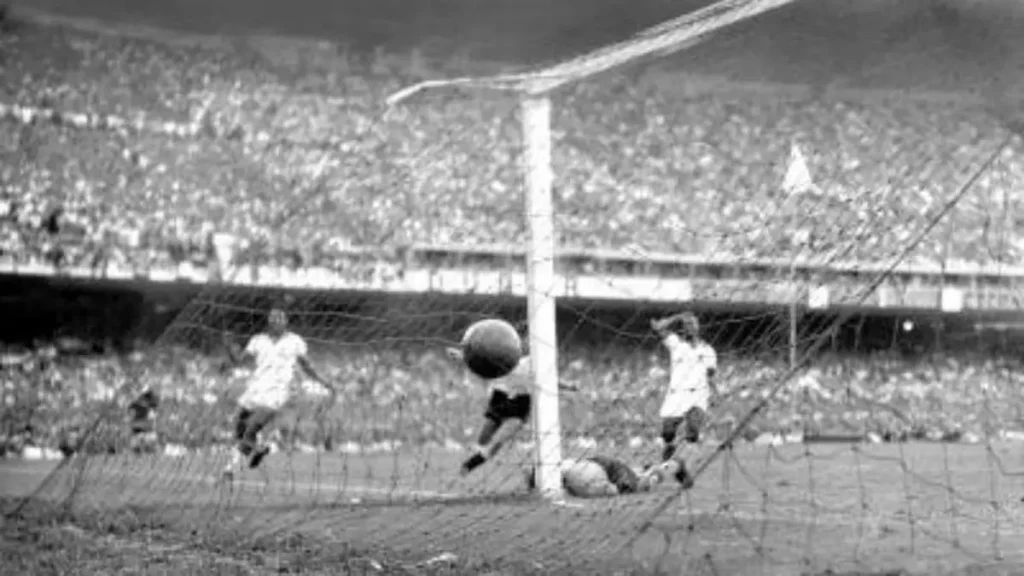
Minute 79. Varela finds Ghiggia. The winger advances, pursued by Bigode. Goalkeeper Barbosa expects a cross, as in the previous goal. But Ghiggia does not cross—he shoots to the near post. The ball goes in.
The stadium fell silent. 200,000 people in silence.
Just over ten minutes later, the world had a new champion. But it was not the one everyone expected.
Jules Rimet, who had already prepared his speech for Brazil, stepped down from the stands. He walked alone through the corridors. He searched the crowd for the Uruguayan captain and, almost in secret, handed him the golden trophy. He shook his hand and left without being able to say a single word.
The greatest silence in history
When English referee George Reader blew the final whistle, something almost supernatural happened at the Maracanã. Most of the crowd left in silence or in tears. Brazilian players openly showed their grief. The band brought for the occasion played nothing. All preparations for a celebration that had seemed inevitable were canceled.
The defeat left deep scars.
Goalkeeper Moacyr Barbosa was blamed for the rest of his life. In an interview, years later, he said in a broken voice: “In Brazil, the maximum sentence for a crime is 30 years. But I have served a sentence my entire life.”
The white uniform worn that day was abandoned forever. From that scar was born the now iconic yellow jersey.
Years later, Ghiggia summed it up with a line that became legend:
“Only three people have managed to silence the Maracanã: Pope John Paul II, Frank Sinatra, and me.”
The legacy
Uruguay’s victory was described at the time as the greatest miracle in the history of football. Not only because of the magnitude of the triumph, but because of how it was achieved: in the home of the overwhelming favorite, before an unprecedented crowd.
The emotional impact was so deep that Pelé—then a child—later confessed that it was the first time he saw his father cry.
For Uruguay, the Maracanazo was much more than a title. It was the confirmation of something they had always known: that a small nation, when it has soul, can defeat any giant. At least, when it comes to football.
After the match, Obdulio Varela did not go to the dressing room. He went out to walk through the bars of Copacabana and spent the night talking with devastated Brazilians. Years later, reflecting on that night, he said:
“I realized they were good people. That’s when I understood what that match meant to them.”
And he himself, the eternal captain, summed up with brutal honesty what they lived that day: “If that match had been played 100 times, we would have lost 99. But that day we won.”
That is the Maracanazo. It was not a miracle. It was the hundredth match.
The Maracanazo is not just a result on a scoreboard. It is the most perfect proof that football is the most human sport that exists, because in it no result is written before the final whistle blows. It is the story of a captain who refused to accept the script others had written. Of eleven men who entered a stadium of 200,000 people and decided not to look up.
Because there are matches that last 90 minutes—and others that live forever.
______________________
COLLABORATE WITH OUR WORK: The 14ymedio team is committed to practicing serious journalism that reflects Cuba’s reality in all its depth. Thank you for joining us on this long journey. We invite you to continue supporting us by becoming a member of 14ymedio now. Together we can continue transforming journalism in Cuba.