The ‘Chinese Costco’ Arrives in Cuba and Everything Has Ridiculous Prices

The gigantic China Import warehouse opens in Havana, for minimum purchases of 50 dollars and in national currency
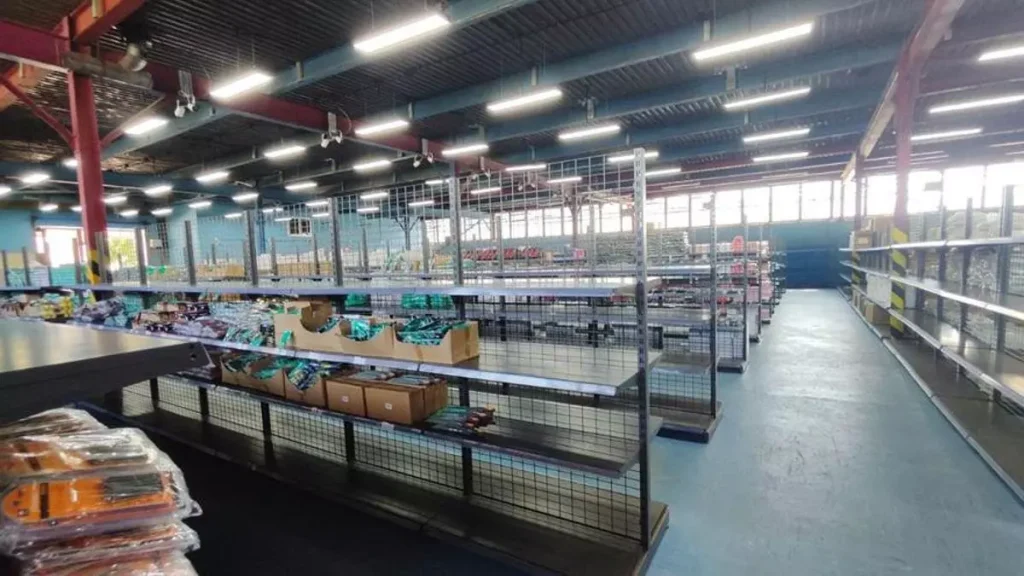

Inside the gigantic warehouse, the shelves with all kinds of products multiply / 14ymedio

14ymedio bigger14ymedio, Juan Diego Rodríguez/Olea Gallardo, Havana, 22 August 2024 — The new China Import store that opened just over a month ago at Manglar and Oquendo, very close to the Cuatro Caminos market in Havana, does not yet have many customers, but it soon will. Unlike the state shops, it offers everything, and in abundance; unlike the MSMEs or on the informal market, its prices are ridiculous.

Although the entrance sign says “wholesale selling” and offers its merchandise to retailers, it is open to the public. On one condition, however: you have to spend more than 50 dollars.

Inside the gigantic warehouse, which until a few years ago was part of the Sabatés soap factory – founded by two Spanish brothers, later sold to the multinational Procter & Gamble, nationalized after the triumph of the Revolution and, today, in ruins – the shelves are multiplying with all kinds of products, from clothing, footwear and perfumes to electronics and household items. In contrast to other large state spaces, such as those selling in freely convertible currency (MLC), let alone the dilapidated warehouses, there are few empty corners. Everything is clean and well lit.
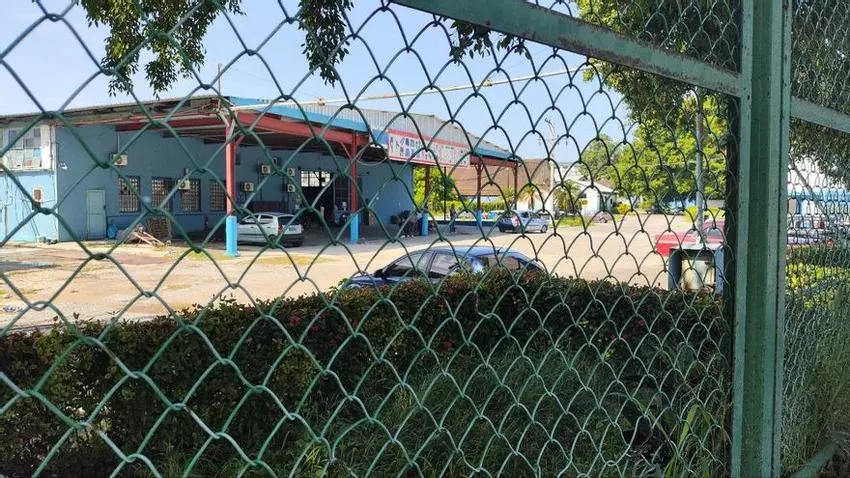
The warehouse occupies part of the old Sabatés soap factory, very close to the Cuatro Caminos market in Centro Habana / 14ymedio

The store, the clerk told 14ymedio on Wednesday, has its prices in foreign currency and accepts national currency, “at the exchange rate of the day,” as the signs under the products say, referring to the informal rate, currently continue reading

around 320 pesos per dollar, and in no way in bills of less than 200 pesos .

They also accept electronic transfers in MLC, the employee explains, “but not today because we have connection problems.” It is not a “national private business,” she pointed out, but rather “a foreign investment business.” There were people with oriental faces around the place, presumably the owners.
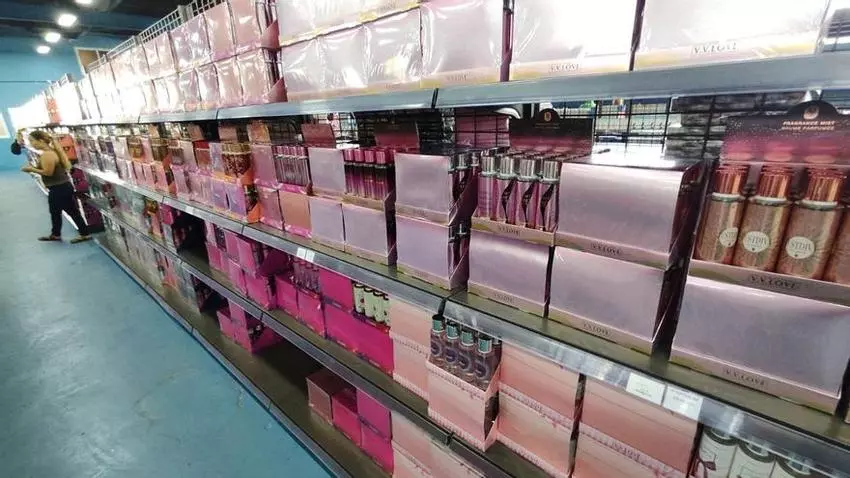
"Those colognes cost me two thousand and something pesos and here they cost three dollars" / 14ymedio
“Those colognes cost me two thousand and something pesos and here they cost three dollars” / 14ymedio

Headphones, $2.00; progressive glasses, $1.00; sun glasses, $1.50; LED lights, $4.50; mobile chargers, $4; cell phone holders for vehicles, $1.80; rechargeable light bulbs for times of blackout, from $11.50; imitation perfumes, $3.00; bras and panties – on sale for having some stains – $1.00; socks, 50 cents. The buyer’s eyes are lost in the abundance of items, but not only is the minimum purchase dissuasive – the equivalent of 16,000 pesos, five times the average monthly salary – but buying wholesale is also mandatory.

Items are not sold separately but in batches that, as a rule, contain a dozen pieces. “This is for those who have a store or receive remittances,” complained a customer who visited the store for the first time, alerted by a cousin who saw the information “on the networks,” and who had to leave empty-handed. “I don’t even have 50 dollars, and I wouldn’t know where to put all that if I bought it.”
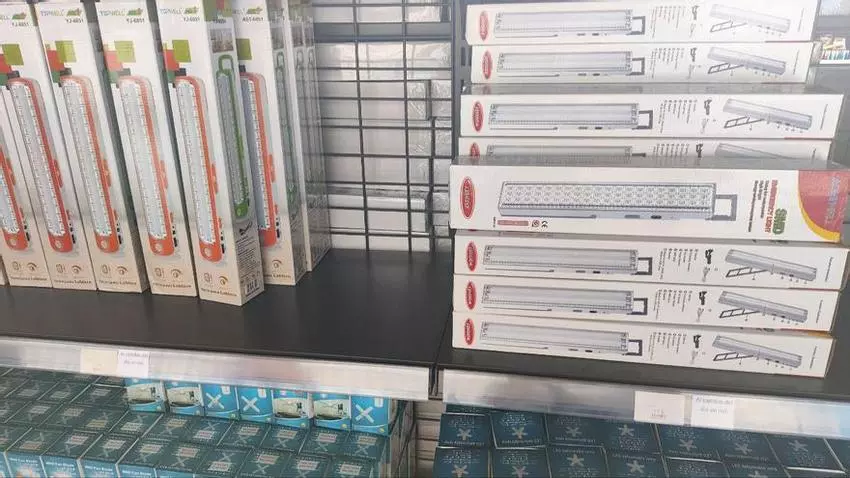
Rechargeable light bulbs, highly valued in times of blackout, were sold from 11.50 dollars / 14ymedio

However, she was amazed at the prices: “Just Imagine, these same things on the street cost three and up to five times the prices here. These colognes cost me 2,500 pesos, and here they are at three dollars [960 pesos at the informal exchange rate]. I have seen the headphones at fairs at 5,000 pesos and the sneakers that here cost 16 dollars [just over 5,000 pesos] – you can’t find them for less than 17,000 pesos out there.”

The sneakers to which this Havana resident of the El Vedado district refers have brand labels, but they are clearly Chinese imitations, like all the merchandise. “They seem to be good quality, but you buy them and after two months have to throw them away because they fall apart.”
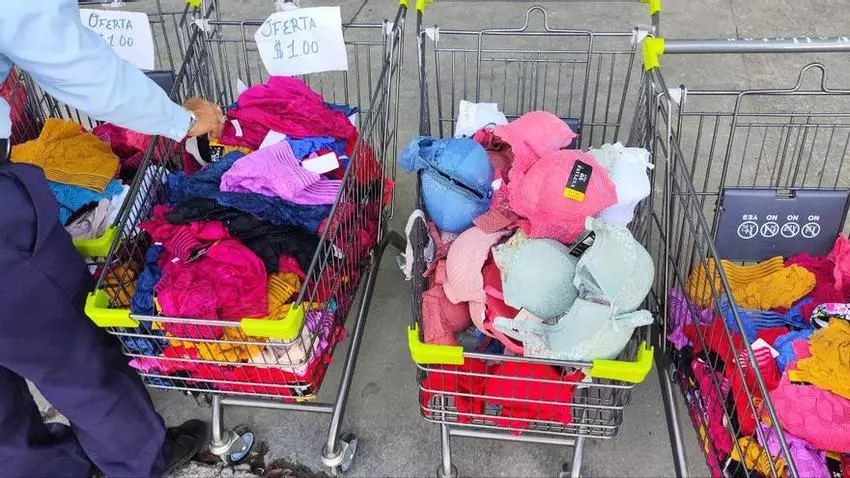
Bras and panties sell for one dollar at China Import /14ymedio

So far, no official media has mentioned the inauguration of the store, nor are there details about its owners. Chinese wholesale businesses had already been established on the Island but only online, such as Ninhao53 and Dofimall, a digital stationery store.

“You’ll see when all the resellers of Galiano or the El Curita park find out, then it will get bad, and this will have three-block lines like when there’s chicken for sale in the bodega [ration store],” said another buyer, a thirty-year-old from Central Havana. He did take a batch of magazines, some fly swatters, light bulbs and underwear of various colors and sizes – “to distribute to the family,” he said.

“The sneakers that cost 16 dollars here can’t be found for less than 17,000 pesos out there” / 14ymedio

The young man, who has family in the US, commented mockingly: “This is a ’Chinese Costco’ but with worse quality.”

Another store that received the nickname “Costco” but “Cuban,” the Diplomarket, closed at the end of last June. Its owner, the Cuban-American Frank Cuspinera Medina, was arrested along with his wife, and their whereabouts are unknown to date. In that store, however, only payment in dollars was allowed, and there was no minimum purchase or wholesale, although they did sell Kirkland products, the “real” Costco brand.

Translated by Regina Anavy

____________

COLLABORATE WITH OUR WORKThe 14ymedio team is committed to practicing serious journalism that reflects Cuba’s reality in all its depth. Thank you for joining us on this long journey. We invite you to continue supporting us by becoming a member of 14ymedio now. Together we can continue transforming journalism in Cuba.

Cuban Writer Reinaldo García Ramos, of the Mariel Generation, Dies in Miami

In order to leave the country, he had to go to a police station and declare himself “scum”

In the foreground, García Ramos in a boat with his friend Reinaldo Arenas, exile and literary companion / Reinaldo Cifuentes

14ymedio bigger14ymedio, Havana, August 20, 2024 — The signature of the poet Reinaldo García Ramos was the third in the inaugural issue of Mariel, the exile magazine that marked an entire generation of Cuban intellectuals and artists. This Monday, the writer’s family reported his death in Miami, at the age of 80, after months of worsening cancer. He was, along with Reinaldo Arenas, one of the most prominent authors of the so-called Mariel Generation.

His death was announced by Milkos D Sosa, García Ramos’ cousin and one of the people – along with the painter Sergio Chávez and his cousin Marianela F. Molina – who accompanied him in his last moments. Sosa described that the poet died “quietly” at 3:45 pm and that his final thoughts were about his books, in particular Una amiga en Paris (Ediciones Furtivas), published this year. “His only wish is that they honor his memory by keeping his literary work alive,” the message ended.

García Ramos defined the Mariel exodus as an “untimely decision of an absolutist ruler,” Fidel Castro. For his colleagues – such as Arenas and the Abreu brothers – exile marked not only their life but also their writing, which acquired a strong commitment to the denunciation of the regime, attested to by the magazine.

He defined the Mariel exodus as an ’untimely decision of an absolutist ruler’

Born in Cienfuegos in 1944, the son of Galician and Canarian emigrants, García Ramos studied French Language and Literature in Havana. A student of personalities such as Camila Henríquez Ureña or Mirta Aguirre – a staunch communist – he remained, in his own words, with a “low profile” so as not to risk the livelihood of his family, which depended on him. continue reading

In 1962, the poetry book Acta – the only book of his that saw light in Cuba – was published by the controversial El Puente project, which the regime dissolved in 1965. He worked for several publishers until his exile, in May of 1980, when he settled in New York. He was a translator at the United Nations headquarters until 2001 and continued his literary work.

He was the author of poetry books such as Caverna fiel and Espacio circular, the essay Una medida exacta and the autobiography Cuerpos al bordo de una isla. His last published book, Una amiga en Paris, collects his correspondence with Ana María Simo, one of the architects of El Puente, between 1968 and 1972.

The recovery of the letters had a great impact on the intellectual community of exile, which saw in the book – in the words of Enrique del Risco – an example of “restitution of the past” in a country like Cuba, of terrible memory. For the essayist, García Ramos and Simo left “an archaeological reconstruction” of a key era for the Island.

They are the years, lived intensely by García Ramos, of the Revolutionary Offensive, the Padilla Case, the fall into disgrace – the parametración – of many writers until then literary critics, the failure of the Ten Million Ton Sugar Harvest and the persecution of his homosexuality, scenes that remain in the 33 letters that García Ramos sent to Simo, who was trying to get him out of the country. Every season of his life realizes his radicalization, which already manifests itself with total freedom in the pages of Mariel.

In an interview he gave to journalist William Navarrete, García Ramos said that he managed to leave after three failed attempts: his aunt, a resident of Miami, had sent boats to pick him up three times, but they never told him. “A neighbor told me that in order to leave by the Mariel (boat lift) we had to go to a police station and declare ourselves ’scum’,” he said. He did so and they gave him a letter; days later, he boarded a bus to El Mosquito, an embarkation point for Florida.

Every season of his life realized his radicalization

He went to New York for Simo – who then lived in that city – to help him, because Miami, according to the writer, was “a city of little importance, not even similar to what it is today. There was a lot of recession and also a lot of drug-related crime.”

García Ramos said that Mariel’s great merit was to provide a space for Cuban exiles, to whom the American cultural world, which sympathized with Castro, closed its doors. It was also “a tribute to those who were part of that exodus of 125,000 people, who were not in their entirety, as the propaganda of Castroism affirmed, criminals and antisocials.”

He returned to Cuba three times, between 2002 and 2006, to see his father, who still lived in Cienfuegos. “My impression was of total sadness in the people,” he said. “Nothing that others have not already said: disappointment, destruction and decadence.”

Translated by Regina Anavy

_________________

COLLABORATE WITH OUR WORKThe 14ymedio team is committed to practicing serious journalism that reflects Cuba’s reality in all its depth. Thank you for joining us on this long journey. We invite you to continue supporting us by becoming a member of 14ymedio now. Together we can continue transforming journalism in Cuba.

With 142 Migrants Dead at Sea, the Route From Cuba to the United States Is the Deadliest in America

So far in 2024 a total of 291 migrants have disappeared or died in Caribbean waters

Hundreds of Cubans leave the Island aboard precarious boats / Coast Guard

14ymedio biggerEFE (via 14ymedio), San José, Costa Rica, 30 August 2024 — At least 291 migrants have disappeared or died so far in 2024 on the dangerous maritime routes of the Caribbean, and international protection actions must be increased, according to the Program of Missing Migrants of the International Organization for Migration (IOM). It added that the route with the most victims is the one that goes from Cuba to the United States, with 142 deaths.

The program’s data indicate that, as of August 30, at least 291 migrants have disappeared or died in 2024, an 18% increase compared to the 247 recorded for all of 2023.

The second deadliest route by sea is the one taken from the Dominican Republic to Puerto Rico, with 91, followed by the route to the Canary Islands, with 15, and from Haiti to the Dominican Republic, with 1 death, according to the program’s data.

The deaths represent an 18% increase, compared to the 247 that were recorded for all of 2023

The regional monitor for the Americas of the Missing Migrants Project, Edwin Viales, said this Friday, in a working session with other similar organizations, that the dangerous natural and climatic conditions of these routes in the Caribbean, added to forced disappearances caused by traffickers, make the boats disappear without a trace. continue reading

“The outlook is not encouraging. Now, more than ever, the coordination of international efforts in the Caribbean is necessary to save lives,” he said.

Viales explained that these routes are used not only by migrants from Latin America and the Caribbean in their objective of reaching the United States, but there have also been cases detected of shipwrecks and disappearances of boats transporting Africans.

One of these cases was recorded on August 6, when the remains of 14 people from Senegal and Mauritania were found on a homemade boat off the coast of the Dominican Republic.

According to Viales, “these transcontinental shipwrecks have been increasing,” since April 13, when a boat was detected in Brazil with the remains of 9 people from Mauritania and Mali.

There is evidence of three similar cases between 2021 and 2022, with a total of 70 deaths in boats found in Trinidad and Tobago, Turks and Caicos, and Granada

In addition, there is evidence of three similar cases between 2021 and 2022, with a total of 70 deaths in boats found in Trinidad and Tobago, Turks and Caicos, and Granada. In 2023, there were also two shipwrecks found with supposed African migrants in Honduras and near Turks and Caicos.

Viales added that in 2023, there was also a complaint from key informants about 105 missing people on the route between San Andrés and the border area between Honduras and Nicaragua. It is suspected that there were two cases of enforced disappearance by groups involved in the trafficking of migrants, and two of shipwrecks.

In this Friday’s session, IOM presented three initiatives on migration in the Caribbean: “One by the Cuban newspaper El Toque, which collects information on the dead and missing; the Route of Life in the Dominican Republic, which aims to raise awareness and educate about the risk of irregular routes, and a project by the Hebrew Immigrant Aid Society (HIAS) to serve and support Caribbean countries.

Translated by Regina Anavy

____________

COLLABORATE WITH OUR WORKThe 14ymedio team is committed to practicing serious journalism that reflects Cuba’s reality in all its depth. Thank you for joining us on this long journey. We invite you to continue supporting us by becoming a member of 14ymedio now. Together we can continue transforming journalism in Cuba.

A Cuban Baseball Player Expelled for Life Participates in a Softball Cup in Ciego De Ávila

Cuban baseball player Alfredo Fadraga with the Rangers softball team in Ciego de Ávila / Facebook/Jeordany Gutierrez

14ymedio bigger14ymedio, Havana, 23 August 2024 — The Cuban baseball player Alfredo Fadraga, who was suspended for life for an escape attempt in Mexico in 2022, reappeared in the Omar Carrero in Memoriam Cup that was held in Ciego de Ávila. The Avileño defended the colors of the Rangers, in the softball tournament, unofficial and organized by Miguel Mirelles, Jeordany Gutiérrez told Cubalite.

The event, much smaller, brought together “16 teams in five fields and everything that entails: referees, scorers, Red Cross, etc.” Gutiérrez said last Monday on the Facebook page of Locos del Softball. In that same publication, several images were shared, including one in which Fadraga appears with part of the Rangers squad. “Excellent tournament with a high-carat organization and the participation of many figures from our national series and the Major Leagues of the United States,” he said.

Cubalite stressed that the career of the Ávila catcher on the Island “is over” due to the severe sanction imposed by the Cuban Baseball Federation. The tournament was organized to honor Omar Carrero, who participated in 17 national baseball series and left a historic average of clean runs of 2.27 for every nine innings, with 149 wins, 105 defeats and 1,225 strikes. continue reading

Alfredo Fadraga in a March 2023 photo in the Dominican Republic, when he was declared a free agent / X/@francysromeroFR

Fadraga was punished in July 2022, and five months later he managed to legally leave the Island; he settled in the Dominican Republic in search of an opportunity with one of the Major League franchises. However, last June, journalist Yordano Carmona reported that an injury prevented the player from joining an unspecified Major League team, and he decided to return to Ciego de Ávila.

The story of Alfredo Fadraga has been closely followed by journalist Francys Romero since in June 2022, together with his teammate Yosvani Ávalos, he decided to jump the fence of the hotel where the Cuban team that participated in the Pan American U-23 Championship was staying in Aguascalientes.

The journalist denounced the capture of these players after the raid of the state police, as if they were criminals, in addition to his immediate return on a flight to Havana after the arrest.

Romero published videos of Fadraga in the Dominican Republic being watched by talent scouts. The level shown by the player led him to be invited to the Dominican Winter League training with the Eastern Stars.

Fadraga lived a dream in the Dominican Republic, and in March 2023 he was declared a free agent by the Commissioner’s Office. The catcher’s qualities attracted the interest – in August of that same year – of “more than five subsidiaries of Major League teams.”

Yosvani Ávalos also left the Island and, in January 2023, entered Mexico through Tapachula to try to reach the United States.

Translated by Regina Anavy

____________

COLLABORATE WITH OUR WORKThe 14ymedio team is committed to practicing serious journalism that reflects Cuba’s reality in all its depth. Thank you for joining us on this long journey. We invite you to continue supporting us by becoming a member of 14ymedio now. Together we can continue transforming journalism in Cuba.

Three Fatalities in Motorcycle Accidents in Havana and Santiago de Cuba

The accidents  also left five injured, one of them critically

A 22-year-old motorcyclist died last Sunday in the municipality of Boyeros / Facebook

14ymedio bigger14ymedio, Havana, 27 August 2024 — In less than 72 hours, three people have died in Cuba from traffic accidents involving motorcycles. Two of them occurred in Havana and a third in Santiago de Cuba. In all cases, the victims were young men, who died immediately at the scene of the accident.

On Tuesday morning, the first victim in Havana died after crashing into a vehicle while riding his motorcycle through an intersection at Fifth Avenue and 112th Street, in the municipality of Playa, not far from the Coney Island recreational park. Witnesses say that the accident occurred when an almendrón, operating as a collective taxi, stopped to drop off some passengers, and the motorcycle hit it from behind.

Although the identity of the victim is unknown, witnesses describe him as a young man who died immediately at the scene of the incident. The police cordoned off the area, one of the busiest avenues in Havana that connects the Miramar neighborhood, where dozens of embassies and hotels are located, with El Vedado.

Another 22-year-old motorcyclist also died last Sunday in the municipality of Boyeros, in Havana, after losing control of his bike. The mishap was recorded near a P10 stop that is on the bridge on 100th Street and Boyeros, according to a social media post. continue reading

The boy – identified as Yoan – was speeding and swerved to avoid a pothole. When he turned, he hit a curb and fell over on the street

A woman who witnessed the accident said in the comments that “the boy – identified as Yoan – was speeding and swerved to avoid a pothole. When he turned, he hit a curb and fell over on the street. He died instantly.” A few minutes after the accident “many people arrived, and there were relatives crying,” other witnesses added.

Also on Sunday, a Cuban teenager died after being hit by a motorcyclist in Santiago de Cuba. Identified as Kevin Quiala Suárez, 16, he was run over while leaving a bar, according to a report by journalist Yosmany Mayeta Labrada on Facebook.

A witness told the reporter that Quiala Suárez “did not realize that the motorcycle was coming, and it knocked him down.” The motorcyclist “was going too fast. It hit him so hard that the motorcycle went down a block later – it was instantaneous,” wrote another person. Mayeta, a U.S. resident, also reported that the motorcyclist “was injured after the impact and is in critical condition in a hospital in the city.” In addition, the accident left two others injured, who are reported stable.

This Tuesday, Mayeta also reported another accident that left two motorcyclists injured after crashing in the intersection of Calvario and San Gerónimo, in the center of Santiago de Cuba. The identity of both drivers, who were transported to the hospital, is unknown.

Motorcycles, scooters and pedestrians were involved in 55% of the accidents recorded in Cuba between January and October 2023

Motorcycles, scooters and pedestrians were involved in 55% of the accidents recorded in Cuba between January and October 2023, said the Island’s traffic authorities, who added that they were related to 59% of the deaths and 50% of those injured in that period.

Likewise, many of the accidents occur because, as the Minister of Transport, Eduardo Rodríguez Dávila, has recognized, 75% of the roads are in fair or poor condition. Given this, the State has justified its null maintenance by the limited availability of raw materials and parts in asphalt factories. Another factor is the significant percentage of vehicles in the country that are between 40 and 70 years old.

Last year alone, 8,556 traffic accidents were recorded that left 729 dead and 5,938 injured. The authorities have said that the main cause of the accidents is the human factor, to which they attribute 91% of the mishaps. “The frequency and dynamics of traffic accidents in the country continues to be marked by the irresponsibility of drivers and pedestrians,” the official newspaper Granma said last January.

During the first half of 2024, according to the Transit authorities of the Ministry of the Interior, accidents on Cuban roads decreased by 13% (543 less), compared to the same period last year, while the number of deaths and injuries fell by 23% and 5%, respectively.

Translated by Regina Anavy

____________

COLLABORATE WITH OUR WORKThe 14ymedio team is committed to practicing serious journalism that reflects Cuba’s reality in all its depth. Thank you for joining us on this long journey. We invite you to continue supporting us by becoming a member of 14ymedio now. Together we can continue transforming journalism in Cuba.

Non-Payments Lead to a 97 Percent Decrease in Rice Production in a Cienfuegos Cooperative

The official press accuses 41% of Avila producers with electrified irrigation of “not contributing to the food of the people”

Non-payments have generated discomfort among producers, which is reflected in the decrease in production /EFE

14ymedio bigger14ymedio, Madrid, 9 September 2024 – “For three months they stopped paying us in the national currency, and they have never paid us what we are owed for over fulfillment,” complains Juan Carlos Durán Rodríguez. The rancher, owner of cattle and land in Cienfuegos, launched the claim in a debate between the authorities and local producers prior to the congress of the official National Association of Small Farmers (Anap), where the impact of these non-payments was verified, which contributed to rice production decreasing by almost 98% between 2018 and 2023.

The official press echoed his complaint this Sunday, saying that Durán complies with the agreed milk delivery figures to the Escambray Dairy Products Company, with between 13 and 18 liters per day. According to September 5, the “accumulation of non-payments to rice and milk producers, along with the inconveniences of banking” are the main concerns expressed by the farmers of the municipality of Aguada de Pasajeros.

“By not having this money on time, we are almost forced to cut back on our duties, because we live from milk production; this is how we maintain the family, pay for electricity and invest, for example, in the fences, something very expensive, because a roll of wire costs up to 18,000 pesos,” Durán argues. continue reading

Their situation is, despite this, better than that of the rice growers, who have accumulated four months of non-payment by the state-owned Granas Agroindustrial Company, which says it has no liquidity. And it is no exception.

“Already last year I went for months without getting paid, and now it’s the same. It’s a very difficult situation, because I’m a major producer”

“Already last year I went five months without getting paid, and now it’s the same. It’s a very difficult situation, because I’m a major producer. I own more than three cabalerrías (126 hectares) of land, with high production costs that are around four million pesos. In addition, I have a family, equipment to fix, and the repair of a tractor today costs between 200,000 and 300,000 pesos,” says farmer Pedro López Izquierdo. “I don’t care about the price, ten pesos more or less doesn’t hurt; the damage is that they don’t pay, because that slows down production, and one lives from what he produces,” he summarizes.

Taymí Torres Machín, president of the Pedro Filgueiras Solís cooperative – which manages to comply with the projections despite everything – puts figures on the damage caused by those non-payments.

“Otherwise, we would have increases in rice production, but the reality is that we do not see solutions, and the farmers are very upset with these issues. In 2018 we contributed 68,000 quintals, but in the recent campaign we delivered only 160 [metric] tons,” equivalent to 1,600 quintals, which reflects a 97.7% drop in production in just five years.

Among those present at the meeting was Caridad Capote Core, deputy director of the Agroindustrial Grain Company, who tried to calm the rice farmers by telling them that a credit has been requested, and she hopes that the Wholesale Company of Food Products will pay off a debt worth 16 million pesos with which they hope to be able to pay what is due.

“You go to the ration store and there is never money; in the Bank they don’t have funds either, and this creates a lot of limitations, because we have to pay for things in cash”

The cooperative members also mentioned banking as a problem, especially because of the lack of mobile coverage in the area, although much more so because of the limitations when it comes to obtaining cash. “You go to the ration store and there is never money, and the Bank doesn’t have funds either. This creates a lot of limitations, because we have to pay for everything in cash. Fuel, when it appears “on the left,” (on the black market) is 8,000 pesos cash in hand,” says Durán Rodríguez.

Non-payments by the State have been, for years, one of the most frequent complaints of Cuban producers, many of whom choose to stop making these contracts and/or live by the “informal” market, although with the sword of Damocles permanently hanging over their heads. However, the reproaches of the regime do not cease. This same Saturday, the provincial newspaper of Ciego de Ávila, Invasor, published an editorial in which it accused the farmers of benefiting from the electrified irrigation systems provided by the Government but who “do not contribute as they should or could, because having to do and being able to do are phrases that are similar but do not mean the same,” it says.

Ciego de Ávila produced almost 62,000 [metric] tons of crops up to June that do not seem to be enough for the editor because, he says, “with what you have, you can do more. ” However, he admits that the so-called “technological package” is not being delivered and that the fuel is insufficient. From 2009 to date, there are 362 “electrified” agricultural producers in this province, of which 41% – according to a commission that has supposedly evaluated it – “do not contribute to the food of the people,” starting with 75 of them who have not delivered anything and an equal number who have not delivered a single quintal to the Acopio Company.”*

Seventy-five of them have not delivered anything and “an equal number have not delivered a single quintal to the Acopio Company”

According to the newspaper, this is a brake on “the transition to food sovereignty,” and an impediment to increasing production and stopping the dependence “on the food imports, which costs Cuba, just for the basic basket, more than 1.6 billion dollars,” according to data from the Ministry of Economy and Planning.

Despite the fact that private farmers – owners, usufructuary or cooperative members – contribute around 75% of the food, fruits and vegetables and 40% of the rice, according to the most recent annual data (from 2021), the Government continues to strengthen state control over these productions. In the latest resolution for the contracting and marketing of these products for 2025, the preamble indicates that agriculture must be oriented to “support the Plan for the Economy.”

*Translator’s note: Acopio is the state-owned company that manages the procurement and distribution of food in Cuba.

Translated by Regina Anavy

____________

COLLABORATE WITH OUR WORKThe 14ymedio team is committed to practicing serious journalism that reflects Cuba’s reality in all its depth. Thank you for joining us on this long journey. We invite you to continue supporting us by becoming a member of 14ymedio now. Together we can continue transforming journalism in Cuba.

The First Secretary of the Party in Villa Clara Imparts ‘Edifying Lessons’ to the Farmers

The leader did not say where they could get the components of his detailed list, but he did recommend that his local subordinates “demand compliance”

Party official Osnay Colina (l) during his visit to Cifuentes / Vanguardia

14ymedio bigger14ymedio, Havana, 30 August 2024 — Escorted by a press team that could not be more loyal to him, the first secretary of the Communist Party of Villa Clara embarked on a journey to one of the great forgotten places of the province: Cifuentes. The tour – narrated in an almost evangelical tone by Vanguardia – describes Osnay Colina’s “edifying lessons” to the farmers, his diatribes against poor production and his “instructive demeanor,” an euphemism to describe his main objective: to scold.

Everyone has left Cifuentes, immersed in the “geographical dispersion” and without resources to guarantee this year’s agricultural goals, of which Colina reminded them insistently. There was no lack of the photographs that Miguel Díaz-Canel has tried to popularize: those of the leader with two or three farmers, who hear from the mouth of a bureaucrat how to do their work.

In the newly founded Agricultural Industrial Company, which was granted 10,000 hectares, Colina gave his first scolding: 10% of the land suffers a “heavy infestation of marabou,” and in the arable area only 72% of the plan has been sown, in “imminent closure.” To top it off, the Company abounds in illegalities, which he asked to be “contained,” and the stocks of milk and meat are plummeting. continue reading

There was no lack of the photographs that Miguel Díaz-Canel has tried to popularize: those of the leader with two or three farmers

Colina’s rigid face, his authoritarian gesture and his speech under the sun were highlighted by the newspaper photographer. Among his many utopian requests was “planting despite the limitations of resources and technological packages, machinery, fuels and the use of animal traction.” The leader did not say where the farmers could get the components of his detailed list, but he did recommend that his local subordinates “demand compliance.”

“A lot of food escapes to third parties,” he warned, alluding to Cifuentes’ black market. Colina asked to go to the farms to see “what happened” with the farmers who did not deliver what was due, and to help – although only “as far as possible” – the one who does comply with the State. To show his interest in the agreements between the producer and the Government, he had himself photographed reviewing the farmers’ contracts.

On paper was, precisely, what was agreed with the state company Acopio, said a delegate of the Ministry of Agriculture in Villa Clara during a meeting with Colina. Eighty-five percent of the farmers hired did not fulfill their agreements or delivered a minimum production. “Where is the other part going? That’s the one that escapes to different destinations,” he argued.

Vanguardia insisted that Colina went on his tour “without many warnings to the parties involved,” a way of saying that no one, supposedly, had time to “put makeup on” Cifuentes’ terrible situation. The “instructions” of his trip are quantified in lessons: if the payments are delayed, it’s because the municipality is “old-fashioned” and ignores the bancarización [banking reform]; if the production is not going well it’s because the “non-state actors” are murky in their management; if the money does not flow, it is because the farmers refuse to have tax accounts.

The situation is not exclusive to Cifuentes: only 21% of the farmers of Villa Clara, Colina complained, have a bank account, and about 200 markets – 23% – still do not have the means to make electronic payments.

Local leaders hoped an old pigsty converted into a “rustic milking shed” would impress Colina. It was a failure. While the official applauded the transformation of the premises, which now has 47 cows bought by the State, milk production is up to the annual plan nor are the animals fed properly.

Local leaders hoped that an old pigsty converted into a “rustic” milking shed would impress Colina

“And what about forage for the livestock?” asked Vanguardia. The answer: 13 hectares of cane and two of grass. Colina got angry again and said that improving the place was “critical. It has to change to achieve systematic improvements,” he said. The cows are “improving genetically, but they don’t have enough water, shade and, even less so, food.”

The worries that the newspaper’s story attributes to Colina have no end. The prose is not afraid to fall back on a kind of resentment toward the farmers who are making the leader suffer, and it asks questions that, like Colina, are also scolding: “Where are the sowing programs, with their respective seed banks? Of course they are null. That, along with the theft and illegal slaughter of livestock, impoverishment and deaths will be the order of the day if critical points are not corrected,” the report concludes.

With the fidelity of the Communist Party newspaper in Villa Clara – known for not departing one iota from orthodoxy or making space for excessive criticism – Colina practices a method that has given results to other colleagues, such as Liván Izquierdo: to be praised by the official press until the Government rewards him and “elevates” him to a post in Havana.

Translated by Regina Anavy

____________

COLLABORATE WITH OUR WORKThe 14ymedio team is committed to practicing serious journalism that reflects Cuba’s reality in all its depth. Thank you for joining us on this long journey. We invite you to continue supporting us by becoming a member of 14ymedio now. Together we can continue transforming journalism in Cuba.

The Silenced Voices of ‘Castrochavismo’

Despots, regardless of ideology or origin, deeply hate their fellow men

Part of a police operation in 2022 that surrounded the home of the Cuban reporter Luz Escobar, now exiled in Spain / 14ymedio

14ymedio bigger14ymedio / Pedro Corzo, Miami, 8 September 2024 — The vast majority of the political prisoners of the castrochavista regimes are young people, sometimes teenagers, who are practically beginning their lives and embrace, with full consciousness, the stanza of the Cuban national anthem that claims: “To live in chains is to live mired in shame and disgrace.” Despots, regardless of ideology or origin, deeply hate their fellow men, but there are two sectors of society that they especially despise: the young and the journalists.

The youth, because they know the willingness to take risks at that stage of life. Young people rarely properly assess danger, and that is probably what makes that period of our existence so magical and unforgettable.

There is a strong tendency to take risks, to defend ideals with sticks and stones, even if their enemies, like the serial killer Ernesto Che Guevara, enjoy the sound of machine guns.

The autocrats of castrochavismo, more than their military peers, like to censor and intimidate journalists and the media

The prisons of Cuba, Venezuela, Nicaragua and Bolivia are full of people sentenced for the honorable crime of justly claiming civil rights for themselves and the country.

In the homeland of the Liberator Simón Bolívar, despot Nicolas Maduro imprisoned around 100 young people between 13 and 17 years old for opposing electoral fraud. These teenagers were then released from prison with severe restrictions on their rights.

Nicaragua is not far behind. According to a report in the newspaper La Prensa, in May of this year, 66 of the 138 political prisoners were between the ages of 15 and 39. Even more tragic is the case of Bolivia, another autocratic state that does not recognize itself as such: its political prisoners, young and old, are barely documented. continue reading

However, in Cuba, the only country in the hemisphere where “real socialism” prevails, there are 1,119 political prisoners according to Prisoners Defenders, mostly young people, some sentenced to life imprisonment for illegally attempting to leave the country and others for participating in protest demonstrations.

The situation of journalists under these regimes of force is worse than what they suffered during the military regimes that overshadow the history of the hemisphere.

The autocrats of castrochavismo revel even more than their military peers in censoring and intimidating journalists and the media, with the ultimate goal of imposing permanent censorship until they achieve the ideal situation in which the communicators censor themselves.

Even more tragic is the case of Bolivia, another autocratic state that is not recognized as such: its political prisoners, young or old, are barely documented

The control or absence of the freedoms of expression and information is an almost constant practice in the countries of castrochavismo, Cuba again being the exception, because in that country all the media were confiscated in 1961 and remain under the absolute control of the Government 63 years later.

The rulers of these countries are ex officio censors, which is why they pay particular attention to the media, since they refuse to admit that information that refutes the official one is reported.

The situation in Cuba is quite unique. The censorship on the island is total. The media are controlled, and the journalists are officials, because they do not have the power to investigate or prepare a work that has not been previously subjected to censorship. Hence, on Castro’s island, independent journalism has emerged that involves great risks for the men and women who practice it.

The situation of journalists under these regimes of force is worse than what they suffered during the military regimes that overshadow the history of the hemisphere

In Venezuela, Nicaragua and Bolivia, the independence of the media has been severely restricted, to the extent that it is practically non-existent.

Nicolas Maduro, imitating a provision on the press issued by the Cuban dictatorship in 1999 – Law 88 on the Protection of National Independence and the Economy of Cuba – created the Strategic Center for Homeland Security and Protection (Cesppa), with the aim of “predicting and neutralizing potential threats from internal or external enemies.”

If Castro’s Law 88 was applied to the infamous Black Spring of Cuba, in which dozens of independent journalists were arrested, among other activists, Maduro’s Cesppa now provides invaluable services to the Venezuelan despot. The same happens in Nicaragua with a law of the Ortega-Murillo regime, which after controlling traditional media such as the distinguished newspaper La Prensa, intends to manipulate the Internet at will with its arsenal of legislation.

Translated by Regina Anavy

____________

COLLABORATE WITH OUR WORKThe 14ymedio team is committed to practicing serious journalism that reflects Cuba’s reality in all its depth. Thank you for joining us on this long journey. We invite you to continue supporting us by becoming a member of 14ymedio now. Together we can continue transforming journalism in Cuba.

Dozens of Devotees Venerate the Virgin of Regla on the Eve of the Day of Cuba’s Patron Saint

The procession precedes the celebration of the Virgin of Charity of Cobre, patron saint of the island, popularly called ‘Cachita’

People participate in the procession of the Virgin of Regla

14ymedio biggerEFE (via 14ymedio), Havana, 8 September 2024 –Dozens of devotees attended the mass and subsequent procession of the Virgin of Regla this Saturday, in the Havana municipality that bears her name, on the eve of the celebrations for the day of the patron saint of Cuba, the Virgen de la Caridad del Cobre.

After the mass at the National Sanctuary of Our Lady of Regla, a crowd accompanied the procession as they do every September 7, dressed in blue and carrying black dolls in allusion to the virgin who, in the Yoruba religion, resembles Yemayá, the goddess of the sea.

The cult of the Virgin of Regla began in 1867, in a wooden hermitage in the fishing village of Regla / EFE

According to historical data, the cult of the Virgin of Regla began in 1867, in a wooden hermitage in the then fishing village of Regla.

In 1708, it was declared by the chapter of the town of Regla patron saint of the fishermen and the population, the port and the Bay of Havana.

This virgin was brought to Cuba by the Spanish colonizers who inherited the religion of Andalusia. This Catholic tradition has become common on the Island, where she is considered a protector of fishermen, sailors and all those people whose lives depend on the sea. continue reading

The church of the Virgin of Regla was built in 1811. It is a humble temple where the image of a black virgin dressed in blue with white lace stands out. The Sanctuary of Our Lady of Regla was declared a National Monument in 1987.

This tradition has become common in Cuba, where the virgin is considered a protector of fishermen and sailors / EFE

This Saturday’s procession precedes the celebration on Sunday of the day of the Virgen de la Caridad, patron saint of the Island, popularly known as “Cachita.” African slaves recognized her in their Yoruba pantheon as the deity Ochún.

According to Catholic legend, the Virgin of Charity first appeared in 1612 with a child in her arms, floating on a board with an inscription that said: “I am the Virgin of Charity,” before three fishermen who sailed in a boat through the eastern bay of Nipe.

Translated by Regina Anavy

____________

COLLABORATE WITH OUR WORKThe 14ymedio team is committed to practicing serious journalism that reflects Cuba’s reality in all its depth. Thank you for joining us on this long journey. We invite you to continue supporting us by becoming a member of 14ymedio now. Together we can continue transforming journalism in Cuba.

Cubans Pay Tribute to ‘Cachita’ in the Midst of Inflation and a Mass Exodus

The profound economic crisis has reduced the number of offerings left on the altar at the entrance to the church of the Virgen de la Caridad del Cobre /14ymedio

14ymedio bigger14ymedio, Natalia López Moya, Havana, 9 September 9, 2024 — The heat and lack of water in wide areas of the Cuban capital did not prevent the church of the Virgen de la Caridad del Cobre on the corner of Manrique and Salud, in Central Havana, from being filled with devotees, who celebrate on September 8 the day of the Patron Saint of Cuba. The effects of inflation and the mass exodus, however, were noticeable.

The bouquet of sunflowers, with its yellow petals in tribute to the saint, fondly called Cachita, now costs 1,000 Cuban pesos, twice the price of two years ago. On this occasion, the deep economic crisis has also reduced the number of offerings left on the altar at the entrance to the church, including candles, holy cards and gifts to the Virgin.

“Coming here was already a sacrifice,” says Celeste, 68, who arrived with her daughter and a grandson. “This is the only family I have left in Cuba, and we have come to ask Oshún (the equivalent of the Virgin of Charity del Cobre in the Yoruba religion) to send them quickly and safely on the way.” The family entered the church shortly after four in the afternoon for the mass given by Cardinal Juan de la Caridad García, archbishop of San Cristóbal de La Habana.

In the large enclosure, the average age of those present exceeded 50 years, a sign of the exodus suffered by the Island / 14ymedio

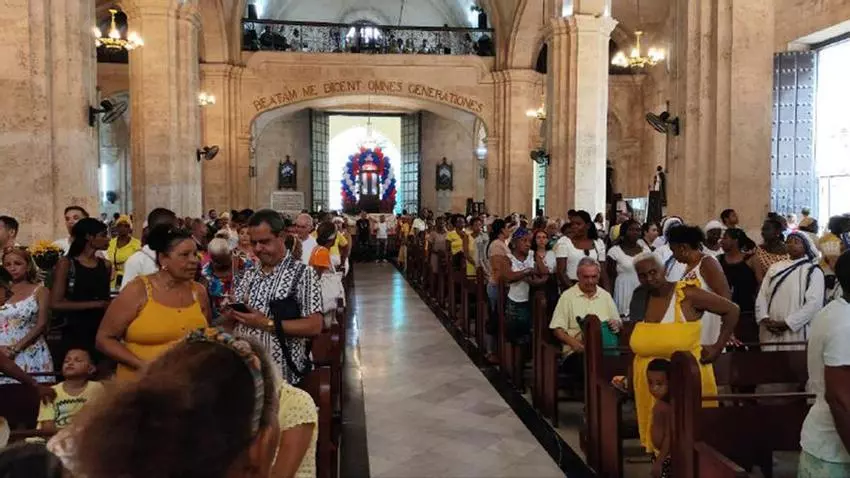
In the large enclosure, the average age of those present exceeded 50 years, a sign of the exodus suffered by the Island. Some children, accompanied by their grandparents, stood out among so many gray hairs and gave some amusement in the middle of the sober ceremony. At the base of an arch continue reading

supported by regal columns, a Latin phrase contradicted the reality of the missing young people: “beatam me dicent omnes generations” (all generations will hold me blessed).

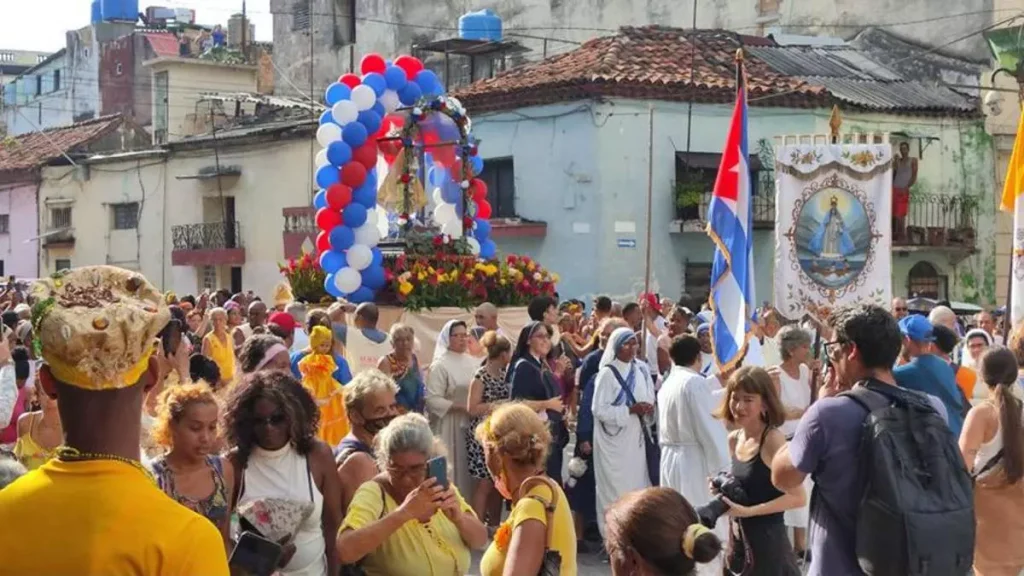
In contrast to the small number of young people and children, those who never miss the date are the police and state security agents who closely monitor, every year, the commemoration of September 8 and, especially, the procession that runs through several streets of one of the most populated municipalities of Havana. The rectangle formed by Manrique, Zanja, Galiano and Reina streets is the route along which Cachita’s followers walk, accompanied by priests, nuns, parishioners, santeros (practitioners of Santería) and segurosos (security guards).

From Galiano Avenue, metal fences and several police officers controlled the passage to the Havana church where tribute is paid to “the mother of all Cubans.” In the vicinity of the church, the surveillance cordon was stricter and, significantly, the large mountains of garbage that are now part of the landscape had disappeared from the area. Now that the filth was further away, the sellers were able to unfold their tables and display their necklaces, wood carvings with the mambisa* virgin’s image, bouquets of flowers and dolls dressed in yellow. But unlike other years, the merchants did not have an avalanche of customers this Sunday, because some were deterred by the high prices, and others, simply, weren’t able to make the journey.

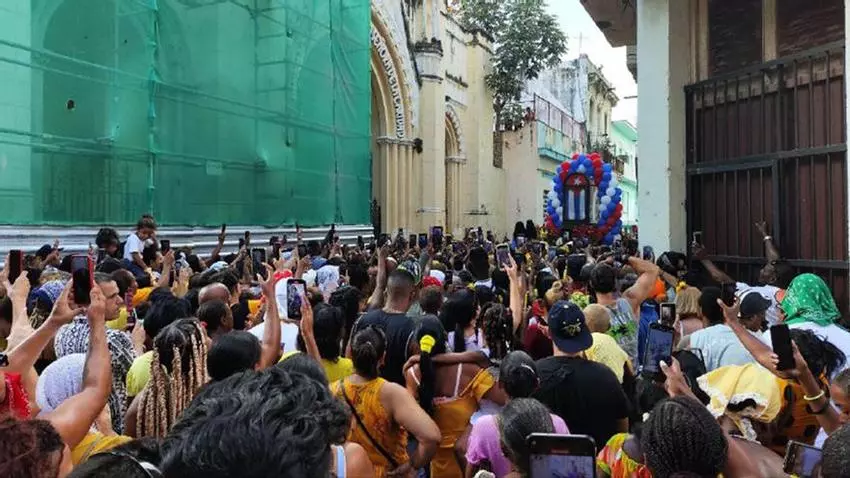
Adorned with balloons with the colors of the Cuban flag, the image of the Virgin of Caridad del Cobre on procession was protected inside a glass case. After five in the afternoon the procession with Cachita peeked through the door of the church, and she was greeted with applause, tears and hundreds of raised arms trying to capture the moment with their mobile phones.

“There are many people but fewer than in other years,” said a young man who was trying to broadcast live on his social networks the moment of the Virgin’s departure. “I barely have 4G so I don’t know if the images are showing,” he said. “I’m trying to send the video to my sisters, who left a few months ago and used to come to this parish a lot. One is in Madrid and the other in Valencia, but they are still very devoted to Cachita.”

Smiles were also scarce. The procession that a few years ago had a certain touch of fiesta and revelry was this time more introverted and circumspect. There were thinner faces, fewer petals falling from the balconies due to the high price of flowers, more calm and fewer spontaneous screams like the ones a few years ago that broadcast the need for a national understanding to “accept us all, under the mantle of Cachita.”

The day has been influenced from the start by the prayers and complaints about the harsh situation that Cuban families are going through / 14ymedio]

During the procession, applause was heard, shouts of “Long live the Virgin” and tunes like “If you go to Cobre, I want you to bring me a a little Virgin of Charity.” Megaphone in hand, the Cardinal asked the Patron Saint of Cuba to help the residents of the Island to “solve the serious economic, political and social problems” they suffer in a debacle for which there is no solution in the short or medium term.

In other parishes of the country, processions and similar masses were held, especially the one that took place at the Cobre Sanctuary in Santiago de Cuba, where dozens of people celebrated the 412nd anniversary of the discovery of the image of the Virgin.

For the rest, the day was influenced from the beginning by prayers and complaints about the difficult situation that Cuban families are going through. For the occasion, the superior of the Daughters of Charity in Cuba, Nadieska Almeida, published a text on Facebook describing the deep crisis on the Island. “I also suffer as a Cuban when I have no strength to get up, when hope seems to be extinguished.” The nun regrets “so many unnecessary deaths due to hunger, lack of resources and, what is more serious, negligence, because our damage is so severe that we stop caring.”

*Translator’s note: In 1915, several veterans of Cuba’s War of Independence (“mambises”) wrote to Pope Benedict XV, asking him to proclaim the Virgin of Charity del Cobre as the patroness saint of Cuba.

Translated by Regina Anavy

____________

COLLABORATE WITH OUR WORKThe 14ymedio team is committed to practicing serious journalism that reflects Cuba’s reality in all its depth. Thank you for joining us on this long journey. We invite you to continue supporting us by becoming a member of 14ymedio now. Together we can continue transforming journalism in Cuba.

The Police Interrogate Former Political Prisoner Samuel Pupo for His Posts Against the Regime

They gave him a warning for being “prone” to committing crimes of “propaganda”

Pupo with his wife, Yuneisy Santana, in a photo taken in July, three months after leaving prison / Samuel Pupo Martínez/Facebook]]

14ymedio bigger14ymedio, Havana, 30 August 2024 — Samuel Pupo Martínez – who was imprisoned for two years, eight months and 21 days following the demonstrations of 11 July 2021 (11J) – was threatened again by State Security agents with being returned to prison, this time for his posts on social networks, which criticized the regime. This Tuesday they forced him to sign a warning. In the document they indicate that he is “prone to committing a crime of propaganda against the constitutional order,” he told 14ymedio.

“They told me to put social networks aside and not post anything more against the Government and the system,” he explained to this newspaper, alluding to his encounter with two agents who identify themselves as “Darío” and “Omar.” The duo has continuously harassed him since his release from the Agüica maximum security prison on April 1, when he received a reduction of his seven-year sentence for the crimes of public disorder and contempt.

According to Cuban law, the crime of propaganda against the constitutional order can lead to sentences of between four and 10 years in prison. On the warning, Pupo wrote that he did not agree with the accusation. continue reading

His posts on social networks criticized the regime

The agents were insistent, and they not only spent part of the interrogation intimidating him in a subtle way, but they also tried to find out what he’s been doing since his release from prison. “They asked about my employment, and I replied that I am not yet working in a permanent job because my computer is broken. I have not been able to repair it, and I need it to be self-employed,” he said.

Pupo has always been an enterprising man and has a good command of English. Before ending up in prison, he taught that language to a group of students. But now, with his computer broken and his health diminished, he does “the odd job, anything else that appears.”

The time he spent locked up in Agüica wreaked havoc on his body. During that period, in addition to enduring the hostile environment, he also had to deal with scleroderma, diabetes and glaucoma, which have afflicted him for years without his receiving proper medical care. “In prison, my illnesses had a field day, so now I’m just trying to survive,” he says. Among other consequences, the prison affected Pupo’s ability to see.

With his computer broken and his health diminished, Pupo limits himself to doing ’the odd job, anything else that appears,’ he told this newspaper

During the interrogation, the agents reproached him for having met with relatives of other political prisoners and accused him of using his social networks to spread what they described as “propaganda” against the regime. This is in reference to various posts on his Facebook page where he denounces prison abuse, among other things.

In the interrogation, “Darío” and “Omar” insinuated that, if he did not comply with the warning to moderate his posts, there could be repercussions for his family. “They told me that if my intention is to leave the country with my family, the best thing is to remain calm, because they could regulate my departure,” the activist explained about the attempt to dissuade him from exercising his freedom of expression.

“Everything happened in a calm atmosphere. They didn’t yell at me; they talked in a normal way but insisted on what I should do, telling me that I could return to prison and for a longer period this time,” he said.

State Security has not left Pupo alone since, in the protests of 11J, he climbed on top of a car in the middle of the demonstration in Cárdenas, Matanzas, in front of Party headquarters, and shouted “down with communism!” and “homeland and life!” The photo taken of him became one of the most iconic images of that day.

For Cubalex, the action of the agents this Tuesday, by harassing and threatening Pupo for expressing his opinions, “violates the Constitution of the Republic of Cuba, which requires public officials to respect the law and act within the bounds of their authority.”

In a statement published this Thursday, Cubalex emphasized that “discriminating against a person for his political opinion threatens human dignity,” and considered that the agents “exceeded the legal limits of their authority,” not only by trying to intimidate Pupo but also by initiating a process of illegitimate criminal prosecution, motivated solely by his political opinions.

The image of Pupo shouting ’down with communism’ and ’homeland and life’ on top of a car is one of the most iconic of 11J

Pupo also denounced on his Facebook account, one day after the interrogation, that he had been restricted from accessing the internet. “I have paid for mobile data, and in advance. But I don’t know why my service was cut off,” he said.

In his most recent post, the activist explained that after spending the whole day without internet he was able to connect to the mobile data network using another telephone line, and that’s when he changed his SIM card. “Something must have happened to my SIM card, or some problem in Etecsa left me without internet. I’ll find out tomorrow. If the Etecsa company could be sued, it would have gone bankrupt a long time ago,” he joked.

Translated by Regina Anavy

____________

COLLABORATE WITH OUR WORKThe 14ymedio team is committed to practicing serious journalism that reflects Cuba’s reality in all its depth. Thank you for joining us on this long journey. We invite you to continue supporting us by becoming a member of 14ymedio now. Together we can continue transforming journalism in Cuba.

The ‘Stylish’ Closing of the Cienfuegos Cultural Summer Celebration Ended in the Dark

The sound equipment was installed in front of Calle 56, very close to the Guiñol Theater / 14ymedio

14ymedio bigger14ymedio, Cienfuegos, 30 August 30, 2024 — It’s 8:00 at night, and much of Cienfuego’s El Prado is without electricity. The Asociación Hermanos Saíz (AHS) had announced a “stylish” activity to close the summer activities. The institution has developed a whole theatrical production in rural neighborhoods and communities whose completion was scheduled for this Thursday in coordination with the Provincial Council of Performing Arts.

The sound equipment was installed in front of Calle 56, very close to the Guiñol Theater for a show, called “El arte nos une” (Art unites us), which was supposed to start at 7:00. “I’ve been here since 6:00 in the afternoon, and when I arrived there was no electricity anymore,” says Betty, a young dancer who was supposed to participate in the evening. Her usual punctuality contrasts with the delay that characterizes the events organized by the ruling party.

“It’s incredible how in this country resources are moved around unnecessarily, with the misery that there is,” says Arturo, a man who sits every night on a bench in El Prado. “Then they post photos on social media as if it had been a success when, in reality, they don’t even have an audience to come see them. Those of us who are sitting here come to clear our heads for a while, not to witness an artistic gala,” he protests. continue reading

At 8:10 at night the electricity was restored, but the lighting continued to be terrible / 14ymedio

Finally, at 8:10, the electricity was restored, but the lighting was still terrible. “Luckily, I listened to my mother when she told me not to wear high heels. When these things happen, and they happen very often, I think about taking a leave from the AHS,” Betty confesses to 14ymedio. But she ends up discarding the idea because, she recognizes, “marking myself” is not going to solve anything.

To the cry of “the snack has arrived,” the cast of the “young artistic vanguard” prepares to consume the squalid assigned ration. “With this and a check of 200 pesos, most of our colleagues are satisfied. Then we go to the meetings to say that everything is fine, deceiving ourselves, because no one believes the story that the work of the Association has any social impact,” admits a leader of the institution.

“Anyone who sees our photos of the theatrical production would think that everything was wonderful” / 14ymedio

“Anyone who sees our photos of the theatrical production would think that everything was wonderful. However, once again, reality surpasses fiction by demonstrating the uselessness of theory and the pointlessness of practice,” says Betty referring to the countless problems that always end, when the performance is not suspended, by reflecting a poor aesthetic quality. Poor aesthetic quality or a suspension of scheduled activities. “I’m going to ask what they’re going to do with this, because I feel like leaving now,” she concludes.

“Could you tell me when the show starts?” Arturo asks, and, after 9:30 at night, a recorded song by the duo Buena Fe is heard, as a preamble to the delayed start. At this time some people stop at El Prado to observe what is happening. They have put a spotlight near the improvised scenario that improves visibility a little. Even so, the small crowd gathered remains in the shadows without any place to sit.

The small audience gathered remains in the shadows without any place to sit / 14ymedio

The show included music, dance, singing, plastic arts and circus acts. “They announced a lot and it lasted a little,” says Arturo, while the audio operator collects the equipment. “United by art” ended up uniting the hopeful young artists, who took advantage of the occasion to talk about future plans, most of them far away from the AHS and Cuba.

Translated by Regina Anavy

____________

COLLABORATE WITH OUR WORKThe 14ymedio team is committed to practicing serious journalism that reflects Cuba’s reality in all its depth. Thank you for joining us on this long journey. We invite you to continue supporting us by becoming a member of 14ymedio now. Together we can continue transforming journalism in Cuba.
General Sotomayor García, Sanctioned by the US for the Repression of the ’11J’ Protests, Has Died

His remains have been cremated and will be on display on Tuesday at the Calzada and K funeral home, between 3:00 pm and 5:00 pm

After the triumph of the Revolution, Sotomayor was sent to La Cabaña, where hundreds of people were executed under the command of Ernesto ’Che’ Guevara. / Radio Bayamo

14ymedio bigger14ymedio, Havana, 2 September 2024 — Hero of the Revolution for some, known repressor of the dictatorship for others, General Romárico Vidal Sotomayor García died in the early hours of September 1 in Havana at the age of 85. The soldier, a member of the Central Committee of the Communist Party of Cuba, deputy in the National Assembly and a senior position in the Revolutionary Armed Forces and the Ministry of the Interior for decades, was one of those responsible for the repression of the anti-government demonstrations of July 11, 2021 (11J), for which he was sanctioned by the United States.

“There are no mysteries in how General Sotomayor has successfully managed to fulfill such dissimilar and complex missions,” Raúl Castro had written about him in the prologue of “Sin olvidar mis raíces (Without Forgetting my Roots”), his biography. The former president stated in the text that his “unconditional loyalty to our people, to the Homeland, to the Revolution, to its Commander-in-Chief and to those who have acted on their behalf; confidence in the decisions of their superiors and absolute commitment to comply with them,” the official press reported.

Born in Bartolomé Masó, Granma Province, in 1938, Sotomayor joined the Rebel Army in 1957, where he was part of column I, and after the triumph of the Revolution he was sent to La Cabaña, where hundreds of people were executed under the command of Ernesto Che Guevara, although his continue reading

biography officially indicates that there “he continued his military studies.”

Sotomayor was in Angola from September 1975, and between 1982 and 1984 he was Chief of Staff, before occupying the post of head of the Southern Troops Group.

Sotomayor was in Angola from September 1975, and between 1982 and 1984 he was chief of the General Staff, before occupying the position of head of the Southern Troop Group

Among the decorations he holds are the order of Che Guevara; the order of Camilo Cienfuegos; the medals of the XX Anniversary of the Moncada; Fighter of the “War of Liberation” [Cuban Revolution] (1956-1958); Combatant of the Clandestine Struggle [the Escambray Rebellion] (1959-1966); First Class Internationalist Fighter; and several others, such as the Calixto García and the Ignacio Agramonte.

In addition, Raúl Castro awarded him the title of Hero of the Republic of Cuba in 2015, coinciding with his retirement, at the age of 77.

The Office of Foreign Assets Control (OFAC) included him on the list of those sanctioned by the US Treasury Department in 2022, for his relationship to “actions to repress peaceful and pro-democratic protests in Cuba,” which is why many Cubans have not regretted his death – in fact, just the opposite.

The messages of condolences – “Before his transfer to the Minint he was head of the 1580 regiment, where I met him. An exceptional boss, my condolences to his family and friends” – have alternated with messages of satisfaction and relief – “He won’t be missed, no great loss” or “I didn’t wish for his death, but we all eventually fade away.”

His remains have been cremated and will be on display on Tuesday at the Calzada and K funeral home, between 3:00 p.m. and 5:00 p.m., according to the official press.

Translated by Regina Anavy

____________

COLLABORATE WITH OUR WORKThe 14ymedio team is committed to practicing serious journalism that reflects Cuba’s reality in all its depth. Thank you for joining us on this long journey. We invite you to continue supporting us by becoming a member of 14ymedio now. Together we can continue transforming journalism in Cuba.
The New Bet of the Cuban Regime To Stop the Tourism Debacle: ‘Peace and Security’

Faced with the decline in visitors from Canada and Europe, the Government tries to attract more Russians and Mexicans

Foreign tourists putting on sunscreen on a street in Havana/ 14ymedio

14ymedio bigger14ymedio, Madrid, 6 September 2024 — Cuba is wrapping up its first tourism law, which should be approved in December 2025. The news broke this Thursday in Montevideo when the Observatory of Tourism Law of the Americas and the Caribbean was inaugurated, a venue agreed on last May in Varadero.

Juan José Álvarez, legal director of the ministry headed by Juan Carlos García Granda, represented Cuba at the inauguration of the Observatory, where the regime will expose – he said – “the values that support its tourism policy, based on peace and security.”

The first task of the new body is to perform a diagnosis of regional tourism legislation in order to subsequently develop proposals and carry out best practices. The basis is sustainability, accessibility and inclusiveness, according to the Cuban official, who did not expand on how this will be transferred to the national context, whose policy has been marked for decades by the exclusion and overexploitation of resources, including natural ones.

Experts in Law and Tourism from the University of Havana are working on the elaboration of the Cuban law, and the only clue about its content is that it will be “a moment of consolidation of what the country has done in tourism,” which is not exactly a good omen. continue reading

Despite the fact that the Island joined the Spanish Smart Tourist Destination program in 2023, neither of the cities that applied – Cayo Largo del Sur and Guardalavaca – have yet managed to advance in the designation. Cities that aspire to enter this category must demonstrate a high level in the five segments that are valued – governance, sustainability, accessibility, innovation and technology – to advance to the fifth and final stage. Montevideo, at level three, is among the cities in the world that are achieving this goal.

The Cuban tourism strategy, despite the repeated declarations of intentions, is still anchored in the past

The Cuban tourism strategy, despite the repeated declarations of intent, is still anchored in the past: a lot of hotel construction and an apartheid attitude towards the national tourist that is no longer a written rule but is still the usual practice.

The result had been positive until, shortly before the pandemic, things began to change. Since then, the tourism data have disappointed by leaps and bounds, and the Island has been unable to catch its breath after the pandemic. In addition, even with the excessively bad investments in relation to both the results and the money, which could have been allocated to food, health and education – the data are worsening.

In July, the last month with available figures published by the National Bureau of Statistics and Information (ONEI), 153,261 travelers arrived in Cuba, similar to the same month of 2022, but lower by 13.56% than last year, when 177,306 tourists were received. In addition, if we count since January, the number of tourists is 1,463,097 – 26,230 fewer, or 1.8% – than for the same period of the previous year, which suggests that the goal of 3.2 million for 2024 is further away than ever. The 2023 target was not met either, when 2.4 million tourists were received compared to the 3.5 million planned.

Given the evidence of a reduction in travelers from some of its traditional markets, starting with Spain and continuing with a worrying setback for Canada, which was first in numbers for decades, Cuba’s strategy has been to seek new horizons.

“Our job is to bring more Mexicans to Cuba and recover the high presence of Mexican tourists that we used to have”

This attempt frames the efforts to capture the Russians, who arrived in record numbers even before the pandemic and, to this day, continue to be among the countries with the highest growth (41% in July). The increase in Mexican travelers, which in June was already 40,146, 221% more than in the same period of the previous year, has not gone unnoticed by the authorities of the sector.

Hence, the regime has pulled out all the stops to continue attracting citizens of the neighboring country, for which it has reserved an online visa program making it possible to obtain the document up to 72 hours before the trip, for a cost of 575 Mexican pesos, about 29 dollars.

The Cuban ambassador to Mexico, Marcos Rodríguez Costa, presented the tourist strategy in the country, stating that the Island, despite the difficulties, “is more than ready to offer an unforgettable experience, full of flavors, colors and a great diversity of places to discover, both on its beaches and in its vibrant cities.”

Aeromexico, Viva Aerobus and Magnicharters connect both countries, and Mexicana de Aviación also plans to fly to Cuba, according to the ambassador, after a meeting at the end of August with the company’s executives.

“Our job is to bring more Mexicans to Cuba and recover the high presence of Mexican tourists that we used to have,” said Rodríguez Costa. However, Mexican media specialized in tourism have echoed the debacle of the sector on the island. This Thursday, Preferente points out in a note entitled “Tourism for the Dominican Republic, Cancun and Cuba,” that the three main destinations in the Caribbean have recorded an “uneven first half of the year, with the enclave that covers Punta Cana at the head, in contrast to the Island, whose tourist axis is located between Havana and Varadero.”

The Dominican Republic has, it emphasizes, an outstanding year-on-year growth of 11%, compared to the 5.4% expected by Quintana Roo, which they consider poor. Cuba’s data, however, are in negative territory.

Translated by Regina Anavy

____________

COLLABORATE WITH OUR WORKThe 14ymedio team is committed to practicing serious journalism that reflects Cuba’s reality in all its depth. Thank you for joining us on this long journey. We invite you to continue supporting us by becoming a member of 14ymedio now. Together we can continue transforming journalism in Cuba.
UN Agency Finances the Installation of Solar Electric Pumps for Agriculture in Cuba

The FAO, a United Nations agency, did not declare the amount it will spend on the project

The purpose of the initiative is to use solar energy to extract water / Granma

14ymedio bigger14ymedio/EFE, Havana, 31 August 2024 — The Food and Agriculture Organization of the United Nations (FAO) and the Global Environment Fund will support the installation of solar electric pumps for agricultural plantations and livestock facilities in Cuba, the State press reported on Saturday. “The collaboration responds to the common interest of introducing sustainable technologies in the agricultural sector,” explains the FAO in a statement quoted by the State newspaper Granma.

The report explains that the equipment will be installed in selected locations in the provinces of Sancti Spíritus and Granma, and in the Company for the Conservation of the Zapata Swamp, in Matanzas. The purpose of the initiative is to use solar energy to extract water for the wellbeing of the animals and the irrigation of the plantations, and to contribute to “the conservation of water resources and the reduction of the carbon footprint.”

“The innovative solution – part of the conservation of biodiversity and the sustainable management of ecosystems in agriculture, promoted by the Ministry of Agriculture – reduces dependence on fossil fuels and minimizes environmental impact,” according to the report. continue reading

Cuba is suffering from an intense drought that, says the Government, as a direct result of the climate crisis. It is not the first time that the Caribbean country has worked together with the FAO; since 2021, the Ministry of Agriculture has received technical assistance from the agency in a project called IRES,* dedicated to climate resilience in rural communities, the first Cuban initiative with funding from the Green Climate Fund.

The project seeks to mitigate the emission of around 2.7 million tons of greenhouse gases

The project seeks to mitigate the emission of around 2.7 million tons of greenhouse gases, involve 52,000 family farmers in the process and introduce better agroforestry practices for 35,000 hectares of land.

At the beginning of August, the FAO announced that it would devote 1.3 million dollars to promoting sustainable fishing practices and protecting the biodiversity on the Island. The sector is one of the most difficult due to the shortage of fishing gear, fuel and other resources. The objective is to strengthen the capacities of the Fisheries Research Center (CIP) of the Ministry of Food Industry and the technical departments of fishing companies operating in the Gulf of Guacanayabo, on the southeastern coast of the Cuban provinces of Granma, Camagüey and Las Tunas, according to FAO reports cited by the Cuban state press.

The initiative is part of the Conpescas Guacanayabo project that focuses on the sustainable management of marine resources, promotes the use of selective and environmentally friendly fishing gear and promotes the application of good practices in the sector, according to the FAO perspective.

The amount of money invested in the Island by the United Nations agency does not stop there. In 2020, Cuba and FAO agreed on the execution of a project to combat climate change in the amount of 119 million dollars, used to help vulnerable communities in three of the Island’s provinces.

*”Increased climate resilience of rural households and communities through the rehabilitation of production landscapes in selected locales of the Republic of Cuba.”

Translated by Regina Anavy

____________

COLLABORATE WITH OUR WORKThe 14ymedio team is committed to practicing serious journalism that reflects Cuba’s reality in all its depth. Thank you for joining us on this long journey. We invite you to continue supporting us by becoming a member of 14ymedio now. Together we can continue transforming journalism in Cuba.