Venezuela Is Heading Towards the ‘Real Socialism’ of Cuba

The control exercised by fear is inconceivable in a society in which what is not expressly allowed is a crime


People run during clashes between opponents and members of the Bolivarian National Guard, in a demonstration after the presidential elections, in Caracas / EFE

14ymedio bigger14ymedio, Pedro Corzo, Miami, 15 September 2024 — During my almost twelve years of residence in Venezuela, I had opportunities that I never enjoyed in my longed-for Cuba. There were problems, some very serious, but the framework of rights and freedoms that we all enjoyed generated spaces for rectification.

What I liked the most was freedom of the press and open discussions in a framework of cordiality and respect. Coming from the absolute social control existing in my country to an environment of tolerance without fanaticism was an invaluable change

There was no censorship, let alone self-censorship. Each scribe said what he had in mind, including those who warned of a disastrous future and were considered prophets of doom.

With the passage of time, I learned how politely inclusive Venezuelan society was. I met old guerrillas, people who had been allied with Fidel Castro to destroy national democracy, and, when they realized what that guy would bring to their country, broke with the tyrant. continue reading

Each scribe said what he thought, including those who warned of a disastrous future and were considered prophets of doom

Most were eminent leaders, such as Américo Martin and Teodoro Petkoff, among others, who did not take long to denounce and oppose Hugo Chávez’s proposal to castrate Venezuela.

There were sympathizers and allies of Castroism in the news media and many organizations. However, my journalistic collaborations were never censored, although I cannot say the same for other entities, such as the Ateneo de Caracas, where Dr. Silvia Meso was told that a documentary critical of Fidel and the Revolution would never be screened there.

There were newspapers and television stations that did not like to spread the news that the exiled Cuban community was proclaiming, and personalities who canonized Fidel Castro in life.

There were Castro supporters even in the Armed Forces, as indicated in the WLRN Opinions program by retired general Carlos Peñaloza. Hugo Chávez, said the high-ranking officer, was protected by other superior soldiers; consequently, there were few moles.

Unfortunately for Venezuelans and the hemisphere, those who warned about the fifth column of the enemies of democracy were not wrong.

Hugo Chávez, said the high-ranking officer, was protected by other superior military personnel; consequently, there were few moles

Venezuela’s present is much more chaotic than predicted, and I warn that it can be even more serious if the president-elect, Edmundo González, a refugee in Spain, does not assume the position for which he was elected by the majority of the people.

Nicolas Maduro, Diosdado Cabello and the rest of the Janissaries* will be forced to change all the government and state paraphernalia, imposing “real socialism” – the Cuban kind – as the only method that will relatively guarantee them the preservation of power.

There are few countries that have suffered a totalitarian regime with the type of real socialism established by the Soviets from 1917, even fewer than those crushed by the Castro variant, one of the cruelest that can be considered, similar to North Korea or the Albania of Enver Hoxha, another bloodthirsty tyrant who ruled his country for 41 years, almost as long as Fidel Castro at 49 years.

Totalitarianism extinguishes the most elementary notion of justice and proscribes the enjoyment of freedoms, in such a way that the most complacent and ignorant subject realizes that everything has changed after it establishes itself. I emphasize this because many citizens do not understand, until they lose them, the invaluable greatness of the insignificant spaces they enjoy – the “little things,” as Joan Manuel Serrat would say.

Totalitarianism extinguishes the most elementary notion of justice and proscribes the enjoyment of freedoms

Sectarianism and intolerance will lead society to a state of perpetual tension. Civil society organizations, including trade unions, professional groups and other associations will become part of the gigantic transmission belt that will move the new state.

Economic activity depends on political interests. The owners will become the proletariat. Repression will be a part of the new state. The control exercised by fear is inconceivable in a society in which what is not expressly allowed is a crime.

Political parties will be declared illegal; there will be no elections, but there will be votes. Education will become a weapon of intimidation and control when private and religious schools disappear, assuming the characteristics of a State theocracy, since its leaders are now the new gods.

*Translator’s note: The Janissaries were the troops who protected the Sultan in Ottoman Turkey. The term also means “devoted allies and followers.”

Translated by Regina Anavy

____________

COLLABORATE WITH OUR WORKThe 14ymedio team is committed to practicing serious journalism that reflects Cuba’s reality in all its depth. Thank you for joining us on this long journey. We invite you to continue supporting us by becoming a member of 14ymedio now. Together we can continue transforming journalism in Cuba.

More Than 208,000 Cubans Arrived in the United States This Year

In August 2024, 11,744 Cubans arrived in the United States / EFE

14ymedio bigger14ymedio, Havana, 17 September 2024 — The figures for the exodus of Cubans are sounding the alarm again. Since October 1, 2023 – when fiscal year 2024 began in the United States – the Customs and Border Protection Office (CBP) registered the arrival of 208,308 migrants from the Island. The number exceeds last year, when 200,287 people arrived during the same period.

Despite the constant flow of migrants, the data updated by the US authorities and published this Monday indicate that August has been the month in which the fewest Cubans arrived, only 11,744 people. In fact, this decrease in arrivals has been a constant since the past months of May (18,984), June (17,561) and July (15,642).

The decrease in the figures, according to CBP Commissioner Troy Miller, is due to “compliance with the law and the consequences for illegal entry.” In June, US President Joe Biden signed an executive order that restricts access to asylum for those who enter the country irregularly. “Border arrests have decreased by more than 50%,” a statement said. continue reading

Between January and August 29, Cuba has received 1,046 deportees from different countries. In April 2023, deportation flights resumed, mainly for people considered “inadmissible” after being detained on the US border with Mexico.

The fishing boat in which 43 Cuban rafters arrived at Sombrero beach this Tuesday / X/@USBPChiefMIP

In the last week of August, the United States deported 48 Cubans – 43 men and 5 women – on a flight to the Island. Among them were seven rafters. One of the migrants, the Ministry of the Interior reported, was “detained in Cuba because he was wanted by the police.”

The same report indicates that a total of 111,000 Cubans have benefited from the Humanitarian Parole Program promoted by the US Government since its entry into force in January 2023.

The statistics were released one day before 43 rafters made landfall at Playa Sombrero, in Cayo Marathon. The Border Patrol put them in custody for deportation, according to officer Andrew Scharnweber.

The Border Patrol warned the rafters, who made the crossing in a fishing boat named Zeno, that they could “face criminal charges.” Likewise, “they will not be eligible to apply for asylum” and will be prohibited from entering US territory for at least five years.

Translated by Regina Anavy

____________

COLLABORATE WITH OUR WORKThe 14ymedio team is committed to practicing serious journalism that reflects Cuba’s reality in all its depth. Thank you for joining us on this long journey. We invite you to continue supporting us by becoming a member of 14ymedio now. Together we can continue transforming journalism in Cuba.

Despite the Capped Prices, Year-on-Year Inflation in Cuba Exceeds 30 Percent

The Hanke index, which measures prices based on the dollar, places the increase at 42%

Price caps have also influenced the influx of customers / 14ymedio

14ymedio bigger14ymedio, Madrid, 16 September 2024 — Price controls on private sales in Cuba, in force since mid-July, may be behind the containment of the consumer price index this August. Official data show that last month, general inflation barely rose by 0.42%, particularly for the sectors of Food and Non-Alcoholic Beverages, which increased by only 0.02%. With these figures, the annual variation remains at 19.3%, while the year-on-year is 30.12%, still very high for the punished pockets of the citizens, but moderate compared to previous months.

In addition, the informal market’s inflation, which is measured by the American economist Steve Hanke and includes the effect of the exchange rate with the dollar, reaches 42% year-on-year, despite the stabilization of the greenback at 320 pesos after having grazed the 400 bar.

The coincidence in a moderation of the increase in the CPI in both the official and informal market data points to a possible reaction to the price cap in private stores of six products considered of basic necessity by the Government. It is also consistent with the paralysis of the exchange rate in the informal foreign exchange market, but it is not a guarantee of good news. As the Observatory of Currencies and Finance of Cuba (OMFI) pointed out in its report last week, the cost of this measure is “increasing shortages and strangling consumption.” continue reading

By sector, the prices of Alcohol and Tobacco fell (-0.3%), although the increases at the beginning of the year weigh down this sector. Cubans have paid 38% more so far this year and 50% more if compared to August 2023.

Food is another sector that rose the most year-on-year, almost 34.9%, despite its record decline this month

Food is another sector that rose the most year-on-year, almost 34.9%, despite its record decline this month. Onions (4.4%) and eggs (4.16%) are the only products highlighted for their rise, while avocado (-8.6%), rice (-5.7%), processed cheese (-4.7%) and white cheese (-4.4%) fell, in addition to cooking oil (-3.6%), one of the products capped by the Government.

It is followed by the year-on-year increase in the Restaurant and Hotel sectors, which essentially also include food. Although in August they rose by just 0.34%, so far this year they have increased by 19.2%, and in relation to the same month of 2023, 30.1%. In this sector, the party or birthday buffet (3.25%) leads the increases, followed by breakfast (1.4%) and soda (1.2%).

Transport rose in August by only 0.58% and puts its annual growth at 22.8% and year-on-year growth at 31.6%. Although it is almost an achievement after having quadrupled the official prices at the beginning of the year, these increases represent a great impact for the mobility of Cubans every day. In this section, the strong rise of urban motorcycles (4.12%) and urban taxis (3.4%) stands out, followed by other interurban (2.8%) and urban (1.26%) transport, while the intercity taxi increased its price by only 0.6%.

This August, the sector of various Goods and Services (1.35%) stood out for its increase, dragged down by shampoo (2.8%), conditioner (3.1%), deodorant (1.4%), hair dye (1.9%) and manicure (1.8%). In addition, toothpaste increased by 7.9%, the highest of any product last month. OMFI also highlighted the “beach excursions” for this holiday month, which increased by 4.8%.

There was much less increase in the sectors of Education (1.17%), Housing services (1.11%), Clothing and Footwear (0.98%), Recreation and Culture (0.75%), and Communications (0.04%). The Health sector did not change (0%), while Furniture and Household items fell by 0.2%.

In the midst of this scenario, where the first signs point to a worsening for September, we must take into account the depreciation of the currency, which has seriously added to the increase in prices. According to Hanke, the Cuban peso has devalued against the dollar by 22% so far this year.

Translated by Regina Anavy

____________

COLLABORATE WITH OUR WORKThe 14ymedio team is committed to practicing serious journalism that reflects Cuba’s reality in all its depth. Thank you for joining us on this long journey. We invite you to continue supporting us by becoming a member of 14ymedio now. Together we can continue transforming journalism in Cuba.

Of the 1,105 Political Prisoners in Cuba, 62 Suffer From Mental Disorders

The most recent Prisoners Defenders report adds two new prisoners of conscience and subtracts 16, for suicide, expatriation or completing their sentences

Political prisoner Lizandra Góngora Espinosa, who suffers from uterine fibroids, is incommunicado / Facebook/Archive

14ymedio bigger14ymedio/EFE, Havana, September 16, 2024 — The number of political prisoners in Cuba barely decreases, according to the latest monthly report of Prisoners Defenders (PD), published on Monday. At the end of August, the NGO, based in Madrid, recorded a total of 1,105 prisoners, 14 fewer than those listed in July. Two were added to the list, while 16 were subtracted. One of them, Yosandri Mulet Almarales, had committed suicide, and the rest had either been forcefully expatriated or completed of their sentences.

In the statement, the organization emphasizes “the horrible situation experienced by prisoners, who are hungry, sick, without medical attention and being tortured.” At least 62 of the politically motivated prisoners suffer from mental health disorders and don’t receive psychiatric care or medications, in addition to being victims of abuse.

The report also points out that the “lack of food, zero medical care and the denial of medications are three common forms of torture for Cuban political prisoners and prisoners of conscience in Cuba.”

According to its records, 329 of the 1,105 political prisoners suffer from “serious pathologies that put their lives at risk,” including cases of diabetes, hypertension, cerebral ischemia, hepatitis B, malnutrition, anemia and cancer.

One example is Lizandra Góngora Espinosa, who suffers from uterine fibroids. “She does not receive medical care nor does the State provide her with her medications in prison,” says PD. Góngora Espinosa was arrested continue reading

for demonstrating on 11 July 2021 – ’11J’ – and sentenced to 14 years for the “fabricated crimes” of attack, public disorder and sabotage. The activist is serving her sentence in the Los Colonos forced labor prison, on the Isle of Youth, where she was transferred in March 2023 from Havana, where she resided with her five children, four of them still minors.

PD says the doctor told her that “there is a line of 1,300 people waiting to have surgery,” and that “most Cuban women live with fibroids, so nothing will happen to you.”

This is another of the tortures pointed out by the NGO: keeping her away from her family, who were able to visit her for the first time in five months in August 2023, thanks to a trip that lasted several days. While waiting for surgery for her fibroids, Góngora Espinosa is incommunicado. PD says the doctor told her that “there is a line of 1,300 people waiting to have surgery” and that “most Cuban women live with fibroids, so nothing will happen to you.”

Also, Prisoners Defenders says that 30 minors are still on the list of prisoners, of which 28 are serving their sentences and two are being criminally prosecuted “with precautionary measures without any judicial protection.” The minimum criminal age in Cuba is 16 years.

Prisoners Defenders reported that 15 of the minors have been convicted of sedition, with an average sentence of five years of deprivation of liberty.

It also highlighted the “discriminatory and abusive” treatment suffered by the 117 women included in its list of political prisoners.

The statement added that since July 2021 – when the largest anti-government protests in almost six decades took place on the Island – “Cuba has had a total of 1,583 political prisoners in its jails.”

The PD report coincides with those of other organizations, such as Justicia 11J and the Cuban Prison Documentation Center, which, after the death of Mulet Almarales, warned that there are a dozen political prisoners at risk of suicide. Abuse and torture are widespread in all these cases.

Translated by Regina Anavy

____________

COLLABORATE WITH OUR WORKThe 14ymedio team is committed to practicing serious journalism that reflects Cuba’s reality in all its depth. Thank you for joining us on this long journey. We invite you to continue supporting us by becoming a member of 14ymedio now. Together we can continue transforming journalism in Cuba.

Leonardo Hierrezuelo Left the Cuban Futsal Team Because They Didn’t Pay Him Even One Peso

The athlete took advantage of international tours to buy things that he could sell on the Island.

Cuban goalkeeper Leonardo Hierrezuelo worked in a bicycle repair shop in Havana to support himself /Leonardo Hierrezuelo

14ymedio bigger14ymedio, Havana, 15 September 2024 — Leonardo Hierrezuelo didn’t even earn one peso as the goalkeeper of the futsal* team in Havana. This was the main reason that led him to flee hours after the national team arrived in Spain at the end of August to face preparation matches. The decision, he tells the Spanish newspaper La Vanguardia, was made “a week before, when the tour in Portugal began.”

Hierrezuelo had been double provincial champion with Old Havana, national champion with Havana and Under-23 champion in the I Caribbean Games of Guadalupe 2022. Despite that record, he only received 350 pesos per month for the medal he won two years ago. He had to work all week in a bicycle repair shop to support himself. Like all athletes, he took advantage of international trips to “buy things that could sell well in Cuba such as sports shoes and clothing,” he says.

“Living in Cuba is very difficult; it has always been bad, but after coronavirus everything has gotten worse,” he emphasizes to the Spanish newspaper.

In Hierrezuelo’s home, that situation is palpable. “It is very difficult to find food in supermarkets, and when there is any, it’s at very high prices,” says the 23-year-old athlete. In addition, his mother “only earns about 3,000 or 4,000 Cuban pesos [monthly], which is equivalent to 10 euros.” continue reading

Leonardo Hierrezuelo received 350 pesos as support for the gold medal won at the I Caribbean Games in Guadalupe 2022 / Instagram/Leonardo Hierrezuelo

Being in Huelva, Hierrezuelo decided to leave the hotel where his team, Los Leones del Caribe, was concentrated, in the early hours of dawn on August 27. Everything was well planned; after the escape, he contacted a friend who paid for his train ticket and who is now hosting him.

The Cuban athlete has taken a step towards freedom, but his immediate urgency is to get a job and be able to stay in Spain to help his family on the Island. He does not rule out continuing his professional career in some Spanish futsal club.

Before Hierrezuelo’s escape on August 24, the Camagüeyan Harold Aguilera, 22 years old, abandoned the Cuban team in Portugal. He is considered one of the “leaders of the locker room and a regular closer.” He was also part of the Phygital futsal team (digital futsal) that recently competed in the Brics 2024 Sports Games in Kazan, Russia.

The escapes of Harold Aguilera and Leonardo Hierrezuelo have been a hard blow to the team led by Osmel Valdivia, who was looking for a competitive team to face the Futsal World Cup in Uzbekistan.

Cuba had a shameful debut against Brazil’s Verdeamarelha by losing 10-zero, an encounter that the official newspaper Jit considered a battle between “David of Judah against the giant Goliath of the Philistines.”

* Futsal is related to soccer but played on a smaller, harder, indoor court with only five players, one of whom is a goalkeeper.

Translated by Regina Anavy

____________

COLLABORATE WITH OUR WORKThe 14ymedio team is committed to practicing serious journalism that reflects Cuba’s reality in all its depth. Thank you for joining us on this long journey. We invite you to continue supporting us by becoming a member of 14ymedio now. Together we can continue transforming journalism in Cuba.

La Chocolatera, an Oasis of Luxury in Cuba, Alongside Poverty and Scarcity

La Chocolatera shop, at the entrance to the Havana Club, in the municipality of Playa / Facebook/ La Chocolatera

14ymedio bigger14ymedio, Juan Diego Rodríguez/Olea Gallardo, Havana, 14 September 2024 — Entering La Chocolatera is a pleasure for all the senses. The place, situated at the Havana Club in the municipality of Playa, is small but clean, illuminated, stocked and perfectly air-conditioned. The strong odor – a sour vanilla – of chocolates and sweets seeps into the brain. The experience is, in short, delicious, and, therefore, very unusual in an increasingly depressed Cuba.

Not many Cubans can afford it, and one of the things that attracts the most attention to the establishment is precisely the number of employees that work there – half a dozen – for so few customers. Of course, they are very friendly, impeccably uniformed, and they serve the merchandise with fine latex gloves. “Look at all that, wow,” agrees Ana María, who visited La Chocolatera a few days ago to buy bonbons for her daughter, who just became a mother, after seeing the store’s ad on social networks. “This place is very expensive, but the occasion deserves it. It’s not every day that I become a grandmother!” she confides to 14ymedio.

Each piece of chocolate, for example, depending on the flavor and shape, ranges between 150 and 200 pesos and can be solid or filled with cream or liquor. “But there are other specialties that cost more,” reports Ana María. “There are some very nice boxes, one of 35 pieces at 8,000 pesos and others of 50 at 9,000. Too bad I couldn’t spend that much, because they are exquisite!” continue reading

The establishment also offers other items, such as stuffed animals, sweet and savory preserves and Spanish sparkling wine / 14ymedio

According to one of the workers, the bonbons and chocolate, of their own brand, D’Carlie, are made by them, while the sweets – cheesecakes, brownies, cinnamon rolls, cheese snacks, fruit drops, nougats – are made on external premises, and, if at all, only then are they covered with cocoa and decorated. The establishment also offers other items, such as stuffed animals (at 7,000 and 8,000 pesos), sweet and savory preserves and Catalan sparkling wine.

Everything is luxury in La Chocolatera, starting with the location itself, at the very door of the Havana Club, next to the complex’s checkpoint. The exclusive facility, founded in the 1920s with the name of Havana Country Club, has a cafeteria, golf course, tennis courts, swimming pools and even stables for the equestrian trails. It was expropriated after the triumph of the Revolution and, having gone through better and worse times, is now intended for housing and the recreation of senior officials, diplomats and foreign businessmen.

Due to proximity and economic capacity, the neighbors themselves are the natural clientele, although the company offers online sales and home delivery on its Facebook page. Not only is it prohibitive to buy in this shop for the vast majority of Cubans, but it’s also expensive to get there. “Just paying for a taxi, the bill shoots up,” laments Josué, who lives in Central Havana and gives up after a private taxi driver wants to charge him 5,000 pesos. With the shortage of fuel, public transport is not an option.

Image of La Chocolatera on the ground floor of the Hotel Gran Muthu in Havana, opening soon / Facebook/La Chocolatera

For La Chocolatera, however, the word “crisis” does not seem to exist. And that is another peculiarity in a country with increasingly harsh conditions for the ever-incipient private initiative. “The company has been developing and investing for its needs,” said its owner, Carlos Luis Menéndez Jorge, in an interview with Revista Visión, in which he shows the shop in all its splendor to the camera.

The firm can even afford to advertise on official media, such as Radio Rebelde, where it sells itself as the “leading store in chocolate-derived products.” All their ads give the opening hours: every day of the week from ten in the morning to nine at night, including Sunday.

Far, very far from the crisis, La Chocolatera is, on the contrary, expanding. This same week they are offering employment for cashiers and salesclerks. No wonder. As they enthusiastically reveal on their social networks, they are about to open two more stores: one outside the capital, in the tourist enclave of Varadero, and another in the Havana municipality of Playa, as part of the luxury hotel Gran Muthu Habana – which has been announcing its opening for more than a year – at 3rd and 70th.

“We are not alone in this dream. This time we are joining forces and discussing ideas with the Palco Business Group to provide you and visitors with our line of fine Cuban handmade chocolates,” said the owner of La Chocolatera in a Facebook post.

Image of the premises of La Chocolatera in Varadero, opening soon / Facebook / La Chocolatera

Palco is one of the most powerful state conglomerates on the Island, dedicated to “integral services” for the Government and the diplomatic corps through shops, congresses, exhibitions and fairs with juicy benefits, such as the Cigar Festival, at whose last edition, by the way, La Chocolatera was present. Menéndez Jorge puts himself out there all the time, and he has ties with the regime, including as a deputy of the National Assembly, and with sports figures like Mijaín López, the hot new savior of the Island’s debacle at the Paris Olympic Games.

What is less clear, according to his account, is how his company was truly born. In an interview published by Cubalite, he says that “this passion” came from his mother, María Cristina Jorge, director of the Latin American School of Chocolate. “I was practically born in the middle of chocolate,” he says, quickly mentioning that he went through “several courses, schools, techniques, preparation and an appointment as Master Chocolatier by the Chocolate Museum of Belgium until we decided to make our own artisanal fine chocolate.”

He does not say that María Cristina Jorge, in addition to directing that educational center, was a senior state official, as head of the Cereal and Milling Plant of the Research Institute for the Food Industry. There she met the inventor of the Latin American and Caribbean School of Chocolate, Quim Capdevila.

According to a 2001 chronicle by the then correspondent in Havana of the Spanish newspaper El País, Mauricio Vicent, Capdevila, an old chocolate master and communist militant, had ended up in Havana a year earlier, after retiring and transferring the family business from the town of Vic, at the behest of his friend Manuel Vázquez Montalbán. The famous writer, who had recently published “And God Entered Havana,” Vicent writes in his piece, “sent him to see Eusebio Leal, the Havana City Historian, who guided him to where he should go.”

This is how he arrived at the Research Institute for the Food Industry, built in the late 1980s with funding from FAO (Food and Agriculture Organization of the United Nations), with the aim of being a “regional training center in the field of food.” And there he met María Cristina Jorge, with whom he created the school.

Carlos Luis Menéndez Jorge with his mother, María Cristina Jorge, at the opening of the shop at the Havana Club, in October 2022 / Facebook / La Chocolatera

“The school’s goal is to achieve self-financing; it is not for profit,” Capdevila explained to El País, saying that the project was subsidized by the Barcelona Provincial Council and the University of Vic. The School offered conferences and training courses, not only on the Island but also in other countries, such as Mexico, and it was even supported by UNESCO.

Neither Quim Capdevila nor María Cristina Jorge has mentioned what happened to the School, but the Facebook page stopped updating in May 2020, just when the covid-19 pandemic broke out in Cuba. This newspaper has tried to communicate on the phone that appears on its social networks, but no one answers, and the number does not appear in the phone book. The institution, according to that same page, had its address in the Havana municipality of La Lisa, a short distance from where Carlos Luis Menéndez Jorge opened the first store of La Chocolatera in August 2019. With that address and with the number 2,054, it appears in the register of micro, small and medium-size enterprises, dedicated to the “production of cocoa, chocolate and other confectionery products.”

He was there until October 2022, when he moved the headquarters to the Havana Club. The rest is a dazzling success story, shamelessly celebrated on September 13, the day of the birth of Milton S. Hershey, founder of the brand of the same name. Roald Dahl, the creator of the Willy Wonka character, commemorates International Chocolate Day, although very few Cubans will have learned of the existence of La Chocolatera, a private company created by the State to satisfy the whims of a privileged few in a sea of poverty and scarcity.

Everything is luxury in La Chocolatera, starting with the location itself, at the door of the Havana Club / 14ymedio

Translated by Regina Anavy

____________

COLLABORATE WITH OUR WORKThe 14ymedio team is committed to practicing serious journalism that reflects Cuba’s reality in all its depth. Thank you for joining us on this long journey. We invite you to continue supporting us by becoming a member of 14ymedio now. Together we can continue transforming journalism in Cuba.

Will a New Oligarchy Emerge in Cuba?

Middle-ranking officials would benefit the most from this law

Middle-ranking officials would benefit the most from this law / Cubadebate

14ymedio bigger14ymedio, Ourense (Spain), 14 September 2024 — With the publication of the Official Gazette on August 19, 2024, the Cuban Government authorized its own political and mass organizations to create private companies, as of September 19. Soon, the Union of Young Communists, the Committees for the Defense of the Revolution, the Federation of Cuban Women and the National Association of Small Farmers will be able to form companies.

This act of “deconcentration” could entail certain benefits for the state officials of these organizations, whose private businesses will be able to take part in a regulated market and will enjoy the regime’s approval.

However, according to the Gazette, these companies will not be able to exercise any function other than “social development programs, particularly in the community, including care for people and families in vulnerable situations.”

One of the possible responsibilities that the regime could give to these newly created companies is the management of food, products and basic services for the inhabitants of the region where they live. This function would ease the burden on the State and focus the population’s attention on these private companies, since they would be the suppliers of essential items and food.

The Gazette refers to Article 53 of the Constitution: “The State encourages, through fiscal or other incentives, private companies that carry out socially responsible practices that pay tribute to the economic, social and environmental development of the territories and the nation.” This rule continue reading

opens the door for these companies to enjoy financial incentives and even state financing – through the mass organizations themselves.

This green light for the creation of economic entities could be the first step toward the emergence of a new oligarchy

This green light for the creation of economic entities could be the first step toward the emergence of a new oligarchy in Cuba, outside the upper echelon but protected by political power.

The law has its precedent in what happened in Russia after the dismemberment of the Soviet Union. During the government of Boris Yeltsin, a process of privatization of industry began, where the main beneficiaries were entrepreneurs and former officials who handled relevant information about the companies, whose shares were put up for sale. That is, these companies never changed “owners.”

In 1999, Vladimir Putin came to the presidency and created – through relations of influence – new links between companies and power. Then the term silovarcas emerged, a union between oligarch and siloviki, a Russian word that describes the military and security elite of that country.

If there were a tropical version of the silovarcas in Cuba – which already exists to a certain extent but maintains a low profile – the intermediate officials who will be in charge of private companies belonging to political and mass organizations would benefit the most. Its emergence, however, would lead to an environment conducive to corruption, influence peddling and the exploitation of resources for one’s own benefit.

There will be no bureaucratic obstacles to the creation of these companies, and they will also enjoy ample facilities to establish preferential prices for their goods and services. Moreover, they will not have supply problems, since their logistics networks are directly connected to the infinity of resources for these organizations.

As of September 19, 2024, political and mass organizations, as a result of these new provisions in the Official Gazette, will have free rein to displace and replace the Cuban private sector.

Translated by Regina Anavy

____________

COLLABORATE WITH OUR WORKThe 14ymedio team is committed to practicing serious journalism that reflects Cuba’s reality in all its depth. Thank you for joining us on this long journey. We invite you to continue supporting us by becoming a member of 14ymedio now. Together we can continue transforming journalism in Cuba.

In José Martí Park in Cienfuegos Boys Bet Money and Girls Look for a Foreigner

“Business” starts after four in the afternoon, when school lets out and the teenagers arrive at the park / 14ymedio

14ymedio bigger14ymedio, Julio César Contreras, Cienfuegos, 14 September 2024 — It is difficult to guess that behind a quiet soccer game or a conversation between friends sitting on a bench in José Martí Park, in Cienfuegos, there are various ways to “earn a living” among children who are barely 15 years old. The “business” begins after four in the afternoon, when the teenagers arrive at the park, still wearing their school uniforms and making sure that no stranger interferes or invades their territory.

“Here we form a big group and play at anything we can think of. Most of the time we bet money, because it’s very boring to play without winning anything. A very clear rule between us is that losers have to pay. That’s how things are settled,” says Marlon, who at just 14 participates in the bets that are being arranged in the park.

Although it doesn’t seem like it at first glance, Marlon and many of his friends come from families in a bad financial situation, and they have learned to “resolve” things any way they can. “We collect empty soda and beer cans to sell them; we bet on cockfights in clandestine cockpits; we make money with the first thing that appears. We do it or we go hungry,” the teenager tells 14ymedio. continue reading

Playing soccer is one of the ways that young people prefer to earn “a few pesos” / 14ymedio

Playing soccer is one of the ways that young people prefer to earn “a few pesos,” and with bets, Marlon has incorporated other habits into his routine that his friends copy. When someone wants to stop the game for some reason, several players go to the rusty metal chairs in the park. Then, the smoke that the cigars give off can be seen from the roundabout or the small Arc de Triomphe. “I learned to smoke here, and from time to time, we consume anything else we can get. This is becoming a man: sharing with friends, without being afraid of anything,” Felix explains, putting his foot on top of a punctured soccer ball.

The activity of young people in José Martí Park is not limited to betting. The frequent passing by of some tourists has not been overlooked by the boys, who rush to ask them for money as soon as they have the opportunity. “A while ago a lot of yumas [Americans] came here. I ran away from school at noon and always ended the day with at least 10 dollars, but this has gotten so bad that not even the pigeons come anymore,” laments the tenth grader, with his uniform’s blue shirt tied to his waist.

At the other end of the park, in front of the city’s cathedral, some girls dressed in the basic high school uniform talk about the best way to quickly sell clothes and shoes. According to Laura, one of the teenagers, she has to leave soon, because her mother is sick.

Experience in “business” has made “clear” to her and her friend their future plans. “What you have to do is look for a foreigner to get out of this country. In the meantime, we sell on Revolico the things that my cousin brings from outside,” she says. Among the girls the possibility of continuing studies after finishing the ninth grade is excluded, because, as they conclude, in Cuba “people are condemned to die in poverty.”

At the other end of the park some girls talk about the best way to quickly sell clothes and shoes / 14ymedio

A similar disenchantment is experienced by Marlon, who as a child liked to act and interpret characters in school events. “I wanted to make my own puppets and act, but neither of my parents could support me to study that career, nor do I have anyone to help me get into an art school,” he says.

With night approaching, the soccer game stops, and the girls, still dressed in their mustard uniforms, decide that it’s time to leave. They will go home for just a few minutes to bathe, eat something and return to the street again. Felix passes in front of the students, proposing to see them later on the Malecón. “Sure, but you have to buy us something. We know that you have money,” says Laura with a mischievous smile on her lips.

Translated by Regina Anavy

____________

COLLABORATE WITH OUR WORKThe 14ymedio team is committed to practicing serious journalism that reflects Cuba’s reality in all its depth. Thank you for joining us on this long journey. We invite you to continue supporting us by becoming a member of 14ymedio now. Together we can continue transforming journalism in Cuba.

The Cuban Parliament Resurrects the Accountability Assemblies, Suspended Since 2021

Delegates propose to hold countless meetings but warn that the solution depends on the Government

The newspapers of the Communist Party have recently published profiles and interviews of the delegates / Periódico 26

14ymedio bigger14ymedio, Havana, September 14, 2024 — A new “meeting fever” threatens to occupy the agenda of Cuba’s leaders between September and November. The huge number of exchanges they have planned to attend is almost impossible, but it already appears on paper: in Villa Clara alone, for example, they will carry out 5,300 “dialogues with the people.” In Havana there will be more than 10,000. In heavily populated municipalities, such as Arroyo Naranjo, the plan is to celebrate 1,327.

These are the accountability assemblies – in which each delegate is accountable to the voters – that the Government held in 2021 and then postponed for several reasons: the pandemic, first, and then the endless “situation that the country faced,” a label with which the official press summarizes three years of blackouts, shortages and transport crises.

There has been little change in Cuba, but Parliament considers it so “necessary” to hold meetings that workers who attend will even be exempted from work. The “essences of the Revolution” are at stake, argued the organizing committee in Havana. According to Liván Alonso Izquierdo – former secretary of the Party in Ciego de Ávila, promoted to a post in Havana – the assemblies propose an objective: “to defend the Cuban political system.” continue reading

According to Liván Alonso Izquierdo, the assemblies propose an objective: “to defend the Cuban political system”

The local leaders have taken the instruction literally, and even meeting “rehearsals” are being carried out. In the Virginia People’s Council, in Santa Clara, the leaders of Villa Clara held their “model assembly” this week. It is part of the long process of preparing the cadres that the official press has been reporting on for months – also with record numbers of “heard concerns” – to “strengthen the ties between the people and their delegates.”

Vanguardia admits that the moment is “extremely complex” and that the Government will not be able to respond “immediately” to the flood of requests which, judging by the number of meetings, will be written in the minutes. “Many of them require investments and their incorporation into the plans of the economy for a definitive solution,” which means we will have to keep waiting, but the dialogue, says the report, is a “challenge” in itself.

There will also be meetings of leaders with leaders, of the Government with the Party and of leaders with subordinates. The objective is to draw attention to state administrators, whose corruption has been the subject of many articles in the official press during the last year. The most serious will need “sponsorship,” a euphemism that refers to greater vigilance so that “community problems” do not continue.

As if that were not enough, groups of pre-university students and those from the Central University of Las Villas will also attend each meeting, “as observers” of the process.

Groups of pre-university students and those from the Central University of Las Villas will attend each meeting “as observers”

The conversations, they predict, will not be comfortable. “We will have to face objective problems that directly affect our daily lives, such as the situation with transport, the instability of the National Electricity System, the collection of solid waste, the condition of the roads, the limitations with medicines and the assurance of the basic family basket, among other problems that affect the population,” warns the official press. This comes just after the notice that no practical response will be given to these problems.

The newspapers of the Communist Party have also taken care, in recent weeks, to publish profiles and interviews of the delegates, so that the citizens can “know” them. In Escambray, for example, Alexis Cáceres appeared this Thursday, a state chef turned politician who is now a delegate of Kilo-12, one of the poorest neighborhoods of Sancti Spíritus.

The leader says that he has spent years “wisely carrying on his shoulders the burden of dissatisfaction” of his 1,700 voters. Cáceres complains that he “lacks the attention” of his superiors and the money to resolve problems with the pharmacy, the doctor’s office, the ration store and the water supply system in his area, the Santa Cruz neighborhood. There are difficulties with the sewer system, and the problems with the aqueduct are alarming. It has cost a lot, he says, “to keep Kilo-12 away from demonstrations of alienation.”

Cáceres states that he and his colleagues have these petitions annotated with bullet points and red underlining in their agendas, the same ones that – along with the checkered shirts, the meetings and the bellies – have become a symbol of the Cuban leader. He talks a lot and takes notes, but solves little.

Translated by Regina Anavy

____________

COLLABORATE WITH OUR WORKThe 14ymedio team is committed to practicing serious journalism that reflects Cuba’s reality in all its depth. Thank you for joining us on this long journey. We invite you to continue supporting us by becoming a member of 14ymedio now. Together we can continue transforming journalism in Cuba.

Pinar Del Río, Cuba, Is Without Public Transport Until Further Notice

The only vehicles that continue to provide service in the province are the electric tricycle fleet

Transport routes in the province have run out of gasoline / Granma

14ymedio bigger14ymedio, Havana, 14 September 2024 — The authorities of Pinar del Río reported that the suspension of public transport that begins this Saturday – justified by the “difficulties” in acquiring fuel – will continue “until conditions allow the restoration.” Nor will the train from the provincial capital to Havana operate, indispensable for pinareños who work in the capital of the Island.

Another of the affected routes is the one that leads to the municipality of Guane, which will resume its “usual departure until the 16th,” according to a statement from the Directorate of Transport. This train left on September 12 to transport students from the provincial capital, although the report does not specify if they are scholarship students whose return transport is guaranteed.

It was a preview of what was to come after the summer

The only vehicles that continue to provide service in the province are the fleet of electric tricycles in which the Minister of Transport, Eduardo Rodríguez Dávila, has encoded the solution to the debacle of transport – a partial one, since it depends on the unstable electricity generation of the country. The statement, however, does not explain whether the 20 tricycles in Pinar del Río will continue to operate normally after the announcement. continue reading

Rodríguez Dávila said last June – when the tricycles were donated – that it would be “very important to incorporate these vehicles” due to the “very complex circumstances and difficulties with the availability of fuel, spare parts, batteries and tires for the means of transport.” It was a preview of what was to come after the summer.

The key to keeping the tricycles going is the operation of thermoelectric plants and other components of the National Electric System, which continues from one crisis to the next. Both the thermoelectric plants and the floating generating platforms, the “patanas” rented from the Turkish company Karpowership, are in check for the same reason that the province’s transport is paralyzed: the lack of fuel, an excuse to which the Government has been resorting for years to explain the debacle.

According to the daily report of the Unión Eléctrica, this Saturday unit 2 of the Felton thermopower plant (Holguín) and units 5 and 6 of the Renté thermoelectric plant (Santiago de Cuba) are damaged. About 50 distributed generation plants are paralyzed, and the Regla patana – part of the floating plants that the Government celebrated as one of its energy solutions – are also out of service.

A deficit of 890 megawatts is estimated for this Saturday, which translates into more blackouts, offering no relief even though the summer – the most critical period due to high consumption – is over.

For this Saturday the UNE estimates a deficit of 890 megawatts, which translates into more blackouts

Each province has sought supposed alternatives in the face of the crisis. In Villa Clara, whose provincial capital depends almost exclusively on private transport, the official press has denounced the overexploitation of animal-drawn vehicles. Horse-drawn carts, which connect the center with key points of the city – hospitals, the bus and train terminals, and the exit to Camajuaní – increasingly expose the drivers’ abuses.

This Friday, Vanguardia described how the animals are subjected to “fright, pain and fatigue” when they are whipped by the cart drivers. Faced with the passengers’ protests, the driver replies: “The horse is mine, and I’ll do with it what I want. If you don’t like it, get off.”

In the midst of the crisis, with no end in sight, it is almost ironic that the Government organizes a Renewable Energy Fair with the aim of “exchanging experiences and knowledge that pay tribute to Cuba’s strategy of changing its energy matrix.” With money from its allies – in particular China – the Island plans to install more and more solar panels, a new “solution” with which the Minister of Energy and Mines, Vicente de la O Levy, promises – as he has done so many times before – to end the blackouts once and for all.

Translated by Regina Anavy

____________

COLLABORATE WITH OUR WORKThe 14ymedio team is committed to practicing serious journalism that reflects Cuba’s reality in all its depth. Thank you for joining us on this long journey. We invite you to continue supporting us by becoming a member of 14ymedio now. Together we can continue transforming journalism in Cuba.

Cuban Activist Jorge Cervantes Is Exiled, Forced by the Regime To Choose Between “Banishment or Prison”

He did not reveal which country he is in and explained that the authorities took him directly to the plane

Jorge Cervantes García, former member of Unpacu and coordinator of Cuba Primero / Facebook

14ymedio bigger14ymedio, Madrid, September 12, 2024 — The Cuban regime forced Cuban activist and former member of the Patriotic Union of Cuba (Unpacu), Jorge Cervantes García, into exile last Tuesday. As the opponent himself revealed on social networks, the authorities gave him a choice between “banishment and prison” and, after deciding to leave the country, led him directly “to the stairs of the plane.”

In a video shared on social networks, the activist did not reveal which country he’s in but said that, although he consulted with people close to him about his decision to go into exile, it was impossible for him to communicate with his family during his transfer from Santiago de Cuba to Havana and before boarding the plane.

As for the leader of the Unpacu, José Daniel Ferrer, this Thursday the European Parliament will vote on a resolution to call for the release of the activists and all the Island’s political prisoners. continue reading

Cubalex announced the granting of an extracriminal license to political prisoner Carlos Manuel Pupo Rodríguez

For its part, the Cubalex platform announced the granting of an extracriminal license to the political prisoner Carlos Manuel Pupo Rodríguez, due to “his critical state of health.” As the organization explained on the social network X, the opponent suffered an ischemia that had an impact on the right side of his body. It also reported that this Wednesday his condition would be evaluated to determine if he would be discharged.

Pupo is not the only prisoner of conscience who, due to his health – which has deteriorated in prison – has obtained an extracriminal license. Last May, Lisdani Rodríguez, one of the two sisters from Placetas, Villa Clara, arrested after demonstrating on 11 July 2021 (11J), was released from prison after being diagnosed with placenta previa – a condition that can cause intense bleeding – during her pregnancy.

Rodríguez was granted a one-year leave after her family and several organizations denounced the terrible conditions of the Guamajal women’s prison, in Santa Clara, to attend to a pregnant woman. The young woman had also noticed the deterioration of her health, and her mother accused the prison authorities of pressuring Rodríguez to abort and to hide sensitive medical data. The young woman gave birth on September 6th.

This Tuesday the Change.org platform created a campaign to call for the release of another Cuban political prisoner: Lizandra Góngora Espinosa, a mother of five who was sentenced to 14 years in prison after participating in the protests of 11 July 2021 (11J), in Güira de Melena, Artemisa.

The Change.org platform created a campaign to ask for the release of political prisoner Lizandra Góngora Espinosa

“The Cuban authorities falsely accused her of sabotage, robbery with force and public disorder, crimes that she did not commit. Lizandra is a member of the Republican Party of Cuba, an opposition organization to the regime, which makes her the target of reprisals by the Cuban government,” says the statement from Change.org, which recalls the numerous occasions in which the prisoner has had her health endangered in prison.

“Lizandra’s children are also suffering the consequences of their mother’s imprisonment. They are bullied at school because of their mother’s political position. In addition, Lizandra’s husband, Ángel Delgado, has received warning letters from the authorities, threatening to take custody of the children if they continue to miss classes to visit their mother in prison,” the organization adds.

This Wednesday, Cubalex reported that at least 26 prisoners have died in the custody of the Cuban State during the first half of 2024. Among the deaths documented by the NGO are those of Luis Ángel Benítez Hernández, Luis Yasser Mesa Brito and Daniel Herrera, who “were subjected to aggression by the police before dying,” says the platform.

Translated by Regina Anavy

____________

COLLABORATE WITH OUR WORKThe 14ymedio team is committed to practicing serious journalism that reflects Cuba’s reality in all its depth. Thank you for joining us on this long journey. We invite you to continue supporting us by becoming a member of 14ymedio now. Together we can continue transforming journalism in Cuba.

Russia Promises New Credits to Cuba To Help It ‘Overcome the Serious Consequences of the Blockade’

Sergei Shoigu announces Moscow’s intention to increase cooperation in security, special services and police departments

Sergei Shoigu in a file photo with Vladimir Putin / EFE

14ymedio biggerEFE (via 14ymedio), Moscow, 10 September 2024 — Russia plans to grant new lines of credit to Cuba to help Havana “overcome the serious consequences of the US blockade*,” said the secretary of the Russian Security Council, Sergei Shoigu, on Tuesday.

“Russia will take additional measures to support Havana; in particular, with the granting of new lines of credit,” Shoigu said during a meeting with Cuban Interior Minister Lázaro Alberto Álvarez in St. Petersburg.

Shoigú, former Russian Minister of Defense, added that Cuba is one of Russia’s closest allies in Latin America, and relations between the two countries have survived “the test of time.”

“We are willing to increase cooperation within the framework of security councils, special services and police departments. We are paying particular attention to commercial, economic and investment cooperation,” he emphasized.

He also trusted that, with the help of Russia, Havana will overcome the “serious” consequences of the “economic blockade” imposed by the United States. continue reading

“We are paying particular attention to commercial, economic and investment cooperation”

Last June, a detachment of the Russian Navy arrived on the Island with a modern frigate and a nuclear-powered submarine, which generated great expectation inside and outside the country.

Political, military and economic relations between Moscow and Havana have deepened qualitatively in recent years.

Cuban President Miguel Díaz-Canel was in Moscow at the beginning of May, his second official visit in less than two years.

Subsequently, Cuban Foreign Minister Bruno Rodríguez and Deputy Prime Minister Ricardo Cabrisas made trips to the Slavic country.

In the economic plan between the two countries, initiatives stand out, ranging from Russian donations to advisory missions on reforms, to the opening of a line of credit for the Island to buy wheat, oil and fertilizers in Russia.

The trips of senior military officials are also frequent, but absolutely opaque.

Translated by Regina Anavy

Translator’s note: There is, in fact, no US ‘blockade’ on Cuba, but this continues to be the term the Cuban government prefers to apply to the ongoing US embargo. During the Cuban Missile Crisis the US ordered a Naval blockade (which it called a ‘quarantine’) on Cuba in 1962, between 22 October and 20 November of that year. The blockade was lifted when Russia agreed to remove its nuclear missiles from the Island. The embargo had been imposed earlier in February of the same year, and although modified from time to time, it is still in force.

____________

COLLABORATE WITH OUR WORKThe 14ymedio team is committed to practicing serious journalism that reflects Cuba’s reality in all its depth. Thank you for joining us on this long journey. We invite you to continue supporting us by becoming a member of 14ymedio now. Together we can continue transforming journalism in Cuba.

Readers of Cuba’s Official Press Question the Government’s Data on the Embargo

The foreign minister says that without the “blockade” the GDP would have grown by 8% instead of falling by 1.9% in 2023

Chicken imported from the US is one of the most purchased products on the Island, due to its exemption from the embargo / 14ymedio

14ymedio bigger14ymedio, Madrid, 13 September 2024 — The wear and tear of the speech about the “blockade”* is noticeable in Cuba. Few would have expected a few years ago that the official press would tolerate the appearance of comments that question the regime’s argument in this regard, but it is happening. An article in Cubadebate includes the press conference of the foreign minister, Bruno Rodríguez, presenting to the international media the report that the Island prepares for its traditional resolution before the General Assembly of the United Nations on the economic consequences of the US embargo.

“Sadly we don’t produce. That’s the sad reality. The blockade affects us, but the grass-filled fields are our responsibility,” says a user. Early this Friday there were only eleven comments on the report, but there were questions in several of them. “Without a doubt, the blockade has an influence on the critical state of our economy, but, personally, I often don’t have the arguments to back that up,” writes a reader who asks for precise examples – with figures and sources – from each ministry.

Another, more incredulous, asks for seriousness in the arguments: “I don’t understand how the cost can exceed the profit (minus expenses) of the country. The cost can be a percent of income but never double or triple. The calculation of the cost cannot be based on assumptions because it’s no longer credible.” continue reading

 “Without a doubt, the blockade has an influence on the critical state of our economy, but, personally, I often don’t have the arguments to back that up”

But it’s not an isolated case. In addition to this report, the document itself was released this Thursday, in a preview, for download. The first comment is devastating for a speech set in stone for more than 60 years. “I don’t think there is a blockade; rather, we have to eliminate corruption, usury, influence peddling and tax evasion. Stop complaining,” it says. This message opens another debate, when a user accuses the author of being a “blockade denier” and reminds him that all the countries of the United Nations General Assembly – except the United States and Israel – have condemned it year after year for decades.

“What is voted on in the United Nations Assembly is the end of the embargo measures, not a blockade. Ergo, what the UN and the international community recognize is an embargo, not a blockade. They are different categories and have different meanings,” argues a third.

In view of that vote and the November elections in the United States, Rodríguez said on Thursday that Washington’s sanctions against the Island constitute an “economic war” of a “genocidal” nature and urged the US president, Democrat Joe Biden, to lift them “immediately.”

According to the official estimate, the impact between March 2023 and February of this year amounts to 5.057 billion dollars, 189.8 million dollars more than a year ago. Havana says that in more than 60 years of sanctions, the impact exceeds 164.141 billion dollars at current prices.

The regime argues that, without US sanctions, the Island would have achieved a growth “at current prices” of 8% in 2023, in contrast to the 1.9% drop with which it closed last year, according to official figures.

The regime argues that, without US sanctions, the Island would have achieved a growth “at current prices” of 8%

According to the foreign minister, the consequences can be perceived in the daily lives of Cubans “like never before” in “many facets of daily life.” He cited blackouts, the shortage of food, medicines and fuel, the lack of transport, high inflation and the “deterioration of other basic services.”

For Rodríguez, US sanctions are the “fundamental and determining” factor in the serious crisis that the country has been suffering for four years, although, surprisingly, he also recognized that the “failures in macroeconomic management” have an influence.

“Not all difficulties are due to the blockade; there are also structural problems, difficulties in economic management, but the fundamental and determining factor is the extreme and unprecedented sharpening and hardening of the blockade since 2019,” he said.

In addition, he stressed that US sanctions – the “most complete and prolonged” system of measures – have led the Island to a situation of a”war economy,” not in “propagandistic” terms but in “technical terms.”

Rodríguez, who reproached Biden for not lifting the measures introduced by his predecessor, Donald Trump, asked the president to act. “He could do it tomorrow if he wanted to,” he said, forgetting that the bulk of the rules depend on the US Congress. The foreign minister asked the US president to remove Cuba from the list of state sponsors of terrorism, something for which he does have “all the executive capabilities.”

Rodríguez, asked about the upcoming US elections, avoided taking a position and indicated that he is indifferent, because the elimination of the embargo “must be unilateral, unconditional, complete and immediate.”

The exemptions from the embargo allow Cuba to buy food and medicine from the US, in addition to, currently, vehicles. According to the most recent report of the US-Cuba Economic and Trade Council, imports of food and agricultural products exceeded 31 million dollars in July alone, and cars reached 36 million. Despite the obstacles of the embargo, the Island has the support of allies that supply it with goods that the United States cannot, mainly China and Russia.

*Translator’s note: There is, in fact, no US ‘blockade’ on Cuba, but this continues to be the term the Cuban government prefers to apply to the ongoing US embargo. During the Cuban Missile Crisis the US ordered a Naval blockade (which it called a ‘quarantine’) on Cuba in 1962, between 22 October and 20 November of that year. The blockade was lifted when Russia agreed to remove its nuclear missiles from the Island. The embargo had been imposed earlier in February of the same year, and although modified from time to time, it is still in force.

Translated by Regina Anavy

____________

COLLABORATE WITH OUR WORKThe 14ymedio team is committed to practicing serious journalism that reflects Cuba’s reality in all its depth. Thank you for joining us on this long journey. We invite you to continue supporting us by becoming a member of 14ymedio now. Together we can continue transforming journalism in Cuba.

The Failure of Cuban Athletes in Paris Confirms That the National Sport Is in a Coma

The official magazine ’Alma Mater’ analyzes the reasons for the collapse, from “the summit to the crisis”

Cuba no longer has the same level of classification, and officialdom considers “the number of athletes under other flags” a shame / Jit

14ymedio bigger14ymedio, Havana, 23 August 2024 — The equation that explains the failure of Cuban sport is simple: there is no “muscle” without money, and Cuba does not have – or at least that is the official version – the money they need to invest in the preparation of its athletes. They have to be sent to other countries to train, and very few resist the temptation to escape. The few who return do so because they prefer to escape in Paris rather than in Nicaragua or the Dominican Republic.

Alma Mater, the university magazine that has become lethargic since the defenestration of its director, dares to addresses a thorny topic. In a text that describes the path of Cuban sport “from the summit to the crisis,” the official publication analyzes why, in the last 20 years, sport has ceased to be a priority for the Government.

The two points of comparison are the 2004 Athens Olympics and the 2024 Paris Olympics. In the Greek capital, the Cubans, with a delegation of 151 athletes, occupied eleventh place in the medal table with 27 medals; in France, where the Island was in 32nd place, they only obtained nine medals, the same number as the exiled Cubans who played under other flags.

The problem could be seen coming, and each Olympic event in the last two decades presented louder warning signs

The problem could be seen coming, and each Olympic event in the last two decades presented louder warning signs. It was a “radical turn,” says Alma Mater, which spends several paragraphs praising the “sport power” that Cuba once was before going into the details. continue reading

Cuba no longer even has the same level of classification, and officialdom considers “the number of athletes under other flags” a shame. “This constant loss of talent, a well-known cause, distorts any type of medium- and long-term planning with those athletes whose abilities are ideal to offer high performance in more than one cycle. And this affects Cuba like nothing else,” Alma Mater admits.

“Seeing them triumph with other anthems on their lips makes one proud, but it hurts. Moving away is not a sin; it is understandable, and above all if stability in all its aspects is pursued as a reason,” it summarizes.

The key question – which closes the article without an answer – “is not why they leave, but why they don’t stay.” They leave because of the “understandable dissatisfactions of athletes and coaches,” the magazine acknowledges. “It is enough to listen to the statements of those who have remained on the Caribbean island, because it is almost impossible to manage being trained with scarce resources.”

Despite their talent, Cuban athletes are light years away from the type of training that their counterparts receive around the world. They do not enjoy the “strong investment” that all governments offer to the “muscle activity” that will give them important income – economic and prestigious – in the Olympics and other key competitions. “It does not require exquisite knowledge about the economy to conclude that in Cuba this issue goes down the path where the accounts don’t add up,” it argues.

Receiving good training is an aspiration that is, says Alma Mater, using a euphemism, a “distant modernity” for the humble Cuban athletes. It lacks “the technology in the development of plans to finish polishing the capacities, the updating in the methodology when applying the concepts necessary for the competitions and the specialization of the adjacent disciplines in the construction of the athlete.” Against these defects, no talent is worth it. After its analysis, Alma Mater has no choice but to enumerate past glories to give the measure of the debacle.

The flagship of Cuban sport – at least since Munich 1972 – was boxing. Thanks to its star quintet – Yan Bartelemí, Yuriorkis Gamboa, Rigoberto Rigondeaux, Mario Kindelán and Odlanier Solis – the Island took five of the nine gold medals in Athens 2004. Since Montreal 1976, boxers – it was the time of Teófilo Stevenson – had stood up for the country thanks to Soviet money, which Alma Mater remembers with nostalgia: “the context under the five (Olympic) rings was different.”

In Moscow 1980 the Island excelled, partly because “the great powers were absent in those games,” comments the magazine

In Moscow 1980 the Island excelled, partly because “the great powers were absent in those games,” comments the magazine, and the competition was not too strong. Politics continued to mark the paths of the sport and not a few athletes of the Island – the magazine regrets with a certain tone of resentment – were prevented from traveling to Los Angeles in 1984 and Seoul in 1988. The great return, they say, was Barcelona 1992, with 30 medals and the fifth place in the world. These were the last moments of fame.

With the Special Period, the consequences of the fall of the Soviet Union and the entry into the 21st century, Cuban sport went into a coma. In Beijing 2008, the Island was ranked 27th and demonstrated the unevenness of the athletes compared to international parameters. The country was saved by isolated names, such as Félix Savón in boxing, Javier Sotomayor in the high jump and Elvis Gregory in fencing.

It was a sign that the Island’s sport depended on a few exceptional athletes and not on an organized process. The bills will be paid now, Alma Mater evaluates, since the last athlete of that “legendary” era, Mijaín López, has just retired after his fifth consecutive Olympic gold.

The analysis ends with an image that strives to be poetic: the coach who finds “in the most remote place of our Island that boy or girl with the abilities of a future star.” But it will not do much good, because – as the stampede of baseball prospects shows – children and adolescents both yearn for “the usual departure in search of other horizons.”

Paris must be seen as a trauma and a sign of the unequivocal “situation of crisis” that Cuban sport is experiencing, Alma Mater says, although it soon covers itself and apologizes, because “the phrase sounds strong” despite the good intentions.

Translated by Regina Anavy

____________

COLLABORATE WITH OUR WORKThe 14ymedio team is committed to practicing serious journalism that reflects Cuba’s reality in all its depth. Thank you for joining us on this long journey. We invite you to continue supporting us by becoming a member of 14ymedio now. Together we can continue transforming journalism in Cuba.

Ozone Therapy, a ‘Miracle Cure’ in Cuba and a ‘Tremendous Deception’ in Europe

  • It helps cure diabetes, rehabilitates heart attack patients and increases libido, believers say
  • There are 16 centers on the island and Díaz-Canel wants to “massify” their therapeutic use
Taking three or four liters is free, although they have now placed a collection dish next to the church, “to contribute a little” / 14ymedio

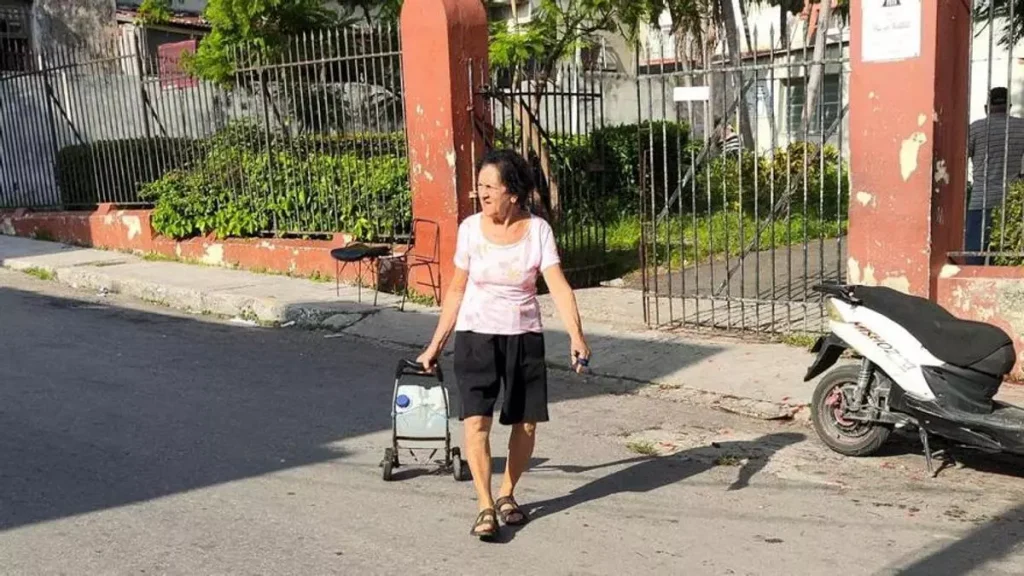
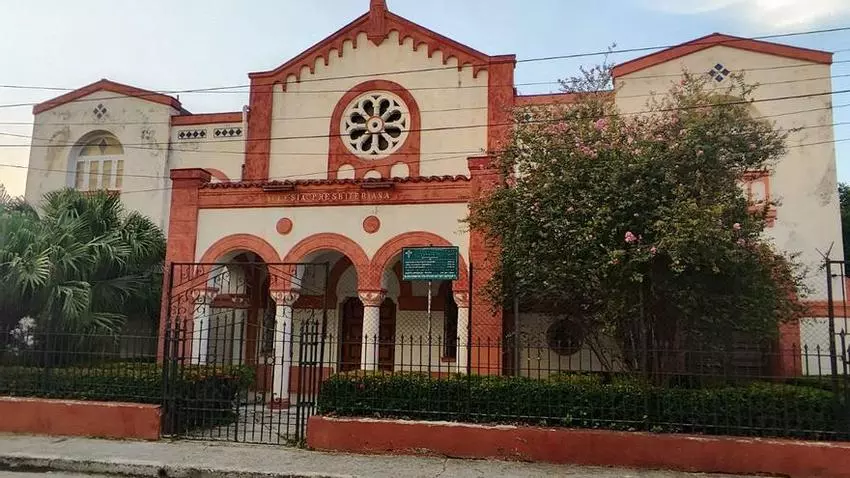
14ymedio bigger14ymedio, Juan Diego Rodríguez, Havana, August 13, 2024 — The line starts at seven in the morning, next to the Presbyterian temple on Reforma Street, between Santa Ana and Santa Felicia. The habaneros who get up early, however, do not come looking for the Lord – nor for the saints of both streets – but for the water that is dispensed in the church. More than blessed, it is “ozonized and purified,” and healing faculties that border on the miraculous are attributed to it.

Mercedes is one of the believers in the “properties” of ozone. “It’s good for everything, from parasites to bone problems,” she says, quoting her family doctor. For years, Mercedes has become – in her own words – an “ozone container.” She gets up early to go to the temple and guarantee “a few liters.” She drinks the water religiously and is unconditional about ozone therapy, which is available in almost any province of the Island.

“Ozone cures me of everything,” she says with fervor, like someone who invokes a healer or San Rafael, whom she does not deny either. For her, from the very Creole spell – a prayer to San Luis Beltrán for protection against the evil eye – to taping a ribbon around her waist to cure indigestion, “everything is natural medicine,” she explains, before finding her place in the line on Reforma Street.

The Presbyterian Church on Reforma Street, between Santa Ana and Santa Felicia, where water is dispensed / 14ymedio

The morning shadow of the temple does not calm the spirits. A line is a line, and when Mercedes asks* who is last in line there is already an argument in full swing. An old man, who is carrying his wheelbarrow with several gallons, shouts and waves his arms to scare away a line-breaker : “I was there before you and so was he,” he exclaims, pointing to a fellow waiter. “There are some shameless people,” he grumbles, when the intruder is already far away. continue reading

Mercedes is used to this kind of scene. In a precarious environment like Cuba’s, with almost no medicines available, the ozone water is gold. A glance at the line is enough to see the profile of most of the believers: elderly, sick, people in pain from various ailments, poor people.

Genaro, a colleague of Mercedes in the line, tells us about everything that ozone relieves: “back pain, blood pressure and circulatory problems, diabetes, asthma, and it also works on hernias.” The 67-year-old man, who goes to church armed with several so-called cucumbers – one and a half liter bottles – and a gallon, considers himself a “historical figure” when it comes to “Presbyterian water.”

For twelve or thirteen years, since the time he estimates that the service at the temple began, Genaro has been coming to get water. The fact that it is cleaner there and without strange particles, in a country where the water supply leaves much to be desired, is “medicinal” for him and his family.

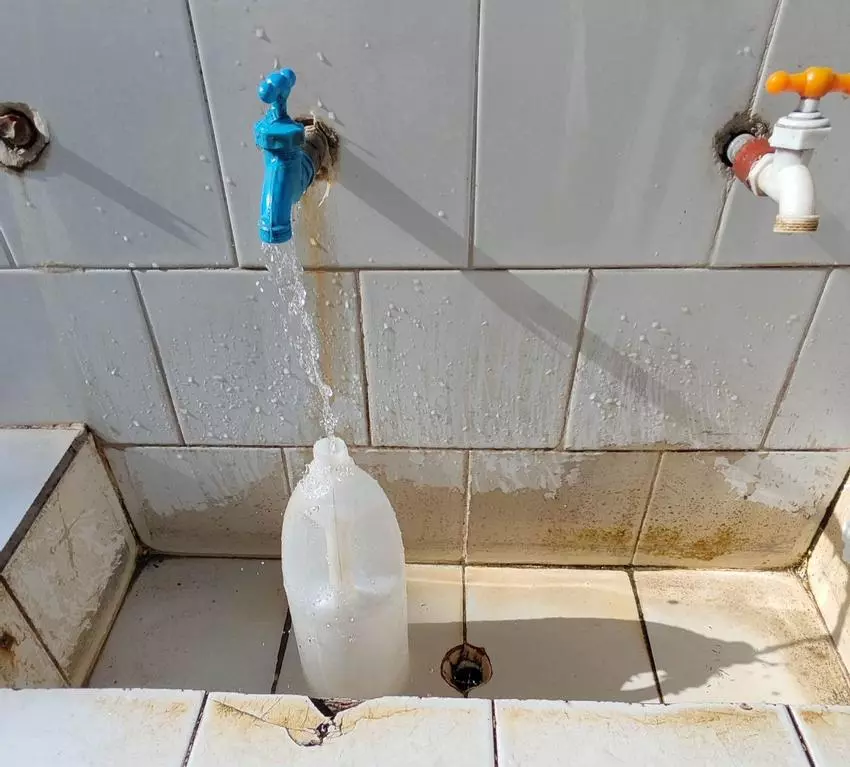
Usually, two people at a time approach the two plastic faucets that dispense the water / 14ymedio

The project of the Presbyterians – one of the Christian Churches that are on good terms with the Government, which lets it do this in exchange for its loyalty to the official Council of Churches – started thanks to American missionaries. The help “of the Americans” continues: they are the ones who, every year, come to repair and maintain the filters.

“The Americans built a cistern because there was a lot of demand,” Genaro explains. “They come every so often and look it over.”

None of the believers in line – neither Genaro or Mercedes – knows very well how the filtration and ozonization system works. The “apparatus,” as they call it, is safe inside the church facilities. No one is allowed to go in to see the equipment or loiter in the area where they keep it.

When there are too many people in line – the process gets slow sometimes, says Mercedes – they allow a group to fill their bottles from a faucet inside the church, but under strict surveillance. “It’s just that the residence is there, and they recently stole some sheets from the pastor,” Genaro confesses.

Usually, two people at a time approach the two plastic faucets that dispense the liquid, with all the calm in the world. The scene is repeated in many Cuban municipalities, where churches offer this service to help alleviate the hydrological debacle, one of many on the Island.

Taking three or four liters is free, although the Presbyterians now place a collection box next to the church, “to contribute a little.” There is a line until 11 in the morning, and then the “believers” return from three to four-thirty during the week and until six on Sundays.

“At the beginning of the project, people from the polyclinic came,” says Genaro. “They ruled that the water was perfect for consumption.” The old man alludes to the Ministry of Public Health as a global authority on ozone therapy issues, one of the alternative treatments that the Government has “expanded” the most – the term comes from the State newspaper Granma – throughout the globe.

Mercedes, for example, was referred to the Diez de Octubre hospital for a cycle of therapies. “First, a specialist, whether rheumatologist, ophthalmologist, etc., has to prescribe ozone therapy after an interview. You can’t have thyroid problems. Then they determine the frequency and method: there is rectal and paravertebral, that is, injections on both sides of the vertebrae,” the woman explains.

The doses increase. The initial is four weeks, every other day. Antioxidants must be removed during treatment. Suspend or eat less guava, tea, coffee, chocolate and fish. Your libido increases,” she explains mischievously, “your immune system improves, you eliminate parasites. You can immediately notice the improvement, although there are countries that do not accept it and say that it’s useless,” she says, before finishing with a fact: “Ozone is a very old project of the Revolution, and that’s why I have given it to myself all my life.”

Mercedes is not wrong. Not a month passes before the official press publishes one or two articles on the “results and horizons” of ozone therapy in Cuba, a treatment more than discussed by specialists around the world.

At the end of last year, Miguel Díaz-Canel himself was informed about the “positive impact” of the treatment. Its therapeutic use must be “mainstreamed,” the president then decreed, guaranteeing that its results “are proven.”

However, ozone therapy falls under the jurisdiction of the department of Natural and Traditional Medicine of the ministry, whose director – in that same meeting – had little to contribute, except for commonplaces and the fact that it is considered “preventive medicine” on the Island. There are 16 ozone therapy centers in the country, and a diploma is offered to study its effects.

The benefits that Cuban Public Health officially attributes to ozone are much more than Mercedes or Genaro imagine. Díaz-Canel was convinced that, with the treatment, fibromyalgia, chronic fatigue and diabetes can be faced; it rehabilitates those who have had aneurysms – no matter if it is heart or brain – and its rectal application “accelerated” the recovery of coronavirus patients in 2020. “We were very advanced,” the specialists congratulated themselves in front of Díaz-Canel.

The truth is that there is no scientific evidence that ozone – either in the “holy water,” by anal route or injected into the spine – has the high healing qualities attributed to it by the Public Health of the Island. Like the venom of blue scorpion, on which a dangerous pseudotherapeutic industry has been built, ozone therapy is one of the standards of regime medicine.

“Ozone therapy is not approved either by the European Medicines Agency or by the US Food and Drug Administration

“Ozone therapy is not approved by either the European Medicines Agency (EMA) or the US Food and Drug Administration (FDA),” Dr. Jerónimo Fernández Torrente, coordinator of the Observatory Against Pseudosciences of the Collegiate Medical Organization of Spain, clarified in 2018. “There is no credible scientific evidence that endorses the use of ozone as a type of medical therapy, much less for serious diseases such as cancer. In fact, medical reports and articles have been published on deaths of patients with this method.”

It is a “tremendous deception that we should denounce,” the doctor then said. “At the end of the day, ozone is a toxic gas; it is not harmless.”

These warnings do not discourage Genaro or Mercedes, who will return tomorrow to line up for the “holy water” of the Presbyterians. They follow the principle of Cuban domestic medicine to the letter: “What does not kill, fattens,” and – with their overflowing buckets and their immovable opinions – they continue to venerate San Ozono.

*Translator’s note: When Cubans join a line they ask “who’s last” and then, after the next person comes and they are now that person’s ’last’, they are free to wander around and can rejoin the line in ’their place’ at any time.

Translated by Regina Anavy

______________

COLLABORATE WITH OUR WORKThe 14ymedio team is committed to practicing serious journalism that reflects Cuba’s reality in all its depth. Thank you for joining us on this long journey. We invite you to continue supporting us by becoming a member of 14ymedio now. Together we can continue transforming journalism in Cuba.