The military conglomerate has also divested itself of the joint venture that managed the Miramar Business Center in Havana.
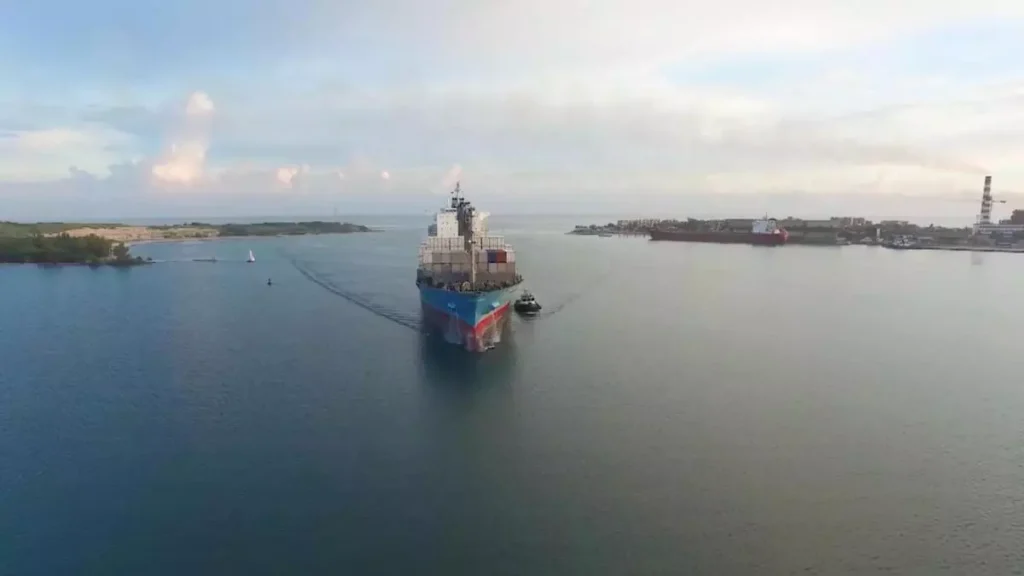
 14ymedio, Madrid, June 28, 2026 — Terminal de Contenedores Mariel S.A. (TCM), owned by the military conglomerate Gaesa and operator of Cuba’s main commercial port, has transferred its assets to Coral Marítima S.A., a state company attached to the Maritime-Port Business Group (Gemar), which falls under the Ministry of Transportation. The move aims to remove a key piece of Cuba’s foreign trade infrastructure from the reach of U.S. sanctions.
The operation was announced through a letter sent on June 25 to the terminal’s clients, a copy of which was obtained by 14ymedio. In the communication, the company states that “Terminal de Contenedores Mariel S.A. sold its assets to the Cuban commercial company Coral Marítima S.A., which established the subsidiary Terminales Portuarias CORAL S.A. to take over the business previously conducted by TC Mariel,” and specifies that the operation is “in the final stages of the corresponding legal procedures.”
The company indicates that the new corporation will assume contractual relationships with clients and that they will be invited to sign new contracts, “ensuring commercial continuity.” It also seeks to reassure customers by stating that “the terminal will continue operating fully throughout this process” and that daily activities will proceed “with complete normality, guaranteeing the execution of the services normally provided.”
The reorganization is a response to efforts to protect the operations of the Port of Mariel and prevent international companies from being exposed to sanctions
Coral Marítima S.A. develops investments and operations related to maritime transport and port activities. Unlike Terminal de Contenedores Mariel S.A., the company is not part of Gaesa’s corporate network. The reorganization is specifically intended to protect the commercial operations of the Port of Mariel and prevent international companies operating there from being exposed to U.S. sanctions.
Gaesa also recently divested itself of the joint venture that managed the Miramar Business Center in Havana. British investment fund CEIBA Investments Limited announced on June 5 that it had acquired 100% control of Inmobiliaria Monte Barreto S.A., which operates the Miramar Trade Center. Until then, the real estate company had been jointly owned with Cimex S.A., Gaesa’s largest commercial and financial conglomerate. Negotiations for the transaction began in 2017 and were finalized in April 2026.
The decree signed by Trump on May 1 expanded U.S. sanctions on trade with Cuba to include “any foreign person” operating in the sectors of “energy, defense and related materials, metals and mining, financial services, or the security of the Cuban economy, or any other sector of the Cuban economy.”
The consequences of the sanctions began to be felt just weeks after they took effect. Two of the world’s largest shipping companies, the French CMA CGM and Germany’s Hapag-Lloyd, suspended their services to Cuba in May. The decision paralyzed a significant portion of international cargo traffic and forced many operators to review or cancel contracts. The latest transfer appears intended to facilitate the resumption of operations by removing the terminal from Gaesa’s corporate structure.
“The situation in Cuba continues to deteriorate while the Island’s corrupt, brutal, and anti-American communist regime continues to prioritize its absolute control over freedom”
The U.S. sanctions package against the economic pillars of the Cuban regime has also prompted the withdrawal of foreign companies such as the Canadian mining firm Sherritt International and the Australian company Antilles Gold. The tourism sector also suffered a major blow with the departure of foreign hotel chains associated with Gaviota—the tourism group controlled by Gaesa—including Blue Diamond Resorts, Iberostar, Meliá, and Archipelago International.
The measures also affected Financiera Cimex S.A. (Fincimex), another Gaesa-affiliated entity, with the suspension of Visa and Mastercard operations on the Island. On June 11, the inclusion of the state-owned oil company Cupet on the list of sanctioned entities maintained by the Office of Foreign Assets Control (OFAC) derailed plans by Florida-based Vanguard Energy, which had hoped to complete one of the largest private fuel sales to Cuba in recent years.
On June 23, OFAC added five more Cuban companies belonging to the military conglomerate to its Specially Designated Nationals (SDN) List: Almacenes Universales S.A., Banco Financiero Internacional (BFI), Geominera S.A., Empresa Siderúrgica José Martí (Antillana de Acero), and Rafin S.A.
Secretary of State Marco Rubio then posted on X: “The situation in Cuba is devolving as the island’s corrupt, brutal and anti-American Communist regime continues to prioritize its own total control over the freedom, opportunity and basic wellbeing of the Cuban people.”
Translated by Regina Anavy
______________________
COLLABORATE WITH OUR WORK: The 14ymedio team is committed to practicing serious journalism that reflects Cuba’s reality in all its depth. Thank you for joining us on this long journey. We invite you to continue supporting us by becoming a member of 14ymedio now. Together we can continue transforming journalism in Cuba.