Two Amusing Statistics / Rebeca Monzo

My husband, who is also a blogger, likes to gather stories and compile statistics. On one of the many days I have to go to Immigration with the son of a friend, whom I am representing, he decided to take us since he had gotten a little gasoline for his new thirty-five year old Lada.

As the lines in that office are always endless and the clocks seem to have stopped, Fernando amused himself while waiting for us in the car by compiling two curious and impromptu statistics. In the three hours he was parked on a stretch of 17th Street in Vedado, he observed that one out of every three people who walked along the sidewalk on the left was a woman of mixed race.

At the same time he was compiling another statistic. Of the seven “buzos” (“divers” — men who collect recyclables from trash containers) who passed by, one caught his attention. After removing all the discarded items from a large dumpster designed for that purpose, he left empty-handed, mumbling to himself. Fernando, who was beginning to get bored, stopped him and asked what had happened to cause him to complain.

“The problem is that there is no trash to collect,” he said. “If people don’t have money, they don’t buy things, and if they don’t buy, they don’t have anything to throw out.”

My husband, who can be quite straightforward, then said to him, “If I were you, I would go through the trash bins in Siboney*. I am sure you will find what you are looking for there.”

*Translator’s note: A well-to-do suburban neighborhood of Havana.

November 23 2012

The Blue Card / Rebeca Monzo

There is not much that is new in the new immigration law. Nonetheless, it has raised expectations among a wide swath of the population: retirees, homemakers, students who have not gotten past the ninth grade, the unemployed and the elderly, to cite a few.

In one paragraph, the much-publicized law mentions that medical technicians are also subject to the burden of having to wait three years from the date of a passport request or the extension of an existing passport without regard for the time they have been out of the workforce. This measure not only discourages the prospects for travel, but—and to me this is the greater danger—it also discourages the desire of people to continue with their studies. Once they have completed the ninth grade, many abandon the classroom for good.

This has been going on for many years with respect to university careers. Many quit before graduating, or simply never begin their studies in the hope of being able to travel someday. The same thing is happening is less specialized fields of study. This is leading and will continue to lead to an even greater lowering of the country’s educational and technical standards, which have already been significantly eroded.

Logically speaking, it remains to be seen whether or not those fortunate enough to be granted a long-awaited passport will be approved for a visa by the countries they hope to visit. In this way the Cuban government, like Pontius Pilate, can wash its hands of the matter, placing the blame on others as usual.

Ladies and gentlemen, make no mistake. This new emigration law seems more like a new, more-sophisticated Mariel, but one that is organized and controlled by the state.

Translated by BW and Unstated

October 25 2012

Traveling on Astro on the Kaftro Route / Rebeca Monzo

About a month ago, my friend, Mariana, her husband and her mom decided to go on a trip to Trinity through a tourist bus company called Astro. They were very excited about the trip and expected it to go very well since they had paid 132.00 CUP (Cuban pesos) for each person both going and returning. They were anticipating a very comfortable ride with amenities such as air conditioning.

The first stop was at the Mulles de la Coubre. At this stop, which was not part of the schedule, five people got on the bus and paid the bus driver directly. However, all the seats in the bus were already full so the extra passengers were forced to accommodate themselves in the aisle of the bus. The luxurious image that they had envisioned had already been disrupted. They were not sitting in comfort, but were cramped in the bus unable to recline their chairs.

My friends also noted that the bus driver would stop to pick up anyone on the side of the road who offered him money, because of this the bus began to fill up little by little. In front of Mariana there was a woman who was holding a huge bag against her body and she had nowhere to move. As they were arriving at Aguada de Pasajeros, the bus driver recognized someone he knows. He starts yelling and signaling for the acquaintance to notice him almost throwing himself out of the window. All of the sudden, he hits the breaks, parks, and gets out of the car. He was there for about half an hour conversing with his friend, while the passengers waited patiently inside the bus. Then the bus driver returned and the journey continued until they stopped at a Terminal, where they were serving pork sandwiches without any attention to hygiene; there were flies and abandoned dogs peeing on the table where the merchandise was kept. All the passengers who desired this meal got down to satisfy their appetites. Trucks pulled by horses and trucks from the 1950s waited for possible clients.

Exhausted and tired and after traveling for five hours they finally arrived in Trindad. The three of them swore not to return through Astro and for that matter never again. After enjoying themselves for a couple of days in this colonial city, they had to negotiate their return trip to Havana through a taxi driver who had driven some people to Trinidad. They were able to bargain for a fair price under the table. Their ride back was much more enjoyable and peaceful.

Translated by: BC CASA

October 11 2012

“Smoke gets in your eyes” / Rebeca Monzo

Photo taken in the neighborhood of Vedado

I’m not referring to the beautiful song by David Kern, that is now an American classic, but to the terrible smoke of the fumigation that irritate the eyes and penetrate the nasal cavities, making it difficult to breathe; becoming in turn, the cause of so many diseases of the breathing passages that afflict many our citizens nowadays.

Every Tuesday they fumigate in my neighborhood. This makes the majority of the neighbors uncomfortable, but almost nobody refuses to let them pass by, still knowing full well that this doesn’t take care of the mosquito problem. I think that this attitude of the majority of people is induced by fear or laziness, because it doesn’t make sense to do this, and complain later, between those same neighbors, and not in front of the responsible authorities.

If this practice solved the epidemic disease, after so much time, it would have already been resolved. But it isn’t like that, every year we confront the same problem, except that it keeps increasing. This fumigation is already becoming the story of The Good Pipe*: endless! It is about filling your house with an unbearable smoke, a product of burning petroleum. It only serves to kill a few cockroaches and to leave the floors saturated with a slippery substance that becomes the cause of not just a few falls and broken bones by older people.

As long they don’t collect the garbage every day, clean the containers on the same schedule, periodically cut the grass in the yards and vacant lots, sweep and wash the streets, fix the potholes where the sewage water accumulates from the innumerable public and private leaks, and above all, eliminate the major causes: state farms located in major streets and avenues which causes these to always be covered with red soil, urban and suburban agriculture, which in itself attracts flies, mosquitoes and rodents, as well as the waste open to the weather, which these inadequate facilities generate. Until this is not eliminated, no progress can be achieved in combating dengue. The number of years they have been spraying without any positive result is overwhelming evidence of this.

Yet, the private fields are clean and so is the merchandise they offer, too. This possibly is due to the fact that it is the private sector where they demand and apply all the norms, penalties and fines. Why not to the State sector, who should be setting the example?

In terms of household fumigation, the process is too negative and annoying, to the point of threatening those who cannot let the bad mannered fumigators — who interrupt whenever they want and make rude demands — into their homes for medical reasons.

*Translator’s note: “The Good Pipe” is what in English is often known as a “shaggy dog story” — a joke that goes on and on and on and on…

Translated in part by: Derek Gonzalez, Jose Mas, and Oscar Sanz

September 26 2012

Requiem for Oswaldo Payá / Rebeca Monzo

Yesterday, around for in the afternoon, the coffin with the body of Oswaldo Payá arrived at the Chapel of the Savior of the World Parish, on Peñón street in the municipality of Cerro, after having completed the formalities of forensic medicine.

The old 19th century church, recently restores, was literally packed. Some of those attending remained outside because there was no room inside, despite the many extra chairs arranged for.

On its arrival the coffin, blessed before entering the sacred enclosure, was greeted with chants which accompanied it until it was placed before the altar. Then the crowd erupted in loud applause, which continued for about ten minutes.

Family, friends and many of those present stayed to keep a vigil over him and wait for the mass to be celebrated at 8:00 in the evening, dedicated to Oswaldo Payá, a person much loved by his community.

This morning Cardinal Jaime Ortega celebrated mass in the parish in memory of Payá, praising the magnitude of his qualities as a human being, religious person, and civic citizen.

The procession left the church accompanied by a large number of religious, laypeople, friends, acquaintances, and admirers of the deceased, as well as the foreign press and a good representation of the diplomatic corps, as well as excited and curious people.

Just after half past ten the hearse arrived at Colón Cemetery, followed by private, diplomatic and rental cars, their occupants descending from them, to join the large group of us who had been waiting there since the early morning hours, forming a crowd that was over a thousand people. All walked quietly behind the car, to the chapel where there was a prayer for the dead and another blessing.

Talking with some friends who had been at the Mass at Cerro, I learned that on leaving towards the avenue, there were some shouts of Freedom, Freedom, and according to what I was told there was pushing and some shoving and arrests were made including of Antonio Rodiles and his wife and Coco Fariñas.

For the rest, the whole ceremony and internment was accompanied by religious chants, moments of silence, a lot of sun, a lot of heat, and a lot of respect for the deceased. In all, some eight hundred of us stayed until the end of the ceremony.

State security agents with their Suzuki bikes stood idly by, under the shade of the laurels. Others moved among us. Everything transpired in apparent peace and normality.

July 24 2012

Cellular Telephony "a la Cubana" / Rebeca Monzo

“+0000000000 Today 6:48

From mobile phones compradetodo.com (buyeverything.com)

Call as soon as possible to 07 2043145

For recharge of minutes balance via Internet,

If you do not call back today the charge will be returned

to the purchaser.

In case of fraud, the line will be cancelled.”

As soon as I saw this same message twice, I called the number in question and the voice of the woman who took care of me repeated that I had received a recharge. I asked for how much, as I was not expecting one, and she did not want to say.

Thereupon she asked my name, the number of my identification card, my cell phone number and the address of my house. I gave her all these facts believing that they were necessary and she immediately asked me the name of the person who was doing the recharge. I asked her if this was an interrogation, to which, a bit irritated, she responded that she had only asked three questions. Since she insisted on the name of the possible benefactor, I answered that it could be one of my two sons or my aunt. Then she told me: “say a man’s name”. I mentioned those of my sons and she said: “Those are not it… (This reply means that she knows the name)… when you know the name, call us. In the meantime, your recharge will be here. Have no fear”. The message in question has been repeated, as of now, five times.

This whole conversation, as well as its very tone, at first appeared to me to be in jest and immediately thereafter, a lack of respect and even a violation of the client’s right to privacy.

I state this so that anyone who might generously recharge my telephone, be they family or friend, may know just how tightly our telephony is controlled. This appears to be a new “Service to the client” of the Cubacel Enterprise.

Translated by: Maria Montoto

June 28 2012

Site manager’s note: If you recharge the bloggers’ cellphones (a WONDERFUL thing to do) it’s a good idea to send them an email with whatever name you used when you recharged it and the amount… otherwise it may not always be credited to them. If there’s no email on their Spanish blogs … email us (translatingcuba … at… gmail…) and we’ll try to get in touch with them. I will also put this information and the emails we have for the bloggers on the “How to Recharge Bloggers’ Phones” page.

The Sweet Blue Bird of Immediacy / Rebeca Monzo

José Luis Antúnez, Yoani Sánchez, Antonio Rodiles
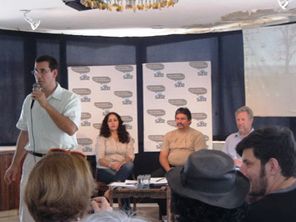
Sprinkled with enthusiasm and soaked in technology, from early this morning, despite the inclement weather, bloggers, alternative journalists, twitterers, as well as the usual comrades from State Security who don’t come inside but who watch over us from the sidewalk in front and both corners, we arrived at the familiar site of Estado de Sats. This three-day festival is sponsored by Estado de Sats, the Blogger Academy, and EBE of Spain.

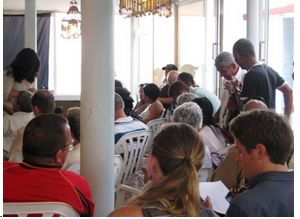
With wide coverage by the international press: the BBC from London, Reuters and AP, the main room and the surrounding areas were packed with an audience that came from different provinces, despite the well-known transportation problems made worse by the weather. Starting at 9:00 in the morning, the presentation and detailing of the program: Background on similar events in Cuba and other countries, as well as the multimedia presentation by Mr. José Luis Antúnez (EBE).

Eliécer Ávila, Yoani Sánchez, Rebeca Monzo, Mario Barroso
Then, with a brief presentation by each of the members of the first panel, Yoani Sánchez, Eliécer Avila, Pastor Mario Barroso and myself, where each of us told of our experiences using Twitter, the challenges of brevity and the immediacy of the message, and how the use of this tool has influenced our lives.

At 1:30 in the middle of the day there was a break to raid the fridge, take group photos and have a short rest.

Right now the discussion is about a future bill of rights for Cuban internauts and the panel includes lawyers and the blogger Regina Coyula. They are also addressing the theme of digital publications in Cuba today, with regards to scope and limits.

Tomorrow, June 22, at the same time, the Festival will continue, and at 8:30 in the evening the BBC documentary “How Did Facebook Change the Arab World?” will be shown.

June 21 2012

The Neighborhood Tough Guy / Rebeca Monzo

He was known as tall, dark and handsome and he boasted of it and of the “power” which he had enjoyed for a long time, not so much in his own right, but by that which the powerful godfathers would make possible.

Always dressed in camouflage and carrying a rifle on his shoulder, even during the Special Period, he got out of his jeep and unloaded the game he had obtained that day: a deer, partridges, and some other unfortunate animal that fell under the fire authorized by his weapon. He never shared his booty with a neighbor, for he was enemies with all. At the slightest disturbance created by any neighbor, he would leave his apartment in the worst of all his handsome stances and brandish his fist, without considering the consequences of fighting over the disturbance. This earned him the nickname Marshall Bigdick.

Once, he badly beat up a young doctor who was trying to calm the cries of the baby in his arms, which became the trigger that made bad mood of the handsome hunk explode. They were taken to a police station and the assailant only remained a few hours in detention, because his powerful backers immediately went to release him. His victim was admitted to the hospital as a result of the beating, but then had to swap housing due to the constant threats from the thug and the impunity with which he acted.

After the passage of several years and various other incidents, the abuser is now a man of a certain age. His reputation has faded now that two of his godfathers have died, and although one is still alive, he is by now quite old.

No more than three days ago the guy had the nerve to barge into the home of his next door neighbor, accompanied by two workers from the gas company, under the pretext that there was a leak in her house.

The husband of the owner blocked his way, saying that, without proper authorization, he could not enter their house, much less excavate in their garden. He pushed the husband aside and ordered the men to begin work.

Summoning strength from who knows where (as I was later told), the wife of the assaulted man grabbed the guy by his shirt, pushed him against the wall and slapped him around a couple of times. She is a quite small and delicate woman. As a result the police showed up, after receiving a call from another neighbor, and took everyone to the police station.

The thug was fined for breaking and entering, and a restraining order was placed against him.

After learning the details of the dispute, the entire neighborhood has new respect and admiration for this fragile woman, who was able to stand up to the handsome guy in a way no man had, up to that point, ever dared to do, possibly more out of fear of his godfathers than of him.

Any similarity with actual persons, living or dead, is not, I assure you, purely coincidental.

Translated by: Rafael Gómez and Anonymous

June 13 2012

Violence / Rebeca Monzo

Patchwork by R. Monzo

Much is publicized, even by the United Nations, about Cuba being one of the countries where less violence exists. It is true that we do not have wars or drug trafficking. But what is undeniable, in spite of the fact that the national press does not speak of it, is the domestic violence, like other kinds of violence carried out, due to many reasons.

Recently there occurred a lamentably bloody event, among members of a sector that is supposed to be cultured and refined. The media have not reported anything about it, but now it is popular knowledge, the crime perpetrated by one of the most outstanding musicians of the Philharmonic Orchestra, a young cellist,ranked among the best in the country.

Rumor has it that she had been a victim, like so many other musicians of the despotism with which the Director General of the Amadeo Roldan Complex,Mr. Chorens used to treat them. It seems that the straw that broke the camel’s back was the denial of a trip abroad,highly anticipated by this virtuoso of strings. Expressing her indignation on learning of the refusal, she made public among his companions, the vengeance that he was going to perpetrate: I am going to hurt him where it hurts most, she said.

She went to the house of the Director, knowing that the director’s mother would be there alone, and finished her off with a blade, repeatedly stabbing her until she died.

This is only one example of the many acts of violence that are practiced daily in our country, and about which the media never report.

There is a lot of contained hatred and frustration, any incident can be the trigger to make them explode with the same fury as a volcano expelling the lava contained in its interior. No one talks about it. The worst is that like everything kept hidden, no one is careful, especially not foreigners, who are sold the line about the safest tourist destination.

As long as the press is not free and transparent, we are going to be believe that we are living in a true paradise. I do not like the “police blotter,” but I also do not agree with hiding the news, that one way or another affects us all. Nor am I going to become a spokesman for the same, but this event has upset the artistic sector and still nothing has been published about it.

Translated by mlk

June 10 2012

From the 19th Floor / Rebeca Monzo

Last Monday I managed to get off unscathed and in one piece from a Route 27 bus, between stops, at 17th and D, thanks to the kindness of the driver, who decided to give me a chance, opening the doors of the bus there.

I took F Street and headed toward Linea. With horror I could observe how destroyed the area is and the number of improvised shacks there, in what in other times used to be the garages and front porches of the old family residences, displaying without the slightest embarrassment architectural cellulite and scoliosis, diseases which almost all new buildings or renovations suffer today. Unfortunately, that day I had not brought my camera, which I had left at home charging. The heat was exhausting and the sweat rolled down my eyelashes, causing me to glimpse as through a veil all those architectural horrors that I was walking toward.

When I finally reached Linea Street, which shimmered like the desert because of the intense sun, I thought I was hallucinating when I saw in the middle of the sidewalk a huge Santa Claus in plain month of June. At first I thought it was a performance, because we are still in Biennial, but there was no audience. As I approached, I saw that it was an advertising gimmick of an unsuccessful street vendor, to attract attention.

Finally I reached the large building where the friend I was going to visit lives. As usual, the main elevator was out of service, leaving only the freight elevator running. Both are ancient Otises from the fifties. I got into this thing alone, which I don’t like to do, and pushed the button for the 19th floor. All was going fine until it stopped on the 10th floor, to pick up a young woman with a little girl about two years old. She punched 13 and, having barely risen one floor, we became stuck between 11th and 12th.

Never before had I been trapped in an elevator, although many times I had thought that it could happen to me. I kept calm, following the example of serenity and peace that the little girl gave us. I knew that the presence of that little angel would bring us luck. I gave my cell phone (which happened to be charged) to the young woman, so she could call the manager, because she lives in that building, and knows its intricacies. Immediately we heard the voices of those coming to our rescue. We put on the emergency (break) and got to work, listening to the instructions that came from outside, to find the famous lever and the black button that had to be pushed, so that they could open from the outside. As soon as we accomplished that, they opened the door to that floor and we saw that indeed we had stopped between two floors. Thanks to the fact that the small window in the door was broken, a little air came in to us.

Naturally, they got the little girl out first. The young woman jumped and almost fractured her ankle in the fall. I, who suffer from vertigo, looked sideways at the dark hollow of two quarters or so wide that was lost in the void and told myself: “Don’t look down, you have to get out.” Any which way, since all residents of the building have been putting up iron gates to protect themselves, adding an uncalculated weight to the property, taking advantage of this architectural error, stretching first my arms and then my legs, I grabbed the bars of the door to the apartment closest to me, like a spider, to get out and let myself fall onto the landing of the service stairwell, to the applause of all who were watching the maneuver.

Fortunately, there was a happy ending. But once I had calmed down, from the 19th floor, observing the beautiful view, I started thinking that with all the gates that all of the neighbors have added around the exits from the elevators, the day there is a fire it will be very difficult to evacuate them.

Translated by: Maria Montoto and others

June 6 2012

Murmurs / Rebeca Monzo

For some months now, they have spread like gun powder throughout the city: rumors about embezzlement, theft, deviation of resources, practices of nepotism, etcetera.

Old Havana has generated the most commentaries these days. The director of Puerto Carenas, the great construction enterprise dealing with the restoration of all the real estate in the historic center and some other buildings and monuments outside this area, is presently being investigated, according to commentary, for crimes against the economy of the State.

In other news, the La Muralla brewery, the recently appointed administrator is being detained under investigation after having had a field planted with marijuana confiscated, in the providence of Pinar del Rio. This caused the spread of the investigation to encompass the business he was administrating up to this time, situated at Muralla and San Ignacio, where other crimes on his behalf were discovered in which some of his workers were implicated, the latter of whom are also subject to investigation. Some are being detained and others are in waiting under house arrest (what we Cubans like to call “the pajama plan” — though only when it is the ’cushy’ version that is applied to high officials).

The Planetarium at the Plaza Vieja (Old Plaza) has also been investigated, due to police reports that these facilities were being offered for functions outside operating hours and administrative control, and whose dividends were ending up directly in the pockets of those implicated. There also exist strong rumors of nepotism practices on behalf of the directorship of Habaguanex. This not taking into account existing rumors as to the sale of job positions within these entities, which oscillate between $1,000 CUC and $1,500 CUC, depending on the type of job.

These rumors give much food for thought. Might it truly be as is being rumored? If so, how is it possible this has not reached the ears of the primary directors of said enterprises, when it is already public knowledge?

But sadly, this is not the only place where such criminal activity occurs. Recently on national television they showed images demonstrating the goods that were illicitly acquired by the administrator of the jam factory in the province of Matanzas; he was dismissed upon proof of illicit enrichment and deviation of resources. The president of the Havana Yoruba Society (Sociedad Yoruba de la Habana) also fell into disgrace, as we say here, for utilizing the influences inherent to his post, in order to secure trips and visas at a price of $3,000 CUC, for those privileged who were able to pay.

Apparently crime and corruption are spreading like a pandemic. It is truly very sad, even more so when, for more than 50 years, we have been hearing talk of the New Man, of revolutionary honor, of our militant Gentlemen, here on my planet, in order to occupy the post of director or administrator of an entity, you at least have to be a militant of the party and, in some cases, a member of State security.

These are the effects, those which regularly come under fire, but what of the causes? What truly are they?

A totalitarian State that monopolizes the administration of all large businesses, that pays miserable salaries, that maintains a dual currency: one with which you are paid for your work and retirement and another, that you need to acquire however you can, and with which one acquires at very high prices, all the articles of primary necessity; do you sincerely believe it can take the luxury of having, in those high positions of directorship, honest and incorruptible men? Who taught them to steal?

Everything here exposed are confidentialities and rumors that have reached me, and that have filtered drop by drop. I don’t have all of the information, that here is almost impossible, but I recall an old saying: “Cuando el río suena, es porque piedras trae.” (Literally: “When the river sounds, it’s because it’s carrying rocks.” Loosely translated: “If you hear rumors, there must be some truth to them.”)

Translated by: Maria Montoto

May 29 2012

The Loss of Self Esteem / Rebeca Monzo

Some days ago I read in the international press a story entitled Serving, not servile, by the journalist from Juventude Rebelde (Rebel Youth), Jose Alejandro Rodriguez, where he laments the tendency of Cubans to appear servile to foreigners. In one of his paragraphs he said and I quote:

Neither can it be forgotten, in order not to repeat it, that certain public institutions have well matched this neo-servile tendency when in a political double standard they demand certain attributes and guidelines of a Cuban in order to access not a few sites, in contrast with the permissive submission with which they treats the foreigner.

If the Cuban were to travel more he would be able to see more and value more, by contrast, the good things of his country,” he continues in another paragraph.

If there is a guilty party in all this deformation of the Cuban, it is due principally to the government which, during the last half century, has treated its own people like third class citizens. At first they enclosed us on this little island, without permitting us to have contact with the outside: that lasted several decades.

The only valid references were the Cuban dailies and some Soviet magazines. We who worked were prohibited from writing to our family or friends in capitalist countries, above all in Europe, on pain of losing our jobs. Remember that the State was the only employer. Likewise, particular trips were prohibited or extremely restricted.

All this served to intensify the material misery and therefore morale. A feeling of distress began to grow because of not possessing the most urgent articles, which was transformed little by little into envy towards those who had access to them. The few trips to the outside were for the party militants or the youth with the most proven loyalty to the regime. Here it began to get worse and to develop the double standard.

One had to pretend and pretend well in order to be deserving of the trust and, therefore, of the little trip that would permit us to breathe a little and to be able to bring shoes and clothes to our relatives, and in a plastic bag the little food that the airplane let us ingest, so that the child at home or the old one could enjoy it. Economizing to the max on food, although that would involve hunger, in order to return to the fatherland with a little money, plus the little soaps gathered in the hotels.

With the economic crisis at the beginning of the 1980’s and the lack of tourism, flights from the Comunidad — Cubans abroad — were authorized. Those countrymen of ours who were denounced in meetings when they expressed the desire to leave, these same ones who were insulted and told never come back, now as if by magic would be converted from “worms” (the epithet that had been screamed at them), to butterflies and would come to save the country’s weak economy and to fill a little the empty bellies of the relatives and even some of the neighbors of those who had been insulted.

I have here other manifestations of the double standard: lying to keep a job,lying to earn a little trip,lying to be able to enjoy a reunion with family and friends and lying to try to contain proportionate happiness, at least publicly.

Now, many years have passed, the Special Period that started at the beginning of the 1990’s does not seem to have ended. Because of that, as soon as tourism began to increase, the siege of the visitors increased at the same time. The bid to see who is the most favored has made many men, women and even children seem like street clowns, trying to win over the foreigner, which is likewise a cunning way of begging.

One must not blame only the suffering people; one must consider the circumstances that have surrounded all this moral deterioration. When a society loses its civility, loses the family and all its values, anything can be expected from it.

Cuban pride is very battered. That national feeling that we used to have, that made us walk with our heads held high and treat others correctly, without difference, including the tourists, without having to lower our s ingratiate ourselves, we have been losing it almost without noticing.

The daily urgencies and the lack of good education, have made us underrate ourselves. I remember when I was a girl, for us a tourist was more ordinary. The only thing that sometimes made us turn our faces towards them was the bright attire that they wore.

As far as the flower vendors of Old Havana, I believe that the costume is excessive or unnecessary. It seems when one walks through the restored streets in that part of the city that one is moving on a movie set. This is too much for me, just like the flattery and mollycoddling that they dispense to the tourists provided that they buy the merchandise that they offer. It would seem that in the whole colonial zone, they were the estates of the big movie companies.

Translated by mlk

May 12 2012

What Unity Are They Talking About? / Rebeca Monzo

In my world the media spends its time talking about the unity of the people, of a single party (like that of Marti), a united vote, and so forth.

First of all, I want to clarify, that the widely used term one-party (referring to what the Apostle — Marti — founded) is a huge fallacy. It was Marti, of course, who created a party to unite Cubans who wanted independence for the island, that was the goal. Why would anyone create more than one? Once the war was over, the party was dissolved and others created, according to the different trends and opinions, as expected, in a system that proclaimed freedom and democracy.

As long as they cluck unity of the people, gentlemen, let me express my humble opinion, never before was this town so divided, or better said, did it behave so individualistically. The first thing the revolution did wasdivide us: pitting parents and children against each other and vice versa; breaking marriages of many years because of political contradictions never previously considered; confronting the neighbors who quickly learned, induced by fear, to keep an eye on and monitor each other. In two words: increased envy and pettiness and hence the division. This is just the Cuba that they do not show the guests of government, including of course the Pope.

For many years we can see in our cities multifamily buildings with the paint peeling and faded by time and neglect, where suddenly, we find a balcony, as well as a small perimeter encompassing the same, of a different color, shiny and gleaming, which further underlines the ugliness and the peeling of the rest of the building, showing publicly the lack of sensitivity and solidarity, as well as the bad taste of the occupants of the apartment in question.

This indicates not only differences in purchasing power, but poor communication between neighbors, not surprisingly, most do not have sufficient resources to take on the cost of painting the entire building, and evidently are unable to reach agreement.The government, during this half century, has only shown indifference to the deterioration and structural damage.Most citizens do not have the resources to improve their own homes.In these cases, the sensible thing would be to leave the outside of the building without paint, or to give it a clear whitewash type coating, in neutral tones so it does not stand out so much from the rest of the facade.

Also, walking the streets, we find round columns that separate townhouses, and these are divided in half, as indicated by a rule, and each half is a different color according to who owns the piece.But more often seen in the old buildings and mansions, which have been divided now into “solares” — a rabbit warren of small, often single room, dwellings — is the profusion of water pumps installed by the different occupants, each one his own, instead of collecting money from everyone to buy a more powerful one.

The same is true with makeshift water tanks on roofs and inside the apartments themselves, adding to the property, with all the dangers that this entails, a weight was not calculated either by architects or engineers involved in its construction.This is another of the possible causes of partial or total collapses, which occur almost daily in this city.

After carefully observing this citizen practice of saving what you can, verifying the accusations among neighbors and the thefts and the audacity to resolve their everyday problems, can anyone with half a brain believe in the vaunted unity that the media so exalts?

Translated by: Jeannina Perez

April 3 2012

There Will Always be a Plan B / Rebeca Monzo

A little over two years, I decided to write and express my opinions freely, I opened a weblog (blog), knowing, as I have stated on previous occasions, that this could bring me many difficulties. Then as now I accept it.

I had the alternative of doing it anonymously, or openly with my photo, my name and my two surnames. I decided on the latter option, because it seemed to me the more civic. This does not mean I’m criticizing in any way those who have taken the step under a pseudonym. It is well-known that there is a single employer in my country, and people who have opted for the latter see the need to do so, because their work is their only support. I, fortunately, am involved in the art world, and this has been my way of life for many years.

Everything moved forward with apparent tranquility, and so far no one had interfered in my life. As is public knowledge, the inhabitants of my planet don’t have Internet and we have to avail ourselves of subterfuge, and especially very good friends, to be able to put our posts on the net.

Everything was in apparent tranquility, and so far no one had interfered in my life. As is public knowledge, the people of my planet we do not have Internet and we have to avail ourselves of subterfuge and above all very good friends, in order to place our posts on the net.

On the site where usually sent them everything seemed normal, but when I checked my blog, I noted with regret that what I thought was published was not. At first glance I thought it might be a technical failure on my part, since I am no expert in these matters, but on starting to investigate I came to some conclusions, and realized that I hadn’t made any errors, but simply someone had been given the task of interfering in my publications.

I feel truly sorry for the people who lend themselves to this. History is passing them by and they’re not paying attention. What explanation can they some day give their children, for having been paid to undertake such petty things? They are wasting the opportunity to stand up as citizens and assume a civic posture, which would require, for them and for others, the inevitable right to speak up and express themselves freely, as befits any human being who respects himself.

Don’t worry, however much they try to harass and silence our voices, there is always a plan B, that we can undertake so that they can not be silenced.

I repeat my thanks to all those friends, from whatever part of the world, who don’t just read up but who also help us so that our opinions continue to emerge into the public light.

March 15 2012

Cultural Exchange / Rebeca Monzo

Last Saturday* in Estado de Sats the theme was cultural interchange between the island and the rest of the world, and specifically with the United States.

The panel was composed of: Miriam Celaya, Julio Ariaga, Charles Barclay, assistant chief of the United States Interest Section, and as moderator, Antonio Rodiles. Alexis Jardines was unable to attend but sent a video from abroad, that was screened before starting the debate.

As is usual in these convocations, the house had a good audience.

The most contentious issue was precisely why the cultural exchange produces so much more from our side over there, then from them to us. Especially if you consider that those who come through these exchanges are, in the vast majority, American intellectuals or artists, not Cuban-Americans as we would hope, because those are the ones who can tell us first hand about their experiences in exile.

Why can Silvio go to sing in the U.S. and Willy Chirino can’t come here and do it in the land of his birth. This topic was discussed very well by Alexis Jardines, who also expressed very sharply, “Without money you can’t be an (official) revolutionary or an opponent.

Notable among the comments from the public present was that of Dr. Jeovany Jimenez, a doctor from Artemisa and author of the blog Citizen Zero, whom the government barred from the practice of medicine, for being an opponent. Right now he is on a hunger strike in Guanajay Park, demanding they return to him the right to practice medicine. Also notable was the absence of “official people”– who were invited.

The cool morning passed peacefully, despite the refreshment that the host would have liked to give the people present was apparently “sabotaged” because the empanadas that he sent for to be enjoyed with the now classic tea, were acquired by “someone” who arrived to pick them up ahead of time [supposedly on behalf of Estado de Sats], and who even paid $100 more than their total cost to the lady that makes them.

At the end of the event, on leaving the residence, some of those attending were intercepted by security agents, who were prowling around the place, right there in the street, but there were no arrests.

*Translator’s note: Rebeca’s text says Friday, but in fact the event was on Saturday.

March 7 2012