Afraid of Change / Rebeca Monzo

In close circles of friends there has been a lot of conversation recently about the slow, almost imperceptible changes announced by the government. What is certainly clear is that soto voce, almost secretly, there is some perceived movement — a hint that “something is up” — out of view, as usual, of the public.

The government is experiencing a never-before-seen crisis. The Cuban economy is virtually non-existent. The country produces no wealth and the hope placed in the government of neighboring Venezuela is fading away along with Chavism, like a mirage in the middle of the desert just as one is about to die of thirst. Our only options lie in the north, not the south.

Are we ready for change? Not as I see it. As an uninformed and isolated people we have waited for solutions to come “from outside.” Many people, perhaps a majority, fear the unknown. On the other hand the daily struggle to survive leaves almost no opportunity for analytical thought.

During the last fifty-four years they have been scaring us with the threat of “the enemy in front.” It is an invention used by the government to paralyze private initiative. It is an attempt to make us complacent—into a people without expectations, always searching for food, blaming all our problems on the so-called blockade, which is itself is clearly on a path to extinction also.

Now that there is a subtle hint that “something is up” with the neighbor in front, instead of being happy, many are terrified and even believe that this is going to turn into a “move out of the way; I’m moving in”* situation. We should never have allowed ourselves be manipulated to such a great extent when in reality the United States has always been our natural market.

A neighbor, whom I consider to be a wonderful person, told me that what he really fears is “what will become of us, the opposition, when it happens.”

We will keep writing, I told him, pointing out what is wrong, come what may. Then our inventiveness and creativity will be given free reign. At the very least we will have equal opportunity. We will regain our freedom as individuals and with it our free will.

An architect, for whom I have great appreciation, shared with me her concerns about the changes. “Those of us who stayed behind and put up with everything are not even going to have a penny in our pockets, while those from over there are going to come in with money to invest,” she said.

“Look,” I told her, “we are the ones who are to blame for accepting everything without complaint. And when it comes to those who are going to come here with money, I do not mind at all; quite the opposite, I am glad. Besides, many of those who are coming to invest their capital are Cubans, or their descendants, from whom the government stripped everything away, and who recovered economically with their sacrifice, intelligence or good luck. That will be good for everyone.”

I believe that now is the time to smooth over political differences and be pragmatic. In many cases this will mean having to “pick ourselves up” and start over without bitterness. To forgive but not to forget, letting the appropriate authorities pass judgement on criminal cases perpetrated against human dignity, which must not go unpunished. Apart from that, we must try to contribute our own grain of sand in the rebuilding of our country and putting it on the path of development in the XXI century.

*Translator’s note: In the original Spanish this is, Quítate tú para ponerme yo, a Cuban expression and title of a popular song.

27 June 2013

Coca-Cola Here / Rebeca Monzo

A few years ago, passing by with my friend in her car, I suddenly saw out the window, in the middle of some trash, something red that caught my attention.

“Stop! Stop!” I told her.

She, ignoring my “almost order,” pulled to the curb and stopped.

I quickly got out of the car and went to the place where the neighbors had inappropriately accumulated right on the parking strip a mountain of trash. Standing out from among the rubble I saw an old metal sign printed with the fire of Coca-Cola. I took it out of the trash and put it in the trunk of the car.

When we got home, I washed it off and saw that in one corner it said, “Made in Canada 1950.” With the notice displayed on both sides, I imagined it had belonged to one of the thousands of bodegas throughout the city, hung on the corner so it could be seen from both sides. Without hesitating, I put it on my terrace overlooking the street, in the same way, to be seen from inside and outside. So it has remained since.

A few days ago, the street door open to enter the building, some kids came up and knocked on my door: “Lady, we want to buy a soda. You have a sign that says Coca Cola here at 5 cents.”

Look, I said to them, first I don’t sell sodas, but in addition, if I did sell Coca-Cola and at 5 cents, you would have to ask me if I had been medically certified, because for sure I would be crazy.

9 June 2013

Centers of Love Become Victims of Apathy / Rebeca Monzo

Colorful Butterflies kindergarten

“Today day care centers celebrate their fifty-second anniversary. These institutions continue fulfilling and improving their mission so that work in education might be more profound and efficient…”

So begins an article published in Juventud Rebelde on April 10 of this year. It goes on to provide a brief history of how the first such institutions began in our country in the early 1960s. It reminded me of how I first got involved in this work through the direct request from a friend.

For a year I did “volunteer work” by myself in a big space in which they provided me with abundant and varied material, making fabric dolls as well as various articles for the home. These would later be auctioned in a raffle which took place on property owned by the Ministry of Foreign Commerce. The goal was to raise funds for a day care center on the ninth floor of a building on 23rd Street where a lot of women worked.

Finally, a year later they were able to bring the project to fruition as a result of many important donations from companies who had entered into negotiations with the ministry as well as my own modest contribution. I also remember actively participating in the decoration of center’s facility.

What I noticed was how this article ignored some of the real reasons for the deterioration and subsequent closure of many of these centers, whose construction had been such a noble goal.

A couple of years ago I was having a conversation with the director of Colorful Butterflies, a kindergarten next door to my house which my two sons attended. I asked her about the visible neglect of the center, and she told me it was due to low enrollment. After reading the article in Juventud Rebelde, it occurred to me that this was perhaps one of many causes, the main one being the lack of resources provided to the these institutions in addition to neglect and lack of maintenance.

“At the moment there are 45,000 applications pending and 46 institutions in the country have been closed — 40 in the capital alone — all for construction problems.”

This is how it was stated in one of the paragraphs from the article in question. We should, therefore, hold the government responsible for the current state of these buildings, which were built in great haste and in excess by people who had no experience in this kind of work to fulfill the usual quotas, not to mention the failure to provide stable funding for their subsequent maintenance.

Additionally, the ever more apparent lack of personnel qualified to work with children has led parents to take their children to private homes which, until a very short time ago, functioned in a kind of clandestine limbo. There is an ever increasing number of self-employed workers who take up this work now that they have a license to do it.

In the face of the importance and magnitude of the problem, since families don’t have sufficient resources to leave their children in private day care, due to poor salaries and not possessing another type of stable source of income, the government has implemented a new type of plan: “Educate your child”, that is being developed in some communities, offering guidance to the family to stimulate and adequately look after the little one, with the objective of achieving integral development and preparation for the start of the child’s school life.  We hope that this plan, like many other before it, will not languish on the road. Ladies and Gentlemen, love must be attended to!

Translated by: Unknown, BW

22 April 2013

Giron or Bay of Pigs: The Same Pain

A couple of years ago I wrote about an event I learned of from someone very close to and emotionally attached to it, about how two Cubans who had fought on opposite sides at the Bay of Pigs, this sad military conflict between brothers, with the passing of time had reunited outside our territory, one as a member of Brigade 2506. and the other as a pilot at Playa Girón, as the event is called in Cuba.  By then both of them were exiles.

These two Cubans melted in a forgiving embrace in Miami and one of them, years later, died in the arms of the other. This is the reason that I decided to re-post fragments of this story because I find it so touching. Some of the offspring of both protagonists live now in Florida.

“One night, during one of the usual occasions when they would get together, as they were all seated at the table having a delicious Creole meal, the pilot became ill and excused himself to go to the bathroom.  A few minutes later, the host ran to the bathroom after hearing a noise.  When he got there, the pilot was on the floor. He gently held the pilot in his arms and watched him die.”

All these events, with the passing of years and the frustrations suffered by each other, have made us reflect about how much we were manipulated and how much history has been distorted. For decades, they tried to “sow” in us a false sense of hatred and resentment, which even if it did exist at some point, was dissipated with our everyday lives, with the disenchantment, and especially with the sad experience of having fought for a “future” that never came, watching ourselves forced to separate from our families and friends, an issue that ultimately has been the most painful, in the balance of all that has happened.

“Many years had to go by, many confrontations, disagreements, misunderstandings and defamation campaigns, so that finally two Cubans who no one should have ever converted into enemies were united forever in an embrace.  Two twists of the same flag.”

Translator: Post quoted was translated by Hank.

17 April 2013

Travelling Without Money / Rebeca Monzo

clip_image002From the moment you know that one of the above mentioned wants to invite you, the Odyssey begins: expensive procedures, paperwork and disbursements, occasionally excessive (in relation to our country), insurance policy if you are travelling to Europe, the cost of the visa, etc. Anyway, all these procedures and payments have to be carried out in CUC, the hard currency, which is precisely not what your salary or pension is paid in. That’s without taking account of the fact that the ticket has to be paid for by the person inviting you.

Many people will say to you before you set off on your outbound trip: listen, when you are over there, take the opportunity and connect to the internet, and bring everything you can, because this is your first trip of the year and here you pay on entering in Cuban pesos.

What nobody tells you and what you have to be very clear about is that you can connect when your host lends you his computer, and that the excess baggage which is very expensive is paid for in the country where you board, not where you arrive. And believe me it would be too unfair to also charge this expense to your hosts’ account!

Generally speaking most of us travel with hardly even any change in our pocket, which can be very worrying. You can be sure that you are going to be waiting around at the airport because with what you’ve got you can’t afford a taxi, as well as the likelihood that any rascal, seeing your worried face, will try to take advantage of you.

Once you’ve got to your destination and having had the happiness of seeing faces you know waiting for you, you begin the other stage of your journey: accommodation. You need to accept your host’s arrangements with a smile on your lips, in order not to put him to more inconvenience or expense.

You will enjoy all the meals and outings which they have planned and you will offer infinite thanks for all the presents they give you, even if you don’t like them or they are not your size in terms of clothing, because you are also thinking at that moment of the friends you have left on your planet to whom you would like to take back something.

Among your excursions there will definitely be included a visit to a big shopping mall, and your eyes will pop when you see the great quantity and variety of things on sale. At that moment you will recognise how wretched you feel about not having the funds to pay for something you have needed or fancied for a long time. Try as hard as possible to resist a visit to IKEA because going there could give you a heart attack.

After enjoying yourself like a little kid who is given presents, you come to the moment when you have to go back to your real world. That’s when the big problem begins. maybe three days before your return date you will feel a stomach pain and will feel nervous or stressed thinking about how you are going to fit in the suitcase they have lent you all the things you have been given. You don’t have the money to pay for excess baggage, and it would be very painful to leave it

… because you need it to buy food on your return. At that moment your coat (if you took your trip in winter)

… which they have given you will be very heavy and you will have to wear it going back even though it’s hot.

Finally, when you arrive, you will suffer with a mixture of impatience and relief, the huge line you have to wait in order to get thru Cuban customs, something you have forgotten about, due to the speed with which you got thru in the other countries.

Some good neighbour will be waiting for you on your arrival, with the loaves of bread, which are entered in your ration book and which he has been good enough to keep for you.

Translated by GH

12 March 2013

ExpresArt in Freedom’s Twitter Contest Winners

The winners, who can choose between an iPad mini, a camera or a laptop as their prize, are:

Orlando Luis Pardo Lazo
My #Cuba2013 fits into the migratory poetry of daisy petals: Do I go or do I not? Do I go or do I not? Do I go or do I not? Do I go or…

Lia Villares
I want a collective conscience that wants to change things #ForAnotherCuba, all together!

The Honorable Mentions are:

Mario Félix Lleonart
#Cuba2013 will finally be the white rose of Marti @expresarte2013 #Cuba

Walfrido López
At this time #Ihaveadream recurs. In #Cuba2013it will be as #INTERNET: universal, free, open and neutral

Rebeca Monzó
#Cuba2013 My granddaughters come home from school and ask me: Grandma, who were the Castros?

30 January 2013, as reported by ExpresArt en Libertad

Cubans Throughout the World / Rebeca Monzo #Cuba

Upon arriving in this corner of France and reuniting with my family, whom I had not seen for seven years, I had the great pleasure of receiving a visit from the son of a very dear friend, whom I had first seen when he was born. Later on, as you might imagine, the subject of the far-off homeland came up, as well as the problems and frustrations that come with abandoning, almost against your will, the place where you were born. This is his case.

This Cuban is not resigned to remaining in forced exile. Life has played him some dirty tricks, so he is undocumented here. They cannot repatriate him, as he would like, because Cuban authorities repeatedly refuse him entry. The last time he was in Cuba, he remained in prison for four months for refusing to leave the country.

This man, who is still young, has two names and a head, so he never stops thinking about the misery to which his homeland is subjected. He has dedicated his free time — which unfortunately is all that he can do since he does not have papers and can work only sporadically — to investigating Cuban issues in-depth.

I was truly impressed when he showed me photos, articles and a wealth of details, to which we Cubans on the island do not have access, regarding the strange accident in which Oswaldo Payá and Harold Cepero were killed.

For this reason I am uploading the video that my friend provided for your consideration.

Site manager’s note: This video is not subtitled but here is a summary of the contents: The person speaking, a friend of Rebeca’s, is Israel Alejandro Cabezas González. He has put together the evidence he shows in the video, with regards to the death of Oswaldo Paya and Harold Cepero in a car crash. He believes that the photo of the car — driven by the Spaniard Carromero — was “fixed,” that is altered, and as a point of comparison he offers a photo that appeared in the Spanish press. He says that the official report of the crash was prepared to match the “fixed” photos.

Using Google maps he shows where the crash occurred, and the little collection of houses located 2 km before the crash. He believes that the “operation” was planned there and that the “supposed ambulances” were already waiting there.

The farmer speaking in he video says he was biking from the nearby town to the rice fields where he works, the entrance to which is directly across from the crash site. While he was biking a car passed him and he saw the dust cloud, based on which Alejandro estimates he’s about 1 km (half a mile) from the crash. By the time of the crash he was just meters away and arrived there in 2 to 3 minutes. He said people were already there taking each of the 4 men out of the car.

The person speaking in English is Jan Modig, the Swede who was in the car. He says, “The second memory I have is that I found myself in some sort of ambulance,” which means it wasn’t an ambulance… it was ‘sort of an ambulance’. Alejandro also says the foreigners were saying “why did you do this to us?” and he believes it was a huge premeditated operation to kill them.

He says they took “the Swede” and Carromero (the Spaniard who was driving) away separately and they didn’t know what happened to Oswaldo Paya. Paya was sitting where he received the direct impact from the crash, but that he served as a sort of ‘airbag’ for Harold Cepero who ultimately also died. Alejandro says that since they were being hit from behind everyone was wearing their seatbelts [the official version is that they were not] and that Harold was alive after the crash; he had a very small fracture of the femur.

When they arrived at the hospital — Alejandro goes on  to say — State Security kicked the regular doctors out of the hospital and brought in “G2” military doctors, and that he hopes Cepero’s body was not cremated because he did not die of natural causes.

Alejandro’s personal version of what happened was that somebody who was G2 (State Security) infiltrated Carromero and Modig’s visit and told G2 where they were going. G2 followed them from Havana and also there were more G2 agents waiting for them in the collection of houses, where everything was prepared, including the ambulances and doctors.

Translated and video summary by Unstated and BW and Chabeli

January 4 2013

Strange Christmases / Rebeca Monzo #Cuba

Workshop of Rebeca

From girlhood, the happiest time of year for me was Christmas. Maybe because the general atmosphere that surrounded that date was happiness and relaxation. All the adults became friendlier, maybe because they received their “bonuses,” which generally equaled another month’s salary,making them more tolerant of the smallest and youngest of the family and of the neighborhood, who back then were like an extension of this.

I always observed with curiosity, but also with the naiveté of a girl, that my aunts and my mother, days before the key dates — Christmas and the day of the Three Kings — would restore old toys and dolls, cleaning them and making them new clothes, so that everything was shiny. I remember that one of my aunts made tin soldiers, which my grandfather later took charge of painting suitably. All this process of pouring the melted tin in the molds fascinated me, and I watched with delight. I never associated this busy workshop with anything but another chore, in a home where everyone was very hard-working. It was not until my cousin Ignacito, the most mischievous of us, approached me in secret and told me: “Cousin, the parents are the Kings. If you want to prove it, the night before stay awake like me to see my father dressed as a King, placing the toys around the Christmas tree.”

After he made this confession to me, I realized that these restored dolls and toys had become the property of other children in the neighborhood from families with fewer resources than ours.

I adored my cousin, he was my hero, and tried to follow him in all his antics. I joined him the night before the anticipated day. Trying to fight sleep, finally Morpheus overcame me before I could see my fantasy shattered. But now things would not bethe same, and in later years, I did not feel like leaving water and straw for the camels. Nevertheless, I do not know for what hidden reason, I continued believing and feeding that illusion for several more years.

I grew, and with my adolescence came the year fifty-nine. The first thing that I saw vanish was that pretty family that I had always so much enjoyed: my aunts and uncles and with them my cousins. That was a strange pain that I had never before felt, as if something was broken inside of me. Later my friends left. No more walks to window shop, no more scent of fresh pine in the doorways of the stores, no more garlands or toys. All that disappeared. I never again heard those Christmas carols and songs, not in the streets or on the radio, much less on television: they were replaced by marches or anthems.

For more than fifty years I longed to again hear a Christmas carol or song. This never happened. Nevertheless, this year, with the new boom in the small businesses and the ingenuity of the self-employed, we have spent the whole summer, until today, listening to the improvised ice cream carts, announcing themselves with music of carols, which evidently (because everyone has the same) have been incorporated, possibly with the music that comes with the garlands, which are sold at the currency raising shops — as we call the hard currency stores.

This has become something like that “you did not want soup, but you drink three bowls.” Nothing, that for more than half a century was a shortage, now has become an overdose. The only signs that it’s Christmas are those little carts and the paladares, the private restaurants.

Translated by mlk

December 8 2012

Campaign for Another Cuba: Video #Cuba

This video is less than 4 minutes long.

Walking With “The Enemy” / Rebeca Monzo

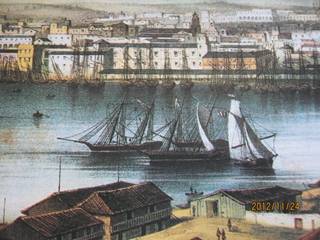
Old view of the city from El Morro.

We have spent more than fifty years hearing talk of “the enemy.” All the blame for our deficiencies is charged to this, just like all the evils and misfortunes, product of carelessness, inattention and neglect, also go to his credit.

With that idea they have tried to hypnotize and “idiotize” the population of “our beloved planet,” and regrettably, in many cases they have achieved it. But in spite of all that, when someone thinks about emigrating, it is always to the country of the “enemy” (USA). Also on occasion to others, which they use as a bridge, in order to achieve the same end.

Many of us have resisted letting ourselves be influenced by such fallacy, but even so, due to all the notoriety that precedes the matter and to the prejudices sown around it, we take care not to fall in the ideological trap, and to pander to the representatives of power.

Just a few days ago I received an e-mail from a very dear American friend, where she announced to me the visit of a friend of hers of the same nationality who wished to get to know me, and in turn he was the bearer of a gift that she was sending me. I was very satisfied to meet him and to report that the friend of my best friend, was a charming “enemy.” Empathy soon arose between us and it remains for us to meet next time.

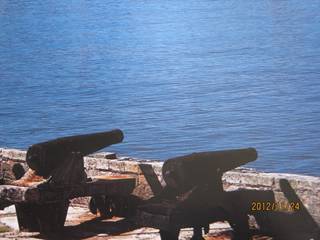
Last Friday afternoon, this one invited us to go to see the traditional ceremony of “the cannon shot,” a custom that exists since the epoch of the brief English occupation, when at exactly nine at night, they closed the doors of the walls that protected the city, and that they now recreate with a pretty representation in the Cabana Morro Tourist Complex. I was pleasantly surprised by how well restored and preserved is this emblematic place, thanks to the work of the Office of City History, the only state entity, that without fear of being mistaken, we can say has been busy rescuing and conserving some of our traditions.

We had a great time in the company of him and his parents. It was what could be called a beautiful night of “walking with the enemy.”

Translated by mlk

November 25 2012