The first beneficiaries are regime militants who lived in overcrowded conditions for many years
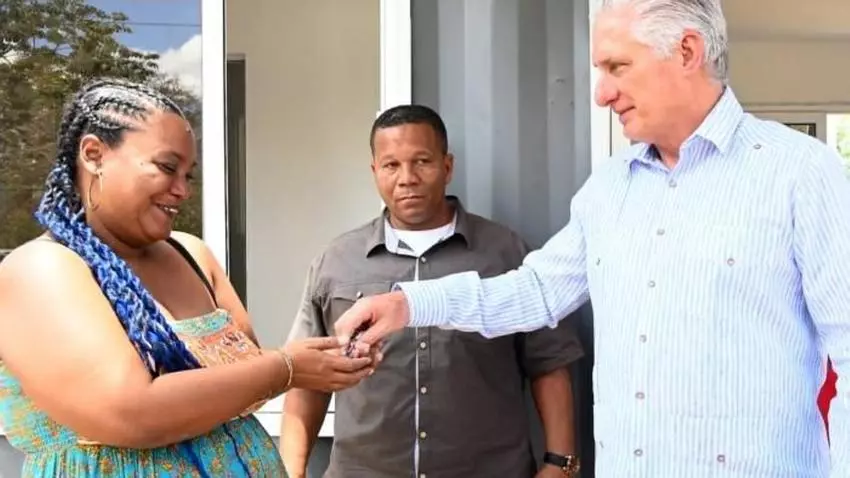
 14ymedio, Natalia López Moya, Havana, May 8, 2026 – It is no surprise that Alina Hinojosa Cardona and Nerelys Madan Catalá are celebrating their new homes, containers converted into housing for “young working women, single mothers and heads of household,” as the official press presented them last Saturday.
The first was living, that report stated, in a “small room in poor and overcrowded conditions,” and the second, in a shelter “for more than 13 years.”
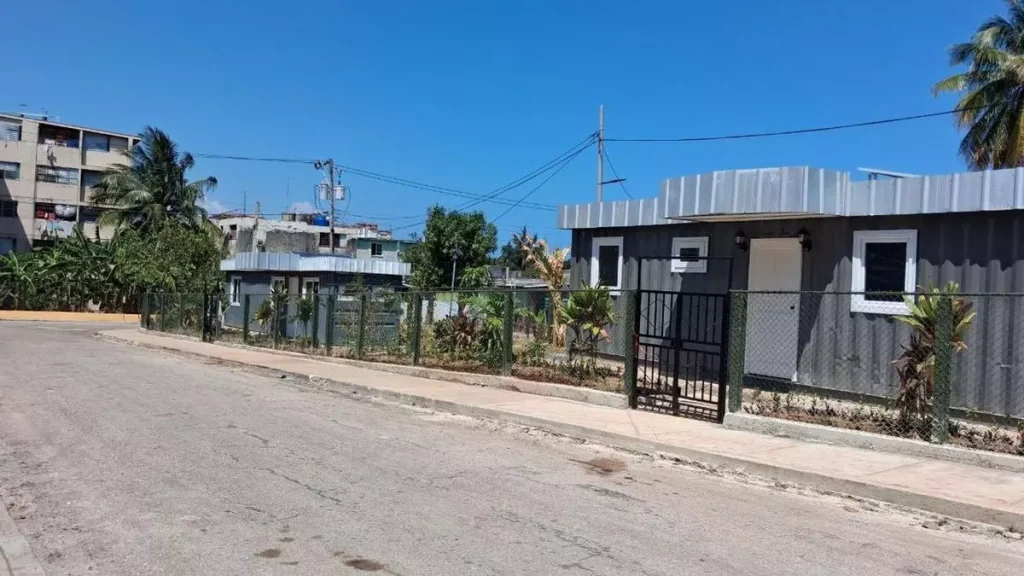
Compared to that, the two little container-houses, located in a good area of Nuevo Vedado, in Havana, near 26th Street and just a few meters from Tulipán Avenue, with a rear patio-garden that includes a wash area, a solar panel on the roof, and brand-new finishes and paint, are chalets.
In Granma’s report on the handover ceremony, carried out by none other than the ruler, Miguel Díaz-Canel, it was not specified whether the homes were privately owned or not.
In Granma’s report on the handover ceremony, carried out by none other than the ruler, Miguel Díaz-Canel, it was not specified whether the homes were privately owned or not, but 14ymedio confirmed, through one of the two brand-new tenants, that they belong to the State. The women and their families have use of them under usufruct rights.
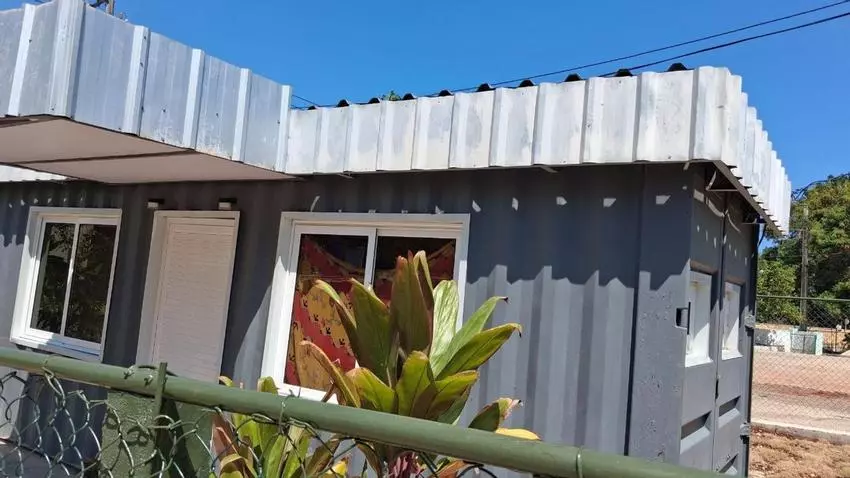
A neighbor from the area informed this newspaper that the new houses were installed in 12 days and assures that “inside they are very beautiful.” They were delivered, she says, with several appliances, “a blender and everything.” In one of the windows, behind completely transparent glass, they placed a colorful scarf as a curtain, to avoid being seen from the outside.
No air-conditioning mechanism can be seen, however, and the iron of the containers has not been covered with any material, as happens in other parts of the world where this type of structure is converted into habitable spaces. They do, however, have a solar panel on top of the roof.
According to Granma, their construction used “leftovers from tourism investment projects and technologies developed by the Revolutionary Armed Forces.” The base consisted of maritime containers in which “parts and components for photovoltaic solar panel parks sent by the People’s Republic of China” had been imported.
There are families living in the homes: Madan Catalá with her mother and child in one, and in the other, Hinojosa Cardona with two children. The official press presents the stories of both women while trying to offer a heroic narrative, but in reality revealing the impossibility of having decent housing even in the case of salaried employees and obedient servants of the Party. Alina, says Granma, leads the base committee of the Young Communist League at her workplace, “an organization she joined at 14 years of age,” and Nerelys, besides being a secretary, “served as delegate for her district for two terms starting at age 22.”
Their stories, however, mainly aim to praise the virtues of recycling maritime containers into modular homes and to validate “the viability of this alternative to respond in the short term to the growing housing needs of our people,” which they insist “is an international practice.” Granma’s lengthy chronicle reported that the delivered homes “are proof that these can be built tastefully and aesthetically, integrated into communities and the urban environment, contributing to beautification, while also helping the neighborhood through induced works and serving as encouragement to women, many of them alone and responsible for their families.”
The program, they also claim, “generates enthusiasm,” but according to statements at the same event by Prime Minister Manuel Marrero, “it is not moving at the speed desired; it is being done, but it can be carried out faster.” The authorities indeed mentioned the housing deficit the country has, of more than 800,000 homes, and praised “the potential” represented by maritime containers, a “material that is generally an environmental problem,” as reasons to carry out the initiative.
Faced with this, several specialists have expressed suspicions, questioning above all whether, since they are metal structures—a strong conductor of heat—the insulation is adequate for a climate like Cuba’s. Thus, for example, engineer Yulieta Hernández, who wrote on her social media: “Even with designed passive solutions (real cross ventilation, air chambers, shading), the interior can become uninhabitable. In the colder months the opposite happens: thermal inertia is low and comfort is easily lost. An oven in summer and a freezer in winter.”
The expert stated she was speaking from experience, “after having used several as temporary facilities on construction projects.” In her lengthy post she also questioned numerous elements, such as the quality of the electrical insulation: “the combination of metal structure, humidity, leaks, and improvised wiring can be dangerous if there is no proper grounding, differential protection, and rigorous execution;” the waterproofing: “critical points are visible at first glance,” “sheet metal undulations around the windows,” and “areas prone to leaks;” and the possible weakness of this type of housing against cyclones. “The roof looks like it will fly away with the first strong wind,” she states, and the materials are incompatible, since “metal is a material with high thermal expansion and contraction, so when combined with rigid finishes like ceramic or tiles, problems of adhesion, cracking, and detachment tend to appear.”
Other specialists, however, have spoken in favor, such as Abel Tablada. The architect offered his point of view, he explained, after visiting one of these container homes that form part of a group of 300 planned for installation in the area of the former Toledo sugar mill, opposite the José Antonio Echeverría Technological University of Havana (Cujae).
“We were able to verify that to reduce heat transfer, a second roof with an intermediate ventilation space was designed, and in the walls, the metal was insulated with an air layer and a plywood panel on the inside,” Tablada assures in a Facebook post that quickly filled with comments. In it he also says that “professors from Cujae measured the interior temperatures before the transformation and will return once the home is finished to validate the effectiveness of the thermal insulation measures.”
Regarding ventilation, he explains, “it is achieved through cross ventilation due to the narrowness of the container and the placement of louvered windows in each room”
Regarding ventilation, he explains, “it is achieved through cross ventilation due to the narrowness of the container and the placement of louvered windows in each room.” The home, he describes, “has a porch, a kitchen-dining room, two bedrooms, a bathroom, and a laundry area with a rear porch,” just like those observed by 14ymedio in Nuevo Vedado.
The architect states that he made several suggestions to improve this type of house, among them “completing the monitoring of interior conditions to determine whether the thermal insulation is sufficient,” “using the double roof to install solar panels so that this community not only becomes energy self-sufficient but can also feed energy into the grid,” and “painting the exterior surfaces light colors” to reduce radiation absorption, “since the eaves do not provide good coverage on the rear façade and the sides.”
His conclusion, in any case, reinforces the official narrative that the reuse of containers was not simply a temporary solution for hurricane victims, as the regime initially presented it, but was also something intended to remain permanently: “For families who have lost everything or for young people beginning adulthood without having been able to inherit anything, obtaining a container home is a considerable improvement in their lives, and this solution, despite any additional improvements it may need, is welcome.”
Translated by Regina Anavy
______________________
COLLABORATE WITH OUR WORK: The 14ymedio team is committed to practicing serious journalism that reflects Cuba’s reality in all its depth. Thank you for joining us on this long journey. We invite you to continue supporting us by becoming a member of 14ymedio now. Together we can continue transforming journalism in Cuba.