They Threaten to Take Farmers’ Lands / CID

In a meeting held December 28, 2013, at the CCSF Rigoberto Fuentes cooperative in the San Juan y Martinez municipality in the Pinar del Rio province, the directors threatened to take land from farmers if they do not participate in the monthly assembly and in the political events convened by the Cuban Communist Party (PCC).

Some of the many problems that the cooperatives face throughout all the national territory is the low participation of their members in the assemblies that are held every month in order to offer a solution to the problems that the farmers present.

The farmers have lost interest in these meetings because no solution to their problems is presented, and they realize that everyone agrees that the problems are just going to end up in a drawer.  They are simply tired of listening to the same lying discourse. continue reading

Another phenomenon is the low participation by members of the enterprises involved in the production of tobacco and the Small Farmers National Association (ANAP), because although there are people who have another standard of living because of the positions they occupy, they know perfectly that they have lost credibility and have nothing to offer.  They are afraid when they confront farmers and have no answer to the problems presented in these assemblies.

That’s why they have threatened to take land from the farmers who do not participate in the assemblies and political events.  They know that is the only tool they have to be able to continue with all their domination, thus the land will continue to be unproductive and the farmers will still be under the yoke of a group of people who have decided to support the Castro dictatorship, in this way they have managed to find a way to continue humbling the Cuban people.

By Rolando Pupo Carralero, Western Coordinator CID

10 January 2014

Translated by mlk.

They Neither Accepted the Charges Nor Paid the Fines / CID

Yilian Lucia Orama and Alexander Rodriguez, her husband–activists for the Independent and Democratic Cuba party (CID) in Santa Clara–were detained at 2 pm January 8 in the municipality of Camajuani, Villa Clara province.

Yanisbel Valido Perez, delegate from CID in the province, reported via telephone that the activists traveled to that municipality with the purpose of buying a pair of shoes and on their return were arrested by ten uniformed police officers who demanded to search them in the public roadway.  As both refused they were transferred to a police station by Cesar, a repressive agent.

After they were stripped of their clothes and absolutely nothing was found, each was fined 30 pesos, national currency, for charges of “Public Disorder,” that is, for not letting themselves be searched in public.  The CID activists did not accept the charges and refused to pay the fines after they were freed.

Translated by mlk.

12 January 2014

Operation Counterrevolutionary Toys / Lilianne Ruiz

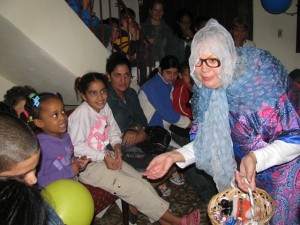
Laura Pollan delighted in entertaining the children on Three Kings Day

HAVANA, Cuba, January 2014, http://www.cubanet.org.- The police operation started at 5:00 in the morning of January 3. They knocked on the door of Hector Maseda’s house, one of the former political prisoners from the 2003 Black Spring Cause of the 75, husband of the late Laura Pollan — the site of the national headquarters of the Ladies in White movement. Opening the door, Maseda saw in the street a group of 20 officers, led by a Lieutenant Colonel accompanied by a prosecutor, the president of his neighborhood Committee for the Defense of the Revolution, and the secretary of the Communist Party “nucleus” in the area. The warrant was signed by the commanding officer: Katia M. Morales Jarrin.

The entered the house like people who knew ahead of time what they were looking for. They wanted to operate simultaneously on the lower floor and on the “barbacoa” half-level. They brought metal shears and broke the hasp of the lock on the door of the room where the joys were stored.

They took everything: 160 bags of toys labeled with children’s names; all the food they found (including what was in the fridge for preparing a cold salad: hot dogs, spaghetti, mayonnaise, chicken, pineapple, apples); a piñata full of candies and suckers; 2 laptops, 3 home printers, children’s clothes, women’s clothes — including those Laura Pollán wore — four painting by friends, rosaries, 57 chairs used by the Ladies in White to hold their literary teas; and other things so small and because of this so important, things that would only interest the family: mementos, symbols. continue reading

The search lasted no more than 15 minutes; they collected everything and took it away. They arrested Maseda and took him to what had been the police station at Picota and Paula. Inside, he could see that it had been remodeled and converted into a kind of “Instruction Center,” like that at 100 and Aldabo.

They kept him sitting in a chair while they recorded and counted everything they’d taken. At 1:00 in the afternoon they released him.

Laurita’s arrest

As she walked to the site at 9:15 in the morning on the same day, Laura Labrada Pollán, Laura Pollán’s daughter, didn’t know what had happened. Three blocks from the house, a State Security car stopped dramatically, and a fat blue-eyed man got out who didn’t identify himself. “Laura, you can’t continue, you’re under arrest,” he said. Two officers dressed in olive-green also got out of the car.

The procedure applied to those arrested by State Security starts with establishing a sense of familiarity in how they address you. The key is considering this the first step to achieving total domination of a human being: removing their legal personhood. Confronted as she had been other times with an arbitrary arrest, Laurita — as Laura Pollán’s daughter is known to her friends — didn’t ask where they were talking her. After many turns the car stopped. They made her get out and walk down a passage, go up two steps and enter an office. There they told her she was at 100th and Aldabo.

Laurita understood the magnitude of what was happening when she read the list of confiscated articles, in a document drafted in terms that, she thought, were worth copying, but unfortunately she was unable to get a copy. The official who showed her the document presented himself as “Reinier.” He told her that at 5:10 in the morning at 963 Neptuno Street they had performed a search and taken everything, that there would be no party, because, in his words, it was “counterrevolutionary.”

From the document, Laurita remembers phrases such as “Cuban children don’t need the toys of counterrevolutionaries.” They repeated ad nauseum the ideological justification for the sterile social sacrifices in favor of the parasitic State: The expensive toys, which languish in the shop windows because of the outlandish prices, are the fault of “the blockade.”

Since November, with Lady in White María Cristina Labrada Varona and in the name of the whole movement, Laurita had begun to collect the names and ages of the children. In the State stores, at a very high cost totally inaccessible on the salary of a Cuban worker, they were able to buy toys for more than 150 children, thanks to help from Cubans in exile.

When the operation invaded the house, every little bag had more than one toy. And the guests were not only the children and grandchildren of the Ladies in White, or of political opponents or activists. The neighborhood children were also invited, with the permission of their parents.

The party

The Ladies in White managed to engineer a party for the children as scheduled, where they received much love, even though the toys were missing. Some parents in the neighboring houses offered to get some jams. The cake which had been commissioned well in advance, couldn’t make it out of the oven, because, according to the baker who paid for his license to be self-employed, at the last minute there was no gas.

Berta Soler with the Children

Some Ladies in White couldn’t come because they were arrested; others were visited by State Security and read the riot act, resorting, finally, to threats. On Aranguren and Hospital streets they set up a police cordon as is their custom, blocking off Neptuno Street, all led by State Security’s Section 21.

They are not uniformed police. They dress in plain clothes although they are armed with pistols. The worst impression is that of their morphology. They deal in violence and impunity. The impression they create and that they try to create is that of lurking and having the ability to jump out and cause every kind of injury of the high command orders them to.

The Feast of the Three Kings at the Ladies in White headquarters goes back to 2004. It was created by Laura Pollán to give some joy to the children and grandchildren of the the 75 peaceful opponents, human rights activists and independent journalists who were unjustly imprisoned in the repressive wave of March 2003, which has gone down in our history as The Black Spring.

Chanel is 6. Her parents are prisoners: her grandmother is a Lady in White. When she learned that “a thief” had taken all the presents brought by the Three Kings she broke into tears. Like her, more than 150 children were left with empty hands after having been fed an illusion that dared to cross the desert on the hump of a camel.

Lilianne Ruiz

Cubanet / 6 January 2013

The “Murderous Law” Which Allows Many Cubans to Eat / Manuel Cuesta Morua

Havana, Cuba,November 2013, www.cubanet.org.– The Cuban Adjustment Act generates a lively controversy on both sides of the Straits of Florida. For the government it is the cause of indiscriminate exodus by Cubans to wherever, and for some of the exiles it constitutes the best escape valve which the regime utilizes to ease its tensions. Another sector inside as much as outside of Cuba considers it a means directed at protecting Cubans from a double abandonment: territorial and by the State.

Curiously this last sector is the only one that demonstrates a nationalist sense when defending the measure. In effect, protecting its nationals in any circumstance shows a vision and foundation that is appropriate for nationalism over ideology and that deserves to be applauded.

This regardless of abuses of the law.  It is true that we Cubans have been taking advantage of this law in two ways: as political refugees, which is not true in a great number of cases, and as a source of economic sustenance for our families, which explains why many Cubans avail themselves of the law to search for an economy that the Cuban regime does not permit to be built. And the effects, it is clear, have been debilitating. continue reading

Here then is a dual judgment: about the responsibilities for the situation created and about the responsibility of States to protect their own nationals. These two responsibilities fall on the Cuban government. The right question should be, in turn, the reasons why Cubans leave the country.

And the appropriate response, on the part of the Cuban government, should be to to applaud a law that protects its own citizens. It should not appear that the United States protects Cubans more than their own State. No national State should protest when its citizens are well received by another nation. Especially when half of the resources with which it operates originate in the United States.

On the other hand, the protests originating in the United States against the law are not consistent. It seems to me that it was always clear that those who avail themselves of the Law are not necessarily political refugees. In any case, one could suffer political persecution for trying to stay in the United States, if one were returned to the island, but very few cases qualified in the strict political sense of persecution by a State. For those cases there exists a political refugee category that the United States grants in Havana.

My analysis ends then with these two ideas: the political refugee category as much as the Cuban Adjustment Act deserve to be discussed but for reasons beyond those offered. The political refuge should be discussed so that it is granted to those who really deserve it. The Cuban Adjustment Law should be revised in light of the immigration changes that both countries have introduced in relation to Cubans.

That dual overhaul can facilitate an immigration regulation that answers the interests of both nations, the reality of family ties on both sides of the conflict and the protection of Cuban nationals in quite difficult economic and social circumstances. But to eliminate the Cuban Adjustment Act would be counterproductive for the legal control of the migratory flow. In the end, for good or bad, Cuba and the United States have shared and it seems will continue sharing a common special destiny. A fact that, paradoxically, the Cuban government itself recognizes when it implores, almost cries, for the elimination of the economic embargo, which is not a blockade.

Manuel Cuesta Morúa

Cubanet, 28 November 2013

 Translated by mlk.

Spanish post
29 November 2013

Benches For Rent at Bus Stops / Ernesto Garcia Diaz

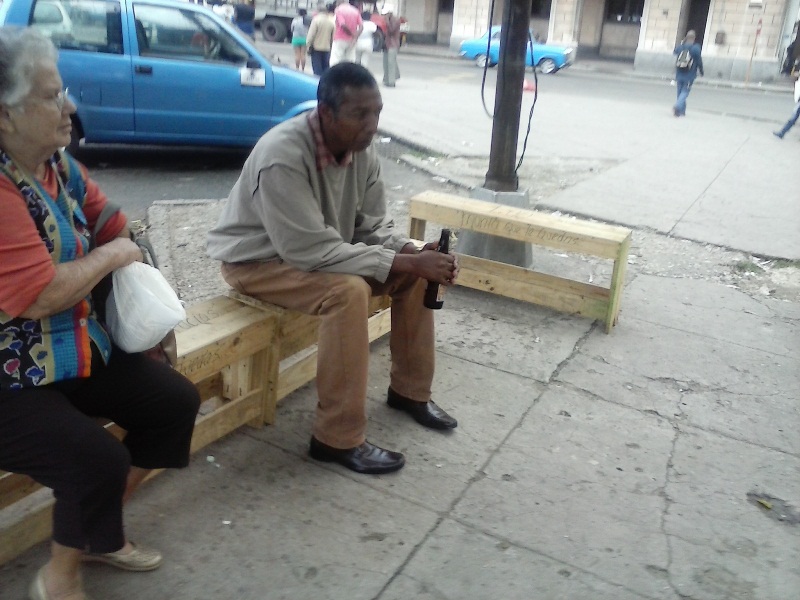
Two passengers waiting for the bus. Author photo.

HAVANA, Cuba, January 6, 2014, Ernesto García /www.cubanet.org.- In Curita Park, located on the block formed by the streets of Reina, Galiano, Águila and Dragones, in Havana, on the initiative a citizen, a seat rental service started  January 3 at the P-12 bus stop (served by articulated buses), for passengers traveling from this site to Santiago de Las Vegas.

The benches were built and designed to seat three people each. The experiment was done with three benches. The charge for their use is 1.00 pesos in national currency (CUP), or one centímino in freely convertible currency (CUC). Now all that’s lacking is for the owner to submit his proposal to the authorities who govern the system of self-employment, to get this activity on the approved list and pay his taxes on it.

The new service relieves the impatience and weariness of passengers who have to wait more than 20 minutes for a bus to take them to their destination, time during which they are exposed to the sun, the rain, the dust and the environmental contamination of toxic gases from traffic and the lack of hygiene and cleanliness in the place. All this given the inability of the appropriate organs, the transport cooperatives and the autonomous shared taxis that could roof the areas at the stops and maintain public facilities.

Ernesto Garcia Diaz

Cubanet | 6 January 2014

The Netherlands Asks to “Update” the Relationship Between Havana and the European Union

The Chancellor of the Netherlands is visiting the Island. The Glasnot in Cuba Foundation, with a site in Amsterdam, asks him to meet with the dissidence.

The Glastnost in Cuba Foundation, with a site in Amsterdam, criticized the Dutch foreign minister’s trip to Havana this Monday, and said that his visit “could only be successful if dialog is established with the whole Cuban society.”

“A dialog without contacts with the peaceful opposition will not be successful over the long-term,” said Kees van Kortenhof, president of Glastnost in Cuba, according to a communication released.

The Dutch NGO said it was surprised because, in association with the trip, the government of the Netherlands classifies Mariela Castro as a “defender of human rights in Cuba and in the world.”

Van Kortenhof said that description is “extravagant and ridiculous.”

“The president’s daughter limits her human rights efforts to gays, lesbians and transsexuals. Bloggers, political opponents, journalists, musicians and the Ladies in White are attacked, but Mariela Castro talks about them as ’despicable parasites,’” explains the Dutch organizations.

The chancellor Frans Timmermans asked in Havana, according to official media, for an “updating” of relations between Cuba and the European Union.

Timmermans cites, among the reasons for the development of ties, the “economic adjustments” implemented by the regime “the business possibilities these bring.”

During his stay, the Dutch minister signed a memorandum for the establishment of political consultations between foreign ministries.

DDC | Havana | 6 January 2014

6 January 2014

Booby-trapped Roofs / Pablo Pascual Mendez Pina

It was the evening of November 29, it was still raining in Havana and Rebollar Augustine, a retired 71-year-old resident of Vedado, stood crestfallen covering his face with his hands so no one would see him cry.

His mattress, appliances, clothing, furniture were all wet and to worsen his mood, his neighbor below started to shout insults when her roof also started to leak.

At an impasse in the downpour, Rebollar looked at the sky with the hope that the storm clouds would disappear, but the downpour increased and he furiously began stomping on the floor and yelling obscenities to let off steam.

Manuala, Olimpia, and Barbarita — neighbors of Rebollar — suffered under similar storms, and after the collapse of a connecting wall of their apartment, the police drove them to a shelter in the town of Boyeros, where they remain permanently evacuated.

Unfortunately, Fidel Vega and Pastora Góngora, residents of 619 Campanario Street in the municipality of Central Havana, died after being suddenly crushed when their dwelling collapsed. continue reading

There were countless victims and more than 2,000 evacuated due to the intense rains after the arrival of the fourth cold front of the current season.

In 72 hours the precipitation reached 300 millimeters (11.8 inches) in the northern municipalities of the capital, causing a catastrophic 227 collapses, 201 of which were partial and 26 of which total, according to government figures.

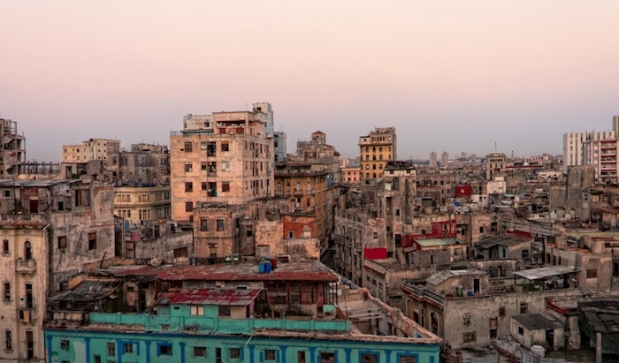
“Our ceilings are booby-trapped,” warned some of the capital’s residents in reference to the possibility that the downpours could cause their roofs to cave in. “Havana is like a sick old man,” noted others, meaning that the city recovers from one slump only to suffer from another.

In the prologue to the most recent edition of The City of Columns by Alejo Carpentier, Dr. Eusebio Leal portrays it as: “The city of the unfinished, the lame, the asymmetrical, the abandoned.”

In an study by María del Carmen Ramón entitled “Havana Is Expensive But It’s Worth It,” published in the online magazine Cuba Now, the architect Mario Coyula, the city’s director of architecture and urbanism, presented a more realistic and frightening image the capital’s future:

“Havana could end up being a Dante-esque vision, a great ring of piled-up trash or an empty crater where a city once was.”

 The solution is the problem

Coyula points out that, if we look at the scale model of Havana, we will notice that the color yellow predominates. This color coding is used to designate areas of urbanization from the first sixty years of the 20th century.

We can therefore surmise that, since then, the socio-economic development of the capital, judging from housing construction, has been poor.

In hindsight, we can see that only Alamar, San Agustín and some areas developed by micro-brigades have been added. The population density increased, however, and with it has come overcrowding, especially in Central Havana, which has about 1,000 inhabitants per hectare*. If we take into account the area’s many low-rise buildings, this suggests that people are practically living on top of each other, like canned sardines.

Coyula notes that Havana still has the same infrastructure it had early in twentieth century, as exemplified by the case of the aqueduct. Now a hundred years old, much of it has collapsed. Its pipes were providing service to 300,000, though it was designed for twice that capacity.

Today the city is home to over two million people and requires heavy investment if it hopes to curtail the sewage spills running through its streets.

Coyula recalled that in a very interesting meeting with a development group in the capital many years ago a specialist from the Ministry of Construction said, “It will cost $3 billion to fix Havana.”

“But the cost is much greater,” claims Coyula. Havana is expensive but worth it and the only way to solve its repair problem is to find a way it can generate money for itself, as Eusebio Leal did with his Historic Center project.**

For 50 years the Ministry of Construction (MICONS) ignored building maintenance of the housing stock. Although the National Housing Institute (INV) created companies to deal with this, its efforts did not meet demand and instead it began shoring up housing in poor condition as a solution to the problem. This solution, however, proved inadequate, confirming that the approach to the problem was misdirected.

“Current home construction is only intended to replace those dwellings that have collapsed,” Coyula points out, “but government cannot be the only sector responsible for solving these problems. People cannot just wait passively for the paternalistic state to fix their house or build a new one.

“Similarly, the new law which legalizes the sale of houses could have a positive effect. It could encourage people to take care of their properties, not just their roofs, because it is an asset that at some point in time could be monetized.”

Coyula’s views are not shared by everyone. Fermín Álvarez, a 52-year-old economist, questions the feasibility of generating more than three billion dollars to fix the city’s problems given the failure of the current economic model and a monetary system made up of two weak currencies, factors which inhibit interest from foreign investors.

Similarly, Alvarez points out that the regime seems more preoccupied with squelching the self-employment sector, which represents a mere 2% of Cuba’s GDP according to official estimates, rather than encouraging individual initiative and development of the non-state sector, which could generate revenues for public services.

An ex-director from the former Ministry of the Materials and Construction Industry (MIMC), who requested anonymity, describes the law legalizing the sale of residences as a subterfuge by the regime to free itself of responsibility.

“For more than 50 years the government was the real owner of all homes, preventing the ’inhabitants who use them’ from selling to other individuals. They could only sell them to the state, which shamelessly took it upon itself determine their value,” he says.

“This situation caused many buildings to deteriorate, especially multi-family homes. After all, if the state was the owner, then it was also responsible for the upkeep.”

The shortages and high prices of construction material in Cuba are a consequence of a decision by the government to set aside most of these products for export and as aid to regional trading blocks while giving lower priority to the domestic market.

A 42 kg bag of cement costs 6.60 CUC (or dollars), the equivalent of half the average Cuban’s monthly salary of 15 CUC. How many people who depend on a salary can make such an investment and still be able to eat?

In addition, there is the purchase of other materials. But the most expensive is the skilled labor to undertake the repairs. “It would be delusional to believe that with the weak credit offered to the most vulnerable people reconstruction costs would be covered, after over 50 years of mistakes and stupid prohibitions by the government,” says the former director of MIMC .

Unexpected

Ninety percent of those affected by the weather event  that occurred on the 28th, 29th and 30th November, say they were surprised by the rains.

They note that the Institute of Meteorology offered a softer forecast, and nothing alerted the public about the possibility of heavy rains, with over 300 mm (12 inches) in the northern municipalities, which would resemble a “bombing” as those regions present the greatest construction problems in the capital. Nor were there any special announcements to keep the population informed.

Nor did the Civil Defense agencies — given their vertical structure — alert anyone nor offer information to support the victims. Hence, 95% of those consulted said there was indolence that caused unnecessary risks and loss of life.

I said “good-bye”

Agustín Rebollar said that on this occasion the downpours never let up so that he could climb to the roofs and sweep our the drains, as he usually does in such cases. He said that to waterproof the roof he’d applied cement aggregates to plug the leaks, but he didn’t know whether or not he did it right.

“If at least they’d show something on educational television to teach us how to do it,” he said, “I myself would do it, despite my 71 years, because with the 270 Cuban pesos (11 CUC), they pay me as a pension, I can’t afford to pay a mason.”

Inside his home, Rebollar shows a beamed and tiled ceiling, arched and covered in slurry for the dampness, which hasn’t come down thanks to a shoring up with wood logs.

“The next time, if there is a next time,” resolves Rebollar, “I will be forced to do what the deceased Álvarez Guedes recommended: Give myself a kiss on the ass and say good-bye.”

Pablo Pascual Méndez Piña | Havana | December 16, 2013

From Diario de Cuba

Translator’s notes:

*According to Wikipedia, Havana overall has a population density of approximately 7,500 people per square mile; Old Havana has a population density of 63,500 per square mile. This is higher than that of Kolkata (Calcutta) India. The density for Central Havana reported here is about 260,000 per square mile; Wikipedia reports the density for this area (possibly for different boundaries encompassing a larger area) as 102,400 per square mile; even at this lower number, of all the cities in the world only Manila has a higher density on a city-wide basis.

** In 1982 the historic center of Havana was designated a UNESCO World Heritage Site and became eligible for funding for its preservation. Tourist taxes are also dedicated to this purpose.

16 December 2013

Life and Death of Cuban Railways / Ernesto Garcia Diaz

They wait for days in La Coubre Station for a ticket

Havana, Cuba, December 27, www.cubanet.org – In Havana’s Central Railway Station, they were fumigating — against the Egyptian aedes mosquito — with passengers inside (children, pregnant women, old people), violating all health standards.  And don’t mention freshening up.  They charge a dollar to use the bathrooms.  And even paying, the bathrooms do not have soap or toilet paper.

The self-employed cleaner told us:  “Some time ago the bathrooms lacked water, they were disgusting, they put a bucket for discharge, we washed them without faucets, the broken toilet bowls, the blocked urinals, we rehabbed the service, but we did have to watch that, because they stole even the brooms from us.”

The disaster of the railways

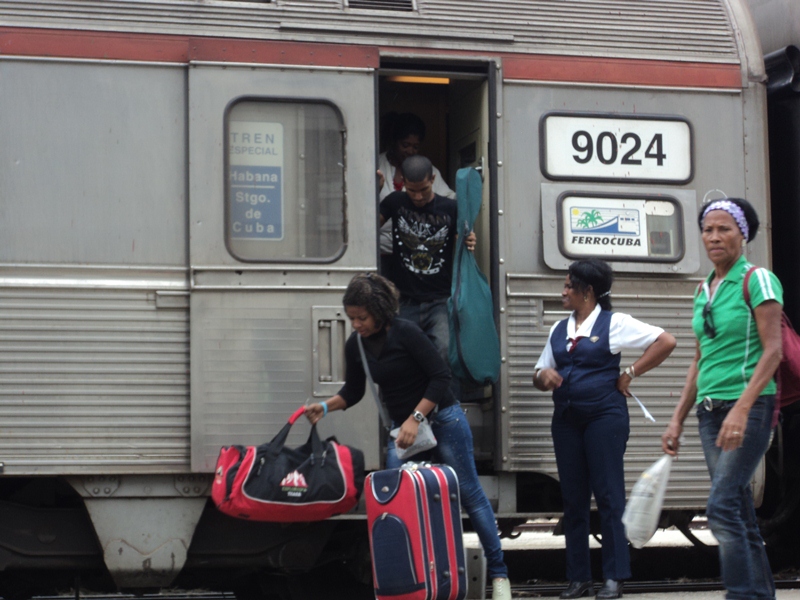
Almost 20 percent of Cuban trains do not leave or arrive on time. Train departures have been reduced. We asked, “How many trains run from Havana to Santiago de Cuba?” continue reading

“There are two trains, one regular and the other special, every three days,” the girl at the counter told us. “Today an extra leaves for Santiago De Cuba at 11 at night. The special from Santiago runs in December on the 24th, 27th and 30th at 6:27 in the afternoon, and the regular leaves on the 25th, 28th, 31st at 4:00 pm.”

The tickets to Santiago de Cuba have to be reserved in La Coubre Station, some 700 meters from the Central Station.  But those going to provincial town be careful! The regular train stops in some municipal stations, but the special to Santiago is express, it only stops in the provincial capitals.

And as the trip from Havana to Santiago lasts 15 hours, prepare to be hungry! They sell a few preserves in the cars, they run out fast. Vendors of bread rolls climb on at the stops with whatever. The railways do not offer drinking water, either. Bring your water. And if you can, bring a bottle for urinating, because the bathroom of the car may be overwhelmed, or worse, closed.

The same information employee, laughing, told us: “I prefer to urinate in a bottle.”

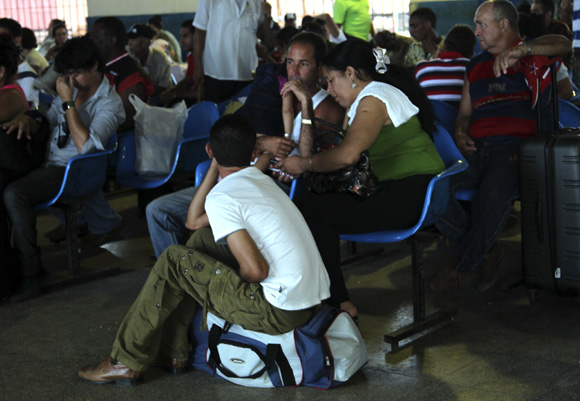
In La Coubre Station, under a fiber cement roof, a sign announced:  “There are no reservations until January 4.”  If you decide to travel, you have to go to the waiting list and sign up.  With luck they will sell you a passage in five days. For those who spend days sprawled on the floor, grumpy, the worst still awaits, boarding a dirty, stinky car, and suffering a tortuous trip.

One on the waiting list commented: “I’m going to Guantanamo, I have been here three days, I have number 500 in the second round, I’m not going today either.” Passenger number 2 added: “I am signed up for Guantanamo, but I am going to Santiago de Cuba. There is no other.”  Another told me, “I’m going to Guantanamo, I spent four days on the list, to be able to go today, I almost had to live and sleep here, but it’s the only way of hoping to spend New Years with my family.  And I almost have no money to arrive with; here, in the terminal, the food is very expensive, to eat I’ve used what little I had.”

In 2012, the railway transported 9.9 million passengers.  More than a million fewer than in 2005.

Special Havana-Santiago train.

Cuba was the second country in America to have a railway. On November 19, 1837, the first section from Havana to Bejucal was inaugurated. In 1859, the capital counted on streetcar service.  A decade later, the railway reached Calabazar, Santiago de las Vegas, Marianao, Cardenas, Jovellanos.

In the first decades of the 20th century, the island would complete the line from downtown Havana to Santiago de Cuba, with secondary branch lines to Pinar del Rio, and even la Bahia de Guantanamo. And it had an electrified network, the little Hershey train, which linked the Cuban capital with the city of Matanzas.

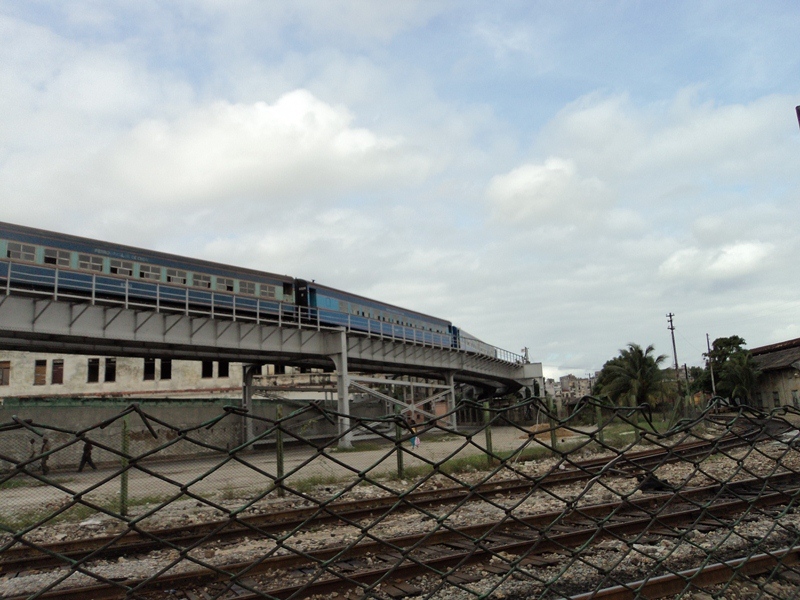
Elevated at the entrance to Havana.

In 1959, the trains were the soul of sugar production, they gave life to towns and cities. They went to almost all corners of Cuba.

In 1961, the revolutionary government nationalized the railways. In a few years, the Cuban rail network which extended over 12,060 kilometers was reduced to 8,367 km.

In Cuba, the official press does not report — except in cases of death — railway accidents.  The Castro administration turned the shining gem of Cuban railways into a true disaster.

Ernesto García Díaz

December 26 2013 / Cubanet

Translated by mlk

28 December 2013

The Sats Refugees / Camilo Ernesto Olivera

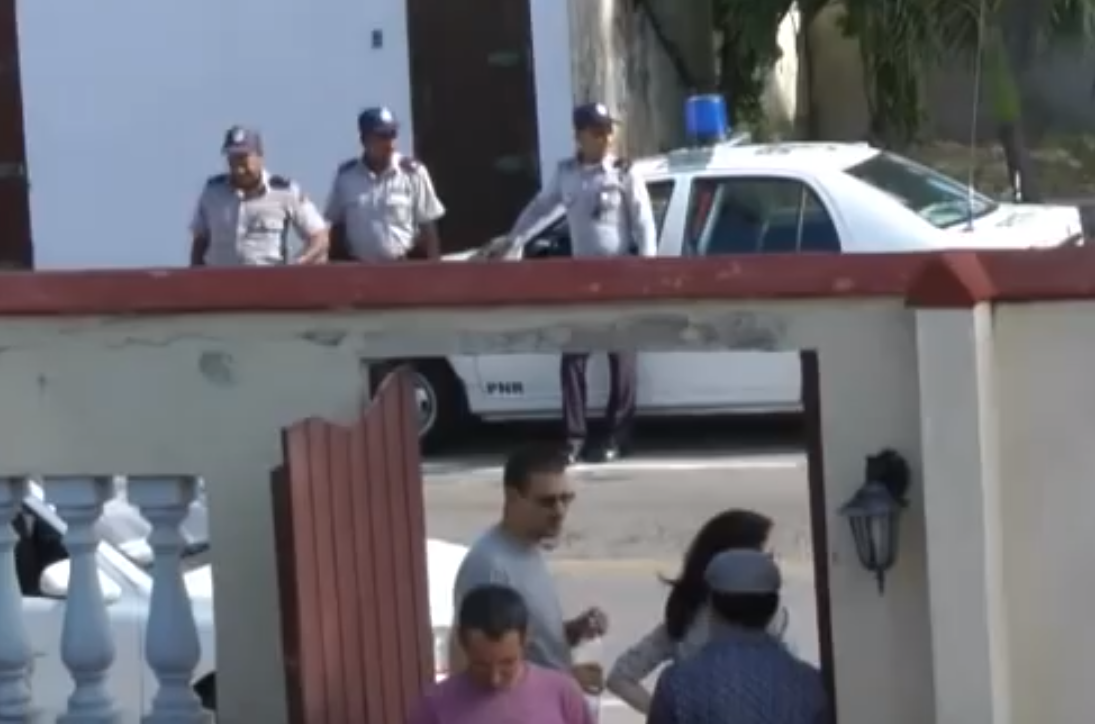
Havana, Cuba, December, www.cubanet.org — It was after 10 am Saturday, December 7.  The patrol car of the PNR (National Revolutionary Police) braked at my side, a few meters from where I live.  The uniformed officers got out of the car, and one of them asked me for my identity card.  With no further explanation, they pushed me against the patrol car, searched me, and put me in handcuffs.  Then they put me in the vehicle.

For almost an hour, we rolled through various zone of Mariano and La Lisa.  In an area near 100 Street and 51st, a Suzuki motorcycle approached.  The driver, dressed in civilian clothes, face hidden in the helmet, told the uniformed officers:

“Take hiim to Melena del Sur.”

After 5 pm I managed to return home.  It was growing dark when Antonio Rodiles called me by phone, and I told him what had happened.  A little later I was entering his house with a backpack loaded with necessities for surviving as a refugee there in the following days.  Like me, other members of the work team of Estado de Sats were coming together in the next hours. continue reading

When I arrived, Walfrido Lopez was polishing the details of the conference about means of communication and human rights.  The First International Meeting about Human Rights and Accords of the UN was due to open on the 10th.  Kissi Macias, wife of Luis Eligio, from OMNI, was there too, editing videos sent by various personalities.  At dawn on Sunday, Boris Larramendi arrived directly from Club Fabio, together with Ailer and Antonio who presented their concert there on Saturday night.

By that time, the news about detentions of activists and members of independent civil society was shaking the whole country.  On Sunday the 8th, Dixan, Sats collaborator, could not leave his house, and if he did, he would be sent to Vivac, detention center for political cases located in Calbazar.  Antonio and Ailer went to look for him, and a traffic patrol car, obeying orders from a motorcycle rider, intercepted them and then tried to capture them at the door to Rodiles’ house.  The police officers confiscated the car’s authorization document, and warned Antonio not to go out driving the car again.  Fortunately, now Lia Villares and her husband Luis Trapaga were sheltered together with us.  By that time, the wall of DSE (State Security) troops and uniformed police officers from the PNR (People’s Revolutionary Police) intensified.  By pure miracle, and with the darkness of night in his favor, David from OMNI passed through it and arrived at the house.  Also, Claudio Fuentes, Regina Coyula and the journalist from Hablemos Press Pablo Marchan jumped the fence.

On Monday we were 19 refugees.  The next days were of entrenchment, deep fellowship, and survival.  Also of much tension and stress, especially in the hours that followed the detention of Antonio, Walfrido, Calixto Ramon and Kissi on the 11th.  State Security surrounded the house, even on the ocean side.  The providential downpour that closed the area during the first hours of that night prevented greater evils. They were obliged to dismantle the repudiation platform that had been retrofitted with a powerful audio system.  The participation of two popular dance music groups was expected:  Arnaldo and his Talisman and Elito Reve and his Charangon.

Several stalls for the sale of rum and beer had been set up.  Evidently, the intention of the DSE was to ply with alcohol the “mass” of concert attendees and then use them in order to hide their civil troops among them, and to attack Rodiles’ house.  The suitable cloak  of night helped them to justify the witches’ sabbath. While it was raining, Boris Larramendi gave a concert of “pure blood,” and David of OMNI offered his own to welcome the return of the detainees at the stroke of 7 pm.

The silence that the ruling champions of the “Cyberwar” have kept during these days is a clear symptom of the demoralization in which their bosses of the DSE (State Security) find themselves.  A small group of refugees in Sats curbed the bullying of a corrupt and decadent regime.

December 23, 2013 / Cubanet

Translated by mlk

Christmas Divided / Tania Diaz Castro

Havana, Cuba, December 24, www.cubanet.org — As a good predictor of the future, this man forecast that Christmas would not be necessary in a socialist country.  He knew since then that there would be no victuals and much less family for the days of celebration.

It is noteworthy that in the Population and Household Census carried out in September 2012, from which definitive results were recently offered, the National Office of Statistics and Information has not included in its questions how many of us Cubans are distant from our families.

Without any doubt any of the 11,167,325 inhabitants of the Caribbean archipelago suffers that pain.  So it is difficult in more than three million Cuban homes in the country, to be able to evoke these Christmas days happily, if those we love are not present since we opened our eyes to the world. continue reading

Even the dictators themselves Raul and Fidel, generals and colonels, representatives of all the new social class — human beings after all — are not exempt from that suffering.

Sonia and Pedro Yanez, my neighbors from across the street, are those who suffer more.  Two years ago their oldest son went in a boat and what remains for them is the same idea of leaving.

Much more these mothers from Santa Fe, who lost their sons in a sea infested with sharks.

Even I myself, with my only three sons scattered across the world, because they cannot live in Fidel’s Cuba.

Those of us older than 70 suffer most from the collapse of the Cuban Christmas. We remember the Christmas Eve dinner, always with family, the marvelous dawning of the Day of Kings, where we discovered in a corner of the room the toys that the invisible mythological kings left us with so much affection, the year’s end, when grandmother threw into the street a pail of old water so that good luck might enter the house.

They were times when we could dream, in which hope had still not been lost, which hope disappeared when the Commander arrived and ordered it to stop, hope that has revived again in spite of repression and draconian laws.

That’s why, this December 24, I am going to toast my sons, my father who walked alone through the streets of Miami before dying, my mother, who did not want to tell me that communist tyranny had killed Christmas so that the divine fantasy might disappear from the mind of civilized Man, my dissident friends, whom I remember with love, my last sweetheart, polititical prisoner for more than 20 years who some day will return.

23 December 2013/Cubanet

Translated by mlk

“The psychological torture was intense, permanent. They wanted to erase his mind.” / Lilianne Ruiz

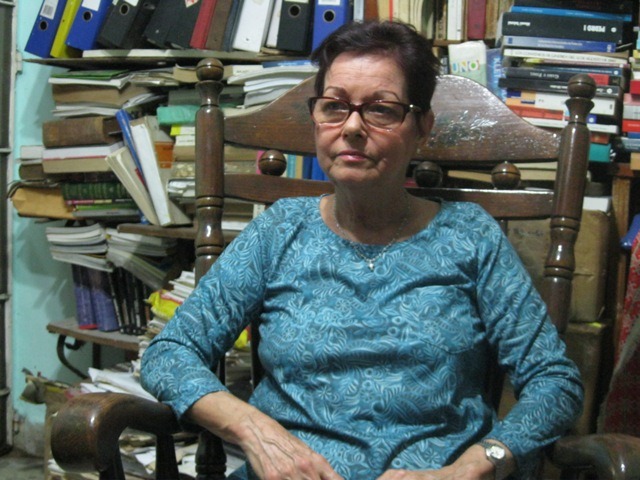
HAVANA, Cuba, December, www.cubanet.org-It was raining heavily in Havana. It was the first day of December and Miriam Leiva had come to Cuba carrying the ashes of her husband and the memories of their almost 40 years together. Oscar Espinosa Chepe had died after a long illness that they shared together like so many things in their lives: work, civic activism and love.

Surrounded by the books and periodicals that he treasured, he was now in the metal urn in the small apartment from which he’d left last March to seek medical treatment in Spain. For those who knew this couple it’s hard to imagine one without the other.

Cubanet– Did he want his ashes returned?

Miriam Leivan– When we arrived at the La Fuenfria Hospital, he was very ill.  He told me, “When the time comes, I want you to cremate me and take me to Cienfuegos.” The doctor came by several times the same day and on one of the visits he told her, forcefully and with tremendous clarity, “Doctor, I want to return to Cuba.” She and I looked at each other, because given the condition he was in this was impossible. And he said again, “It’s hard to say… When it happens, I want to return to Cuba. Because I have always wanted to be in Cuba.” And then she told him, “Don’t worry, your wife already has everything arranged.”

We went there in March and he died at the end of September. September 23. continue reading

Cubanet– Why didn’t you go earlier to improve his health?
Miriam Leiva – They wouldn’t allow him to go abroad and return. That is, we had to leave Cuba permanently. When he got out of prison in November 2004 he could have gone abraod and lived there permanently and gotten medical treatment, and he told me no, not without being able to return to Cuba, he wasn’t going anywhere.

Cubanet– What other limitations were imposed on his life on parole.

Miriam Leiva – When he was released in 2004, he comes to the house. Then they tell him he can’t return to his activities, he can’t write, he can’t speak. I alerted the foreign press that Oscar was here and they all came, everyone who wanted to, tons of correspondents accredited in Havana, and he immediately began writing and speaking.

In a year and a half they called him before the Playa Municipal Court and told him he could not continue the activities he was engaged in, that he was being monitored by the neighborhood “factors” (the Party, the Young Communist League, and the Committee for the Defense of the Revolution) who would report on his behavior.

On the basis of that they gave him a document with some 11 prohibition, among that that he couldn’t leave Havana without permission, he couldn’t engage in exchanges, could not work. All this was in the document, something like 10 or 11 prohibitions. And he continued to do exactly the same things because there is a reality which he expressed in his opinions in a constructive manner and for the betterment of our country, and as he and I have always told them: prove that we are lying. Prove that we are saying something that is incorrect. They can’t prove it; we carry on.

Cubanet– And this year his health worsened?

Miriam Leiva – Last year in June he started to have a leg problem, with a lot of pain and then the problem in his liver started to get worse and he felt badly and lost weight. He was admitted to intensive care in Fajardo Hospital, which where he was always seen, and there they say that the biliary system was clogged, which seemed to have been going on for some time, and it was deteriorating.

The immediate solution was to put a prosthesis in the bile duct endoscopically, or minimally invasive. But this prosthesis lasted 2 or 3 months and had to be changed because it became contaminated by an infection in the bile processes, so they had to change it. He was admitted in December because it was going very badly and they told him they didn’t have an opening for him and he would have to wait until the beginning of January, it wasn’t the beginning it was the middle. But fine, they had an opening and the doctor he saw that time told me the problem wasn’t just an obstructed vile duct, but due to the deterioration of the bile system many of the branches of the ducts were badly damaged and that there was nothing they could do here. Perhaps abroad they would have other treatments but in Cuba there weren’t any more resources, no other possibilities.

Cubanet– And that time did they guarantee he could return?

Miriam Leiva – That was when we started to try to convince him to get treatment abroad because now, yes, if he remained in Cuba he would be dead sooner or later. And it was hard to convince him. Then he said, if they let me return I will go, and that mobilized me. I got in contact with different governments to see what the immediate possibilities were because somewhere else perhaps there was something they could do.

And the government of Spain — where they a lot of expertise in liver disease — said yes, they could offer medical care, but all the other costs would be up to us. And I didn’t ask how much the fare would be, but I said, yes, we will start the paperwork to get permission to leave and return. Here, we asked if he accepted a passport, could he return. Finally it was clear that he could return.

Cubanet– Tell us about Madrid…

Miriam Leiva – I was very afraid he wouldn’t make it to Madrid alive; but luckily he arrived. Very weak, but he got there. I got a travel helper and in the airport he went everywhere in a wheelchair. He didn’t have the strength to walk. We got there on Tuesday and on Wednesday in the morning we were at Hospital Puerta de Hierro. He went to the emergency room. They did everything, all the checks he needed to be admitted and when there was a room available, they took him there.

After some tests they changed the prosthesis. There they discovered that in addition to a diseased liver and the bile problems he had hepatitis B that hadn’t been diagnosed, and a bacterium called Clostridium. He was put in isolation because of the hepatitis. He was there for days while the hepatitis was treated and he was improved. They started a special treatment for the clostridium and he was better. But he was still feeling very very weak. He was hoping for a liver transplant, but given his age, over 70, they couldn’t do it. Besides he was very run down.

Cubanet– In Madrid there were the two professors…
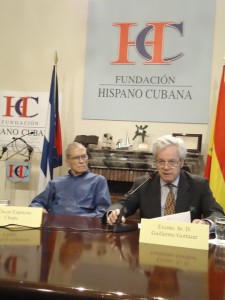
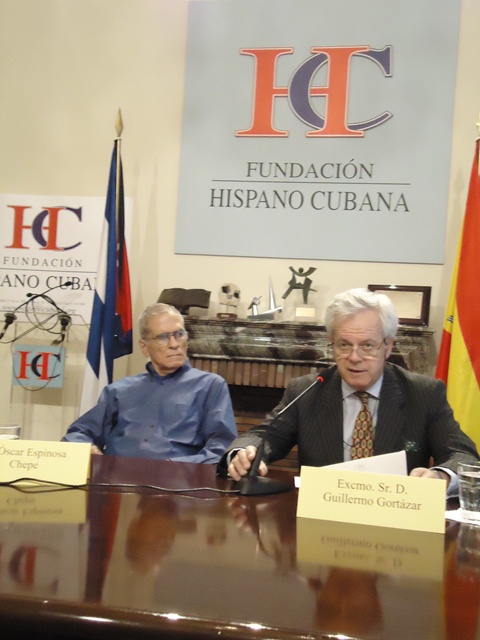
Miriam Leiva – He gave a lecture at the Hispano-Cuban Foundation, which was his last recorded lecture. He had a very high fever that day. Afterwards, when Professor Carmelo-Mesa-Laga was there, he invited us to the hotel where he was staying. By email we told him it would be a huge effort for Oscar. Then Carmelo and his wife came to see us, we had already moved to a smaller and cheaper hostel. It wasn’t bad, I can’t fault the price.

Carmelo invited us to go to his lecture at the Casa de America and another meeting at the Elcano Institute, a very prestigious Spanish institution in the area of Foreign Policy. It was nice because when Carmelo finished speaking in Casa de America, and other people were already asking questions, Oscar didn’t know that he was going to speak at Carmelo’s conference and asked a question. And before answering Carmelo said, “Oscar Espinosa Chepe, who is here.” It was very nice, he said some very nice words about Oscar and they applauded a great deak and that was a nice thing.

Miriam tells the story

Cubanet– Did his health worse in prison, in the Black Spring of 2003?

Miriam Leiva– After the search that begin in hour home at 4:30 in the afternoon and lasted until 3:00 in the morning they took Oscar to Villa Marista. A few days went by before they let me visit, maybe a week, I thought I would get a visit a week. It was a 15-minute visit with the officials in the little room and you couldn’t talk about anything other than family problems. He had already lost a lot of weight. He was sallow, a typical color when the liver is in crisis. Why? Because ot the intense interrogations in Villa Marista.

The Cuban government doesn’t torture in a way that is visible physically, but their psychological torture is suffocating and very intense. And this was what they did to Oscar. Then they simply put him in a cell with three common prisoners, and he could barely walk because it was very small, they had nothing there, no toothpaste, when he wanted something he had to bang on the metal for the jailer to come and open the bars and say “What do you want?”

The interrogators were there whenever it occurred to them, whenever they wanted, and especially when they thought he might be sleeping. So he wasn’t able tog et any rest. Oscar told me about the conversation, basically in his case, for example” how did he think, and why as he involved in this, why, it wasn’t worth it, that ultimately what was he talking about when he talked about reforms, he would give an example, “If even Vietnam and China are making changes and reforms, why can’t Cuba do it?”

The interrogator finally answered on the day of the trial, “Boy, because we’re not Chinese nor Vietnamese.” He continued to say the same things that he said here at home. The intensity of this system of interrogation and the bad food, the conditions, everything, what crowding there… he deteriorated a lot.

Because of our demands they took him to the Military Hospital. There they didn’t do any tests or anything, they told me that because he had been sent to prison he was going to prison. They sent him to the prison in Guantanamo. A journey very difficult for everyone, very hard, because they put them handcuffed in a bus, and they couldn’t talk to each other and they were left in all the prisons along the way until Guantanamo which was the last.

Cubanet– From Guantanamo he was taken….

Miriam Leiva – In Guantanamo he became very ill. I went there. Then they finally put him in the hospital of that city. It began to rain and the hospital only served emergencies, and they sent him to El Cobre Hospital, in Santiago de Cuba, that served the Boniato prison. There They wanted to do all the medical tests they thought necessary there and he said no. They told him if would have the tests they were going to take him to Boniatico, the isolation cells in Boniato. There were others of the 75 Black Spring prisoners in isolation cells there. Then I learned that he’d been sent to Boniatico.

Cubanet – What happened in Boniatico ?
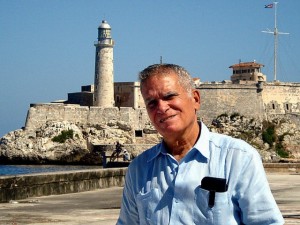
Miriam Leiva – They dragged him off again to Santiago, with a doctor, from our family, and the prison director told me there weren’t any doctors, that I couldn’t talk to the doctors. I said, “Look, the only thing I have to do in my life is take care of Oscar Espinosa Chepe, and to I can stay here in the prison where I won’t bother you, but I will be there.”

Then an official from the Ministry of the Interior appeared and called him aside. This man never spoke the whole time, he simply sat there and when something in the conversation interested him he called an official from outside and told him what he had to do. Three doctors appeared, the head doctor and two others. We explained the whole situation, the doctor explained about Oscar. They went to see Oscar who was obviously very sick and they took him back to the prison part of the El Cobre hospital. They didn’t give him newspapers or anything, they put him in total isolation. They didn’t tell him we were there, that we came three times a day; his mother in the morning, his sister at noon and I at night. They completely isolated him.

Cubanet -From Boniatico to Habana…

Miriam Leiva — One day I learned that the afternoon before Oscar had been taken very ill about 3:00 in the afternoon and at the 11:00 PM they put him a plane for Havana and he was in the C.J. Finlay Military Hospital. This was in August 2003. I asked for a medical report. They said, “Yes, we will give it to you,” and they were going to do that when I met with a doctor in September, what they gave me was a piece of paper that didn’t say anything substantial. It was a tiny little medical history with less than I knew, much less. They didn’t tell my how Oscar was at that time, nor why he was there. You know they don’t give you medical information because they don’t want to. In March of the following year they gave me some information after a great deal of insistence on my part and also under pressure from the international community.

The psychological torture of Oscar Espinosa Chepe was intense, permanent, very malicious, everything. When the inmates were in the hospital they had one visit a week. Oscar had one visit a month and we never knew when it would be. It didn’t matter that I didn’t know, but he was the prisoner and he didn’t know. You know when Oscar found out? When they opened the cell. In this place the cells are rooms, it’s an old house with some little rooms. And he was with common prisoners, he knew Coco Fariñas was there for a time but he didn’t hear him, never saw him.

The prisoners had a right to television, but they never let Oscar see television. When he came from Santiago they took away everything, absolutely everything. They left him in Villa Marist and I I had to go to Villa Marista to find him. They even took his bible. The letters, photos, everything, everything, they took away everything.

On the first visit I showed up with a Bible and said, “Can’t Oscar have this here,” and so he had the Bible. He couldn’t have anything having to do with his life, with economics, with Cuba, with anything. They wanted to erase that man’s mind. They wouldn’t even give him the Granma newspaper. The only time they showed him television, they opened the curtain they had put across the bars of the cell and showed him the television from there — it was when the former foreign minister, Felipe Perez Roque said on TV that Oscar was lying about his illness.

Cubanet – Miriam, you were experiencing the punishment imposed by the regime on Oscar; but you continued writing…

Miriam Leiva – Yes, of course, I was writing more than ever. I didn’t stop. Then I was coordinating with the wives of the 75 Black Spring prisoners and we started a strong movement for their release.

Cubanet– Were you afraid at any point?

Miriam Leiva – Look, I’m going to tell you one thing: fear is felt for a moment sometimes, in certain situations. What happens is that you overcome the fear and it doesn’t overcome you. When it gets too much it gets on your nerves and you have to go or overcome it at home. And, well, all human beings are afraid… I think I’ve been very afraid at certain times, but it’s seconds and it passes and I continue on. You understand? The problem is overcoming the fear.

Do you know where I got my greatest strength? I can’t turn away from an injustice, they want to impose on me, they want to blackmail me, they want me to say things that aren’t true. And in addition, they are injuring a person who has done nothing wrong.

Cubanet – And now, what are the personal plans of Miriam Leiva?

Miriam Leiva – I will continue writing and expressing my opinion. My fundamental commitment was to bring Oscar’s ashes. It too two months to resolve the death certificate and to undergo my own medical check up, but I didn’t want to prolong it because I wanted to bring the ashes as soon as possible.

Lilianne Ruíz  

26 December 2013, Cubanet

The Dismantling of the Republic / Fernando Dámaso

It is no secret that Fidel Castro always rejected the Cuban Republic (1902-1958). This rejection, stemming perhaps from the knowledge that its laws and institutions would never allow him to realize his hegemonic political ambitions, is evident from two early incidents. In his student days there was the strange “abduction, rescue and return” of the bell of Demajagua, the symbol of the call-to-arms of Yarra.* As an adult there was the assault on the Moncada Barracks. In both actions Fidel Castro was looking for political advantage by positioning himself against the “evils” of the Republic. To conveniently gain “patriotic cover,” he first invoked the name of Carlos Manuel de Céspedes, the Father of the Country, and later José Martí, known in Cuba as the Apostle. The tactic of using both national and international figures would become a hallmark of all his future actions.

The dismantling of the Republic began early in January 1959 with the decision to move the nation’s capital from Havana to Santiago de Cuba, a decision that was impossible to carry out given its economic and political impracticality.

It continued with the refusal to re-establish the Constitution of 1940, which had been a commitment and objective of the struggle against Batista. It was replaced with the Fundamental Law, which made all his actions legal while ignoring existing laws. continue reading

Subsequently, there was the replacement of the designated president, who demanded he share power, with a compliant president, who allowed him to exercise complete power. Agencies and institutions such as ministries, the national army and the national police were also deactivated, replaced with others which served his interests.

Existing political parties and organizations were banned. The entire institutional framework of the nation — the Congress, Senate, House of Representatives, governors’ and mayors’ offices — ceased being democratic, becoming instead an autocratic pyramid scheme.

Not even public buildings escaped this overhaul. Many such as the Capitolio, the Presidential Palace, the Court of Audit and the Supreme Court no longer fulfilled the functions for which they were designed and built. In most cases they were reassigned and underutilized, given functions of little importance, with the clear objective of discrediting them as symbols of the Republic.

In making a clean sweep of everything that had anything to do with the Republic, monuments were dismantled while avenues, streets, parks, schools, hospitals and other facilities — even companies, factories and businesses — were renamed.

For anyone with no experience of these things, it might seem all seem like a great folly or an exaggeration, but it is the sad reality of a country under the control of a man filled with contempt for anything that does not carry his personal imprint.

After each “dismantling,” anything transformed or created anew became part of his legacy, marked by a commemorative plaque with the date of its inauguration and a commemoration each year. This dismantling affected the arts and sciences, industry, technical procedures in livestock and agriculture, as well as education — including even the design of students’ uniforms — as well as medical and hospital practices, not to mention chemistry and physics.

Such exaltation of ego, though easy to witness daily in our official media outlets, has no precedent in the nation’s history — not even in its darkest periods — and is the direct result of a total absence of civil and political controls for over fifty-four years.

Re-evaluating the Republic

Fortunately, some honest historians, serious researchers and talented writers working largely overseas have for some time now been objectively re-evaluating this subject in order to preserve the memory of the Republic, which constitutes an important part of the national memory. Unfortunately, this has not been the case within Cuba, where the period is considered taboo, unless you look at it through the monochromatic governmental lens, and where the impartiality necessary to evaluate its main events and key players is absent.

This re-evaluation has filled in a lot of “black holes” and “dead zones,” and overturned some “fake pedestals” created for political reasons. These include the largely successful first four-year term of Tomas Estrada Palma, the first president of Cuba, and his later mistaken decision to seek re-election which, over the objections of most Cubans and the American government itself, led to the second U.S. occupation of Cuba.**

What follows are the administrations of José Miguel Gómez, Mario Garcia Menocal, Alfredo de Zayas and their governments of light and shadow, a period — in spite of it all — of social and economic development. We then have the first Machado administration, with its ambitious Public Works Project filling the national landscape with highways, roads, bridges, schools, hospitals and other important constructions, followed by the later phase in which he tried to hold onto power in defiance of the popular will.

Years of instability — a period when presidents lasted weeks, days or even hours due to conflicts between national and foreign interests — ended with Federico Laredo Brú, the historic Constitution of 1940 and the restoration of democratic order. Fulgencio Batista’s first term was won in a free election, followed by those of Ramón Grau and Carlos Prío. It was all undone with a senseless military coup in March 1952, which brought down the young democracy.*** There was a return to violence, which could not be contained in time because of the irresponsibility and weakness of existing political forces. While rejecting it in principle, they felt forced to accept it, thus cutting off any hope for a possible political solution in spite of the fact that the country was in the midst of a period of accelerated economic development.

Then the period of insurrection — marked by sabotage, attacks and civil war — consolidated and laid the foundation for the totalitarian system and denial of democracy under which we still suffer.

The possibility of re-engaging today as Cubans depends on putting aside ideology and politics, and turning away from pointless confrontations that have only brought us pain and misery. It means taking up the search for our lost republican roots, looking back to the key moments when it all happened to make sure the same errors are not repeated.

First came March 10, 1952, the moment the constitutional order was brought down. Then on January 1, 1959 the Republic ceased to be. We must re-evaluate this crucial time in our history without attempting to reproduce that Republic, which would be utterly impossible anyway. Too much time has gone by and the current situation is very different from that of the past, as are we Cubans. We should carefully re-assemble it so that it is in tune with the current era while ensuring that it is truly democratic, modern and “with all and for the good of all,” as the Apostle would have wanted.

Fernando Dámaso | Havana | 25 December 2013

Diario de Cuba

*Translator’s note: Demajagua and the call-to-arms of Yarra represent the site and beginning of Cuba’s 1868 war of independence against Spain.

**Estrada Palma has been criticized by Castro and his supporters for agreeing to allow the United States to establish a naval base at Guantanamo and for appealing to the American governement to intervene in Cuba in 1906.

*** Former president Fulgencio Batista seized power for a second time, cancelling scheduled presidential elections.

25 December 2013

Santa Claus in Old Havana / Victor Manuel Dominguez

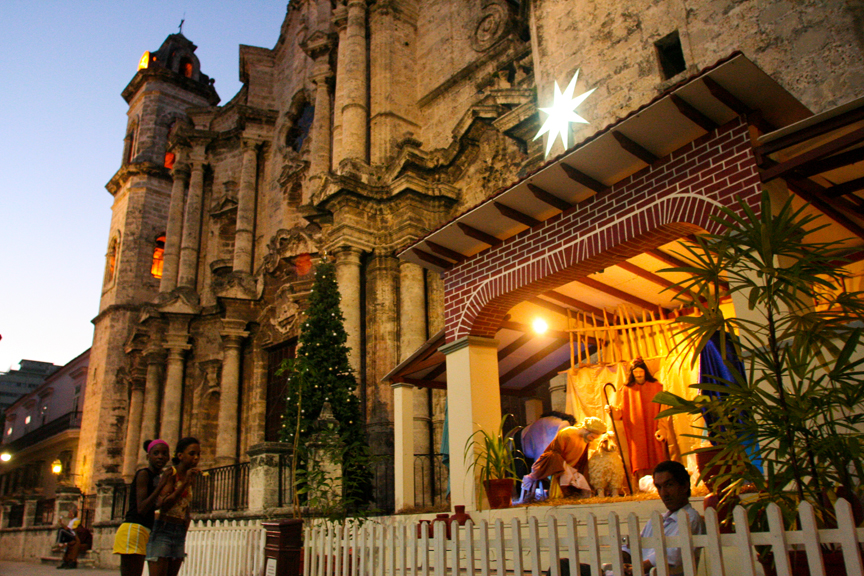
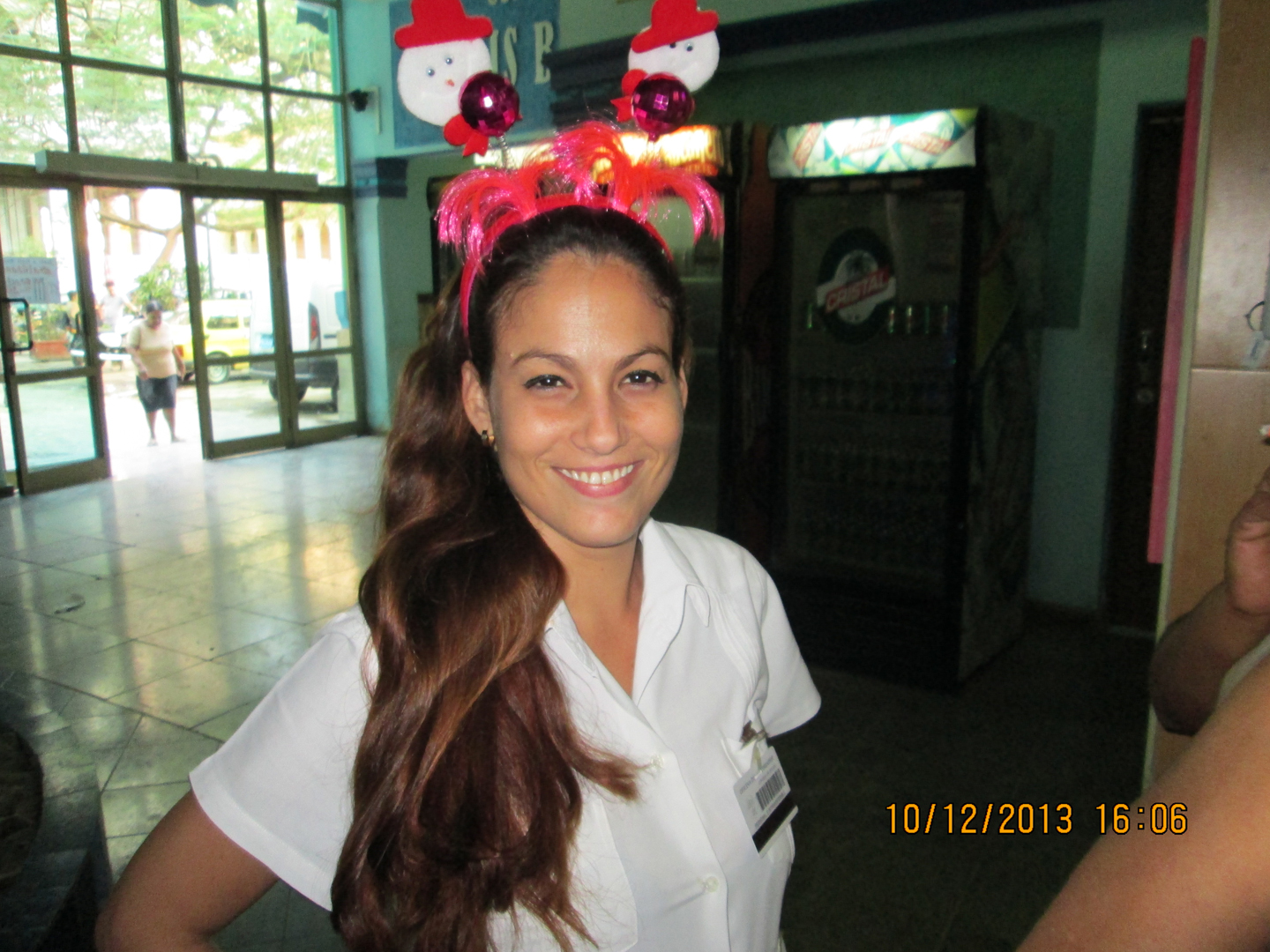
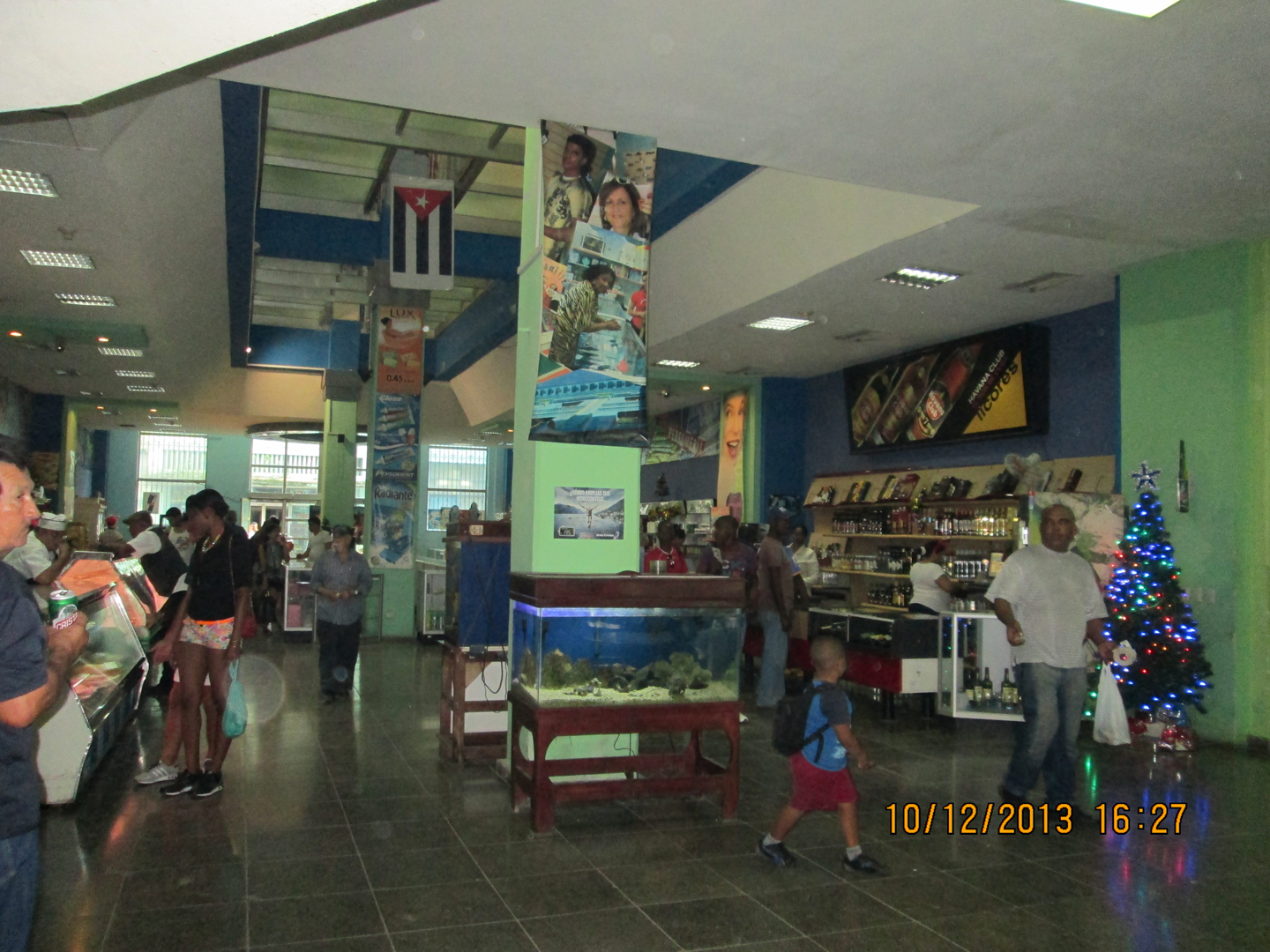
HAVANA, Cuba, December 24, www.cubanet.org – After all Christmas festivities, including Christmas Eve, New Year’s and Three Kings Day were, with the greatest silliness, ended by decree, the image of workers in the tourist industry decked out as Santa Claus, sweating away in hats, beards and boots (with no air conditioning to save electricity at their workplace), could not be more ridiculous.

To make this domestic comedy even more extreme, they strut around in their exotic hats bought with their own money, hoping to present an image of well-being that is belied by the poorly stocked shelves, and above all by a family atmosphere fragmented by the machinery of a revolutionary horde that never believed in God.

The elderly Otilia, who according to her own words is poorer than a rat, lived decently before 1959, with decency and the ability to enjoy real Christmas celebration in Cuba, gives short shrift to the unusual scene where there are little trees, Santa Clauses playing the saxophone, or garlands whose bulbs flash on and off depressingly, trying to look happy.

continue reading

“That’s over Sir, or rather the Communists exterminated it when they took over the country. You can’t resuscitate the dead, and they buried Christmas in the cane fields*, the coffee harvest, the agricultural and political mobilizations, and a fanfare of slogans, tasks, confrontations and victories that ripped it out by the roots.”

“In addition,” she said, “they replaced the traditional Christmas carols by Pello el Afrocán; midnight mass for a witches’ coven; the turkey and roast pork by a beans and rice sandwich; the wine by Bocoy rum; and the birth of the baby Jesus by the images of a disheveled troop of bearded ones passing by on television that day.”

“How can you talk about Christmas when people have barely anything to eat, dreams of abandoning the country, live off those who no longer live here, and don’t believe even in pretending to be what they are not? What celebrations can there be with the low salaries, disunity and violence, and yet they pay for those for the anniversary of the Revolution that provoked all this evil?”

A worker at the Carlos III department store says she only remembers Christmas festivities in which it was forbidden to light the tree in their house and instead of a celebration the New Year brought another anniversary of the triumph of the Revolution. If they violated these precepts her father could have lost his job.

Young workers at Harris Brothers, La Dominica, El Rapido at 15th and L, la Fuente and other establishments where workers do not walk on snow or slide on sleds because the budget does not allow it, say they don’t know anything about it and do it all by imitation, or because the union demands they pretend. What a way to celebrate Christmas.

Party and pachanga, demands the Revolution, and the more it seems that the traditions are cultivated in capitalism the better. Here we’ll go with many guidelines and supposed reforms to perfect the country’s socialism. The issue is staying in power.

No one is surprised, then, if during the days of Christmas Eve and Christmas the soldiers substitute crucifixes for weapons, and those who still pretend to be communists exchange the Che beret for a Santa Claus hat. As the poet said: Let the rumbón continue!

Victor Manuel Dominguez, Vicmadomingues55@gmail.com

Cubanet / 23 December 2013

*Translator’s note: The initial excuse for “postponing Christmas” was that it interfered with the sugar cane harvest.

Unification of Dual Currency, but the Economic Future Remains Uncertain / Miriam Leiva

HAVANA, Cuba , December, www.cubanet.org – Monetary and exchange rate unification was addressed by Raúl Castro in his speech at the closing session of the National Assembly and by Vice President Marino Murillo Jorge, on December 21, according to the Cuban media. The interest of calming the population can be seen in the president’s assertion that there will be no affects on those who legally earn income in hard currency and in Cuban pesos, nor on the cash in hand of the population, or on deposits in the national banking system. continue reading

He also added that “it will not be a magic solution to our problems, but it will contribute decisively to improving the workings of the economy and the building of a prosperous and sustainable socialism, less egalitarian and more fair, which will ultimately benefit all Cubans.” It will begin with legal entities (agencies and state enterprises and cooperatives) and will continue with natural persons, but currently plans for its implementation are still be developed.

Meanwhile, Murilla said that in the coming two years the more technical and complex tasks of updating the economic model will be undertaken. He confirmed that the CUP (Cuban pesos) will be the only currency in the country and that in no case would there by any impact on people’s purchasing power, as the financial capacity of the CUC (convertible peso) will be respected.

He reiterated that the measure will not by itself resolve all problems, but that it should be undertaken within the “guidelines” (the adopted measures for updating the economic model), to continue promoting the development of the state socialist enterprise, unleashing the productive forces and creating an export mentality.

Undoubtedly, the tasks are immense, as it is almost impossible to achieve efficiency in a socialist enterprise. First there must be an effort to overcome all the characteristic deficiencies of the Cuban system, such as reliability in accounting and respect for contracts, eliminated in the 1960s as “capitalist malformations.” The value of work must be recovered, through conscious and creative participation of the workers, which is not resolved by the Labor Code adopted at the National Assembly session on 21 December.

Increases in production and productivity will be required in order to be able to adequately reward employees whose salaries don’t cover their basic needs and who feel no incentive to work hard and, therefore, to consider work as a social honor. The diversion of state resources as compensation for the poverty level wages or to increase one’s economic level — enrichment Cuban-style — must be eliminated; in short, the corruption generated by the system must be eradicated.

Unleashing productive forces is an imperative, but how? The straitjacket of central planning and socialist enterprises, the rejection of market forces, the restrictions on farmers and the self-employes, and other problems, prevent it. To day, the measures implemented under the adopted “guidelines” to update the system have not resulted in increases in the food supply, which in many components has declined. Manufacturing production is also falling and the private activities permitted do not complement the straitened macroeconomics of the country.

We can see that in developed countries and in those that have overcome poverty, small and medium enterprises (PYMES) carry important weight in the national economy. The vicious circle of scarcity of products for the national and international market, and the situation of nothing to export and the importing of what could be produced in Cuba, continues. An export mentality could be created, but will it happen? Will there be solutions in the “more technical and complex tasks” as predicted by the vice-president?

Miriam Leiva

25 December 2013, Cubanet

Downpours Emphasize the Chaos / Martha Beatriz Roque

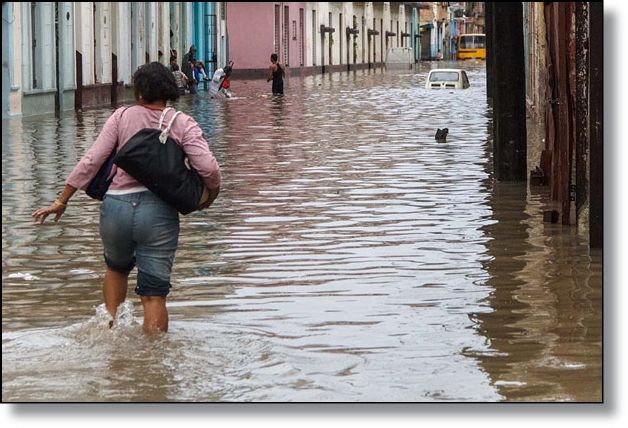
HAVANA, Cuba, December 2013,  www.cubanet.org.- . It’s frightening the number of housing collapses that have occurred in Havana, up to the end of November and in the first days of December. Officially, there have been 227 collapses, including 26 which were total and the rest partial. 627 individual families have been affected. They haven’t listed the localities where they occurred, to enable one to check the accuracy of the figures, and whether those identified by human rights organisations are included in the official government report.

In most of the neighbourhoods of the capital, including Miramar, which is crossed by 5th Avenue, the sewage system doesn’t work. When there is a downpour, the streets flood and the traffic is affected. But the drains appear so clogged as if they were cemented up, and some houses at a higher level also flood, because the gutters in the roofs have no way to run out onto the streets.

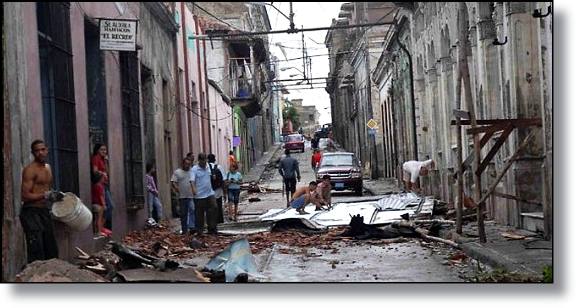
There are streets which remain full of mud and debris. That makes getting about difficult, including on the pavements, which are already affected by trees, whose roots break the concrete and form potholes which make it difficult to pass. In some municipalities like Centro Habana, Habana Vieja and Diez de Octubre it is dangerous to pass down the streets because the balconies are at risk of collapse, and the buildings too.

Given such government apathy, most of the streets have dumpsters crammed full and overflowing, with great mountains of solid rubbish. The divers, which is what they calll the people who rummage in the dustbins, spill the rubbish and the surroundings are converted into focal points for possible disease. And when it rains, like in recent days, this trash flows down the streets with the water.

Although you don’t see cats in public spaces, because they end up as the main course on the dining table of the Cuban poor, the dogs are all over the place, covered in scabies, near food shops. They also enter into some shops and annoy the customers.

The bicycle taxis go the wrong way along the streets, especially in Central Havana, endangering the lives of passers-by. The mobile salespeople also, in accordance with their custom, move their carts along different streets, and park them on any corner, dumping the waste from their sales. Both situations produce problems when it rains.

It’s very hard to find a public toilet in the city. If there is one, there is someone there who charges for its use, and because of that many people have used rubbish bins on the corners, out-of-the way columns, and other uninhabited places, as toilets. Even worse, those that have some sort of shelter, because they have walls, have been converted into accommodation for sexual acts.

The water falling washes away substantial quantities of urine and excrement from those sites.

The list of problems is endless, but the most unbearable is that there won’t be a solution, not even with the 10 million guidelines of the Cuban communist party, because solving the problems requires financial resources and political will, and both things are absent in the government’s programmes.

18 December 2013

Translated by GH