The fuel crisis and the disappearance of state-run routes turn every journey between San Jose de las Lajas and Guines into a battle
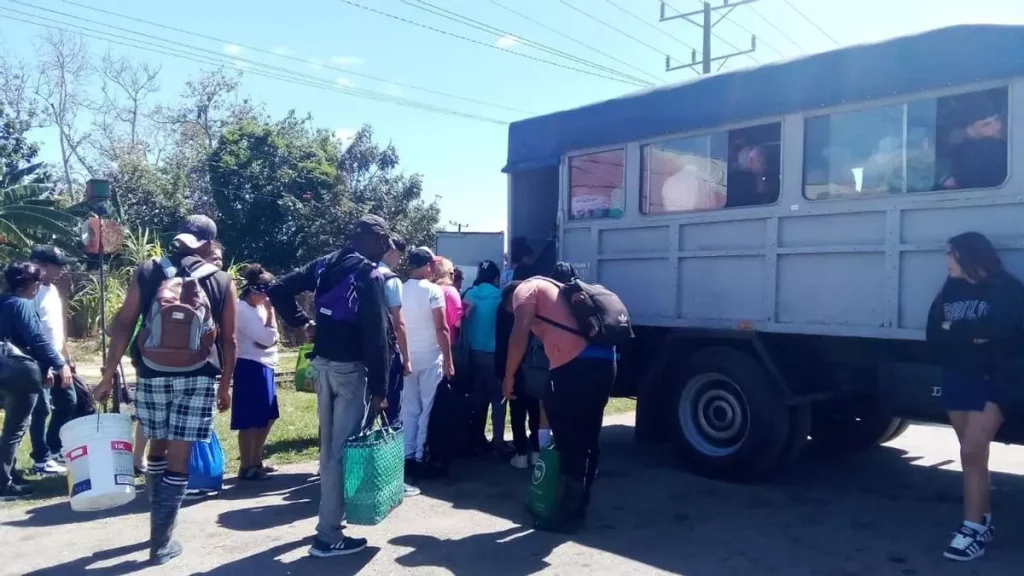
 14ymedio, Julio César Contreras, San José de las Lajas (Mayabeque), 21 June 2026 / Although Fernando and Marianne were both born and raised in Guines, they met at the old train station in San Jose de las Lajas, in the daily struggle to travel back to their municipality. The two often find themselves together beneath the potholed roof of the platform, where no locomotive whistle is heard any more, nor the screech of carriages on rails. In their place predominate the resigned conversations of those waiting, the shouts of private taxi drivers calling out their destinations, and the murmur of a crowd that seems to have taken up permanent residence there.
The old railway terminal has become a kind of improvised refuge for travellers caught between the lack of fuel, the disappearance of state-run routes, and the constant rise in the cost of private transport. The rails still cut across the ground, but they jut up through the grass like a relic of better times. Sitting on the walls of the building, dozens of people wait under the midday sun with shopping bags, backpacks, plastic buckets, and even sacks of root vegetables. Some have been there for hours.
“With all this fuel shortage, even private cars are nowhere to be seen. Sometimes hours go by without anything appearing for us to get on,” says Marianne.
A specialist at the Mayabeque Electric Company, the young woman admits that she can rarely complete her full working hours. The problem is not the work itself, but getting home.
The young woman admits that she can rarely complete her full working hours
“After two in the afternoon it’s practically impossible to get on anything heading to Guines. Right now there’s only one lorry leaving from there at six in the morning, which is the same one I take at midday. If I miss that chance I have to pay 600, 700, even 1,000 pesos for a car. At that rate my salary wouldn’t last me a week, and it’s 5,200 pesos that have to cover everything for the whole month.”
As she speaks, she watches the road anxiously. Every time a cloud of dust appears or the engine of some vehicle is heard, several people leap to their feet thinking that the lorry has finally arrived. Almost always it is a false alarm.
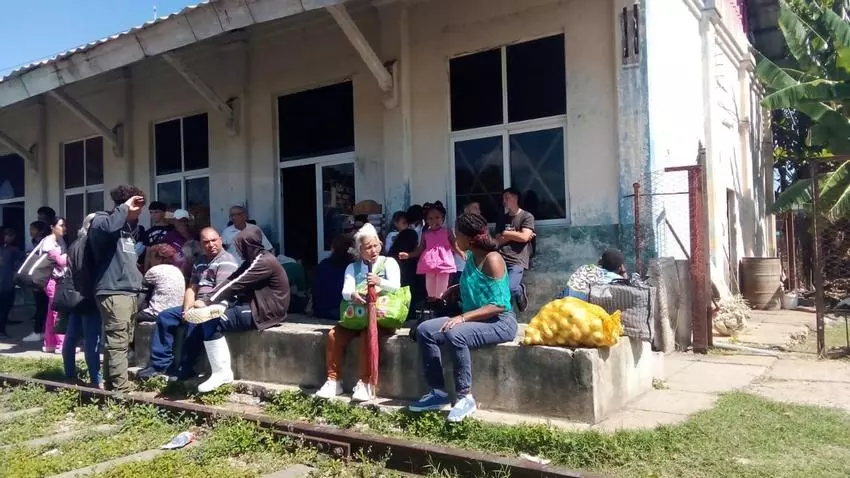
The waiting has something of a collective ritual about it. An elderly woman shields herself from the sun with a red umbrella, worn out by the years. A young man holds a bicycle wheel he has just repaired. Several students in uniform sit chatting on their backpacks. Near them, a pregnant woman searches for shade while shifting the weight of her body. All share the same uncertainty.
The most the sole employee who remains in the old building can do is try to manage the queue.
“In their desperation to get on, people resort to the law of the strongest, pushing and shoving included”
“In the end, there’s no point getting in last, because when the lorry arrives, people in their desperation to get on resort to the law of the strongest, pushing and shoving included,” Marianne complains, growing worried as she realises she should already be on her way home. “Today I really can’t take a shared taxi. I’ve got just enough money.”
The same scenes repeat themselves every day. When a lorry adapted for passengers finally shows up, people cluster around the door even before the vehicle has finished stopping. Boarding becomes a silent competition where every second counts. No one wants to be left behind to face several more hours of uncertainty.
When it comes to economic hardship, Fernando has his own stories.
“I was moved by an elderly woman who had just asked me for 100 pesos to make up her fare. In just a few days the cost has gone up four times, from 200 to 500 pesos. If the driver arrives today and charges more, there’s no choice but to pay whatever he asks. It’s true that diesel is hard to come by, but it’s also true that we poor people are being squeezed from every direction.”
Fernando travels daily to San Jose to care for his father, bedridden with a chronic illness. Every journey brings an added worry for his budget.
A trained industrial engineer now working for himself, Fernando travels daily to San Jose to care for his father, bedridden with a chronic illness. Every journey brings an added worry for his budget.
It is lunchtime and in front of the terminal, several kiosks are selling pizzas and soft drinks. Few people, however, go up to buy anything. For most, every peso must be kept back for transport. Eating has become a secondary expense when there is a chance that the next journey might cost even more.
“From five daily bus routes that at one point existed between Guines and San Jose, we’ve ended up with none,” Fernando recalls. “The worst of it is that in this country, things that disappear never come back. I myself am lucky enough to earn more than any professional’s salary, and yet I can’t afford to hire a taxi regularly, not even to ride one throughout the whole week.”
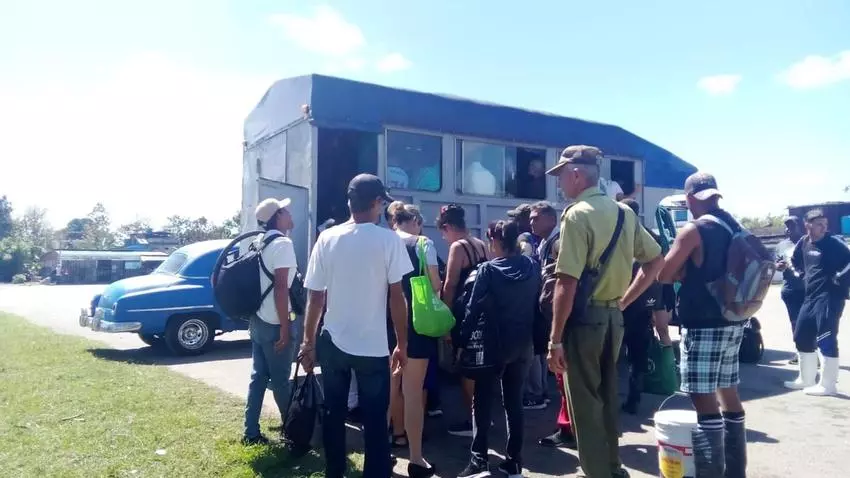
The transport crisis has ended up reshaping habits, schedules, and even family relationships. Many workers leave in the small hours to guarantee their return journey. Others have cut back on visits to sick relatives or have given up jobs that involve moving between municipalities. The distance between Guines and San Jose de las Lajas has not changed on the map, but for those who depend on public transport it seems today far greater than it did a few years ago.
The distance between Guines and San Jose de las Lajas has not changed on the map, but for those who depend on public transport it seems far greater today
Both Fernando and Marianne are working out ways to travel less and less. Logic has won out over desire.
“State buses are already out of service and the price of fares in private cars is going to keep rising without limit. So the best thing you can do is go as little as possible beyond the area where you live, because even with the money in your hand you can’t be sure of getting where you’re going in peace.”
As she speaks, the long-awaited lorry finally appears. The crowd gets to its feet almost all at once. Conversations break off, shopping bags change hands, and the queue dissolves into disorder within seconds. At the old train station in San Jose de las Lajas, where trains stopped coming years ago, there are still people waiting. They are no longer waiting for a train. They are waiting for something far more basic: the chance to get home.
Translated by GH.
______________________
COLLABORATE WITH OUR WORK: The 14ymedio team is committed to practicing serious journalism that reflects Cuba’s reality in all its depth. Thank you for joining us on this long journey. We invite you to continue supporting us by becoming a member of 14ymedio now. Together we can continue transforming journalism in Cuba.