More than a hundred residents marched in Centro Habana, while in other neighbourhoods barricades went up and rubbish bins burned
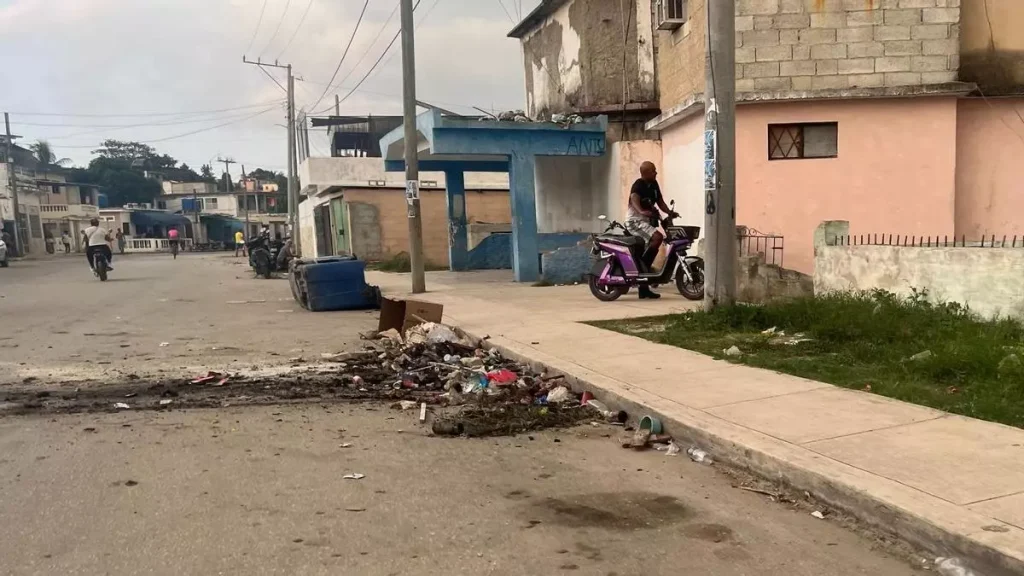
 14ymedio, Havana, 20 June 2026 / After more than 40 hours without electricity, more than a hundred residents took to the streets on Friday afternoon to protest in the San Leopoldo neighbourhood, in Centro Habana.
“They set fire to things right around the corner and everything,” one protester said in a video circulating on social media. “The police came with the ‘securocrats’ and they put the power back on,” she added, though it was cut again within minutes. “The situation we are living through in this country is unbearable and unsustainable.”
The footage shows entire families gathered in the street, in the area around Calle Rayo, between Zanja and San Jose. Some residents remained on pavements and balconies, while dozens of people occupied the roadway demanding answers from the authorities, banging their pots and pans.
“There are children, there are elderly people, and we have no way to cook,” one woman declared. Other protesters chanted “Freedom!” and expressed their rejection of the Government, in a protest that began over the lack of power but quickly took on a political tone. For a moment the gathering recalled the ’11J’ protests of 11 July 2021, with residents marching together, apparently in the direction of the Havana Capitol building.
For a moment the gathering recalled the protests of 11J, with residents marching together, apparently in the direction of the Havana Capitol building.
An increased police presence was reported in the area, though at the time of publication there was no confirmed information on arrests or confrontations.
Likewise, during the night simultaneous protests were recorded across several municipalities of the capital. 14ymedio confirmed protests in the municipality of Regla, which have been recurring daily over the past week. On Friday, rubbish bins were overturned and set alight. The previous Thursday, around thirty residents demonstrated outside the headquarters of the Communist Party. Although the Municipal Sanitation Services removed the bins to prevent them from being set on fire, waste continues to pile up in the streets and serves as fuel for the bonfires. Residents of the area confirm that, following the protests, the duration of the blackouts has been reduced.
On Friday, in another neighbourhood within the same municipality of Regla, after 72 hours without electricity, a group of residents blocked the street and gathered in broad daylight to bang pots and pans. Although the protest did not reach the intensity of those recorded in Centro Habana, police arrived quickly at the scene and shortly afterwards the electricity supply was restored, according to a report by CubaNet.
Among the most tense protests of the night was one that took place in the central area of Buena Vista, in the municipality of Playa, where dozens of residents gathered and burned rubbish bins in the street while banging pots, pans, and metal objects, demanding amid shouts that the power be restored.
Notable among the protesters was the presence of women and children, who threw combustible items onto the fire while striking any piece of metal within reach with force.
The situation was equally tense in Centro Habana, on Calle Escobar, between Neptuno and Concordia, where a group of residents lit bonfires to block the road. In the videos circulating online, the presence of women and children among the protesters stands out; they threw combustible items onto the fire while striking any piece of metal within reach with force. The police, who were watching without intervening, did not stop the minors from surrounding the officers while continuing to bang their pots.
Other spontaneous protests were reported in San Miguel del Padron, where residents burned tyres in the street after more than 24 hours of blackout. In El Cotorro, several rubbish bins were also set on fire. According to videos circulating on social media, in Barbosa, an area of the municipality of Playa bordering La Lisa, a number of protesters lit bonfires on Calle 23.
Protests have spread across different parts of the country as the duration of the blackouts has increased, in some cases exceeding 30 and 40 consecutive hours in the capital. Combined with the summer heat, food is spoiling and disease-carrying insects are proliferating. The prolonged power cuts are also affecting the supply of drinking water and the functioning of public services, including hospitals. Indignation increasingly appears to be overcoming fear of reprisals.
Indignation increasingly appears to be overcoming fear of reprisals.
In the early hours of Friday, after a week of consecutive blackouts lasting more than 24 hours, residents of the Valle Grande community in La Lisa – a neighbourhood surrounded by Ministry of the Interior and State Security installations – took to the streets and banged pots and pans until the electricity was restored, according to a report by 14ymedio.
Last Thursday, residents of Alamar took to the streets to protest in broad daylight after 28 hours without power, according to information from Alas Tensas. After a police deployment that cordoned off the area, the electricity came back on.
According to the information bulletin issued by the Electrical Union (UNE), a deficit of 1,989 megawatts (MW) was reported on Friday at 20:50 hours. Saturday night is also ex
pected to be difficult. With nine thermoelectric units out of service – among them the Antonio Guiteras plant, which has left the grid on 14 occasions so far this year – and 1,203 MW offline due to fuel shortages at distributed generation plants, an impact of 1,935 MW is estimated for peak demand hours, against a national demand of 3,050 MW.
Translated by GH.
______________________
COLLABORATE WITH OUR WORK: The 14ymedio team is committed to practicing serious journalism that reflects Cuba’s reality in all its depth. Thank you for joining us on this long journey. We invite you to continue supporting us by becoming a member of 14ymedio now. Together we can continue transforming journalism in Cuba.