The study by Sergio Arboleda University reveals that vaccines promised by Havana and a rice export project never materialized.
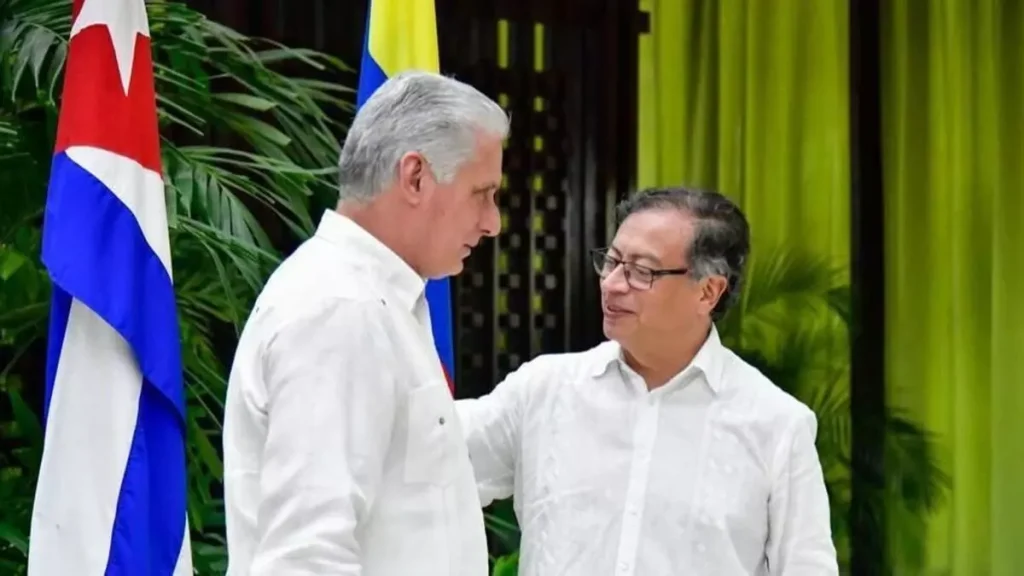
 14ymedio, Madrid, June 21, 2026 — During the government of Gustavo Petro, the Cuban regime expanded its influence over various Colombian institutions through cooperation agreements in sectors such as health, agriculture, education, and culture, according to an investigation by the Cuba Program of Sergio Arboleda University, based in Bogotá.
The study, titled The Silent Co-optation of the Colombian State by the Cuban Regime During the Government of Gustavo Petro, argues that these ties are part of a strategy of gradual interference by Havana, publicly presented as “bilateral cooperation.”
The research, which began in 2025, has already produced two installments, with a third containing the complete findings currently in preparation. Sergio Ángel, director of the Cuba Program, explained in an interview with Martí Noticias that the team requested information from various government agencies through formal public information requests.
One of the most significant findings concerns the 2,000 yellow fever vaccines that the Cuban regime announced it would donate to Colombia during a public health crisis.
“One out of every three institutions in Colombia entered into some type of agreement with some type of Cuban institution,” Ángel stated, describing the figure as “alarming” when compared with previous governments and after analyzing the content of the collaborations.
The researcher noted that the rapprochement between Bogotá and Havana was less visible than in other countries in the region because Colombia did not receive the usual Cuban medical missions during these four years. Nevertheless, ties developed through other programs and institutional agreements.
One of the most significant findings concerns the 2,000 yellow fever vaccines that the Cuban regime announced it would donate to Colombia during a public health crisis. The offer was publicized by the Cuban Embassy and publicly celebrated by Colombia’s then-Foreign Minister, Laura Sarabia.
However, a response from the Ministry of Health obtained by the researchers confirmed that the vaccines never arrived. The Cuban Embassy also provided no explanation when questioned by the newspaper El Espectador, according to Ángel.
For the director of the Cuba Program, the announcement allowed Havana to project an image of solidarity and create the appearance of reciprocal cooperation, even though the aid never materialized.
“What matters is not sending the vaccines, but demonstrating that they have a cooperative relationship,” Ángel said. In his view, such announcements serve to justify the subsequent transfer of Colombian resources to the Island.
The investigation also examined an alleged export of 300 tons of Colombian rice to Cuba
Colombia shipped a 100-ton cargo of humanitarian aid from Cartagena containing non-perishable food, medicines, hospital supplies, solar panels, electrical materials, and household goods. The operation was managed by the Presidential Agency for International Cooperation.
“There is no reciprocity in this type of relationship,” Ángel argued, maintaining that the Cuban regime obtains resources, diplomatic support, and political legitimacy in exchange for contributions that, in some cases, amount only to propaganda announcements.
The investigation also examined an alleged export of 300 tons of Colombian rice to Cuba. The Rural Development Agency promoted the operation on its social media accounts and presented it as a commercial opportunity for producers in the Meta department.
However, an official response indicated that the Cuban importer was never authorized, meaning the export never actually took place. Despite this, according to Ángel, the Colombian producers received the corresponding payment.
“Who paid for that rice?” the researcher asked. According to the study, the funds may have come from the Presidential Agency for International Cooperation, which is attached to the Presidency.
The publication coincides with the second round of Colombia’s presidential election taking place this Sunday
The case, he added, suggests that an operation presented as a commercial export may have ended up diverting Colombian public funds for unknown purposes, while the Cuban regime obtained propaganda benefits without bearing the cost of the purchase.
Another agreement examined involves Cuban participation in CampeSENA, a program of the National Learning Service aimed at farmers and rural workers. Ángel questioned why Cuba, a country that imports most of the food it consumes and is experiencing a severe agricultural crisis, is being presented as an “agro-industrial reference” for Colombia.
The study also identifies collaborations in education and culture, although details will be included in the third installment. The researchers state that several government agencies responded incompletely and that they had to file additional requests and legal actions to obtain the information.
Ángel argues that Petro’s government represented only the first stage of Cuba’s strategy in Colombia. According to his analysis, Havana seeks to reproduce a model of influence already implemented in Venezuela and Mexico, based on political alliances, state agreements, and economic assistance.
The publication coincides with the second round of Colombia’s presidential election taking place this Sunday. More than 41 million citizens have been called to choose Gustavo Petro’s successor between left-wing candidate Iván Cepeda, who represents continuity with the current administration, and right-wing candidate Abelardo de la Espriella. According to the study’s authors, the outcome will also determine whether the agreements established with Havana during the past four years are maintained or reviewed.
Translated by Regina Anavy
______________________
COLLABORATE WITH OUR WORK: The 14ymedio team is committed to practicing serious journalism that reflects Cuba’s reality in all its depth. Thank you for joining us on this long journey. We invite you to continue supporting us by becoming a member of 14ymedio now. Together we can continue transforming journalism in Cuba.