What Fidel Castro Left Us (Part 1) / Iván García

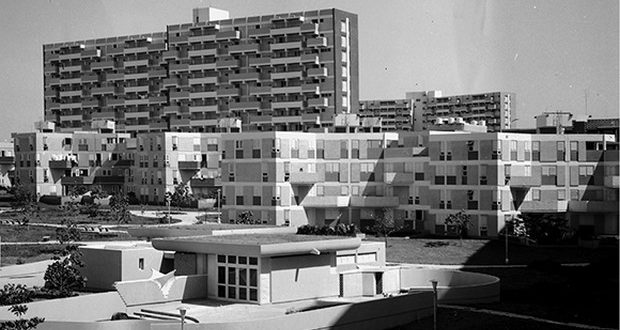
Neighborhood Unit No. 1 of Camilo Cienfuegos City, Havana, 1961. From the Department of Disclosure of the National Institute of Savings and Housing, currently conserved in the National Photo Archive of Cuba.

Ivan Garcia, 17 December 2016 — At the exit of the Bay Tunnel, the P-11 bus is packed with passengers. While the riders enjoy the view of the sea, the odor of saltpeter fills their noses.

In this stretch of Havana’s geography, where Monumental Avenue runs, an eight-lane street inaugurated in 1958 by the dictator Fulgencio Batista, there were plans to build dozens of hotels, casinos, condominiums and suburban neighborhoods very close to the Bacunayagua Bridge, almost at the border of Matanzas province.

“It was a project of skyscrapers and daring designs to attract tourists and also for middle class professionals to rent or buy a house east of Havana. If the Revolution had triumphed in 2016, it would have found a wonderful city. In the style of Rio de Janeiro. And Miami wouldn’t even compete,” emphasized Roberto, a retired architect aged 75. continue reading

The son of a designer who worked for Govantes and Cabarrocas, an architecture firm dedicated to the design and construction of works that constitute the urban landmarks of Havana, Roberto says that Cuba needed to get democracy, stop the corruption and create government strategies to do away with poverty, particularly in the countryside.

“But apart from the political situation, Havana and other cities in the interior were a little piece of gold. The public transport services, the post office and the water system, among others, all worked efficiently. Without being chauvinistic: In Latin America, other than Buenos Aires, there was no other city with such architectural riches and functional neighborhoods,” said Robert, adding, “In the downtown and old part of the capital we find linear portals supported by Doric columns with original designs, one- or multi-story stores, restaurants, inns, bars, bookstores, banks, offices… Miami today is what Havana did not become.”

In 1940, Fulgencio Batista presented himself as candidate of the Socialist-Democratic Coalition in the elections of that year and won. He had great popular support and one of his first measures was to legalize the Communist Party.

In 1940, not only was a formidable Constitution approved in Cuba, but there also began the construction of public schools, technical institutes, clinics, hospitals and shelters. Avenues, buildings, neighborhoods and mansions were inaugurated.

Twelve years later, on March 10, 1952, Batista seized power at the barrel of a gun and became a bloody ruler. But even the most brutal dictators always seek to leave an urban legacy. Adolf Hitler inaugurated the best motorways in Europe. And Augusto Pinochet built a robust economy in Chile.

Fidel Castro did not murder millions like Hitler (although according to Maria Werlau, director of the Cuba Archive, the dead of the olive green revolution multiplied by five the crimes of Pinochet). Castro’s repressive resources were based on the formula “more fear and prison than blood.”

In politics, with regards to what his supporters boast about, his successes have been exaggerate. Fidel Castro, it’s true, was a political animal. Purebred. Astute, cynical, and capable of doing anything to achieve his objectives. He had an enormous ego and a sick need to call attention to himself. Manipulator, liar, charismatic and a laudable ability to lead.

He enchanted people with a masterful combination of extensive verbiage, seasoned with a dose of nationalism and social justice. He offered a blast of populism. He promised to lower rents and the cost of electricity, offer free college and enact agrarian reform. Almost all these promises were kept in the first years of his Revolution.

Then he became radicalized. He polarized society and ruled for his supporters. His adversaries were marked with a scarlet letter. They were not people: they were worms, scum, mercenaries.

Several of his deranged projects triumphed only in his head. From draining the Cienaga Swamp, to sowing thousands of coffee plants on the outskirts of Havana, to the constructions of a hundred thousand houses a year. His plans were Homeric. Let us focus, for a minute, on his urban projects.

In February of 1959, on doing away with the National Lottery, considered corrupt by Fidel Castro, one “the bearded ones” (as Castro’s guerrillas were called) named Pastorita Nunez, former tax collector for the insurrectional movement and former fighter in the Sierra Maestra, was the director of the National Institute of Savings and Housing (INAV). From that moment, Nunez decided to put all his energies into ensure that Cubans throughout the island had a decent house or apartment.

In East Havana, less than two miles from the center of the city, a stone’s throw from the Bay Tunnel on 80 acres of wasteland, bordered on the north by the shoreline and the Atlantic Ocean and on the south by Monumental Avenue, under the direction of Pastorita Nunez and UNAV, rose Camilo Cienfuegos City, the best residential complex built to date by Castroism, declared a National Monument in 1996.

For a population of 7,836 people 1,306 apartments were erected, distributed in 51 four-story buildings with twenty different models and 7 eleven-story buildings of three different models. The team of architects was made up of Roberto Carrazana, Hugo D’Acosta Calheiros, Mercedes Álvarez, Ana Vega, Manuel Rubio, Mario González Sedeño and Reinaldo Estévez. They were joined by several architecture students, among them Mario Coyula.

The City, or “Reparto Camilo Cienfuegos,” began construction in April of 1950 and was finished in November of 1961. In 667 days, at a rate of two houses per day, a balance was achieved between high and low buildings, green areas, pedestrian paths and vehicle circulation, commercial and recreation areas. And with an excellent quality of construction. The specialized labor came from Havana and other provinces. Among them was Angelito, a relative or ours who in his native Sancti Spiritus was a first-class mason.

Although the architects took into account the worldwide trends of the 1950s, and had studied international experiences such as the Clarence Perry neighborhood unit in the United States, British New Towns and the satellite cities of the Scandinavian countries, among others, it is clear that the design of the tallest buildings resemble the Focsa Building, at 17 and M in the Vedado neighborhood of Havana, inaugurated in 1956 and with its 36 floors — the highest in the country — which  is considered one of the seven marvels of Cuban civil engineering.

After the good work of Pastorita Núñez and the INAV came the architectural debacle. “I’m going to talk about Havana, which is what I know best. Without fear of being mistaken, after the Camilo Cienfuegos deal, nothing worthwhile has been built in the capital in the capital,” says Roberto, a retired architect.

And he lists the multiple absurdities. “At the triumph of the Revolution, in 1959, there were two large slum neighborhoods in Havana, Las Yaguas and Llega y Pon. In the municipalities there was no current overcrowding and no one had had the idea of constructing “barbacoas” — platforms referred to as “barbecues” — to make two rooms out of one. And 90% of the houses were in a state of good repair.”

And he adds, “Today there are hundreds of slum neighborhoods and 50% of the housing is in fair or poor condition. As in the former socialist countries of Eastern Europe, it will be necessary to demolish or rebuild dozens of bedroom cities like Alamar, San Agustín and Bahía, where there are buildings constructed with poor quality materials by neophytes. The microbrigades — made up of workers and professionals who became builders by necessity — caused a colossal architectural chaos in Havana. Placing the shabby microbrigade buildings next to other buildings or residential areas of quality construction is an urban crime,” says Roberto.

For the retired architect, “the construction systems adopted were prefabricated and tasteless. Some imported from Yugoslavia, like the IMS. Others were designed in Cuba, but as a whole they were ugly and uniform. As they didn’t have the 100-yard blocks like the Spanish blocks, they put up buildings without sewers, parks, schools and other social works. An urban absurdity.”

In Roberto’s opinion, Fidel Castro’s legacy in architectural matters is rather poor. “The exceptions are Camilo Cienfuegos City, the Coppelia Ice Cream building by Julio Girona and the National Schools of Art by Ricardo Porro in collaboration with the Italian architects Roberto Gottardi and Vittorio Garatti. By Antonio Quintana I would mention The House of the Cosmonauts in Varadero, the Palace of Conventions in Cubanacan, Lenin Park and a twelve-story experimental building on Malecon and F, currently in a deplorable condition due to lack of maintenance. I may miss some other important work. But there are not many more. ”

It’s enough to tour Havana to see what an urban shipwreck it is. The majority of the 20th century buildings with any architectural value were built during the Republic Era (1902-1958).

A detail: The founders of Fidel Castro’s Revolution live today in houses built before 1959, expropriated from prosperous local bourgeoisie. The Fidelistas are not stupid and they don’t have bad taste.

The Ubiquitous Dictator / Cubanet, Miriam Leiva

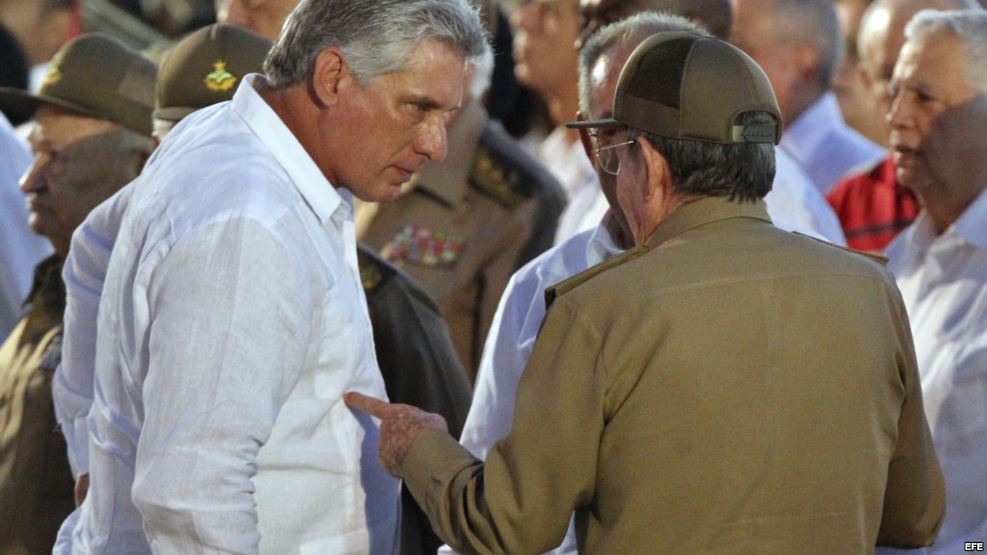
Cubanet, Miriam Leiva, Havana, 6 December 2016 — Raul Castro wants Cubans to commit their support to major economic restrictions in 2017, during the complex period of the transfer of power from the so-called historic generation, through the signing of an oath to the definition of the Revolution and Socialism promulgated by the deceased leader, using the slogans “the permanent teaching of Fidel is that yes we can,” and “life continues.”

Fidel Castro prevented his physical permanence after death. The body was cremated. His tomb, apparently modest, in a rock from the Sierra Maestra, is a representation of strength and durability. There will be no monuments, statues, plazas nor allegorical streets, according to the Commander’s own decision. continue reading

Raul Castro announced that he will present proposed legislation for this for approval by the next session of the National Assembly. However, Fidel Castro will be omnipresent through the recurrence of his phrases and actions in discourse and in posters. During the days since his death on 25 November he has been mentioned in the media at the same level as José Martí, [the national hero whom Cubans of all stripes call] “the Apostle” of Cuba, and invoked as Father of the Fatherland, displacing Carlos Manuel de Cespedes.

Raul Castro deftly focused his farewell speech, given at Antonio Maceo Plaza in Santiago de Cuba on 3 December, on “yes we can,” based on the determination of Fidel to bring his proposals to fruition, to infect his followers, to find solutions and to overcome great obstacles.

Fidel spoke the words sworn by the participants in the funeral rites, placed next to his tomb, and that will be invoked permanently by the authorities, on 1 May 2000, when the Special Period had been ongoing for nearly a year, and a few months after Hugo Chavez assumed the presidency of Venezuela.

He had had time to work with his soulmate on help for the Cuban economy and expansion through Latin America and the Caribbean, but achieving this would possibly require changes in the concepts expressed to date and the methods utilized so far.

So the crisis provoked then, by the loss of the subsidies from the Soviet Union and the Socialist Camp, now comes from the loss of aid from Venezuela, both the result of the waste of resources on mega-plans rather then economic needs.

Fidel left Raul his words to confront the economic situation, the hidden intentions of the hardliners, and the disgust of a population exhausted by privations and unmet promises. His major legacy is that “socialism is irrevocable” according to the Constitution. As Fidel explained in May of 2002, Bush demanded that Cuba change its political and social system, and in response there were two months of large demonstrations, the National Assembly approved amending the constitutions, and eight million Cubans signed their names to it, through different mass organizations.

Fidel did not mention it as a cause of the expansion of the peaceful opposition movement throughout the country, in organizations of journalists, librarians, doctors, independent educators and the Varela Project, which was repressed in March of 2003, with 75 prisoners of conscience condemned to long prison terms, in a process that came to be known as The Black Spring.

Fidel acknowledged that everything is revocable, but being part of the Constitution, it can only be revoked by the National Assembly of People’s Power. They decided to declare the socialist character of the Revolution irrevocable, which means “that to revoke the socialist character there has to be a revolution, or rather a counterrevolution… including a legal takeover of the government by the enemies of the Revolution, leaving them a theoretical clause: go to the Assembly and being the majority… and then doing the same, collect the millions of signatures, which they can never do, and declare by decree, revoking by decree, socialism.” (from One Hundred Hours With Fidel, Conversations with Ignacio Ramonet).

Achieving a National Assembly majority would face the challenge that the electoral system in Cuba makes it impossible for people to be candidates without the recommendation of the Communist Party.*

Raúl Castro, who has stated his plan to retire in 2017, will have to resolve the obstacles posed by the hardline leaders at the same time he deals with his replacement in the Councils of State and of Ministers in 2018. As the first secretary of the Communist Party, surrounded by his military, he will maintain the maximum power to direct and support the handing off of power to those who will not have the aura of having fought in the Revolution. He could use Fidel’s words that “revolution is to change everything that needs to be changed” to promote his limited reforms, apparently obstructed by the conservatives.

The general will have to reformulate the “updating of the economic and social model” with relaxation of the tight controls through real changes to free up agriculture and self-employment, to streamline the management of state enterprises, and to simplify legislation and decision making at all levels, with an emphasis on rapid approval of foreign investments.

Before the end of the 2016 concluding session of the National Assembly, where the general-president reports on the failure to achieve the 2% GDP growth planned, and even the 1% later projected in July, perhaps there will be new measures to cope with the recession in 2017, and the demand for renewed “heroism” following the spirit of Fidel.

The policy followed by the new US president, Donald Trump, could stimulate the hard line leaders if he reverses the measures taken by Barack Obama and obstructs the advance of reformist elements. The just demand for respect for human rights and space for the opposition could have counterproductive effects, if hardliners remain in positions of strength as they have during the previous 55 years of failures.

*Translator’s note: In fact, candidates can propose themselves for election without Party support, but the Party prepares all the election materials. Campaigning is illegal and candidates are presented entirely by officially prepared single page biographies, posted in windows. For two 2015 candidates, this meant biographies that stated they were “counterrevolutionaries.” They both lost, but one received 19% of the votes in his polling place, to the winning candidate’s 28% (in first round elections).

Is Raul Castro Preparing for a Handover to Diaz-Canel or Something Else? / Juan Juan Almeida

Juan Juan Almeida, 15 December 2016 — Thirteen months before his anticipated retirement, General Raúl Castro is setting the agenda for an individual who, even within the ranks of the Communist Party, provokes a rare mix of opposing opinions and strong reactions.

Miguel Mario Díaz-Canel Bermúdez is today the person most likely to be the next President of the Council of State of the Republic of Cuba and curiously has already come up with a series of measures that should guarantee an awkward form of popular approval. continue reading

I do not know if the Cuban government is planning an early transition of power. I anticipated surprises but I don’t know if they are preparing for something else. There is, however, a rumor circulating in the halls of power that a presidential agenda is already being prepared for “comrade Díaz-Canel.”

The new leader’s work schedule includes repealing certain regulations and creating others, such as reforming the country’s financial system, passing a new law on foreign investment, implementing labor reform focused on drastically increasing the quality of the Cuban workforce, generating more private sector employment and ostensibly improving pension benefits.

I asked a few acquaintances about the rumor and this was one response:

“It could be; he is a quiet guy. He keeps to himself and his strategy for getting ahead amounts to keeping his mouth shut. But he is still a good man,” says one.

Another said, “I heard something but I don’t believe he is genuine reformist who suddenly appeared on the scene after lying low. He has no leadership abilities. Díaz-Canel is an opportunist who has molded himself to please Raul Castro.”

But opinions vary. The measures being planned seem quite attractive but, without severing ties to family members of the country’s longtime leaders, I doubt they will do much to improve the island’s financial system.

A new investment law more appropriate to our times, one that offered financial benefits, could incentivize serious investors. But it could also be a magnet for scoundrels and astute money launderers.

Labor reform would increase productivity. Since Cuba has one of highest proportions of elderly in Latin America, improving retirement benefits for pensioners would also provide hope for the larger population. But increasing their income and extending their coverage seems misleading to me. After all, it is the unstoppable emigration of younger people and the decline in the birthrate that has given rise to a progressively aging population, a development which threatens the financial sustainability of the pension system. Its resources are completely inadequate to cover the retirement needs of any elderly Cuban. Increasing the paltry benefits they receive today would be nothing more than a semantic trick. Due to currency devaluation, done to reflect the currency’s true value, any increase would actually be a big decrease.

It is not enough to have an agenda that, on simple inspection, seems designed to confuse the public, add a new element to US-Cuba relations, play with people’s uncertainties and destroy dissident proposals through reforms that seem significant but have very little to offer.

It is difficult to predict but I feel that Díaz-Canel who now serves as vice-president of the Council of State and Council of Ministers, lacks the political will to become the magician who will transform today’s troubling reality into a more pluralistic, inclusive and productive Cuba.

Last Imports Before Cuban Customs Raises the Duties / 14ymedio

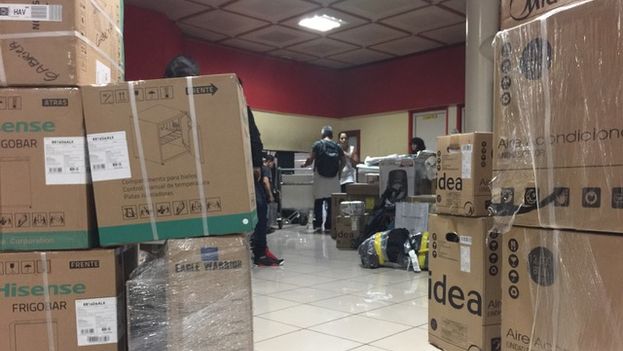
Technology imports overwhelms the luggage rooms in the Havana airport. (14ymedio)

14ymedio bigger14ymedio, Havana, 20 December 2016 — Jose Marti International Airport in Havana is busy. The increase in tourists, the avalanche of foreign journalists who came to the island on the occasion of the death of Fidel Castro and the proximity of the end of the year recharged its infrastructure. To this is added the completion, on 31 December, of the deadline for those who have not yet made their first non-commercial import of this year, paid for in national currency, the Cuban peso (CUP).

The “mules” who travel and buy, preferably in Panama, Cancun or Miami, are hurrying to bring everything in the country before the last day of the year. According to customs regulations, in force since September 2014, each resident in the national territory can make a single import annually, beyond what is considered personal effects, with the duties paid in Cuban pesos. Duties on merchandise brought in on subsequent trips must be paid in Cuban convertible pesos, which are worth 25 times more than Cuban pesos. continue reading

The most behind are in a rush and it is common to see Cubans arriving on flights from Interjet, Aeromexico, Cubana and Copa Airlines loaded with boxes filled with air conditioners, flat screen TVs and other appliances. The luggage collection rooms are overwhelmed with so many bundles and tourists look stunned at the parade of technology.

Cuba Sends A Shipment Of Vaccines To Syria Worth Almost One Million Dollars / 14ymedio

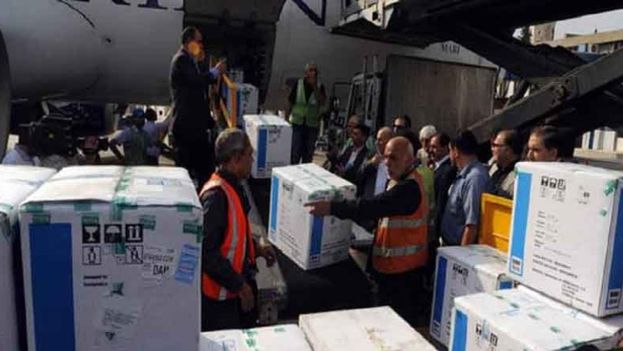
Arrival of cargo of medicines to Syria. (SANA)

14ymedio bigger14ymedio, 19 December 2016 — The Cuban government has sent Syria a shipment of nearly 240,000 doses of meningitis vaccine valued at $930,000.

The container, received this Sunday, is part of the agreement signed between Syria and Cuba last April that includes, in addition to medicines, an economic agreement to liquidate the debts of the Government of Damascus with the island.

Relations between the Syrian and Cuban authorities have been very close in the last five decades. President Bachar al-Assad and Raúl Castro have carried on, in recent times, the friendship initiated by Hafez al-Assad and Fidel Castro.

This is the second time in 2016 that Cuba has sent medicines to the Arab country, heavily devastated by almost six years of war.

Party In A Whisper: The End Of The Year To Come / 14ymedio, Marcelo Hernandez


Pánfilo’s program has not been broadcast for three weeks. In the video above Obama and Pánfilo appear in a ‘sketch’ recorded during the visit of the American president to the Island.

14ymedio bigger14ymedio, Marcelo Hernandez, Havana, 15 December 2016 — Celebrations postponed, revelry suspended and a call not to party in the street, is the reality for Cubans at this year’s end. The sobriety for the death of former President Fidel Castro has spread to television programming and the popular comedy show, “Living to Tell the Tale,” with the lead character Pánfilo, has not been broadcast for three weeks.

“We have received a circular with details on what can be broadcast and what cannot,” a specialist from the Cuban Institute of Radio and Television (ICRT) who preferred anonymity told 14ymedio. “The directions are clear: everything that is programmed has to be analyzed very carefully so as not to fall into frivolities,” he says. continue reading

Throughout the country, all the centers with cultural programming have held meetings to direct their workers to show austerity and moderation, but the calls to avoid celebrations extend beyond facilities for shows, concerts and movies.

Vivian, 42, works as a nurse in a polyclinic in the city of Santiago de Cuba. She explains that in a meeting she was in last week, they were ordered not to hold the gift exchange the medical staff had organized for the last week of December. “I already bought everything,” she said.

Pedry Roxana Rojo, a LGBT activist and worker at a branch of the Cuban Book Institute (ICL) in Caibarién, Villa Clara, published on her Facebook account a protest against the suspension of popular festivities traditionally held at the end of the year.

Rojo, who is also an independent reporter, complains about the secrecy of the official media about the postponement of the festivities. “They have suspended the holidays here this year by royal edict,” she quipped on the social network, telling14ymedio that the decision affects not only residents but also tourists coming to the area for those dates.

The parrandas of Remedios, along with other popular celebrations in the center of the island, have been postponed to January 6 and 7, according to a source from the Municipal Assembly of People’s Power speaking to this newspaper. It is the fourth time in the last six decades that these celebrations have been suppressed or had their dates changed.

The first cancellation of the parrandas occurred in December 1958, when guerrilla commander Camilo Cienfuegos arrived in the area with the so-called “invading column” that brought the combat actions from the Sierra Maestra to the west of the island.

In 1969, the parrandas were again suspended in the midst of the “decisive effort” promoted by Fidel Castro’s government to achieve a 10 million ton sugar harvest. All the end of year celebrations were postponed, but the harvest did not achieve the planned figures.

A decade later, an official directive moved all the popular celebrations of the country to the months of July and August. The parrandas were not allowed to be held in that December of 1979. The measures became more flexible with time and “the waters took their course,” says Moisés Luaces, a peasant from the area who remembers every interruption of his favorite festivities.

So far, official media have not called for the moderating of Christmas parties held inside homes, but many fear that the ruling party will urge Communist Party militants and members of the Committees for the Defense of the Revolution (CDR) to snitch on the most enthusiastic.

Cuban Christmas: Between Killjoys And Mourning / 14ymedio, Miriam Celaya

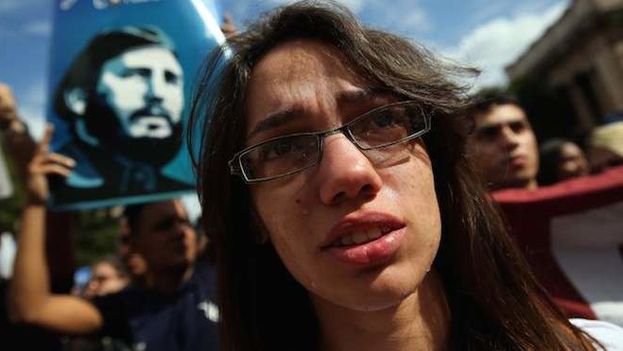
Cuban university students march after Fidel Castro’s death in Havana. (EFE)

14ymedio, Havana, Miriam Celaya, 18 December 2016 — I’m clueless as to what they are called in other cultures, but for Cubans here and abroad, the word “sapo,” which literally means “toad,” is a term applied to the typical individual who always shows up in a situation where there is fun, optimism or joy, for the sole purpose of ruining it, spoiling the fun, souring the wine, in short – using the verb form of the word, sapear – acting like a toad (or in English, like a killjoy, a drag, a sourpuss, a wet blanket).

In Cuba, hedonistic and smiling despite adversities, being a killjoy is one of the many ways of being a drag, which, among us, is the worst of defects. Understand the subtlety: you can be a drag without necessarily being a killjoy, but it is irrefutable, that absolutely all killjoys are drags. That is why the killjoy can earn the dislike of everyone present in a second, in any setting and circumstance. “Don’t be a killjoy” is an expression of resounding rejection among us, against the individual who sabotages pleasure in any of its manifestations. continue reading

That is why it’s all the more curious and contradictory that in Cuba the killjoy has been inflated to become an institution and State policy. In fact, in the last 60 years the Power has been in the hands of a small group of green batrachians who systematically and by decree, are committed to put down any hint of popular happiness.

In the last 60 years the Power has been in the hands of a small group of green batrachians [toads, as in killjoy] who systematically and by decree, are committed to put down any hint of popular happiness

If anyone has any doubts about this, suffice it to list a few brushstrokes of the unrepentant olive-green killjoys: the proscription of traditional festivities like Christmas, the rationing of food and everything that meant prosperity and comfort, Volunteer Work to ruin the workers’ Sunday rest, the exclusion of a lot of very good foreign and local music from national radio stations, the imposition of mournful commentaries of the calendar of “communist saints” list to the detriment of religious holidays (Holy Week, among others), and many other examples too numerous to list here.

In these final days of 2016, another thorny and barren year, and after barely surviving the recent novena of the Deceased in Chief (Killjoy par excellence), Cuban workers have been informed that traditional Christmas festivities will not be held, festivities which in many State labor centers are practically the only celebrations almost devoid of political nuance. And I say “almost” because it is known that, at least officially, Cuban workers do not celebrate the birth of the Baby Jesus or the advent of the New Year, but the glorious anniversary of the triumph of the revolution. (Lowercase letters are intentional).

Only that mourning must seem like a spontaneous expression of the people, that is why it has not been decreed by the government nor divulged in the official means, but it has been ordered from each Ministry to the directors of its different institutions

Anyway, there will not be any hullaballoo. “We are in mourning,” according to the secretaries of the Cuban Communist Party (PCC) and the directors of each state work center, minor killjoys responsible for revealing the bad news, which is in addition to the already known suspension of festivities and popular celebrations in the towns in Cuba’s interior.

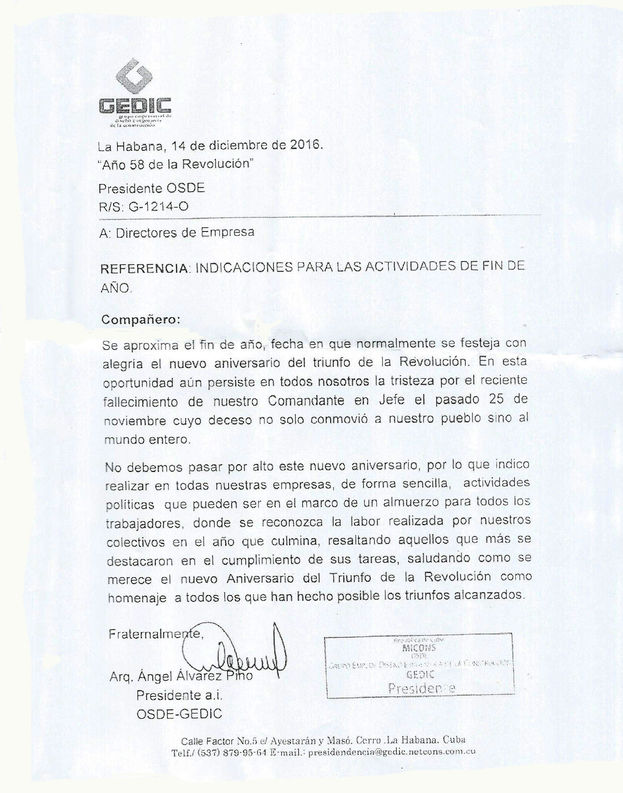
The director of the Business Group of Design and Construction Engineering, Architect Ángel Álvarez explains to the workers the need to “not overlook” the anniversary (sic) of Fidel Castro’s death. (Miriam Celaya)

But the mourning must seem like a spontaneous expression of the people, that is why it has not been decreed by the government nor divulged in the official media, but it has been ordered from each Ministry to the directors of its different institutions, who in turn have “indicated “in writing to the Directors of Companies subordinated to them, that this time the celebration should be “simple” through “political activities that can be in the framework of a lunch for all workers.” And, though the official document does not express it, the order is that there will be no alcoholic beverages in the aforementioned lunch. Mourning is mourning, which means that one doesn’t really need to be sad, just look like it.

The reference comes from the Business Group of Design and Engineering of Construction (GEDIC) and the Superior Organ of Business Management (OSDE), both of the Ministry of Construction, to which more than thirty companies are subordinated at the national level, including those responsible for supervising the construction work of the Mariel Special Development Zone (ZEDM).

It was in one of these subordinate companies where the Director, after successfully fulfilling his mission of killjoy in office duties and announcing the non-holiday party, went to the office of the superior chief where, according to stupefied witnesses, the killjoy-directors gathered there toasted with a generous drink of Havana Club Reserve to the memory of the Main Batrachian killjoy.

Berta Soler Released, But UNPACU Activists Still Detained / 14ymedio, Mario Penton

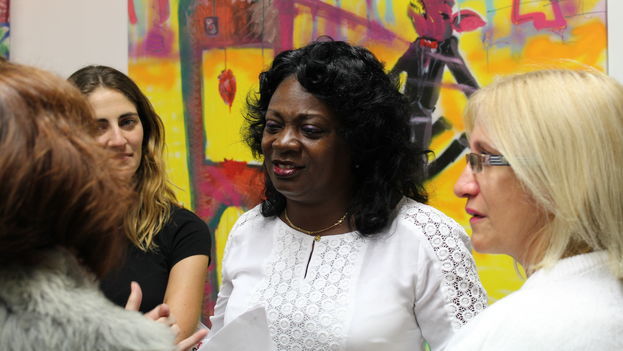
The leader of the Ladies in White, Berta Soler, during an exhibition of the work of Danilo Maldonado, known as El Sexto. (14ymedio)

14ymedio bigger14ymedio, Miami, 19 December 2016 — The leader of the Ladies in White movement was released on Monday after being detained for 24 hours. Berta Soler was arrested the previous day in one of the largest raids against the opposition in recent months. Meanwhile, approximately ten activists of the Patriotic Union of Cuba (UNPACU) remain imprisoned, according to a report by phone from Jose Daniel Ferrer, leader of that organization.

“According to the count we have done, some 117 UNPACU activists were arrested on Sunday and nine houses were raided by the police, who seized five personal computers and dozens of phones, flash drives, printers and printed materials,” Ferrer told 14ymedio. continue reading

UNPACU had called for a march for freedom of all political prisoners and solidarity with Danilo Maldonado, known as El Sexto, and Eduardo Cardet, who were both detained after the death of Fidel Castro.

Six of the houses raided were in Santiago de Cuba, two in Palma Soriano and one in Palmarito de Cauto.

According to Ferrer, the police also seized cash in the houses where they entered, including 370 CUC “intended for the feeding of a pregnant woman and the purchase of things for her unborn child.”

The opponent considers that the government is trying to behead the movement. “They want to capture as many coordinators of UNPACU as possible,” he explains. Almost all detained activists have this organizational role within UNPACU.

This Monday the trial of Lisandra Rivera Rodriguez, accused of the crime of attack, was expected to be held.

UNPACU leader, Jose Daniel Ferrer (EFE)

“They are afraid of the reaction of the organization, so they are developing a rather large operation in Santiago de Cuba. They have placed police barriers around my house,” says Ferrer. The police again threatened to return him to jail, when he and other left together to seek the mediation of the Catholic Church.

“I was told that I was inciting the members of the UNPACU to commit crimes of public disorder, attack, contempt and espionage,” he commented.

UNPACU is the largest opposition organization in the country, centered mainly in the eastern provinces and with a presence in Havana.

The Ladies in White also reported the arrest of 32 activists in Havana and an undetermined number in the provinces.

“We are now updating the report to have the total number of arrests because many Ladies are still being arrested,” said Eralidis Frómeta, who belongs to that movement, which was founded by Laura Pollán in 2003.

Cuba’s State Phone Company Lowers Internet and Email Prices / 14ymedio

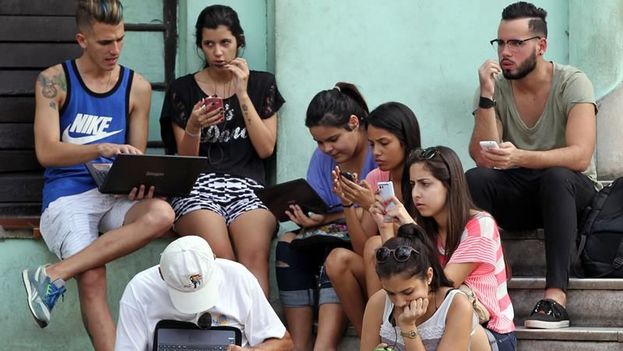
A group of young people in a wifi zone in Havana. (EFE / Archive)

14ymedio bigger14ymedio, 19 December 2016 – The state-owned Cuban Telecommunications Company (Etecsa) – the only phone company permitted to operate in the country – announced on Monday a reduction in the prices of its internet service and its Nauta email service from cellular phones. The state monopoly thus responds to growing criticism for its high rates for data.

The international online navigation service to connect to the internet, accessed by users from wifi enabled areas or from terminals in Etecsa’s navigation rooms, now costs 1.50 Cuban convertible pesos (CUC) per hour, a reduction from the 2.00 CUC it cost before Sunday. (1 CUC is roughly equal to one US dollar, and is also close to the average wage for a full day’s work.) continue reading

Each hour of national navigation – which allows users to visit only sites hosted on Cuban servers – now costs 0.25 CUC, a more than 50% price cut from the previous price of 0.60 CUC. With this reduction, Etecsa wants “to facilitate access to websites and portals of cultural, information and research interest, with Cuban content.”

The measure will also benefit users “doing schoolwork and research,” as well as those who want “to know what cultural events are happening throughout the country, the news of Cuba, and of the rest of the world,” the state company’s notice emphasized.

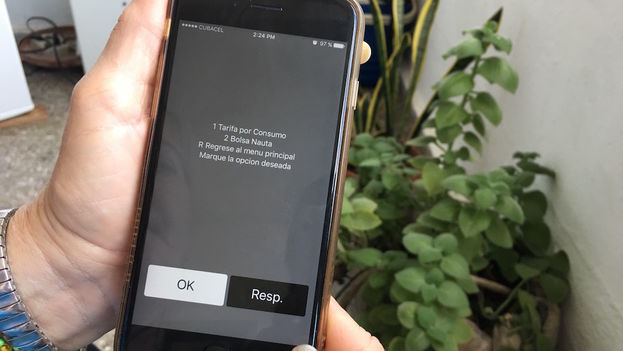
A user consults the “Nauta purse” service, recently announced by Etecsa. (14ymedio)

With regards to Nauta email from mobile phones, Etecsa has provided the ability to contract for data packages. The customer doesn’t have to go to a commercial office, but can simply type *133# to access a menu to buy the so-called “Nauta Purse.” This service offers 5 megabytes, valid for 30 days, at a price of 1.50 CUC.

Until now, customers of the service have paid 1.00 CUC for every megabyte received or sent. Now they can choose between that rate and the new data package more favorable to their pockets.

According to Giselle Fernández, head of the commercial services department of Etecsa, rollover is available: “If at the end of the 30 days the client has megabytes available and activates another Nauta purse, these available megabytes will be added to those newly contracted for.”

The price reduction comes a few days after the publication of two articles in the official newspaper Juventud Rebelde (Rebel Youth) where the company Cuballama (Call Cuba), located outside the country, was accused of telephone fraud. However, the majority of comments left by readers pointed to Etecsa’s high prices as the main stimulus for illegalities.

In the announcement released Monday, the state monopoly confirms its intention to conduct a test of providing access for Internet browsing in 2,000 Cuban homes, at a date yet to be specified.

Film “Hands of Stone” Excluded from Havana Film Festival / 14ymedio, Zunilda Mata

New Latin American Film Festival Awards program section

14ymedio bigger14ymedio, Zunilda Mata, Havana, 19 December 2016 – The New Latin American Film Festival ended as it began: marked by censorship. The exclusion of the film Santa y Andres stained the opening of Havana’s main cinematographic event with gray, and spectators were also unable to see the film Hands of Stone as punishment for the solidarity of its director, Jonathan Jakubowicz, with Cuban director Carlos Lechuga.

The film, based on the life of Panamanian boxer Roberto Duran, was initially included among the feature films that would be shown in the Festival Awards section, but it was never screened. The event’s organizers dropped contact with its director after learning of his condemnation of the censorship of Lechuga, says the Venezuelan artist. continue reading

Days before the beginning of the Festival, Jakubowicz spoke by telephone with the directors of Santa y Andres in order to assess the possibility of withdrawing his film from screening in the competition as a condemnation of censorship. After the publication of an interview with Jakubowicz in 14ymedio on December 7, the Festival’s organizers stopped writing him. “Not only with respect to the copy of the film, but about my attendance,” he says.

“As the death of Fidel Castro was announced the next day, I thought that was why, but they never wrote again. I suppose they preferred to avoid an uncomfortable situation with me in Havana, at a time of such tension for the island,” reflects the prestigious director.

For viewers who sought explanations for the absence of Hands of Stone, the Festival organization contended that the director “never sent the exhibition copy.” Although the director was planning to travel to Havana, he could not bring it personally either without confirming the trip after getting no answer from the event organization.

In the interview published by this newspaper, Jakubowicz explained that he had thought about withdrawing his film from the billing because he was afraid of becoming “that awful artist figure who supports the repressor, a frequent figure in our countries and one who has done a lot of harm to our peoples.”

However, after speaking with Lechuga and his wife, he learned that “the Festival is one of the Island’s few windows looking to the world outside,” and he decided to keep the film in the festival. But when it came time to organize sending the copy to Havana, the event organizers were silent.

“It is a shame for the Cuban public who wanted to see the film. But fine, in the end all of Cuba saw Express Kidnapping, and it is forbidden, too. Art always reaches those whom it has to reach,” Jakubowicz reflects.

Nevertheless, the director thanks the “festival for the initial invitation” and wishes it “much luck in its continued struggle to bring light to Havana’s theaters. There will be better times. The winds of changes are blowing strong and are inevitable, in Cuba as well as in Venezuela,” he asserts.

Translated by Mary Lou Keel

Cuba Commits To Large-Scale Genetically Modified Crops To Reduce Food Shortages/ 14ymedio

Soybean plantation. (Pixabay)

14ymedio bigger14ymedio, Madrid, 19 November 2016 – Cuba expects to grow genetically modified (GM) corn and soybeans beginning in the Spring of 2017, according to a long article published in the government newspaper Granma this weekend, which details the island’s advances in this area.

“On successfully completing all the tests required by Cuban regulatory bodies, in the spring of 2017 we can expect the introduction of [genetically modified crops…] on large areas of land,” said Mario Estrada, Director of Agricultural Research at the Center Of Genetic Engineering and Biotechnology (CIGB).

The major sum of money the government spends in importing food (some two billion dollars a year) is not only unsustainable, but clearly insufficient. In 2014, imports of grains whose genetically modified versions are expected to be grown, exceeded some 500 million dollars, which accounts for up to 75% of what Cubans eat. continue reading

GM crops are the object of strong controversy worldwide because of the genetic modification of organisms, but Granma says that criticisms come from “experiences related to the misuse of technological innovations, lack of information, poor training and the abusive practices of certain seed-producing companies worldwide.”

“We are currently working on obtaining new hybrid transgenic lines of corn which, on the scale of a small experimental plot, show potential yields of nine tonnes per hectare, very close to the levels reached by the world’s leading countries in this production,” explained Mario Estrada.

In addition, experiments with “transgenic soybeans resistant to herbicides, which in experimental areas of the Cubasoy company showed a yield of up to 2.8 tonnes per hectare, much higher than the usual reached there,” he added.

The official newspaper notes that controlled production of genetically modified crops is supported by the World Health Organization, the Food and Agriculture Organization of the United Nations (FAO), the Royal Society of the United Kingdom, the Food and Drug Administration of the United States, the European Food Safety Authority and the Academies of Science of several countries. “Genetically modified crops have helped mitigate the food shortage crisis stemming from global population growth and the impact of climate change, making it the most rapidly adopted technology of cultivation in the history of agriculture,” the article added.

As of 2009, the years in which the corresponding safety licenses were received, Cuba has been testing the first production of modified corn on some 900 hectares belonging to Cubasoy, in the province of Ciego de Avila. Although the result was more than double the yield of the traditional crop, it was lower than expected, which was the reason for suspending the application of the advances.

At present, there is a search ongoing for “new transgenic hybrid lines of corn,” with much higher yields, which, if they pass all the controls, will be applied starting this coming spring.

Harsh Police Operation Against the Patriotic Union of Cuba / 14ymedio


Note: The video was taken surreptitiously and thus is of poor quality.

14ymedio bigger14ymedio, Havana, 18 December 2016 – Beginning at 6:00 AM on Sunday morning, Cuban State Security forces attacked nine homes of members of the Patriotic Union of Cuba (UNPACU); six in Santiago de Cuba, two in Palma Soriano, and one in Palmarito de Cauto. More details are expected in the coming hours; currently most of the activists’ telephones have been cut off.

Jose Daniel Ferrer, leader of the organizations, explained to 14ymedio that the “justification” for the harsh repressive operation was a call made by UNPACU for people to come into the streets in protest, in Havana and Santiago de Cuba. The objective of the opposition organization was “to demand the release of the political prisoners and the end to increasingly severe repression against independent civil society groups,” Ferrer said. continue reading

The homes simultaneously attacked were those of Leonardo Pérez Franco, Ovidio Martín Castellanos and Damaris Rodríguez. At the home of Iriades Hernández, who is currently abroad, the police entered and took two laptops. The police also broke into UNPACU’s working headquarters and the home of Jose Daniel Ferrer.

In Palma Soriano the homes of Yenisei Jiménez, wife of political prisoner Geordanis Muñoz, and that of Yeroslandi Calderín, coordinator of the March 18 Cell and a replacement for Víctor Campa who is currently a political prisoner. In Palmarito de Cauto, so far it has only been possible to report an attack on the home of Yasmani Diaz, but it is presumed that there may be other cases.

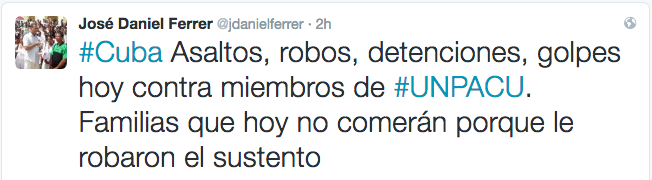
Assaults, thefts, detentions against member of #UNPACU, Today families won’t eat because their sustenance was stolen.

Among the possessions seized were printed material, discs, audiovisual materials, hard drives, four laptops and several cellphones. In the home of Jose Daniel Ferrer they seized 370 dollars intended to feed a pregnant woman and to buy supplies for her unborn child. As a part of the operation, more than 50 activists in the province of Santiago de Cuba and 10 in Havana had been detained by 1:30 this afternoon.

Some ten of those arrested have been released, among them Jose Daniel Ferrer, who reported the following: “A lieutenant colonel who refused to give me his name showed me a warning notice where it said that our call gave rise to the crimes of public disorder, contempt, attack and espionage. They also warned me that they had been disturbed by my statements about the late Fidel Castro on our website and my modest interpretation or translation of his concept of Revolution.”

After the Mourning, Forced Grief / Rebeca Monzo

Rebeca Monzo, 16 December 2016 — After the nine days of national mourning, we thought we were going to be able to breathe a little peacefully with our Christmas celebrations among family and friends, because at the state level these are practically ignored.

Once again we were wrong, committing the mistake of getting the idea that the government would allow us to enjoy a little happiness at the end of the year, but this is not the case.

All the popular parties that are normally programmed have been cancelled, among them the largest and most anticipated: the traditional and extremely famous parrandas. continue reading

The TV continues on with its mourning and is supersaturated with obsolete ideological messages. The presenters and announcers continue to dress austerely in mourning, or half mourning, as do the signers and groups of officials, along with the extremist representatives of the culture.

The Cuban people, in general, have turned their TV sets into monitors, where they connect flash memories or DVDs with copies of the famous Weekly Packet, which has every kind of foreign program like movies, series, soap operas, competitions, and so on, because there is nothing agreeable or new to see on the state programming.

Now, to top it off, it is strongly rumored that the sale of alcoholic beverages will again be prohibited in stores and restaurants — as it was during the official mourning period — starting on the 21st of this month and running to 2 January 2017, with its disagreeable consequences, already experienced during the mourning period by those who disobeyed the edict.

So, without taking into account public opinion, as is their way, the government, which doesn’t feel secure, imposes on us after the 9-days of mourning, a grief that might last until January 2nd, a date on which they will celebrate with a military parade in honor of the fallen, who even after his death appears to be governing.

An added note: The webpage “compradetodo” (purchase everything) from the Cimex Corporation — the state company in charge of imports and exports — announced yesterday that the dinner and drinks packages sold would be cancelled, although the national TV news, last night, in contradiction to this publication, assured that these offerings are guaranteed.

There Will Be No Parties And No Keggers In Cienfuegos / 14ymedio, Caridad Cruz

The ‘5 de Septiembre’ newspaper makes clear that parties in open spaces, such as the one pictured above, “will not proceed.” (Networks)

14ymedio bigger14ymedio, Caridad Cruz, Cienfuegos, 17 December 2016 – The rumor was confirmed Thursday by the local newspaper 5 de Septiembre, the official organ of the Communist Party in Cienfuegos province: all parties are suspended until January as part of the ‘hangover’ of the obligatory mourning for the death of former president Fidel Castro.

“The people themselves, in the majority, prefer solemnity and intimacy in these celebrations,” says the weekly, which is once again available online after a lengthy period of inactivity. continue reading

The news does not come as a surprise to anyone. During the official mourning for the death of the former leader, the police made clear that no one could express the slightest sign of joy. A young Cienfuegan was beaten and arrested near La Calzada service station, and there are several reports of arrests and threats in the city in the south of the island.

“A week after the death of Fidel, the bosses explained to us that there could be no loud music in the bar,” explained a beer seller who didn’t want to be identified for fear of reprisals.

The man affirmed that it was even said that alcoholic beverages would not be sold for the rest of the year, but in the end “those up above” changed the decision.

“I’m sure that for Christmas there will be a shortage of beer and then the government will say they didn’t prohibit it, but there simply isn’t any available. That’s nice, you have to understand,” he added.

Using a term typical for the Cuban bureaucracy, 5 de Septiembre makes it clear that activities in open spaces, such as trochas, carnivals or keggers “will not proceed.”

The justification given by the newspaper is that “the particular idiosyncrasy of we Cubans establishes that crying and sadness do not end overnight.”

“In the end it’s all the same to me, I do not go to those carnivals because the products are expensive and low quality, there are tremendous crowds of people and you’re just looking for trouble,” says Liudmila, a housewife of 41.

“How many people have they killed at those parties when they get drunk? They should end them all. Besides, what products are they talking about, if all you find at the stands is an infinite variety of egg dishes and the same things as always that nobody buys,” she adds.

Yurizán, a 24-year-old barber, believes it is “an abuse.” “Why do they have to decide for me if I want to be sad or not? It’s always the same in this country, they think and the rest have to obey, that’s why people finally go somewhere else,” he says, annoyed.

Although the newspaper specifies that the province is not in mourning, it makes clear that all celebrations will be moved to January, but citizens will have the opportunity to celebrate historical anniversaries such as “the advent of the 58th anniversary of the Revolution,” the landing of the yacht Granma and one more edition of the Freedom Caravan*.

In addition, the paper explains that “the sale of alcoholic beverages in stores and establishments is not restricted and will take place daily.” The newspaper says that the Ministry of Internal Commerce is managing the importation of beverages to keep them on the market.

“Even though they ban parties, no one can take my end of the year blow out away from me, even if I have to have it in my back yard,” says the young man.

*Translator’s note: The 9-day cross-Cuba journey of Fidel Castro and the guerillas after the triumph of the Revolution, from Santiago to Havana, was dubbed the “Freedom Caravan” and continues to be celebrated annually. Recently, the reverse journey of Fidel’s ashes was also called by the same name.

“Get on that plane or go to jail,” Cuban Authorities Tell American Lawyer / 14ymedio

Activists Gorki Aguila and Luis Alberto Mariño and American lawyer Kimberley Motley. (Courtesy)

14ymedio bigger14ymedio, Havana, 18 December 2016 – The American lawyer Kimberley Motley, arrested Friday in Havana, returned to the United States after being subjected to three interrogations, the last of which, held at the Havana airport, made her miss her flight.

“Get on that plane tomorrow or go to jail,” Cuban officials told her the night she was interrogated at the Sheraton Four Points Hotel in Havana’s Miramar neighborhood. continue reading

Speaking to 14ymedio, the international litigator explained that she knew about the case of Danilo Maldonado, known as El Sexto (The Sixth), and had documented it.

The Human Rights Foundation (HRF) wanted to denounce El Sexto’s case before the United Nations. Motley offered to travel to the island and discreetly gather information to provide advice on the matter. She met the artist at the Oslo Freedom Forum and considers him a friend.

Once in Cuba, visiting the island for the first time, Motley tried to interview Maldonado in the Combinado del Este prison, but the authorities prevented her from holding the interview.

Nor was she able to obtain new information on El Sexto’s case from the Court.

According to Motley, she was interrogated three times after being arrested by uniformed and plainclothes officers in a sprawling police deployment that included four police cars and about 15 officers. Once she was taken to the station she was interrogated first by a policeman and then by an immigration officer.

The interrogations were in English and Spanish, although she was never provided with a translator.

The questions asked the American lawyer were: “What are you doing in Cuba? Are you an artist? Do you know the artist? And the other artists?” But they never mentioned Danilo Maldonado by name and never told her why she was under arrest.

In a second episode two immigration officers went to her hotel at midnight and threatened to put her in jail if she did not leave Cuba. They told her, “Get on that plane tomorrow or go to jail,” recalls the lawyer. In addition, the questions of the previous interrogation were repeated.

She was also held at the airport, this time by immigration agents who questioned her about why she was there and searched her backpack.

Motley says she did not call a press conference, although she knew that one would be held by the activists who accompanied her to talk with Maldonado’s mother, Maria Victoria Machado.

However, the lawyer did have a meeting scheduled with a national and a foreign journalist to discuss the case.

Although she did not communicate with the US embassy in Havana, the mediation of the diplomatic headquarters was crucial to her release.  According to Javier El-Hage, International Legal Director for the Human Rights Foundation who spoke with 14ymedio, that organization alerted American officials which speeded up the matter.

The lawyer has said she will continue to support El Sexto’s cause because “the arrest of Danilo Maldonado has no legal or moral basis.”