At the Karl Marx auditorium, packed with uniformed military personnel, Miguel Díaz-Canel celebrated the general’s 95th birthday and the 65th anniversary of the Ministry of the Interior with a totalitarian slogan: “Raúl is Cuba, and Cuba is untouchable!”
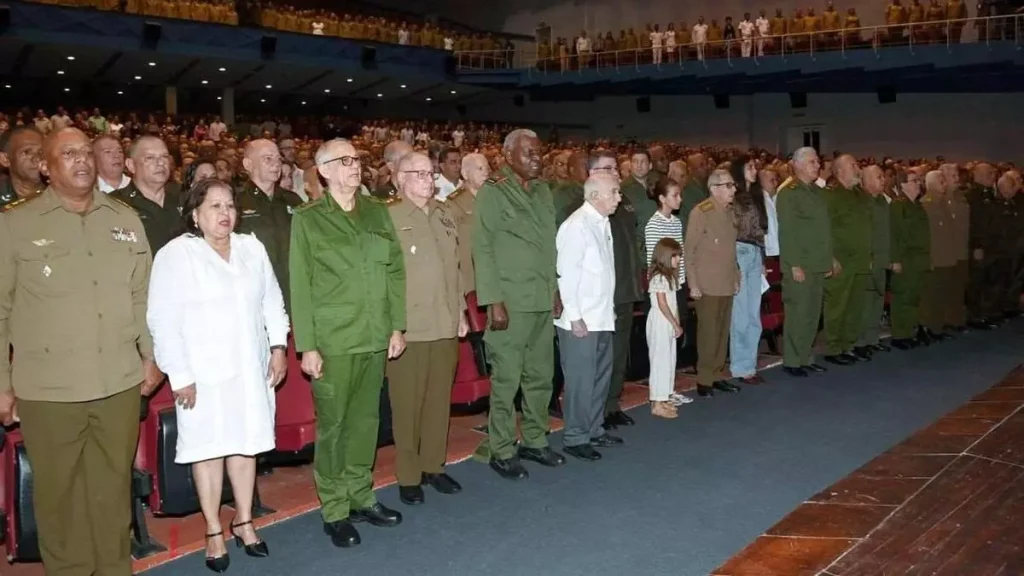
 14ymedio, Havana, June 6, 2026 — Raúl Castro reappeared this Friday in Havana wearing a military uniform and surrounded by the Cuban power elite and its repressive forces, at an event the Government presented as a tribute to his 95th birthday and the 65th anniversary of the Ministry of the Interior. The ceremony, held at the Karl Marx Theater, marked the Army general’s first public appearance since U.S. authorities criminally charged him in May over the deaths of the four crew members of two Brothers to the Rescue aircraft shot down in international waters in 1996.
The former ruler did not speak. Seated in the front row, he sent a message that was read by Minister and Army Corps General Lázaro Alberto Álvarez Casas. In the text, Castro congratulated the institution’s “officers, combatants, civilian workers, and students,” describing it as “an indispensable bastion in the defense of the sovereignty and tranquility of the Cuban nation.” He also praised their “unwavering loyalty” and urged them, in the “current historic moment,” to continue working with “order, control, and responsibility.” The message concluded with a call to “continue defending with honor and commitment the work of the Revolution and the future of the country.”
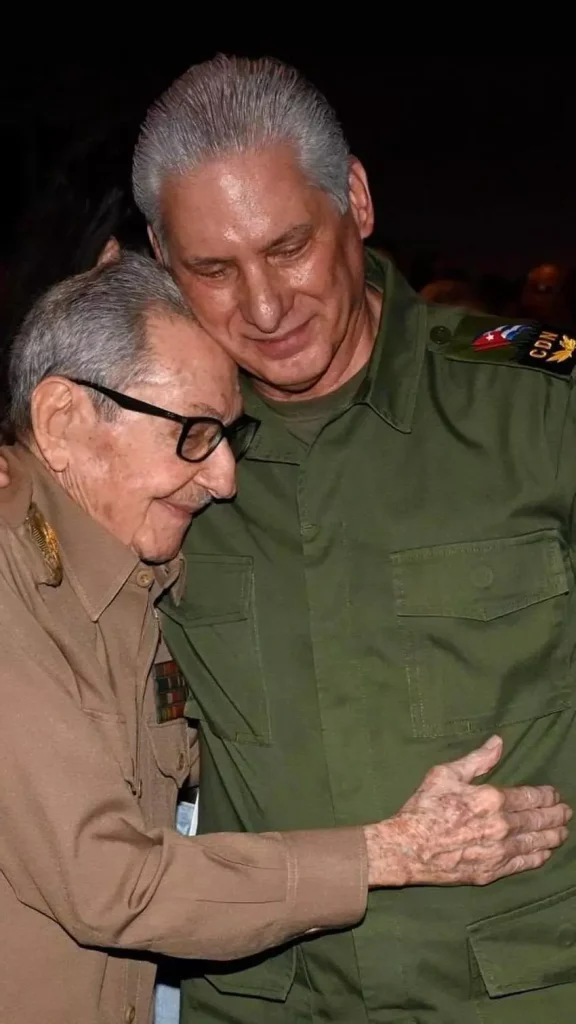
Miguel Díaz-Canel—dressed in olive green—presented the nonagenarian general not only as a historic leader but as the spiritual founder of Cuba’s security apparatus at the age of 27. Díaz-Canel recalled that the State General Staff Secret Service Corps of the Frank País Second Eastern Front had been created to confront “anything that could affect, compromise, or endanger the security of our rebel forces.”
Díaz-Canel asserted that the United States is targeting Gaesa “because it knows of its effectiveness in the face of the permanent economic siege” and because “the contributions of its companies to the country’s socioeconomic development are significant.”
The scene appeared designed less to respond to Washington than to urgently appeal to the loyalty of internal forces. Díaz-Canel called Castro the “leader of the Cuban Revolution,” the “teacher, guide, and inspiration” of both the Armed Forces and the Ministry of the Interior, elevating the slogan of recent days into an all-encompassing formula: “Raúl is Cuba, and Cuba is untouchable!” The message sought not only to shield the aging general from external pressure but also to remind the military and security apparatus that, according to the official narrative, loyalty to Raúl is equivalent to defending the nation itself.
The reappearance came two days after the United States imposed new sanctions on Díaz-Canel, his wife Lis Cuesta, several members of the Castro family circle, and regime entities, including the Ministry of the Interior and the Ministry of the Revolutionary Armed Forces. Washington had already intensified its offensive in May against Cuba’s economic and military apparatus, particularly against Gaesa, the military-controlled conglomerate.
In that context, Díaz-Canel devoted a substantial portion of his speech to defending Grupo de Administración Empresarial S.A. “The attack on Gaesa is no coincidence; it is not just another media campaign,” he said. According to the ruler, the United States is targeting the business system “because it knows of its effectiveness in the face of the permanent economic siege” and because “the contributions of its companies to the country’s socioeconomic development are significant.” He also denied the existence of corruption or enrichment within the military elite, dismissing such accusations as “another great lie,” despite numerous indications regarding Gaesa’s opaque management of billions of dollars in funds.
What he did not mention, however, is that those “infiltrators” were Cubans residing in the United States and that the episode remains shrouded in considerable opacity
“The reaction of several companies leaving Cuba these days is the result of coercive measures by the U.S. government,” Díaz-Canel said. He did not name any hotel chain or company specifically, but framed those departures as part of a broader offensive that, according to him, seeks to cut off fuel, investment, credit, trade, food, medicine, and basic supplies.
The speech also revived a military tone. Before Raúl, Interior Ministry commanders, and Armed Forces chiefs, Díaz-Canel recalled the 32 Cubans “who fell in Venezuela on January 3.” According to his account, those men “went into combat” despite the “element of surprise” and the enemy’s “superiority in weapons and forces.” Their deaths, he said, left “a clear message of how millions of Cubans would act in defense of the homeland if it were attacked.”
He then referred to another episode presented by the Government as evidence of armed infiltration. Five Border Guard Troops members, he said, neutralized a group of ten men who intended to establish themselves in Cuban territory with “a considerable cache of military weapons.” “Five defeated ten!” he exclaimed, before highlighting that the commander of the vessel, though seriously wounded, “never abandoned his mission.” What he failed to mention, however, is that those “infiltrators” were Cubans living in the United States and that the incident remains surrounded by significant unanswered questions.
The closing remarks took the ceremony to Guantánamo. Díaz-Canel invoked Operation Patty, an alleged 1961 CIA plot to assassinate Raúl Castro in Santiago de Cuba and stage an attack against the U.S. Naval Base at Guantánamo in order to justify military intervention. According to Díaz-Canel, the newly created Ministry of the Interior dismantled the operation through a counterplan called Candela, which “preserved Raúl’s life and publicly exposed” Washington.
The reference is directly linked to a recent event. On May 29, the commander of the U.S. Southern Command, General Francis Donovan, met at the perimeter of the Guantánamo Naval Base with General Roberto Legrá Sotolongo, chief of the General Staff and first deputy minister of the Revolutionary Armed Forces. According to reports, both sides discussed operational security matters and agreed to maintain communication channels.
Díaz-Canel thus linked past and present in a tense speech marked by nervous gestures. Operation Candela, the Guantánamo enclave, the 32 deaths in Venezuela, the intercepted boat, the sanctions, the departure of companies, and fuel shortages were all woven into a single narrative of a besieged nation.
“If the homeland is attacked, we will respond in legitimate self-defense,” he warned. “And if they attempt to enter, let there be no doubt: there will be determined and resolute combat!”
Translated by Regina Anavy
______________________
COLLABORATE WITH OUR WORK: The 14ymedio team is committed to practicing serious journalism that reflects Cuba’s reality in all its depth. Thank you for joining us on this long journey. We invite you to continue supporting us by becoming a member of 14ymedio now. Together we can continue transforming journalism in Cuba.