Youth Club Launches A ‘Special Backpack’ Dedicated To Fidel Castro / 14ymedio

‘My Backpack’ is the program created by the Youth Club to counter the success of the Weekly Packet (screen capture).

14ymedio bigger14ymedio, Miami, 22 December 2016 – “My Backpack,” which was created by the Youth Club to counter the influence of the Weekly Packet, will launch this coming December 27, with a wide variety of materials about the recently deceased former president Fidel Castro.

The idea of including materials about Castro started in the Youth Club network in Artemisa, a province in western Cuba, according to the local newspaper, El Artemiseño.

According to Lisandra Garcia, institutional spokesperson for the Provincial Directorate of the Youth Club of Computing and Electronics, the special Backpack includes a catalog for easy access to all content, with “historical content” games, “poems and TV shows.” continue reading

The catalog “will contain allegorical music, celebrity interviews, series like Memoirs of a Grandfather and 90 Reasons, the route of the recent “Freedom Caravan,” taken by Fidel Castro’s ashes between Havana and Santiago de Cuba, the political event in the Plaza, documentaries about Fidel’s impact on sports, health, education, culture… and in different countries,” says the newspaper.

“This program (My Backpack) is being created at the central level in Havana and distributed to each of the provinces, so if Artemisa makes a special about Fidel, it will be distributed throughout the island,” said a lab technician from a Youth Club who did not want to be identified for fear of reprisals.

The lab technician also said that the purpose for which My Backpack was created is still far from completion. “Most people prefer the Weekly Packet because it is more fun and has more options,” he adds.

“The Packet is the internet of the poor, but My Backpack is still far from being done, it is like the internet of those who don’t even have the one for the poor,” he added.

Due to the strong ideological slant of programming on national television, the Weekly Packet — considered one of the largest sources of alternative employment on the island — has become indispensable in Cuban homes. It has been tolerated, more than accepted, by the powers-that-be, who on occasion have intervened to eliminate any kind of political content in these informal distribution networks.

In the days following Fidel Castro’s death, many of the audio-visual products distributed by private individuals omitted any critical reference to the figure of the former president.

“We have to compete with ‘Our Latin Beauty’, with concrete proposals, with ideas, with the coordinated work of teachers, artists, editors, journalists… giving people tools so they do not get ripped off,” said the minister of culture, Abel Prieto, referring to the Weekly Packet in April 2014 at the Eighth Congress of the Writers and Artists Union of Cuba (UNEAC).

“We have not yet succeeded in creating the cultured and free people [envisioned by] José Martí,” he added.

Cuban Faces of 2016: Gilberto ‘Papito’ Valladares, Barber (b. 1969) / 14ymedio

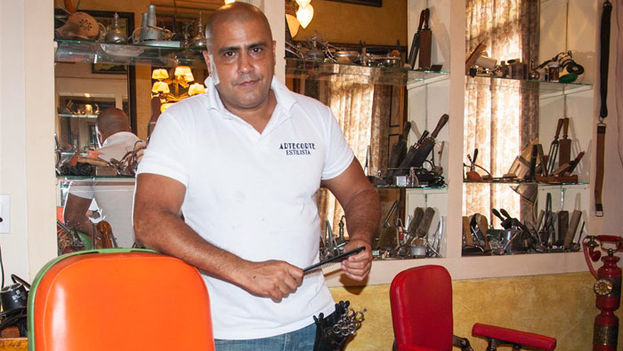
Gilberto ‘Papito’ Valladares, barber. (EFE)

14ymedio bigger14ymedio, Havana, 24 December 2016 — Cuban Faces of 2016: At 16, Gilberto Valladares, known as Papito, began to work in hairdressing, self-taught. At the beginning of the nineties he worked as a hairdresser in the Habana Libre Hotel, but with the relaxations allowing Cubans to work for themselves, he decided to set up his own business in Old Havana’s Barrio Santo Angel.

Papito leads the ArteCorte project, popularly known as the Callejón de los Peluqueros, Hairdressers’ Alley, which involves several neighborhood entrepreneurs and promotes small-scale development. The owners of the private businesses devote a part of their earnings to improving the neighborhood and solving problems such as unemployment, the lack of recreational opportunities for children, and alcoholism.

In March of this year, Papito spoke with US President Barack Obama during the latter’s visit to Havana. In the Cuba-United States Business Forum, attended by business owners from both countries, the entrepreneur related his experience and said that the private sector is growing among Cubans, despite all the impediments and obstacles.

Cuban Faces Of 2016 / 14ymedio

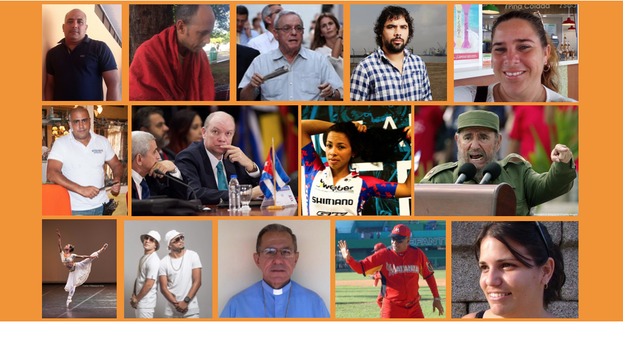
Cuba: The faces of 2016

14ymedio bigger14ymedio, 24 December 2014 — Putting a face to a year like 2016, in which several historical events indelibly marked the Cuban reality – for better or worse – is a task as difficult as it is risky. This newspaper has selected 14 people who stood out in the last twelve months, in science, activism, sports, politics or entrepreneurship, among many other sectors.

From today and throughout the week, we present to our readers these 14 faces, which contributed to make this year a singular compendium of achievements and failures, projects completed and others indefinitely postponed. They are those who chiseled the peculiar physiognomy of a year that is about to expire.

  1. Papito Valladares, barber
  2. Carlos Lechuga, filmmaker
  3. Eusebio Leal, historian
  4. Yomil and the Danny, reggaetoneros
  5. Ariel Urquiola, scientist
  6. Rodrigo Malmierca, Minister of Foreign Trade and Foreign Investments
  7. Elaine Díaz, Director of Neighborhood Journalism
  8. José Ramírez Pantoja, journalist
  9. Víctor Mesa, baseball manager
  10. Juan de la Caridad García Rodríguez, Archbishop of Havana
  11. Viengsay Valdés, dancer
  12. Marlies Mejías, cyclist
  13. Fidel Castro, former president
  14. Joanna Columbié, activist

Rice Might Be In Short Supply This Festive Season / Juan Juan Almeida

Juan Juan Almeida, 22 December 2016  — Sad, paradoxical and irresponsible — but real. Rice, the common denominator, and basic ingredient, of Cuban cuisine, could be almost absent from the island’s tables at the end of the year.

The official press has already started its plan of offering free publicity for the dinner parties which will be celebrated the coming 24th and 31st of December and January 1st in cinemas, cultural centres, social circles and theatres on the island.

The idea, as they explain it, is to guarantee family enjoyment and dining during the Christmas period and, fundamentally, for the coming of the 58th anniversary of the triumph of the Cuban Revolution. continue reading

For that reason, they have doubled the work schedules for catering units and restaurants belonging to the government commercial chain.  They will arrange exceptional supplies to livestock markets and local market places, and they are  planning the sale of foodstuffs, from a variety of crops to different types of meat. But … is there the productive support to achieve this aim? As far as rice is concerned, no.

One of the directors of the agro-industrial company “Fernando Echenique Urquiza” made the point, in the national press, that, although in 2016 the production of rice was much higher than in previous years, he could not get hold of a good supply.

The government official blamed the problem on the early maturing of the crop, but another worker in the sector proposed other explanations:

“During the rainy season, we had a lot of rain, which helped the crops”, was the rice expert’s explicit and clear explanation.

“It’s true that it was ready early, but there are other factors which also have a negative effect, and not only in this harvest” he said.

“The country has developed an important investment programme to increase rice production nationally.  Agreements have been signed authorising credits from the Import Export Bank of China (EXIM) for the purchase of medium and high-powered YTO tractors, and financial arrangements for the promotion of the national rice-growing agro-industry. We are setting up new irrigation systems, repairing dryers and mills. Modern seed-processing factories have been built and advanced equipment and technology has been purchased.

“But we still cannot depend on a sufficient fleet of vehicles to transport the product from the farm to the dryers, and to the stores, let alone to the markets. Nor do we have enough combine harvesters. And the dryers both here in Mayabeque province, and nationally, do not have the capacity to deal with a good harvest. And all of that is without taking into account the ridiculous price paid to the farmers for the demanding task of producing the grain which is irreplaceable in Cuban cooking”, said the expert.

As a last resort, the government has had to make up for negligence and inefficient production with last-minute imports, taking a hit with the purchase price, which, in turn, has a clear impact, especially at this time of year, on your average Cuban table.

Nevertheless, in spite of all these difficulties, for all Cubans, this is a Christmas to celebrate.

Translated by GH

Cuba’s Ration Book Survives For Another Year / 14ymedio, Marcelo Hernandez

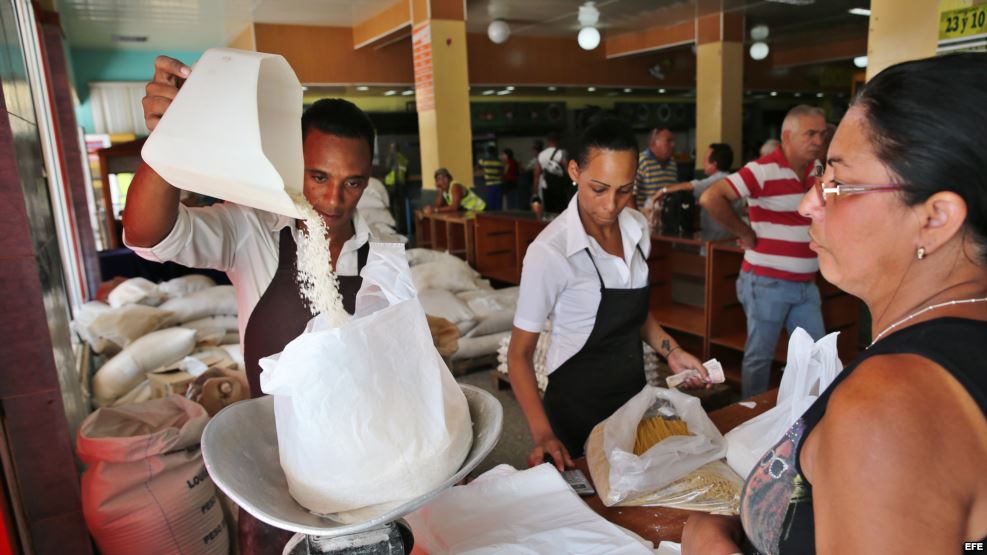
A bodega of rationed products in Havana’s Plaza de la Revolución municipality (14ymedio)

14ymedio bigger14ymedio, Marcelo Hernandez, Havana, 22 December 2016 — At the end of this month the ration market quotas for January 2017 will go on sale. Cubans who depend on products distributed at subsidized prices will gather outside the bodegas, in long lines, for the 55th anniversary of the ration book, whose elimination continues to be one of Raul Castro’s unmet projects.

In 2014, the average monthly salary on the island increased by 24%, to 584 Cuban pesos (some 24 dollars). Despite this increase, many families still depend on the subsidized prices maintained by the ration card. Their income does not allow them to pay the prices in the supply-and-demand markets or in the retail network of stores in Cuban Convertible pesos. continue reading

Different analysts and official functionaries have warned that the elimination of the ration book could cause a fall in the standard of living in the most vulnerable sectors of the population, among whom are the retired and families who don’t receive any additional income beyond their state salaries.

Among the Guidelines approved by the Seventh Communist Party Congress, last April, it was agreed “to continue the orderly and gradual elimination of the ration book products.” However, so far, the proposal has not gone into effect, in part because of the poor economic development experienced by the country in recent years.

Cuba’s gross domestic product will grow only 0.4% this year, its lowest level in the last two decades, as recently confirmed by the Economic Commission for Latin America and the Caribbean (ECLAC). Faced with this reality, the government has not been able to improve people’s purchasing power or dismantle the rationed market.

The Government is faced with the dilemma of maintaining the enormous infrastructure and the hefty costs of prolonging the life of the ration book or suppressing it, with the consequent deepening of poverty for various social groups. Such a measure would have an undeniable political impact on a process that has been defined as a revolution “by the humble and for the humble.”

Officialdom has repeated on several occasions that it is preferable to “subsidize people rather than products,” but the rationed quota is still given to every citizen equally, even those who have reached an above average level of income. The practice has focused on removing products from the subsidized basic market basket.

Rice, grains, oil, sugar, salt, eggs, chicken and bread are some of the foods that are still subsidized, while other goods have been removed from the ration book altogether, including liquid detergent, bath and washing soap, toothpaste, beef and cigarettes.

During the 1970s and ‘80s it was virtually impossible to live without ration book products. This phenomenon resulted in, among many other ills, low internal migration and a greater control of the State over the citizens.

Currently, the mobility of the population to provincial capitals and especially to Havana has increased as a result of the easing of the policy on rental housing. The ability to purchase food and hygiene products outside the rationing system has also contributed to the phenomenon.

The emergence of a parallel market that includes state establishments and private bakeries has also been hugely important to the process of citizen independence. Ration book bread, a recurring theme in the “accountability meetings” of the People’s Power, a topic of critical analysis in the official press and a target of mockery for the majority of Cuban comedians, has lost its importance.

Families with better incomes have given up standing in the traditional lines to get bread for 10 centavos in national currency (less than one cent on the US dollar). They prefer to go to the private bakeries that offer a wide variety of products at unregulated prices.

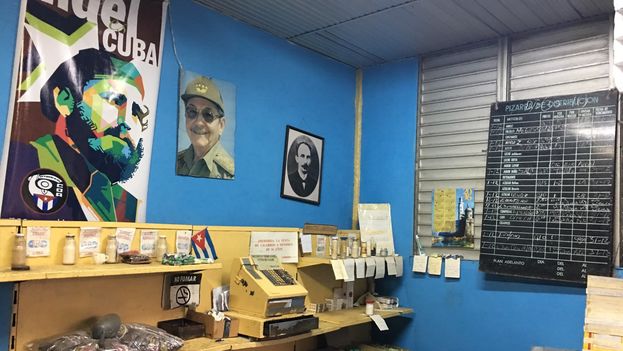
The bodegas with empty shelves and a blackboard listing the products of the month have become, along with the old American cars that still circulate on the streets of the island and the billboards with political messages, among the photographic trophies taken by tourists as part of the social landscape of Cuba.

The disappearance of the ration book will have to wait until the completion of the gradual reforms announced by the authorities. There will probably be more who mourn its end than those who will celebrate it, but the day will come when some incredulous grandchild will listen to his grandfather repeat stories of “that era when everyone ate the same thing on the same day in the whole country.”

No Right to Breakfast / Cubanet, Tania Diaz Castro

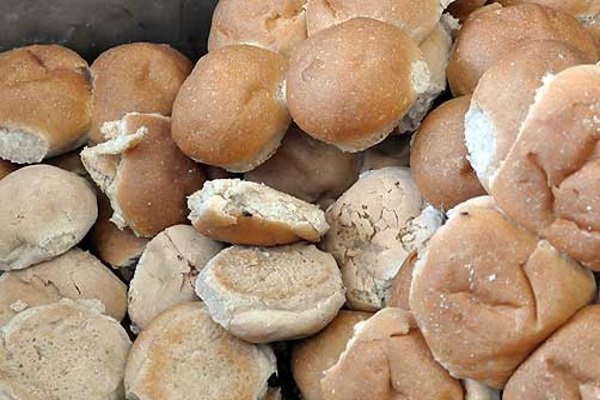
Bread rolls in a Cuban ration market bakery

Cubanet, Tania Diaz Castro, Havana, December 12, 2016 – When in 2006 Raul Castro took power, one of the first things he said was that he would give a glass of milk a day to every Cuban. He knew very well the importance that the people gave to the strong tradition of having breakfast with coffee with milk and a piece of bread with butter. Even during the years of the Republic years it was within reach of the poorest in any cantina, inn, kiosk, or cafeteria.

Starting in 1991, with the collapse of Soviet communism, Cubans’ breakfast disappeared. In this way, Fidel’s permanent teaching failed, when he had said: “Yes we can.” continue reading

It was simply not possible for dairy industry to supply enough milk, although in a speech in December 1966 Fidel predicted that he would fill Havana Bay with milk because “in 1970 the island will have 5,000 experts in the livestock industry and around 8 million cows and calves, good milk producers.”

A little history

The Cuban dairy industry began its great development in 1927, under the government of Gerardo Machado. A few years later, when our population was 6 million, the island had one head of cattle per person and the price of meat was one of the lowest in Latin America. Cuba’s annual milk production was 1,014 million quarts, equivalent to 157 quarts per person per year.

Canned condensed milk and packaged skimmed milk.

According to economic data of those years, and as we Cubans of the third age remember it, in Cuba an excellent butter was produced, as well as good cheese, condensed, evaporated or powdered milk, and a quart of fresh milk could be acquired daily And at modest prices, thanks to private companies and modern factories, which disappeared practically at the beginning of the Castro dictatorship, when in 1960 Che Guevara was appointed Minister of Industry.

What the future says 

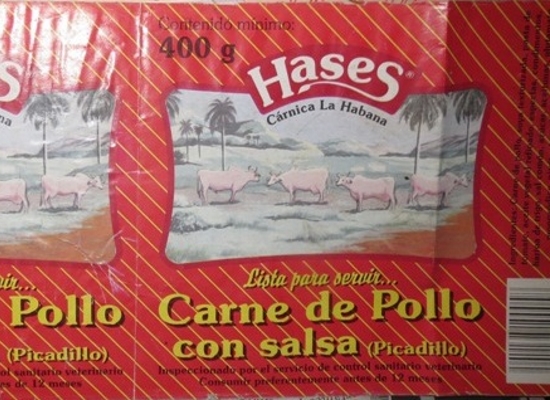
Just a few hours ago, on the occasion of the visit of a senior Russian leader, General Raúl Castro offered great news: The government of Russia would participate in the island’s economy! ¡Madre mía! I hope it’s not so that they will again send us Russian canned meats swimming in water instead the meat of good native cattle.

The future of the domestic industry, especially of food products, is uncertain. It is an industry that is unable to participate actively in resolving the country’s shortcomings. One of its problems, Commander Ramiro Valdés said recently, is the exodus and the lack of discipline of the workers and, above all, the bad technological and risky conditions in plants and factories.

Just to give one example, in 2014, a factory, the only one of its kind for dairy products, began operating in Ciego de Avila at a cost of 800 thousand pesos in hard currency. Its commercial director, Pérez de Corcho, informed the newspaper Granma in February 2015 that: “The factory does not work at full capacity because for months there has been low milk production in the territory, even though what is produced was destined for the tourist-focused cities of Jardines del Rey, Venezuela and Ciego de Avila.”

The current reality 

Today, even with all the juggling they do, Cubans cannot have breakfast. In order for a family consisting of couple and two children, for example, to be able to afford their daily breakfast, they would have to have about 50 Cuban Convertible pesos per month, equivalent to more than one thousand Cuban pesos, in a country where the average wage of a worker does not exceed four hundred pesos in national currency. (That is, two-and-a-half monthly salaries, just for breakfast.)

Ready to serve chicken with sauce.

This is because the imported products — milk, coffee and butter — come from very distant countries, although they can also be seen in Latin America, with the exception of Venezuela, Bolivia, Ecuador and Nicaragua, from where we get no foods, neither expensive nor cheap.

The privilege of having breakfast is enjoyed only by Cubans who receive family remittances, principally from the United States, so they can buy things in Cuban Convertible pesos. The ordinary Cuban, which is almost everyone, has irretrievably lost this right.

Our food industry, we are faced with an irrefutable truth, thanks to Cuban communism has gone to hell in a handbasket.

 Translated by Jim

The One Who Left Ashes / Miriam Leiva

Poster of Fidel Castro in a Havana window (AP)

Cubanet, Miriam Leiva, Havana, November 29, 2016 – Fidel Castro died on November 25 at 10:29 p.m. and, according to his own will, his remains will be cremated, according to the brief statement read by Raúl Castro on Cuban television. at midnight.

As a deceased person, the former president deserves respect. Surely he expired on a soft bed, surrounded by his closest family members; perhaps he left directions for his funeral. Jose Marti, the man Cubans call the Apostle of Cuba, will welcome him in his monument in the Plaza of the Revolution and in the Santa Ifigenia Cemetery in Santiago de Cuba. continue reading

The government decreed nine days of official mourning and a journey of the funeral cortege from Havana to Santiago de Cuba, following in reverse the route of the “Freedom Caravan” of the guerrilla chief in January of 1959. The Comandante bequeathes his predilection for symbolism in dates: his death coincided with the 60th anniversary of the beginning of the Revolution with the departure of the yacht Granma from Mexico in 1956, and the burial on December 4th will coincide with the day of Saint Barbara, Shangó in the syncretic religion, a day venerated with great offerings. The drumming and all the rituals that begin in the early hours of the morning will be suspended on this solemn occasion, to the disgust of thousands of believers.

Most Cubans within the archipelago reacted with silence, no comment, without grief. The outcome had long been expected. The cheerful, humorous, jovial and bustling Cuban protects himself in the shell when he feels it dangerous to think differently from the official line, fears the consequences in his life, and disenchanted with the unfulfilled promises, is careful of his weak status or he looks the horizon to jump abroad.

Respectful relief floats in the environment, because the Comandante will allow everyone to rest, not fearing his interference in the essential changes. Every photo and every writing was overwhelming. The impressive olive green presence and thunderous voice became pitiful and the phrases delirious. He asserted, “history will absolve me,” at the conclusion of his trial for the attack on the Moncada Barracks in 1953. Much accumulated for 63 years, and there will be a delay in the objective writing of his until the secrets of all the parties involved are known. However, it is impossible to exempt him from the precarious present state of Cuba, because for 47 years he decided and prohibited everything.

In 1959, Fidel Castro liquidated a bloody dictatorship, he was Cuba’s most popular politician of all time and came to power with the false promises of democracy and a commitment to the religion. He will be remembered for dismembering families and sending their children to schools in the countryside, the exodus of more than two million Cubans, the hardships of a people overshadowed and disposed to immense sacrifices.

From the initial dispossession of the great owners, he continued with the small ones during the Revolutionary Offensive of 1968. Among his immense unproductive works: the failed Ten Ton Sugar Harvest of 1970, the destruction of the sugar industry that forged the Cuban nationality and of all agriculture with the uprooting of the peasants. For the waste of resources from the Soviet Union and the socialist camp. For not having invested Hugo Chavez’s petrodollars in the capitalization of the destroyed or antiquated industry.

Fidel Castro curtailed rights, credited the state with granting universal education and healthcare, when in fact this was paid for with the contributions of all workers. He left a weak economy, misery-level salaries and pensions, a dual monetary system, large debts accumulated since 1986, and a social fabric devoid of high ethical and moral values, a pride of the Cubans for centuries.

Fidel Castro will be remembered for the executions and long prison sentences. For punishing those who thought differently from the official opinions with agricultural work and expulsion from their jobs. For the surveillance and stalking by State Security, the informants and the Committees for the Defense of the Revolution. By the impossibility of attending a university because the universities were “only for the revolutionaries.”

Time will not forget that he was about to provoke a nuclear conflagration in October 1962, his support of guerrillas in Latin America and wars abroad, his persecution of homosexuals, his ban on miniskirts and the Beatles until the end of the 1980s, and on the practice of religion and tourism until 1992.

Raúl Castro inherited the ruins that he helped create. He mentioned the need for structural changes and concepts in 2007, which he reduced to the updating of the failing economic and social system. But he acknowledged that “the fundamental obstacle we have faced, as we predicted, is the burden of an outdated mentality, which forms an attitude of inertia, or lack of confidence in the future,” in his Report to the Seventh Congress of the Cuban Communist Party in April 16, 2016.

Ten years after the inevitable abandonment of absolute power, outside the Cuban archipelago, Fidel Castro is credited with the positive collaboration of doctors, teachers and technicians abroad. With the high rates of healthcare and education, achieved with the sacrifice and low quality of life of Cubans for 57 years.

The worn-out old man is kindly visualized, thanks to the process of cleaning up his nefarious image undertaken by Raúl Castro with the opportunities offered by the international community, the popes and eminences of various religions, the relationship with the United States, collaboration with the European Union, and the cancellation of debts. Economic interests have played an important role, but also the general president has the space to open up citizen participation in decision making.

Raul’s actions after Fidel’s death in compelling Cubans to sign an Oath to the Commander’s Words could strengthen the stagnation, or he could use them to reverse it: “Revolution is a sense of the historical moment. It is changing everything that must be changed. It is full equality and freedom. Is to be treated and to treat others as human beings,” Fidel said in his speech of May 1, 2000.

The high attendance of the population to the extensive and pompous funeral rites is a sign of the usual compulsion of students, workers, peasants and members of the so-called organizations of the masses and civil society, as well as the mobilization of the hundreds of thousands of party members and Youth communists, military agencies, ex-combatants and people who really did admire him.

However, the authorities should recognize the real feelings of the majority of Cubans and undertake radical changes.

It Is Not Because Fidel Says It, It Is Because I Believe It / Somos+, Arlenys Miranda Mesa

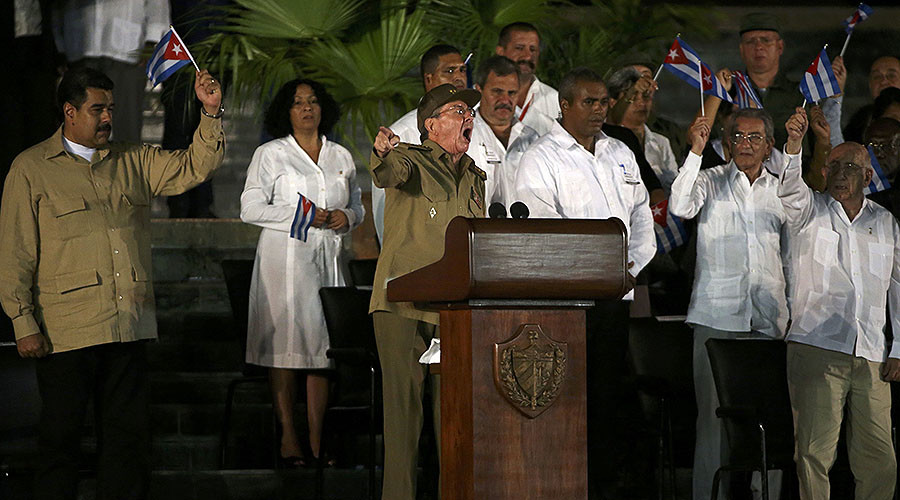
Cuban President Raul Castro speaking in Santiago de Cuba, Cuba, December 3, 2016. © Carlos Barria / Reuters

Somos+, Arlenys Miranda Mesa, 21 December 2016 — December 3rd was the ceremony in Santiago de Cuba after the death of Fidel Castro and the procession of his ashes across the entire Cuban archipelago. I sat down to observe the ceremony, although I knew it would be repeated many times, but I preferred to be an eyewitness rather than “hear about it” in the hallway. At the end, Fidel Castro stood up. His speech is important, of course, be is the president of the nation. And not because the majority elected him, in fact, I don’t know who elected him, no one ever explained it, but he is.

His speech was more of the same, and the figure of his brother was exalted one more time, to the height of a god. May God have mercy on Cuba, for He sees the wickedness of the idolatry of the fathers to the third and fourth generation of those who hate Him. continue reading

He spoke about how, in circumstances of extreme difficulty, Fidel always said, “Yes we can.” Yes, we can attack the Moncada Barracks, yes we can make a revolution i Cuba, arrive on the coast in a yacht, resist the enemy and even do away with him in less than 72 hours; resist hunger, rain, cold. Yes we can organize an army in the Sierra Maestra and open a new guerrilla front, withstand the blackouts, the limitations of public transport, preserve health and education in the midst of crises and blockades, in short, so many things. A visionary man.

Today he no longer exists. It is the end of one era, giving way to another, where we see our hopes reborn. It is for this that I feel very excited and inspired because like him I believe that “Yes we can.” But I go in the opposite directions from everything he believed and that he could do and not do in Cuba. He imposed his opinions, his crazy ideas. I am even-tempered, sensible, logical. I am a mother, woman and Cuban. I think about my children, my family, my country.

I believe that Yes we can have internet in Cuba, cheap and uncensored. Why in internet a human right in other countries but not for us, is it perhaps that we are not human. What are they hiding from us that is on the internet?

Yes we can have free elections, where every Cuba can, with dignity and conscientiously choose their president. Yes we can dream of a younger leadership in tune with our reality, that although it did not participate in the in attack on the Moncada Barracks in the 1950s, arrive later that decade on the yacht Granma, or fight in the mountains, is not therefore less qualified to take on the challenge.

Yes we can aspire to have different political parties for one to belong to and identify with. Yes it is possible for an army and a police officer without surnames, that responds not to the interests of the elite but rather of the people.

Yes we can aspire to a government that pays attention, and creates a space for dialog with those who think differently. Yes we can aspire to an objective and committed journalism, but not with an ideology, but simply with the truth, so that the press doesn’t silence those who shout in the street.

Yes we can respect those who think differently and not call them worms or scum, those who want to “change everything that needs to be changed,” as Raul Castro himself is so fond of repeating.

If, for capturing these ideas in this article, they disappear me, then what is said about Camilo Cienfuegos is true. If after doing so, I die in a car accident, then what is said about Oswaldo Payá is true. If they put me in a car and drive me far away and release me in some other province without any money, or bruised in a gutter or threatened, then I am fighting for the right side, because Fidel fought against these things in the Batista dictatorship. The national president of the Federation of University Students said in her speech that Fidel was a friend who defended just causes.

I am defending a just cause, freedom and democracy, therefore I am not on the opposite site, I am not a terrorist nor a counterrevolutionary. I am a 41-year-old woman, married for 18 years, the mother of three children, Christian since I was 19, pastor of a church for 9 years. A licensed English Teacher and licensed in Sacred Theology.

I am a woman who years for changes and who has not lost faith or hope, because I believe “That Yes We Can.”

Opposition Leader José Daniel Ferrer Released / 14ymedio

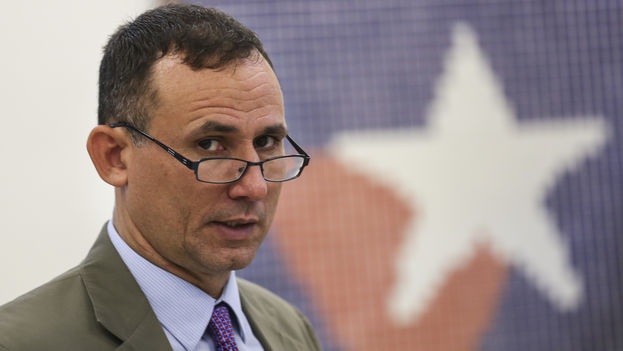
José Daniel Ferrer, leader of the Patriotic Union of Cuba. (14ymedio)

14ymedio bigger14ymedio, Havana, 22 December 2016 — José Daniel Ferrer, general coordinator of the Patriotic Union of Cuba (Unpacu), was arrested on Thursday around one in the afternoon when he left the organization’s headquarters in the city of Santiago de Cuba, and released about 40 minutes later, as reported in a phone call to 14ymedio from Omar Fayut, a member of the opposition organization. Ferrer was taken in a bus, handcuffed, to the third police station in the city of Santiago de Cuba and then released, without further explanation.

The activist denounced that since the death of former President Fidel Castro “many members of the movement have been harassed” by the political police who maintain a cordon around Unpacu’s headquarters. continue reading

Last Sunday, some hundred members of the UNPACU were arrested when they tried to march to the shrine of El Cobre to demand the release of political prisoners. Most of the detainees were released after a few hours, but nine remain imprisoned.

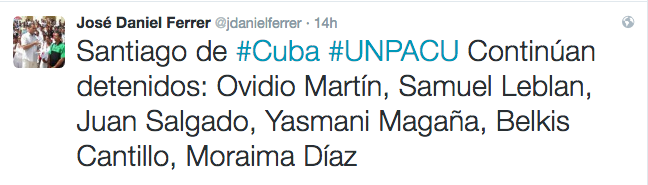
Minutes before his arrest, Ferrer had denounced on Twitter that activists Ovidio Martín, Samuel Leblan, Juan Salgado, Yasmani Magaña, Belkis Cantillo and Moraima Díaz, among others, continued to be detained.

Carlos Amel Oliva, a member of Unpacu, maintains that “the threat is constant” and that since Monday the headquarters remains besieged with police officers “stationed on the corners.” The young man explains that the soldiers “put up fences to prohibit the access of any type of vehicles.”

The arrests and police cordons are in addition to the searches of at least 13 houses of Unpacu activists.

The last report of the Cuban Commission for Human Rights and National Reconciliation (CCDHRN) said that during last November there were at least 359 arbitrary arrests of peaceful dissidents on the island. That is roughly one hundred fewer than in October but the independent organization warns of possible repression after the death of former President Fidel Castro on November 25.

Raulito’s Plan to Inherit Power from His Grandfather / Juan Juan Almeida

Raúl Guillermo Rodríguez Castro, Raul Castro’s grandson

Juan Juan Almeida, 19 December 2016 —  With 2018 approaching, alarm bells are already sounding over fissures in what was once the monolithic unity of the Communist Party and weaknesses in the supposed cohesiveness of Cuba’s royal family.

The long-awaited announcement of Raul Castro’s retirement has unleashed an “every man for himself” and “looking out for number one” attitude among those who, driven by the influence that supposedly comes from proximity to power, are already lobbying to build a future from the dictator’s throne.

The fact that Raúl Guillermo Rodríguez Castro, more widely known as “The Crab,” is continue reading

one of the leading contenders seems like a joke. To gain attention, he began promoting an incoherent platform which, to be honest, makes him look more like someone with a propensity for blunders who is planning an unsuccessful coup.

“Raulito is a moron. He lacks self-control so he acts first and thinks later. But he is not completely clueless. He is trying to get out from under the shadows by displaying his power, just like other aspirants for the top job. He knows that by mid-2017, which begins in a few days, the initial debate will begin on a successor to the post that everyone covets: Secretary General of the Communist Party of Cuba,” says an elderly member of the National Assembly of People’s Power.

An economist by training, of limited intellect and functionally impaired from the use and abuse of steroids, he is equal parts embarrassment and failure. Recently named head of the Department of Personal Security (DSP), he tried to cement his support within the future government by announcing that by the middle of next year he would raise the salaries of the more than one thousand men who make up his personal army by fifty pesos a month.

It is worth noting, as I wrote some time ago, that the DSP includes 1) a traffic police unit, 2) a film unit, 3) a section devoted to documentation and emigration procedures, 4) a foreign relations department, 5) an anti-terrorist brigade, 6) sharpshooters, 7) divers, 8) explosive experts and 9) a medical department with clinics staffed with doctors, nurses, radiologists, lab technicians, physical and occupational therapists and specialists in other areas. Additionally, it runs 10) a technology and telecommunications division, 11) manufacturing workshops, 12) gymnasia, 13) a very efficient counterintelligence service and even 14) an employment agency that hires personnel who go on to work in the homes of the elite.

But rather than encouraging unanimity, the move is being viewed unfavorably by members of the DSP, who are responsible for protecting, guarding, spying on and taking care of Cuban leaders. Even with the raise they have been promised, they will still earn less than members of the special police unit working in popular tourist sites such as Plaza de San Francisco, Plaza de Armas and Plaza de la Catedral as well as in other areas in Old Havana.

The move has backfired. The discontent is such that soldiers and officers of what was once the most powerful bureau in both the Ministry of the Interior and in Cuba have handed in their resignations. This is not a trivial issue.

This is the last game… there is no direct elimination, no quarterfinals.

Donald Trump and Raul Castro / Dimas Castellano

(Ilustration: Giovanni Tazza)

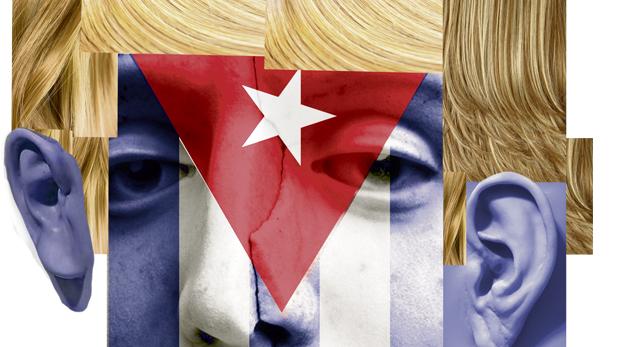
Dimas Castellano, 29 November 2016 — The great majority of Cubans were surprised by Donald Trump’s electoral victory. Surveys in other countries, and the official Cuban press, labelling Hillary Clinton as the favourite, created false expectations.

Since the results have become known, all sorts of opinions have been put forward. Some believe that Trump is a dangerous man, who will damage things, others that he will demand more from Havana, and they are happy about that, and many are worried that there will be a setback to relations and regret his triumph, while a majority are unhappy with the official press campaign against president Barack Obama’s policy.

What almost everyone is agreed upon is the poor state in which Cuba finds itself, and the need to emigrate. continue reading

Going back on the established improvements in relations will be extremely difficult. Why is that? Because of the division of public authorities, the existence of a diversity of interest groups, and its institutionalisation in the United States.

The president could limit or eliminate some things, but not everything, because that would imply affecting North American interests. Quite simply, electoral populism is one thing, and presiding over an institutionalised country is quite another.

Even supposing that Trump really could be a threat to the improved relations with Cuba which Barack Obama managed to achieve — in my opinion the most important political act in the last half century in Cuba — the biggest danger of sliding backwards up to now has been, and still is, the Cuban side of things.

Nationalisation, centralised planning, and the absence of liberties, are among the principal causes of the permanent crisis in which Cuba finds itself. The Obama administration’s policy offered an opportunity for change, which was missed by the Cuban side.

Therefore, whatever risk the Trump administration might represent would be less than the negative influence of the Cuban government, trapped in an insoluble contradiction between changing and at the same time preserving power.

Fidel Castro’s thesis that “Cuba already changed, in 1959,” produced a more pragmatic vision than General Raúl Castro’s one of “changing some things to hold onto power.” Nevertheless, the measures implemented to that end have not brought about the desired result, because of a conflict of powers. Instead, they have revealed the unviability of the economic and social model and the depth of the crisis.

The series of measures enacted by the White House have, among other things, led to increased tourism and remittances sent to families, the first cruise ship has arrived, flights have restarted, agreements reached with American telecommunication companies, negotiations with other countries and restructuring of external debts. Meanwhile the Presidential Decision Directive of last November was aimed at rendering irreversible the advances achieved.

If those measures have not produced a better outcome, it is because the obstacles in the path of production and the absence of civil liberties in Cuba have prevented it. For that reason, changes are dependent on the Cuban authorities, rather than on Trump. To tackle these changes now, albeit very late, would neutralise any intention by Trump to set things back.

Bearing in mind that the suspension of the embargo is the prerogative of the United States Congress, what is needed now, after the “physical disappearance” of Fidel Castro, is to get on with a comprehensive structural reform, like that carried out by the Vietnamese, who, having abandoned centralised planning and adopted a market economy, have positioned themselves as the 28th largest exporter in the world.

Taken from: El Comercio, Peru

Translated by GH

What Fidel Castro Left Us (Part 2) / Iván García

Volunteer teachers (see longer description at end of post).

Ivan Garcia, 19 December 2016 — According to Luisa, 76, a former prostitute, the first time she collected money for sex, she bathed herself three times trying to remove the smell of an old man who sweated over her body.

“I was once young and pretty. The dawn that Batista fled from Cuba, I was in bed with an businessman who was my lover. Then everything changed. The Revolution made plans to integrate the prostitutes into society. I was in a school for women in Marianao. Several of my friends had courses on cutting and sewing, others to be taxi drivers,” says Luisa, while she eats a ration of rice, peas, and boiled egg in a horrible state-run restaurant that sells food to low-income people. continue reading

But necessity obliged her again to barter of sex for favors. “They say that the bird always returns to the mountain. The fact is that in 1970, after the Ten Million Ton Sugar Harvest, with three children and divorced, I went to bed with a FAR officer who in exchange gave me cans of Russian meat and condensed milk, among other canned food, and gave me money to support the children. Fidel Castro did not encourage prostitution, but mi’jo, the country has never worked, and when it is not one problem it’s another. People cannot live on speeches or promises,” says Luisa.

One of her daughters was a jinetera — a prostitute — at the end of the ’80s. The oldest granddaughter inherited the “office.” When night falls, she goes to a bar south of Havana and hunts for customers.

“It seems we carry being hookers in our blood,” emphasizes Luisa with a grimace that pretends to be a smile, but reflects shame. The olive green autocracy tried to change the customs of society, to dignify women and those who never had anything and to build a New Man immune to the vices of consumerism.

The goal was to achieve a citizen loyal to the Revolution. Atomic bomb proof. Who was circumspect, almost a saint, who drank little, did not practice sex too much and was able to recite from memory excerpts from important speeches of the Maximum Leader.

Like their efforts in crossing cattle breeds or experimenting in a laboratory with guinea pigs, Fidel Castro and Ernesto Guevara set to work. The first thing was to create a political commitment and a culture of hatred of Yankee imperialism.

The state propaganda apparatus and the party commissars were in charge of carrying out the task. It was an ideological war of high intensity on radio, television and in literature.

The shelves of Cuban bookstores overflowed with classics of socialist realism. The novels of Corín Tellado were forbidden. The directions for being a future communist passed through “No One is a Solldier at Birth,” “August of ’44” and “Panfilov’s Men,” among other works of Soviet war literature.

At that time, control over the media was absolute. Internet sounded like science fiction, a shortwave radio was something subversive and don’t even dream about a computer, something very large at that time.

The regime dominated the information flow at will. This allowed it to easily rule. In the 1970s, says Gerardo, an ex-combatant in the Angolan civil war, “We Cubans all believed that the Ku-Kux-Klan lynched blacks in every corner of the United States and that that nation’s days were numbered. Our mission was to build socialism first and communism later. The future belonged to us.”

Gerardo still remembers the litany of slogans they repeated every morning in the military camps. “Many believed that we were breeding a new future. We did not learn about, or we looked away from the abuses of power against those who thought differently. I came to know of the harassment of opponents and homosexuals and the creation of UMAP — internment camps for homosexuals, religious, dissidents and other “inconvenients — in the 90’s thanks to the internet. We lived in a bubble.”

Thousands of men and women were separated from their families with the mission of evangelizing Castroism. The journalist Tania Quintero, 74, says that in 1960, after listening to Fidel Castro talking about the creation of volunteer teachers, who would prepare in the mountains of the Sierra Maestra and later would be destined to rural schools, she decided to leave her job as a typist in the People’s Socialist Party offices, and become a teacher.

“I enrolled in the third and final contingent of volunteer teachers. From March to June of 1961 I was in La Magdalena, in Las Minas del Frio. Along with elementary notions of pedagogy we received classes in political indoctrination. We did not have a radio and every day the press came to us, that’s how I heard about the Bay of Pigs invasion,” Quintero recalls, adding:

“We young women who had better records were selected to take a course in revolutionary instructors, newly created by Fidel Castro and the Federation of Cuban Women (FMC). It was a one year study and work plan. From Monday to Friday we lived in residences in the old Havana Biltmore, renamed Reparto Siboney by the Revolution. The professors were University of Havana graduates in teaching, but the subjects were not limited to mathematics, Spanish, history, geography … We also had to study Marxism-Leninism and its creators: Marx, Engels and Lenin.”

Tania studied in the morning and afternoon and at night gave classes in “revolutionary instruction” — that is, in commenting and discussing Fidel Castro’s speeches — to former maids, prostitutes and housewives. “Fidel spoke almost daily, but it was not easy for those students of low academic and cultural level to express themselves freely. And I confess that I succeeded because I ignored the dense paragraphs of his speeches. At that time, one of his mono-themes was artificial insemination and that allowed me to give animated classes. I remember one student saying to me: ‘I do not know why Fidel wants to do away with the zebu cows, if those are the ones we have always had and until 1959 they gave us a lot of meat and lots of milk.’ ”

Carlos, a sociologist, can not demonstrate that the new social essay, including the plan of study and work created in 1961 by Fidel Castro and the FMC was scientific. “I think that it was an empirical plan and gave its results, because, if I am not mistaken, it spoke to thousands of women, old maids and peasants. But there were well-defined codes with regard to the evangelization of Castroism and the creation of a new Cuban. It was a well-structured protocol for achieving the purpose of transforming the human being into a zombie. The result of designing a laboratory man is now being collected. Simulator, liar and generally rude.”

The great adversary of the regime of Fidel Castro, first, and of his brother Raúl later, has been the new information technologies. What the anti-Castro insurrectionist strategy in the 1960s could not achieve, and what the subsequent peaceful activism of dissent also failed to achieve, the Internet and social networks are achieving now.

Despite the fact that an hour of internet costs the equivalent of two-and-a-half days of a worker’s wages, facts can no longer be hidden. The information highway has made evident the failures and the proverbial manipulation of the state press.

The network of networks is the weapon that has destroyed the outlandish project of building the New Man on a Caribbean island. For the autocracy, the internet is a Trojan Horse. That is why they try to censor it.

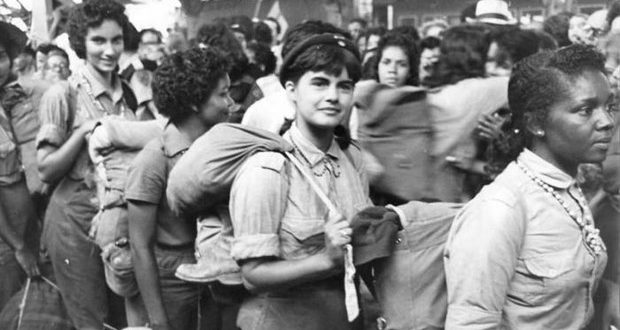
Photo: Members of the Second Contingent of Volunteer Teachers who graduated in Havana on 23 January 1961. The first contingent graduated in April 1960 and the third and last in June 1961 in Holguin. About 10,000 young people from all over the country were trained as rural teachers in makeshift and rustic camps in the Sierra Maestra. As a culmination of each course, the young people climbed Pico Turquino, which at 1,974 meters is the highest mountain in Cuba. The photo was taken from the newspaper Granma (TQ).

Translated by Jim

On Your Marks, Get Set…Trump / 14ymedio, Marcelo Hernandez

Many Cubans must dispose of all their property in order to pay for a plane ticket and to migrate by air. (14ymedio)

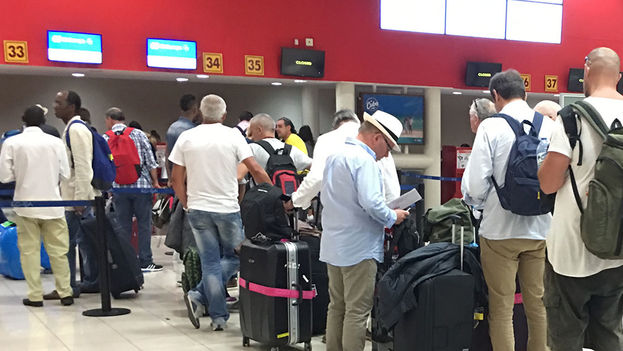
14ymedio bigger14ymedio, Marcelo Hernandez, Havana, 21 December 2016 – Walking around the block with a suitcase in hand has been added to the rituals to mark the end of the year, as a plea to be able to travel outside the country. Many Cubans fear, however, that the situation is becoming complicated with the pending arrival of Donald Trump to the White House.

The president-elect of the United States has been so contradictory in his declarations about Cuba that no one knows what will happen between the two countries when he is installed in the Oval Office. Cubans on the island seem less concerned about a possible setback in the diplomatic thaw, than about the loss of their immigration privileges. continue reading

The debate over the repeal of the Cuban Adjustment Act, which awards benefits to migrant Cubans arriving in the United States, could put an end to the dreams of many in the new year. Foreign consulates in Havana, especially those of Latin American and European countries, have seen a surge in visa applications.

“We are overworked,” the custodian of the Mexican consulate site in the Miramar neighborhood told 14ymedio. Outside the building, Roberto, who prefers not to give his last name, managed to get a temporary visa to travel to the land of the Aztecs. This Thursday he will fly to Cancun, the cheapest flight between the two countries. “I’m working against the clock,” he says, while finishing the bureaucratic paperwork before the journey.

Roberto has a long journey ahead of him, plagued with obstacles and dangers to reach the US border, but he feels confident. “My brother who lives in Miami is going to help me and pay for the whole trip,” he explains. “It will be much more expensive, but I have to get there before January 20th,” he says.

Trump’s inauguration date has become the goal in a marathon race for thousands of Cubans. People who in recent months have liquidated their possessions, managed to get a visa and are preparing to leave.

Most consulates close their doors at the end of December for the Christmas holidays, an element that contributes to the desperation.

Departures by raft have also increased. The US Coast Guard recently reported that since last October 1st, the beginning of the fiscal year, around 1,000 Cubans have tried to enter the US illegally by sea. For fiscal year 2016, which ended on 30 September, the figure reached 7,411, compared to 4,473 for the same period in 2015.

With this exceptional winter, without cold and with an ocean free of hurricanes, many Cubans embark on the route to Florida in makeshift crafts. Raul Castro’s government has redoubled its vigilance along the coast lately, but the rafters choose to leave from remote places, among the mangroves or the rocks.

“I don’t know if Trump will be good for us or not, but I’m not going to stay here to find out,” says Yusmila Arcina, who worked as an accountant for a state company until she decided to “make the leap.” The young woman considers herself fortunate, in part, for having obtained a work visa for the Schengen Area (a free movement zone made up of most of the EU countries and others in the area). From Europe, where she expects it will be easier, she hopes to get a tourist visa to travel to the US, using the old continent as a springboard to realize her “American Dream.”

“Yes or no, we have to take advantage now,” suggests the young women, who has no family in the United States. Arcina has paid for the paperwork and a plane ticket in the high season, which cost her around 2,000 Convertible Cuban pesos (roughly the same in dollars), with the sale of a mid 20th century Cadillac that belonged to her father. “That car has been my ticket to freedom,” she jokes.

Arcina’s boyfriend is stranded in Colombia waiting to take the route through the Darien Gap. The challenge for both of them is to reach US territory “before that millionaire gets into office.” Both hope “to watch the inauguration ceremony on local TV in Miami,” says Arcina. Trump has fired the starting gun, and each one, on their own side, has embarked on their migration journey.

What the Newspaper ‘Granma’ Can Change / 14ymedio, Reinaldo Escobar

As of this Thursday, the official newspaper ‘Granma’ will have a new design with changes limited only to the visual. (EFE)

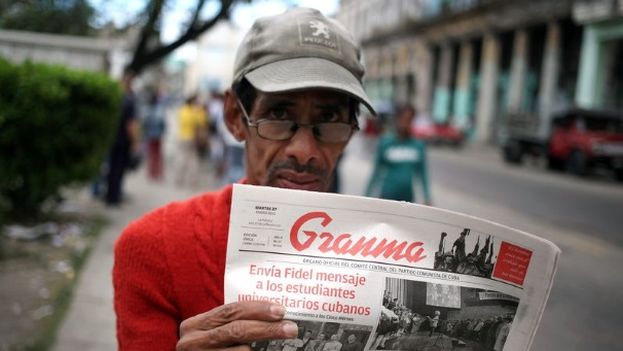
14ymedio bigger14ymedio, Reinaldo Escobar, Havana, 21 December 2016 — The newspaper Granma announced that as of tomorrow, in Thursday’s edition, it will debut a new design. For the peace of mind of the most orthodox, the note concludes by warning that “the official organ of the Central Committee of the Cuban Communist Party is being renewed, but it will remain the same.”

The modifications refer to the alignment of the headlines, more readable typography, better composition of the front pages and greater prominence of photographs. According to the paper itself, its new design “is more compact, more modern, more contemporary, and cleaner.” continue reading

What is striking is that the intention “to look like current times” will be limited to the visual aspect. Apparently, the paper will not stop practicing secrecy, political debate will remain absent, and criticisms will never be directed towards the highest levels of power. No one will question the legitimacy of the rulers or the viability of the system.

The change of image will coincide with the date when, 55 years ago, the end of illiteracy in Cuba was proclaimed, but the directors do not seem to understand that what its readers require from this press organ is precisely a change of philosophy, of its essence, in order to leave behind “the conceptions of the founding era.”

Only a profound political illiteracy can come to the conclusion that a newspaper at the beginning of the 21st century should continue to be dogmatically governed by such narrow ideological guidelines.

Granma will continue to choose “positive” verbs, adjectives and adverbs for its national news and will select “negative” ones for the titles that refer to the rest of the world (excluding its allies). We will have to continue reading that in Cuba the harvests are growing, the goals are being exceeded, the programs are advancing without delays, meanwhile foreign economies are collapsing, unemployment only grows, and the richest intend to despoil the planet.

“The purpose of this redesign is to compete with ourselves and win,” confesses Granma in an act of utmost honesty. When an athlete runs alone on a track she always takes the trophies. It would be another kettle of fish if at the newsstands the readers could choose among several publications, if in citizens’ homes there were access to the internet and any digital news source that circulates in the world, without restrictions or censorship.

However, the notice that something changes is always welcome.

Maduro, Disciple of a School in Decline / 14ymedio, Yoani Sanchez

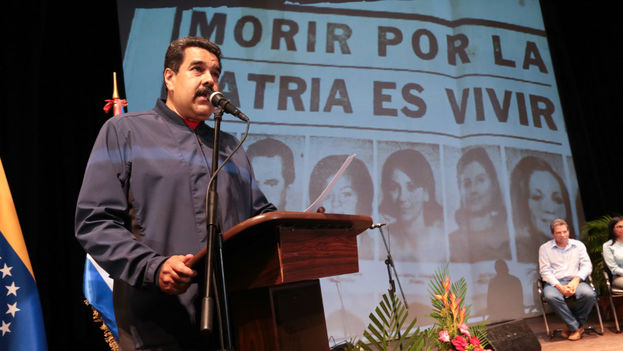
The differences of style between the Fidel Castro and Nicolas Maduro are endless, but something more decisive separates them: Time. (Headline: To die for the fatherland is to live.) (Nicolasmaduro.org.ve)

14ymedio bigger14ymedio, Generation Y, Yoani Sanchez, Havana, 21 December 2016 – On television a speech by Nicolas Maduro reverberates. He is talking about international conspiracies, the enemy that wants to end the “Bolivarian” revolution and the “monetary mafias,” a refrain that recalls the deceased Cuban ex-president Fidel Castro, obsessed with blaming others for the disasters caused by his own decisions.

The differences in style between the two leaders are endless, but something more decisive separates them: Time. Decades have passed between Castro’s interminable oratory about Cuba and the Venezuela ruled by the erratic Maduro. continue reading

In that time, we Latin Americans have become suspicious of populist discourses and learned to reveal the seams of the redeemers, who hide authoritarians under their robes. Their political speeches do not work like they did before. Like those hackneyed verses that compare the eyes with the stars or the mouth with a rose, and that now only provoke mockery.

In these times, when from the podium the homeland is invoked too often, the spectrum of foreign interference is constantly dangled and results are never offered, this is the time to be on alert. If the leaders call on us to spill every last drop of blood, while they surround themselves with bodyguards or hide at some “zero point,” we have to cease to believe them.

A dose of skepticism immunizes against these pernicious harangues where it is explained that the country’s problems originate outside the national borders. Suspiciously, the whistleblower never takes any responsibility for the disaster and blames the failure on some alleged externalities and media wars.

Maduro was trained in the school of politics as permanent agitation, a school headquartered in Havana. To make matters worse, the Venezuelan leader has been a mediocre student, who interprets the original script with a lot of huffing and puffing, very little charisma and a huge dose of nonsense. His main blunder has been not to realize that the manual designed by Fidel Castro no longer works.

The Venezuelan leader arrived too late to take advantage of the gullibility that for decades made many people of this continent exalt dictators. His speeches resonate with the past, like bad poems, that neither move our souls nor win our affections.