Bruno Rodriguez describes the inclusion of Diaz-Canel among those affected by US financial restrictions as “vile”
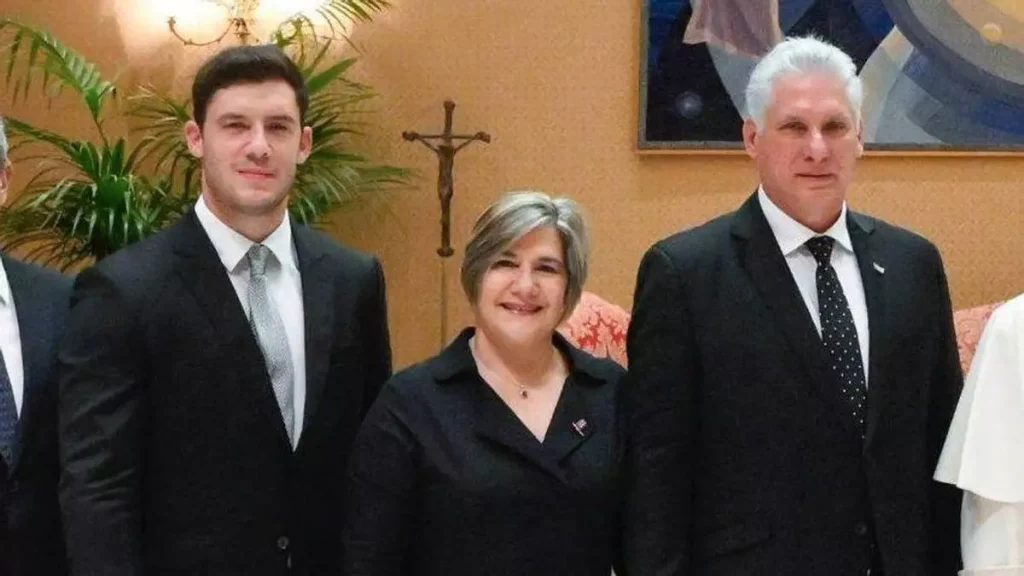
 14ymedio, 5 June 2026 / It is less than a month since Miguel Diaz-Canel once again declared that the sanctions imposed by the US do not affect him because he holds no accounts or assets in the United States, so his reaction to Washington’s latest salvo came as no surprise. The president avoided personalising the issue and considered that the “illegitimate addition” of new names to the lists of those affected is “designed to reinforce the blockade measures and the scenario of conflict between Cuba and the United States.”
“The US president is making new threatening statements against Cuba and the Treasury Department has added new names of Cuban leaders, organisations and companies to an illegitimate sanctions list,” Diaz-Canel denounced on X. In his view, this attitude stems from a “political blindness” that “adds to the coercive measures applied in recent weeks (…), designed to harm the Cuban people” — a reference to the executive order signed by Donald Trump on 1 May that opens the door to sanctioning foreign companies that cooperate with Cuban state entities.
“The aggressiveness and perversity of the Yankee government will collide with our determination to face the worst scenarios and resist the imperial onslaught,” Diaz-Canel added.
“The aggressiveness and perversity of the Yankee government will collide with our determination to face the worst scenarios and resist the imperial onslaught”
His brief message followed a statement by Foreign Minister Bruno Rodriguez, who did allow himself to personalise the matter. “The vile inclusion of President Miguel Diaz-Canel, part of his family, as well as Cuban institutions, civil society organisations and companies on an illegitimate and unilateral list by the US government is the latest demonstration of the American interventionist plan to present Cuba as a threat to United States national security,” he wrote on his X account.
In the same vein as the president, he devoted the second part of his post to a message of resistance. “Every US action aimed at constructing a scenario of conflict between the two countries is destined to fail. Every threat against Cuba’s independence and sovereignty will be met with greater unity and determination from our people,” he argued.
In addition to Diaz-Canel, the United States Treasury Department imposedfinancial sanctions this Thursday on the Ministry of the Armed Forces, the Committees for the Defense of the Revolution, the Cuban Institute of Friendship with the Peoples, the mining company La Victoria and the travel agency Amistur.
The measures extend to the president’s wife, Lis Cuesta, his stepson Manuel Anido Cuesta, Colonel Alejandro Castro Espin, son of former president Raul Castro, and the latter’s son, Raul Alejandro Castro Calis. Spared — and this is no minor detail — was Raul Guillermo Rodriguez Castro, known as El Cangrejo, grandson of the elderly general and informal interlocutor with Marco Rubio himself in negotiations with the US that continue in spite of everything.
Diaz-Canel addressed this matter in an interview published today by elDiario.es, which sent its US correspondent to spend a few days in Havana and to whom the most newsworthy material in the piece is owed. The journalist, who explains in the introduction that the meeting with the president took place on Wednesday afternoon, asked him: “You were talking about the last round of sanctions, the one on 1 May. This very morning it happened to me at the hotel – I went to pay for something at the cafeteria and my credit card was declined.”
The Central Bank of Cuba had announced that day that Visa and Mastercard cards would not be usable from 6 June onwards, although hours later Fincimex warned that it had halted operations at 2 p.m. that same day and this newspaper confirmed on Thursday that shops were already refusing them. The journalist’s words make clear that the effect was immediate.
“You were talking about the last round of sanctions, the one on 1 May. This very morning it happened to me at the hotel – I went to pay for something at the cafeteria and my credit card was declined.”
Little that is new emerges from the rest of the lengthy conversation in which Diaz-Canel insists on how the sanctions imposed during Donald Trump’s first administration – maintained under Joe Biden and intensified in this second Republican term – have contributed to the worsening of the Cuban economy and, by extension, of its industry and services.
While acknowledging mistakes, the president insists that Cuba has held out under extreme conditions by drawing on science and innovation, claims that steps towards economic openness have been taken, and calls for the regime’s incompetence to be demonstrated by lifting sanctions. “If we are so incompetent, why blockade me? Why not let me collapse on my own? Because they have no interest in Cuba improving. That is a lie. They want to take possession of Cuba,” he added.
The two most noteworthy remarks come when Diaz-Canel is asked what will happen if there is a social uprising like that of 11 July 2021: “We have our programmes for each of those scenarios, to navigate them,” he says enigmatically, though he goes on to speak of little more than neighbourhood and recreational programmes to keep young people occupied. He also responds on the subject of talks with the US, which the journalist raises precisely when Diaz-Canel is insisting on his rhetoric of whole-people war and resistance.
“We could have a civilised dialogue of the kind the United States has with other countries it also regards as adversaries, regardless of ideological differences. Moreover, we could have trade relations, cultural, academic, sporting and scientific exchanges… There could be tourism on both sides without restriction,” he notes – but the condition remains the same: the system is not up for negotiation.
On the other side of the strait, Donald Trump – who had been absent from public life for a week – was again asked about Cuba. “The country is starving, it has no energy, no oil, no money, nothing,” he said, before declaring: “We are going to treat Cuba well and we have very good plans.” The president also maintained that his popularity among Cuban Americans is extremely high – 95% of them voted for him, he said – and that his expectations include their return to the island. “They are incredible people, energetic, entrepreneurial. Some of the wealthiest people in Miami are Cuban. I am going to take good care of them and I am going to allow them to return to their homeland,” he said.
Either way, the president again made any concrete steps conditional on what happens in the Middle East. “I like to do one thing at a time, and first we will deal with the Islamic Republic of Iran. And as soon as that is done, on the way back we will make a brief stop…” he said, before alluding to those good plans.
Translated by GH
______________________
COLLABORATE WITH OUR WORK: The 14ymedio team is committed to practicing serious journalism that reflects Cuba’s reality in all its depth. Thank you for joining us on this long journey. We invite you to continue supporting us by becoming a member of 14ymedio now. Together we can continue transforming journalism in Cuba.