Burned Dolls, Buckets Of Water And Suitcases: End Of Year Rituals / 14ymedio, Zunilda Mata

Today, different rituals will accompany the end of the year, but all are intended to lead to the same outcome: that 2017 bring better opportunities. (EFE)

14ymedio bigger14ymedio, Zunilda Mata, 31 December 2016 — Before Silvio Lázaro moved to Havana from Guantánamo he had the tradition of burning a doll made out of straw and old clothes every December 31. However, in the capital he has replaced that custom with throwing out a bucket of water at midnight. Today, different rituals will accompany the end of the year, but everyone wants the same thing: for 2017 to bring better opportunities.

The National Assembly of People’s Power has just made a nefarious gift to Cubans. The parliament announced that the recession has taken over the country, expressed in a GDP in negative numbers: -0.9%. Cuba is facing a difficult economic scenario and the next twelve months are a mystery that few analysts dare to decipher. continue reading

Not even the bad omens and the austerity in celebrations imposed by the authorities after the death of the ex-president Fidel Castro, can put the brakes on the deeply rooted custom of the dinner on Saint Silvester’s Day, New yYear’s Eve. This morning you could still see many people carrying home tomatoes, some kind of drink and the little pork left in the agricultural markets.

Silvio Lázaro, 46, shows a special interest in celebrating. “My oldest son has everything prepared to travel to Mexico in the next few days,” he says. The young man will try to it to the border with the United States to reach that country and to avail himself of the Cuban Adjustment Act.

The family plans to change the habit of throwing a bucket of water from their balcony this midnight. “We are going to go out with suitcases and walk around the block so that everything goes well,” says the proud father. He does not hide that he is worried about the journey that his son will make and will even “light a candle so that the saints and orishas” will protect him.

A few yards from Silvio Lázaro lives a mother with a daughter who will get her degree in psychology next July. “This year she will achieve everything I’ve dreamed of,” says the woman, who works as a maid in a hotel in Old Havana. Her party tonight includes “grapes and cider,” which she bought thanks to tips given to her by some customers.

Despite the economic situation in the country, the mother of the future professional feels optimistic. “We have come out of worse things,” she reflects, although she acknowledges that during the last year it has been especially difficult “to buy food and find toiletries.”

A situation that could worsen, because as Raúl Castro clarified in his speech during the last parliamentary session this year, “it has not been possible to overcome the transitional situation we are experiencing in current payments to suppliers.” Imports of commodities could be affected by this delinquency.

The authorities limited the public dances that characterize the last day of the year and have emphasized the celebrations on January 1st, when the 58th anniversary of the Revolution is commemorated. On Monday, a military parade presided over by the Cuban leader will be the climax of official celebrations.

“There is nothing to celebrate, everything goes from bad to worse,” reflects Maurín, 38 and unemployed. The woman believes that “we are bottoming out” and for her family it has been especially difficult to acquire the ingredients for the end of the year dinner. Her brother, who is part of a medical mission in Caracas, has arrived this year to spend the holiday with his family.

“He does not want to return to Venezuela, nor do many of his colleagues,” says the woman. The doctor is greatly affected by the violence, the shortage of basic products and the restrictions of movement in the South American country. Among the few things he could bring on his trip were colorful garlands for the Christmas tree.

On centrally located G Street in Vedado, young people will also gather to bid farewell to the year. This December some have promoted a new custom to mark the date: having money in your hand just when the clock strikes midnight.

“That way it ensures that there is financial solvency for the next year,” says Daniela, a member of Havana’s Goth community, to 14ymedio.

“But it has to be dollars, euros or Cuban convertible pesos … with Cuban pesos it doesn’t work,” the young woman clarifies.

American Chicken for Cuban Christmas / 14ymedio, Zunilda Mata

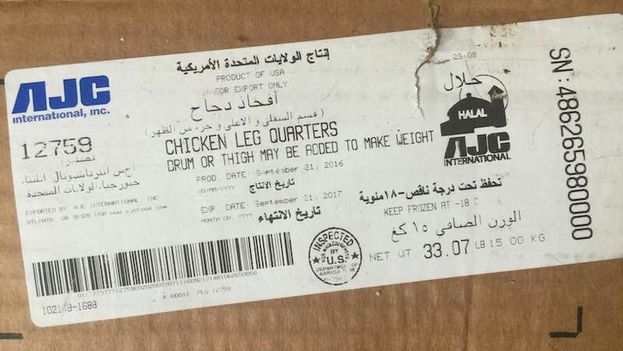
The frozen chicken ‘made in the USA’, a product in great demand in Cuba amid the rise in prices for domestic meat. (14ymedio)

14ymedio bigger14ymedio, Zunilda Mata, Havana, 23 December 2016 — Against all odds, two years after the beginning of the diplomatic thaw between the governments of Cuba and the United States, trade between the two countries has diminished. The Island bought 21% less food from its northern neighbor in the first four months of this year, compared to the same period in 2015.

However, this Christmas Cubans have seen frozen chicken Made in the USA reappear in the network of state markets, a product in high demand amid rising prices for domestic meat. Many have decided to change the traditional pork menu that families eat on December 31 for a plate with breast, thighs or wings.

Imports of US poultry fell by half between January and April 2016 in contrast to last year. Hence, consumers have received happily the news about the recent supply, though they fear the quantity of this yuma (American) product will decline further with the arrival of Donald Trump at the White House.

End of Year Declaration / Rafael León Rodríguez

Rafael Leon Rodriguez, 30 December 2016 — One more year of the young third millennium is about to conclude and give way to the next, 2017, the fifty-eighth of the totalitarian and one-party regime that, under the omnipotent power of the Castros, has controlled the Cuban archipelago since the middle of the last century.

This year, which is now over, has witnessed important and hopeful political events on the islands, framed fundamentally in the real opportunity of an opening towards a new, prosperous and plural state of law.

The visit to Havana of the President of the United States of America, Barack Obama, last March, certified the political will of the head of the US executive branch of government to accompany us in this essential and urgent task. continue reading

The European Union, for its part, recently concluded an agreement with Cuba to try to leave behind the so-called Common Position and to make viable other political openings.

The refusal of the Cuban authorities to take positive steps in terms of civil and political rights of citizens — that promote their plural participation in the political and economic development of society — has stopped the start of this process of democratic opportunities.

The other significant event of the year that will soon end was the physical disappearance of Fidel Castro. The fall of the founder of the dictatorial regime began, actually, ten years ago, in July of 2006 when, due to health problems, he was forced to hand over power to his brother Raúl. This transit towards the end, announced in some way, concluded last November.

But in our opinion, all this recent history must be analyzed and projected in the future, which obviously does not imply erasing historical memory. Cuba and the Cubans deserve a better present and a hopeful future.

However, so far, the authorities are reluctant to take steps in the direction of respect for civil liberties and the human rights of society. Worse still, they have increased repression and harassment of peaceful opponents and open dissent. This reality, coupled with the uncertainty caused by statements by the US President-elect Mr. Donald Trump on migratory issues, which may have some effect on certain modifications to the Cuban Adjustment Act, have once again triggered a citizen exodus in all directions.

The country’s economic scenario also remains stressed, a victim of lack of productivity and government contradictions. Right now, President Raúl Castro informed the National Assembly that we are in an “economic recession.” The nation’s GDP decreased 0.9% in 2016.

The historical dependence of specific countries, as for example in recent times to Venezuela, paralyzes us when they suffer adverse situations. In these December declarations to Parliament, the president also assured us that Cuba would not return to the capitalism. Nevertheless, he called for work to boost foreign investment.

That is: the investment of foreign capitalists in Cuba. Then: capitalism in Cuba, but not of Cubans. Is not this a contradiction and an absurdity? In essence we continue to live under the effects of a systemic crisis that, of course, will only be resolved when the prevailing system changes. A system that has already provided evidence that proves that it has not been successful in those Western countries where they have implemented it. And we belong to that part of the world: the Western Hemisphere.

In recent years, Cuban institutions dealing with statistical issues have been warning of the accelerated aging of the population. And even, they warn about the decrease of the population, saying that we will never reach 12 million people. False. We are already more than that, scattered all over the world. Therefore, we must begin by recovering them through a necessary new law.

One Constitution that we contemplate recognizes all of us, through dual citizenship, with rights and duties as equals, without privileges of individuals, groups or classes. Beginning a process of democratization involving all the children of the Cuban nation and based on the United Nations Human Rights Covenants, which have been signed by the Cuban authorities and now are only awaiting ratification and implementation.

Then and only then, we will leave behind the crises and will begin a new era of progress towards modernity, prosperity and the common good, with all, for all and in Peace.

Cuban Parliament Sessions Predict Somber Times / 14ymedio, Miriam Celaya

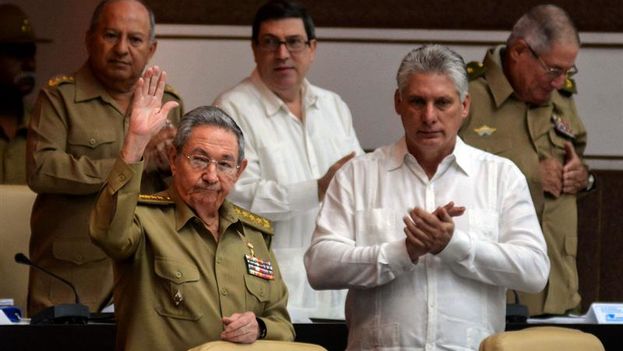
Cuba’s president Raúl Castro, and first vice-president, Miguel Díaz-Canel, at the session of the National Assembly of People’s Power. (EFE / Abel Padrón Padilla)

14ymedio bigger14ymedio, Miriam Celaya, Havana, 28 December 2016 — On December 27th, at the Havana Convention Center, the Eighth Session of the Eighth Legislature of the Cuban Parliament opened, with a balance sheet on the socio-economic results of the year ending and the proposed draft of the National Budget Law for 2017.

This time, there is no good news or triumphant speeches. 2016 ended with a 0.9% drop in Gross Domestic Product (GDP), according to the report presented by Ricardo Cabrisas, Minister of the Economy and Vice-President of the Council of State, and there are no reasonable grounds to date to believe that the forecast of a 2% growth of the GDP for 2017 will be realized. In fact, that was the modest growth prediction for the second half of this year, which finally failed. continue reading

Even more somber, Cubans will start the New Year with overdue payments to suppliers. “It has not been possible to relieve the transitory situation we are experiencing in the current payments to suppliers …”, indicated the general-president, Raúl Castro, in presenting the central report, although he announced, without going into details, “a number of measures that will alleviate the described scenario”.

“It has not been possible to relieve the transitory situation we are experiencing in the current payments to suppliers …” indicated the general-president

As for the 2017 budget plan, he cautioned: “I must warn that financial tensions and challenges will persist that could even increase in certain circumstances.” The current difficulties related to the economic downturn in 2016 will affect next year, the president stated, unless three “permanent and decisive” objectives are met: guaranteeing exports and working immediately to create the conditions to increase them in successive years; identifying the possibilities in the national production and substituting any level of imports; and reducing possible non-essential expenses, among which he indicated trips abroad by the cadres and leaders at different levels.

“We will have a definitive solution to these traditional deficits if we produce more goods and services, both internally and externally, and reduce expenses as much as possible,” said Cabrisas. But the proposed solutions revolve around the usual jingle of the last decades which is never fulfilled, such as the one that proposes the substitution of imports based on the development of national productions “with a well-designed program” encompassing the entire national industry, including the military, or a “greater requirement of the efficient use of carriers to avoid purloining and theft,” in addition to increased controls in this area.

The Cuban president said that he attaches “great importance to the need to boost foreign investment in Cuba” as an essential road for the country’s economic development. However, he made it clear that there are forces opposing this solution, which are blocking this inflow: “I recognize that we are not satisfied in this area and that excessive delays in the negotiation process have been frequent. We need to overcome, once and for all, the obsolete mentality of prejudices against foreign investment and, to resolutely make strides in this direction, we must shed false fears towards foreign capital.”

The report by the Minister of the Economy detailed an opaque and unpromising scenario for now and for the future, because of “the persistence of existing financial constraints due to the non-fulfillment of export earnings, the difficulties faced by some of our main partners due to the fall in oil prices, and by the commercial and financial blockade, strengthened by large fines to international banks that transact business with our country.”

While figures on investments and imports are expressed in dollars, the State’s income and budget -including so-called subsidies and other social benefits -are expressed in CUP

In general, the budget plans for 2017 are similar to those of 2016, except for lower fuel imports, which should stimulate the growth of electric power generation from better utilization of the national capabilities.

One confusing aspect is that, while figures on investments and imports are expressed in dollars, the State’s income and budget – including so-called subsidies and other social benefits – are expressed in Cuban pesos (CUP, that is the “national currency”). This creates a distortion that masks the actual amount of profits and expenses.

For instance, it is stated that the State proposes to invest $1,750,200,000 in food for the population ($82,000 more than in 2016), although total imports in physical terms are similar to 2016. However, we do not know the total amount of foreign exchange revenues generated mainly from tourism, a sector that is controlled by the generalship.

The official reports remain mysteriously silent on this subject. Something similar happens with the issue of monetary duality, an insoluble distortion pending a solution and not mentioned among the great problems that hinder foreign investment in Cuba.

Another problem of the domestic economy during 2016 was the positive reaction of agricultural production, but the industry was unable to respond to production, thus affecting the high level of imports to meet the demand of the population. This is a situation that the Government will try to reverse in the 2017 plans through an “accelerated medium-term program to recover this industry and enable it to respond to both domestic consumption and visitors.”

Another problem of the domestic economy during 2016 was the positive reaction of agricultural production, but the industry was unable to respond to production

The transportation sector is another old and pressing problem, although it is officially acknowledged that “it is strategic for any of the branches of social and economic development of the country”, therefore, its boost is projected for 2017.

In this sense, the State proposes 3% growth compared to 2016, guaranteeing the essential services of national bus companies, transportation for workers and for school children, as well as taxi and cooperative services, in addition for guaranteeing necessary fuel “for buses manufactured in 2017”.

An interesting note was the Minister of the Economy’s reference to maintaining “the current production capacity of bicycles and spare parts” as well as the importation of tires. In the present circumstances, the mere mention of producing bicycles casts over the Cuban population the lugubrious and counterproductive memory of the hardest years of the Special Period.

Other figures for the 2017 plans were the program of 9,700 homes and the start and development of an additional 4,890, similar indicators to those in 2016, which were not met. This program will prioritize the homes affected by Hurricane Matthew in Guantánamo and “those affected by previous hurricanes in Pinar del Río and Santiago de Cuba”.

But the most serious problem is that the solution to our economic ills, foreign investment, remains extremely low at just 6.5% of the plan. In other words, the provisions of Guideline 78, which gives an essential role to this investment, are not fulfilled. Cabrisas stated: “These projects need to be energized,” starting with making a list of investment projects for development that will guarantee the economic development plan until 2030, “concentrating the efforts in strategic and prioritized sectors.”

Thus, 2017 investment takes into consideration supporting priority tourism programs in Havana, Varadero, the Northern Keys, Holguín and in the infrastructures of the Special Development Zone of Mariel (ZEDM) or fuel storage, among others. Measures have also been developed to increase salary systems in the development of tourism and ZEDM sectors.

2017 investment takes into consideration supporting priority tourism programs and in the infrastructures of the Special Development Zone of Mariel (ZEDM) or fuel storage

An increase in the income levels of the population and the absorption capacity of the State is projected in the plans. Productivity will grow by 6.6% and the average wage by 3.5%. To accomplish this, it is essential to avoid payments without productive results, the consistence between the indicators, and taking into account added value, in order to avoid monetary imbalance.

The preliminary draft of the 2017 budget foresees revenue growth of 1.525 million pesos, mainly from taxes on profits, an investment of the state enterprise sector with 6.330 million pesos in increase in expenses with respect to 2016, and an 11. 454 million fiscal deficit, 12% of the GDP.

The report of the Finance and Prices Minister, Lina Peraza, did not offer much detail, other than that of the Minister of the Economy. It seems that the “solution” for the Cuban economy has been reduced to a simple list of elementary considerations, such as deepening the country’s financial obligations, assessing the impact on credit levels, guaranteeing exports and substituting imports, making progress on foreign investment projects, increasing controls in the use and pilfering by energy carriers and stopping the decreasing trends in production, among others. These are about the same solutions as in previous years.

“The plan we are presenting to this Assembly is tense, (…) but we believe we can meet it,” Cabrisas said. “The above calls for willpower, decision, organization, discipline and attention prioritized to all these matters” especially by those responsible for enforcing them.

Apparently, the Cuban economy’s “solution” is reduced to the same solutions as in previous years.

It has been a redundant day to announce the dark clouds that hang over an unborn 2017, a somber gloomy Parliament on a somber Island. No one expected an economic miracle, but perhaps the most candid were trying to picture see some sign of change. For the time being, everything indicates that Cuba is on its leaderless way, tottering towards some enigmatic horizon.

Curiously, the greatest novelties now are what’s missing: this is the first session of Parliament without the shadow of a Fidel Castro -not sufficiently alive or completely dead -vigilant and omniscient; there was no Council of Ministers prior to the sessions, so that the last one, held on July 25 of this year, was referred to; the full plenum of the Communist Party of Cuba (PCC) was not held, and the former Minister of the Economy, Mr. Marino Murillo, who accompanied the “Raúl reforms” for a long time, was not seen at the sessions.

What these signals might mean would be material for another analysis.

Translated by Norma Whiting
Legislative Proposal Would Grant Spanish Citizenship to More Cubans / Juan Juan Almeida

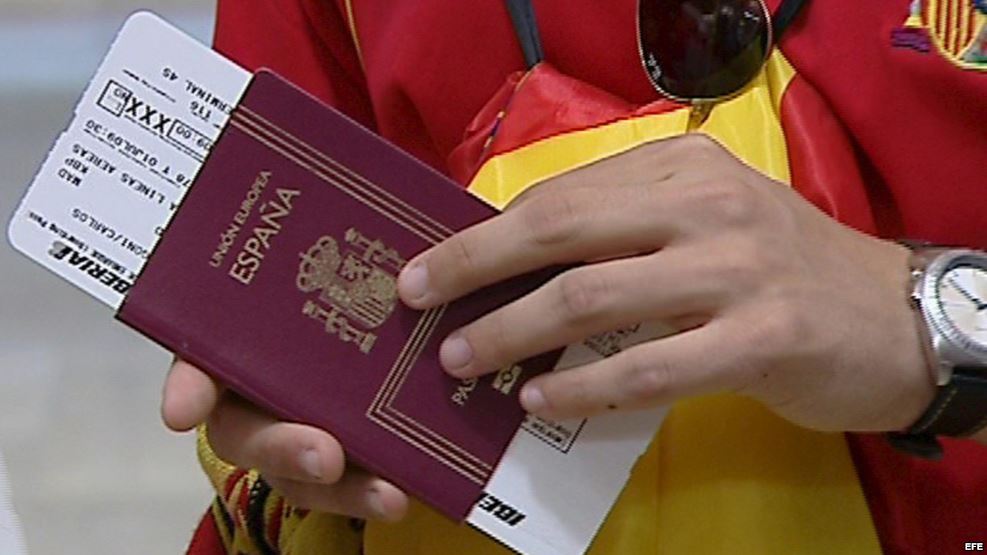
Juan Juan Almeida, 29 December 2017– On December 21 a leftist coalition led by Spain’s Podemos party introduced a legislative proposal that could benefit thousands of Cubans, as well as people of other nationalities, who are descendants of Spanish citizens born outside of Spain.

If approved, the bill submitted to the Chamber of Deputies would grant Spanish citizenship to descendants of Spaniards who had emigrated.

Spanish law had already made a person whose mother or father were native-born Spaniards eligible for citizenship. Law 52/2007, also known as the “Historical Memory Law” or the “Grandchildren’s Law” expanded the opportunity and, within two years and eleven months, some 446,277 people had acquired citizenship under the law. 95.2% of them were from Latin America, with more than half of the applications made through Spanish consulates in Cuba and Argentina. continue reading

If approved, this legislation will greatly expand the number of descendants eligible for Spanish citizenship. It would allow the mother country to legally recognize, among others, grandchildren of Spanish women born in Spain and married to a Spaniard before the adoption of the 1978 Spanish constitution and children of those who obtained citizenship through Law 52/2007.

“Thousands of legislative proposals are made by various parliamentary factions and not even 10% of them manage to get the necessary support in the Spanish parliament. The Podemos proposal does not have this support,” says a source within the ruling party.

However, the proposal by the leftists comes at a significant as well as opportune moment for thousands of Cubans of Spanish descent who were not covered by the Historical Memory Law.

The year 2016, which is quickly coming to an end, was an important year for the Cuban government. In terms of marketing, it was excellent.

President Barack Obama’s visit at the end of March aroused people’s hope for a change. With the resumption of relations, they watched high-level US officials parade through the Havana airport. The Old World’s interest in strengthening political-economic dialogue with the island culminated in the repeal of the the EU’s “Common Position” towards Cuba. And the visit to Cuba by Prime Minister Shinzo Abe of Japan was the first by a head of government from that country.

But in spite of all the publicity and the VIP visitors, the Cuban people’s prospects for development are obsolete and the arrival of much anticipated changes is nowhere in sight.

This legislation would encourage many Cubans to look for an alternative emigration route in light of the still ambiguous outlook for relations between the United States and Cuba.

I personally am unaware how this law in the land of Serrano ham would work. But I do know that, today, Spain is not prepared to handle an influx of 100,000 new citizens, who will surely arrive seeking assistance.

Inter-American Press Association Names Henry Constantin Vice President for Cuba

Cuban activist and journalist Henry Constantin with an issue of Time Magazine covering Cuba. (Twitter)

14ymedio bigger14ymedio, 30 December 2016 — The Inter-American Press Association (IAPA) has named independent journalist Henry Constantín Ferreiro as regional vice president for Cuba. Director of the magazine La Hora de Cuba and a resident of the city of Camagüey, the reporter told 14ymedio that he intends to defend and spread “the reality of journalism” on the island from his new responsibility.

A few hours after the announcement, Constantín told this newspaper via phone that he received the news with a mixture of “surprise and pride” and said he was grateful to be part of an organization that “has engaged in numerous battles over the freedom of the press in the region.” continue reading

Born in 1984, Constantín is a contributor to several independent media, including the magazine Coexistence. He studied journalism for several semester as an undergraduate and also the specialty of film direction at the Higher Institute of Art (ISA).

The reporter feels that the journalism in Cuba is going through “a special moment” marked by “an increasing plurality, although still restrained by the government.” On the island there are “media that cover almost the entire political spectrum,” says the new vice president of the IAPA.

“In this new year we will have to defend the national press because although the context is new, the threats are the same and some of them are even growing,” Constantín points out.

Upon his appointment, the reporter will be responsible for reporting the violations of press freedom that occur in the country and for drafting the report that is published each semester by IAPA.

Previously, the vice president for Cuba was occupied by journalist and director of 14ymedio Yoani Sanchez, who assumed the responsibility in 2012.

Last November, Henry Constantín was detained at Customs at the Ignacio Agramonte International Airport in Camaguey, on his arrival from Miami. The dissident was taken to a police station where his mobile phone and his laptop were confiscated.

See also:

Of UMAP and Other Demons / Henry Constantin

Kidnapped Trip / Henry Constantin

The University / Henry Constantin

Constantin Answers in Diario de Cuba / Orlando Luis Pardo Lazo

So Did Havana Go Back To Laughing, Singing, Dancing? / Iván García

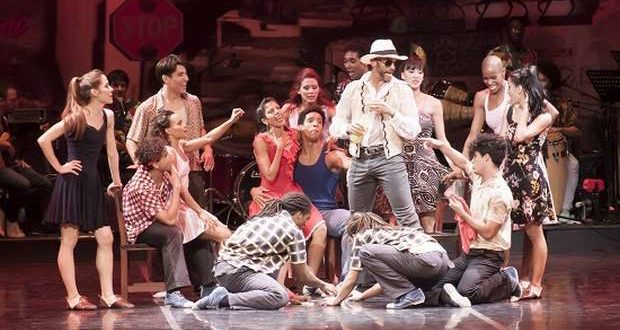
Acosta Danza company, directed by the Cuban, Carlos Acosta – See details below (Source Ana León from Cubanet)

Iván García, 13 December 2016 — The heat returned to the city along with the Reggaeton, the bustle and the alcohol. There’s nothing that bothers Danay, 26 years old, more than the drops of sweat running down her cheeks, mixed with the unbearable smell of kerosene of the old cars used as taxis in Havana, and the scandalous Reggaeton of Micha booming in her ears.

“Turn yourself around, tight and on your toes,” echoes the husky voice of Micha, an ex-slum dweller converted into a singer, coming from the audio equipment of Luis Alberto, 56, a self-employed taxi driver who drives a hybrid racing car 12 hours a day. It has a 1948 Chevrolet body, a German Mercedes Benz motor, a Japanese band-brake and a South Korean Hyundai gear box. continue reading

“I really missed the noise and the sandunga (a type of dance) of Cubans. Those nine days of mourning made Havana into one big funeral parlor. A magic trick. Rum wasn’t being sold, and if they saw you drinking a beer, you were pigeon-holed as a counterrevolutionary,” says Luis Alberto, while he tries to swerve around the collection of potholes on the streets of the capital.

Of the five passengers, no one mentions Fidel Castro. Nor the national mourning. Zulema says she got some bags of chicken at 24 fulas (Cuban Convertible pesos/dollars) each in a market at Carlos III and tells how she rations them out to her family.

“If I put them in the freezer, my children and my husband, who eat like pigs, will devour them in a week. I put five pieces of chicken in a little container inside the fridge. I keep the rest in a freezer under lock and key,” she explains to the passenger at her side, a sporty-looking black man who rides with his head shrunken into the back of the car and only knows how to nod, without commenting.

A young man with a bizarre hairstyle is living in another dimension. He listens to Jay Z with wireless headphones at elevated decibels. He doesn’t participate in the daily debate of the habaneros about the lack of money, food and a future.

He only looks out the car window and occasionally wipes the screen of his shiny Samsung Galaxy 7 with a cloth. Twenty minutes into the trip, Danay explodes.

The heat, the drops of sweat that are spoiling her makeup, the Reggaeton at high volume and the driver’s cigarette smoke, one cigarette after the other, like Marlon Brando in the Godfather saga, have gotten to her: “Please, can you turn down that music and stop smoking?”

The taxi driver looks are her like she’s an extra-terrestrial and answers, “Baby, although it doesn’t look like it, the car is mine. If you’re in a bad mood, you can get out. I bet anything that your boyfriend has left you,” and everybody laughs.

I’m left with this image. The laughing. In the last nine days, just to smile was suspicious. The habaneros were walking around like zombies, solemn and crestfallen.

When people talked about Fidel Castro, they threw out that automatic reproduction that many Cubans carry inside: “The greatest statesman of the twentieth century, the undefeated comandante, the man who escaped more than 600 attempts on his life by the CIA.” Something in that style. The commentaries were replicas of the official jargon.

People drank rum on the sly, the noise died down and a silence that brought more fear than calm spread throughout the whole city. Those who liked to tell tales about Pepito — the little boy who stars in so many Cuban jokes — in the corners, where Fidel Castro was the center of the joke, postponed the pleasantry until new notice.

The private bars sold only soft drinks, malt, fruit shakes and hamburgers. Neither mojitos nor wine. “You’re crazy, brother, if you think I’ll let the inspectors take away my license,” whispers the bar owner to a client. But before closing, he looks from one side to the other, and to those who remain in the bar he offers of drink of aged rum: “This is on the house, so you can celebrate what you want to celebrate.”

And so Fidel Castro’s death suddenly switched off the local customs, the proclamations in the street and that juicy and casual language of the Cubans. But Cuba is a game of mirrors.

Below ground they were betting on the numbers game and playing cards or baccarat in the clandestine casinos known as burles. The hookers worked exclusively door-to-door.

“In those nine days of national mourning it wasn’t wise to prowl around the outskirts of the private bars and discotheques,” says Zaida, who on Monday returned “to the fire.” “The clients were hungry. The mourning ended at 12 midnight on Sunday the 4th, and right away I began to have requests. Because the men were tense.”

Twenty-four hours after Fidel Castro’s ashes were placed by his brother, Raúl, inside an enormous rock that supposedly was brought from the Sierra Maestra to the Santiago cemetery of Santa Ifigenia, 900 kilometers from Havana, the chatting and the noise returned to the capital, and the drunks came back to uncork their bottles.

And the Reggaeton at high volume couldn’t be far behind.

Diarío Las Américas, December 9, 2016

Photo: Once the nine days of official mourning for Fidel Castro’s death was over, the habaneros not only went back to laughing, singing, dancing and making jokes, they also resumed their cultural life. On the night of December 7, many attended the Gran Teatro de La Habana to enjoy the premiere of four works from the Acosta Danza company, directed by the Cuban, Carlos Acosta, who, in addition to the National Ballet of Cuba, has been a dancer in the Houston Ballet, American Ballet Theater and The Royal Ballet, among other important companies. One of the works premiered that night, taken by Ana León, from Cubanet.

Translated by Regina Anavy

What Will Become of Cuba? / Paulina Alfonso

Photo source: traveler.es

cubanet square logoCubanet, Paulina Alfonso, 26 December 2016 — What will become of Cuba in the new year now that Fidel Castro is gone? This is a question only foreigners ask. It is of no interest to most Cubans. They have other concerns: how to get out, how to survive and what number to bet on in the Florida lottery.

The ten years since the Comandante retired have been a period of transition during which his successor, Raul Castro propped up the regime and tested new economic methods.

Some political analysts believe that Raul Castro will now feel less pressured if he were to make attempts to alleviate the difficult economic situation threatening his government. continue reading

Although Raúl Castro has made a commendable effort in the last ten years to improve the Cuban economy, his reforms — he refuses to label them as such — have not gone much beyond changes in land distribution, emigration laws, and the freedom to buy and sell cars and homes. An expansion of the private sector has not had a significant impact or led to a vital economic turnaround.

The main goal, the lifting of the US embargo, was not achieved despite President Obama’s policy toward Cuba. There is still no realistic possibility of the embargo being lifted, at least for the next four years.

Thus, Raúl Castro’s only option is try to improve Cubans’ standard of living, which might allow him to at least regain some of their respect and discourage young people, for whom the current situation offers nothing, from emigrating.

Raúl Castro has publicly indicated he plans to retire from government in 2018. Most analysts agree that he will not be able to accomplish anything he set out to do in the time remaining.

All indications are that Raúl Castro has run out of ideas and has chosen to broaden the current economic reforms — he refers to them as “updates” — as much as he can to at least maintain the status quo.

Will Miguel Díaz-Canel be the means by Raúl Castro maintains this status quo? The fifty-six-year-old politician appointed to succeed the general appears to be a new and improved version of his predecessor, José Ramón Machado Ventura.

For example, Díaz-Canel is never without his smart phone, communicates through Facebook and has a Twitter account. His speeches, though far from eloquent, are more realistic and down-to-earth. He increasingly announces policies that appeal to young people, especially when they pertain to things such as internet access, though nothing that could be called transformative.

They do not include constitutional changes that would codify separation of powers or ten-year term limits. That is yet to be seen. And let’s not forget that none of this has anything to do with political power.

As has been the case since 1975, the first secretary of the Cuban Communist Party (PCC) presides over the Coucil of State and the Council of Ministers and is the country’s highest office. The post will go to the the person who is elected by the next Communist Party congress.

Miguel Díaz-Canel is not the second party secretary; that is Machado Ventura. Getting to be second party secretary will be Díaz-Canel’s main task, even though he is widely known to have been chosen as the successor.

The PCC has a large inventory of veteran cadres with their own ideas and more experience than Diaz-Canel. If they accept him — and this is especially true of members of the military — it will be out of discipline and not because they see him as a leader to be followed.

In reality, the Council of State and Council of Ministers posts are strictly formalities. If Raúl Castro were to disappear tomorrow, the real power would revert to the PCC and whoever is its leader.

Nevertheless, all the regime can do now is wait until Donald Trump takes office and see if he maintains the process of normalization of relations with Cuba or deals it a fatal blow.

Author contact: palfonso44es@gmail.com

It’s Time For Politics To Stop Separating Families And Friends / 14ymedio, Pedro Campos

People leaving Cuba during the Mariel Boatlift.

14ymedio bigger14ymedio, Pedro Campos, Havana, 29 December 2016 — The model imposed in Cuba in the name of a socialism that never existed had, among its worst results, the politicization of everything. Families fought over politics. Friends became enemies. This was one of the most disastrous consequences of the “revolutionary intransigence” in which several generations of Cubans were (badly) educated.

This intransigence, generated by the group in power, facilitated the development of others.

The phenomenon affected practically every family and friendship, which according to tradition had always remained very united. The divisions began in 1959, when the provisional government that was intended to give way to the restoration of institutionalized democracy, failed to do so and turned itself into a permanent revolutionary government that began to apply justice in its own way. continue reading

Immediately, more than a few began to see how to advance the centralized and anti-democratic policies, traditionally identified with communism, that had done so much damage in Europe and which, in the island’s past, had been linked to Batista, the tyrant who was expelled from power.

Disagreement in democracy is normal, but when there is none and dissent is considered treason and is not accepted, as in Cuba in the early days after the triumph of the Revolution, thinking differently is identified as “counterrevolutionary.”

With the first “counterrevolutionaries” began the first great exodus and many families stopped seeing each other or even communicating for many years. Then came other waves. In the early 80’s, some of those who had gone into exile began to return to visit and that began to break the ice.

It was not easy for families to welcome “worms” and “traitors” who now returned with gifts and greater incomes, from a country with another language, culture, climate and traditions. People were afraid that they could lose their membership in the Communist Party or a government job.

Some of those who remained in Cuba would not receive their relatives at that time. Or old friends would not visit with them.

With time and new waves of migration, many of those who had refused to receive their relatives or friends also went into exile. During the Mariel Boatlift, some had participated in the repudiation rallies and shouted, “Let the scum go.” They threw eggs. And later, more than a few them took the same path.

The intransigents insist on continuing to confront families and friends over politics, and they still reject friendships between people who think differently, but there are also people who feel individuals are separate from their ideas and they leave them alone, considering them friends. Pope Francis comes to mind when he talked about “social friendship.”

In Miami, on the other side, there are also intransigents. Both sides make it all the more difficult.

Now, in the aftermath of the former leader’s death, we hear again about “revolutionaries” who did not make friendships carry the weight of politics and did not accept judgments about the consequences of their imprint on democracy and socialism. Intolerance is necessary for nothing to change.

There are many people who do not lend themselves to politics destroying families and friendships. They are fundamental pillars of the future Cuba.

Today, because of the wide exchanges among all Cubans, despite the intolerance expressed from the rulers, there is more tolerance. This is part of the preparation necessary to live in a democracy, which will come sooner rather than later.

It is time for politics to stop separating families and friends. We are in a good moment for it. Cuba, to advance, needs to leave behind so much confrontation, so much stubbornness, so much stupidity. Perhaps all that, on both sides, reached the highest possible point in recent days, and now, like all that rises, it must descend.

It must be understood that, regardless of the political differences, we Cubans will one day have to talk to each other and sit together in a democratic parliament leaving behind grudges and the difficult and dramatic moments of our history, leading with the future and looking for a way to accept ourselves in our diversity.

There will have to be apologies and pardons, difficult encounters. If not men, history will punish crimes and abuses. There will have to be changes in political power, it will have to be peaceful and democratic, but blood must be avoided in order not to resume the cycle of violence, if we really want to see Cuba as a great nation with its international economic and political weight. Politics will have to give way to family and friendship. A divided country is easily made a victim of national and global hegemonies.

Citizens… Time To Tighten Your Belts / 14ymedio, Yoani Sanchez

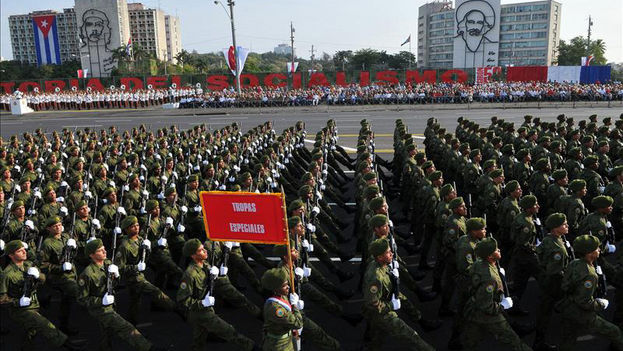
Raúl Castro will preside this January over his first parade, similar to the one shown here, without the shadow of his brother. (EFE / Archive)

14ymedio bigger14ymedio, Generation Y, Yoani Sanchez, 29 December 2016 – My generation knows no good news. We grew up with the grey subsidies of the rationed market, we reached puberty amid the rigors of the Special Period, we raised our children in a country with two currencies, and now they warn us that times of economic stress are coming. It appears there is no respite from this long sequence of disasters, collapses and cuts that we have suffered for decades.

This December the National Assembly of People’s Power acknowledged the negative numbers that reality made clear long ago: Cuba is not growing, production is not recovering, and the so-call Raulist reforms have not given citizens a better life. The island is heading toward the abyss of defaults, cuts in vital sectors of the economy, and continued stagnation. continue reading

In other places, the rulers would resign before the panorama facing this nation, due – in great measure – to bad management. However, since the general president did not win office by a popular vote, no one can punish him at the ballot boxes in the next elections. To the opposition that has demanded his departure, the iron fist of repression and punishment is always applied.

Instead of a mea culpa, the officials who, on Tuesday, detailed the economic debacle and in somber tones said it will continue in the coming year, have called for greater productivity, a reduction in superfluous expenses, and using the so-called “efficiency reserves,” the final official euphemism used to explain what little remains in the national treasury.

However, a few hours after concluding the parliamentary session in which such bad omens were unveiled, the second of the three planned test runs began – Friday will be the third – for the huge military parade that will be staged in Havana’s Plaza of the Revolution on 2 January. A mass gathering, with parades of war tanks and soldiers marching in lockstep, that will cost Cuba hundreds of thousands of pesos, if not millions.

The traffic on the capital’s most important arteries has been paralyzed as of the early morning hours of yesterday, Wednesday. Thousands of state employees didn’t have to complete their workday, and a long line of buses had to travel from various municipalities to the parade grounds. Countless snacks were distributed among the most faithful participants in what is coming to be seen as a “Raulist coronation.” The younger brother has planned his own investiture in power, now on his own, after the death of the former president Fidel Castro.

Why this waste of military resources in the middle of the crisis that the country is going through? Such delusions of grandeur are not consistent with the 0.9% decline in GDP this year. This military parade, with its boasts of strength and a “baring of teeth,” will squander some of the resources needed to repair the deteriorated roads of the island, to give just one example.

In this city that has suffered serious cuts in public lighting, where the last-hour bus terminal have been overwhelmed before the lack of interprovincial transport, and where a pound of pork costs up to two day’s wages, what will take place this coming Monday is far beyond wastefulness, it is a sign of lack of respect.

And so, there are certain politicians. They call – for the umpteenth time – for a tightening of belts and a reduction in the expectations for a better life, while they waste enormous quantities of national resources playing at war.

Hola Ola Technology Park Rush to Open Leaves Some Users Disappointed / 14ymedio, Zunilda Mata

The biggest attraction of the site, for the users of Hola Ola, is the internet access wifi zone installed around the perimeter. (14ymedio)

14ymedio bigger14ymedio, Zunilda Mata, Havana, 29 December 2016 — The long-awaited installation of an internet connection area on Havana’s Malecon has taken its first step. The opening of the Hola Ola Technology Park last weekend was welcomed with great enthusiasm by the state media that described the infrastructure as “the architecture of high technology.”

The center, managed by the Youth Computer and Electronics Club (JCCE), has two rooms, one of them with 15 computers and 32-inch TVs for playing computer games, and another with 15 more machines and electronic games, among them several simulators, as announced by the provincial director of the capital’s Youth Club, Brigida Baeza Bravo. In practice, a visit to the center is enough to confirm that there are about 20 computers that lack access to the internet. continue reading

It is clear that the Technology Park was opened in haste and its first breakdowns are already visible. Tuesday, the simulators for flying, driving and shooting, installed by the Ministry of the Armed Forces (Minfar), were having software problems and were unusable, pending the necessary fixes.

The end-of-year school holidays have stimulated people’s interest in bringing their children to Hola Ola (Hello Wave) to better fill their time. One employee tried to give them hope, this Tuesday, in the face of the mishap that caused the breakdown. “The machines will be repaired very soon, but the FAR (Revolutionary Armed Forces) will have to do it,” she explained.

The explanation did not seem to improve the mood of the frustrated visitors who demanded their time in at the controls or with the toy gun and, to ease the situation, the employee reminded them of the air conditioned room with video games. The line began to extend beyond the compound, where the use of a computer costs two Cuban pesos (CUP) an hour (about 8 cents US).

One mother with two small children waited her turn in the cafeteria. “No one can eat this croquette, it’s dry and they didn’t even use breadcrumbs to make it go down better,” the woman complained, having paid two Cuban pesos for the product.

Another of the services announced in the official press by Brigida Baeza is the rental of tablets, who use was intended to be free during the opening days until a reasonable fee was approved. But the option, for now, is not available to the public.

But the biggest attraction of the site, for the users of Hola Ola, is the wifi access area installed around the perimeter. The network, managed by the Telecommunications Company of Cuba (Etecsa), is also not working to its full capacity, because the antennas are not operational in the back, where the barbecue is located.

There is also no place on site to buy the Nauta cards needed to connect to the internet, which also limits the experience of would-be net surfers, a problem that will be solved “very soon,” according to several employees consulted by this newspaper.

“It’s the wifi area closest to me,” said Amarilys, a Havanan of 34 who lives in the Cayo Hueso neighborhood, although she complains that “the price to connect is still very high,” despite Etecsa’s recent drop from 2 Cuban Convertible pesos (CUC) an hour (roughly $2 US) to 1.50 CUC.

The infrastructure problems affecting Hola Ola also affected its bathrooms this Tuesday, which were flooded by a water leak. Nevertheless, the desire of many citizens to connect to the internet is huge and the web surfers didn’t let any of these inconveniences ruin the kilobyte party.

Cuba is one of the countries with the least internet connectivity in the world. In the last couple of years about 1,100 internet connection points have been enabled on the island, both in navigation rooms with computers provided, and in outdoor wifi zones, but many websites critical of the government remain censored and cannot be accessed from the island, the connection speed is low, and the service suffers from frequent outages.

The Challenge of a Government without Fidel / Dimas Castellano

Machado Ventura, Fidel and Raúl Castro.

Diario de Cuba, Dimas Castellano, 15 December 2016 — Fidel Castro spent decades leaving his personal imprint on Cuba. Wielding absolute power and imbued with a high degree of of messianism, populism and voluntarism, he determined the fates of several generations. He undertook important social projects but hampered the economy and rolled back civil liberties. The government under his leadership anchored the country in the past and missed the opportunities for change provided by his various and continued failures. His death, given the time and conditions in which it occurred, will undoubtedly have a strong impact on Cuban society.

Due to their limitations, slow pace and the contradictions inherent in a kind of power sharing arrangement, the reforms implemented since 2008 under the leadership of Raúl Castro did not yield positive results. A 1% drop in GDP in the first half of 2016, a projected recession in 2017 and an increase in the mass exodus of Cubans in recent years are confirmation of their failure. continue reading

These timid and limited reforms did, however, give birth to an embryonic private sector that the government cannot afford to ignore. Relations with the United States, even if tense under the incoming administration of Donald Trump, established areas of mutual interest that preclude their being reversed. Finding a new godfather in the international arena to replace Venezuela is not an option. And the package of measures put together by the Obama administration, which breathed life into Cuba’s relations with the West, revived tourism and created expectations that will not continue without changes in Cuba itself.

Under this scenario, the government has only two options: to slam on the brakes, which amounts to leading the country into total ruin, or to go forward. The latter is the more likely choice since choosing the former means we would all be losers, including those in power. Even if the political will is lacking and this turns out the be the chosen option, change will come soon enough. We will then see if the current leadership is capable of handling the complexities of getting the country out of stagnation and moving it forward. In any event, any chosen path will, sooner or later, inexorably lead to the democratization of the country.

Given the magnitude of the challenge, what is most important and urgent now is to refrain from judging the actions of the past. Though necessary, the results are already clear for all to see and will, in time, be subject to the implacable judgement of history. Instead, the task at hand is to define the path ahead and to move forward. It is this path that, in the absence of alternative forces capable of imposing rhythm and direction, the Cuban government will have to first define. With no maximum leader or two heads of state, it alone has the resources to initiate any transformation.

With the exception of the fledgling private sector, very little in the economy is working. Dependent on tourism, the Port of Mariel Special Development Zone and a few factories, it is concentrated in the hands of the Business Administration Group (GAESA) under the direction of Major General Luís Alberto Rodríguez López-Callejas.

As for the Revolutionary Armed Forces (FAR), the Cuban constitution stipulates that the president of the Council of State is supreme commander. His principal deputies are army generals Leopoldo Cintra Frías, Álvaro López Miera, Ramón Espinosa Martín, Joaquín Quinta Solas. There are also Brigadier General Lucio Morales Abad, Raúl Rodríguez Lobaina and Onelio Aguilera Bermúdez, who trained under the command of Raúl Castro when he led that institution. All of them are members of the Communist Party Politburo and Central Committee.

Additionally there is the National Defense Council, which can be summoned by the  president of the Council of State at will. In special circumstances, it can become the main organ of governmental and and political power, to which even the provincial and city party secretaries are subordinate.

As a result, the current President holds all the reins of power, allowing him to take Cuba down the necessary path with little or no opposition.

Since the unfeasibility of the current political and economic model is the root cause of people’s apathy and despair, of the mass exodus and of economic inefficiency, any reform that is implemented must attack this fundamental cause. Adopting measures aimed at changing things in order to avoid change, as happened before, would be totally useless today.

Time has completely run out. Although it holds all the reins of power, the government cannot afford to use them for anything other than to effect profound transformation. This is as necessary for resolving the crisis as it is useless for making cosmetic changes or trying to hold onto power in the long term.

Time has been lost but the new scenario, though more complex than those before, offers one last chance for those in power to effect significant change to in a orderly fashion. Totalitarianism is utterly spent. Therefore, regardless of what the government wants, change is inevitable for the government itself. This is the unique feature of the new scenario, which is the ultimate outgrowth of process begun in 1959.

Among the many difficulties are the need for large investments and, therefore, a large influx of foreign capital, which would require new revisions to the country’s investment law; implementing constitutional changes to give legal legitimacy to successors who did not participate in the 1959 revolution; an economy capable of reassuring a dissatisfied populace; changes to property laws to allow producers to own their means of production. For these transformations to be beneficial, they have to be accompanied by transformations in the area of human rights and freedoms.

One of the most feasible possibilities is for the government to take the Vietnamese route. The dilemma of such an approach is that Vietnam’s reforms did not address civil and political freedoms. Given Cuba’s history and culture, this is something that will be impossible to ignore once economic reforms are under way.

In the short term, what happens from this point on will be decisive for Cuba and its society but also for the current government. It is a difficult but inescapable challenge in a landscape without godfathers, without Fidel, with an economy in freefall, and for a people without hope.

The Meteoric Rise Of Susely Morfa González / 14ymedio

Susely Morfa Gonzalez talking to Univision television network. (Screen capture)

14ymedio bigger14ymedio, Havana, 28 December 2016 — The political career of the psychologist Susely Morfa González has been meteoric. This Tuesday she was chosen to be a deputy in Cuba’s National Assembly of People’s Power and a member of the Council of State, barely two years after she burst on the public scene.

Morfa was born in 1982 in Cienfuegos and as a teenager was the president of the Federation of Middle School Students in the town of Rodas. She also held various positions within the Young Communists Union (UJC), and before turning 30 was the first secretary of that organization in her native province. continue reading

She has a degree in psychology, and her entire adult life has played the role of political cadre. Several sources in the Ministry of Public Health consulted by 14ymedio say that she has never practiced her profession at any hospital in the country.

She was named at the last annual session of the Parliament to fill one of the vacancies in the legislative body, and only in this way, as established by law, was she able to become a part of the government’s highest body.

“It’s not a good sign, because it means the most hard-line are winning,” said a retired academic who preferred anonymity. However, analyst Julio Aleaga, author of a study on Cuban politics, considers it difficult to know Morfa’s true ideological positions. To catalog her as more hard line or more reformist is risky, he points out.

Her new position could respond to the Government’s desire to place “women, young people and afro-descendants” in the top positions to fill gender, age and race quotas, says Aleaga, but when it comes to decision-making, “they behave like nondescript people,” without real power.

Morfa shot to fame for her combative performance at the Summit of the Americas in Panama, in April 2015, when she starred in several acts of repudiation and described the activists and exiles who participated in a parallel event as members of Cuba’s civil society as “lackeys, mercenaries, self-funded, underpaid by imperialism.”

During an extraordinary meeting of the UJC in the middle of this year, Morfa was named first secretary of the organization, replacing Yuniask Crespo Baquero.

Last September, she affirmed that “the non-state sector can not be stigmatized” within the island’s economy, although she clarified that entrepreneurs have to remain “within the socialist system.”

At the VII Congress of the Communist Party of Cuba (PCC), last April, the psychologist was elected a member of the Central Committee of the only political organization allowed in the country. During the conclave she was in charge of proposing the candidacy of the ruler Raúl Castro as first secretary of the Central Committee of the Cuban Communist Party.

Cuban Faces of 2016: Yomil and El Dany, Reggaetoneros (b. Havana, 1991 and 1989)

Yomil and El Dany, reggaetoneros. (Facebook)

14ymedio bigger14ymedio, Havana, 25 December 2016 – Cuban Faces of 2016: Roberto Hidalgo Puentes (Yomil) and Daniel Muñoz Borrego (El Dany) reached the status of the most listened to reggaetoneros in Cuba this year. Previously known for being part of projects like Los 4 and Jacob Forever, respectively, both young men joined last year in a group that has not stopped gaining space in the clubs, private parties and the music section of the weekly packet.

The growing popularity of Yomil and El Dany is partly due to the fusion of electronic rhythms hovering between hip hop and more Cuban rhythms, and all that mixed with the catchy reggaeton. Their most recent album, Overdose, reached first in sales on Google Play last March, on the Top Albums of Latin Music, while their musical theme Tengo debuted in 8th place in World Top Albums.

In the middle of this year, the duo recorded the song Enamorado with Amaury Pérez Vidal, a version of the song Tonada Enamorada, composed by the troubadour in the ‘90s.

Bus Terminals Overwhelmed By Hundreds Of Travelers Without Tickets / 14ymedio, Marcelo Hernandez


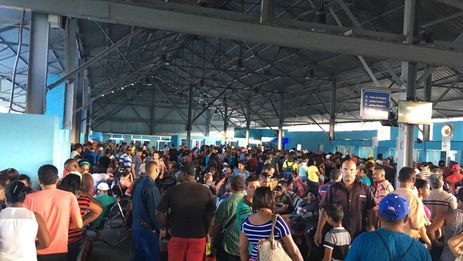
14ymedio bigger14ymedio, Marcelo Hernandez, Havana, 27 December 2016 – Hundreds of people are crowded right now in the “last hour” bus terminals, or are on the waiting lists. With the regularly scheduled seats sold out, travelers sleep in the floors of these places and eat frugally, while dreaming of a vehicle that will get them home to spend New Year’s with their families.

In mid-December, the newspaper Granma reported that the Voyager Company would put on sale new seats for interprovincial transport for the end the year. However, the tickets sold out in a couple of days and thousands of customers have been left stranded at “last hour” terminals throughout the country. continue reading

This time, unlike other years, the so-called “waiting list” was not addressed with a greater number of vehicles. The Business Group of Automotive Transport Services preferred to sell in advance the additional tickets to travel between 22 December 2016 and 7 January 2017.

The state transport company sold 9,000 seats above those offered by the regular National Bus Service, but only the most forward-thinking were able to get the tickets. The agencies that sell the tickets experienced days of huge crowds, and five days after the official announcement, tickets to Camaguey and Guantanamo were sold out.

Private transport companies provide only a little relief. Their high prices make it difficult for many travelers to use their services, because they can only afford the state rates.

The scene at a “last hour” bus terminal crowded with Cubans wanting to get home to their families for New Year’s.

“I know the face of almost everyone here, because most of these people have been here for many days,” confides the employee who takes care of the men’s toilet in the Villanueva last hour station in Havana. Chaos and discouragement reigns in the facilities, where the average stay is “four or five days” according to the worker.

“The police are coercing people to get them to leave,” he explained to 14ymedio freelance reporter Juannier Matos Rodriguez, who was waiting in Villanueva Monday to travel to Baracoa, Guantanamo. Entire families have placed cardboard on the floor to sleep and the uniformed police patrol the place.

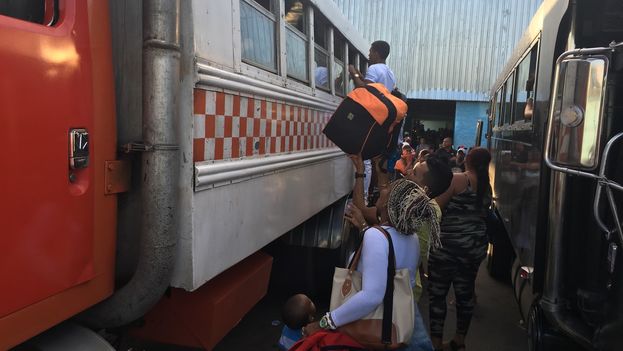
Private carriers relieve the situation, but only for those who can afford to take one of their expensive vehicles. (14ymedio)

“Several passengers have approached the employees asking for them to arrange extra buses so that all these families can travel, but they do not respond,” says the young man. “The waiting list for Santiago de Cuba is not moving, it’s been stuck on the same numbers for two days,” he adds.

The most desperate, with the resources available, pay between 14 and 15 Cuban Convertible Pesos (CUC) for a ride on a private truck bound for Santiago de Cuba, twice as much as the state bus. These are cargo vehicles re-configured for the transport of passengers. The best ones have cushy seats and even air conditioning, but in most cases they are uncomfortable and hot.

The National Bus Company serves 132 routes and in the first nine months of this year it moved 7.6 million people, but when holidays approach, the system collapses in the face of high demand. Most of the state-owned equipment is Yutong brand buses from China, with a decade of overuse and poor mechanical conditions.

The deterioration of the vehicles has combined this year with cuts in fuel consumption that affect the entire country. Passenger transport has been among the sectors most affected, although the government has also imposed restrictions on electricity consumption and a drastic reduction in the state sector’s quota for gasoline or diesel.

Earlier this year, a discussion on the Roundtable TV program confirmed that interprovincial transportation only meets 70% of demand.

“Why doesn’t ‘Cuba Says’ come here now?” a woman at the Villanueva last hour station complained Monday afternoon, in an allusion to the official television program critical of the bureaucracy and laziness. Several passengers recorded scenes with their mobile phones and from time to time a shout was heard over the general murmur: “A truck arrived for Holguín!”

After an announcement like this many throw themselves into the race, pushing and shoving to the point of small brawls, to board the vehicle. The police pull some people out of the melee and put them in their patrol cars. Everyone wants to get out of the hell the Villanueva station has become.