
“Human rights in Nicaragua have deteriorated considerably since 2008” / 14ymedio, Reinaldo Escobar

Flores-Centro-Nicaraguense-Derechos-Humanos_CYMIMA20150508_0010_13 (1)

14ymedio bigger14ymedio, Reinaldo Escobar, Brussels, 9 May 2015 — Wendy Flores Acevedo, a young lawyer with the Nicaraguan Human Rights Center (CENIDH), spoke with 14ymedio in Brussels about the loss of legal guarantees in recent years in her country, under the government of Daniel Ortega.

Escobar. What is the situation today with human rights in Nicaragua?

Flores. Human rights in Nicaragua have deteriorated considerably since 2008, one year after Daniel Ortega was reelected, because they have lost the value they had. They are not given due respect by the officials and above all non-governmental organizations who devote themselves to this work have been excluded, accused of being mercenaries in the service of imperialism. On top of that, we lack access to information.

The CENIDH made at least two annual visits to the eight prisons in the country, and in addition when we receive complaints about serious violations, we were able to visit the complainant, and physically see the individual in an interview. Since 2008, this is no longer possible. We aren’t even allowed to enter the prisons.

Escobar. Has the government withdrawn your legitimacy? continue reading

Flores. We still have legitimacy, in the sense that citizens continue to trust us, they continue to send us complaints, and that is what legitimizes us as an organization in defense of human rights. Despite the difficulties, we investigate cases. Often, the lack of information, refusal of access, is a confirmation of the alleged facts.

“A military doctor was denounced and sentenced just for commenting that it seemed we were back in the 80’s”

Escobar. How are political prisoners currently registered?

Flores. We don’t have it now but we did have it. For example, a military doctor who was sentenced last December just for commenting that it seems like we were in the 80s again, in a “Red Christmas,” because it was stained with the blood of the peasants. He made statement was made on the sidewalk outside his home when he was on vacation. This lieutenant was accused of the crime of “against military decorum.” His comment was heard by one person, who denounced him. Thanks to the pressure they gave him a sentence of only three months, but it still was a political case, because it violated his right to freedom of expression.

Escobar. And what was this military man referring to when he spoke of the blood of the peasants?

Flores. He was referring to the repression suffered by several peasants at the hands of the national police for protesting against the canal they are planning to build in Nicaragua. Those demonstrations lasted one week and on 24 December ended with violence by the authorities.

Escobar. And what is the conflict with the canal?

Flores. The main problem is perhaps the lack of information people have about the consequences of having a canal. Informing them has not been possible because, among other reasons, there are no studies of the economic feasibility or the environmental impact. At a recent hearing before the Inter-American Commission on Human Rights, the State affirmed they were terminating these studies, but the problem is the law has already been approved and a concession agreement is already signed through which a Chinese concession acquires the rights to 107 square miles of the nation’s land. In this agreement it specifies that neither the Constitution nor the laws of the country will apply to this area in the case of future conflicts.

Escobar. What about the majority of Nicaraguans, are they happy or unhappy with this project?

Flores. There is a lot of discontent. Indigenous peoples have not been consulted and it is an obligation of the State to do so. Farmers have not been consulted, nor have they been given any information about the process of land expropriation, or if there will be compensation. This is ancestral land with and this has generated all kinds of protests.

Escobar. Is a referendum or something similar not provided for as a part of the public consultation?

Flores. Many have raised this issue, but the government does not mention this possibility. There have been deputies who have questioned the project and have supported the peasantry. Private business is silent, because it is assumed that there will be many economic interests at stake. The same goes for politicians who are businesspeople.

Escobar. Do you suspect that there is some corruption behind this plan?

Flores. It is assumed that behind the canal there could be money laundering or corruption, and this assumption rests on the lack of transparency about the financial resources to be employed. In fact, the Chinese company that has the concession does not have the money to carry out this project, which is immense.

What there is now doesn’t fit into any definition of philosophy or of what we once knew as “Sandanistism,” as an orientation of the political Left.

Escobar. So ultimately does all this seem a little “too good to be true”?

Flores. That’s part of the hypothesis: that the canal scheme is a strategy to carry out the expropriations and ultimately what they will end up creating will be tourist centers. But it could be a canal, or something else, the fact is that by law they have established the occupation of a strip of territory that will divide Nicaragua into a North and South and that has been approved due to the lack of independence on the part of the judicial system. We are not seeing the canal, nor the resources, nor the viability, nor the increase in demand for labor. The only thing we are facing is the imminent threat of expropriations.

Escobar. But a work of this magnitude would necessarily create a high demand for labor.

Flores. They say about 50,000 Chinese will come to the country, considering that they have done similar projects in other countries.

Escobar. How is it in Nicaragua today with regards to women’s rights?

Flores. We have suffered a legal setback since political parties decided to pass a law that completely criminalizes abortion, including therapeutic abortion or abortions for pregnancies that occur as the result of rape. We had an article in the law establishing the exception to guarantee the health of the woman. That article was repealed in November 2006. In 2008, with the new government of Daniel Ortega, a new penal code which repealed all criminal regulations were formulated, but in this new code did not set any exceptions to the ban on abortion, and even established language on “injuries due to giving birth” which eliminate every consideration regarding the risk of childbirth. The United Nations has made ​​recommendations for allowing termination of pregnancy in case of congenital malformations or in the case of rape, but to date the Supreme Court has not made ​​a judgment on the appeals filed.

Escobar. Are what we are seeing in Nicaragua is still “Sandinistism” or is it something else now?

Flores. What there is now doesn’t fit into any definition of philosophy or of what we once knew as “Sandanistism,” as an orientation of the political Left. Today all this is contradicted by the practices of the government, with the living conditions enjoyed by the senior political leaders, who bow are businessmen with great economic resources whose priorities have nothing at all to do with situation of human rights and protecting the disadvantaged.

Escobar. And will they continue in power?

Flores. Yes, probably for a long time. They have full control of the economy, the army, the media and parliament.

Better Than Nothing / Fernando Damaso

Fernando Damaso, 6 May 2015 — A few years back, in one of the many failed initiatives of Cuban socialist commerce, there was an attempt to promote the sale of items for which there was little demand. The  term coined to describe this was venta convoyada, or “joint sale.” Three different items (a deodorant, a machete and a roll of toilet paper for example) were bundled and sold together for one price. The items had nothing to do with each other but were sold as a unit rather than separately, which would have better served the needs of purchasers. Rather than being customers, buyers were forced to take on the role of lenders. As might have been expected, the initiative failed.

It seems this practice has been revived, repeating the same mistake, but this time with political and cultural events rather than commercial goods. For example, we have just found out that there will be a political event in support of Venezuela as well as in honor of “The Five.” (The two causes are fashionable right now.) There will be a concert marking the anniversary of a muscial group, which will also be giving it. Additionally, it will commemorate an old speech as well as the allegedly successful fulfillment of a production target. In other words, we are seeing the emergence of the “joint celebration.”

Perhaps this is because the number of anniversaries, events and people to commemorate has become so large that it exceeds the number of days in the year, hence the need to bundle them.

While not being terribly important, this initiative might well be considered one of Cuba’s greatest contributions to twenty-first century socialism. It’s better than nothing.

Elections Highlight Need for Political Change in Cuba / Dimas Castellanos

Dimas Castellanos, 24 April 2015 — Elections for delegates to the Municipal Assemblies of People’s Power were held in Cuba on April 19. In light of the reestablishment of diplomatic relations with the United States, they highlight the pressing need to expand the reforms to the political arena.

For the first time close to one million voters, 11.70% of the electorate, did not go to the polls. If we add to this the 700,000 voters who cast invalid ballots, the number of abstentions climbs to 1.7 million Cubans. That amounts to more than 20% of the electorate.

In 2003 the number of abstentions and invalid ballots totaled 6.09%. It 2008 it was 7.73%. In 2013 it reached 14.22%, almost double the 2003 total. This year it topped 20%. Such sustained growth is a clear indication of change in Cuban voting patterns that the authorities cannot afford to ignore. continue reading

The causes are quite obvious. A profound crisis brought on by an unfeasible economic model — exemplified by low salaries, widespread corruption and a mass exodus from the island — has had an adverse impact. Cubans are aware that delegates lack the basic power to effect change. In spite of the risks inherent in a one-party system — one which holds a monopoly on information, and a lack of fundamental freedoms — they have opted to boycott the polls. Or they cross out, nullify, scribble on or turn their ballots in blank. This includes tens of thousands of voters who cast their ballots at the last moment as a form of protest. We also know that for everyone who dares take such actions, there are others who are gradually losing the fear that has paralyzed them. In response to the argument that it is the people who nominate candidates, one might add that is also the people who boycott elections and invalidate ballots.

Rather than clinging to the past or continuing to make changes “slowly but steadily,” the authorities should take a critical look at these numbers and acknowledge the need to expand the reforms to political arena, beginning with a real electoral law that allows citizens to choose from candidates who offer a range of options. It is a matter of fulfilling the promise made on January 8, 1959 when the leader of the revolution announced that there would be elections “in the shortest period of time possible.” This period dragged on for no less than seventeen years, when in July 1976 the first post-revolution election law was enacted. Plagued with shortcomings, it was repealed in 1992 when Law 72, which governs current elections, was enacted.

This law limits direct elections to delegates for municipal assemblies. From here candidates for the provincial and national assemblies as well as the presidents, vice-presidents, secretary and other members of the Council of State are chosen by the various commissions for candidacies (as stipulated in article 67), which are made up of members of so-called mass organizations (article 68), all of whom are members of the only party allowed under the constitution.

According to the law, delegates elected directly by the people cannot exceed 50% of the total number of candidates. The other half are nominated by the commissions for candidacies, which has the power to choose people not elected by direct vote (articles 77 and 86), a violation of popular sovereignty.

In his famous book, The Social Contract, Jean Jacques Rousseau argued that people joining together to protect and defend their property expresses a general will, making the parties a collective political body. The exercise of this will — an expression of power — is referred to as sovereignty and a people which exercises it is sovereign.

If elections are a manifestation of popular sovereignty, then the Cuban electoral system is a denial of that sovereignty, as demonstrated in the recently held elections. What is needed is a new law that will respond to the interests of the Cuban people rather than simply serve as a means to hold onto power.

During the Tenth Plenary Session of the Central Committee of the Cuban Communist Party it was announced that a new electoral law will govern the 2018 general elections. One might infer that it will set term limits for senior governmental posts and establish a maximum age for those occupying such posts. Such changes, however, are not enough. The new law must be enacted through a popular referendum that itself is the result of consensus, abandoning the practice of simply imposing laws without taking into consideration the interests of the people.

The 1.7 million Cubans who reject the electoral system have a right to choose from other options. Some years ago an opposition figure was nominated in the town of Plaza on two consecutive occasions and the only votes he got were his own and that of his wife. Nevertheless, in the last elections a computer technician, Yuniel López de Arroyo Naranjo, and a lawyer and journalist, Hildebrando Chaviano de Plaza, ran as opposition candidates in preliminary elections and won. In the subsequent municipal elections the former obtained 233 votes and the latter 189.

In other words, voters who abstained or voided their ballots now joined with those who openly voted for the opposition, despite the smear campaigns against the candidates.Given that the nation is a community made up of a diversity of people of equal dignity seeking a common good, one must recognize multi-party democracy as an expression of that diversity. It is, therefore, essential that Cubans’ political liberties be restored so they can begin to play an active necessary role in the destiny of Cuba.

Previously published in Diario de Cuba 

From Ferry Line to Internet Line / Yoani Sanchez

Key West-Havana Ferry, takein in 1951 (Miami History Archives and Research Center)
Key West-Havana Ferry, taken in 1951 (Miami History Archives and Research Center)

Generation Y, Yoani Sanchez, 7 May 2015 – Toward the other side of the sea, that point on the horizon that so many Cubans dream of, several of the curious were gazing yesterday as they sat along Havana’s Malecon. Hours earlier word begun to spread that the United States has authorized “certain specific licenses for passenger ferry service” to Cuba. The rumor was enough for many to play with the idea of how this country would change if it were connected by boat to the other shore. A thousand and one illusions have been unleashed in recent hours, although the four ferry companies authorized by the U.S. Department of the Treasury have yet to receive approval from the Cuban authorities. continue reading

However, the symbolic effect of this relaxation reaches dimensions that transcend the political gesture. We live on an island and this has given the sea, for us, the character of an insurmountable frontier, a wall that isolates us from the world. When a Cuban prepares to visit another country, we rarely use the verb “to travel,” but rather appeal to a more dramatic word, salir: which means to “go out” or “get out” or even “break away.” To escape our insularity, to get to the other side, we have to saltar: “leap over.” A catamaran from Florida arriving along our coast every day would break – at least metaphorically – this geographic isolation used, for the last half century, for ideological purposes.

People in the street, however, are waiting for more than allegories. Now hopes focus on trips by Cuban-Americans becoming cheaper with the new maritime connection. Many dream that the holds of these boats can also bring the resources for private enterprise, agriculture and domestic life. “The pieces I’m lacking for my Russian-made Lada car,” Cheo, an engineer turned taxi driver, dreamed yesterday. His brother bought some Soviet car parts in Miami but he can’t send them because “they weigh too much and it’s too expensive by air.”

In the afternoon, two men were arguing in a crowded bus about whether the Cuban government would authorize a ferry landing in Havana. “Not even crazy people are going to allow that, boy,” shouted the older one, continuing his argument with, “Do you really think they’re going to let a boat with an American flag dock here?” The younger one, however, turned the conversation to his interests, ”What we need them to do, in addition to a ferry line, is put in an Internet line.” And so he finished with an ironic laugh.

Cubans appear ready to make up for lost time. To fit into the world in every way possible. To convert the sea that for so long was a barrier into a path, a road, a connection.

Privatized? / Regina Coyula

Regina Coyula, 6 May 2015 — I have noticed that the old-time “conductor” has recently made a comeback on city buses (though the person driving them is still called the driver). Rather than using the fare box, passengers must now pay the conductor instead. Being the curious type, I got into a conversation with one of them and found out a few things that our informative newspaper Granma has not mentioned.

According to the conductor — the driver also joined in on the conversation — the buses are in essence leased to the workers, who are responsible for maintenance and repairs. However, the Chinese manufacturer will not ship spare parts because the state has not paid its bills. If anything breaks, fare receipts drop, so the bus company deals with it by unofficially passing the problem on to the drivers. Since the driver has his hands full, a co-worker — a driver himself — is there to make sure every passenger pays the requisite fare. continue reading

The workers must set aside a certain portion of their share of the receipts for bus maintenance, a percentage much lower that what the company gets, which amounts to more than half the receipts according to my source. And that is not his only complaint.

“Newspaper articles only talk about the things people complain about, but no one talks about what we are going through,” he says.

There is music in the background as we talk. Music can be heard on every bus these days, typically whatever a driver happens to like. On this particular day it happens to be love songs.

“I like timba and some reggaeton but this music relaxes me,” says the driver. “If I have problems now, can you imagine what it would be like if I played the other?”

Google Toolbar now available in Cuba / 14ymedio

Google headquarters in Mountain View, California. (CC)

14ymedio bigger14ymedio, 6 May 2015 — Cuban Internet users can now download the Google toolbar, according to a Tuesday announcement on the firm’s corporate blog. The new service joins last year’s arrival of Google’s Chrome browser, as well as the applications and free games of Google Play and the free version of Google Analytics.

The directors of the US Internet giant have traveled to Cuba twice in the last year. This March a company delegation led by deputy director Scott Carpenter met with students and professors of the University of Information Sciences (UCI) in Havana and visited Jose Antonio Echeverria City University (CUJAE ) as well as facilities of the state Youth Club of Computing and Electronic.

That trip was preceded by a trip last June by Eric Schmidt, chief executive of the company, who visited the Island with Google employees Jared Cohen, Brett Perlmutter and Dan Keyserling, with the aim of “promoting the virtues of a free and open Internet.” continue reading

After the trip, Schmidt wrote in his profile on Google Plus: “If Cuba is trapped in the 1950’s, the Internet of Cuba is trapped in the 1990s.  About 20-25% of Cubans have phone lines but mostly subsidized land lines, and the cell phone infrastructure is very thin. Approximately 3-4% of Cubans have access to the Internet in internet cafes and in certain universities.”

Several US companies such as Netflix and Apple are trying to break into the Cuban market after the easing of access to information infrastructure introduced after the announcement of the restoration of diplomatic relations between Havana and Washington on 17 December.

However, Internet access remains restricted in Cuba. With few exceptions home-based connections are not permitted and the rates in public internet rooms or in hotels are extremely high for most people. There are one million computers in the country, of which only half have Internet access, according to statistics from the ONE.

Alan Gross leads movement to strengthen relations between Cuba and the US / 14ymedio

Alan Gross on the plane returning him to the US after his five years in a Cuban prison (CC)

14ymedio bigger14ymedio, 5 May 2015 (With information from agencies) – Alan Gross, the former US contractor who imprisoned in Cuba for five years for espionage until last December, is heading up a movement created to push for a closer relationship with the Island.

The “New Cuba” mission is pressuring the United States Congress to put an end to the travel restrictions on Americans who want to visit the Island, as well as to expand commercial relationships, according to its organizers.

This Monday Gross participated in a presentation in Miami Beach attended by members of the large Cuban community in south Florida, both Democrats and Republicans. The committee has the support of companies hoping to do business in Cuba. “We want to send a strong message to all candidates for Congress. There is a bipartisan push for further changes in policy,” added Luis Miranda, a political strategist and former White House spokesperson who is consulting with the committee. continue reading

The “New Cuba” movement defies the power of the pressure long-exercised by more politically radical Cuban-Americans, led by the US-Cuba Democracy PAC, which has raised more than $4 million since 2004.

Alan Gross was released as part of the agreement between the US and Cuba announced on December 17 to restore diplomatic relations and he now wants to contribute to the restoration of normalization between the two countries, according to his lawyer, Scott Gilbert. “Alan supports president Barack Obama’s initiative 100 percent and he believes that open travel and trade between our countries is the best thing for the people of Cuba and the people of our country,” he added.

On Tuesday, US Senator Marco Rubio, who aspires to be the presidential candidate of his party for the 2016 elections and who and opposes Obama’s policy towards Cuba, will chair a hearing on US Department of State’s budget, which is expected to focus on Cuba.

Pavel Giroud finally finishes filming “The Companion” / 14ymedio, Luz Escobar

The poster for the film “The Companion” by Pavel Giroud. (FACEBOOK)

14ymedio bigger14ymedio, Luz Escobar, Havana, 5 May 2015 — Cuban filmmaker Pavel Giroud announced Tuesday through his Facebook profile the completion of the long process of his film El acompañante (The Companion), after finishing the assembly stage and sound mixing in the Clap Studies of Medellin, Columbia.

This film project has received awards on multiple occasions in its preproduction phase. One of the most important recognitions was the best project award at San Sebastian’s Europe-Latin America Co-production Forum, as well as the SGAE Julio Alejandro Screenplay Award, awarded at the Malaga Film Festival. continue reading

These tributes provided indispensable economic support for the shooting of the film, undertaken as an independent project, outside the Cuban Institute of Cinematographic Art and Industry (ICAIC). Another key factor was the success of his previous film La edad de la peseta, (English title: The Silly Age), for which the young director won the award for best feature film at festivals in Cartagena and Cinesul, as well as the Chris Holter Humor in Film Award in San Francisco. The many awards garnered by this film led some publications to elect Giroud as one of the ten most promising young directors in Latin America.

Among the stars of the film are the Cuban singer Yotuel Romero and Armando Miguel Gomez, who recently starred in Meleza (Molasses). Pavel Giroud had announced in several interviews the presence of the Brazilian actor Lázaro Ramos, who, despite a highly successful debut in Madame Satã, is better known in Cuba as André Gurgel in the Brazilian telenovela Insensato corazón (Foolish Heart). The actor, however, eventually did not participate in the shooting.

The film recreates the story of a great boxer from the eighties who ends up spending his days at the bedside of an HIV patient at a sanatorium in Los Cocos, as a form of punishment for testing positive for banned drugs. The athlete must follow the steps of the patient, a hero of the war in Angola who is spending his days at the facility against his well and who needs a companion for his weekly excursions outside the sanatorium.

After long months of research and interviews, the director found the documentary Al Margen del Margen (Beyond Outcasts – 1992), filled with images of a sanatorium and testimonies of the patients. Although “The Companion” is fictional, the real story of a sanatorium gave it a sharper focus. This film is the first time that the subject of AIDS patients has been addressed in Cuban fictional film.

In April there were at least 338 arbitrary detentions in Cuba / 14ymedio

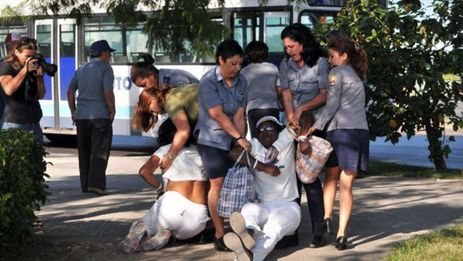
Arrests of Ladies in White (Source: MartiNoticias)

14ymedio bigger14ymedio, 5 May 2015 – During the month of April, at least 33 arbitrary detentions were recorded in Cuba, according to the report released Monday by the National Cuban Commission for Human Rights and National Reconciliation (CCDHRN). Although the figure represents a decrease compared with 610 cases recorded the previous month, the organization warns of increased police violence against opponents.

The CCDHRN especially condemns the assaults against members of the opposition group Ladies in White, which have intensified in recent weeks, with dozens of arrests every Sunday.

Throughout the month of April, the organization headed by Elizardo Sanchez also recorded 101 cases of victims of other forms of political repression on the Island, generally directed by the political secret police (physical attacks, harassment, vandalism and acts of repudiation). continue reading

The CCDHRN mentioned the incidents that occurred in the forums parallel to the Summit of the Americas in Panama, when representatives of pro-government organizations confronted dissidents. The “ruling totalitarian regime in Cuba showed its true face, beyond speeches and empty promises, and its decision to continue imposing the ruinous model of the [Communist] party and unique thinking,” explains the group in a statement.

“We continue have the worst situation in the entire hemisphere and our forecast is that there will be no improvements in the near future, unless some kind of legal and political miracle happens in our country,” the statement said.

The CCDHRN also demands an investigation into the murder of Yunieski Martinez, age 30, in the province of Matanzas, who was shot despite being unarmed, and holds an official of the Ministry of Interior responsible for the death.

Rain comes to Holguin after months of drought / 14ymedio, Fernando Donate Ochoa

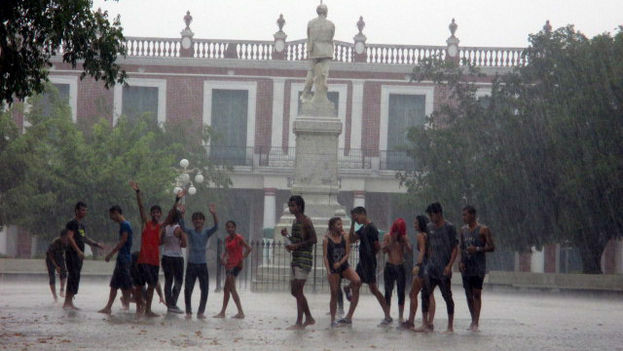
Young Holguineros celebrate the arrival of rain in Calixto Garcia park in the city center (Donate)

14ymedio bigger14ymedio, Fernando Donate Ochoa, Holguin, 2 May 2015 – The capital of Holguin received one-and-a-half inches of rain this Friday after months without rain. The city’s residents received the precipitation with hope that the drought in the territory would be alleviated, but expect a brief respite for agriculture and the consumption of water by the population.

The figure for Holguin was recorded at the weather station located in the area of the Pedagogical University José de la Luz y Caballero in the city, while in the town of Velasco two-and-a-half inches were recorded, according to what Jose Marrero from the Provincial Center of the Institute of Meteorology informed 14ymedio.

The rain, which started about 5:30 pm and lasted almost two hours, was not sufficient for recovery of the aquifer nor to fill the reservoirs affected by poor rainfall in recent months. This situation has plunged the province into a severe drought that affects more than 38,000 people and which, along with the high temperatures of recent days, has resulted in several fires.

“Four months of rain is needed to fill the reservoirs,” Marrero told this newspaper. However, in April less than two-tenths of an inch of rainfall was reported in the territory.

The Mass of the Bread Line / 14ymedio, Victor Ariel Gonzalez

Victor Ariel Gonzalez, Havana, 4 May 2015 – His shirt, once white and elegant, has turned yellow with age. He wears frayed pants and well-worn dress shoes, perhaps a size or two larger than ideal. Contrasting with his clothes, on his head he wears a black beret with an embroidered red star, and slung over his shoulder the tiniest bag emblazoned with the Cuban flag.

The old man reads today’s Granma newspaper in a loud voice alongside the line to buy bread. Excited, he maintains a grandiloquent tone more mocking than declarative, and pauses when he wants to impart gravity to a phrase. Adding some of his own details, such as news of past decades and great failures that have left their mark in his deceptive memory.

His voice fades at the end of an official announcement. Few are those who take their role so seriously. Among those who could not help but listen to him, some smile and gaze at him with expressions of complicity, others remain serious, absorbed in their own problems. Most don’t even pay attention to the nutcase. “Poor thing,” whispers a woman.

Then the old man, feeling that he’s done a favor to the public and after the oven beeps, offers plastic bags at one Cuban peso each to carry the hot bread. The line moved, and even the most worried faces come alive a little. The fantasy ended and the rhythm of the city hurries everyone, even the least sane.

Their Weapon is the Word, Peaceful is their Struggle / Cubanet, Rafael Alcides

The dissidents, labeled as “mercenaries,” seek only, through peaceful means, democracy for Cuba (file photo)

Our “mercenaries” do not plant bombs, nor do they plan attempts on people’s lives, nor sabotages, as did those who today are in power.

cubanet square logo

Cubanet, Rafael Alcides, Havana, 30 April 2015 – A young Communist, lamenting how the Cuban government delegation (supposedly there representing Cuban civil society) made fools of themselves in Panama, told me, “Well, at any rate, all you people are mercenaries.”

“First of all,” I responded, “exclude me from that group. I do not belong to any party, I am an independent voice. Secondly, regarding that ‘mercenary’ label, even the government doesn’t believe it. It has always been thus: for the autocrat, there is no ‘opponent,’ no ‘adversary’ – there is only ‘the enemy.’ ”

I took a mental trip back to the administration of José Miguel Gómez, when, to take advantage of the recently enacted Platt Amendment, the striking term “annexationist” came into use to exterminate the opponent, the enemy. Indeed, extermination is the issue. The “mercenary” term began having the demolishing effect of ten tons of cast concrete falling on its target. continue reading

It is the equivalent of the Germanophile appellation, nurtured by the Major General of the Liberating Army, Mario García Menocal, in the days of the First World War, and when Cuba, following the United States’ lead, declared war on Germany and even purchased 30 aircraft and trained 30 aviators to send them to the battlefields on the other side of the Atlantic.

It is poetic to observe, at all times in history, the behavior of the autocrat toward his enemies. In those days, there were no strikes, especially in the sugar industry where, other than the local “Germanophile,” no true Germans (Germans who came from Germany to help Cuban workers) took part. There are even reports of ambushes and crossfire between the rural police force and Germans who, with the help of certain elements in the area, managed to break through the enclosure and, on one occasion, sink a submarine that was to have collected them at the heights of Nuevitas.

But the Germans lost the war and the Russians expanded the territory that had been taken by the Czar and, on the ideological front, spread out over the world. Machado, to keep up with the times, started calling his political enemies “Bolsheviks” and preached hatred towards the “Russian experiment.”

To save the country from such an odious potential destiny, one must cast the enemy to the sea, for the expeditious man does not waste time executing the common malcontent, nor agitating him until he grabs four boards and two truck tires and heads for the sea.

No, a man like General Machado throws the fellow to the sharks right there at the mouth of El Morro, so that if this enemy is heard from again, it is only through fishermen’s bad habit of describing a wristwatch still on an arm, or a pair of underpants still bearing a Chinese laundry stamp, which they at times discover upon opening a shark’s belly – for which reason President Machado, being unable to tape fishermen’s mouths shut, ended up outlawing shark fishing.

Batista during his second term, perhaps exaggerating a bit but not lying, called the 26th Enemy (i.e. the 26th of July Movement) by a name that turned out, to a great extent, to predict the future: “Fidelocommunist.” I say, to a great extent, because many worthy members of the movement did not accept its surprising turn towards the Leninism which was evident by the time they emerged from The Sierra. It was the “traitor,” the “pro-imperialist,” created under duress by Fidel Castro, that served as the model (for those who did not come down from The Sierra and stopped applauding) for the later, “worm,” “scum,” “unpatriotic one” – and, from the Bay of Pigs, the “mercenary.” *

In other words, the dissident, who, having no place in the totalitarian state where it is the ruler who imparts the law and distributes employment, needs the help of the countries and institutions interested in democracy; just as, for reasons opposed to democracy, the Cuban government has aided numerous foreign political movements and has, in turn, been helped by Russia, China, Czechoslovakia and other socialist countries, and later – and up until today – by Hugo Chavez’s (and now Nicolas Maduro’s) “Chavista” Venezuela.

But, you know what? Even those little epithets created to diminish the opponent get worn down and lose their edge from overuse, i.e. “mercenary,” which used to inspire such fear, and is already being disputed by children when organizing their games, and which is borne with pride because of what it implies, with that same pride with which half the Cuban exile community today bears yesterday’s dishonorable title of “worm.”

I don’t know if I have convinced you, but the young Communist (a law student, by the way) did not reply to me. Along the way I had made him note that our “mercenaries” have put their trust in words and images to serve as their weapons, which can be seen in the only space where with much effort they manage to rear their heads: the Internet. No bombs, no assassination attempts nor sabotages, such as were committed by those who today are in power. So peaceful and patient they are that, so as not to hurt anybody, they don’t even want to proclaim themselves as “dissidents.”

About the Author

rafael461.thumbnail

Rafael Alcides was born in Barrancas, municipal district of Bayamo (Cuba) in 1933. A poet and storyteller, he was a master baker in his teen years. He has worked as a farmhand, cane cutter, logger, wrecking crew cook, and manager of a sundries store in a cane-cutters’ outpost. In Havana in the 1950s he worked variously as a mason, broad-brush painter, exterminator, insurance agent, and door-to-door salesman. In 1959 he was the chief information officer for the Department of Latin American Affairs in the Ministry of Foreign Relations, and spokesman of this agency in a daily television program in which he hosted and interviewed foreign political personalities. He was chief press officer and director of Cultural Affairs in the Revolutionary Delegation of the National Capitol.

Among his most recently-published titles are the poetry collections, GMT (2009), For an Easter Bush (2011), Travel Log (2011), Anthologies, in Collaboration with Jaime Londoño (2013), Conversations with God (2014), the journalistic Memories of the Future (2011), the multi-part novel, Ciro’s Ring (2011), and the story collection, A Fairy Tale That Ends Badly (2014).

As of 1993, he had been employed by the Cuban Institute of Radio & Television for more than 30 years as a scriptwriter, announcer, director and literary commentator when, at that time, he ceased all publishing and literary work in collaboration with regime in Cuba.

As a participant in numerous international literary events, Rafael Alcides has given conferences and lectures in countries in Central and South America, Europe, and the Middle East. His texts have been translated into many languages. He was honored with two Premios de la Crítica, and a third for a novel co-written with another author. In 2011 he received the Café Bretón & Bodegas Olarra de Prosa Española prize.

*Translator’s Notes: The epithets “worm,” “scum,” and “unpatriotic one” have been used for decades by Fidel Castro and his supporters against those who oppose the regime.

Translated by: Alicia Barraqué Ellison

Voters vote in the second round of local elections / 14ymedio

14ymedio bigger14ymedio, 27 April 2015 — More than 1.2 million citizens were summoned on Sunday, 26 April, to the second round of the elections to choose delegates for the municipal Assemblies of People’s Power in 1,166 constituencies of 149 municipalities.

Voters exercised their right to vote at more than 3,300 poll locations, between seven o’clock in the morning and six in the evening. At the end of the process, the precinct workers counted the ballots.

In the first round, on 19 April, 11,425 delegates were elected from a total of 27,379 candidates. This Sunday, voters were called back to the polls in constituencies where candidates failed to get more than 50% of the valid votes.

During the first round of the elections, the percentage of abstention reached 11.7%, almost six points more than in the similar elections of 2012. The President of the National Electoral Commission, Alina Balseiro Gutiérrez, attributed these results to the fact that “tens of thousands of Cubans” are on temporary visits abroad.

However, several analysts attributed the increase of abstention, as well as the number of blank ballots submitted, to a “growing discontent” among the population. Also, according to left-wing opponent, Pedro Campos, in truly democratic elections, “the ruling party would lose in the first round.”

This year, among the candidates there were at least two regime opponents, branded as “counter-revolutionaries” by the Electoral Commission. Hildebrando Chaviano (Plaza de la Revolución municipality) finally attained a total of 189 votes, while Yuniel López O´Farrill (Arroyo Naranjo municipality) got 233.

Translated by Alberto 

‘Cachita’ and ‘Paquito’ / 14ymedio, Yoani Sanchez

Francis I greeting the faithful. (CC)

14ymedio bigger14ymedio, Yoani Sanchez, Havana, 4 May 2015 – He is Argentine and she Cuban. Separating them are the thousands of miles between the Vatican and the Sanctuary of Cobre. This coming September they will be very close, when Pope Francis I visits this island where the Virgin of Charity is adored as the patron saint of all Cubans. Cachita – as we call our Virgin – has spent decades listening to the prayers springing up on all sides; some pleas that will soon be known, first hand, are those of the one we already affectionately call Paquito.

The visit to Cuba of the head of the Vatican City State, Jorge Mario Bergoglio, could usher in a new era for the country. If last December’s announcement about the restoration of relations between Cuba and the United States opened the door to hopes of substantial change, perhaps the arrival of the Pope will grant to the current negotiations a character that transcends the agreement between the two governments. continue reading

As a mediator of the secret talks held between the White House and the Plaza of the Revolution, Francis knows that the process will be plagued with obstacles. Perhaps he believes that the greatest danger lies in one of the parties deciding to abandon the negotiations, but the risk is elsewhere. The most alarming would be that this spirit of understanding will not be completed with the dialog, so needed, between the Island’s authorities and its civil society.

The little David of this story is personified by the Cuban people, while the great Goliath is represented by an authoritarian government that controls and silences

Like a biblical scene, the Pope will find that the little David of this story is personified by the Cuban people, while the great Goliath is represented by an authoritarian government that controls and silences. The urgent medicine is directed to making the intolerant and aggressive giant see that it should not continue to censor its own population, but usher in a new time of freedom and respectful coexistence. Is there a possibility that Paquito can help us elevate these desires?

We also hope that during his stay among us Francis will go beyond asking for the release of activists, as happened with previous papal visits. These quotas of prisoners handed over to the “shepherd,” and in many cases forced to leave the country, would not provide sufficient relief right now. We Cubans need to put an end to political imprisonment. Hasten to close a stage of our national history during which so many people have been behind bars from thinking differently from the ruling party.

Francis can help us to close the chapter of the criminalization of dissent and suggest to the authorities of the Island that they make a public commitment to accepting “the other,” regardless of their political orientation. Returning to our compatriots in the diaspora their right to enter, reside in, and freely leave the country, would be another historic act of justice that would eliminate the painful and artificial separation between “Cubans inside” and “Cubans outside.”

Cachita’s nation needs a new project for the future that includes economic relief and returns to citizens the rights of free association and free expression

Simply by setting foot on Cuban soil, the pope will perceive that Cachita’s nation needs a new project for the future that includes economic relief and returns to citizens the rights of free association and free expression. In the circumstances facing Cuba, also urgent is a process of understanding that lets Cubans know that there is life after authoritarianism. That it is possible to have a prosperous country without faking a political affiliation, bowing to one party, or offering up one’s own children to the altar of ideological indoctrination. It is time to end this absurdity and fully enter into the 21st Century, with all the advantages and risks that this signifies.

Nor should they wait any longer to end the shameful acts of repudiation where Cubans confront Cubans. These picketers who use screams, insults and hatred to intimidate defenseless people should be condemned to the past in our lives. May the crozier and miter contribute to promoting a national healing process, where the victims and the victimizers recognize their roles as simple pieces on a board of polarization that has ensured fear doesn’t give way to a civic conscience.

It will be difficult for Francis to exceed that January 1998 when John Paul II breathed faith into the Catholics of this Island and hopes for those who do not embrace any religious creed. Now, the current pope comes when it seems that Karol Wojtyla’s prediction will come true: that Cuba will open itself to the world, and the world will open itself to Cuba. Paquito, for his part, could pass into our national history by encouraging a new goal: “Let Cuba open itself to Cuba.” Only then will Cachita stop hearing to so many stories of separation and pain, to be the patron saint of a country that looks to the future.

Self-employed…That Damn Breed / 14ymedio, Miriam Celaya

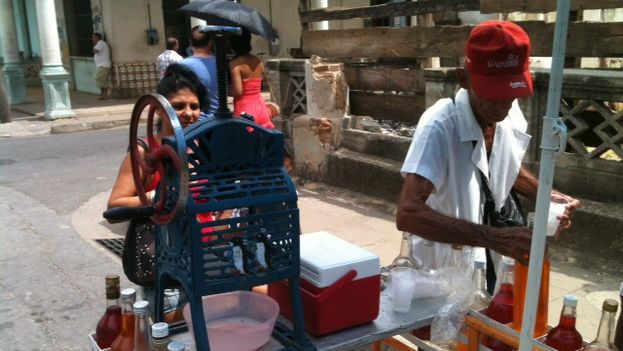
Traditional business of a self-employed. Slushy making with an ice-grating machine in Pinar del Río. (Juan Carlos Fernández/14ymedio)

14ymedio bigger14ymedio, Miriam Celaya, Havana, 2 May 2015 — Few sectors have been so viciously beaten in Cuba as the one grouped under the generic name of “entrepreneurs”, or, according to the informal term, “cuentapropistas” (“self-employed”).

The backgrounds of the self-employed have their roots in small business, family business owners and street vendors that swarmed throughout the Island until their extermination by the revolutionary guillotine called The Revolutionary Offensive of 1968. However, this is a breed that will sprout from the ashes, at any opportunity, a quality that is, at one and the same time, the secret of its survival and its curse because if there is anything that totalitarian power distrusts it is individuals with aspirations of independent entrepreneurship, especially if they have demonstrated their ability to thrive outside the “protection” of the flock.

Thus, at the smallest fissure in the system’s monolithic structure there would follow a fast flourishing trade with glimpses of prosperity for the most daring children of that wicked caste, whose autonomy allowed them to distance themselves somewhat from the political-ideological commitments hanging over the rest of society, and the respective official raids would then follow. continue reading

Perhaps the most famous purifications were the so-called Operación Pitirres en el Alambre (Operation Kingbirds on a Wire) and Operación Adoquín (Operation Cobblestone), which hurled all the fury of Castro I against the peasants of the “free market” and the artisans of the Cathedral Plaza respectively.

The egregious one had decided that those emancipated individuals were becoming too rich, maybe almost as rich as the leaders of the Communist Party. It was necessary to root out evil and demonize the nouveau riche, who were immediately re-christened “flower pots,” imprisoned, dispossessed, prosecuted, and convicted, as a general warning. At the same time, commercial activities of the self-employed were suppressed until the 1990’s, when the crisis stemming from the soviet collapse and the ensuing famine among the Cuban population left the government no choice but to allow their activities once again.

By the mid to late 1990’s foreign investment and capital inflows began, giving a respite to the Castro regime and, at the end of the decade, the almost providential appearance of Hugo Chávez on the stage breathed new life into the regime. It then immediately “froze” the issuing of new licenses for the self-employed sector, while raising taxes on those who already had licenses plus the pressures of inspectors contributed to the contraction of the sector.

Currently, the government has created new support and control mechanisms to keep a short leash on the “private ones”

Currently, with the sector’s most recent revival by the hand of so-called Raulista reforms, the government has created new mechanisms of support and control to keep a short leash on the “private ones.” A large body of inspectors – a whole army of corrupt officials – and a “union of the self-employed” allow for monitoring, keeping individual incomes at low levels while retaining the ability to mobilize on the side of the political discourse. Innate entrepreneurs and the government remain antagonists that tolerate but mutually rebuff one another.

One witness among thousands

Sandra lives in a small town in Matanzas and became self-employed 21 years ago. She is a survivor of that outpost of proto-entrepreneurial Cubans who, in the worst years of the 1990’s, decided to take a risk in tackling the economic crisis under the government’s “opening” for the self-employed. It was then that Sandra was licensed as a seller of handicrafts and other trifles. She was very young then, but she had a nose for business and she was also good with people, so she found a niche in the marketing world, sought and found her own suppliers and soon mastered all the intricacies of the trade, including contacts that alerted her about police and inspection operations within a time frame sufficient to hide far from her selling space anything she was not licensed to offer for sale.

Despite all the alarms, a short while after, she was able to start a small pizza business, baking them in an an old electric oven at a time when any kind of food offered for sale was sure to be a hit. To tell the truth, Sandra sold whatever she found, from clothing, make-up or video equipment to frozen yogurt or plaster ornaments. She found out that she was much better off working by and for herself than continuing at her job as secretary at a government office at an obsolete typewriter, typing information that nobody would read, only to get 148 Cuban pesos a month, while a mere bar of bath soap manufactured in Cuba cost 50 Cuban pesos.

It was much better to work by and for herself than to continue at her job as a government secretary for 148 Cuban pesos a month.

Today Sandra is a veteran self-employed, owns her own home and has forged ahead with her two daughters. However, though she now only sells custom jewelry, just as she is licensed to do, she still feels like she walks the tightrope, and assures us that she cannot make ends meet.

“There is a war against us (the self-employed). Our taxes go up for whatever reason and it is hard to see the benefits. In country towns, like mine, things are even worse. I have to travel to Havana to buy merchandise and bring it home, risking being detained by police, taken to the station and having to justify everything with paperwork. If you don’t have the papers or contacts to come to your aid, they will seize everything. Imagine that! If I bought my merchandise at the government stores, how much would I have to sell it for at home to not only clear a small profit, but just to break even? And to top it all off, the Government invents more legal mechanisms every day to get more money out of you.”

Indeed, in recent years they have increased our taxes briskly. If when she started out Sandra paid the almost symbolic amount of 40 pesos in tax for the sale of small handicrafts, the current monthly tax is 349 pesos per license, plus 10% of sales (which the authorities estimate at over 1,000 pesos a week, implying a tax of 400 pesos each month), plus 60 pesos for social security. Add to that 300 pesos for rent for the site where she conducts her business and she ends up paying 1,109 pesos a month. In addition, there is the annual tax return on sales which must be paid promptly to the National Tax Administration Office (ONAT) each January, which amounts to paying twice for the same sales: monthly and annually.

In recent years the sector taxes have multiplied rapidly

And this is not the only reason why Sandra and many others feel cheated. At the beginning of the so-called “Raulista” reforms, the speech by the General-President stated that the self-employed were honest workers who paid taxes to the government while generating jobs, therefore they deserved all the respect and the rights of any worker. Among those rights, he said, we should recognize their working years to guarantee them a decent retirement.

Sandra was one of the ones who got excited about this news: she already had 20 years under her belt as a self-employed individual paying her taxes under established law. However, she was told at the ONAT that the measure was not retroactive, so if she wished to count those previous years, she should contribute 60 pesos per month for social security for each of the 18 years she had worked before the official law, however, at the ONAT they explained that this measure was not retroactive, so, if she wanted to have those previous years counted she should contribute 60 pesos per month in social security for each one of the 18 years she had worked before the official change, which, translated into hard numbers, would mean paying 12,960 pesos within three calendar months because “we haven’t established any other way to pay.”

Sandra resigned herself to watching the retirement promise go up in smoke: “If I had almost 13 thousand pesos, I would immediately hand it over to my son-in-law to help him build the raft for all of us to get the hell out of here. No matter how I struggle to better my life, I end up screwed.”

“If I had almost 13 thousand pesos, I would immediately hand it over to my son-in-law to help him build the raft for all of us to get the hell out of here”

This year we have seen yet another way to squeeze the self-employed, under the guise of “sub respondents.” This is a note slipped under the crack of the door of the self-employed when the “computer system” decides that the amount declared is less annual income than has actually been received. This document bears the printed amount that “the system” considers correct, and states the exact debt due to the fiscal authorities. If not paid by the established date, the license will be suspended.

However, there is no control mechanism to establish how much each self-employed person has sold in each case, but the estimated amount in question is not subject to appeal. None of the defendants –all the self-employed in Sandra’s hometown – knows by whom or on what parameters those “sub-declarations” are based. She, for instance, has been taxed an extra 1,600 pesos over and above what she has already paid.

“Some of us went to ask that they clarify this for us, because it had never taken place before, but at the ONAT they tell us that they know nothing, that this is established by ‘the system’. I told them that it’s clear that ‘the system’ is the one that’s not working, we can be sure of that! But, how can we change it?

And while Sandra is not one to give up, she confesses that she already feels tired of such an uneven war. She, who has a technological degree in economics, says that the self-employed worker can’t even count on the legal backing of a signed contract. “When you request a license, they hand you a card and that’s it. You don’t sign anything, they don’t tell you any more than what you should pay in taxes and nobody has an obligation towards you, though you do have the obligation to pay on time all the taxes they impose for an amount they determine, though the government does not invest one cent or risk anything. It’s unfair and abusive. And now they also want to force you to pay union dues, and to march and shout slogans!”

Sandra is convinced that this responds to a government strategy to prevent the self-employed sector from growing and consolidating. That is why there are so many obstacles and so much harassment. “We, the self-employed, are just as repressed as the opposition,” she jokes. And she is not far from the truth in this.

“I told them that it’s clear that ‘the system’ is the one that’s not working, we can be sure of that! But, how can we change it?”

On the other hand, neither she nor her fellow associates have legal options, so many are giving up their licenses and choosing between getting jobs as an employee of a more prosperous self-employed person – perhaps one of those who run restaurants or rent rooms to foreign tourists – entering the illegal market (from which many came), or more radically, emigrating however they can and taking their chances far away from the guarantee of poverty they have in Cuba.

“For now, I will not give up my license after 21 years of struggle. I will simply keep up the façade selling the custom jewelry and will have to conduct other business under the table to catch up. If ‘these people’ will not let me breathe while I’m working, I will have to prosper by being inventive. Because if I’m killing myself working, it is logical I should see some profit. It’s not worth it to be legal: they force you to violate laws. But for now, I am seriously thinking that I should leave with my daughters and my son-in-law. There’s not much left for us here.”

Now, when the winds will once again favor foreign investments, Cuban entrepreneurs continue being excluded from all benefits and try to survive the new cycle of simulated suppression they are suffering. Sandra sums up the situation with an illustrative phrase: “When they hand you a license it’s as if you are picking up a machine gun. From that moment on, you will be living in a permanent war: the war of the government against us.”

But Sandra is wrong about this last part, because the government’s war is against all Cubans.

Translated by Norma Whiting