The details of Maduro’s talks with Vladimir Putin have not been revealed, but it is to be assumed that, in view of the serious situation in Venezuela, the alliance between the two dictators was part of the agenda. Venezuela and Syria are very different countries in different parts of the world, but the truth is that when the critical moment came, neither the Russian naval base at Tartus nor the alliance with Russia could prevent the overthrow of Assad.
A week ago, several media reported that the Trump administration would extend the license to Chevron to operate in Venezuela that had been approved by President Biden. For Maduro it was good news because of the millions of dollars it meant at a time when Caracas is facing difficulties. But it was not to be.
The US government is composed of three independent branches: the executive, the legislature and the judiciary. In the House of Representatives, a law of extreme importance to President Trump was being discussed, and several Cuban-American Republican members of Congress pressed for the non-extension of the license that was so important to the Venezuelan dictator. continue reading
The law was approved by 215 votes with the support of the Cuban-American members of Congress. The license to Chevron expired on Tuesday, as scheduled, although Chevron will continue to service Venezuelan refineries; but the US administration plans to impose high tariffs on countries that buy Venezuelan oil in the future. Things look bad for Maduro.
What happened offers a perhaps little-known insight into the functioning of American democracy: in mid-May, El Nuevo Herald reported on a 60-day extension that was to allow Chevron’s operations in Venezuela. The president of the oil company, Mike Wirth, warned in an interview with Fox Business that, if the license is not renewed, China and Russia could fill the void left by the US company, which would represent a strategic loss for the
United States.
Wirth did not comment on the benefits that this operation could represent for the government of Nicolás Maduro
However, Wirth did not comment on the benefits that this operation could represent for the government of Nicolás Maduro, nor on the situation of human rights in Venezuela or the national interest of the US in the matter. Probably he is not familiar with the popular saying that warns that “capitalists will sell the rope that hangs them.” Cuban and Venezuelan communities in south Florida expressed concern about this possibility.
A few days later, Secretary of State Marco Rubio settled the controversy by announcing on his X account: “Biden’s pro-Maduro oil license in Venezuela will expire as scheduled next Tuesday, May 27.”
The decision was not favorable for Maduro nor for his ally Miguel Díaz-Canel in Havana, especially if President Trump, as reported, increases tariffs by 25% on countries that buy Venezuelan oil.
To understand why Chevron’s license has become a strategic issue, it is useful to review recent history.
At the end of the 1990s, Venezuela produced more than three million barrels per day, consolidating itself as an energy power. However, after years of expropriations, erratic decisions and a state-run oil industry turned into political booty, production plummeted.
When Hugo Chávez died in 2013, oil production was already showing signs of deterioration.
With Nicolás Maduro, the fall was even more severe: in 2023, the average production was just 783,000 barrels per day. Although it rebounded to 921,000 in 2024, the country is still far from the almost three million that it pumped at its best times, according to OPEC figures.
In this context, the presence of Chevron in Venezuela ceased to be merely economic and acquired a political nuance.
Its permanence offered the regime a minimum of international legitimacy and, above all, a source of foreign exchange that was difficult to obtain by other means.
It is not surprising, then, that Chevron’s possible departure would cause anxiety among those who depend on this operation to keep the state apparatus afloat, at least symbolically.
As Venezuelan production disintegrates, other neighboring countries begin to stand out. One of them is Guyana, whose Atlantic coast has revealed important oil deposits. Companies like ExxonMobil have already started exploiting them, sparking the interest and annoyance of the Venezuelan government.
Caracas insists on claiming Essequibo, a region that appears on its official maps as part of the national territory, despite the fact that the international community recognizes Guyanese sovereignty. It is no coincidence that in 2023, tensions increased when Venezuelan troops were seen near the border.
Response from Georgetown was immediate, with calls to the international community.
Washington backed Guyana with clear statements, reaffirming its commitment to regional stability.
All this is happening while Maduro is losing space.
The non-renewal of Chevron’s license, the pressure on Venezuelan oil buyers and the support for neighboring countries with stable governments and clear rules suggest a new stage. And in it, the margins to sustain an exhausted model are narrowed, with or without rope in between.
Washington backed Guyana with clear statements, reaffirming its commitment to regional stability
Meanwhile, in Cuba the blackouts continue, and the European oil companies that invested millions of dollars in search of the Cuban black gold unfortunately did not find it.
It is difficult to understand the priorities of President Díaz-Canel’s government, which has allowed the lack of maintenance and deterioration of the Cuban oil industry. There is no other country in Latin America with the continuous blackouts suffered by Cubans. Let us hope that in the future, as we have seen in Washington, the Assembly of People’s Power will not approve millions of dollars for the construction of hotels for foreigners, where there is never a lack of electricity, and will focus instead on the maintenance and repair of the country’s electrical system.
Frank Calzon is a Cuban political scientist and human rights activist.
Translated by Regina Anavy
____________
COLLABORATE WITH OUR WORK: The 14ymedio team is committed to practicing serious journalism that reflects Cuba’s reality in all its depth. Thank you for joining us on this long journey. We invite you to continue supporting us by becoming a member of 14ymedio now. Together we can continue transforming journalism in Cuba.
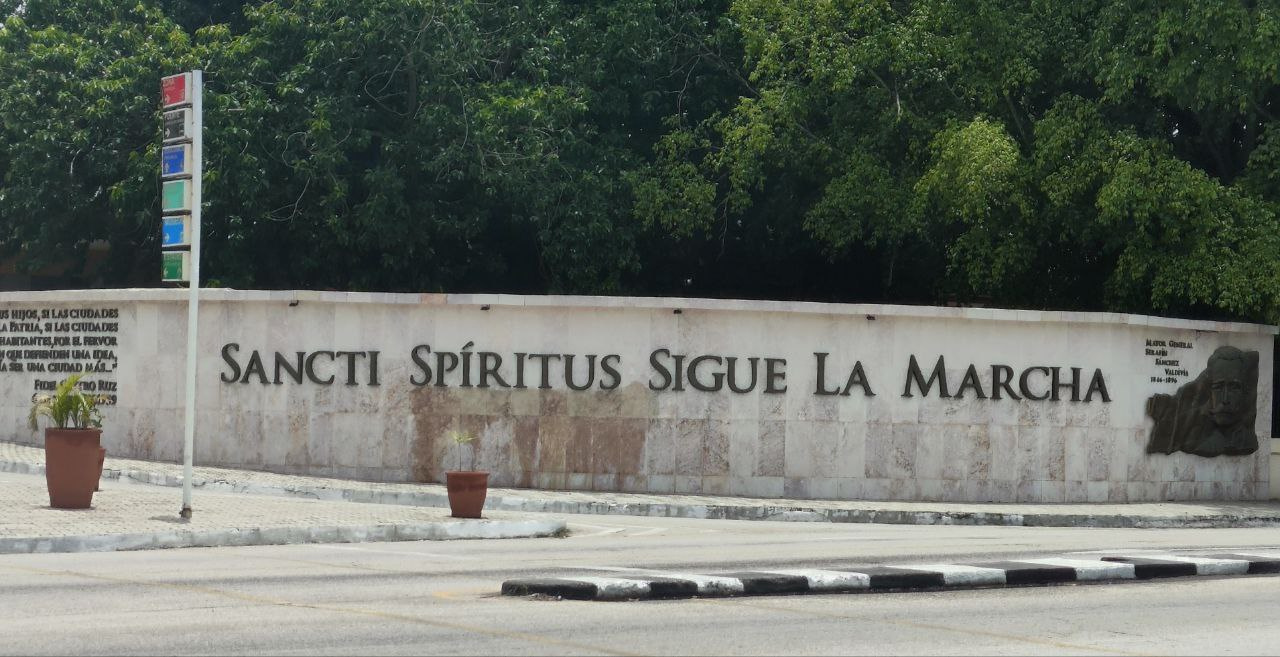
 14ymedio, Mercedes García, Sancti Spíritus, 4 June 2025 — A stain can say more than a message. A smudged wall reads as if the letters that once covered it were still there. The phrase “Down with the dictatorship,” which appeared this Tuesday at the intersection of Carretera Central and Avenida de los Mártires (Marcos García) in Sancti Spíritus, has already been painted over, but everyone who passes by the central corner looks at the mark on the wall and visualizes what it said.