Cuban Doctors in Angola Spend Christmas Without Pay and With No Date Set for Their Vacations

Cuban doctors in Angola spend Christmas without pay and with no date set for their vacations


Late payments, delayed flights and silence from Antex mark the end of the year for health workers and teachers on official missions in the African country.

14ymedio bigger14ymedio, Natalia López Moya, Havana, 25 December 2025 — Christmas once again finds hundreds of Cuban health professionals in Angola caught between family distance, job uncertainty and administrative silence. Hired by Antex, the state corporation that manages these official missions abroad, many doctors and teachers arrive at the end of December without having received their salary for this month and without minimum guarantees to organise a temporary return to the island. The scenario is not new, but it repeats itself with a regularity that erodes any institutional promise.

From Luanda, a Cuban doctor sums up present feelings among his colleagues: “This Christmas will be a little more painful.” In addition to being separated from their children, parents and partners, they cannot afford a dinner that is any different from their daily routine. “It is now usual for Antex to delay payments. Normally, salaries arrived around the 20th, but that’s just a memory now,” he complains, referring to the equivalent of $200 they should receive in Angola, while most of their salary is kept in a bank on the island.

Antex had announced that it would most likely only be able to pay half that amount, but as the days go by, the promise has been reduced to $50. “If that’s the case, they would have to guarantee us a New Year’s Eve dinner, at least, but I doubt they will,” says the doctor.

“If that’s the case, they would have to guarantee us a New Year’s Eve dinner, at least, but I doubt they will,” says the doctor.

In December, as in other months, payment has been delayed and questions remain unanswered: will there be a special end-of-year meal organised by the Cuban authorities, will the pattern of 2023 be repeated — when some went more than two months without being paid — or will we simply have to resign ourselves to another year-end in limbo?

This testimony coincides with other complaints received by 14ymedio in recent days, in which Cuban doctors in Angola report systematic delays in payments, unclear deductions and obstacles to accessing their statutory holidays. Not only does this situation persist, but it is worsening in a context of local inflation, rising food prices and declining purchasing power of wages.

Added to the economic uncertainty is the chronic delay in return trips for vacations in Cuba. Many professionals expected to return between August continue reading

and September, but that schedule was almost completely disrupted. “Antex has not even sent 10% of the teachers who should have travelled during that period,” explains the doctor. The domino effect is evident: mission time is accumulating, holidays for all staff are being postponed, and there are increasing numbers of colleagues who have been in Angola for 15 months with no clear return date. For some, the wait is even turning into a forced extension of their contract.

“There’s always a manager who manages to leave on the scheduled date,” he adds, adding to the perception of privilege.

The official explanation changes depending on the situation, according to those affected. When there are no TAAG Angola Airlines flights, the response is that there are no connections available and that chartering a flight would be too expensive. When there are flights, the argument is reversed: the airline has raised its prices and it would therefore be preferable to hire a charter flight. “But neither is true,” says the doctor. In practice, almost no one travels. “There’s always a manager who does leave on the scheduled date,” he adds, fueling the perception of privilege and arbitrariness.

The impact of these breaches goes beyond just economics. For many, the mission in Angola was presented as an opportunity to improve their income, help their families in Cuba and build up savings. However, wage arrears and travel restrictions have turned that expectation into frustration. Christmas, with its symbolic significance, accentuates the feeling of abandonment. With no money in hand and no certainty of return, even basic gestures—buying a gift, preparing a special meal, connecting with family—become difficult.

From a contractual point of view, professionals insist that the agreed conditions are not being met. Late payments, lack of information and “total silence”, as they describe it, contrast with the official rhetoric on international medical cooperation. Angola is one of the historical destinations for these missions and a significant source of income for the Cuban state, which acts as an intermediary and retains a substantial portion of the salaries. For workers, this intermediation should entail clear responsibilities: punctuality in payments, transparency and guarantees of rest.

Angola is one of the historical destinations for these missions and a significant source of income for the Cuban state.

The institutional response, however, remains elusive. There are no statements explaining the delays or public timetables for regularising salaries and flights. The lack of information fuels rumours and anxiety, especially on sensitive dates. “Will we not be able to have a New Year’s Eve dinner either?” some ask, no longer expecting a formal response.
In a context where medical missions are presented as one of the pillars of Cuban foreign policy, reports from Angola once again bring forward the human cost of the model. For professionals in Luanda, Christmas brings no respite: it arrives with unpaid bills, broken promises and the certainty that, once again, the the solutions are not keeping up wioth the problems

Translated by GH

____________

COLLABORATE WITH OUR WORK: The 14ymedio team is committed to practicing serious journalism that reflects Cuba’s reality in all its depth. Thank you for joining us on this long journey. We invite you to continue supporting us by becoming a member of 14ymedio now. Together we can continue transforming journalism in Cuba.

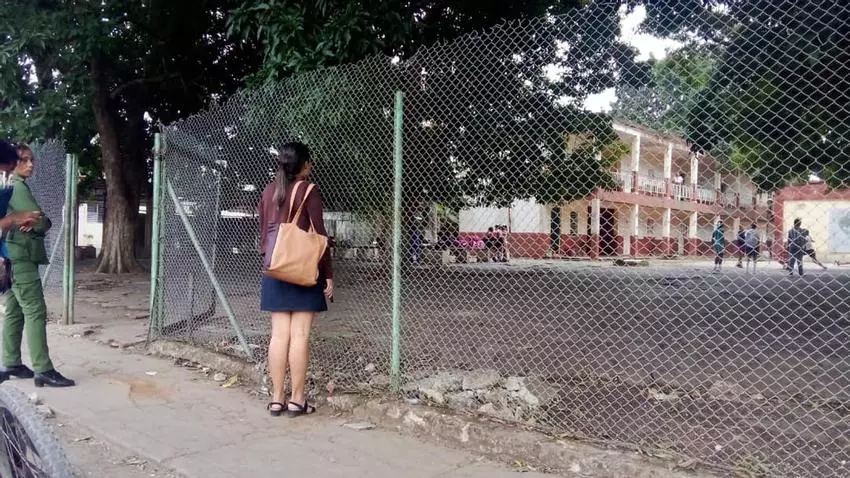
Due to a Lack of Teachers in Cuba, Recess Is Permanent at a School in San José De Las Lajas

Staff shortages turn afternoons into lost teaching hours at Camilo Cienfuegos Elementary School

A grandfather approaches on his bicycle and chats with his granddaughter. / 14ymedio

14ymedio bigger14ymedio, Julio César Contreras, San José de las Lajas, 23 December 2025 –At four in the afternoon, the air on Avenida 40 is thick with smoke in front of the Camilo Cienfuegos Elementary School in San José de las Lajas. Under the dense shade of the flamboyant trees, parents gather in front of the fence that separates the street from the inner courtyard. They balance patience and frustration as they watch the children run haphazardly among loose stones, puddles, abandoned backpacks, and trees with roots protruding from the ground. It doesn’t seem like school time. There are no blackboards or notebooks, only impromptu races, wads of paper, games of hide-and-seek, and noise. Lots of noise

Among the parents stands Marlén, her son’s uniform folded over her arm, her face weary. “When he’s not covered in dirt, his shirt’s missing a button,” she says, her gaze fixed on the little boy playing at the edge of the fence. “They force him to come in the afternoon, supposedly because he has classes, but most of the time they spend those two hours playing in the playground, with no one to supervise them, much less teach them.” Since last year, her son hasn’t had a regular teacher. What used to be routine now seems like improvisation: a school without teaching, a schedule without content.

Since last year, her son hasn’t had a regular teacher. What used to be routine now seems like improvisation.

The surrounding scenes confirm it. A grandfather approaches on his bicycle and, through the fence, talks to his granddaughter, who shows him a crumpled folder. Further on, a mother leans against the metal fence and barely blinks as she watches her daughter run after a group that has turned the courtyard into a maze. Two children are throwing small stones, another is juggling a stick, and a teenager, her headscarf undone, kicks up dust with her shoes that are no longer so white. A few meters away, the only teaching assistant who should be keeping order is looking at her phone screen.

Through the fence, the old painting of the school mural can be seen, almost erased by the sun / 14ymedio

“Before, there were teachers in every classroom here,” recalls Marlén, who studied there in the 1990s. Now, every day is marked by absences: there’s a lack of teaching staff, a lack of teachers, a lack of classes. And, meanwhile, those children who should be learning their multiplication tables, spelling, or reading comprehension spend hours in the sun, during an extended recess continue reading

that no parent asked for.

The school celebrated its 70th anniversary this year. It received a Lifetime Achievement Award from the local government. But none of that changes the scene that repeats itself every afternoon: first-grade students with no activities, no proper supervision, and no security. The state institution, founded in 1956 as the Eliodoro García School, seems to be stuck in an indefinite limbo.

A few meters away, the only teaching assistant who should be in control is looking at the screen on her phone.

“In their eagerness to change everything and solve nothing, the government has even lost the educators,” says Marino, the grandfather of a fifth-grade student. He speaks while waiting, bicycle in hand, for the main gate to open. “My granddaughter has to come in the afternoons five days a week, and they don’t even give her physical education. If this continues, I won’t bring her after noon anymore.”

Many family members arrive before four o’clock. They line up in front of the metal fence waiting for the dismissal signal, which should theoretically come at 4:20. Although they can see and even talk to the children from the street, the gate remains locked. “They make the rules arbitrarily, because the Ministry of Education mandates it, even though not even the teachers agree,” Marino insists.

While they wait, street vendors appear with sweets and cookies. A mother takes the opportunity to briefly feed her daughter through the fence, who complains about the school lunch menu: “What they serve here isn’t even fit for pigs,” she says bluntly.

Her daughter’s teacher, she says, is 67 years old and by 11:00 in the morning “she can’t do any more”

At the far end of the courtyard rises the building’s facade: columns, open corridors, and peeling walls. The flag seems small compared to the magnitude of the problem. Where there should be books, there is disorder; where the dictation of a prayer should be heard, there are shouts. “They’re trying to cover the teaching with university students,” says Marisol, who now takes care of two nephews because her sister emigrated. “The few old teachers who are still left are teaching because they have no other choice.” Her daughter’s teacher, she says, is 67 years old and by 11:00 in the morning “she can’t go on anymore.”

Through the fence, the old paint of the school mural is visible, almost faded by the sun. “Every day they come with the story that the teachers are asking for the parents’ help,” Marisol sighs. “That means bringing brooms, floor mats, chalk, money for the Teacher’s Day party… everything.” But what weighs most heavily on her isn’t the list of supplies, but what she sees every afternoon from the street: “The children doing everything but studying. And in the end, there’s no one to complain to.”

When the gate finally opens, the parents are able to hug their children. The yard is left behind, full of dust kicked up by the running.

The state institution, founded in 1956 as the Eliodoro García school, seems trapped in an indefinite pause today / 14ymedio

____________

COLLABORATE WITH OUR WORK: The 14ymedio team is committed to practicing serious journalism that reflects Cuba’s reality in all its depth. Thank you for joining us on this long journey. We invite you to continue supporting us by becoming a member of 14ymedio now. Together we can continue transforming journalism in Cuba.

Cuba’s Telecommunications Company Etecsa Restarts Mobile Line Sales, Generating Long Lines in Havana

The shortage of SIM cards has further complicated Cubans’ access to telecommunications

For months, the shortage of SIM cards left numerous users without service. / 14ymedio

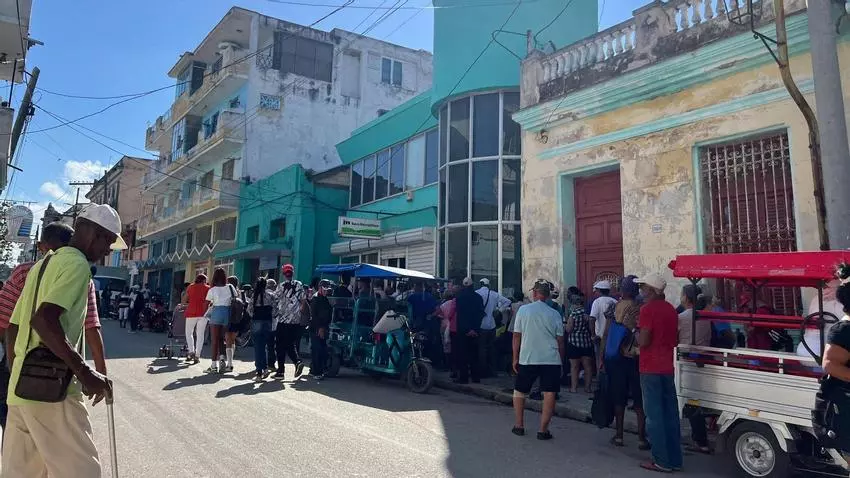
14ymedio bigger14ymedio, Dario Hernandez, Havana, December 23, 2025 – This Monday, the offices of the State telecommunications company Etecsa in various parts of Havana were packed after the start of sales for new mobile lines and replacement SIM cards, a service that had been unavailable for months. The prolonged shortage made losing a phone a secondary problem compared to the impossibility of recovering the number, essential for communication, internet access, or carrying out basic tasks. The reopening of the service led to long lines, tension, and uneven organization in a context marked by the precariousness of telecommunications

Early on, 14ymedio visited several of these branches and confirmed how quickly the news had spread among customers. At the office located beneath the Focsa building in El Vedado, they attempted to maintain some control by issuing 100 tickets daily. The wait was long and the atmosphere tense, but relatively orderly. Similar stories were repeated among those waiting: stolen or lost phones and months of fruitless visits to Etecsa. “What hurts the most is losing the line,” several commented while they waited.

“What hurts the most is losing the line.”

In Regla, the lack of a clear queuing system led to constant arguments. Some, despite arriving late, tried to cut in line, an attitude that fueled the discontent among those who had arrived at the office early. The shouting and recriminations increased as rumors spread that supplies could run out at any moment, a possibility many considered certain after previous experiences of shortages and sudden sales suspensions.

For months, the shortage of SIM cards left many users without service. Some reported that the only alternative offered was to manage the line from abroad or pay in foreign currency, options beyond the reach of a large part of the population. This situation was compounded by frequent power outages and mobile service interruptions, which affected the quality of the connection.

This crisis is part of a broader scenario marked by Etecsa’s so-called “tarifazo” — a huge rate hike — which last May raised the cost of data and telephone services relative to salaries in pesos. The price increase, coupled with a shortage of lines and dependence on top-ups from abroad, has deepened inequality in access to communication. The lines this Monday reflect the cumulative impact of a commercial policy that has made connectivity an increasingly difficult commodity to obtain.

____________

COLLABORATE WITH OUR WORK: The 14ymedio team is committed to practicing serious journalism that reflects Cuba’s reality in all its depth. Thank you for joining us on this long journey. We invite you to continue supporting us by becoming a member of 14ymedio now. Together we can continue transforming journalism in Cuba.

Theft Within Cuba’s Public Health System Aggravates Drug Shortages

The complaint comes from the authorities themselves, who also admit a “significant decrease” in national production

It is estimated that pharmacy shortages reach 70% of products / Cubadebate

14ymedio bigger14ymedio, Havana, December 22, 2025 — Cuban health authorities pointed to a new culprit yesterday for the shortage of medications in Cuban pharmacies: the illegal market generated from within the public health system itself. “Prestigious institutions” are involved, as well as pharmacy workers “from other areas and other activities of the sector,” said Maylin Beltrán Delgado, head of the Department of Pharmacies and Optics of the Ministry of Public Health, on Monday.

The official pointed out on the television program Mesa Redonda that, in view of the “growing phenomenon of the illegal market,” a nationwide surveillance ”plan of measures” was implemented. “We have done more than 5,000 inspections this year, about 13 per day, on average,” said Beltrán Delgado. These joint operations, she added, made it possible to gauge “the severity of control problems in the network.”

By the end of October, “authorities had identified 33 extraordinarily serious incidents” in the pharmacy system. Of these, 18 were “forcible thefts committed by persons outside the health sector who broke into pharmacies to steal the scarce medications available.” She specified that of those thefts, “about 10 were related to controlled substances (drugs, narcotic drugs, psychotropic and substances with similar effects)” and reminded viewers that selling these products “is a drug trafficking offense.”

“Today, the industry has also stopped responding routinely to medication orders”

The shortage, which last year was already at 70% in pharmacies, is also due to the “significant decline in national drug production.” Today, the industry has also stopped responding routinely to medication orders,” admitted continue reading

Cristina Lara Bastanzuri, director of Medicines and Medical Technologies.

Regardless of the fact that China and India are by far the main producers of pharmaceutical raw materials, the official blamed the “US blockade” for difficulties in importing active and inactive ingredients and for the “technological obsolescence in some plants, interruptions in the energy supply and limitations on performing proper industrial maintenance.”

Poor domestic production has a major impact, given that the country’s basic list includes 651 medications, of which 62% – 403 products – correspond to medications that are supposed to be produced by the national pharmaceutical industry. The remaining 38% are imported, and at least 60% of these are unavailable.

The breaking point, said Lara Bastanzuri, was the rupture in 2019 with Brazil, which was ruled at that time by Jair Bolsonaro, resulting in the loss of an “important source of supplies, inputs and revenues for the sector.”

There is “an almost total shortage in pharmacies. It’s real, the drugs are not there”

This has led to “an almost total shortage of supplies in pharmacies. It is real, the drugs are not there,” acknowledged the official. She added that it is not even possible to guarantee the continuation of card-controlled medications, which are intended for patients with chronic diseases such as hypertension, diabetes mellitus and epilepsy. They constitute the highest priority within the outpatient care system.”

“Practically, the funding that goes to the industry is allocated to saving lives with drugs and serums,” she said, which sometimes leaves community pharmacies by the wayside, with several days of delay in receiving supplies.

The wait can be long, up to 60 days, when the original design of the supply system operated on a replenishment “every 12 to 15 days.” This delay has increased pressure on the organized sales system “and has inevitably intensified public dissatisfaction.”

Irregular distribution has also affected prescribing practices, “because people are practical and will take whatever medications are available.” Family doctors and specialists are “often forced to adapt their treatments to the momentary availability of drugs.”

Doctors are “often forced to adapt their treatments to the availability of drugs”

Without medicine and with a collapsed health system, Cuba is currently facing an “epidemic phase” due to viruses that plague the island, which have so far left 55 people dead.

However, despite the lack of supplies and electricity to operate certain medical equipment, the government announced with great fanfare that as of Monday it has been attending patients suffering from the sequelae of viral fever. According to Cubadebate, specialized consultations, “unprecedented in Cuba,” offer patients access to diagnostic tests such as CT scans and ultrasound.

“For those with severe pain, specialized anesthetic treatments will be available. In addition, personalized physiotherapy programs will be designed to promote rehabilitation and rapid reintegration into daily and work activities,” said the media. The consultations are being held at the Institute of Neurology and Neurosurgery.

Translated by Regina Anavy

____________

COLLABORATE WITH OUR WORK: The 14ymedio team is committed to practicing serious journalism that reflects Cuba’s reality in all its depth. Thank you for joining us on this long journey. We invite you to continue supporting us by becoming a member of 14ymedio now. Together we can continue transforming journalism in Cuba.

Cuban Bank Employees Are Still Awaiting ‘Guidance’ on Buying and Selling Dollars

“We ourselves have doubts. The banks are collecting foreign currency only; they haven’t given us the order yet to sell”

In private businesses, it’s common for employees to accept US currency at the informal exchange rate and even purchase it. / 14ymedio

14ymedio bigger14ymedio, Havana, Darío Hernández, December 23, 2025 — Nearly a week after the Central Bank of Cuba (BCC) announced the implementation of a floating rate for the foreign exchange market, in addition to other official exchange rates, the measure has yet to materialize for most Cubans. In Havana, the banks are not selling dollars to the population, despite the regulation being presented as a step to “organize” the exchange market and bring the official rate closer to the country’s economic reality.

In practice, the only thing that has begun to function is the purchase of foreign currency, and even that operation is surrounded by improvisation, administrative silence and confusion among bank employees themselves, as 14ymedio was able to confirm during visits to several bank branches in the Cuban capital.

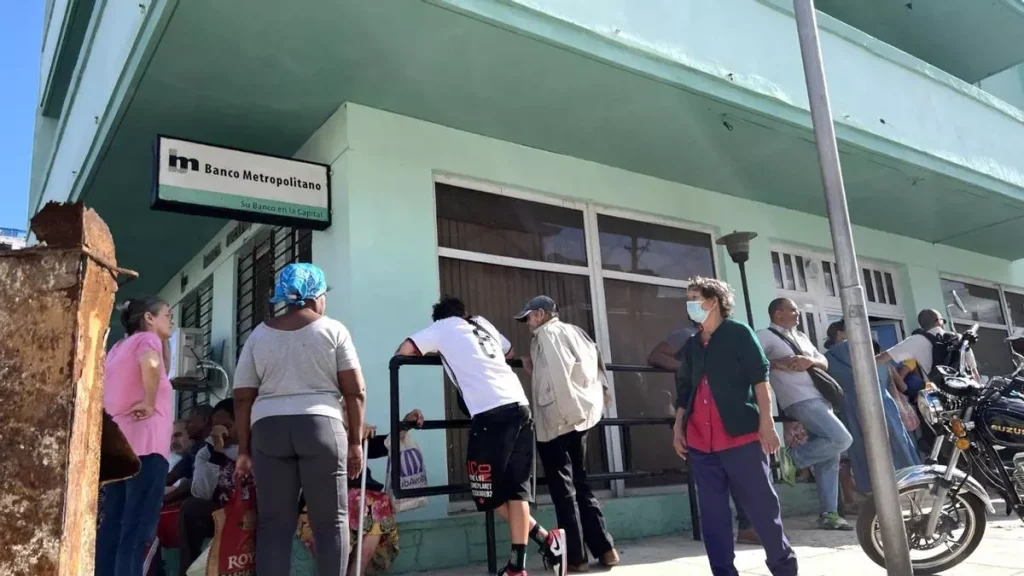
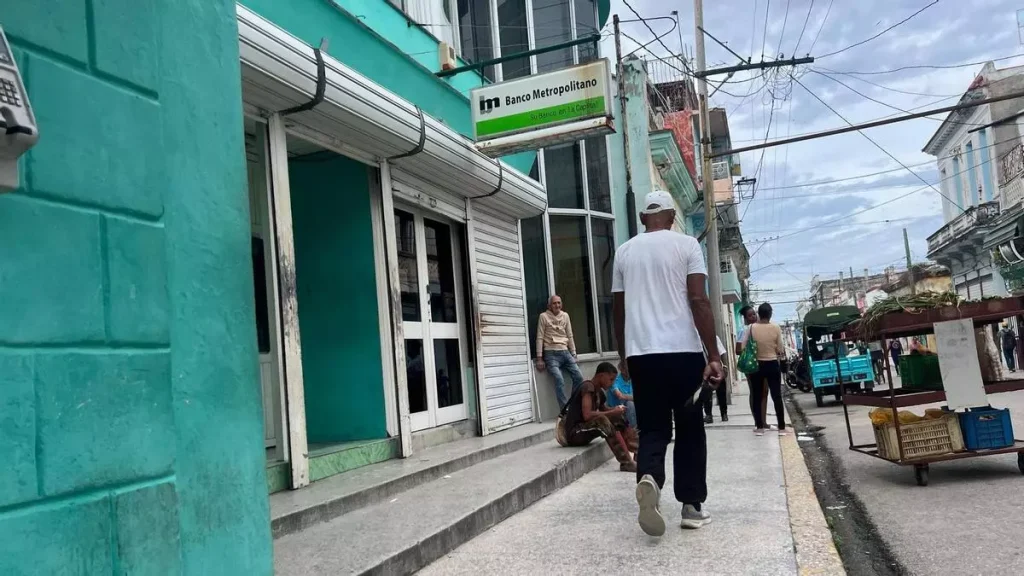
“So far, I have no news that dollars are being sold to the population under the new rate; what they are doing is buying,” a Banco Metropolitano branch employee in El Vedado, who prefers to remain anonymous, explained to this newspaper on Monday. According to his account, US currency was being received that day at 401 pesos.

“If the customer hands over a large amount of dollars and the bank doesn’t have enough cash in national currency, part of the payment is made through electronic transfer. If the disbursement is made completely in cash, a 3% discount is applied as a tax,” the state worker specifies.

The new rate was announced by monetary authorities as a flexible mechanism, subject to adjustments based on supply and demand. The stated objective was to compete with the informal market and capture dollars currently circulating outside the state financial system. However, what is happening at the branches is very different from the official narrative. There are no clear protocols, and staff continue reading

are working without precise instructions on how to proceed.

There are no clear protocols and staff are working without instructions

This scheme, far from conveying confidence, feeds the perception of improvisation. “This entire process of the new floating dollar exchange rate has been implemented without notice or prior preparation of the bank staff,” the worker summarizes. “We haven’t received any guidance on how to sell the dollars, whether we’ll give it to them in cash or through electronic transfer. Even yesterday we had a meeting at our bank, and the topic of selling dollars didn’t even come up.”

The uncertainty repeats itself at other branches in the capital. At the bank located on the ground floor of the Focsa building, also in El Vedado, an employee confirms that the order for now is to buy only foreign currency. “We ourselves have doubts. Now all the banks are doing is collecting, buying dollars,” she explains. Although she says that selling will happen “at some point,” she recognizes that there still isn’t an official instruction allowing them to offer dollars to the public.

The worker also confirms that the rate of 401 pesos is already being used in other financial operations. “Those who have MLC [freely convertible currency] cards, now when you do a transfer from Transfermóvil to national currency, the exchange rate used is that one, and you gain cash that way.” If this detail is confirmed, then it would be a signal that the BCC is trying to consolidate the freely convertible currency again, as seems to be indicated by the rapid rise of that virtual financial instrument on the informal market exchange board published daily by the site El Toque. At the end of October; a dollar was worth barely 200 pesos and is now at 350.

The design of the sales mechanism, when finally activated, also raises questions. According to banking sources, MSMEs (micro, small and medium-sized enterprises) will receive dollars exclusively through electronic transfers, not in cash, which is in line with the chronic shortage of bills in state coffers. For individual customers, a combination of cash and transfers is expected, “when they approve it,” clarifies the Focsa employee. For now, the outlook is an asymmetric scheme: the bank buys dollars from the population but doesn’t sell them.

The BCC announced a new banking channel for the non-state sector to purchase foreign currency in the official market. “Requests will be made from commercial banks and through the fiscal account, without handling cash,” the brief informative note clarifies. “The limit will be up to 50% of the average gross income of the fiscal account in the last quarter,” the text adds.

For now, the outlook is an asymmetric scheme: the bank buys dollars from the population but doesn’t sell them. / 14ymedio

Regarding individuals, this note clarifies that the limit of 100 dollars per person will continue and that the cumbersome and ineffective system of turns through the Ticket app at the 41 sales offices will be maintained.

Outside the Focsa bank branch on Monday, however, the urgent concerns were different. The long line to collect pensions or attempt to withdraw cash from ATMs monopolized customers’ anxiety. Each time an employee poked their head out the main door, a shower of questions rained down on them. Doubts ranged from the establishment’s operating hours during the upcoming holidays to questions about when they will start selling dollars.

Informal currency exchangers, meanwhile, seem to be starting to react after days of paralysis and uncertainty following the official announcement. “The guy who buys dollars in my neighborhood went a week without accepting them but has started again and has set them at 420 pesos,” a young resident of the Guanabacoa municipality explains to this newspaper. In private businesses, it is common for employees to accept US currency at the informal exchange rate and even to purchase it.

El Toque reports that the dollar this Tuesday is at 440 pesos on the informal market, where the greenback continues to circulate with greater agility and without taxes or cumbersome procedures. For many Cubans, handing over their foreign currency to the bank and having to register personal data with no certainty of being able to buy it back doesn’t seem like an attractive option at the moment.

“I had 100 dollars saved for Christmas and I preferred to change them with an individual who has a cafeteria on my block,” recounts a neighbor from Cotorro. “He gave me 425 pesos for them and I came out better than I would have with the bank and didn’t have to show my ID card,” she adds. However, she will avoid selling the remaining US currency she has saved “until things settle down.”

Translated by Regina Anavy

____________

COLLABORATE WITH OUR WORK: The 14ymedio team is committed to practicing serious journalism that reflects Cuba’s reality in all its depth. Thank you for joining us on this long journey. We invite you to continue supporting us by becoming a member of 14ymedio now. Together we can continue transforming journalism in Cuba.
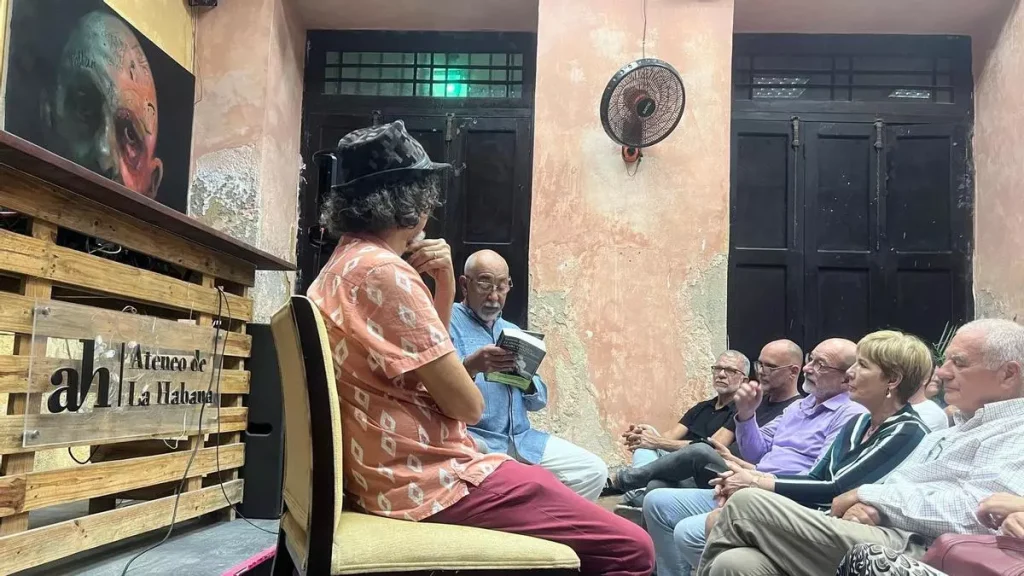
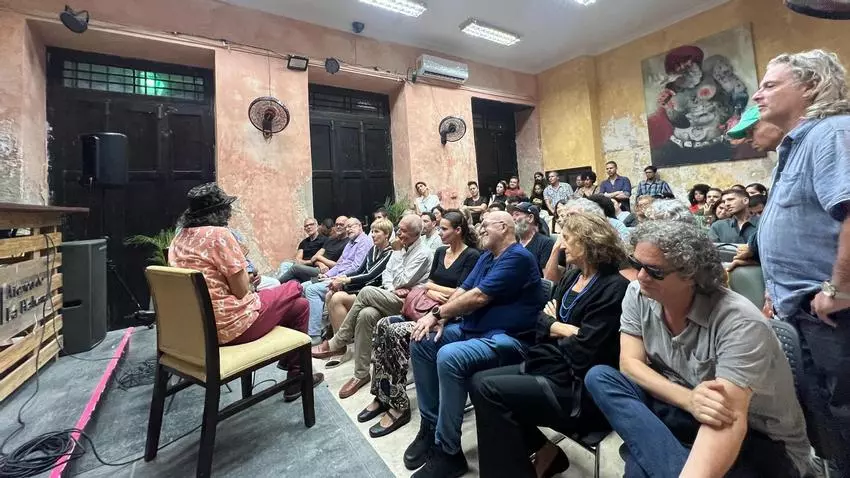
Vargas Llosa According to Padura: A Literary Conversation in a Packed Room at the Ateneo de La Habana

The Cuban author acknowledged he is an admirer of Vargas Llosa’s work, especially ‘Conversation in the Cathedral’.

The dialogue also addressed Vargas Llosa’s relationship with the Cuban Revolution. / 14ymedio

14ymedio bigger14ymedio, Dario Hernandez, Havana, 20 December 2025 — For just over an hour, Havana experienced one of those rare moments when literature manages to triumph over blackouts and hardship.

The Ateneo de La Habana was packed to overflowing to hear Leonardo Padura speak about Mario Vargas Llosa, in a conversation moderated by Rafael Grillo and organized by La Tertulia. The sustained attention and the diversity of the audience confirmed that literature continues to draw people in Cuba, despite the crisis, censorship, and fears surrounding certain topics.

The room, with its peeling walls and fans that barely offered any relief from the tropical winter chill, was packed long before it began. Readers of all ages filled every available chair; others sat on the floor, leaned against the walls, or remained standing throughout the entire event. Among the attendees were writers, editors, artists, university professors, and regular readers, all mingling without any apparent protocol or hierarchy.

The hall was packed long before it started. / 14ymedio

Rafael Grillo led the discussion with sobriety and precision, avoiding a laudatory tone and opting for questions that placed Vargas Llosa at the center of the literary debate, not in the realm of superficial political polemics. From the outset, it was clear that this was not an uncritical tribute, but rather a reasoned reading of a pivotal work of Spanish-language narrative. Padura knows that speaking about Vargas Llosa on the island entails acknowledging contradictions, areas of conflict, and an intellectual trajectory that cannot be reduced to slogans.

The Cuban author acknowledged his admiration for Vargas Llosa’s work, especially Conversation in the Cathedral, a novel he defined as one of the undisputed masterpieces of the 20th century. He detailed the Peruvian writer’s obsession with power, the mechanisms of domination, and the moral degradation produced by authoritarian structures. He also continue reading

emphasized the tension between Vargas Llosa’s liberal thought and a literature that, in many passages, seems written from a leftist perspective.

One of the most talked-about moments was when Padura recalled personal anecdotes from his first encounter with Vargas Llosa. The first time he approached him, as they were getting off a plane, he told him he was a close friend of Ambrosio Fornet, with whom the Peruvian had studied in Madrid during his youth. Then he confessed: “Maestro, I just wanted to tell you one thing so as not to bother you: every time I start writing a novel, I read Conversation in the Cathedral .”

Among those present were writers, editors, artists, university professors, and regular readers. / 14ymedio

The dialogue also addressed Vargas Llosa’s relationship with the Cuban Revolution. Padura recalled that the Peruvian writer’s initial enthusiasm was shared by much of the Latin American intelligentsia of the 1960s and that the break was not immediate. The definitive rupture came in 1971, after the Padilla case, when Vargas Llosa spearheaded the letter of protest against the Cuban poet’s arrest and forced self-criticism. From that moment on, he noted, the distance was irreversible, and the writer understood that the revolutionary project had betrayed basic principles of intellectual freedom.

The audience listened in silence, without interruptions or signs of impatience. The final questions confirmed the level of attention and the need for these spaces. They discussed literature and politics, censorship and the market, in a country where the price of a book in Europe is equivalent to two months’ salary for the average Cuban. There were also references to Donald Trump and the current regional context, where old stories that “Cubans heard in fourth grade” are resurfacing, such as the Monroe Doctrine and gunboats.

Padura insisted that his relationship with Vargas Llosa has always remained on the literary plane, without demands for alignment or concessions, as if literature were the last territory where it is still possible to converse without preconditions.

Leonardo Padura speaks about Mario Vargas Llosa in a packed Ateneo de La Habana.

____________

COLLABORATE WITH OUR WORK: The 14ymedio team is committed to practicing serious journalism that reflects Cuba’s reality in all its depth. Thank you for joining us on this long journey. We invite you to continue supporting us by becoming a member of 14ymedio now. Together we can continue transforming journalism in Cuba.

Cuba’s Council for the Transition Chooses a New Leadership After the Departure of José Daniel Ferrer

Manuel Cuesta Morúa assumes the presidency while Ferrer focuses on reorganizing the opposition from exile.

Manuel Cuesta Morúa assumes the presidency while Ferrer focuses on reorganizing the opposition from exile. / EFE

14ymedio bigger14ymedio/EFE, Havana, 22 December 2025 — The Council for Democratic Transition in Cuba (CTDC), one of the main platforms for articulating the Cuban opposition, announced this Monday the election of a new Executive for the period 2026-2028, in an internal process that marks the replacement of its historic president, José Daniel Ferrer, who went into exile in Miami last October.

The new leadership is headed by opposition leader Manuel Cuesta Morúa as president, accompanied by four vice presidents also residing in Cuba—Osvaldo Navarro, Juan Alberto de la Nuez, Marthadela Tamayo, and Félix Navarro, the latter currently imprisoned—and two vice presidents living abroad, Iris Ruiz and Elena Larrinaga. The leadership will formally assume its duties on January 10.

Ferrer confirmed to EFE that he will not be part of the new CTDC leadership, after having requested internal elections and submitted his resignation from all his positions within the organization. The opposition leader explained that his decision stems from the need to prevent his political activities from exile—which he defined as “non-violent in a broad sense”—from conflicting with the Council’s profile, which is primarily focused on legal and institutional proposals.

Although he is stepping down as president, Ferrer emphasized that he will remain a member of the organization and continue to support its initiatives. “We remain brothers and sisters, and I support the Council’s actions,” he stated, in an attempt to convey continuity and avoid any perception of a formal break with the platform he has led until now.

Ferrer also stated that his opposition activity is now focused on creating a census of dissidents on the Island and in exile.
In a statement released on Facebook, continue reading

the CTDC Electoral Commission highlighted that the elections were held between December 11 and 15, “under difficult communication conditions” and in a general environment that, from the regime’s perspective, does not favor “free citizen expression.” Of the 46 registered voters—including organizations and independent individuals—63% participated, a figure the Council described as an achievement given the circumstances under which the opposition operates on the island.

The statement emphasizes that the process was “organized, pluralistic, democratic and legitimate” and that it responds to one of the founding aspirations of the Council: to allow its members to express, through voting, diverse priorities and concerns within the same political space.

The change in leadership coincides with a new phase in the career of Ferrer, 54, who left Cuba for the United States more than two months ago after spending several years in prison for his opposition activities. During that time, he was considered a prisoner of conscience by Amnesty International. From Miami, the leader of the Patriotic Union of Cuba (UNPACU) affirmed that his priority would be to work for the unity of the Cuban opposition, both within and outside the country, a historically elusive goal marked by deep internal divisions.

Ferrer continues to lead Unpacu, one of the opposition groups with the most recognized track record in the country.

In his statements to EFE, Ferrer also affirmed that his opposition activity is now focused on “mobilizing political, social, and humanitarian activity” within Cuba, as well as on creating a “census” of dissidents on the island and in exile. This registry, he explained, would serve as the basis for attempting to organize opposition primaries and move toward forming a “common front.”

Ferrer’s departure from the presidency of the CTDC also highlights the difficulties faced by the Cuban opposition. Those operating from within the country are subjected to severe repression; and those operating from exile, with greater political leeway, tend to have less direct influence on daily life on the island.

Ferrer himself acknowledges this tension, justifying his resignation by citing the need to avoid interfering with the Council’s work, whose agenda includes projects such as a proposed amnesty law and the decriminalization of dissent, initiatives against violence, and the organization of citizen assemblies for political dialogue. The CTDC has also attempted, without visible results, to promote Vatican mediation in relations between Cuba and the United States.

Ferrer remains at the helm of UNPACU, one of the most established opposition groups in the country. It is worth remembering that in Cuba, the only legal political organization is the Communist Party of Cuba, which makes any attempt at an opposition coalition precarious, closely monitored, and constantly criminalized.

____________

COLLABORATE WITH OUR WORK: The 14ymedio team is committed to practicing serious journalism that reflects Cuba’s reality in all its depth. Thank you for joining us on this long journey. We invite you to continue supporting us by becoming a member of 14ymedio now. Together we can continue transforming journalism in Cuba.
Democratic Congressman Denounces Cuban Interference With Florida Radio Stations Using ‘Harmful Communist Propaganda’

Darren Soto introduces a bill to help those stations block signals coming from the island “for hours every night”

Congressman Darren Soto says many small stations lack the resources to block those signals / Facebook

14ymedio bigger14ymedio, Miami, December 16, 2025 — U.S. Congressman Darren Soto announced this Tuesday the introduction of a bill aimed at stopping signal interference coming from Cuba on Florida radio stations in order to “spread communist propaganda.”

The Democrat said that Cuba’s official radio “broadcasts communist propaganda for several hours every night and affects the transmission of local stations,” especially on the AM band.

The initiative was promoted by Congressman Soto, from central Florida, who warned about the alleged impact these interferences are having on stations with limited resources and—according to him—on the communities they serve.

A local radio station in central Florida regularly sees its signal interfered with by Cuban state radio

“At this moment, a local radio station in central Florida sees its signal regularly interfered with by Cuban state radio, which for hours every night broadcasts harmful communist propaganda to Floridians,” the lawmaker stated.

Soto also underscored the economic difficulties faced by the affected stations.

“Many small AM radio stations in Florida and Alaska do not have the financial resources necessary to block these signals,” he said.

The bill, called the Stop Communist Radio Act, seeks to instruct the Federal Communications Commission (FCC) to establish a grant program to support stations suffering harmful interference from foreign signals originating in communist countries such as Cuba, Russia, and North Korea.

Translated by Regina Anavy

____________

COLLABORATE WITH OUR WORK: The 14ymedio team is committed to practicing serious journalism that reflects Cuba’s reality in all its depth. Thank you for joining us on this long journey. We invite you to continue supporting us by becoming a member of 14ymedio now. Together we can continue transforming journalism in Cuba.
Brief Autopsy Report of a Corpse Called Cuba

While power remains in the hands of those who designed and sustain the disaster, the Island will continue on its path to extinction

Continuing to repeat that “next year will be better” is premeditated cruelty and a slap in the face of Cubans. / Instagram / Nicole Pankalla

14ymedio bigger14ymedio, Madrid, Yunior García Aguilera, December 21, 2025 — At the end of every year, Miguel Díaz-Canel repeats the same slogan: “next year will be better.” It doesn’t matter how grave the closing balance has been, nor how deep the accumulated wounds. Official optimism appeals each New Year’s Eve to rhetorical morphine for the grieving and to keeping the Revolution’s corpse in chloroform. Reality, however, behaves like an implacable forensic report. And the diagnosis leaves us with a country in a prolonged process of decomposition whose reversal is unviable while the same authors of the disaster remain in power.

The year 2025 was a clear confirmation of that trajectory with no light at the end of the tunnel. The price hike [‘tarifazo‘] from Etecsa, the national telecommunications monopoly, applied in a country where average salaries barely allow survival, provoked a university protest that was quelled with threats and pressure on the main leaders of the rebellion. Blackouts increased until they became the daily norm. Hurricane Melissa worsened structural damage and added to the list of victims with unresolved problems. The scandal of Alejandro Gil’s conviction once again exposed that the power’s method is punishment without transparency. The country faces a health crisis marked by outbreaks of chikungunya, dengue and other diseases, with dozens of deaths, medicine shortages, hospitals operating at capacity and collapsed cemeteries.

Closing the year, Parliament experienced a series of unusual resignations, including that of the Secretary of the Council of State, Homero Acosta, seen by some as part of the reformist bloc. His replacement by José Luis Toledo Santander—a staunch conservative—is an unequivocal signal that immobilism has won the internal fight and is calling the shots. Toledo Santander became sadly famous for his phrase that “the Communist Party is above the Constitution.”

The demographic dimension converts that sum of crises and bad omens into an even more serious problem. Cuba lost the balance between births and deaths long ago. In the last five years, the country registered—according to official data—a negative external migratory balance exceeding one million people. This is a systematic bleeding of population of working and reproductive age. And the result is a society that ages without accumulated wealth, without sufficient productive force and without generational replacement. In historical terms, Cuba has entered a phase never seen in the region for a country that is not at war. continue reading

Cuba offers blackouts, human decapitalization, chronic corruption, inflation and massive emigration

Comparison with other countries in the Caribbean environment is necessary to understand that the problem is not the geographical zone nor post-pandemic effects. The Dominican Republic, with a similar population, maintains sustained demographic growth: many more Dominicans are born than die. Additionally, it attracts investment, expands its tourism sector and sustains an imperfect but functional energy system. Cuba, in contrast, sees tourism income fall to levels so low they don’t even cover the most basic imports.

Energy explains much of that divergence. The Dominican Republic consumes and serves more than 22,000 GWh annually, with installed capacity exceeding 7,200 megawatts (MW), which allows it to sustain industry, services and urban life. Cuba, with similar capacity, though 50% inoperative, and with much lower consumption, cannot cover even half of daily demand. Blackouts are the logical result of decades without real investment, dependence on imported fuels and mismanagement. Without stable energy there is no productivity, and without productivity there is no possible improvement.

In this context, the insistence of some on applying the Chinese or Vietnamese models is unsustainable and absurd. China and Vietnam bet on deep reforms, large-scale opening, insertion into global value chains and a relatively stable framework of rules for capital. Cuba has done the opposite, with partial reforms, state control over strategic sectors, criminalization of private accumulation and an unpredictable regulatory climate. The Asian model requires abundant energy, sustained investment, fiscal discipline and an expanding workforce. Cuba offers blackouts, human decapitalization, chronic corruption, inflation and massive emigration. Asian culture, in contrast, is based on effort, competitiveness and ambition to grow. Cuban culture settles for “resolving” and “surviving,” accumulating social weariness from the permanent demand for sacrifice without reward.

The Cuban crisis is not reversible in the current political framework

The Island doesn’t have many allies left capable of artificially sustaining the system. Venezuela faces its own crisis and has reduced fuel shipments. Russia confronts a war economy with resources concentrated on another front. Mexico cooperates in limited fashion, while dealing with internal tensions and an increasingly critical young generation. At the same time, the regional political map has changed. Governments that for years offered ideological support have lost elections or face internal weaknesses. For the international left, Cuba has ceased to be an exportable symbol. It is, rather, an uncomfortable problem that cannot be mentioned without having an excuse manual nearby.

The health and education crisis completes the crime scene. The health system, for decades presented as a showcase, now functions with chronic shortages, professional exodus and rising negative indicators. Education also suffers abandonment, quality loss and teacher desertion. Human capital, the country’s main historical asset, deteriorates or emigrates, and is no longer capable of maintaining high standards in a world that prioritizes technology and the handling of new tools. The regime has repeated several times that it has Artificial Intelligence development on its agenda: how the hell is that achieved in a country without energy, aged, poorly connected and bankrupt?

Everything leads to an objective conclusion: the Cuban crisis is not reversible in the current political framework. Not because natural resources, talent or geographical possibilities are lacking, but because the system governing the Island is incompatible with recovery. Each passing year, the demographic base shrinks, infrastructure degrades, energy becomes scarcer and social trust erodes.

In official rhetoric, the entire disaster is justified with the expressions “intensified blockade” and “enemy campaigns.” The paradox is that, if the country’s clinical death has not yet been decreed, it is thanks to Miami and other capitals of exile. Without the oxygen of remittances and diaspora investment in the private sector, the Island would have long ago entered respiratory arrest.

Continuing to repeat that “next year will be better” is premeditated cruelty and a slap in the face of Cubans. The country needs a profound and urgent break with the model that brought it here. While power remains in the hands of those who designed and sustain the disaster, Cuba will continue on its path to extinction.

Translated by Regina Anavy​​​​​​​​​​​​​​​​

____________

COLLABORATE WITH OUR WORK: The 14ymedio team is committed to practicing serious journalism that reflects Cuba’s reality in all its depth. Thank you for joining us on this long journey. We invite you to continue supporting us by becoming a member of 14ymedio now. Together we can continue transforming journalism in Cuba.

‘Right Now Nobody Is Exchanging Dollars; Cubans Are Waiting To See What’s Going To Happen’

In the provinces, the official floating rate has been ignored and only the informal market is operating, with a rate of 440.

The official discourse itself acknowledges—though in a much more sugar-coated tone—the limitations of the measure. / 14ymedio

14ymedio bigger14ymedio, Havana/Holguín, Darío Hernández and Miguel García, December 20, 2025 — “Do you want to change two bucks?” asks a customer in a MSME in Alamar. “Nah,” replies the person behind the counter. “It’s pointless; the dollar is going down.” The scene, unremarkable, has been repeated in recent days at several points around the Island. It’s the immediate reaction to the uncertainty created by the official floating rate, which this Saturday fell to 408 pesos per dollar on the third day of its implementation (its launch rate was 410 on Thursday, December 18).

This Saturday it fell to 408 pesos per dollar on the third day of its implementation. / Cubadebate

In its crusade against the informal market—and particularly against the daily publication of rates by the independent outlet El Toque—the Government seems determined to curb inflation the way Cuban mothers bring down a fever: with cold showers and “horse cures.” The paradox is that the rate announced by the Central Bank looks far too similar to the one that, until now, set the street thermometer—well above the official rate of 120 CUP supposedly in force at banks, where it had become impossible to obtain dollars or any other foreign currency.

The official gamble has generated a tense silence in the market. “Right now nobody is exchanging dollars—at least not those who usually do it. I myself am having trouble exchanging. Some say they don’t have cash; others say they’re going to wait,” a self-employed worker in Havana tells 14ymedio. Another source confirms the same atmosphere: “I have a colleague who wants to exchange dollars and says that in Havana nobody wants them. He’s been all over.” The response is almost unanimous: “Now is the time to lie low and wait.”

However, the effect threatens to be short-lived. The official discourse itself acknowledges—albeit in a much more sugar-coated tone—the limitations of the measure. In a lengthy analysis published by Cubadebate, it is admitted that implementing a floating-rate foreign-exchange market does not occur “at an ideal moment” for the Cuban economy. Low levels of production, falling exports, severe restrictions on external financing and a still-high fiscal deficit conspire against any attempt at rapid stabilization. According to the text, the Central Bank of Cuba enters the market as “just another competitor,” but with the administrative capacity to publish the rate daily, which will float according to supply and demand. The same official note acknowledges that, at the outset, the rate will have to remain “close to what currently prevails in the informal market” in order to avoid a greater inflationary shock.

Nobody wants to get stuck holding greenbacks in a market that is uncertain. / 14ymedio

On the street, that admission translates into pragmatism and, in many cases, resignation. At an MSME [Micro, Small, Medium Enterprise] near the Santa Fe bridge in Guanabacoa, a woman tried to exchange 40 dollars. “But at 408,” the clerk told her. “That’s fine by me,” the customer replied, “I don’t have money even to continue reading

take a pedicab.” The scene illustrates well the dilemma between selling now—even at a rate that could change tomorrow—or holding on to dollars that few people want to buy today.

“In general, I think few people are selling their dollars at 408, but there are some, because right now it’s the only option,” explains another interviewee. In Old Havana, an MSME where foreign currency had previously been accepted decided to slam that door shut: “Yesterday I went to buy a couple of things and they weren’t accepting dollars—only national currency.” Nobody wants to get stuck with greenbacks in a market that is uncertain due to the official measure and the proximity of the Christmas festivities.

In Holguín, the scene is different. Far from Havana—where, predictably, most of the dollars available for the Central Bank’s operations are concentrated—the official floating rate has stirred more apathy than expectation. A self-employed worker who moves around the city daily tells 14ymedio that in the province “the measure has been ignored; here the dollar is still at 440.” Geographic distance once again translates into economic distance.

The Cuban peso will continue to be a weak currency, no matter how much a new official price is published every morning. / 14ymedio

The official narrative insists that this new system will allow greater fiscal control, a gradual reduction of inflation and more resources for sectors such as health, education and culture. It also promises to stimulate exports, offer a “safe” channel for exchanging remittances and combat the distortions created by informality. All of that sounds good on paper. The problem is that Cuba has already experienced too many reforms that, in their initial phase, promised order and ended up multiplying the chaos.

The key lies in what is not said with sufficient clarity: the market will sell only what it buys. In other words, there is no foreign-currency backing that guarantees sufficient liquidity. The availability to buy dollars—and thus the credibility of the system—will depend on a “gradual process” of strengthening that, in an exhausted economy, may take too long or never arrive. In the meantime, informality retreats, watches and waits.

The floating rate may have caused a tactical pause in foreign-currency trading, but it has not resolved the structural causes of the problem, according to most economists—both from the opposition and from a critical sector close to the regime—who have spoken out about the new measures. Without a real increase in production, without sustained exports and without access to external financing, the Cuban peso will continue to be a weak currency, no matter how much a new official price is published every morning. The market, inside or outside the institutions, will ultimately adjust the figure in its own way.

Translated by Regina Anavy

____________

COLLABORATE WITH OUR WORK: The 14ymedio team is committed to practicing serious journalism that reflects Cuba’s reality in all its depth. Thank you for joining us on this long journey. We invite you to continue supporting us by becoming a member of 14ymedio now. Together we can continue transforming journalism in Cuba.

Mexico Sends 80,000 Barrels of Fuel to Cuba, Without Saying Whether It Is a Sale or a Donation

President Claudia Sheinbaum insists that Gasolinas Bienestar, a private subsidiary of the state-owned Pemex, “was not created solely” to send oil to the island.

The Liberian-flagged tanker Eugenia Gas is about to arrive at the port of Moa, in Holguín. / Marine Traffic

14ymedio bigger14ymedio, Mexico City, December 19, 2025 — A total of 80,000 barrels of fuel will arrive in Cuba in the coming days, loaded onto two ships from Mexico, at a time when power cuts are lasting more than 20 hours a day and Venezuelan crude oil donations are compromised by the US military deployment in the Caribbean. The calculations are by specialist Jorge Piñón of the University of Texas (USA), based on the capacity of the tankers, the Eugenia Gas and the Ocean Mariner, both flying the Liberian flag.

The first is already in the Gulf of Mexico, en route to Moa (Holguín), after loading at the Pemex refinery in Pajaritos, Coatzacoalcos, Veracruz, as can be seen on the ship geolocation pages. The second remains in the same Mexican port, waiting to depart for the island.

The shipments are taking place in the midst of a worsening energy crisis. The electricity deficit, as reported daily by the Electric Union, rarely falls below 2,000 megawatts (MW), which is almost always more than half of the country’s demand. Fuel is vital for distributed generation, which has a daily deficit of around 1,000 MW.

Meanwhile, the operation deployed in the Caribbean by Donald Trump’s government against Nicolás Maduro’s regime is jeopardising oil shipments to Cuba from Venezuela, Cuba’s main fuel supplier for more than a quarter of a century. Last Wednesday, the US seized continue reading

the tanker Skipper, which was heading to Cuba, in what was the first direct seizure of a ship carrying Venezuelan crude oil since Washington imposed sanctions in 2019.

The fact that it is private exempts Pemex from providing information on the contracts that Gasolinas Bienestar has with the island.

The operation revealed something that was already suspected: that the Cuban regime resells part of the crude oil it receives in order to obtain foreign currency. According to details published by The New York Times, for example, the number of barrels transferred by the Skipper to the Neptune 6 tanker bound for Matanzas was 50,000, although Reuters had initially reported 200,000. The rest of the cargo, 1.9 million barrels according to Venezuela’s state-owned oil company PDVSA, went to Asia, more specifically to China, Caracas’ main customer in the oil sector.

Although shipments have fallen this year, Havana continues to receive an average of 27,000 barrels per day from its Bolivarian ally, making Mexico’s intervention providential. This has sparked intense controversy in the North American country.

Last Tuesday, a journalist asked Mexican President Claudia Sheinbaum, during her regular morning press conference, why a private company, Gasolinas Bienestar, was established as a subsidiary of Pemex, with public money, to export oil to Cuba. The fact that it is private (S.A. de C.V., a variable capital limited company), the reporter explained, is what exempts Pemex from providing information on its contracts with the island, in accordance with the transparency law.

These contracts, the journalist explained, “are not held by Pemex, nor by the Ministry of Energy, nor by anyone else,” except for Gasolinas Bienestar, a company “created by former President Andrés Manuel López Obrador in 2022-2023 exclusively to sell oil to Cuba.” Pending the release of data for 2024, this subsidiary reported exports to the island in the last quarter of 2023 totalling some 6.5 billion pesos (more than 360 million dollars).

The subsidiary reported exports to Cuba in the last quarter of 2023 totalling some 6.5 billion pesos (more than 360 million dollars).

“How does a private company operate with public money and public officials, but is not required to disclose information about the resources it obtains?” asked the reporter, after pointing out that Pemex owns 99% of the subsidiary, even though it is private, and another subsidiary of the state oil company owns the remaining 1%. “You’re wrong,” Sheinbaum snapped at the journalist. “It’s not that a private company was created solely for this purpose, but rather that they are part of subsidiaries that have been created within Pemex that have specific objectives.”

In the case of Gasolinas Bienestar, she explained that service would be provided to indigenous communities through the so-called Gasolineras del Bienestar (Welfare Petrol Stations). The president did not mention, however, that some of these service stations – located in Guelatao de Juárez (Oaxaca), Calakmul (Campeche), Cuetzalan del Progreso (Puebla) and other communities in Hidalgo – have been denounced by the local press for offering fuel that is more expensive than Pemex’s own.

“It is not something strange that President López Obrador has created, that is outside the law,” he insisted, without answering the specific question asked by the reporter. To this end, he called on the Secretary of Energy, Luz Elena González Escobar, and the director of Pemex, Víctor Rodríguez Padilla, “so that they can explain it.” And he repeated: “There is nothing that should be hidden in any way.”

In addition, the president recalled that part of the fuel sent to Cuba is “contracts” and another part is “humanitarian aid,” without specifying the amount in each of these categories.

In any case, the 80,000 barrels supplied by Pemex – currently the world’s most indebted oil company – do not go very far. The country needs around 110,000 barrels to meet its basic energy requirements, of which around 40,000 come from domestic production.

Translated by GH

____________

COLLABORATE WITH OUR WORK: The 14ymedio team is committed to practicing serious journalism that reflects Cuba’s reality in all its depth. Thank you for joining us on this long journey. We invite you to continue supporting us by becoming a member of 14ymedio now. Together we can continue transforming journalism in Cuba.
Even the Least Critical Economists Describe Cuba’s Coexistence of Several Exchange Rates as a ‘Very Serious Error’

In ‘La Joven Cuba’, Omar Everleny Pérez Villanueva, Ricardo González Águila, Carlos Enrique González and Arturo López-Levy fear the failure of foreign-exchange market regulations

Informal currency buying stand at the La Cuevita market in San Miguel del Padrón, Havana. / 14ymedio

14ymedio bigger14ymedio, Havana, December 19, 2025 — Confusion has been a constant on the first day of life of the floating exchange rate for the Cuban peso. “The banks in Regla are without power, so they’re closed. But they did tell me they’re already buying dollars,” says Alfredo, a Havana resident who had gone -unsuccessfully- to inquire about the service at Cadeca, a currency exchange house. For now, the exchange offices are not buying foreign currencies, and bank branches are the only option for selling US dollars, which in its first two days is at 410 pesos per dollar.

“In the morning it was packed, but that was just to withdraw the 3,000 pesos a day allowed on the card,” says Alfredo. He had to keep walking in search of an official dollar buyer.

It was to be expected that the value of the new rate would initially be set at a high level, though perhaps not so close to that of El Toque, after its demonization by the official press. It stands at 440 both yesterday and this Friday, only 7% more than the exchange rate of the Central Bank of Cuba (BCC).

“We recognize that the new rate announced will not be low; perhaps it is not what many expected, but it is the one that will allow the exchange market to work”

“We recognize that the new rate announced will not be low; perhaps it is not what many expected, but it is the one that will allow the exchange market to work,” the BCC’s macroeconomic policy director, Ian Pedro, told the press, echoing comments made weeks earlier by officials. Although they have endeavored to explain the many benefits the new rate will bring — for the population, the private sector and, ultimately, for the State — few economists agree. continue reading

There is no need to turn to the most critical voices, such as Pedro Monreal, Mauricio de Miranda Parrondo or Pavel Vidal, who have already left eloquent analyses. Criticism comes from closer quarters as well, beginning with Omar Everleny Pérez Villanueva, who has commented in La Joven Cuba with unusual force. “The existence of multiple rates is a very serious error in economic policy, because segmented markets will persist, and that is the same distortion that is intended to be eliminated. It has been announced that it is gradual, but in Cuba this term is terrifying, because prior experiences have not been successful,” he argues.

One problem, he notes, is linked to the $100-per-person purchase cap, “which will necessarily keep the informal market alive and likely push the rate higher.” Pérez Villanueva, who laments the lack of transparency on how 410 pesos per dollar was reached as a starting point, is categorical: “The real economy will prove that those intentions of a third rate will not lead to the results expected by the Government. The measures that are missing should focus on removing obstacles to the production of goods and services, and especially on resolving the issue of food production.”

It is something “extremely complicated in a declining economy with important macroeconomic imbalances”

Carlos Enrique González expands on the idea and underlines that this implementation is “extremely complicated in a declining economy with important macroeconomic imbalances.” He says setting it below the informal rate is a defect. “It is, at the very least, reckless, and it limits the ability to capture those fluctuations.”

Another element introduced by the expert is the low confidence that Cubans have in the BCC, although he does see something positive: “the possibility that exporting companies sell part of the foreign currencies they retain under closed financing schemes at the new exchange rate. It is very beneficial for them, and one can start talking about import substitution as a serious possibility rather than an exhortation.”

Ricardo González Águila, who also spoke to media close to officialdom but slightly critical, considers that allowing exporters to sell foreign currency at a higher exchange rate is “bold and necessary” although it has major risks. Among them is the BCC buying expensive dollars and selling them cheaply to State-owned enterprises, “with implications for macroeconomic balances.” The expert believes that if this announcement is not accompanied by a micro-economic reform that gives companies autonomy to set prices, wages and investments, the failure will continue.

Arturo López-Levy, for his part, welcomes the long-overdue recognition of the real value of foreign currency compared to the “administrative fiction” maintained until now, but he believes that a floating rate requires productive capacity and reserves that Cuba does not currently have. “Without a truly mixed economy, where the private and State sectors are integrated; without clear property rights; without a modern, redistributive, regulatory and developmental State; without orderly privatizations and credible competitive rules, Cuba will remain trapped in precariousness,” he notes.

The list includes the coexistence of multiple exchange rates, which creates a lack of transparency and makes it difficult to measure the real profitability of companies

These considerations do not differ much from those made by Pavel Vidal, who authors a new article for the Cuban Monetary and Financial Observatory (OMFi), in which he draws attention to how close the BCC rate is to what his team of experts has calculated. There are positive assessments in the article, notably the inclusion of private actors and individuals in this new market, the exclusion of State-owned companies — which limits the risk of imbalances — and the application of the rate to current accounts and not just cash.

However, it also contains many criticisms. The list includes the coexistence of multiple exchange rates, which creates a lack of transparency and makes it difficult to measure the real profitability of companies. In addition, the BCC recognizes a “managed float” based on discretionary criteria rather than supply and demand — an issue complicated by the fact that the military conglomerate Gaesa holds international reserves in secret accounts outside the country. Operational limits, coupled with the inability of branches to operate well due to technical and energy problems and the lack of confidence in the banking system do not help either.

“To the extent that the population and the private sector fail to fully satisfy their demand for foreign currency in the official floating market, a willingness to pay a spread or premium may be observed in the informal market in exchange for immediate and unrestricted access to foreign currency. As a result, it is expected that the informal market exchange rate will remain above the official floating rate, at least during the initial phase,” concludes the article.

Mauricio De Miranda Parrondo, for his part, has exploded on social networks with a long, hypercritical post about the measure, which, in short, he calls “new nonsense. The most sensible decision — and I will repeat it ad nauseum — is a unified exchange rate, starting from defining which exchange rate regime will be used. Do you peg the national currency to the dollar? to the euro? to a basket of currencies?” he asks. He insists that partial dollarization “will not improve living conditions and will deepen social differences.”

Translated by Regina Anavy

____________

COLLABORATE WITH OUR WORK: The 14ymedio team is committed to practicing serious journalism that reflects Cuba’s reality in all its depth. Thank you for joining us on this long journey. We invite you to continue supporting us by becoming a member of 14ymedio now. Together we can continue transforming journalism in Cuba.

‘It’s a Matter of Life and Death’: Transport Collapse Affects Haemodialysis Patients in Holguín, Cuba

Patients throughout the province are left without transport to receive treatment, while costs, pain and the risk of fatal complications increase.

Haemodialysis is an invasive, painful and exhausting process. / Facebook / Holguín Surgical Clinical Hospital

14ymedio bigger14ymedio, Miguel García, Holguín, December 21, 2025 — The suspension of transport for haemodialysis patients in Holguín province has alarmed family members, patients and healthcare personnel, who describe the current situation as “unsustainable” and “cruel”. Several people affected have told 14ymedio that for two weeks, the transport service managed by the Public Health Department has been paralysed due to a lack of fuel. The measure particularly affects those who live outside the provincial capital and must travel long distances to receive treatment that cannot be delayed or interrupted.

Until the suspension was announced, state buses picked up patients in different municipalities and took them to hospitals in Holguín where the sessions are held: the Lucía Íñiguez Landín Surgical Clinic and the Vladimir Ilich Lenin University General Hospital. But with the buses stopped, transport is now left to the patients and their families. The result is devastating: trips that cost thousands of pesos, journeys lasting over two hours in private vehicles and very difficult situations for patients in a delicate condition, some of whom are recovering from dengue or chikungunya.

“For me it’s a matter of life and death, it’s not something I can put off or leave for another day,” a 30-year-old woman who has been receiving haemodialysis for 12 years told this newspaper. On Saturday, she travelled from Rafael Freyre to Holguín, paying for the journey out of her own pocket. “I have to come three times a week. The transport alone is impossible for me to afford,” she says. The journey from her municipality, in a car with minimal conditions for a patient who leaves treatment in pain, costs more than 3,000 pesos per day with a family member. “I have to come accompanied because I leave with practically no strength. It’s crazy,” continue reading

she adds.

An electric tricycle to your doorstep inside the city is from 1,000 to 1,500 pesos a person.

Haemodialysis is an invasive, painful and exhausting process. It involves hours of connection to machines that replace kidney function and leave the patient in a state of extreme exhaustion. What’s more, many have other common conditions: diabetes, high blood pressure, chronic anaemia or infections. For those who live in the city of Holguín, the situation is not easy either.
Although the distances are shorter, an electric tricycle to your house door is from 1,000 to 1,500 pesos a person. If the patient needs three trips a week, the monthly expense is easily over 12,000 pesos for a single person, and more than 20,000 if you are with a companion.

“You feel completely abandoned,” says another patient who attends the Clínico, a centre that is treating fewer and fewer patients due to the deterioration of equipment at Lenin Hospital. “Many machines are broken, and those that work are practically never given a rest. So when there is also no transport, the whole process collapses.” In Holguín, it is estimated that over a hundred people need regular haemodialysis, according to calculations shared by patients’ relatives.

But fuel is not the only problem. The young woman from Rafael Freyre reports that medical supplies are also scarce and that “almost everything has to be bought outside.” “From needles to gauze and solutions, whatever we can’t find here we have to look for on Calle 13,” she says, referring to a street market in the city of Holguín where there are lots of informal medical supplies sellers.

Many machines are broken, and those that work are practically never given a break.

The most alarming detail concerns the use of haemodialysis needles: according to several reports collected by this newspaper, healthcare workers have had to reuse some needles up to five times per patient due to a lack of supplies. “This is dangerous because it can cause infections and is very painful because the needle is no longer in as good condition as it was the first time,” the woman explained. In a process as critical as haemodialysis, where any inadequate disinfection can lead to serious complications, this information is deeply worrying for patients and their families.

The crisis worsened during December, when hundreds of vehicles weren’t running due to a general fuel shortage in the region. People going to the municipal public health authorities are just told “there is no fuel at the moment” and that the service will restart “when possible”. According to patients, there is no specific date for when it will restart.

“Some people have had to suspend sessions because they have no way of travelling, and that can be fatal, it’s very dangerous,” warns a nursing technician who preferred not to give her name for fear of reprisals. Every session missed increases the risk of complications: poisoning of the body, heart failure, brain damage and even death. “This type of treatment cannot be interrupted, not even for a few days,” she explains.

“There are people selling furniture, clothes, phones, anything they can to pay for the car.”

In some municipalities, such as Mayarí and Banes, several family members are organising group trips in rented cars to share costs, but the financial burden remains enormous. “If it was difficult before, now it’s almost impossible,” summed up the son of a 64-year-old patient who requires three weekly sessions at the Lucía Íñiguez hospital. “My father leaves shaking after each haemodialysis session; he can’t go in just any car. It has to be decent transport that drops him off at home. And that costs money we don’t have.”

Although health authorities have not issued an official statement, medical sources confirmed to this newspaper that “alternatives are being sought” to transfer patients, without specifying when they might be available.

Meanwhile, families live in distress and debt. “There are people selling furniture, clothes, phones, anything they can to pay for the car,” says the young patient. “I don’t know how long people will be able to hold out.”

Translated by GH

____________

COLLABORATE WITH OUR WORK: The 14ymedio team is committed to practicing serious journalism that reflects Cuba’s reality in all its depth. Thank you for joining us on this long journey. We invite you to continue supporting us by becoming a member of 14ymedio now. Together we can continue transforming journalism in Cuba.
When the Last Bishop in Cuba Says Adiós

What were so many police officers doing there, at every street corner from the Cathedral to the cemetery, and so many motorcycles and police cars?

We still have much to discuss about the Cuba of our dreams, “with everyone and for the good of all.” / Courtesy of the author

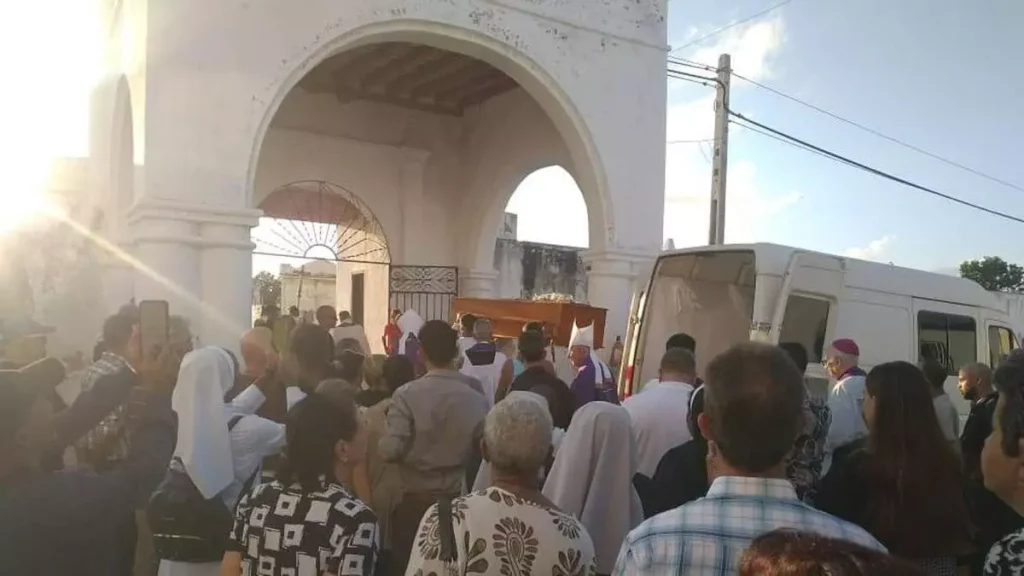
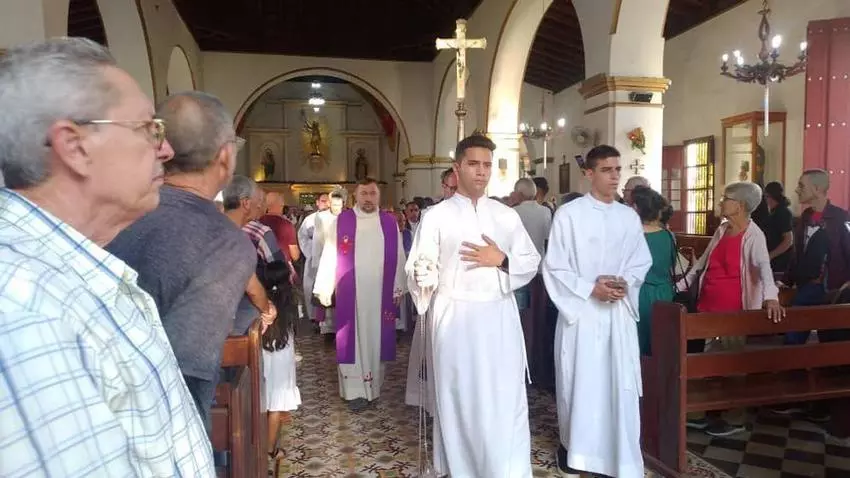
14ymedio bigger14ymedio, Ghabriel Pérez, Holguín, 19 December 2025 — Héctor Luis Lucas Peña Gómez, Bishop Emeritus of Holguín and a central figure in the Cuban episcopate for decades, passed away in the early hours of December 18, 2025, at the age of 96. He was one of the signatories of the pastoral letter El amor todo lo espera [Love endures all things], one of the most significant documents of the Church in Cuba. His funeral Mass was held at the Cathedral of San Isidoro, presided over by the Archbishop of Santiago de Cuba, Monsignor Dionisio García Ibáñez.

It was September 1993. Cuba was experiencing years of great uncertainty when the bishops released those pages, which were read with devotion from church to church. And then, passed from hand to hand, they were read by everyone. Immediately, the regime condemned them, hurling every imaginable insult at our bishops and accusing them of calling for a “bloodbath.” Nevertheless, the pastoral guidance of the wise bishops continued to strengthen the Christian community.

In the early years of the 21st century, the courage of our bishop allowed the existence of the Bifronte Magazine , a literary project that triggered alarms in the Ministry of the Interior, and all the Holguin writers of the Hermanos Saíz Association were summoned to the police units as if continue reading

we were criminals.

In 2010, Monsignor Peña invited me to his home in the Peralta neighborhood for a conversation he wished to have with me, expressing his admiration after reading several of my articles published in Cocuyo, our diocesan magazine. It was the opportunity to leave him the twelve questions for an interview that I lost when I was putting together the magazine Pirámide, which mysteriously and digitally disappeared one day.

Clearly, my dearest Peña, you stirred the springs of a faith rooted in pure rebellion. / Courtesy of the author

That February night in 2010, my farewell embrace was interrupted by a television voice when, on the porch of the bishop’s mansion, we heard the voice of the National Television News, and Peña pulled me by the arm and sat me in a rocking chair. And so we were confronted with one of the most horrendous farces of official Cuban journalism: Gladys Rubio, speaking off-camera, was echoing the smear campaign surrounding the case of Orlando Zapata Tamayo, the prisoner from Banes who died after 85 days on hunger strike. The pro-government journalist didn’t hesitate to disrespect even the pain of this mother, Reina Luisa Tamayo, by broadcasting her voice, recorded with a hidden camera, as Reina “thanked” the medical staff for her son’s care at the hospital.

I share this anecdote because it was the beautiful time I saw tears in my bishop’s eyes, tears like those of a crucified Jesus, and because I have decided not to worry about those who claim that my writings, whatever they touch on, carry the burden of dissent, for I am indeed a dissident, and moreover, from my Roman Catholic perspective. Nothing is more dissident than the Christian faith, whomever doesn’t see it this way doesn’t know what it means to honor Christ. I am as much a dissident as the very soul of Monsignor Héctor Luis Lucas Peña Gómez and all the Cuban bishops, from the celebrated Félix Varela and Enrique Pérez Serantes to the one who these days, evangelically cries out for our suffering people.

So, I must mention in this farewell my annoyance at seeing so many police officers at every street corner from the Cathedral to the cemetery, and so many motorcycles and police cars—protecting what? Just a few weeks ago, a similar procession took place following the death of Father José Necuse, and there wasn’t a single police officer on duty.

Clearly, my dearest Peña, you stirred the springs of a faith with a purely rebellious root. Truly, I couldn’t have imagined this day any other way, even though today, unlike the time when Cuba bid farewell to Pedro Meurice, our Church is more infiltrated than ever, and 90% of our faithful have gone into exile.

The 96-year-old bishop, declared the longest-serving member of our episcopate, bids farewell. / Courtesy of the author

To make matters worse, you leave on days when the Cuban environment offers the image and reality of compatriots with a loss of mobility not seen since Cuba has been on the maps and the mouths of our people barely have breakfast and barely have the strength to sing or shout.

Nevertheless, we went to Mass for you, we went to your final resting place for you, a new “Father Las Casas” (the Holguín native knows!). And I say that your farewell doesn’t surprise me, but it does distress me. Many of our conversations were left unfinished, like that day when I discovered on a page from the 1950s that your town of Velasco was called “the breadbasket of the Antilles,” and you were surprised because it was much more than just the breadbasket of Cuba.

We still had much to talk about regarding the Cuba of our dreams, “with everyone and for the good of all,” and that conversation about Reinaldo Arenas that we never finished…

The 96-year-old bishop, declared the longest-serving member of our episcopate, bids farewell. And when the last bishop says goodbye, one cycle closes and another opens, one that implies a powerful interpretation for this Cuba of forbidden church bells, of the imprisonment of innocent voices, of a thirst for justice, and of an uncertainty similar to that denounced in the classic Cuban pastoral letters, which offered their early and first warning to the “new revolutionary government” on January 3, 1959, in a Santiago de Cuba plaza.

Your people, Monsignor, thank you and honor you and are honored to have had you as their pastor and celebrate you, as an evangelical spirit that will continue to guide the mysteries of the secular city, from your body deposited in the very center of the Chapel of the Merciful Christ of the Necropolis of Luz y Caballero.

____________

COLLABORATE WITH OUR WORK: The 14ymedio team is committed to practicing serious journalism that reflects Cuba’s reality in all its depth. Thank you for joining us on this long journey. We invite you to continue supporting us by becoming a member of 14ymedio now. Together we can continue transforming journalism in Cuba.
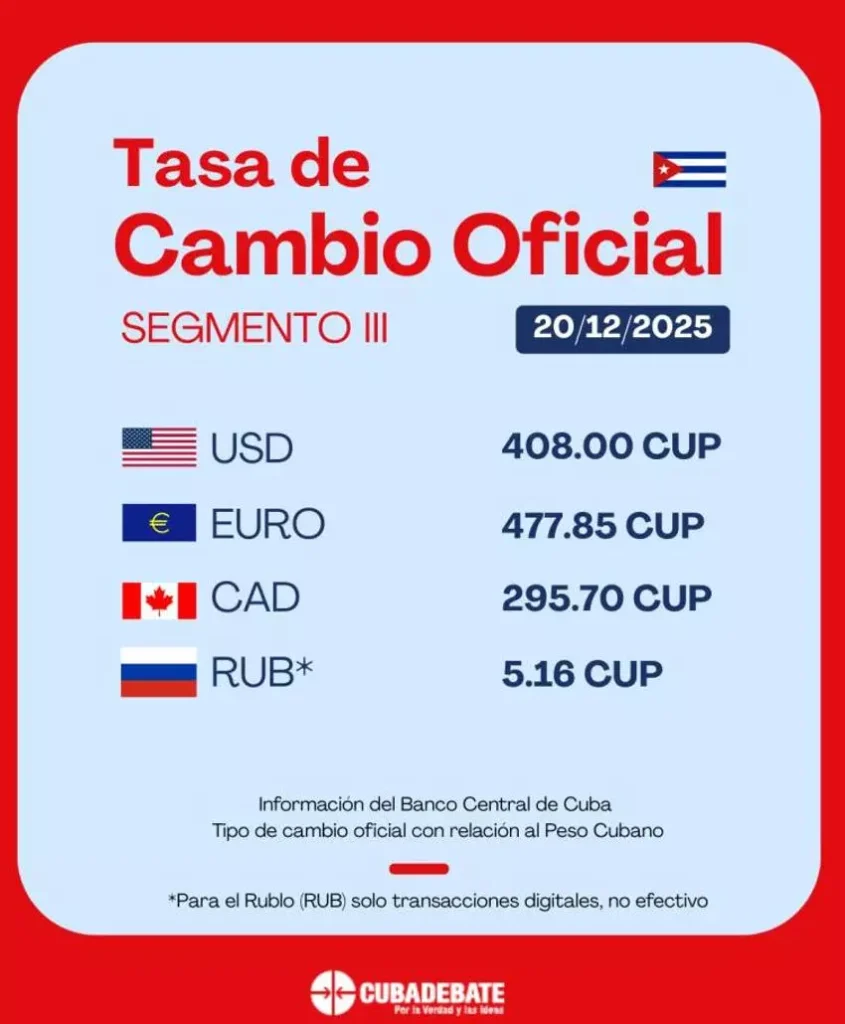
The Number of Tourists Visiting Cuba This Year Will Be Under Two Million.

The sector’s revenue will reach $917.4 million, almost 25% less than expected.

Tourism is fundamental to the Cuban government’s economic recovery plans. / 14ymedio

14ymedio bigger14ymedio/EFE, Havana, 18 December 2025 — On Thursday, the Cuban government acknowledged that the tourism sector is facing a complex situation and that it will not meet its forecasts for revenue and international visitors by around 25 percentage points in each case.

The Minister of Economy and Planning, Joaquín Alonso, took stock of the situation of the former engine of the national economy when he addressed the plenary session of the National Assembly of People’s Power. According to his department’s calculations, the sector’s revenue will reach US$917.4 million, 75.8% of the forecast, and the number of visitors will be around 1.9 million, 73.1% of the state estimate for the whole year.

If confirmed, this number of travellers would be the worst annual record for the Cuban tourism sector since 2003, not counting the three years most affected by COVID-19. By comparison, the island attracted some 4.6 and 4.7 million visitors in 2017 and 2018, respectively.

This would be the worst annual record for the Cuban tourism sector since 2003.

The State Office for Statistics and Information recently reported that between January and October, the country received a total of 1,477,892 international visitors, 19.9 per cent fewer than in the same period in 2024.

The weakness of Cuba’s tourism sector, which has been the island’s economic engine for years, is mainly due to the serious economic and energy crisis affecting continue reading

the country – which has an impact on services and the visitor experience – the reduction in air routes and US sanctions.

Tourism is fundamental to the Cuban government’s economic recovery plans, due to its contribution to gross domestic product and the foreign currency it brings in, which is usually among the most important sources of income, along with professional services and remittances.

Tourism is fundamental to the Cuban government’s economic recovery plans.

Currently, the situation of tourism in Cuba contrasts with that of similar destinations in the Caribbean, such as Punta Cana in the Dominican Republic and Cancún in Mexico, which are recording record numbers of visitors following the pandemic.

In this context, the crisis in Cuban tourism coincides with a broader political, economic and social deterioration, marked by prolonged power cuts, shortages of basic services and internal tensions.

In recent weeks, several countries have also issued health warnings that directly affect travel to the island. The Spanish Ministry of Foreign Affairs warned of a serious epidemic with simultaneous outbreaks of dengue and chikungunya, recommending that people refrain from travelling unless they have been properly vaccinated.

Russia, one of the main source markets for Cuba in recent years, issued a similar warning through its Foreign Ministry, advising extreme caution and even reconsidering travel, amid growing concern reflected in the press and by tourists already in the country.

____________

COLLABORATE WITH OUR WORK: The 14ymedio team is committed to practicing serious journalism that reflects Cuba’s reality in all its depth. Thank you for joining us on this long journey. We invite you to continue supporting us by becoming a member of 14ymedio now. Together we can continue transforming journalism in Cuba.