What were so many police officers doing there, at every street corner from the Cathedral to the cemetery, and so many motorcycles and police cars?
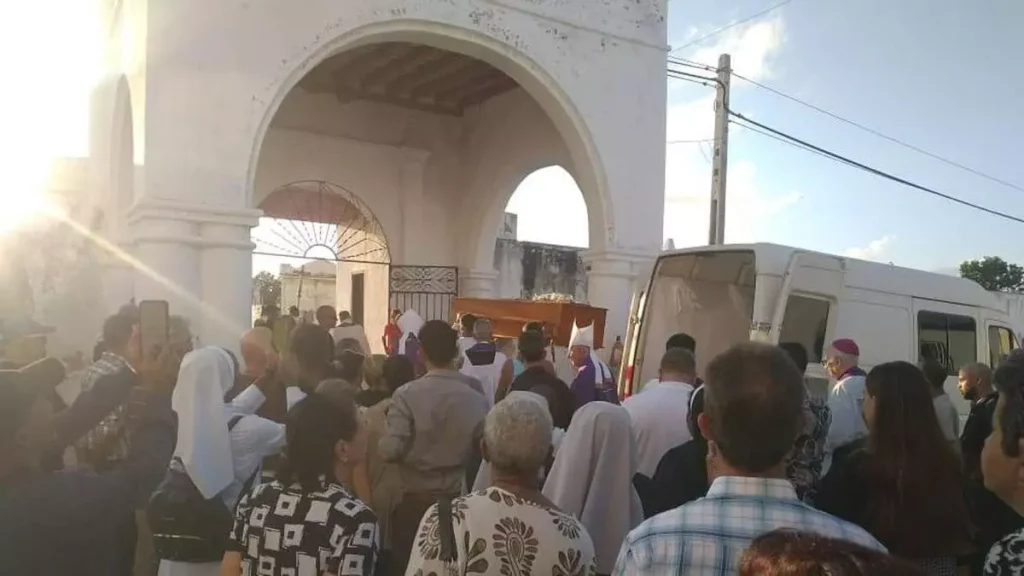
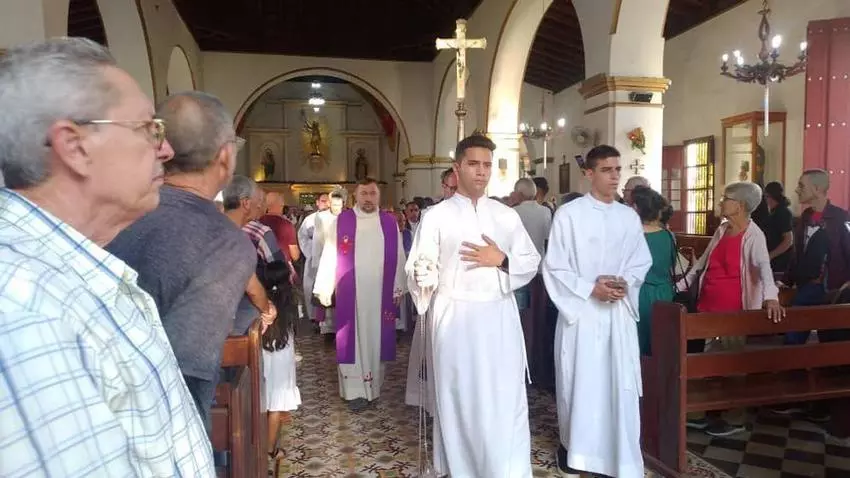
 14ymedio, Ghabriel Pérez, Holguín, 19 December 2025 — Héctor Luis Lucas Peña Gómez, Bishop Emeritus of Holguín and a central figure in the Cuban episcopate for decades, passed away in the early hours of December 18, 2025, at the age of 96. He was one of the signatories of the pastoral letter El amor todo lo espera [Love endures all things], one of the most significant documents of the Church in Cuba. His funeral Mass was held at the Cathedral of San Isidoro, presided over by the Archbishop of Santiago de Cuba, Monsignor Dionisio García Ibáñez.
It was September 1993. Cuba was experiencing years of great uncertainty when the bishops released those pages, which were read with devotion from church to church. And then, passed from hand to hand, they were read by everyone. Immediately, the regime condemned them, hurling every imaginable insult at our bishops and accusing them of calling for a “bloodbath.” Nevertheless, the pastoral guidance of the wise bishops continued to strengthen the Christian community.
In the early years of the 21st century, the courage of our bishop allowed the existence of the Bifronte Magazine , a literary project that triggered alarms in the Ministry of the Interior, and all the Holguin writers of the Hermanos Saíz Association were summoned to the police units as if we were criminals.
In 2010, Monsignor Peña invited me to his home in the Peralta neighborhood for a conversation he wished to have with me, expressing his admiration after reading several of my articles published in Cocuyo, our diocesan magazine. It was the opportunity to leave him the twelve questions for an interview that I lost when I was putting together the magazine Pirámide, which mysteriously and digitally disappeared one day.
That February night in 2010, my farewell embrace was interrupted by a television voice when, on the porch of the bishop’s mansion, we heard the voice of the National Television News, and Peña pulled me by the arm and sat me in a rocking chair. And so we were confronted with one of the most horrendous farces of official Cuban journalism: Gladys Rubio, speaking off-camera, was echoing the smear campaign surrounding the case of Orlando Zapata Tamayo, the prisoner from Banes who died after 85 days on hunger strike. The pro-government journalist didn’t hesitate to disrespect even the pain of this mother, Reina Luisa Tamayo, by broadcasting her voice, recorded with a hidden camera, as Reina “thanked” the medical staff for her son’s care at the hospital.
I share this anecdote because it was the beautiful time I saw tears in my bishop’s eyes, tears like those of a crucified Jesus, and because I have decided not to worry about those who claim that my writings, whatever they touch on, carry the burden of dissent, for I am indeed a dissident, and moreover, from my Roman Catholic perspective. Nothing is more dissident than the Christian faith, whomever doesn’t see it this way doesn’t know what it means to honor Christ. I am as much a dissident as the very soul of Monsignor Héctor Luis Lucas Peña Gómez and all the Cuban bishops, from the celebrated Félix Varela and Enrique Pérez Serantes to the one who these days, evangelically cries out for our suffering people.
So, I must mention in this farewell my annoyance at seeing so many police officers at every street corner from the Cathedral to the cemetery, and so many motorcycles and police cars—protecting what? Just a few weeks ago, a similar procession took place following the death of Father José Necuse, and there wasn’t a single police officer on duty.
Clearly, my dearest Peña, you stirred the springs of a faith with a purely rebellious root. Truly, I couldn’t have imagined this day any other way, even though today, unlike the time when Cuba bid farewell to Pedro Meurice, our Church is more infiltrated than ever, and 90% of our faithful have gone into exile.

To make matters worse, you leave on days when the Cuban environment offers the image and reality of compatriots with a loss of mobility not seen since Cuba has been on the maps and the mouths of our people barely have breakfast and barely have the strength to sing or shout.
Nevertheless, we went to Mass for you, we went to your final resting place for you, a new “Father Las Casas” (the Holguín native knows!). And I say that your farewell doesn’t surprise me, but it does distress me. Many of our conversations were left unfinished, like that day when I discovered on a page from the 1950s that your town of Velasco was called “the breadbasket of the Antilles,” and you were surprised because it was much more than just the breadbasket of Cuba.
We still had much to talk about regarding the Cuba of our dreams, “with everyone and for the good of all,” and that conversation about Reinaldo Arenas that we never finished…
The 96-year-old bishop, declared the longest-serving member of our episcopate, bids farewell. And when the last bishop says goodbye, one cycle closes and another opens, one that implies a powerful interpretation for this Cuba of forbidden church bells, of the imprisonment of innocent voices, of a thirst for justice, and of an uncertainty similar to that denounced in the classic Cuban pastoral letters, which offered their early and first warning to the “new revolutionary government” on January 3, 1959, in a Santiago de Cuba plaza.
Your people, Monsignor, thank you and honor you and are honored to have had you as their pastor and celebrate you, as an evangelical spirit that will continue to guide the mysteries of the secular city, from your body deposited in the very center of the Chapel of the Merciful Christ of the Necropolis of Luz y Caballero.
____________
COLLABORATE WITH OUR WORK: The 14ymedio team is committed to practicing serious journalism that reflects Cuba’s reality in all its depth. Thank you for joining us on this long journey. We invite you to continue supporting us by becoming a member of 14ymedio now. Together we can continue transforming journalism in Cuba.