Staff shortages turn afternoons into lost teaching hours at Camilo Cienfuegos Elementary School

 14ymedio, Julio César Contreras, San José de las Lajas, 23 December 2025 –At four in the afternoon, the air on Avenida 40 is thick with smoke in front of the Camilo Cienfuegos Elementary School in San José de las Lajas. Under the dense shade of the flamboyant trees, parents gather in front of the fence that separates the street from the inner courtyard. They balance patience and frustration as they watch the children run haphazardly among loose stones, puddles, abandoned backpacks, and trees with roots protruding from the ground. It doesn’t seem like school time. There are no blackboards or notebooks, only impromptu races, wads of paper, games of hide-and-seek, and noise. Lots of noise
Among the parents stands Marlén, her son’s uniform folded over her arm, her face weary. “When he’s not covered in dirt, his shirt’s missing a button,” she says, her gaze fixed on the little boy playing at the edge of the fence. “They force him to come in the afternoon, supposedly because he has classes, but most of the time they spend those two hours playing in the playground, with no one to supervise them, much less teach them.” Since last year, her son hasn’t had a regular teacher. What used to be routine now seems like improvisation: a school without teaching, a schedule without content.
Since last year, her son hasn’t had a regular teacher. What used to be routine now seems like improvisation.
The surrounding scenes confirm it. A grandfather approaches on his bicycle and, through the fence, talks to his granddaughter, who shows him a crumpled folder. Further on, a mother leans against the metal fence and barely blinks as she watches her daughter run after a group that has turned the courtyard into a maze. Two children are throwing small stones, another is juggling a stick, and a teenager, her headscarf undone, kicks up dust with her shoes that are no longer so white. A few meters away, the only teaching assistant who should be keeping order is looking at her phone screen.
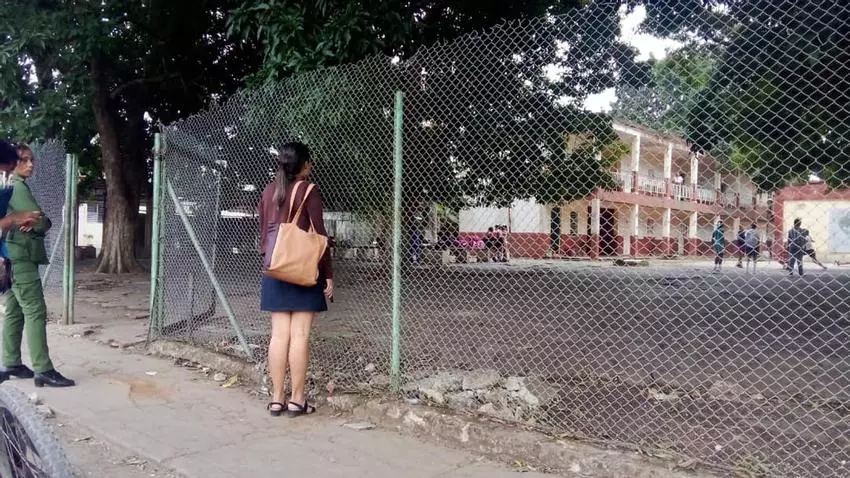
“Before, there were teachers in every classroom here,” recalls Marlén, who studied there in the 1990s. Now, every day is marked by absences: there’s a lack of teaching staff, a lack of teachers, a lack of classes. And, meanwhile, those children who should be learning their multiplication tables, spelling, or reading comprehension spend hours in the sun, during an extended recess that no parent asked for.
The school celebrated its 70th anniversary this year. It received a Lifetime Achievement Award from the local government. But none of that changes the scene that repeats itself every afternoon: first-grade students with no activities, no proper supervision, and no security. The state institution, founded in 1956 as the Eliodoro García School, seems to be stuck in an indefinite limbo.
A few meters away, the only teaching assistant who should be in control is looking at the screen on her phone.
“In their eagerness to change everything and solve nothing, the government has even lost the educators,” says Marino, the grandfather of a fifth-grade student. He speaks while waiting, bicycle in hand, for the main gate to open. “My granddaughter has to come in the afternoons five days a week, and they don’t even give her physical education. If this continues, I won’t bring her after noon anymore.”
Many family members arrive before four o’clock. They line up in front of the metal fence waiting for the dismissal signal, which should theoretically come at 4:20. Although they can see and even talk to the children from the street, the gate remains locked. “They make the rules arbitrarily, because the Ministry of Education mandates it, even though not even the teachers agree,” Marino insists.
While they wait, street vendors appear with sweets and cookies. A mother takes the opportunity to briefly feed her daughter through the fence, who complains about the school lunch menu: “What they serve here isn’t even fit for pigs,” she says bluntly.
Her daughter’s teacher, she says, is 67 years old and by 11:00 in the morning “she can’t do any more”
At the far end of the courtyard rises the building’s facade: columns, open corridors, and peeling walls. The flag seems small compared to the magnitude of the problem. Where there should be books, there is disorder; where the dictation of a prayer should be heard, there are shouts. “They’re trying to cover the teaching with university students,” says Marisol, who now takes care of two nephews because her sister emigrated. “The few old teachers who are still left are teaching because they have no other choice.” Her daughter’s teacher, she says, is 67 years old and by 11:00 in the morning “she can’t go on anymore.”
Through the fence, the old paint of the school mural is visible, almost faded by the sun. “Every day they come with the story that the teachers are asking for the parents’ help,” Marisol sighs. “That means bringing brooms, floor mats, chalk, money for the Teacher’s Day party… everything.” But what weighs most heavily on her isn’t the list of supplies, but what she sees every afternoon from the street: “The children doing everything but studying. And in the end, there’s no one to complain to.”
When the gate finally opens, the parents are able to hug their children. The yard is left behind, full of dust kicked up by the running.

____________
COLLABORATE WITH OUR WORK: The 14ymedio team is committed to practicing serious journalism that reflects Cuba’s reality in all its depth. Thank you for joining us on this long journey. We invite you to continue supporting us by becoming a member of 14ymedio now. Together we can continue transforming journalism in Cuba.