Nervous and hoarse, Díaz-Canel addressed an indifferent audience at the Anti-Imperialist Tribune
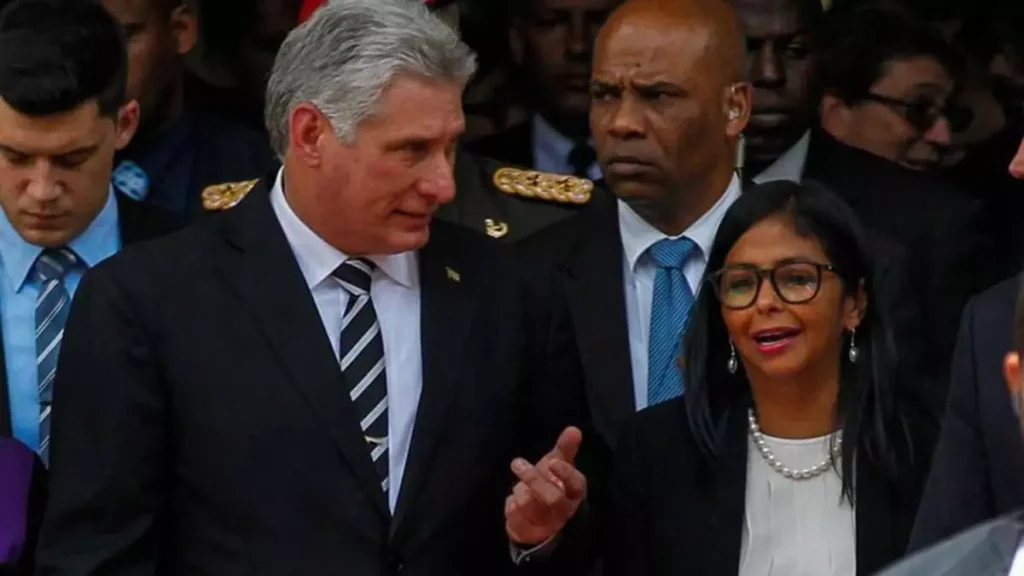
Miguel Díaz-Canel, during his speech this Saturday at the Anti-Imperialist Tribune in Havana. / 14ymedio
14ymedio, Darío Hernández, Havana, January 3, 2026 – The morning dawned somewhat cold in Havana, with clear skies that failed to conceal the power outages in several municipalities and the water supply problems that continue to affect daily life in large areas of the city. Added to this everyday scene, early in the morning, was a last-minute official announcement: a rally at the Anti-Imperialist Tribune, next to the Malecón, to “denounce US attacks against Venezuela,” following the capture of President Nicolás Maduro by US troops.
While the Electric Union warned that the generation deficit for the day would exceed 1,600 MW, at bus stops and doorways people were talking less about the energy report than about what had happened in Caracas. The topic spread quickly throughout the city. At the popular market in La Cuevita, in San Miguel del Padrón, the pulse of the conversation seemed more intense than at the Anti-Imperialist Tribune itself.
Among the stalls selling jewelry, clothing, and household items, the comment was almost unanimous: “Did you see what happened to Maduro?” Some people were boasting: “That wouldn’t happen here, because they’d shoot down at least one or two helicopters,” said a man while offering sneakers and T-shirts for sale. Others preferred sarcasm and emphasized “how easy” it had been for U.S. special forces to capture the Venezuelan president and his wife, Cilia Flores. “It was like a movie,” said a young man, cell phone in hand, scanning the headlines.
Cubans are concerned about the oil supply being cut off due to Maduro’s fall.
There was no shortage of conspiracy theories. One woman claimed that “it was all planned” and that without Havana’s complicity, it would not have been possible for the Venezuelan leader to fall into Washington’s hands. “But we can rest easy because there’s nothing in Cuba that interests the Americans,” she said, as she chose a scouring pad. A few meters away, a household goods vendor told 14ymedio that “there’s sure to be a cut in oil supplies now, and everything here is going to get even more heated,” a concern that resonated more strongly than any slogan.
That restless murmur contrasted with the scene unfolding at the Anti-Imperialist Tribune, in front of the US Embassy in Havana. There, by mid-morning, hundreds of people had gathered with little enthusiasm. Many arrived in groups organized by their workplaces and tried to protect themselves from the sea breeze, which this January is not only laden with salt spray but also with a cold that seeps through coats.
One of the attendees at the rally at the Anti-Imperialist Tribune captured by this newspaper. / 14ymedio
The event began with predictable speeches, laden with references to “imperialism” and the defense of regional sovereignty. Miguel Díaz-Canel took the floor with a tone that sounded nervous. His hoarse voice, attempts to raise his volume, and forced gestures conveyed more tension than firmness. Some in the audience listened in silence; others took the opportunity to check their cell phones or talk quietly. The solemnity of the leaders contrasted with the evident fatigue among those gathered.
A few minutes after Díaz-Canel finished his speech, the stampede began. / 14ymedio
Unlike La Cuevita, where the debate was spontaneous and at times heated, the atmosphere at the Tribune seemed encapsulated, detached from people’s immediate concerns. A few minutes after Díaz-Canel concluded his speech, the stampede began. Entire groups left almost in unison, seeking shelter from the wind, looking for a bus, or simply thinking about getting home before the next power outage.
On the way back, the city was still talking about Venezuela. In a line to buy bread, someone asked if “Venezuelan oil is now really gone.” In a park, two retirees discussed how Maduro would behave before the US judges. “Change is coming,” summed up a bicycle taxi driver who, wearing long sleeves and sunglasses, was trying to convince a couple of tourists to get into his vehicle.
Translated by GH
____________
COLLABORATE WITH OUR WORK: The 14ymedio team is committed to practicing serious journalism that reflects Cuba’s reality in all its depth. Thank you for joining us on this long journey. We invite you to continue supporting us by becoming a member of 14ymedio now. Together we can continue transforming journalism in Cuba.
The regime always denied the presence of Cuban troops in Venezuela
There will be almost two days of official mourning in Cuba for the soldiers who died in Venezuela. / Courtesy
14ymedio, Madrid, January 5, 2025 — Cuba declared official mourning at 6 a.m. this Monday and will remain in mourning until midnight on Tuesday for the 32 people killed in the US operation to arrest Nicolás Maduro on Saturday. The government, which had remained silent after comments by US President Donald Trump—”many Cubans lost their lives protecting Maduro”—reported the events through the Presidential X account.
“As a result of the criminal attack perpetrated by the United States Government against the sister Bolivarian Republic of Venezuela, 32 Cubans lost their lives in combat actions,” reads the post, which links to a statement published in the State newspaper Granma.
The article reports that the deceased “were carrying out missions on behalf of the Revolutionary Armed Forces and the Ministry of the Interior, at the request of their counterparts in the South American country,” without explicitly stating that they were part of Maduro’s security detail. The presence of Cuban military personnel in Venezuela, confirmed by multiple sources over the past two decades, had been explicitly denied by Foreign Minister Bruno Rodríguez in statements made in 2019 and reiterated in several subsequent appearances.
“The accusation by the President of the United States that Cuba maintains a private army in Venezuela is outrageous. I urge him to present evidence.”
“The accusation by the President of the United States that Cuba maintains a private army in Venezuela is infamous. I urge him to present evidence. Our government rejects this slander in the strongest and most categorical terms,” the foreign minister responded to a comment made by Trump during his first term, prior to his claim that the Cuban personnel deployed in the country were entirely civilian, 94% of them working in the health sector. continue reading
The Cuban government now states that, having verified the identities of the deceased and informed their families, it is informing the public of what happened. “Faithful to their responsibilities for security and defense, our compatriots fulfilled their duty with dignity and heroism and fell, after fierce resistance, in direct combat against the attackers or as a result of the bombing of the facilities,” the statement reads.
This assertion contradicts statements from the US military high command, which described a lightning operation that took less than two minutes to capture Maduro and only five hours in total. The same sources indicate that there was little resistance from the security detail thanks to the element of surprise, and that the bodyguards of the president and his wife, Cilia Flores, did not have time to move them to a nearby fortified area designated for this type of emergency.
Many Cubans were part of Maduro’s security detail. / Courtesy
The families of the deceased have received “heartfelt condolences and support” from Army General Raúl Castro Ruz, leader of the Cuban Revolution, and from the first secretary of the Central Committee of the Party, Miguel Díaz-Canel Bermúdez, as well as from the Ministries of the Interior and the Revolutionary Armed Forces.
“Victims of a new criminal act of aggression and state terrorism, the combatants, through their heroic actions, upheld the solidarity of millions of compatriots. The Revolutionary Government will organize the corresponding actions to pay them the tribute they deserve,” concludes the statement, which has been disseminated in the official media.
Díaz-Canel, who also shared the statement on his Twitter account, highlighted the content with the hashtag #HonorYGloria, adding that the victims “fell confronting terrorists in imperial uniforms, who kidnapped and illegally removed the president of Venezuela and his wife from their country, whose lives they were helping to protect at the request of that sister nation.” The message suggests that the government plans to claim the soldiers were recently on Venezuelan soil.
“I share the pain and outrage of our people and especially the loved ones of our courageous comrades. As I embrace their families and friends in this tragic hour, I reiterate my deep affection, admiration, and pride for them and their heroic conduct,” the statement concludes.
“The Bolivarian Republic of Venezuela pays tribute to the 32 Cuban combatants who gave their lives fulfilling their duty.”
Venezuela has also issued a communication thanking Cuba for its support “within the framework of cooperation between sovereign states and [the deceased] were carrying out institutional protection and defense tasks.”
“The Bolivarian Republic of Venezuela pays tribute to the 32 Cuban combatants who gave their lives fulfilling their duty,” the document says, praising the deceased for acting with “courage, discipline and unwavering commitment to peace and regional stability.”
The statement also expresses “deep solidarity” with the Cuban government and personalizes its gratitude to Raúl Castro and Díaz-Canel, while extending “a fraternal embrace to the Revolutionary Armed Forces and the families of the fallen combatants, whose sacrifice strengthens the historical bonds of brotherhood, sovereignty and shared struggle between our nations.”
The total number of deaths in the operation, according to The New York Times , which cites Venezuelan sources, amounts to 80 people, while Washington officials told the newspaper that there are half a dozen wounded US soldiers, although Trump did not want to confirm the numbers.
____________
COLLABORATE WITH OUR WORK: The 14ymedio team is committed to practicing serious journalism that reflects Cuba’s reality in all its depth. Thank you for joining us on this long journey. We invite you to continue supporting us by becoming a member of 14ymedio now. Together we can continue transforming journalism in Cuba.
Most of Maduro’s bodyguards were linked to Cuban State Security and came from the east of the island, especially from Granma and Santiago.
Some of the 32 Cubans killed in Venezuela during the capture of Nicolás Maduro. / Collage
14ymedio, Havana, 5 January 2025 — Official information regarding the 32 Cubans killed in Venezuela during the US operation to capture Nicolás Maduro remains scarce, fragmented, and marked by silences. However, in recent hours, social media, private messages, and partial confirmations from local authorities have allowed for a preliminary reconstruction of who some of these men were and what kind of roles they played in Venezuela.
What has been emerging consistently points to personnel linked to Cuban State security organs and the Armed Forces, many of them integrated into rings of direct protection of the Chavista power, and mostly from the east of the Island, especially from the provinces of Granma and Santiago de Cuba.
The Cuban government declared a national day of mourning after acknowledging that the deceased were “carrying out missions on behalf of the Revolutionary Armed Forces and the Ministry of the Interior,” an admission that contrasts sharply with years of official denials regarding the presence of Cuban troops in Venezuela. However, no official lists with names, ranks, or roles have been published, nor have clear details been provided about the circumstances of each death, leaving fertile ground for speculation and secondhand accounts. continue reading
The first secretary of the Communist Party in Granma province, Yudelkis Ortiz Barceló, acknowledged that six of the deceased were officers from Granma.
One of the first confirmations with institutional backing came from Granma province. The First Secretary of the Communist Party in Granma, Yudelkis Ortiz Barceló, acknowledged that six of the deceased were officers from Granma, without specifying their identities. Subsequently, specific names began to circulate. Among these is Fernando Báez Hidalgo, 26, a native of Río Cauto (Granma), linked to the Personal Security Directorate of the Ministry of the Interior and identified as a direct bodyguard of Maduro. His name has been mentioned in several concurring publications, although without official confirmation.
Also from Granma, Erduin Rosabal, a native of La Rinconada, has been identified, indicated in messages and publications as a member of the first security ring of the Venezuelan president.
Landy Osoria López, originally from Baire, Contramaestre, is from Santiago de Cuba. He has repeatedly been described as a member of Cuban State Security and part of the team deployed in Caracas. Several publications place him among the deceased, even citing family addresses, although this information has not been corroborated by a single official source.
Independent journalist Yosmany Mayeta Labrada reported the death of 33-year-old Alejandro Rodríguez, a resident of the Boniato neighborhood. According to testimonies gathered by the reporter, the family received conflicting accounts from authorities regarding the location and removal of the body. A relative recounted that they were initially told the body was missing, then that it had been located and they would be notified. According to this source, both Rodríguez Royo and his brother were allegedly linked to State Security structures.
Also from Santiago is Yordenis Marlonis, who was identified as a member of the Venezuelan president’s and his wife’s direct security detail. According to various publications, he was the son of parents from the town of Dos Caminos and leaves behind his wife and young daughter in Cuba. Sources cited by La Tijera indicate that prior to his assignment in Venezuela, he had been a bodyguard for Lázaro Expósito Canto, the former first secretary of the Communist Party in that province, a fact that reinforces his affiliation with high-level security forces. Officials from the Ministry of the Interior reportedly informed his family of his death, although without providing specific details.
These names are in addition to images and messages posted by profiles linked to veterans of special forces, such as the Black Wasps.
Other identities have emerged from Pinar del Río, including Yoel Caraballo, a native of Consolación del Sur, whose death was reportedly officially confirmed to his daughter by the Personal Security Directorate of that same ministry. His case stands out as one of the few so far in which a direct and formal notification to a family member is mentioned.
The case of Yandri, whose last name is still unknown, also falls within the family sphere. His death was announced by his cousin Moraima Rodríguez on social media. In her message, the woman expressed pride in his “duty fulfilled” protecting Maduro, a statement that, regardless of its tone, confirms the deceased’s role as a bodyguard.
These names are in addition to images and messages posted by profiles linked to special forces veterans, such as the Avispas Negras [Black Wasps], who have disseminated photographs of alleged unidentified fallen bodyguards, accompanied by slogans of loyalty and sacrifice. Although these types of posts have a strong propaganda slant, they all point to direct protection duties.
The absence of a complete official list, the opaque handling of information, and the reliance on leaks and private mourning reinforce the feeling that the truth about these 32 deaths is still incomplete and continues to trickle out, from the margins, rather than from institutions.
____________
COLLABORATE WITH OUR WORK: The 14ymedio team is committed to practicing serious journalism that reflects Cuba’s reality in all its depth. Thank you for joining us on this long journey. We invite you to continue supporting us by becoming a member of 14ymedio now. Together we can continue transforming journalism in Cuba.
Who is the leader taking over in Venezuela? Why does she both reassure and worry Cuba?
For Cuban audiences, it’s worth taking a moment to consider who Delcy Rodríguez is and why her name is so familiar in Havana. / EFE
14ymedio, Havana, 4 January 2025 — Following the capture of Nicolás Maduro, power in Venezuela has not been left hanging. As is often the case in highly centralized regimes, the transition was expected. Delcy Eloína Rodríguez Gómez, until now the executive vice president, assumed the role of “interim president” in a move that can be summarized as “the king is dead… the queen is crowned.” For the Cuban audience, it is worth examining who is this woman who is now managing the forced transition from Chavismo and why her name is not at all unfamiliar in Havana.
Delcy Rodríguez was born in Caracas in 1969 into a family deeply rooted in leftist activism. She is the daughter of Jorge Rodríguez, a historic leader of the Socialist League, who died in police custody in the 1970s, and the sister of Jorge Rodríguez, one of the most influential political operatives of Chavismo. A lawyer by training, Rodríguez built her career not on charisma or popularity, but on ideological loyalty, party discipline, and systematic confrontation with the West—virtues highly valued in both Caracas and Havana.
Her ascent was steady. As Foreign Minister from 2014 to 2018, she became one of the most aggressive voices of Chavismo in international forums, especially before the OAS and the UN. Her rhetoric, sharp and militant, earned her personal sanctions from the United States and the European Union, but also solidified her position as a trusted figure within Maduro’s inner circle. Since 2018, she has held the Executive Vice Presidency, a position from which she has controlled key areas such as the economy, oil, foreign relations, and, no less important, communication with strategic allies.
Delcy Rodríguez has not only visited the island on multiple occasions, but has also become one of the principle managers of the Caracas-Havana axis.
Among these allies, Cuba occupies a central place. Delcy Rodríguez has not only visited the island on numerous occasions, but has also become one of the principle managers in the Caracas-Havana axis in recent years. She has met repeatedly with Miguel Díaz-Canel, held meetings with delegations from the Communist Party of Cuba, and participated in negotiations related to energy supplies and bilateral cooperation. For the Cuban government, Rodríguez represents a guarantee of continuity: a leader trained in the same political language, with the same distrust of pluralism, and a profound understanding of continue reading
the value of repression as a tool for stability.
This alignment became clear after the 11 July 2021 protests in Cuba, when Delcy Rodríguez publicly expressed her support for Díaz-Canel and justified the repression against the demonstrators. At that time, she did not appeal to nuance or call for dialogue, but rather embraced without reservation the official Cuban narrative of a “soft coup attempt” and “foreign interference.” This stance placed her, unambiguously, in the same political and moral camp as the ruling Castro regime.
In Venezuela, her figure evokes mixed reactions. For the opposition, Delcy Rodríguez is neither a moderate nor a pragmatic technocrat, but rather one of the architects of the Chavista system of control, involved in decisions that have deepened the country’s economic and social crisis. She has been singled out for her role in opaque financial operations, in managing international sanctions, and in forging alliances with actors such as Russia, Iran, and Turkey. For the most hardline sectors of Chavismo, however, she embodies the continuity of the Bolivarian project.
Her prominence after Maduro’s fall might therefore imply neither an opening nor a rupture, but rather a closing of ranks. Cuban Foreign Minister Bruno Rodríguez Parrilla quickly understood this, expressing his immediate support for the Venezuelan government and Delcy Rodríguez on Saturday, denouncing what he called a US aggression. The message was clear: Havana is counting on her as a guarantor of its interests in Caracas.
However, President Donald Trump has made it clear that Washington will lead the Venezuelan transition and manage the country’s oil sector, a tutelage whose compatibility with the nationalist and anti-imperialist rhetoric that Rodríguez has maintained thus far remains uncertain. The US president asserted that his Secretary of State, Marco Rubio, had a “long conversation” with the then-vice president. According to the Republican, the Chavista leader expressed her willingness to cooperate with the United States.
Only in the coming hours will it be known whether the lawyer chooses to facilitate the dismantling of the regime and US administration’s control over the oil sector, or maintains her confrontational rhetoric against the White House. Havana is closely monitoring every nuance in her words, every gesture of rapprochement or rejection that Rodríguez makes toward Trump, and any statement that strengthens or weakens the alliance with Cuba.
In contrast, Marco Rubio has made it clear that he doesn’t care about words, but about actions: Washington will work with the current Venezuelan government if it makes the “right decisions” and will evaluate those who currently hold power in the country “by what they do,” not by what they say.
This could be the guarantee that, despite the blow suffered with Maduro’s capture, Chavismo does not dissolve, but rather reorganizes itself, and does so under figures reliable to the Cuban apparatus.
For the Castro regime, Delcy Rodríguez’s appointment represents more than just an institutional change. It could be the guarantee that, despite the blow dealt by Maduro’s capture, Chavismo will not dissolve, but rather reorganize itself, and do so under figures trusted by the Cuban apparatus, with assurances of economic support and the continuation of official missions that keep thousands of Cubans in the Venezuela. It is no coincidence that Rodríguez has been one of the main advocates for maintaining oil cooperation with the island, even during Venezuela’s most severe economic hardships.
From a Cuban perspective, the question isn’t just who is Delcy Rodríguez, but who will she be from now on. Everything indicates that she could behave as a crisis manager, not a reformer; a facilitator of Maduro’s downfall, not of a genuine democratic transition. Her track record shows a leader prepared to negotiate through hardline tactics, not concessions. But in a context like Chavismo, where opportunism and dissimulation have been rewarded for decades, no one knows her true colors.
For Havana, Delcy Rodríguez was until yesterday a known ally, but now she is becoming the great unknown that must be resolved as quickly as possible.
___________
COLLABORATE WITH OUR WORK: The 14ymedio team is committed to practicing serious journalism that reflects Cuba’s reality in all its depth. Thank you for joining us on this long journey. We invite you to continue supporting us by becoming a member of 14ymedio now. Together we can continue transforming journalism in Cuba.
From Havana and exile, voices from civil society warn about the implications for the Island of the ruler’s arrest
“When chemotherapy is required, chemotherapy must be applied. Anything else is pure hypocrisy or total complicity,” said Ferrer. / Wikimedia Commons
14ymedio, Havana, January 4, 2026 — Various voices from Cuban civil society have been reacting since Saturday to the capture of Nicolás Maduro by U.S. troops. Activists and independent journalists have welcomed the arrest of the leader and are calling for the process in Venezuela to lead to a real, peaceful, orderly, and verifiable democratic transition.
For opposition figure Ángel Moya, the capture of Nicolás Maduro is a positive step, and he recalls that the ruler “gave the order to murder and imprison hundreds of thousands of Venezuelans fighting for freedom, justice, and human rights.” The former prisoner of the 2003 Black Spring recommended that U.S. President Donald Trump “demand the immediate release of political prisoners” and guarantee “security for opposition members and for exiles who decide to return,” including María Corina Machado and Edmundo García.
For his part, dissident Manuel Cuesta Morúa, president of Cuba’s Council for the Democratic Transition, noted that the events reopen the debate over sovereignty, since chavismo, the historian also argues, usurped the popular will expressed at the ballot box in last July’s elections.
In Cuesta Morúa’s view, an opportunity has opened for the Venezuelan people to reclaim their democratic process, although he underscored the importance of respecting international law. The activist also warned that, for Cuba, Maduro’s fall would have serious implications: the loss of a key ally, an essential economic lifeline, and international backing for its authoritarian model.
“Cancer is not cured with paracetamol”
José Daniel Ferrer, leader of the Patriotic Union of Cuba and recently exiled to Miami, described the U.S. military action to capture and prosecute Maduro for drug-trafficking-related crimes as “necessary and positive.” Ferrer maintained that as long as the Cuban regime persists, freedom and human rights will continue to be at risk in the region. “Cancer is not cured with paracetamol. When chemotherapy is required, chemotherapy must be applied. Anything else is pure hypocrisy or total complicity,” he warned.
Academic Alina Bárbara Hernández opted for caution and announced on her Facebook account that she needs to reflect a bit more before commenting on what happened: “I’m taking a little time to publish my analysis of what’s going on.” Nonetheless, she shared a text by Cuban digital creator José Manuel González Rubines, who made it clear that after the U.S. operation, “Maduro is no longer in power and, in all likelihood, will be tried in the United States,” and that “his coterie of satraps handed him over and, with him, handed the country over to a foreign military intervention and a “supervised transition.’”
Meanwhile, writer Jorge Fernández Era called for caution in the face of propaganda and anticipated possible unexpected turns in the Venezuelan political landscape. For its part, the Cuban Observatory of Human Rights, based in Madrid, celebrated the arrest and demanded the immediate release of political prisoners and the restoration of democracy.
In a statement from the Independent Trade Union Association of Cuba, Secretary General Iván Hernández Carrillo emphasized that any legitimate outcome must lead, without ambiguity, to a transition with clear rules, a public timetable, and national and international verification, culminating in the installation of the government chosen by Venezuelans.
In this newspaper, Yoani Sánchez wrote on her blog: “What happens in the coming hours is crucial for both nations, but it is already clear that the boastful and arrogant Nicolás Maduro is a thing of the past. The Cuban dictatorship will be watching him closely in his next appearances, like someone looking in a mirror.”
Translated by Regina Anavy
____________
COLLABORATE WITH OUR WORK: The 14ymedio team is committed to practicing serious journalism that reflects Cuba’s reality in all its depth. Thank you for joining us on this long journey. We invite you to continue supporting us by becoming a member of 14ymedio now. Together we can continue transforming journalism in Cuba.
Military escalation casts doubt on the future of the medical brigades
Independent organizations have been denouncing the labor conditions of these missions for years. / Archives
14ymedio, Havana, January 3, 2026 — From the early hours of this Saturday, when news broke of the United States’ intervention in Venezuela, one of the questions that began circulating in Cuba was what would happen to the Cuban doctors who remain on mission in that country. The Ministry of Public Health assured, in a brief message circulated on social media, that all collaborators are safe. Nevertheless, beyond that official statement, the immediate future of one of the Cuban regime’s main sources of hard currency remains undefined.
After the military action took place, a retired nurse from Havana told this newspaper that a colleague in Venezuela assured her that “they have the Cubans on mission confined to barracks.”
In addition, a doctor stationed in Caracas told 14ymedio that, despite the messages of calm conveyed by their coordinators, nervousness is evident: “The bosses keep saying that everything is fine and that we have to wait for what Havana says, but they are very nervous.” At that moment, the U.S. president was about to begin a press conference from his residence in Mar-a-Lago, Florida. “I can’t talk much because we’re all trying to listen to Trump’s speech, but what I can tell you is that it makes me nervous that I’m about to finish my mission and I’ve already bought the kids’ clothes. Imagine if they move us somewhere else and I can’t take anything with me.” continue reading
“The bosses keep saying that everything is fine and that we have to wait for what Havana says, but they are very nervous”
Another Cuban collaborator, from Zulia, commented that “everything is calm in the streets, but there are people who are very happy.” Several Venezuelan reporters, who maintained a live broadcast on X for more than ten hours, also reported crowds forming at markets and gas stations to buy supplies, amid fears of business closures.
The unease has been strongly reflected on social media, especially in comments responding to the official call for a demonstration at the Anti-Imperialist Tribune in Havana. Meanwhile, on social media numerous users demanded that priority be given to the safety of medical personnel and their return to the Island. “They are not military; they deserve to be with their families,” wrote one participant. Other messages expressed anxiety and irritation over the lack of foresight. “Now they’ve got the families of those who are over there going crazy here,” another comment noted.
However, not all opinions agree. There are also messages defending the continued presence of the brigades in Venezuela and arguing that, in a context of crisis, the doctors’ work is even more necessary. “In this imminent war, Cuban health brigades in Venezuela will be more necessary than ever,” states one of the comments, appealing to the continuity of the mission as part of a political commitment built over many years.
Beyond the opposing views, a possible interruption of the medical missions in Venezuela would have direct consequences for Cuba’s already fragile economy. Amid inflation, shortages, and the deterioration of basic services, the loss of one of its main sources of hard-currency income would worsen the internal crisis.
A possible interruption of the medical missions in Venezuela would have direct consequences for Cuba’s already fragile economy
Although Cuban authorities say they are maintaining constant communication with the mission, so far no plans for relocation, shelter, or return to Cuba have been made public, nor has it been explained what would happen if the conflict intensifies.
The presence of Cuban healthcare personnel in Venezuela dates back more than two decades and has been central both to the political relationship between the two governments and to the Island’s economy. Through these agreements, the Cuban state receives significant income, while professionals work under state contracts that limit their pay and their personal lives.
Independent organizations have been denouncing the labor conditions of these missions for years, including the withholding of salaries, political control, and restrictions on personal freedom. In a scenario of military intervention and high regional tension, these complaints take on an even more critical dimension.
Translated by Regina Anavy
____________
COLLABORATE WITH OUR WORK: The 14ymedio team is committed to practicing serious journalism that reflects Cuba’s reality in all its depth. Thank you for joining us on this long journey. We invite you to continue supporting us by becoming a member of 14ymedio now. Together we can continue transforming journalism in Cuba.
Los más infames de 2025 (Ilustración: Mary Esther Lemus)
The Most Notorious of 2025 Cubanet, Luis Cino, Havana, 30 December 2025
Miguel Díaz-Canel Bermúdez. Photo: Cuban News Agency (ACN)
1-Miguel Díaz-Canel Bermúdez
As he has done since taking office, the most inefficient and unpopular ruler that Cuba has ever had repeats in first place. This past 2025, Díaz-Canel has enthusiastically added to his track record, further increasing his total disconnection from reality: faced with the catastrophic situation in the country, in almost-daily meetings, all he managed to talk about was “creative resistance.”
The hand-picked ruler demonstrated his lack of charisma and empathy when, during his pointless and choreographed tours of the eastern provinces in the wake of Hurricane Melissa, he lost his composure before complaints from several victims. And this year he also threatened once again to make those protesting in the streets over power outages and water shortages feel “the full weight of the law”; a mere handful of people, according to him, whom he described as being “confused by the narratives created by enemy propaganda,” and even “lowlifes and criminals.”
2-Alejandro Gil Fernández
Alejandro Gil Fernández, Photo: Cuban News Agency (ACN)
The man sentenced to life imprisonment—Gil, the now-former Minister of Economy—once so hated by the people (as was Marino Murillo Jorge*) because of the chaos and inflation unleashed by the failure of the Ordering Task**, now is to be pitied. In the most significant purge since “Case Number One of 1989,”*** Gil was chosen as a scapegoat, and the blame for ill-conceived decisions—approved by the regime’s top leadership at the most inopportune moment—was placed squarely on him. But he wasn’t only blamed for that: among other charges, Gil was accused of “espionage.” It is unknown for whom he was spying. This remains unknown because the two trials against him were held behind closed doors. Therefore, the corrupt individuals involved in the case, who must be numerous and highly placed, also remain unknown.
Gil had more luck than Arnaldo Ochoa and Tony de la Guardia and avoided the firing squad. But, given how much he knows, he will most likely die in prison: he’ll have a heart attack or be “suicided”.**** Just like José Abrantes, the former Interior Minister who was purged in 1989. But, in Gil’s case, they likely won’t even announce his death.
3-Vicente de la O Levy
Vicente de la O Levy Photo: Video capture, Canal Caribe
With help from the services of his sidekick, journalist Bernardo Espinosa of the jet-black dyed hair, Energy and Mines Minister de la O has comfortably beaten other scoundrels for this ranking on the list by the many and lengthy blackouts (planned or not) occurring on his watch, the energy generation deficits, the thermoelectric plant breakdowns, the National Electric System failures, and the unconvincing explanations that nobody understands.
4-Manuel Marrero Cruz
Manuel Marrero Cruz (Photo: Estudios Revolución)
Prime Minister Marrero, despite habitually staying closer to reality than Díaz-Canel, got himself into a straitjacket when trying to explain (but only superficially and with a dearth of detail) the so-called “Government Plan to Correct Distortions and Restart the Economy.” For the most part, he left us Cubans dumbfounded by his prattle about “dollarizing now so that we can gradually de-dollarize later.”
5-Bruno Rodríguez Parrilla
Bruno Rodríguez Parrilla (Photo: Cuban News Agency – ACN)
Besides his attacks on the US Secretary of State, the Cuban-American Marco Rubio, and his accusations of piracy against Washington for its operations in the Caribbean—Foreign Relations Minister Rodríguez also made time to complain about his compatriots’ hate speech and incitements to violence via social media, and declared himself to be all for moderation and respect. He, no less, who represents before the world a regime that advocated revolutionary violence, preached hatred, and which today–through official spokespersons as well as the so-called “cyber catfishers” *****–dedicates itself to insulting its adversaries and muddying their reputations. And the chancellor knocked it out of the park when he denied that in Cuba there are political prisoners or people who are going hungry.
6-Raúl Castro Ruz
Raúl Castro Ruz, Photo: Prensa Latina
Fidel’s hermanísimo [‘Supreme Brother’] and successor to head the Castro network, Raúl Castro has returned this year to frustrate those who believed the rumors of his demise. It has happened so many times before, that when it finally occurs for real, nobody will believe it. But the fact that the nonagenarian Army General continues to cling to the world of the living is no longer news. What is novel is that he’s no longer content to have one foot in the stirrup, but rather, given how screwed up everything is, he has decided to show that he is the one in charge. After all, isn’t he, by dynastic right, the “Leader of the Revolution”?
Castro already proved that he is determined to leapfrog over institutional processes, and anything else, whenever he deems it opportune. Such as when he postponed until further notice the IX Congress of the Communist Party (PCC), which was supposed to take place in April, 2026–a decision that was not his to make, but rather up to Díaz-Canel, First Secretary of the PCC.
7-Marta Elena Feitó Cabrera
Marta Elena Feitó Cabrera in the National Assembly of People’s Power. Photo: Cubadebate
Once the Minister of Social Security, Feitó resigned in July. This followed the great controversy provoked by her brazen insensitivity in declaring that the indigents seen on the streets rummaging through the garbage and panhandling are not beggars, but rather people in costume seeking easy money or hunting for recyclables.
The sad thing is that many of the parliamentarians who applauded these shameless statements of the then-minister, such as Yosuán Palacios, later applauded Díaz-Canel when he lambasted Feitó and left her with no other choice than to resign.
8-Sandro Castro Arteaga
Sandro Castro Arteaga during the podcast, ‘‘Solo gente bonita’’ (Only nice people). Photo: video capture
The grandson of the deceased “Maximum Leader,” indifferent to the embarrassment he must cause his family, Castro continues performing his clown show. The most recent episode involved “Vampicash,” a convertible currency exchange, which Little Prince Castro—fancying himself “Mama’s Boy in Chief”— tried to establish before the National Bank announced the official floating rate.
9-Oscar Pérez-Oliva Fraga
Photo: Cuban News Agency (ACN)
The nephew of Fidel and Raúl Castro (he is the grandson of Ángela, a sister of theirs) Pérez-Oliva rose fast like foam this year. From Vice Minister of Foreign Commerce he went on to Minister and, more recently, to Vice Prime Minister of the Republic, one of the highest State positions. Additionally, he was elected deputy to the National Assembly of People’s Power, which makes him presidential material.
Many believe that this engineer, a member of the dynasty albeit he doesn’t bear the surname Castro, will be the one who takes the place of Díaz-Canel. If this comes to pass, it is to be supposed that next year (if the regime lasts that long), Pérez-Oliva will rise higher on this list also.
10-Luis Carreres Ortiz y Belissa Cruz Pupo
The actors Luis Carreres Ortiz and Belissa Cruz Pupo. Photos: MINCULT [Ministry of Culture]/ TVCThe actor from Santiago, who was so funny in his role as the coarse Voltímetro in the lamented TV show Vivir del Cuento [“To Live By Lies”], Carreres lost his charm and a considerable portion of his fan base recently when—more than acting appeasing and compliant—he declared himself against the anti-Castro exile and the street protests in Cuba.
A similar loss of public favor happened to the actress Belissa Cruz. Not even lending aid alongside her colleague Alejandro Cuervo to the victims of Hurricane Melissa has managed to improve her standing after she appeared in a TV spot and cynically suggested that Cubans should solve their energy problems by buying their own electrical plant instead of protesting the blackouts. And Cruz made matters even worse when she tried to rectify her comments but ended up complaining about her critics.
Translated by: Alicia Barraqué Ellison
Translator’s Notes
* Marino Murillo Jorge is the president of Tabacuba, the Cuban state-owned enterprise that oversees all aspects of the Island’s tobacco industry.
** The “Ordering Task” (Tarea Ordenamiento) was a set of measures that include eliminating the Cuban Convertible Peso (CUC), leaving the Cuban peso as the only national currency, raising prices, raising salaries (but not as much as prices), opening stores that take payment only in hard currency which must be in the form of specially issued pre-paid debit cards, and a broad range of other measures targeted to different elements of the Cuban economy.
*** “Case Number One of 1989” refers to the trial and execution of General Arnaldo Ochoa and other officials on charges of drug smuggling and treason.
**** “….[to be] suicided” is a colloquialism used by Cubans when referring to someone, usually a prominent figure, who is reported by official channels to have committed suicide but whose death is popularly suspected to have been perpetrated by the government.
***** “Catfishing” is pretending to be someone else online, i.e., stealing someone’s identity. In this context, the term refers to fake, pro-government, social media accounts operated by Cuban government-recruited trolls. See Freedom House’s Cuba: Freedom on the Net 2024 Country Report.
Havana reacted quickly, but it did so following a familiar, almost automatic script.
The Cuban regime’s alliance with Nicolás Maduro is not merely ideological; it is, above all, about energy and survival. / EFE
14ymedio, Yoani Sánchez, Generation Y, 3 January 2025 — In the early morning hours of Saturday, as darkness descended across large zones of the island, the political landscape of the Cuban regime’s main ally was being shaken. The United States carried out an attack on military installations in Venezuela, and shortly afterward, President Donald Trump announced that Nicolás Maduro had been captured and removed from the country.
Havana didn’t delay in reacting, but it followed a familiar, almost automatic script. From his account on X, President Miguel Díaz-Canel denounced “the criminal attack by the US on Venezuela” and demanded an “urgent” response from the international community. “Our zone of peace is being brutally assaulted,” he asserted. “State terrorism against the brave Venezuelan people and against our America,” he added in the hasty message, resorting to a rhetorical repertoire that is activated in Cuba whenever Washington makes a move on the continent. The biological clock of Cuban power was calibrated to respond before the sun rose and uncomfortable questions arose.
The speed of the pronouncement contrasts sharply with its lack of nuance. For Havana, the narrative has been clear from the first minute: imperialist aggression and violation of sovereignty. The old reflex of closing ranks with Caracas has once again prevailed, even though the regional and global context is very different today than it was a decade ago.
While the Cuban government is refining its condemnation, the reaction on social media has been less solemn and more down-to-earth.
While the Cuban government is finalizing its condemnation, the reaction on social media has been less solemn and more down-to-earth. As soon as the news broke, groups on Telegram and WhatsApp erupted. “Venezuelan oil is gone!” a young woman wrote to her family, bluntly and without slogans, putting her finger on the wound that really hurts on the Island. In a country plagued by daily blackouts, where the energy crisis is measured in hours without power and food spoiling, Maduro’s capture was immediately interpreted in domestic terms: what will happen now to the fuel that, for better or worse, keeps the Cuban electrical system afloat?
That popular interpretation says more about the current situation in Cuba than any official statement. The alliance with Caracas is not merely ideological; it is, above all, about energy and survival. That is why Havana’s inflammatory rhetoric sounds increasingly defensive, like someone shouting to ward off a very real fear.
Another phrase has also been repeated in the phone calls between friends that began before dawn: “Cuba is next,”a retiree from eastern Cuba said an audio message sent by Messenger, with a sense of finality from one who has been waiting for decades for the fall of Castroism.
The diplomatic and political alliance between the two regimes has been very close since the beginning of this century, which is why the “extraction” of the Venezuelan president leaves Havana more isolated in a regional landscape where it has lost much influence in recent years.
What happens in the coming hours is crucial for both nations, but it is already clear that the boastful and arrogant Nicolás Maduro is a thing of the past. The Cuban dictatorship will be watching him closely in his next appearances, like someone looking in a mirror.
COLLABORATE WITH OUR WORK: The 14ymedio team is committed to practicing serious journalism that reflects Cuba’s reality in all its depth. Thank you for joining us on this long journey. We invite you to continue supporting us by becoming a member of 14ymedio now. Together we can continue transforming journalism in Cuba.
The opposition leader called for continued vigilance until the democratic transition is complete.
“This is the moment for the citizens. A transition that needs all of us,” Machado stated. / EFE
EFE/14ymedio, Madrid, 3 January 2025 — Venezuelan opposition leader and Nobel Peace Prize laureate María Corina Machado called on citizens this Saturday to remain “vigilant, active, and organized” until the democratic transition is achieved, following the arrest of Nicolás Maduro and the collapse of the political leadership exercised by Chavismo. In a statement released through her official channels, Machado affirmed that “what had to happen is happening” and maintained that the country is entering a decisive stage after years of confrontation and resistance.
In her message, the leader stated that Maduro “from today onward faces international justice for the atrocious crimes committed against Venezuelans and against citizens of many other nations,” and asserted that, given his refusal to accept a negotiated solution, the United States government decided to act. “The time has come for popular sovereignty and national sovereignty to prevail in our country,” she declared.
Machado affirmed the beginning of a process aimed at restoring institutional order, freeing political prisoners, and laying the foundations for national reconstruction. “We have fought for years, we have given everything, and it has been worth it,” she said, while promising to work so that millions of Venezuelans who emigrated can return to the country.
The opposition leader maintained that Edmundo González Urrutia, whom the Unified Platform recognizes as the legitimate president following the elections of July 28, “must immediately assume his constitutional mandate.” She added that González Urrutia must be recognized as commander-in-chief of the National Armed Forces by all officers and soldiers, and affirmed that the citizenry is prepared to uphold the popular mandate. “Today we are prepared to take power,” she stated.
A process begins aimed at restoring institutional order and laying the foundations for reconstruction.
In the statement, Machado made specific appeals to different sectors. She asked Venezuelans within the country to remain vigilant and organized to carry out instructions that will be communicated “very soon” through official opposition channels. She asked Venezuelans abroad to remain mobilized, to activate governments and citizens around the world, and to engage them in the great operation of building a new Venezuela.
“This is the time for citizens. A transition that needs us all,” stated Machado, who closed her message with a call for unity, active calm, and sustained mobilization in what she described as decisive hours for the future of the country.
On Saturday morning, US President Donald Trump held a press conference in which he addressed the situation in Venezuela. Trump stated that the United States would temporarily assume control of Venezuela to prevent any official linked to Maduro from attempting to replace him or perpetuate structures of the previous regime. He explained that this measure would ensure control of the process and prevent a power vacuum. He also indicated that Washington would recoup, through oil production, the resources that—according to him—the United States lost in infrastructure during the years of the dictatorship.
Amidst anticipation and tension, Venezuela thus enters a transitional phase marked by uncertainty, citizen mobilization, and the redesign of political power. “Venezuela will be free,” Machado concluded.
____________
COLLABORATE WITH OUR WORK: The 14ymedio team is committed to practicing serious journalism that reflects Cuba’s reality in all its depth. Thank you for joining us on this long journey. We invite you to continue supporting us by becoming a member of 14ymedio now. Together we can continue transforming journalism in Cuba.
“Maduro’s security ring was full of Cubans,” according to Marco Rubio, who issued a warning to Havana.
Vice President Delcy Rodríguez’s role could only be limited to facilitating an orderly exit
Trump described the situation in Cuba as “grave” and an example of political and economic failure that “we’re going to end up talking about.” / Screenshot
14ymedio, Havana, 3 January 2025 — “We are going to run Venezuela” until “a safe, proper and judicious transition” can be ensured, US President Donald Trump declared this Friday from his Mar-a-Lago residence in Palm Beach, Florida. During a lengthy press conference, the president offered details about the capture of Nicolás Maduro, the immediate future of the South American country, and the role the United States will play in the post-Chavista era. Secretary of State Marco Rubio went further, issuing a direct warning to the Cuban regime: “They should be worried.”
US President Donald Trump has said the US will “run” Venezuela until a “safe, proper and judicious transition” can be ensured
The operation that precipitated this historic turning point began in the early hours of January 3, when U.S. armed forces carried out a large-scale military action on Venezuelan territory. The stated objective was the capture of Maduro and his wife, Cilia Flores, both accused by Washington of narcoterrorism and other federal crimes. The operation, dubbed “Operation Absolute Resolve” by official sources, began around 10:46 p.m. Caracas time (9:46 p.m. in Havana) and combined targeted airstrikes with a ground incursion by special forces into the Venezuelan capital.
According to the White House, the initial bombings were aimed at neutralizing anti-aircraft defenses and command centers, clearing the way for the entry of elite units. After this first phase, U.S. special forces penetrated the perimeter where Maduro was located and captured him and Flores within minutes. There were exchanges of fire with forces loyal to Chavismo, although neither Washington nor Caracas has confirmed any casualties. The United States stated that it suffered no losses among its troops, although it acknowledged that an aircraft was hit by anti-aircraft fire and returned to base damaged. “Maduro’s security ring was full of Cubans,” Secretary of State Marco Rubio asserted. continue reading
Once detained, Maduro and his wife were transported by military helicopters to an extraction point in international waters, where the U.S. Navy ship Iwo Jima was waiting. Images released by Trump himself showed the Venezuelan president in handcuffs and in U.S. custody. According to the president, during the transfer they were informed that they would face legal proceedings in federal courts in New York, where both had been indicted since 2020 on charges related to drug trafficking and criminal conspiracy.
Trump asserted that the country will remain under US supervision until a political transition deemed safe and orderly by Washington is established.
Venezuela, Trump asserted, had become a “narco-state” under Maduro, exporting drugs, violence, and instability for years. The capture of the Chavista leader, he maintained, puts an end to “decades of impunity.”
The president acknowledged that he did not inform Congress beforehand about the scale of the operation. He justified this by citing security reasons and the need to prevent leaks. “If it leaks, the mission fails,” he said, while emphasizing that he acted within his authority as commander-in-chief.
Trump was particularly explicit when referring to Venezuela’s immediate future. He asserted that the country would remain under US supervision until a political transition deemed safe and orderly by Washington was established. He warned that any attempt by Chavista factions to fill the power vacuum left by Maduro could trigger a second, “much larger” military operation.
The president did not rule out a prolonged military presence, including the possibility of ground troops if the situation warrants it. He also announced that U.S. companies would play a central role in revitalizing Venezuela’s oil industry, whose revenues, he explained, would finance the country’s reconstruction and support the interim administration.
Adding to the confusion are Trump’s allusions to Delcy Rodríguez, whom he referred to as part of Maduro’s inner circle, and to opposition leader María Corina Machado. The president stated that Rodríguez’s circle had expressed a willingness to cooperate with the United States. However, in her subsequent public statements, Rodríguez has continued to condemn the situation and reiterate that Maduro is “the only president of Venezuela.”
Trump also mentioned Machado with condescending remarks, noting that she is “a very nice woman,” but without presenting her as a clear figure to lead the transition. Statements by Secretary of State Marco Rubio, who avoided identifying any specific opposition leadership, have contributed to the uncertainty surrounding who the United States can count on to guide the transition process.
The Secretary of State confirmed that Washington maintains communication with leaders of the democratic opposition, including María Corina Machado
For his part, Secretary of State Marco Rubio confirmed that there had been exploratory contacts from Rodríguez’s camp, although he stressed that these were neither negotiations nor political recognition. Rubio was emphatic in stating that the vice president is not considered a suitable figure to lead a democratic transition and that, at best, her role could only be limited to facilitating an orderly exit. Any attempt to perpetuate Chavismo, he warned, would be met with further actions.
On the diplomatic front, Rubio coordinated contacts with Venezuelan actors and international allies. The Secretary of State confirmed that Washington maintains communication with leaders of the democratic opposition, including María Corina Machado, whom he described as a key figure in the opposition movement. He indicated that the talks focus on an orderly transition and institutional reconstruction, though he avoided specifying whether Machado would hold a formal position.
The Cuban chapter was also present at the press conference. Trump described Cuba as a historical ally of Chavismo and part of the network that sustained Maduro for years. He called the situation on the island “grave” and an example of political and economic failure that “we’re going to end up talking about.” Rubio was even more direct: “Take note. What has happened in Caracas should serve as a warning.”
Without announcing specific measures, Trump hinted that Cuba is part of the regional analysis following Maduro’s fall. His words suggest a hardening of rhetoric and a possible review of policies toward governments allied with Chavismo.
____________
COLLABORATE WITH OUR WORK: The 14ymedio team is committed to practicing serious journalism that reflects Cuba’s reality in all its depth. Thank you for joining us on this long journey. We invite you to continue supporting us by becoming a member of 14ymedio now. Together we can continue transforming journalism in Cuba.
The ineffectiveness of multilateral organizations in the face of institutional collapse and external intervention
This is not about absolving any leader or nation of responsibility, but about exposing the damage caused by the lack of consensus. / EFE
14ymedio, Federico Hernández Aguilar, San Salvador, 3 January 2025 — The new year began with Venezuela cornered by the United States military presence. Finally, in the early hours of January 3, Nicolás Maduro and his wife were extracted from Caracas. The political and social situation in the South American country had become so manifestly undefendable—a diagnosis also applicable to Cuba and Nicaragua—that US intervention appeared to be the only viable solution. Out of a sense of historical responsibility, however, it is worth asking ourselves why this extreme scenario came to pass.
The threat of one nation against another violates one of the basic principles of international law: non-interference. No country should feel justified in interfering in another’s affairs. Both the Charter of the United Nations (UN) and that of the Organization of American States (OAS) establish “non-intervention in matters which are essentially within the domestic jurisdiction of states” as a pillar of peaceful coexistence.
Although both documents acknowledge this principle, neither of the two declares it to be absolute. It admits the existence of valid reasons for interference in the domestic affairs of a nation, provided that the intervention is carried out by a multilateral organized force whose criteria must prove these reasons: real dangers to peace, the defense of a country under attack, and when a state has demonstrated its inability to protect its own people from monumental crimes.
Since the creation of the UN, hundreds of armed conflicts have broken out around the world.
According to Chapter VII of the UN Charter, the Security Council is the body charged with “taking the initiative” in all matters concerning the pursuit and maintenance of world peace. If the organization were successful in this mission—the very purpose for which it was created, let us not forget—fraternity and cooperation would be the defining characteristics continue reading
of international relations, and preventive diplomacy would always be at the forefront of addressing any hint of conflict.
Historical reality has proven quite different. Since the creation of the UN in October 1945, hundreds of armed conflicts have erupted around the globe. In fact, according to the most recent edition of the Global Peace Index, there are currently 59 active state conflicts, “the highest number since the end of World War II.” Furthermore, the rate of peaceful resolution of these conflicts is lower than at any other time in the last half-century.
The internationalization of disputes has also grown exponentially. At least 78 countries are currently involved in tensions that transcend their territorial borders, and a total of 106 nations have increased their military capabilities. In 1970, only six countries possessed substantial influence over other states, while now that number has risen to 34. The fragmentation of global power has not only weakened good neighborliness but has also demolished it.
The UN’s evident failure stems from many factors, beginning with the veto power held within the Security Council, even by those countries that carry out acts of aggression against others. Russia, for example, blocks any resolution on the war in Ukraine; the United States obstructs any decision on the conflict in Gaza; and China typically defends the interests of its allies. Why do these three states possess such power? Because, along with the United Kingdom and France, they were the victorious nations of the last major war, securing for themselves a permanent seat on the Council. To make matters worse, the non-permanent members of this body have included Gaddafi’s Libya, Musharraf’s Pakistan, Al-Bashir’s Sudan, and Mubarak’s Egypt.
The UN could have been far more effective if the veto system between major powers had an intelligent technical counterpart. But that is not the case either. For decades, the organization has been promoting and imposing large-scale “progressive” agendas, causing more divisions than necessary and fueling a multilateral bureaucracy that never provides a clear accounting of its work. The OAS operates with very similar limitations, unable to achieve the two-thirds majority needed in its Permanent Council to properly implement its Democratic Charter (another shining example of a worthless document).
The organization has spent decades promoting and imposing “progressive” agendas on a large scale.
In consequence, lacking a global organization with sufficient authority — operational, legal and moral — to manage conflicts, authoritarian leaders feel free to intimidate their own people or to attack neighboring countries. Thus, we see Hugo Chávez and Nicolás Maduro establishing a 25-year dictatorship in Venezuela, or Vladimir Putin invading Ukraine, all under a cloak of impunity.
The encirclement of the Maduro regime by the US military would have been unnecessary if a supranational entity existed with the capacity to act promptly against tyrannies, with defined criteria, concrete actions, and well-defined limits. But in the chaotic landscape of humanity, when those who should guarantee peace and individual rights display their exhaustion and venality, it is difficult to expect change to occur without upheavals.
This is not about absolving any leader or nation of responsibility, but about exposing the damage caused by the absence of objective and viable consensus around the eternal challenge of peace.
____________
COLLABORATE WITH OUR WORK: The 14ymedio team is committed to practicing serious journalism that reflects Cuba’s reality in all its depth. Thank you for joining us on this long journey. We invite you to continue supporting us by becoming a member of 14ymedio now. Together we can continue transforming journalism in Cuba.
U.S. special forces entered Caracas at dawn and removed the dictator without causing any fatalities
First photograph of Maduro after his arrest, shared by Trump. / Donald Trump Truth
EFE/14ymedio, Madrid, January 3, 2026 — U.S. President Donald Trump provided details this Saturday to Fox News about the capture of Nicolás Maduro in Caracas. In his first statements to the media, the president said that the Venezuelan leader “was in a house that was more like a fortress.” When U.S. troops arrived, “everything happened very fast and he didn’t manage to get to” the secure room.
According to Trump, Maduro and his wife, Cilia Flores, “have been indicted in New York. They were taken first to a ship, the Iwo Jima, and will continue on to New York. The helicopters took them. A good flight, I’m sure they loved it.” Although the president declined to reveal details ahead of a press conference scheduled for this morning, he indicated that it was a capture operation carried out “down to the last detail,” in which “everything was rehearsed.” They even “built a house identical to the one they went to,” with armor plating and reinforced security measures, as well as the hallways and stairways they needed to pass.
Trump’s remarks help complete the picture of what happened early Saturday morning, when Washington carried out bombings on Venezuelan territory. “We were going to carry out the attack four days ago, but the weather didn’t allow it,” Trump explained to Fox journalists. The president emphasized that U.S. special forces suffered no fatalities during the operation.
“I should say that two guys were injured but returned and should be fine. But no one was killed. We didn’t lose any aircraft; they all returned safely. There was one helicopter that went down, but continue reading
we brought it back to the United States,” Trump added. He is expected to provide more details in a broadcast scheduled for 11 a.m. Saturday from his residence at Mar-a-Lago in Florida.
The elite Delta Force pulled Maduro and Flores out of bed
According to U.S. media, the operation was carried out by a unit of the elite Delta Force, which pulled Maduro and Flores out of bed and took them to a helicopter.
Maduro was protected in a residence that “had steel doors and also what they call a ‘secure space’ made of solid steel.” However, the Venezuelan leader was unable to access that secure area within the house. For years, accounts have circulated about the presence of Cubans within Maduro’s closest protection circle, but so far Havana has not confirmed whether any Cuban military personnel were killed or injured.
As for what will happen next, Trump stated: “We are making that decision now. We can’t give someone else the opportunity to come out and take his place. So we’re making that decision now; we will be very involved in that.” Amid the surprise and confusion following the attack, Venezuela’s state media have entered a loop repeating recent statements by Vice President Delcy Rodríguez from Moscow and the brief remarks by Diosdado Cabello and Vladimir Padrino after the U.S. attack.
Fox News aired a segment of a press conference in which a reporter asked Trump whether it was true that “Maduro offered everything in his country, all the natural resources. He even recorded a message for you in English, offering mediation.” The president nodded and added: “He has offered everything, you’re right.”
Translated by Regina Anavy
____________
COLLABORATE WITH OUR WORK: The 14ymedio team is committed to practicing serious journalism that reflects Cuba’s reality in all its depth. Thank you for joining us on this long journey. We invite you to continue supporting us by becoming a member of 14ymedio now. Together we can continue transforming journalism in Cuba.
Alain Núñez also has a social security number and yet he has been at IAH Polk in Livingston for eight months
Despite having committed no crime, Cuban national Alain Núñez has been detained by immigration authorities for the past eight months. / Telemundo video screenshot
14ymedio, Havana, 2 January 2025 — Cuban national Alain Núñez has been detained for eight months at the IAH Polk adult detention center in Livingston, Texas. The migrant arrived in the U.S. in 2021 and, according to what he told Telemundo, has “a work permit and a social security number.” He also attended his credible fear interview and is awaiting a decision.
Núñez says authorities have not offered him an explanation for his detention. He said he voluntarily went to IAH Polk months ago for an immigration hearing and was arrested. “I don’t understand why I’m still being held,” he says from his cell at the detention center run by Community Education Centers (CEC), a company that has been accused of mismanaging its reintegration centers in New Jersey.
“My wife is pregnant and this situation has devastated her,” Núñez said, adding that his wife “has had to go to psychological therapy to cope” with the situation.
The interview with Núñez revealed the six-meter-wide by eight-meter-long space where IAH Polk holds groups of eight migrants. The video call shows four bunk beds that occupy almost the entire cell. During the conversation, the sound of the toilet being flushed can be heard in the background; they have had to cover it with a blanket to avoid being seen naked.
The facility was flagged in 2011 by the NGO Detention Watch Network for having “inappropriate and unsanitary cells where eight people are crammed together.” Some of the inmates complained about how “degrading it is to drink water from the drinking fountains located directly above the toilets.” continue reading
Furthermore, the same report notes that “the medical and nursing staff did not speak Spanish, and this, according to the detained men, has led to cases of medical negligence, misdiagnoses, and incorrect prescriptions for treatments.” Recommendations were issued but have not been followed.
Cuban Juan Manuel Fernández Ramos told ‘El País’ that the IAH Polk adult detention center is “a hell” for migrants. / El País
Last July, Cuban Juan Manuel Fernández Ramos told the Spanish newspaper El País that IAH Polk was a “hell” for migrants. The 30-year-old had been imprisoned for six months. Authorities arrested and fined him for speeding after drinking beer.
Fernández left the island on a raft and settled in Tampa, where, before his arrest, he worked for three years as a delivery driver for Costco and had wedding plans. The Cuban claimed he fought his case in court, but the judge was emphatic in his ruling, telling him that his political asylum was not eligible. The only option was “voluntary” departure.
During his stay, he has endured days of unbearable heat. “It’s not normal heat. We’re trapped inside; there’s no air coming in,” the migrant says. On several occasions, they have had to remove their stiff red and orange uniforms and are left in their underwear.
Fernández says that deportation “is not voluntary,” and that the appalling conditions force detainees to sign. “I want to get out of here. No one can endure being here for so many months. This is the worst thing that has ever been done.” Last year, 1.9 million people opted for self-deportation, according to data from the U.S. Department of Homeland Security.
____________
COLLABORATE WITH OUR WORK: The 14ymedio team is committed to practicing serious journalism that reflects Cuba’s reality in all its depth. Thank you for joining us on this long journey. We invite you to continue supporting us by becoming a member of 14ymedio now. Together we can continue transforming journalism in Cuba.
The solution extends across several provinces despite the challenges of inhabiting steel structures under the Caribbean climate
Recycling shipping containers to create housing in Guantánamo. / Venceremos
14ymedio, Havana, 2 January 2025 — Four news stories published this Friday in Cuba’s official media, each different but all on the same topic, make it clear how the government plans to address the housing crisis, primarily caused by a lack of resources: by converting recycled shipping containers into homes. This solution, already being implemented in provinces such as Sancti Spíritus, Las Tunas, and Guantánamo, appears to be more than just a localized measure and is being extended across the entire island.
In this last phase, 70 container-homes are currently being manufactured : as Venceremos lists, 15 in the Buenavista settlement of San Antonio del Sur; 20 in the Cabaña Mariana community of Guantánamo; and 35 in the area near the airport in Imías. All of them, the newspaper emphasizes, “are intended for families affected by total collapses caused by Hurricanes Oscar and Melissa, as well as by the intense rains of September.”
The program, the provincial newspaper notes, “is part of the state housing investment plan and stems from the repurposing of shipping containers used to import solar panels for photovoltaic parks. Once their logistical function is fulfilled, these metal structures become available, and it was therefore proposed to use them as an alternative housing project with technical and regulatory support at the national level.”
It is a project that is also “advancing” in Sancti Spíritus, where a total of 105 homes are planned. Escambray reported, this Friday, that in that province all municipalities have “the required documentation,” foundation work has begun in three of them, and 164 containers “have been released,” of which 50 have been delivered to the Ministry of the Armed Forces continue reading
for recycling, and 38 to workshops of other state agencies.
These houses made from shipping containers will be between 32 and 70 square meters.
In Santa Clara, the local development project (PDL) Reluxes Herrerías is assisting in this effort, according to the newspaper Venceremos. The project is about to unveil an experimental prototype, begun last November and based on a design from the Ministry of Construction, to which it is closely linked. Mario Eduardo Valdivia Beyra, coordinator of the PDL—whose stated purpose is to retail basic hardware products but which has also focused extensively on repairing state-owned property, such as bathroom fixtures and garbage collection bins — said that they are prepared to deliver ten homes per quarter during 2026, “although the number could be subject to specific supply issues.” He added that they have a skilled workforce of 42 employees to achieve this.
He also announced that after the final approval of the prototype, they will begin large-scale implementation. He indicated that Reluxes Herrerías is responsible for the metalworking, while the Construction and Assembly Company will handle the site selection.
These container homes will range in size from 32 to 70 square meters (344 sq. ft. to 753 sq. ft.), he reported, and will have “several rooms, including a kitchen, bathroom, dining room and two bedrooms with closets, as well as doors and windows that will provide greater ventilation.”
The technology, he acknowledged, “is expensive,” although he assured that they have “a number of resources available to reduce costs and continue the project with the support of other economic actors.” The official also alluded to the biggest concern raised by Cubans regarding this type of housing: how to withstand the heat in a steel structure that was not designed to house people but to transport goods. Steel, specialists explain, has good weather resistance, but it conducts both heat and cold, so to be converted into a dwelling, it needs a durable insulation system.
View of one of the container homes inside. / We will overcome
“The thermal insulation lining the interior walls ensures a comfortable temperature, and the roof is placed above the container,” said Valdivia Beyra, who did not specify the price or the exact type of insulation material to be used. Instead, he guaranteed: “The homes will be of high quality and finish, so that the families who will live in them will have the minimum necessary conditions.”
In Matanzas, Girón announced, 132 of the 142 shipping containers that previously transported equipment and materials for the Chinese photovoltaic parks currently under construction in the province will be converted into homes. The state-run newspaper acknowledges that this is “a novel and unexpected alternative in Matanzas,” but notes that it has already been implemented in several other provinces.
“Before carrying out any action on the construction site or in the factory, several specialists study the behavior of the terrain, where they analyze the conditions of the chosen sites. This includes the accessibility of electricity and drinking water; in the latter case, to determine if it is necessary to create elevated tanks, cisterns, and septic tanks,” according to this Friday’s report from the newspaper.
In this province, the design of these homes is being handled by the Matanzas Architecture and Engineering Projects Company and the Community Architects group. The former is specifically working in the Río San Juan residential area, while the latter is responsible for the rest of the municipalities, including the provincial capital.
Regarding the construction, several firms have been involved since October, including the Varadero Tourism Construction and Assembly Company, the Matanzas Construction and Assembly Company, the Industrial Technical Services Company (Zeti), the Mario Muñoz Sugar Company, the Southern Provincial Maintenance and Construction Company, and the Matanzas Noel Fernández Forming Company, known as the Cube Factory.
Officials promise that these types of houses take only 15 to 20 days to build. The announced structure for these homes is similar to that described for other provinces, and similar caveats are mentioned: “in certain areas, changes may occur.” This can happen, says Girón, because “self-financed companies can develop other models without affecting the state budget, since they have the power to make an investment.”
Regarding the price, the estimated cost per home is 900,000 pesos.
Regarding the locations for these homes, Guillermo López-Calleja Pérez, the official in charge of the Comprehensive Projects Directorate, mentioned an area on San Sebastián Street, where “eight-meter plots will be set aside so that families can gradually continue building.” He clarified that “the best option for this type of project is to use areas with pre-prepared foundations,” meaning state-owned land, “already prefabricated,” such as the site of the meat processing plant in La Jaiba, another of the areas selected for the settlement. Recycled land for recycled houses.
The Matanzas official did specify some of the heat-insulating materials, such as fiberglass, henequen fiber, and bagasse cardboard from Cárdenas, “with 100 sheets available,” he assured. Regarding another understandable concern, the corrosion of the structure due to humidity, Daniel Arencibia, from Community Architects, stated that “waterproof paint will be applied” and a covering will be placed on top, “an element that protects them from the elements and humidity, but also acts as thermal insulation.”
According to Danay Ordúñez García, director of Housing in Guantánamo, these houses are not donations, although they are “state-owned housing with public funding.” This means that “the beneficiary assumes the cost of the container according to the approved budget, while the urbanization and other associated expenses are covered by the State.”
Regarding the price, the estimated cost per home is 900,000 pesos, the official said, adding that the payment mechanism would be established “later with the banking system through negotiation and mutual understanding, following the usual procedures of the housing program.”
____________
COLLABORATE WITH OUR WORK: The 14ymedio team is committed to practicing serious journalism that reflects Cuba’s reality in all its depth. Thank you for joining us on this long journey. We invite you to continue supporting us by becoming a member of 14ymedio now. Together we can continue transforming journalism in Cuba.
On December 30, a man from Sancti Spíritus murdered his ex-wife and another Cuban man, both in Missouri ,before committing suicide.
The first femicide of 2026 on the island occurred on January 1st
Yuleidis Sánchez Rodríguez was murdered with a knife in Altamira. / Periódico Cubano
14ymedio, Madrid, January 2, 2025 — There is no respite from gender-based violence, which begins the year as it ended. 2026 had barely begun when the first femicide of the year in Cuba was reported: that of Yuleidis Sánchez Rodríguez, from Altamira, in Santiago de Cuba. Several sources on social media claim that the 43-year-old woman was stabbed by her ex-partner on the Altamira Tourist Highway, although other versions indicate it happened on 14th Street in Luis Dagnes.
Sánchez had left home shortly after midnight to take food to some relatives when the assailant attacked her in the street. The two wounds, to her neck and leg respectively, proved fatal within minutes, leaving her three children orphaned. Her only son is currently serving his mandatory military service in Havana, which is why the funeral was delayed.
The suspected killer surrendered to police after several hours on the run. Among the hundreds of comments the incident has generated was one from an acquaintance of the victim, who stated that back in July the deceased had told her she was being threatened by the suspected killer, who said he would cut her face. “She had already reported him and the police were looking for him, but he hadn’t turned up. That was a premeditated murder,” she exclaimed.
Sánchez is the first Cuban woman murdered this year, at least the first publicly reported case. The most recent is presumably Elizabeth Hernández-Sánchez, although in this case the crime was committed on the other side of the Florida Straits and also resulted in the death of another Cuban national, Yeisir Buster Concepción. Both were allegedly murdered continue reading
by Randy (Randys) Ramírez, Sánchez’s ex-partner, from Sancti Spíritus.
Elizabeth Hernández-Sánchez will be buried on January 5th. / Gofundme
The incident occurred in Missouri on December 30th at approximately 3:00 a.m. According to official information from the Warren County Sheriff’s Office, several deputies responded to a report of a shooting near South Stracks Church Road and State Highway M, where they found two people critically wounded by gunfire, who later died. The victims were identified as Yeisir Buster Concepción, 42, originally from Céspedes, Camagüey, and Elizabeth Hernández Sánchez, 33, born in Sancti Spíritus. Hernández Sánchez was the mother of three children, two of whom were fathered by her ex-husband and alleged killer.
Both were attacked while traveling together, presumably by Ramírez, who had previously threatened them with death, a fact that is being investigated by the authorities. The assailant appeared before the police who had arrived at the scene, but pulled out a gun and shot himself.
Local press reports say that around twenty officers are working on this case, which has disrupted life in the quiet town of Warrenton.
Hernández’s sister has started a GoFundMe campaign to “cover funeral expenses, as everything happened so suddenly.” So far, they have already raised more than half of the $6,000 the family is seeking. The funeral is expected to take place this coming Monday, and although it hasn’t been explicitly stated, it is assumed it will be in the US and that Elizabeth’s body will not be returned to Cuba.
____________
COLLABORATE WITH OUR WORK: The 14ymedio team is committed to practicing serious journalism that reflects Cuba’s reality in all its depth. Thank you for joining us on this long journey. We invite you to continue supporting us by becoming a member of 14ymedio now. Together we can continue transforming journalism in Cuba.

 14ymedio, Darío Hernández, Havana, January 3, 2026 – The morning dawned somewhat cold in Havana, with clear skies that failed to conceal the power outages in several municipalities and the water supply problems that continue to affect daily life in large areas of the city. Added to this everyday scene, early in the morning, was a last-minute official announcement: a rally at the Anti-Imperialist Tribune, next to the Malecón, to “denounce US attacks against Venezuela,” following the capture of President Nicolás Maduro by US troops.